| Table of Contents | 1. Overview 2. Performance Indices 3. Comparison by Performance Indices ……. 3-1. Elasticity Indices ……. 3-2. Vibration Indices 4. Summary |
Donic ‘Zhang Jike’ series, released in early 2025, is the new flagship blade family that Donic launched after recruiting Zhang Jike as its brand ambassador. It consists of two models those have been developed in collaboration with Zhang Jike who has won titles in the Olympic Games, World Cup, and World Championships. Of the two models, ‘Zhang Jike Original Carbon’ is the more powerful version which is based on the configuration used by Zhang Jike, while ‘Zhang Jike New Era’ is the more controllable version with softer feeling and improved control.
In this article, TTGearLab will analyze two models by Performance Indices, and for further understanding compare those two with some other blades in the market.

1. Overview

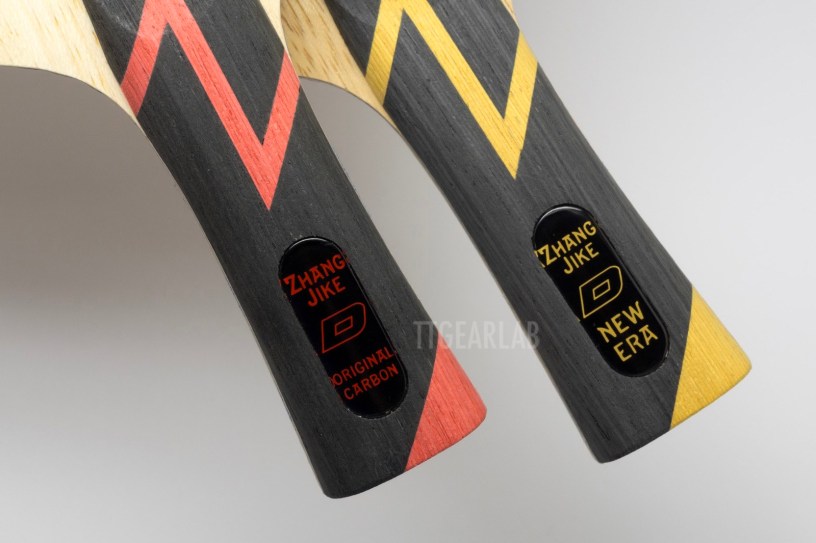
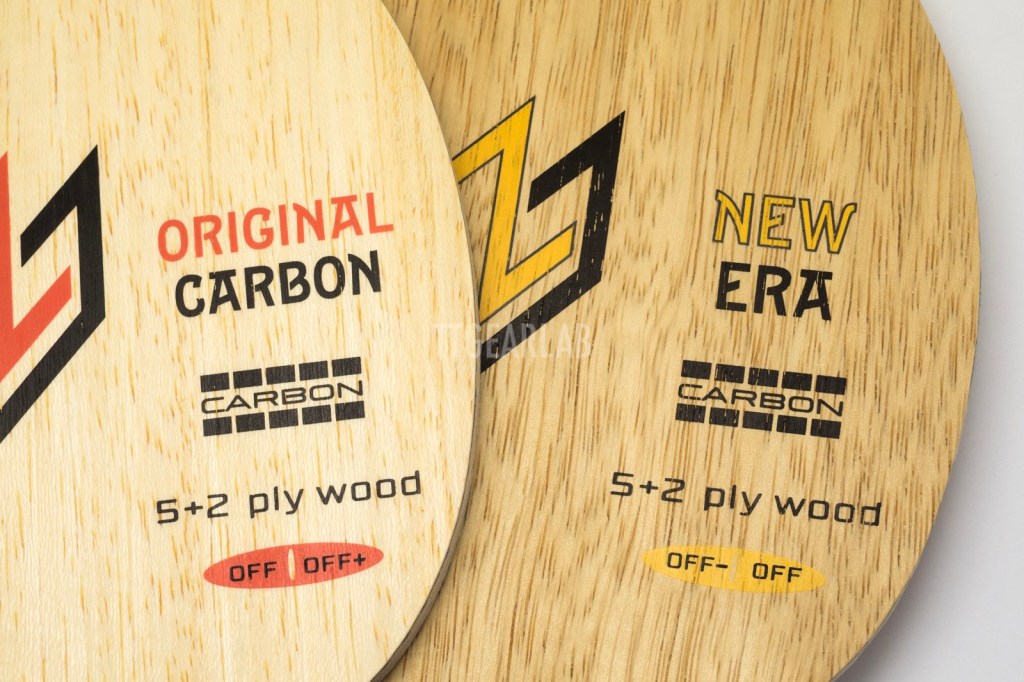
Donic ‘Zhang Jike’ series is the new flagship blade family of Donic, and it consists of two outer-type fiber blades with different top layers and artificial materials. Left is ‘Zhang Jike Original Carbon’ with Koto top layer and Cured Aramid Carbon. Right is ‘Zhang Jike New Era’ with Limba top layer and Trio UAC Synthetic Fiber.
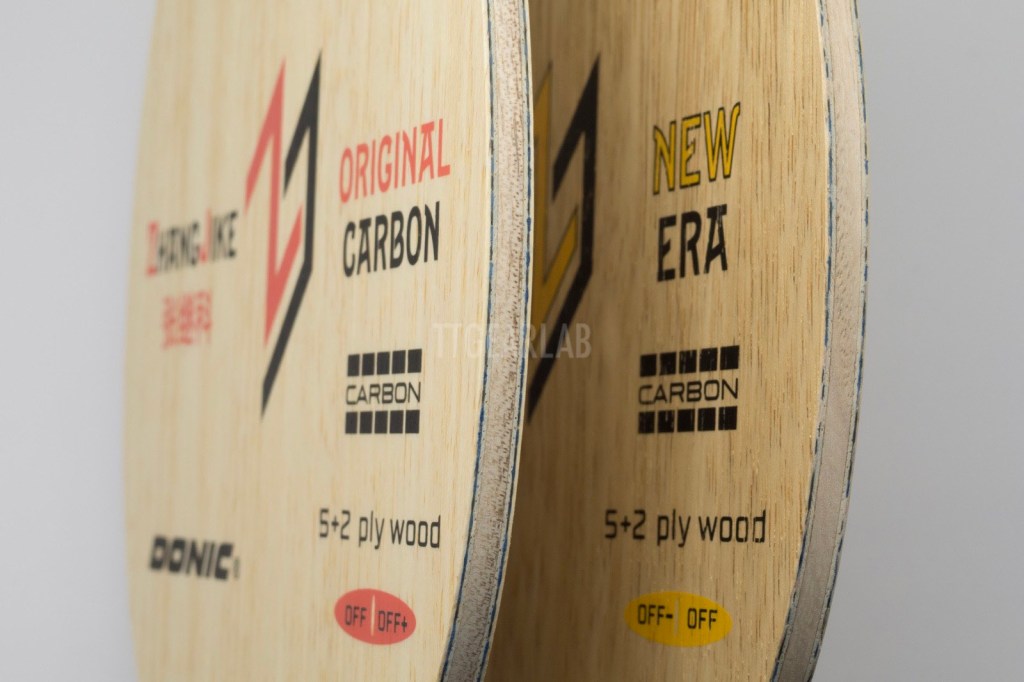
‘Zhang Jike Original Carbon’ (left) and ‘Zhang Jike New Era’ (right) share the basic plywood construction, and are distinguished by top layers and artificial fibers.
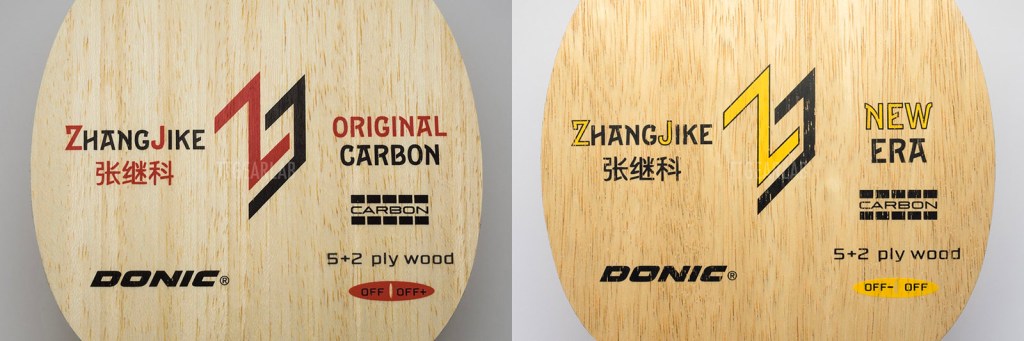
Two models share the design concept, and are distinguished from each other by point color. The point colors are red for ‘Zhang Jike Original Carbon’ and yellow for ‘Zhang Jike New Era’.
1-1. Zhang Jike Original Carbon
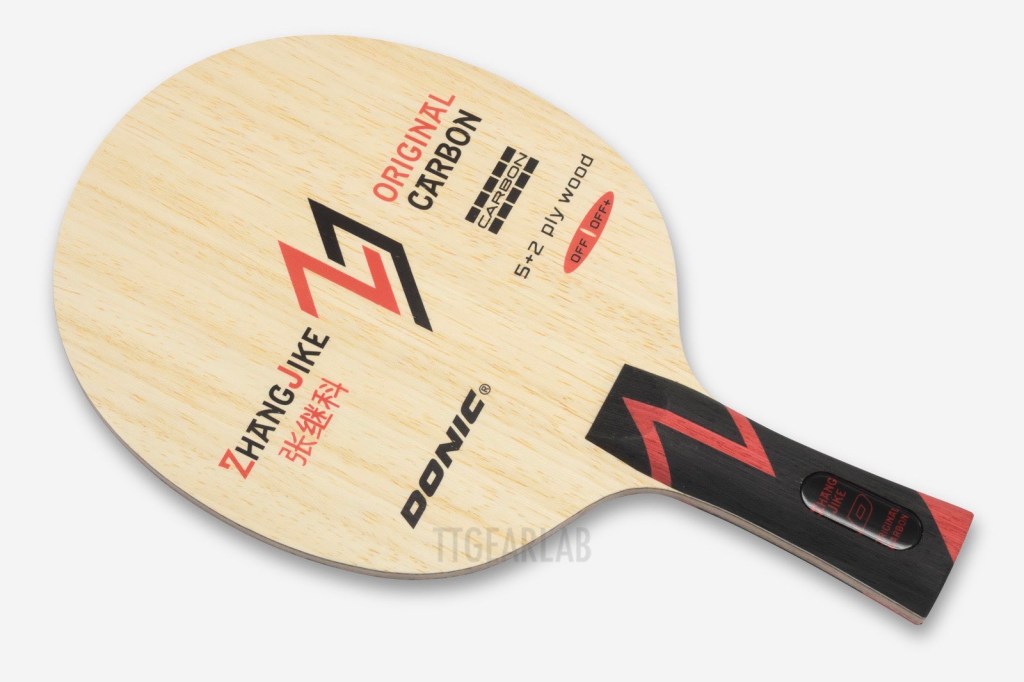
‘Zhang Jike Original Carbon’ is the new flagship blade of Donic. Between two models of ‘Zhang Jike’ series, ‘Zhang Jike Original Carbon’ is more biased to power.

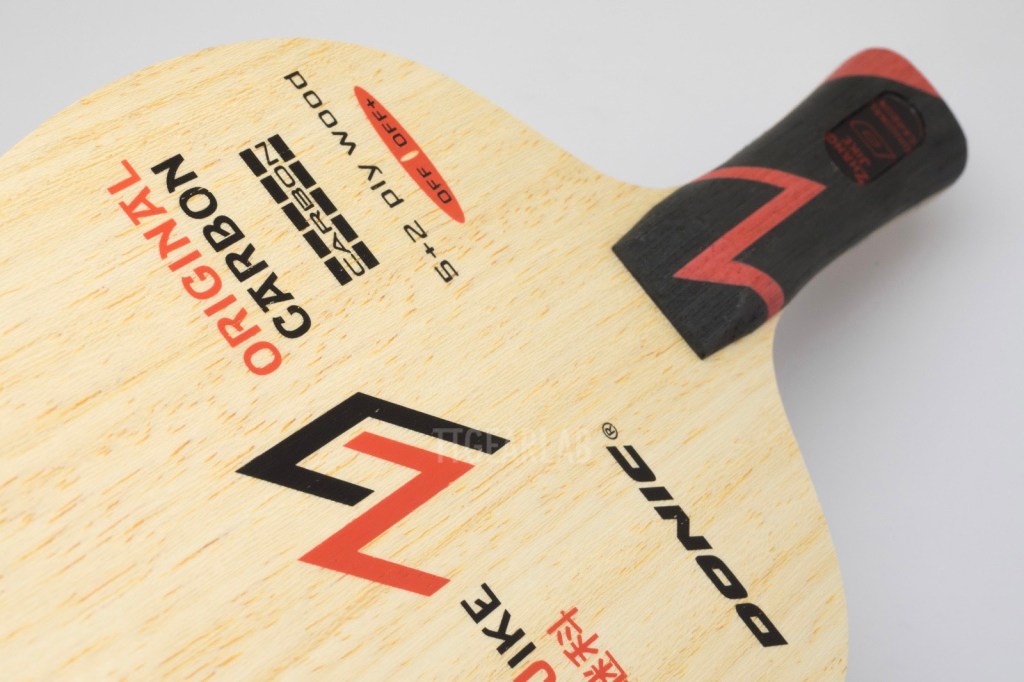
The construction of ‘Zhang Jike Original Carbon’ is an ‘outer-type’ construction. The top layer is Koto, the middle layer is Ayous, and the center layer is Kiri. Cured Aramid Carbon is inserted directly under the top layer. Overall thickness is around 5.8mm. (Although the artificial material is called as ‘Aramid Carbon’, it looks like Japanese Arylate Carbon. This blade is made by a famous Chines factory. And, in Chinese language, both of Aramid Carbon and Arylate Carbon are expressed as ‘Aramid Carbon’ in many cases. Arylate Carbon which is used for Butterfly blades is also often called as ‘Aramid Carbon’.)

The width of FL (flared) handle is around 24mm (at head side) ~ 27.5 mm (at bulge) ~ 26.5mm (at narrowest point) ~ 32mm (at the end). And, the thickness of FL handle is around 22.5mm (at thumb) ~ 24.5mm (at the end). The width is close to that of a FL handle of semi-wide type, but it doesn’t feel wide in the hand. The size of ST hasn’t been measured yet.

The size of head is around 157mm x 150mm which is the common head size of most of recent offensive blades. (Actual length is close to 156.5mm.)
1-2. Zhang Jike New Era
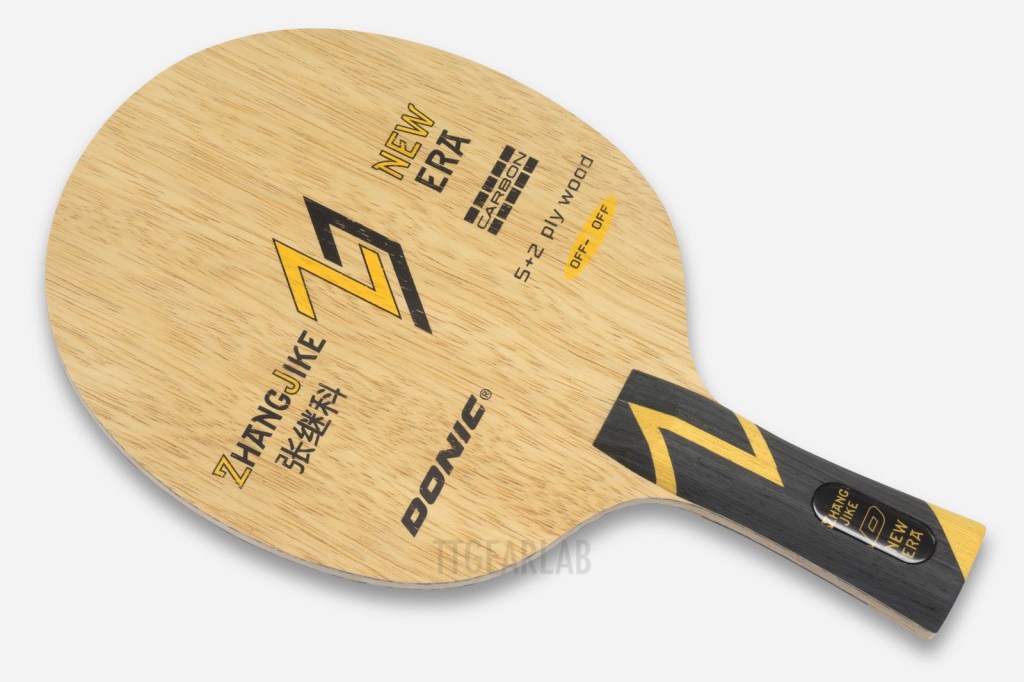
‘Zhang Jike New Era’ is the new standard offensive blade for every player suggested by Donic. Between two models of ‘Zhang Jike’ series, ‘Zhang Jike New Era’ is more biased to control. (But, it isn’t a control-oriented blade. Although slower than ‘Zhang Jike Original Carbon’, it is still categorized as a very fast blade.)
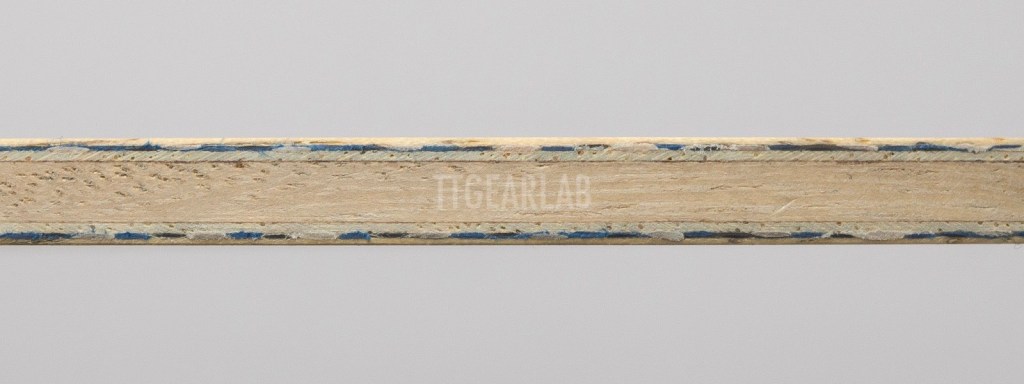
The construction of ‘Zhang Jike New Era’ is an ‘outer-type’ construction. The top layer is Limba, the middle layer is Ayous, and the center layer is Kiri. Trio UAC Synthetic Fiber is inserted directly under the top layer. Overall thickness is around 5.8mm. Trio UAC Synthetic Fiber is woven by three different fibers – one kind of carbon fiber and two different kinds of aramid (or arylate) fibers. The advantage of using three different fibers is that fine tuning of the characteristics of different orientations – vertical and horizontal – becomes easier.
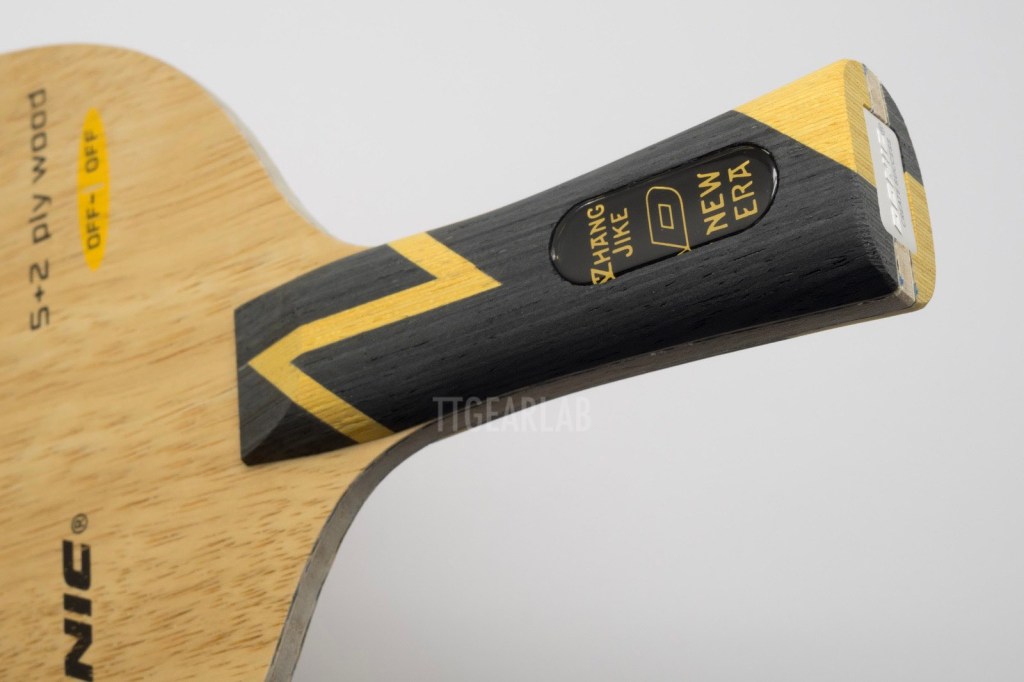
The width of FL (flared) handle is around 24mm (at head side) ~ 27.5 mm (at bulge) ~ 27.0mm (at narrowest point) ~ 33mm (at the end). And, the thickness of FL handle is around 22.5mm (at thumb) ~ 24.5mm (at the end). It can be dealt as a kind of ‘semi-wide’ FL handle, and in the hand it feels wider than the FL handle of ‘Zhang Jike Original Carbon’. The size of ST hasn’t been measured yet.

The size of head is around 157mm x 150mm which is the common head size of most of recent offensive blades. (Actual length is close to 156.5mm.)
Then let’s check the characteristics of ‘Zhang Jike Original Carbon’ and ‘Zhang Jike New Era’by Performance Indices and then compare with some existing blades.
Please click here to return to top (table of contents)
2. Performance Indices
Performance Indices are measured objective values to represent the characteristics of table tennis gears. Concerning the detail of four performance indices, please refer to following articles in ‘About TTGearLab’ section :
- Performance indices : the way to evaluate blade by measurement
- The example of comparison by performance indices
2-1. Zhang Jike Original Carbon
| Name | Avg.Wt (g) | Ep | Ec | Ec/Ep | Vp | Vl | Vl/Vp |
| Donic Zhang Jike Original Carbon | 85.8 | 2.31 | 2.03 | 0.88 | 1.37 | 1.46 | 1.06 |
The Ep (=2.31) is a very high value which is higher than what we can expect from ordinary outer-type blades. It significantly exceeds 2.0 which is considered as the criteria of ‘very fast’ blade. Further, the Ec (= 2.03) is also very high but is not as high as the Ep. As the result the ratio – Ec/Ep – (= 0.88) is lower than 0.9 which is the criteria between the ‘Mild Hold’ range and the ‘Deep Hold’ range. Therefore ‘Zhang Jike Original Carbon’ is located at the ‘Deep Hold’ range. It means that ‘Zhang Jike Original Carbon’ hugs the ball very deeply when the player hits the ball very strongly. It is good characteristic for the aggressive topspin.
Regarding Vibration Indices, the Vp (= 1.37) is a quite high value, and its Vl (= 1.46) is even higher. Those values are in the range that we can expect from ordinary outer-type blades. The ratio – Vl/Vp (= 1.06) – is higher than 1.0. Although the Vl/Vp doesn’t exceed 1.1 which is the criteria between ‘Sharp’ range and ‘Near Uniform’ range, we can consider that it is sufficiently higher than 1.0. It means that the feeling transferred to the player’s index finger is sharper than the primary feeling, but the different is not significant. The sharp feeling will help the player feel and control the ball in very aggressive game.
From the values, we can expect that ‘Zhang Jike Original Carbon’ fits for the players who play mainly with aggressive topspin and at the same time lay emphasis on speed.
2-2. Zhang Jike New Era

| Name | Avg.Wt (g) | Ep | Ec | Ec/Ep | Vp | Vl | Vl/Vp |
| Donic Zhang Jike New Era | 84.4 | 2.23 | 2.05 | 0.92 | 1.39 | 1.49 | 1.07 |
The Ep (=2.23) is a very high value which is higher than what we can expect from ordinary outer-type blades. It significantly exceeds 2.0 which is considered as the criteria of ‘very fast’ blade. Further, the Ec (= 2.05) is also very high but is not as high as the Ep. As the result the ratio – Ec/Ep – (= 0.92) is between 0.9 and 1.0. Therefore ‘Zhang Jike New Era’ is located in the ‘Mild Hold’ range. It means that ‘Zhang Jike New Era’ hugs the ball when the player hits the ball very strongly, but the level of hug is not extreme. We can see that ‘Zhang Jike New Era’ is not as extremely biased to aggressive topspin as ‘Zhang Jike Original Carbon’.
Regarding Vibration Indices, the Vp (= 1.39) is a quite high value, and its Vl (= 1.49) is even higher. Those values are in the range that we can expect from ordinary outer-type blades. The ratio – Vl/Vp (= 1.07) – is higher than 1.0. Although the Vl/Vp doesn’t exceed 1.1 which is the criteria between ‘Sharp’ range and ‘Near Uniform’ range, we can consider that it is sufficiently higher than 1.0. It means that the feeling transferred to the player’s index finger is sharper than the primary feeling, but the different is not significant. The sharp feeling will help the player feel and control the ball in very aggressive game.
From the values, we can expect that ‘Zhang Jike New Era’ will be better than ‘Zhang Jike Original Carbon’ if the player uses more various technics for example smash and block.
Both of two models in ‘Zhang Jike’ series provides very high elasiticity, and there isn’t significant difference in the level of elasticity between the two models. The difference is in the level of hug when the player hits the ball very strongly. ‘Zhang Jike Original Carbon’ which hugs the ball very deeply is expected to fit more for the aggressive topspin, and ‘Zhang Jike New Era’ which hugs the ball in moderate level is expected to fit more for using various technics.
Two blades will be compared with some existing blades by graphs in next Chapter.
Please click here to return to top (table of contents)
3. Comparison by Performance Indices
‘Zhang Jike Original Carbon’ and ‘Zhang Jike New Era’ can be compared with some existing outer-type blades. Following is the list of the blades to be compared:
Following is the list of the blades to be compared:
Outer type
| Name | Average Weight | Feature |
| Butterfly Zhang Jike/Fan Zehndong Super ZLC | 90.8g | Outer Super ZLC with Koto top layer |
| Butterfly Zhang Jike/Fan Zehndong ZLC | 85.1g | Outer ZLC with Koto top layer |
| Butterfly Viscaria | 87.1g | Outer ALC with Koto top layer |
| Butterfly Freitas ALC | 87.4g | Outer ALC with Limba top layer |
| Donic Skachikov Carbon | 82.5g | Outer Aramid Carbon with Koto top layer |
| andro Treiber CO OFF/S | 83.9g | Outer KVL Carbon with Limba top layer |
| Stiga Dynasty Carbon | 93.4g | Outer Carbon fiber (TeXtreme) with Koto top layer |
| Stiga Carbonado 190 | 92.4g | Outer Carbon fiber (TeXtreme) with Limba top layer |
| Victas Liam Pitchford | 89.2g | Outer ZX-Carbon (= ALC) with Limba top layer |
| Nittaku Acoustic Carbon | 90.8g | Outer Carbon fiber with Limba top layer |
All wood blades (including reference blade)
| Name | Average Weight | Feature |
| Butterfy Korbel | 88.7g | The representative of 5-ply wood offensive blade. |
| Stiga Allround Classic (Reference) | 84.3g | The representative of 5-ply wood allround blade. |
3-1. Elasticity Indices

Fig.15 shows the comparison graph of Elasticity Indices.
Ep (Primary Elasticity Index) is directly concerned with the rebound speed of blade. Ec (Central Elasticity Index) is concerned with additional ‘kick’ when player hits ball very strongly.
What we can observe from above graph can be summarized as follows:
- The overall elasticity levels of two models in Donic ‘Zhang’ Jike series are sufficiently high as those of outer-type blades. Both of two models in Donic ‘Zhang Jike’ series are more elastic than most of outer-type blades in the comparison.
- ‘Zhang Jike Orignal Carbon’ is more elastic than ‘Zhang Jike New Era’ in primary elasticity, but a bit less elastic in central elasticity. The differences are not significant.
- Butterfly ‘Zhange Jike / Fan Zhendong (= ZJK/FZD) Super ZLC’ is noticeably more elastic than two models of Donic ‘Zhang Jike’ series. However, ‘ZJK/FZD ZLC’ and ‘Viscaria’ are noticeably less elastic than those two. Therefore we can notice than none of two models Donic ‘Zhang Jike’ series can be the direct replacement of old Butterfly ‘Zhang Jike’ series.
- ‘Zhang Jike Original Carbon’ performs differently from ‘Viscaria’ although its blade construction looks similar to that of ‘Viscaria’.
- ‘Acoustic Carbon’ shows the elasticity characteristics closest to Donic ‘Zhang Jike’ series.
Examining Ec/Ep is also an easier way to understand the characteristics of blade concerned with elasticity. Fig.16 shows the relationship between Ec/Ep and Ep.
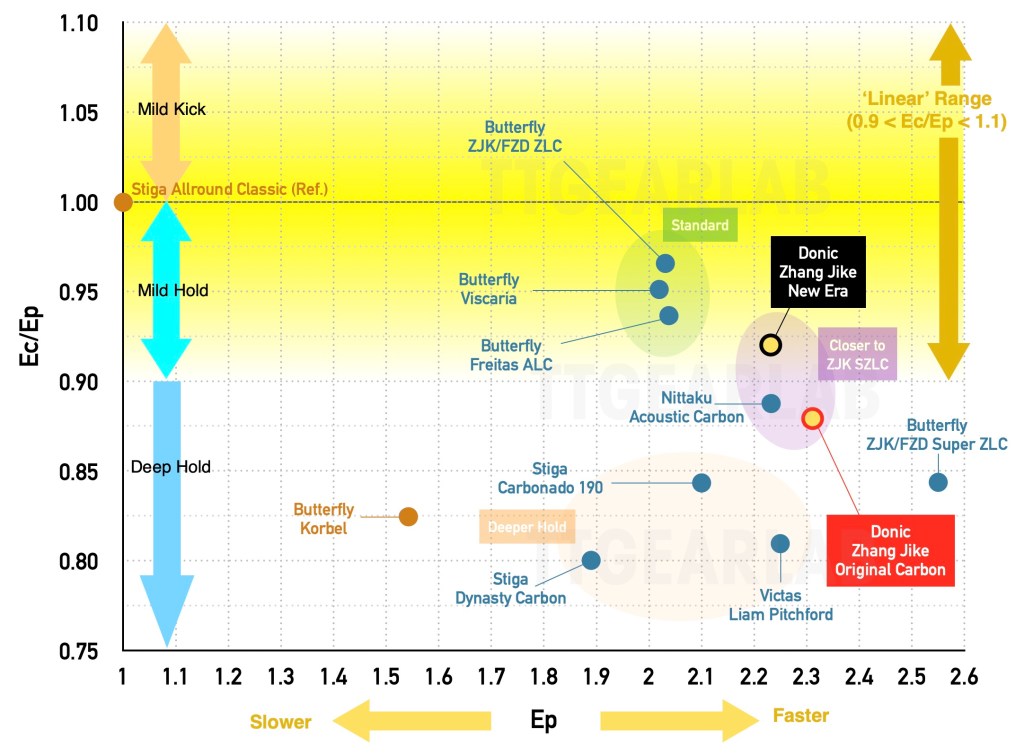
Ec/Ep expresses the ‘tendency’ of the elasticity of blade. By examining Ec/Ep and Ep at the same time, we can understand the behavior of blades more easily.
On the graph, all the blades except for the reference blade – Allround Classic – are located in ‘Hold’ range (Ec/Ep < 1.0). Because we are dealing with outer-type fiber models, the blades are mostly clustered on the right on the graph.
What we can observe from above graph can be summarized as follows:
- Two models of Donic ‘Zhang Jike’ series are located between Butterfly Zhang Jike Super ZLC and the group of ‘Standard’ Butterfly outer-type blades which includes three models – ‘Viscaria’, ‘Zhang Jike ZLC’ and ‘Freitas ALC’. It means that two models of ‘Zhang Jike’ series are different from the standard Butterfly outer-type blades, although ‘Zhang Jike Original Carbon’ looks similar to ‘Viscaria’ and ‘Zhang Jike New Era’ looks similar to ‘Freitas ALC’.
- Between two models, ‘Zhang Jike Original Carbon’ hugs the ball more deeply than ‘Zhang Jike New Era’ when the player hits the ball very strongly. It means that ‘Zhang Jike Original Carbon’ is relatively more biased to continuous topspin while ‘Zhang Jike New Era’ is relatively more biased to hard hitting, if we just compare between those two models.
- Nittaku ‘Acoustic Carbon’ is located very close to ‘Zhang Jike Original Carbon’. But, because of the differences in their constructions, we can expect that those two will be different in feeling. If the player doesn’t care about the feel, it would be possible to switch between those two.
- There are the group of three blades – ‘Carbonado 190’, ‘Dynasty Carbon’ and ‘Liam Pitchford’ – those are located at the bottom of the graph. And, it will be possible that we also put ‘Zhang Jike Super ZLC’ into this group. Because the blades in this group hugs the ball very deeply when the player hits the ball very strongly, those blades fit for the continuous topspin, and can be the faster replacement of 5-ply wood offensive blade like Butterfly ‘Korbel’. Donic ‘Zhang Jike Original Carbon’ also hugs the ball very deeply, but it doesn’t reach the level of hug of the blades in this group. Some players will think that the hug level of the blades in this group is too excessive. In that case ‘Zhang Jike Original Carbon’ or ‘Acoustic Carbon’ will be able to the optimum choice.
Then next, let’s compare Vibration Indices.
Please click here to return to top (table of contents)
3-2. Vibration Indices

Fig.17 shows the comparison graph of Vibration Indices. Vibration Indices are concerned with feeling. Vp indicates primary feeling which is transferred to player’s palm. And, Vl is the feeling at the edge of the wing – the lower side of blade head. It is felt by player’s index finger or middle finger.
What we can observe from above graph can be summarized as follows:
- Players may expect that the values of ‘Zhang Jike Original Carbon’ will be higher than those of ‘Zhang Jike New Era’. However, the results of the measurement are the opposite. We can observe that the values of ‘Zhang Jike New Era’ are higher than those of ‘Zhang Jike Original Carbon’, although the differences are very small.
- The values of Butterfly ‘Zhang Jike Super ZLC’ are very close to those of two models of Donic ‘Zhang Jike’ series. On the contrary, the values of ‘Viscaria’ or ‘Zhang Jike ZLC’ or ‘Freitas ALC’ are quite different from those of Donic ‘Zhang Jike’ series. The differences in Vp’s are not significant. But, there are huge differences in Vl’s.
- The values of ‘Acoustic Carbon’ are also different from those of ‘Zhang Jike Original Carbon’. Especially its Vl is noticeably lower than the Vl of ‘Zhang Jike Original Carbon’.
- ‘Carbonado 190’ and ‘Liam Pitchford’ show the Vl’s as high as those of Donic ‘Zhang Jike’ series. However, the Vp’s of those two are noticeably lower than those of ‘Zhang Jike Original Carbon’ or ‘Zhang Jike New Era’.
Examining Vl/Vp is easier way for the comparison of the tendency of feeling. Fig.18 shows the relationship between Vl/Vp and Vp for easier comparison.
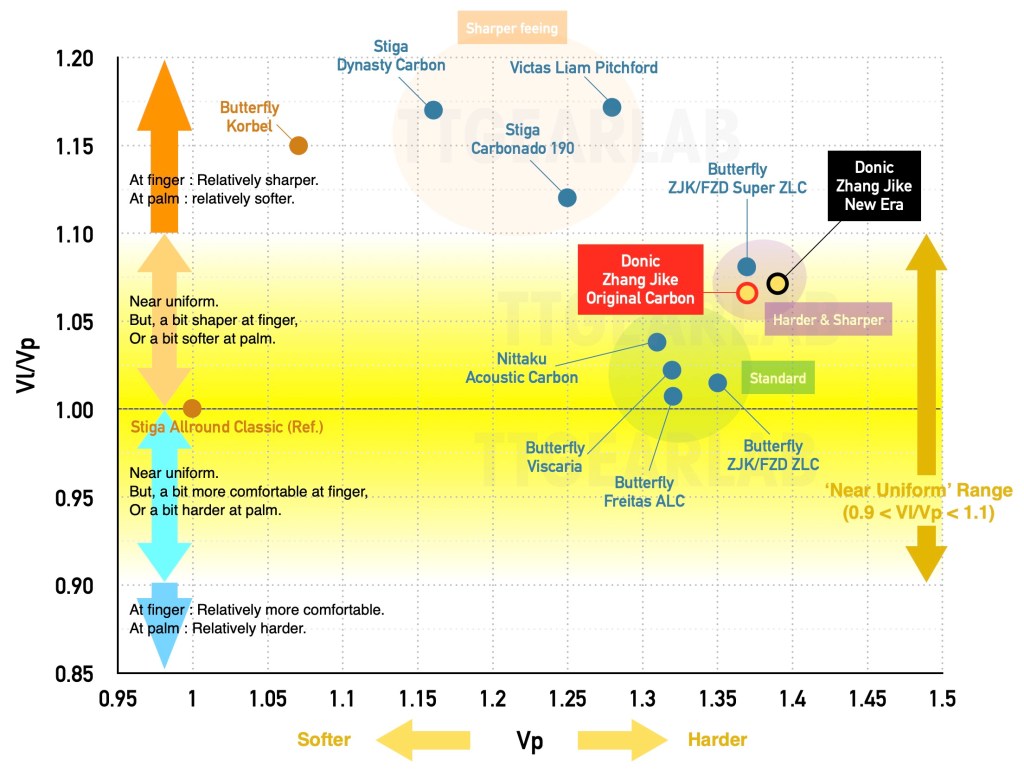
On the graph, all blades except for reference blade – Stiga ‘Allround Classic’ – are located in upper part of the graph – ‘Relatively sharper at finger’ range (Vl/Vp > 1.0). But we can observe that there are three ‘clusters’ of blades on the upper part of the graph.
What we can observe from above graph can be summarized as follows:
- On the graph, two models of Donic ‘Zhang Jike’ series are located on the far right, with Vl/Vp’s between 1.1 and 1.05. Those two can be grouped together with Butterfly ‘Zhang Jike Super ZLC’. Based on this, it can be inferred that two models of Donic ‘Zhang Jike’ series were developed based on the feel of ‘Zhang Jike Super ZLC’. (Note : There will still be differences in feeling because of the differences in materials.) We can group these three models together.
- ‘Acoustic Carbon,’ which was located close to ‘Zhang Jike Original Carbon’ in the comparison of elasticity characteristics, is now located somewhat to the lower left, that is, closer to ‘Viscaria.’ Compared to Donic ‘Zhang Jike’ series, ‘Viscaria’ and ‘Acoustic Carbon’ give a softer basic feeling, and the feeling transmitted to the index finger is less sharp. We can group these two models together with two other nearby models – ‘Freitas ALC’ and ‘Zhang Jike ZLC’. This group can be considered as the group of standard outer-type.
- The group of two models of Donic ‘Zhang Jike’ series and Butterfly ‘Zhang Jike Super ZLC’ is located to the upper right of ‘Standard’ group. So it can be called as ‘Harder & Sharper’ group. If a player wants to change from ‘Viscaria’ or nearby models to ‘Zhang Jike Original Carbon’ or ‘Zhang Jike New Era’, it should be kept in mind that the basic feeling will become stiffer and the relative feeling transmitted to index finger will become sharper.
- In addition to these two groups, there is another group located at the top of the graph. This group is located in the upper left compared to the previous two groups – the basic feeling is softer, and the relative feeling transmitted to index finger is sharper. These blades are quite easy to adapt to when switching from a standard 5-ply offensive blade like Butterfly ‘Korbel’. However, because the Vl/Vp’s of ‘Zhang Jike Original Carbon’ and ‘Zhang Jike New Era’ are noticeably lower, the ease of adaptation when the player switches from a 5-ply offensive blade to one of those two will not be that high. But, if those two are compared with ‘Standard’ outer-type blades like ‘Viscaria’, those two may provide a bit higher ease of adaptation because of higher Vl’Vp’s.
Please click here to return to top (table of contents)
4. Summary
Donic ‘Zhang Jike’ series is a new top blade family of Donic. It consists of two products with different top layer and artificial materials, both of which are blades capable of delivering the high power expected from an outer-type blade. The characteristics of two models can be summarized as follows.
4-1. Zhang Jike Original Carbon

- ‘Zhang Jike Original Carbon’, the flagship model of the Donic ‘Zhang Jike’ series, is an outer-type fiber blade with Koto top layer, similar to ‘Viscaria’ used by player Zhang Jike during his active career. Its artificial material is Cured Aramid Carbon which enhances overall power of the blade.
- ‘Zhang Jike Original Carbon’ provide very high elasticity, surpassing most outer-type fiber blades. And, it hugs ball deeply when the player hits the ball very strongly.
- Regarding feeling, its primary feeling is stiffer than most existing outer-type blades. But, the relative feeling transmitted to index finger is not that extremely sharp.
- ‘Zhang Jike Original Carbon’ is based on typical outer ALC blade with Koto surface like ‘Viscaria’. But, its elasticity is significantly enhanced to the level of an outer Super ZLC blade, and the level of hug at strong impact is also enhanced.
- The characteristics of ‘Zhang Jike Original Carbon’ are suitable for the players whose main strategy is close-to-table topspin but requires higher power and higher speed.
4-2. Zhang Jike New Era
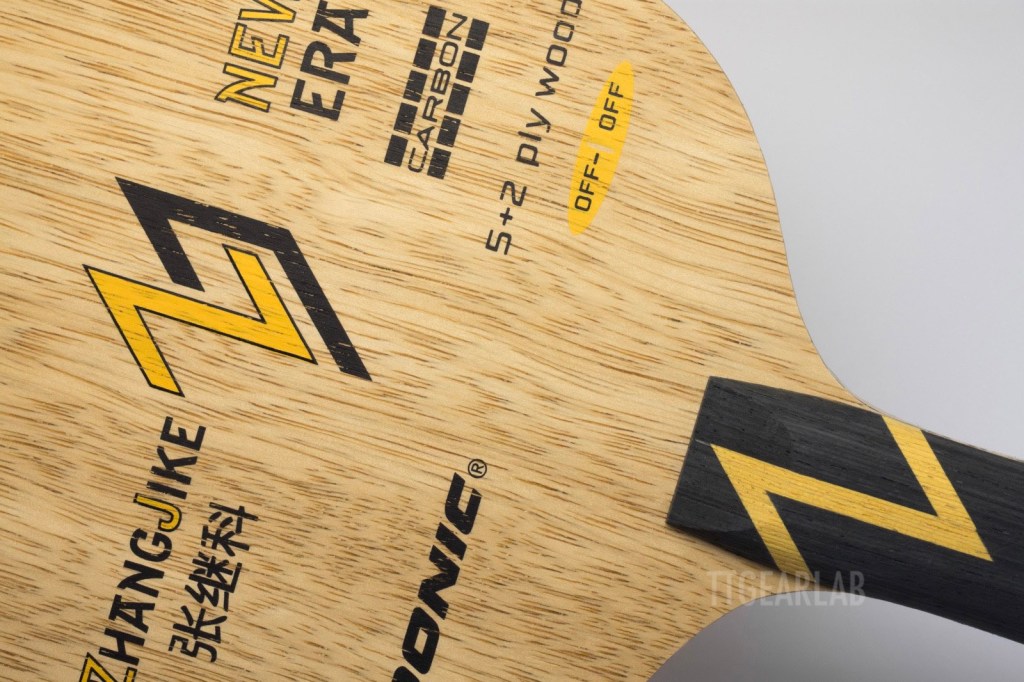
- ‘Zhang Jike New Era’ is a blade designed to be easier to use for not only top players but also a wider range of players of various levels. It is an outer-type blade with Limba top layer, and its artificial material is UAC Synthetic Fiber which is woven by three different fibers – one kind of carbon fiber and two different kinds of aramid (or arylate) fibers.
- ‘Zhang Jike New Era’ provides softer touch of surface when compared with ‘Zhang Jike Original Carbon’. However, it is as elastic as ‘Zhang Jike Original Carbon’. And, it is more elastic than most of existing outer-type blades. The level of hug is weaker when compared with ‘Zhang Jike Original Carbon’, and as the result ‘Zhang Jike New Era’ is relatively better for direct hitting. (Of course still ‘Zhang Jike New Era’ is good for topspin.)
- Regarding feeling, its primary feeling is as stiff as that of ‘Zhang Jike Original Carbon’, and the relative feeling transmitted to index finger is sharp but not extreme.
- ‘Zhang Jike New Era’ is based on typical outer ALC blade with Limba surface like ‘Freitas ALC’. But, its elasticity is significantly enhanced to the level of an outer Super ZLC blade, and overall characteristics are adjusted to be suitable for various offensive strategy.
- When compared with ‘Zhang Jike Original Carbon’, ‘Zhang Jike New Era’ is expected to be better for amateur players whose mainly play with topspin but also use smash and block frequently.
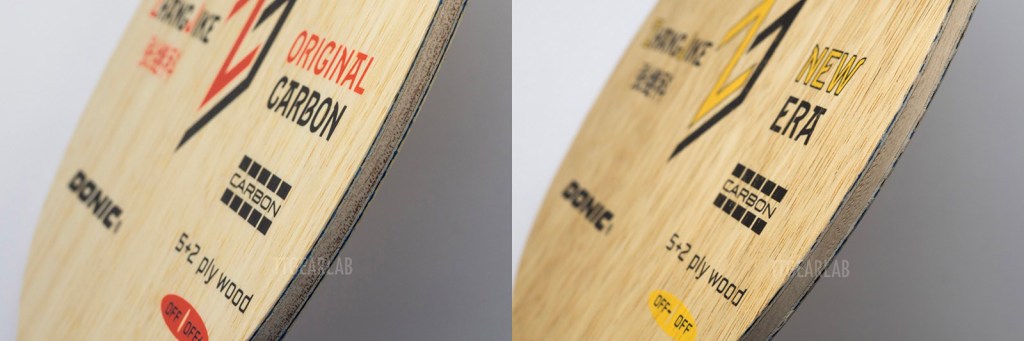
Fig.21 Donic ‘Zhang Jike Original Carbon’ (left) and ‘Zhang Jike New Era’ (right)
The biggest feature of ‘Zhang Jike Original Carbon’ and ‘Zhang Jike New Era’ is their high elasticity. Both of those two are more elastic than most existing outer-type fiber blades. The criteria for selection between those two are the feeling of surface material and the level of hug when the player hits the ball very strongly. If the player like the clearer ball touch of Koto top layer and the characteristics that hug the ball a bit more deeply, ‘Zhang Jike Original Carbon’ is recommendable. And, if the player like the softer ball touch of Limba top layer and the characteristics that hug the ball a bit less deeply, ‘Zhang Jike New Era’ will be better choice.
Please click here to return to top (table of contents)


Great statistics for both blades. It seems to me that their description from the manufacturer is somewhat imprecise: original carbon is presented as an offensive weapon for the high skilled players, while new era as a more balanced blade. I expected the former to be close to Viscaria, the blade Zhang Jike used during his career, while the latter to be a slower and softer version of it. From these statistics, however, this is not entirely true: original carbon is a very fast/ elastic outer carbon blade, considerably faster than Viscaria and faster than most outer carbon blades; new era is more or less the same in terms of elasticity, it just holds the ball a bit less. Both appears to me as blades for high skilled/ experienced players, one primarily for loopers while the other for more allround players that like to block and smash often. Very interesting. Great analysis as always! Thank you so much.
LikeLike
Thank you for comment. In my opinion, the difference in top layer is the criteria with which Donic distinguishes those two. 🙂
LikeLike