| Table of Contents | 1. Overview 2. Performance Indices 3. Comparison by Performance Indices ……. 3-1. Elasticity Indices ……. 3-2. Vibration Indices 4. Summary |
The table tennis blades with artificial fibers are categorized into various types based on their construction. Currently, the mainstream options are 5+2 ply constructions – consisting of a 5-ply wood reinforced with 2 layers of composite material – divided into ‘Outer-type’ (fiber layers are placed directly under the top layers) and ‘Inner-type’ (fiber layers are placed near the center layer). Generally, because fiber layers are placed deeper, Inner-type blades offer a more natural “wood-like” feel compared to Outer-type blades, though they typically lack the same level of elasticity. Consequently, the conventional common sense in equipment selection is to choose an Outer-type for higher power and an Inner-type for better touch and sensation. However, table tennis blade constructions are incredibly diverse, and some kinds defy these common assumptions. Here, we will examine four powerful Inner-type fiber blades those break the common sense. By adjusting the type of fiber, the thickness of individual layers, and the overall thickness, these models achieve elasticity level on par with – or in some cases, exceeding – those of Outer-type blades. Below is an analysis and comparison of these four models using Performance Indices.

1. Overview
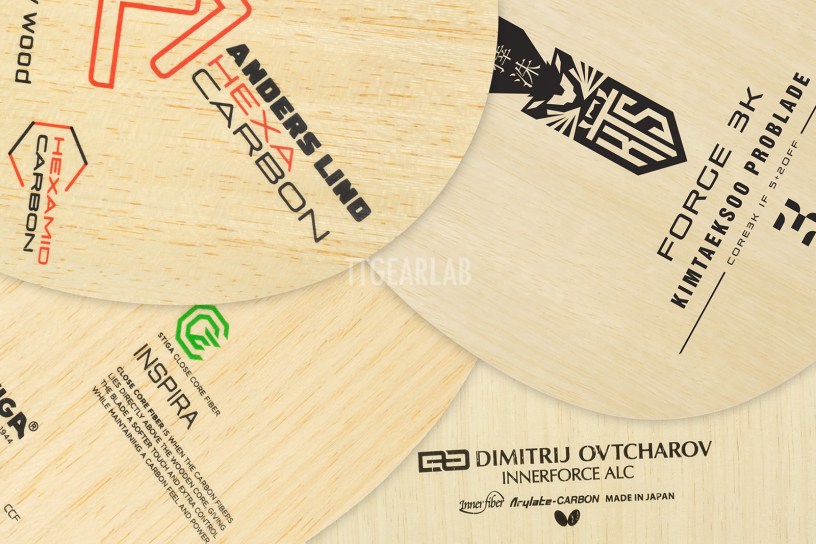
Four powerful Inner-type fiber blades are Donic ‘Anders Lind Hexa Carbon’, KTS ‘Forge 3K’, Butterfly ‘Ovtcharov InnerForce ALC’ and Stiga ‘Inspira CCF’. Amonng those four, ‘Forge 3K’ and ‘Inspira CCF’ have pure woven carbon fibers (those don’t include softer fibers) as their artificial materials, and ‘Anders Lind Hexa Carbon’ and ‘Inspira CCF’ adopt Koto instead of softer Limba as the wood of their top layers.
1-1. Donic Anders Lind Hexa Carbon
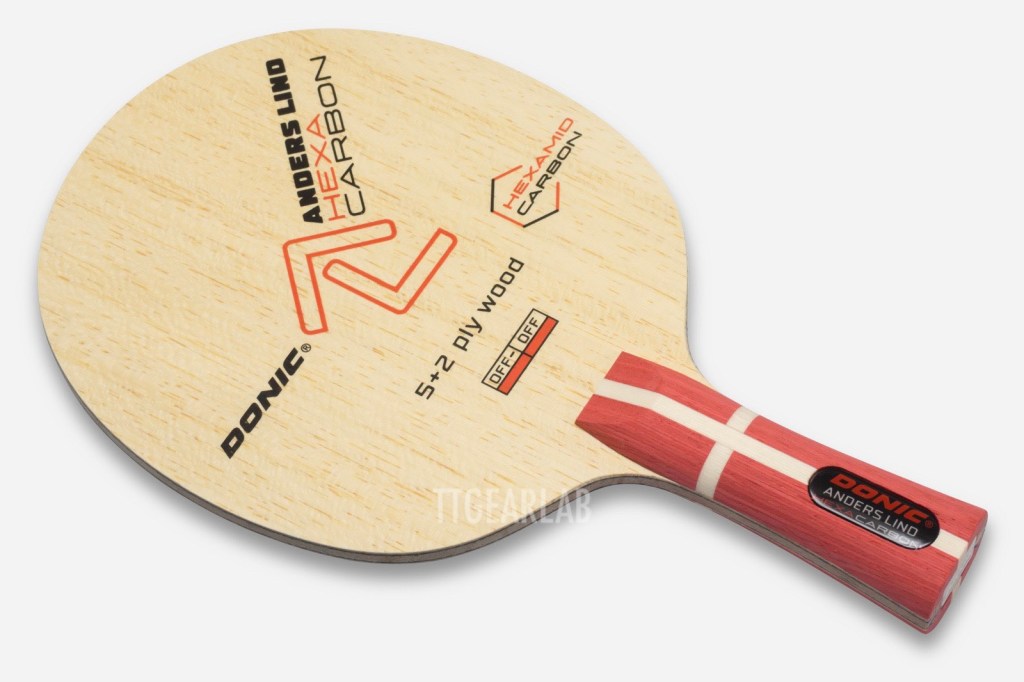
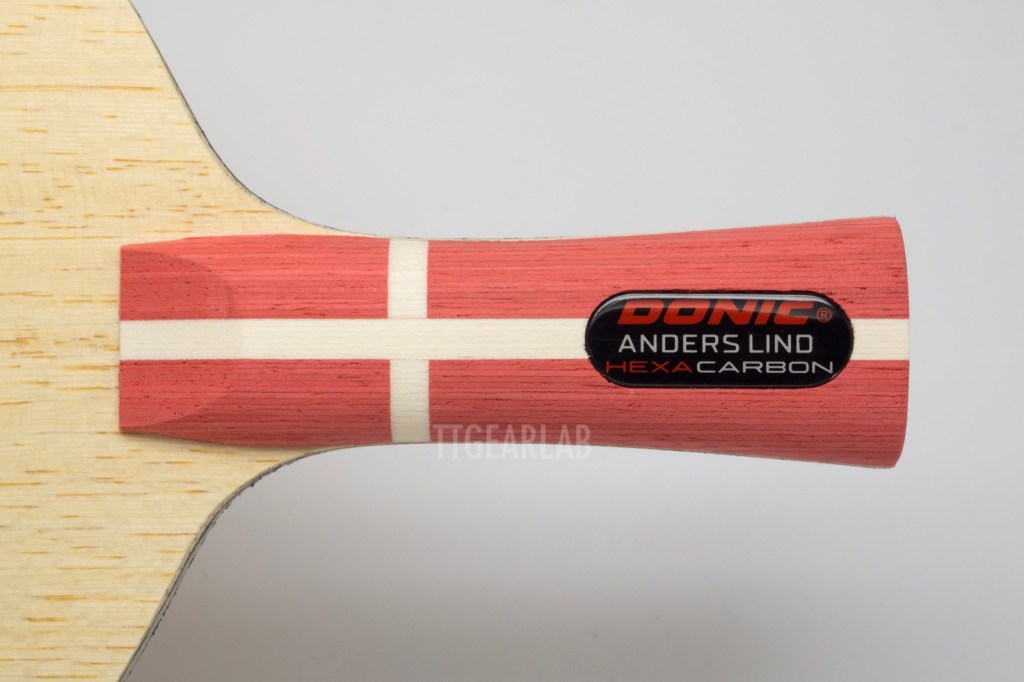
‘Anders Lind HexaCarbon’ is the blade made for Danish player Anders Lind. Also as its name expresses, its artificial material is ‘Hexamid Carbon’. The handle design inspired by Danish national flag is impressive. Currently ‘Anders Lind HexaCarbon’ is one of the most important models in Donic blade range. It would not be an exaggeration to say that ‘Anders Lind HexaCarbon’ is the blade that practically represents Donic blades.
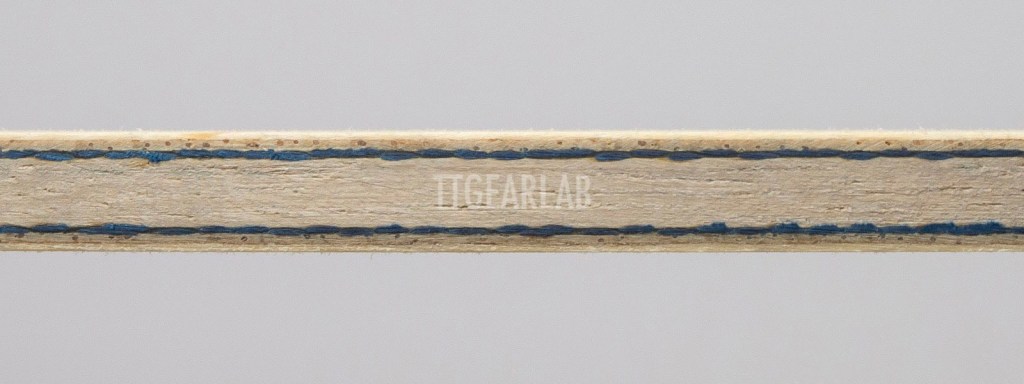
The construction of ‘Anders Lind HexaCarbon’ is an ‘inner-type’ construction, but it is somewhat different from ordinary inner-type constructions with Limba top layer. The top layer is Koto, the middle layer is Limba, and the center layer is Kiri. Hexamid Carbon, which is the mixed woven of PA6 fiber (= hexa-type polyamide fiber) and carbon fiber, is inserted between the middle layer and the center layer. Overall thickness is around 5.7mm. (It is actually measured value. The official thickness is 5.6mm.) We can expect higher elasticity than ordinary inner-type blades because the top layer and the middle layer are stiffer than the woods for ordinary inner-type blades. The result of measurement (shown at the next chapter of this article) is also indicating that the elasticity of ‘Anders Lind HexaCarbon’ is very high.
1-2. KTS Forge 3K
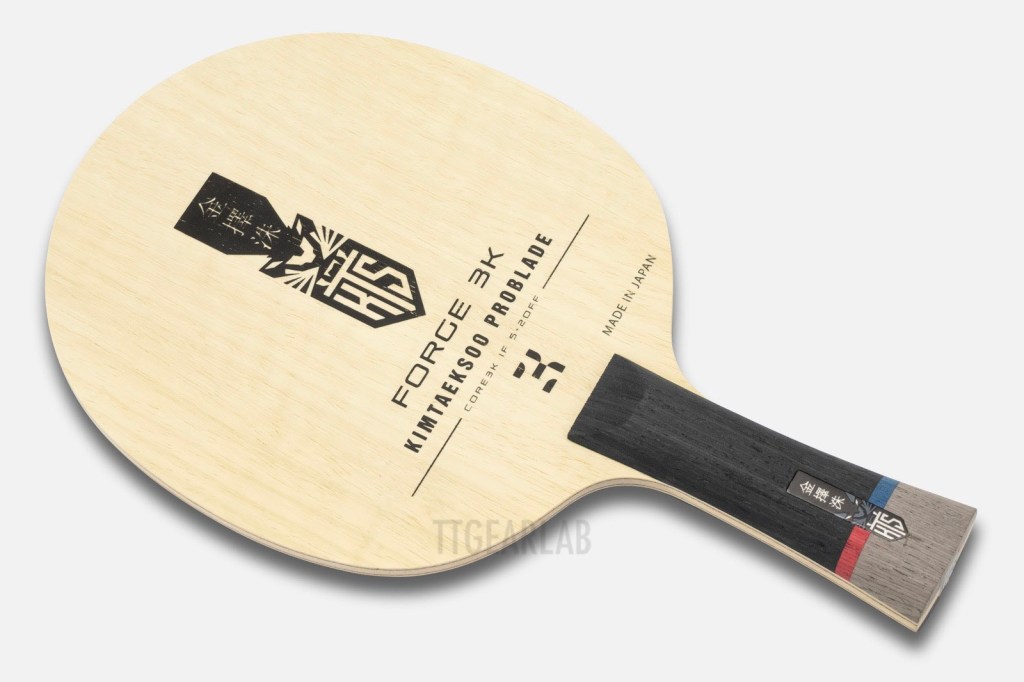
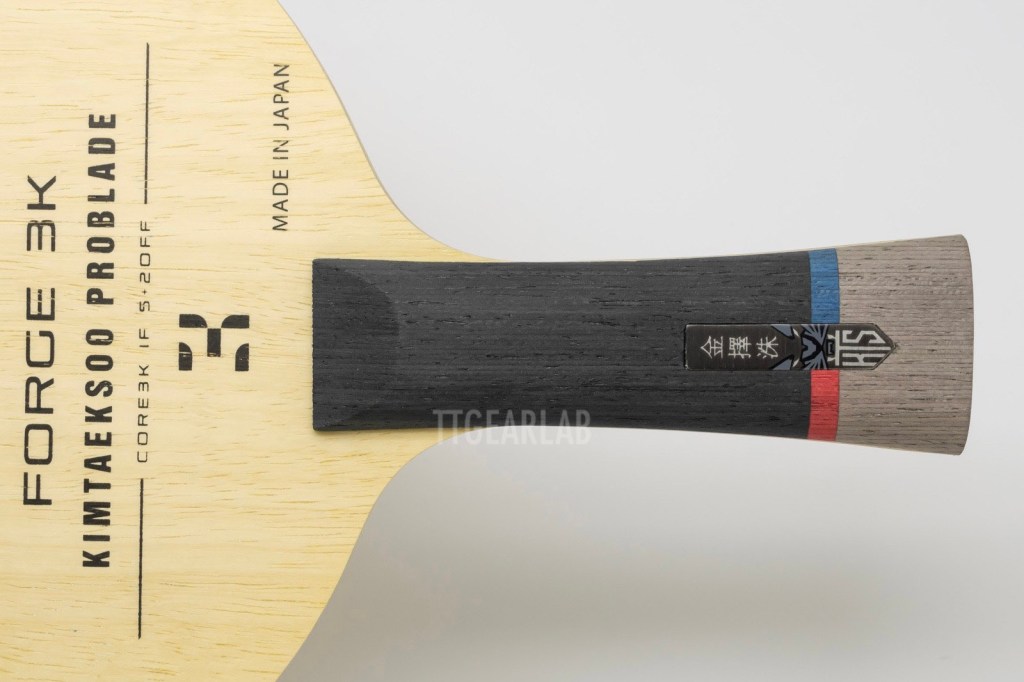
‘Forge 3K’ which is the fastest model in KTS ‘Problade’ series is an inner-type fiber blade whose artificial material is woven 3K carbon fiber. It adopts highly elastic artificial fiber for very high power, but at the same time it pursuits natural feeling as far as possible. The full name of this blade is ‘Problade Forge 3K’, but the maker also omits ‘Problade’ and calls it just as ‘Forge 3K’, this article will follow that way.
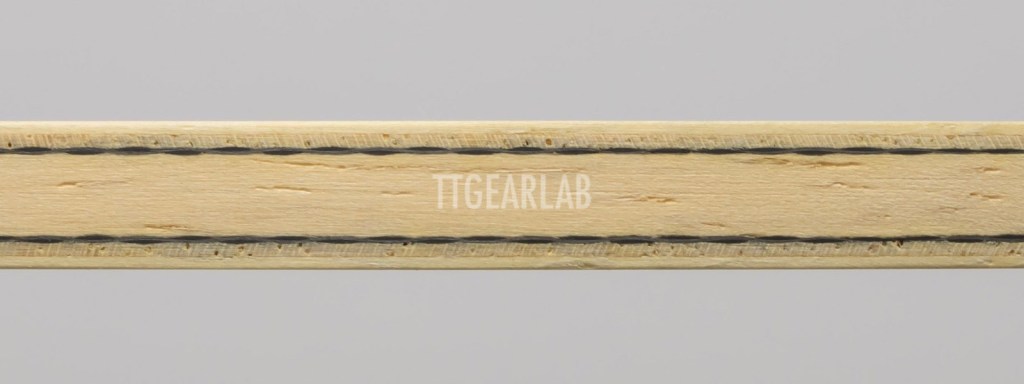
‘Forge 3K’ is an inner-type fiber blade of 5+2 ply construction. The top layer is Limba, the middle layer and the center layer are Ayous. 3K Carbon Fiber is inserted between the middle layer and the center layer. ‘3K’ means that 3,000 carbon filaments are bundled together in a single tow of woven structure. 3K Carbon Fiber is much more elastic than ALC or ZLC those are woven with other fibers than Carbon fiber. Because of very high tensile modulus of 3K Carbon Fiber, we can expect very high elasticity from ‘Forge 3K’. Overall thickness is around 6.0mm.
1-3. Butterfly Ovtcharov InnerForce ALC
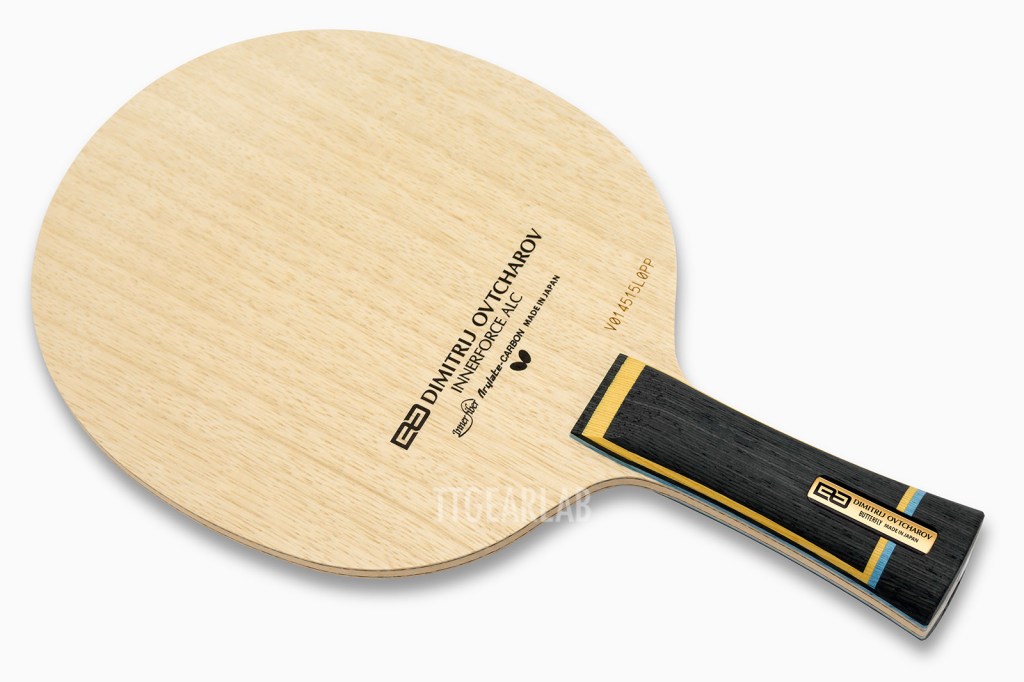
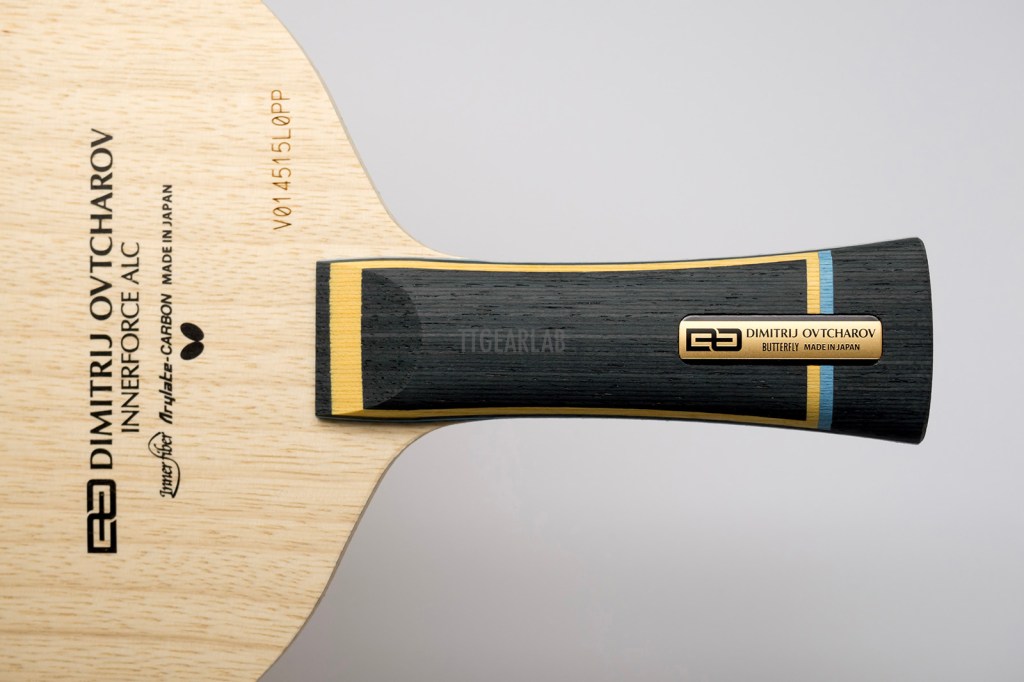
‘Ovtcharov InnerForce ALC’ is the blade for Dimitrij Ovtcharov of German Men’s National Team, and has thicker construction and bigger 158mm x 152mm head than the standard inner ALC blade – ‘InnerForce Layer ALC’.
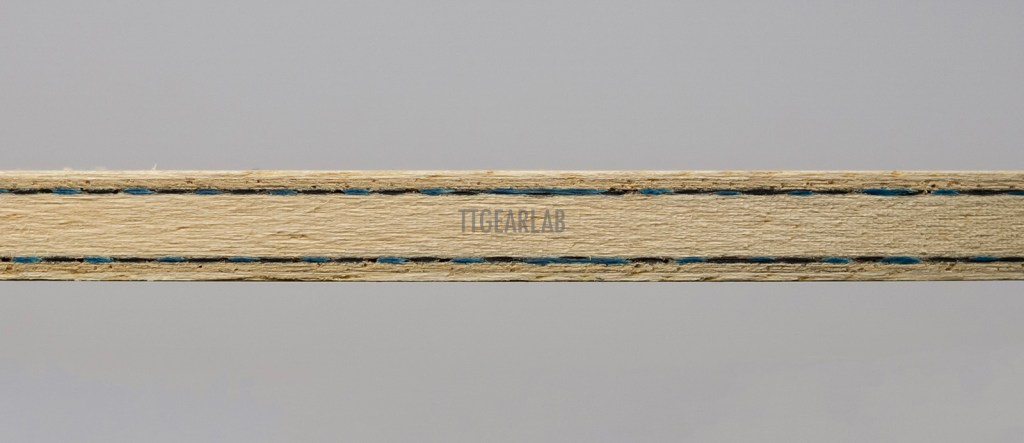
The construction of ‘Ovtcharov InnerForce ALC’ is based on that of ‘InnerForce Layer ALC’ but much thicker. The top layer is Limba. The middle layer and the center layer is Ayous. ALC (= Arylate Carbon) is of course inserted between the middle layer and the center layer. The Arylate fiber that is used for Butterfly blades is Vectran that is produced by Kuraray, and it is woven together with Carbon fiber. (Other companies also use Vectran that is not dyed in other colors such as red, orange, or green to weave ALC, but because they cannot use the name ‘arylate’ due to trademark issues, they call it by a different name.) Overall thickness is around 6.2mm.
1-4. Stiga Inspira CCF
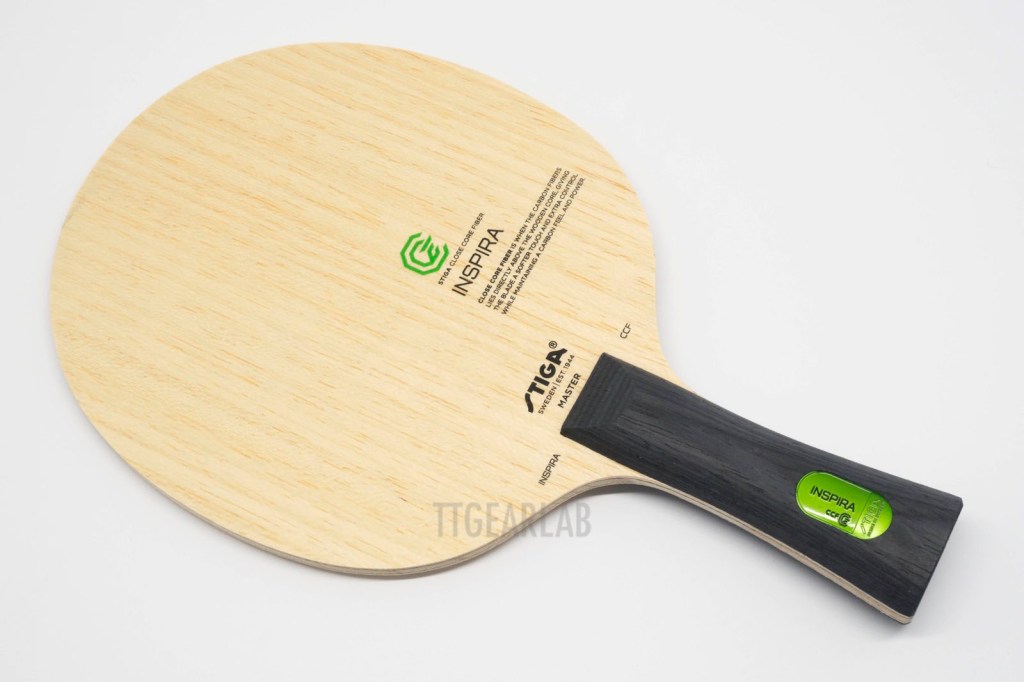
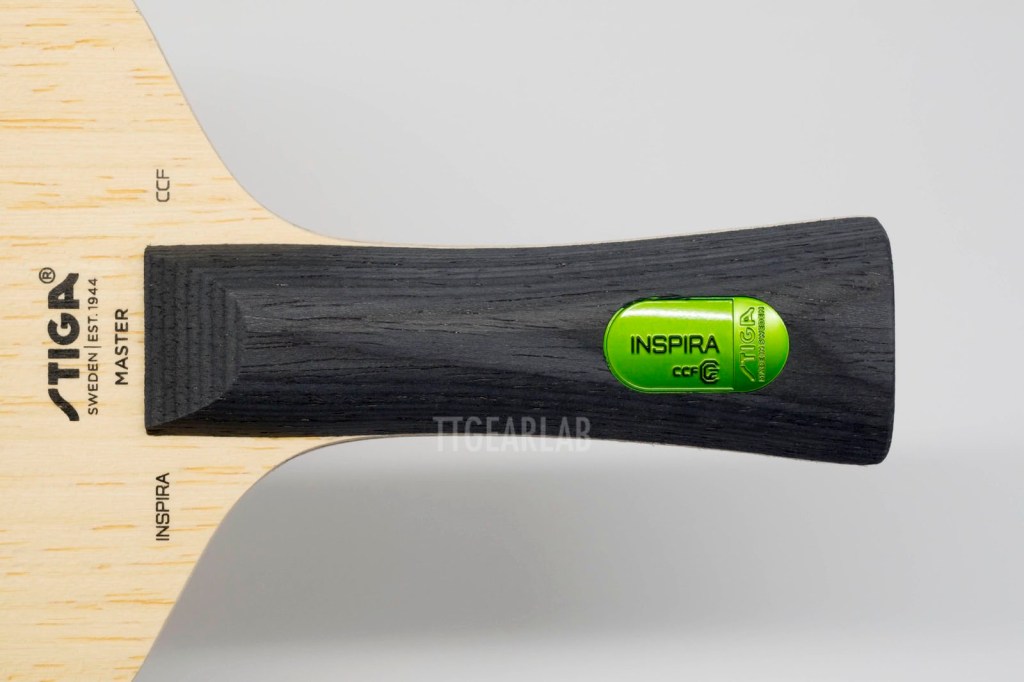
Stiga ‘Inspira CCF’, released in the spring of 2021, is a fiber blade designed to offere the highest speed asmong Stiga’s Inner-type blades. The acronym ‘CCF’ stands for ‘Close Core Fiber’, denoting its Inner-type construction. Aside from details such as surface dyeing, the construction of ‘Inspira CCF’ is identical to that of ‘Cybershape Carbon’. Consequently, players who appreciate the performance of ‘Cybershape Carbon’ but dislike its unconventional head shape can opt for ‘Inspira CCF’ as a ‘normal shaped’ alternative.
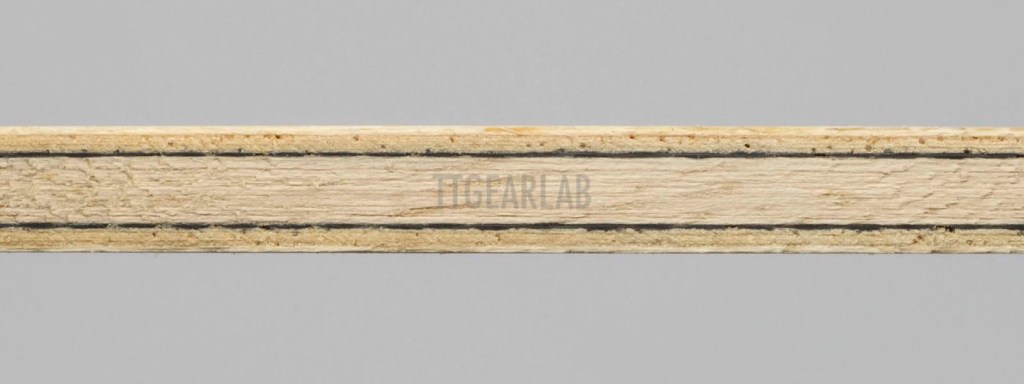
‘Inspira CCF’ is an inner-type fiber blade of 5+2 ply construction. The top layer is Koto, the middle layer is Ayous, and the center layer is Kiri. The top layer is stiffer than Limba which is commonly used as top layer wood of Inner-type blades, and on the contrary, the center layer is softer than Ayous which is commonly used for the center wood of Inner-type blades. The overall thickness is 6.2~6.3mm. Because it is a relatively thicker blade equipped with more elastic fiber material when compared with common Inner-type blades, ‘Inspira CCF’ boasts the elasticity level that can be compared with that of common Outer-type fiber blades.
Then let’s check the characteristics of above four blades by Performance Indices and then compare with some existing blades.
Please click here to return to top (table of contents)
2. Performance Indices
Performance Indices are measured objective values to represent the characteristics of table tennis gears. Concerning the detail of four performance indices, please refer to following articles in ‘About TTGearLab’ section :
- Performance indices : the way to evaluate blade by measurement
- The example of comparison by performance indices
2-1. Donic Anders Lind Hexa Carbon
| Name | Avg.Wt (g) | Ep | Ec | Ec/Ep | Vp | Vl | Vl/Vp |
| Donic Anders Lind Hexa Carbon | 86.5 | 2.04 | 1.88 | 0.92 | 1.31 | 1.38 | 1.05 |
The primary elasticity index (Ep) of ‘Anders Lind Hexa Carbon’ exceeds 2.0. It is a very high value as that of an inner-type fiber blade, and is the value as high as those of many known outer-type fiber blades. The Ec/Ep isn’t lower than but close to 0.9. It means that ‘Anders Lind Hexa Carbon’ clearly but not extremely hugs the ball when the player hits the ball very strongly.
The Vp (Primary Vibration Index) is 1.31. It is much higher than the Vp of typical inner-type fiber blades such as ‘InnerForce Layer ALC’. It is close to the values of the typical outer-type fiber blades. So we can understand that ‘Anders Lind Hexa Carbon’ is as stiff as outer-type blades in primary feeling. Its Vl (= 1.38) also reminds us those of typical inner ALC blades. The Vl/Vp (= 1.05) is higher than 1.0, but not extremely high. We can expect that the feeling transferred to index finger is sharper than the primary feeling transferred to palm, but the difference isn’t big.
2-2. KTS Forge 3K
| Name | Avg.Wt (g) | Ep | Ec | Ec/Ep | Vp | Vl | Vl/Vp |
| KTS Forge 3K | 84.4 | 2.11 | 1.93 | 0.92 | 1.35 | 1.47 | 1.09 |
The primary elasticity index (Ep) of ‘Forge 3K’ exceeds 2.0. It is a very high value as that of an inner-type fiber blade, and is the value as high as those of many known outer-type fiber blades. The Ec/Ep isn’t lower than but close to 0.9. It means that ‘Forge 3K’ clearly but not extremely hugs the ball when the player hits the ball very strongly.
The Vp (Primary Vibration Index) is 1.35. It is much higher than the Vp of typical inner-type fiber blades such as ‘InnerForce Layer ALC’. It is close to the values of the typical outer-type fiber blades. So we can understand that ‘Forge 3K’ is as stiff as outer-type blades in primary feeling. The Vl/Vp (= 1.09) is much higher than 1.0, and is close to 1.1. We can expect that the feeling transferred to index finger is noticeably sharper than the primary feeling transferred to palm.
2-3. Butterfly Ovtcharov InnerForce ALC
| Name | Avg.Wt (g) | Ep | Ec | Ec/Ep | Vp | Vl | Vl/Vp |
| Butterfly Ovtcharov InnerForce ALC | 89.2 | 2.02 | 1.68 | 0.84 | 1.21 | 1.30 | 1.07 |
We have already examined the values of ‘Ovtcharov InnerForce ALC’ for some times. The primary elasticity index (Ep) of ‘Ovtcharov InnerForce ALC’ exceeds 2.0. It is a very high value as that for an inner ALC blade, and is the value as high as those of many known outer-type blades. The Ec/Ep is lower than 0.9. It means that ‘Ovtcharov InnerForce ALC’ hugs the ball very deeply when the player hits the ball very strongly.
The Vp (Primary Vibration Index) is 1.21. It is just a bit higher than the Vp of typical inner ALC blades such as ‘InnerForce Layer ALC’. So, although ‘Ovtcharov InnerForce ALC’ is fast than most of inner ALC blades, its feeling is not stiff. The Vl/Vp (= 1.07) is higher than 1.0, but not extremely high. We can expect that the feeling transferred to index finger is noticeably sharper than the primary feeling transferred to palm, but the difference isn’t big.
2-4. Stiga Inspira CCF
| Name | Avg.Wt (g) | Ep | Ec | Ec/Ep | Vp | Vl | Vl/Vp |
| Stiga Inspira CCF | 87.3 | 2.17 | 1.90 | 0.88 | 1.33 | 1.47 | 1.11 |
The primary elasticity index (Ep) of ‘Inspira CCF’ greatly exceeds 2.0. It is an extreme high value as that of an inner-type fiber blade, and it even exceeds those of many known outer-type fiber blades. The Ec/Ep is lower than 0.9. It means that ‘Inspira CCF’ hugs the ball very deeply when the player hits the ball very strongly.
The Vp (Primary Vibration Index) is 1.33. It is much higher than the Vp of typical inner-type fiber blades such as ‘InnerForce Layer ALC’. It is close to the values of the typical outer-type fiber blades. So we can understand that ‘Inspira CCF’ is as stiff as outer-type blades in primary feeling. Vl/Vp (= 1.11) exceeds 1.1 a bit. We can expect that the feeling transferred to index finger is much sharper than the primary feeling transferred to palm.
Please click here to return to top (table of contents)
3. Comparison by Performance Indices
Then we can compare four powerful inner-type fiber blades with some other existing blades. Following is the list of the blades to be compared :
Inner-type fiber blades
| Name | Average Weight | Feature |
| Butterfly InnerForce Layer ALC | 91.2g | Typical Inner ALC blade with Limba top layer |
| Butterfly Hurricane Long 5 | 88.1g | Another representative of inner ALC blades |
| Donic Original No.1 | 88.7g | Inner Acryl Carbon blade with Limba top layer |
| Victas Fire Fall VC | 81.8g | Inner ALC with Limba top layer / Thick construction |
| andro Synteliac VCI OFF | 88.6g | Inner ALC blade which is being used by Simon Gauzy |
Outer-type fiber blades
| Name | Average Weight | Feature |
| Butterfly Viscaria | 87.1g | The representative of outer ALC blade with Koto top layer |
| Butterfly Viscaria Super ALC | 92.7g | The woven pattern of ALC is different from the ALC of Viscaria |
| Stiga Carbonado 190 | 90.8g | The outer-type blade with Textreme which is a kind of woven carbon but with enhanced feeling |
| Butterfly Fan Zhendong ZLC | 85.1g | The typical outer ZLC blade with Koto top layer |
| Butterfly Freitas ALC | 87.4g | The typical Outer ALC blade with Limba top layer |
| Victas Liam Pitchford | 89.2g | The outer Zxion Carbon(= a kind of ALC) blade with Limba top layer and hardwood middle layer |
5-ply wood blades (including reference blade)
| Name | Average Weight | Feature |
| Butterfy Korbel | 88.7g | The representative of 5-ply wood offensive blade. |
| Stiga Allround Classic (Reference) | 84.3g | The representative of 5-ply wood allround blade. |
3-1. Elasticity Indices
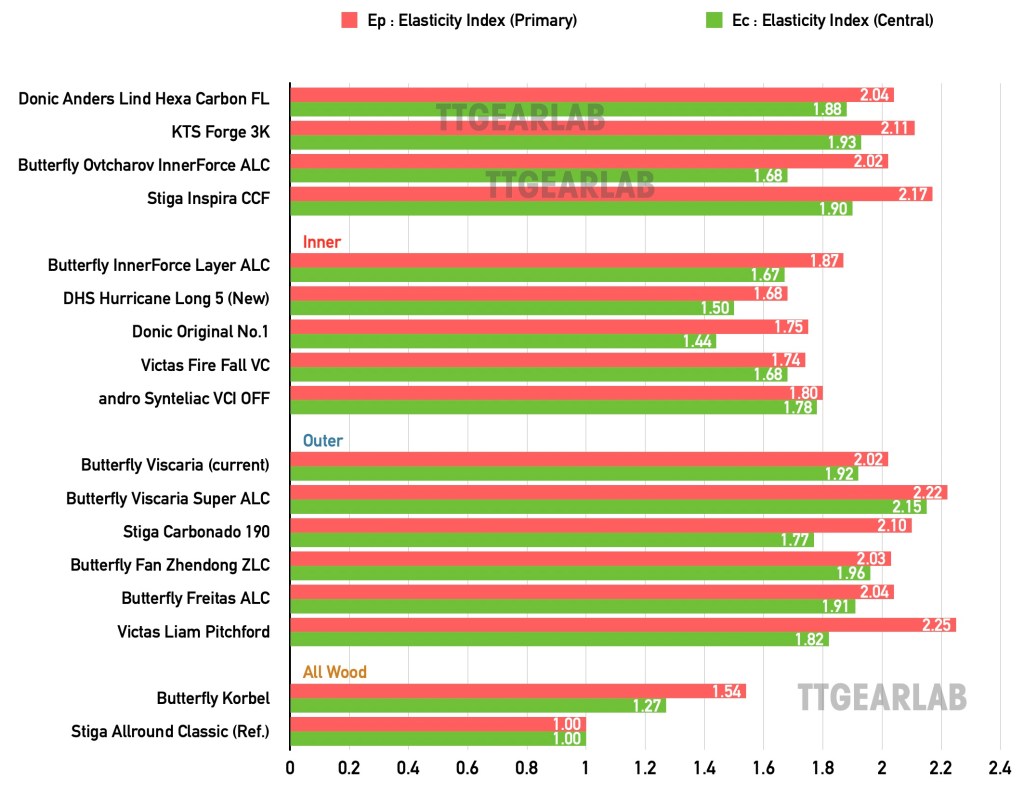
Fig.13 shows the comparison graph of Elasticity Indices.
Ep (Primary Elasticity Index) is directly concerned with the rebound speed of blade. Ec (Central Elasticity Index) is concerned with additional ‘kick’ when player hits ball very strongly.
We can see that the Ep’s of four high-power inner-type blades exceed 2.0. The value of ‘Inspira CCF’ is the highest among the four, and that of ‘Ovtcharov InnerForce ALC’ is the lowest. But, the differences in Ep’s will note be that noticeable in actual use because those values are sufficiently high. In this case the relationship between Ec and Ep becomes more important in the comparison, and that can be examined by the graph shape. We can see that the graph shape of ‘Anders Lind Hexa Carbon’ looks very similar to that of ‘Forge 3K’. But, the graph shape of ‘Inspira CCF’ is somewhat different from those two because its Ec is not high as its Ep. And, the graph of ‘Ovtcharov InnerForce ALC’ shows much difference from the shapes of the other three. Especially the low value of the Ec of ‘Ovtcharov InnerForce ALC’ is noticeable.
Then we can compare those four with other blades in two groups – ‘Inner’ group and ‘Outer’ group.
[Inner-type fiber blades]
Four blades being examined in this article are inner-type fiber blades. Therefore, those four can be compare with other inner-type fiber blades whose characteristics are more typical as those of ‘inner-type’ fiber blade.
- The overall elasticity levels of ‘ordinary’ inner-type fiber blades are noticeably lower than those of four ‘high-power’ inner-type fiber blades. In general, the Ep of a typical inner-type blade doesn’t exceed 1.9. Even the highest value (= 1.87 of ‘InnerForce Layer ALC) in the group is apparently lower than the lowest value (= 2.02 of ‘Ovtcharov InnerForce ALC’) among four high-power models.
- The Ec of an ordinary inner-type blade is also lower than the Ec of a high-power inner blade. But, there are some exceptions. The Ec’s of ‘InnerForce Layer ALC’ and ‘Fire Fall VC’ are not much different from that of ‘Ovtcharov InnerForce ALC’. And the Ec
- The Ec’s of two models – ‘Hurricane Long 5’ and ‘Original No.1’ are especially low. Especially the Ec of ‘Original No.1’ is the lowest in the group, while its Ep is normal in the group. That makes the graph shape of ‘Original No.1’ look similar to that of ‘Ovtcharov InnerForce ALC’.
[Outer-type fiber blades]
Then we can compare four high-power inner-type blades with some typical outer-type fiber blades.
- The overall elasticity levels of typical outer-type fiber blades look very similar to those of four high-power inner-type fiber blades. It means that the characteristics of four high-power inner-type blades are not those of inner-type blades but those of outer-type blades.
- Especially the graph shapes and values of two models – ‘Viacaria’ and ‘Freitas ALC’ – look very similar to those of ‘Anders Lind Hexa Carbon’ and ‘Forge 3K’.
- The Ec’s of ‘Carbonado 190’ and ‘Liam Pitchford’ are lower than those of ‘Anders Lind Hexa Carbon’, ‘Forge 3K’, and ‘Inspira CCF’. That means the graph shapes of those two look similar to that of ‘Ovtcharov InnerForce ALC’.
[5-ply wood incl. Reference Blade]
5-ply wood blades can be compared with fiber blades just as reference.
- The elasticity level of ‘Korbel’ is of course much lower than those of high-power inner-type fiber blades. But, its graph shape looks similar to that of ‘Ovtcharov InnerForce ALC’.
- ‘Allround Classic’ is much less elastic than all the blades in this comparison. However, there are some blades whose graph shapes look similar to that of ‘Allround Classic’. (= Ec is not much different from Ep.) For example, ‘Synteliac VCI OFF’ and ‘Viacaria Super ALC’. That kind of blade will be good replacement of ‘Allround Classic’ if the player wants to increase the power of ball. None of four high-power inner-type blades can be direct replacement of ‘Allround Classic’.
Examining Ec/Ep is also a easier way to understand the characteristics of blade concerned with elasticity. Fig.14 shows the relationship between Ec/Ep and Ep.
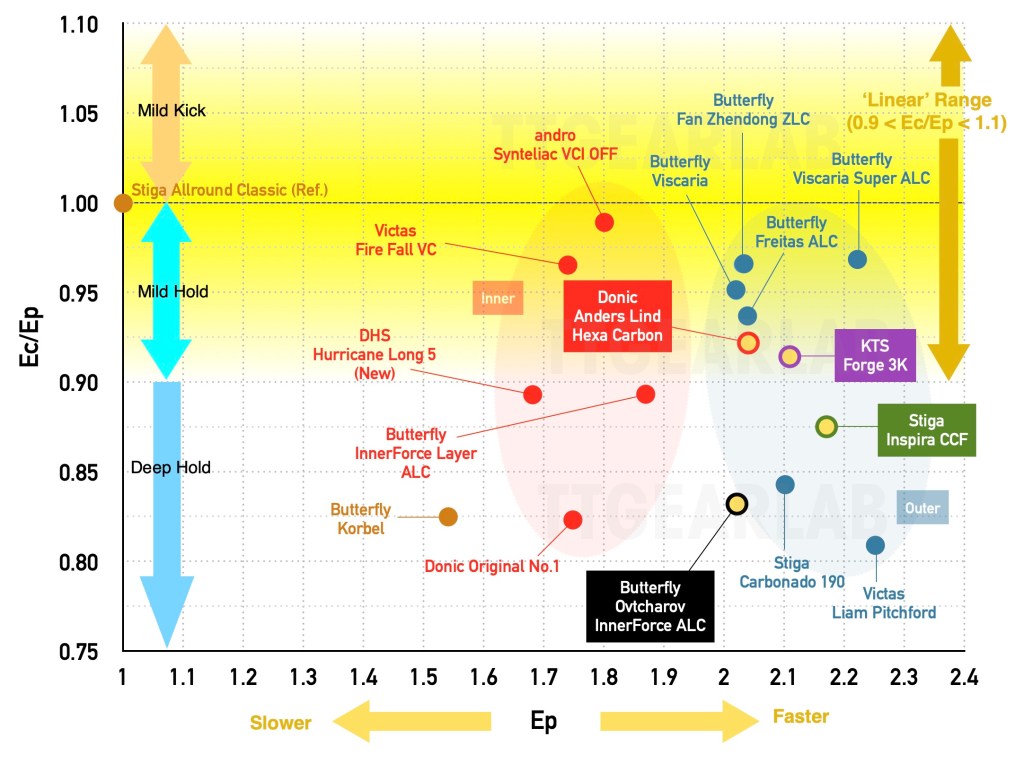
Ec/Ep expresses the ‘tendency’ of the elasticity of blade. By examining Ec/Ep and Ep at the same time, we can easily understand the behavior of blades. We can categorize the blades except for four theme blades in this article and reference blade into two categories – ‘Inner’ and ‘Outer’. The blades in ‘Inner’ group are indicated in red, and the blades in ‘Outer’ group are indicated in dark blue. The ‘Outer’ group is located to the right of the ‘Inner’ group because of relatively higher Ep’s. But, the blades of both groups are widely distributed in the vertical direction. We should note that when selecting a blade, the Ec/Ep ratio is a more important factor to consider to suit personal preferences than Ep or Ec. What we can observe from the graph can be summarized as follows:
- The four blades examined in this comparison – ‘Anders Lind Hexa Carbon’, ‘Forge 3K’, ‘Ovtcharov InnerForce ALC’, and ‘Inspira CCF’ – are inner type blades, but we can see that they are not located in the area of the ‘Inner’ group, but on the right side of the graph, that is, in the area of the ‘Outer’ group. Their Ep’s are very high, over 2.0, and are comparable to those of ‘Viscaria’, ‘Fan Zhendong ZLC’, ‘Freitas ALC’, and ‘Carbonado 190’ in the ‘Outer’ group. Even ‘Opcharov Inner Force ALC’, which has the lowest Ep among the four, shows high values that cannot be found in typical inner type blades.
- ‘Anders Lind Hexa Carbon’ is located close to three Butterfly outer-type blades – ‘Viscaria (= Fan Zhendong ALC)’, ‘Freitas ALC’ and ‘Fan Zhendong ZLC’ but at a bit lower position. It can be categorized as an inner ALC blade, and its top layer is Koto. For that reason it can be compared with ‘Viscaria’ which is an outer ALC blade with Koto top layer. It means that ‘Anders Lind Hexa Carbon’ can be a good choice if a player wants a blade that has similar elasticity to the outer ALC blades with Koto top layer such as ‘Viscaria’ but hugs the ball a little deeper. That coincide with the concept of ‘Anders Lind Hexa Carbon’.
- ‘Forge 3K’ is also located close to the three Butterfly blades, and its top layer is Limba. So it can be compared with ‘Freitas ALC’ whose top layer is also Limba. It means that ‘Forge 3K’ can be a good choice if a player wants a blade which is a bit faster and hugs the ball a bit deeper than the outer ALC blades with Limba top layer such as ‘Freitas ALC’.
- Because ‘Anders Lind Hexa Carbon’ and ‘Forge 3K’ are located close to each other, we can select between those two based on materials. When comparing ‘Anders Lind Hexa Carbon’ and ‘Forge 3K’, ‘Anders Lind Hexa Carbon’ has a harder surface while the special material inside is softer, whereas ‘Forge 3K’ has a softer surface while the special material inside is harder.
- ‘Inspira CCF’ has higher Ep than ‘Anders Lind Hexa Carbon’ and ‘Forge 3K’, while Ec/Ep is lower. It is located in ‘Deep Hold’ range. Therefore, ‘Inspira CCF’ can be a good choice if a player wants a feature that hugs the ball more deeply. For a blade with this high primary elasticity, the difference Ep may not be meaningfully noticeable, and the difference in how deeply it hugs the ball is likely to be more noticeable. And, if a player wants the blade which hugs the ball even more deeply than ‘Anders Lind Hexa Carbon’ and ‘Forge 3K’, the ‘Ovtcharov InnerForce ALC’ is an option to be chosen.
- ‘Ovtcharov InnerForce ALC’ has the lowest Ep among the four blades in this comparison, and its Ec/Ep is also low enough to be considered extreme in this comparison. Therefore, some players may feel that ‘Ovtcharov InnerForce ALC’ is not a fast blade as expected.
- ‘Ovtcharov InnerForce ALC’ is located in the range of Ec/Ep = 0.8 ~ 0.85, and ‘Korbel’, ‘Original No.1’, and ‘Liam Pitchford’ are also located in this range. They have similar Ec/Ep and the same Limba top layer, making them easy to adapt when a player changes blades among those ones. If a player wants to increase the elasticity of blade while maintaining the HOLD characteristics of ‘Korbel’ to some extent, ‘Original No. 1’ can be the first choice. If the player wants to increase the elasticity even more, ‘Ovtcharov InnerForce ALC’ can be the next choice, and if the player wants to increase the elasticity even more, ‘Liam Pitchford’ can be the proper selection. The probability of failure will be lowered. If the player changes the blade it in this way, the probability of failure will be lowered. Based on similar criteria, if a player wants to increase only the elasticity from ‘InnerForce Layer ALC’, ‘Inspira CCF’ could surprisingly be a good option. Further, if a player is looking for something that is more elastic than ‘InnerForce Layer ALC’ or ‘Hurricane Long 5’, with not much different level of hug, then ‘Anders Lind Hexa Carbon’ and ‘Forge 3K’ can be the options to choose.
Elasticity characteristics are important criteria when selecting a blade, and Ec/Ep in particular is a criterion that can be used to determine whether a player will be able to easily adapt to a new blade. If a player has a preferred Ec/Ep range, choosing a blade within that range increases the chances that the player won’t have too much trouble of adaptation. At this time, please also remember that Ep has surprisingly little effect on adaptation unless the change is very extreme. Also, if a player wants the blade that hugs the ball more deeply than the blade currently being used, selecting a blade at lower position on the graph will be the solution. And if the player needs characteristics that give a stronger kick when hitting strongly than the blade currently being used, selecting a blade at higher position on the graph will be the solution. This way of selection will help to reduce the chances of failure in changing the blade.
Then next, let’s observe Vibration Indices.
Please click here to return to top (table of contents)
3-2. Vibration Indices
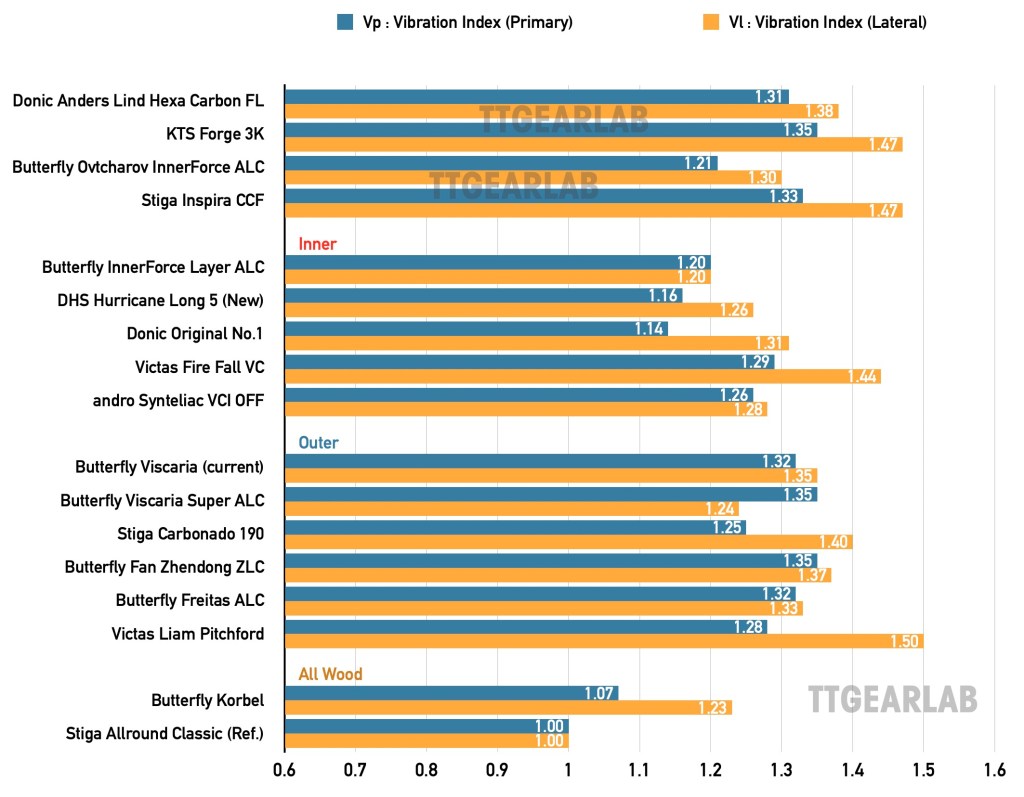
Fig.15 shows the comparison graph of Vibration Indices. Vibration Indices are concerned with feeling. Vp indicates primary feeling which is transferred to player’s palm. And, Vl is the feeling at the edge of the wing – the lower side of blade head. It is felt by player’s index finger or middle finger.
We can see that the Vp’s of three among four high-power inner-type blades exceed 1.3. That is the level we can expect not from inner-type blades but from outer-type blades. Only the Vp of ‘Ovtcharov InnerForce ALC’ is lower than 1.3, and is what we can expect from ordinary inner-type blade. Regarding Vp, we can observe that the Vp’s of two models – ‘Forge 3K’ and ‘Inspira CCF’ – are especially high. Those values are even higher than the Vp’s of most of outer-type blades. Probably that is because both of those two models are equipped with pure woven carbon fiber that doesn’t include soft fiber.
Then we can compare those four with other blades in two groups – ‘Inner’ group and ‘Outer’ group.
[Inner-type fiber blades]
Four blades being examined in this article are inner-type fiber blades. Therefore, those four can be compare with other inner-type fiber blades whose characteristics are more typical as those of ‘inner-type’ fiber blade.
- The overall vibration levels of ‘ordinary’ inner-type fiber blades look lower than those of four ‘high-power’ inner-type fiber blades. In general, the Vp of a typical inner-type blade doesn’t exceed 1.3. And, three models among four ‘high-power’ inner-type fiber blades have Vp’s over 1.3. The exception is ‘Ovtcharov InnerForce ALC’ whose Vp is just 1.21.
- The Vl’s of four ‘high-power’ inner-type fiber blades are higher than the Vl’s of the most of ordinary inner-type blades. Again, the Vl of ‘Ovtcharov InnerForce ALC’ is not much different from those of ordinary inner-type blades. We can understand that the overall feeling of ‘Ovtcharov InnerForce ALC’ is as soft as the feeling of typical inner-type blades.
- Among ordinary inner-type blades those are relatively softer than high-power inner-type blades, the exception is ‘Fire Fall VC’ whose values are not much different from those of ‘Forge 3K’ and ‘Inspira CCF’.
[Outer-type fiber blades]
Then we can compare four high-power inner-type blades with some typical outer-type fiber blades.
- The overall vibration levels of typical outer-type fiber blades look very similar to those of four high-power inner-type fiber blades. That coincides with what we have already observed in the overall elasticity levels. It means that the characteristics of high-power inner-type blades are not those of inner-type blades but those of outer-type blades. One exception is ‘Ovtcharov InnerForce ALC’ whose vibration characteristics are those of ordinary inner-type blades.
- The Vp’s of ‘Anders Lind Hexa Carbon’, ‘Forge 3K’ and ‘Inspira CCF’ are close to those of four Butterfly outer-type blades – ‘Viscaria’, ‘Viscaria Super ALC’, ‘Fan Zendong ZLC’ and ‘Freitas ALC’. All values are in the range of 1.30~1.35. We may be able to consider that range as the common range of the Vp of outer-type blade.
- On the contrary, there are dramatic differences in Vl’s of those seven models. Both of ‘Anders Lind Hexa Carbon’ and ‘Forge 3K’ have very high Vl’s those are close to 1.50. Among outer-type blades in this comparison, only ‘Liam Pitchford’ has the Vl of that level.
- The graph shape of ‘Carbonado 190’ looks quite similar to those of ‘Forge 3K’ and ‘Inspira CCF’. All those three models are equipped with pure woven carbon fiber.ades.
[5-ply wood incl. Reference Blade]
5-ply wood blades can be compared with fiber blades just as reference.
- The Vp and the Vl of ‘Korbel’ is of course much lower than those of high-power inner-type fiber blades. Especially there are big differences in Vp. But, the differences in Vl are relatively small.
- ‘Allround Classic’ is shows the lowest values in this comparison. We can find some blades whose graph shapes look similar to that of ‘Allround Classic’. For example, ‘InnerForce Layer ALC’, ‘Synteliac VCI OFF’ and ‘Freitas ALC’. But, none among four high-power inner-type blades shows the graph shape similar to that of ‘Allround Classic’.
Examining Vl/Vp is easier way for the comparison of the tendency of feeling. Fig.16 shows the relationship between Vl/Vp and Vp for easier comparison.
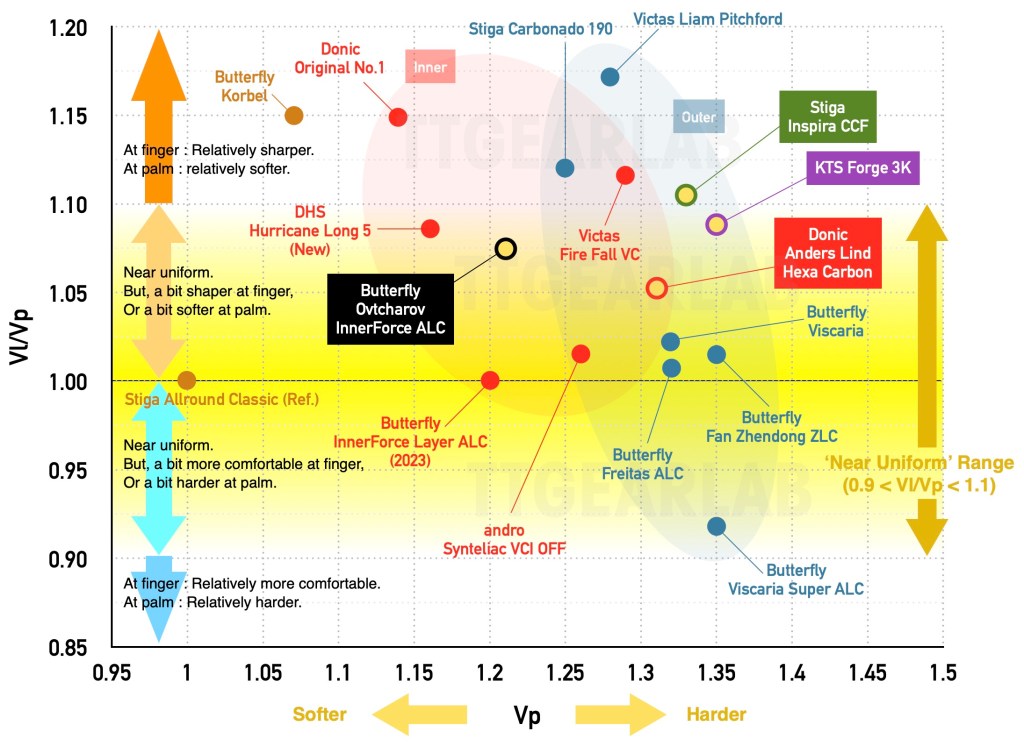
On the graph, most of models in this comparison (except for three blades) are placed in upper part of the graph – ‘Relatively sharper at finger’ range (Vl/Vp > 1.0). However, within that range, blades are widely distributed up, down, left and right. We can categorize the blades except for four theme blades in this article and reference blade into two categories – ‘Inner’ and ‘Outer’. The blades in ‘Inner’ group are indicated in red, and the blades in ‘Outer’ group are indicated in dark blue. The ‘Outer’ group is located to the right of the ‘Inner’ group because of relatively higher Vp’s, although there is overlapped area. And, the blades of both groups are widely distributed in the vertical direction. We should note that when selecting a blade, the ratio Vl/Vp is a more important factor to consider to suit personal preferences than Vp or Vl. What we can observe from the graph can be summarized as follows:
- The four blades examined in this comparison – ‘Anders Lind Hexa Carbon’, ‘Forge 3K’, ‘Ovtcharov InnerForce ALC’, and ‘Inspira CCF’ – are inner type blades, but we can see that ‘Anders Lind Hexa Carbon’, ‘Forge 3K’ and ‘Inspira CCF’ are not located in the area of the ‘Inner’ group, but on the right side of the graph, that is, in the area of the ‘Outer’ group. Their Vp’s are very high, over 1.3, and are comparable to those of ‘Viscaria’, ‘Fan Zhendong ZLC’, ‘Freitas ALC’, and ‘Viscaria Super ALC’ in the ‘Outer’ group. Only one model – ‘Ovtcharov InnerForce ALC’ – is located in the area of ‘inner’ group. ‘Anders Lind Hexa Carbon’, ‘Forge 3K’ and ‘Inspira CCF’ exhibit characteristics unrelated to the ‘inner-type’, not only in elasticity but also in vibration. Of course those three will give a bit more natural feeling than outer-type blades because the fibers are inserted at relatively deeper position. That will be the only ‘inner-type’ characteristics those three models possess. (Note: ‘More natural feeling’ doesn’t mean ‘softer feeling’.)
- ‘Anders Lind Hexa Carbon’ is located close to ‘Viscaria’. When compared with ‘Viscaria’, its Vp is just a bit higher, and its Vl/Vp is noticeably but not significantly higher. We have already observed that ‘Anders Lind Hexa Carbon’ is also located close to ‘Viscaria’ on the graph of elasticity indices. From two graphs, we can clearly see the concept of ‘Anders Lind Hexa Carbon’ – an inner-type blade similar to ‘Viscaria’.
- ‘Forge 3K’ and ‘Inspira CCF’ are located at even higher positions. The Vl/Vp’s of those two are around 1.1. If the player prefer sharper feeling transferred at index finger, those two may be better choice than ‘Anders Lind Hexa Carbon’.
- From the viewpoint of feeling, ‘Ovtcharov InnerForce ALC’ is a typical inner-type blade, differently from the other three high-power inner-type models. But, its Vl/Vp is much higher than that of ‘InnerForce Layer ALC’. If a player wants a sharper feeling at finger while maintaining the soft primary feeling (at the palm) of ‘InnerForce Layer ALC’, ‘Ovtcharov InnerForce ALC’ may be a good choice, if the difference in Ec/Ep is acceptable. If Ec/Ep is critical for the player, ‘Freitas ALC’ will be better choice for getting higher power, even though its feeling at index finger is not sharper than that of ‘InnerForce Layer ALC’.
- If a player who has been using ‘Korbel’ wants to change the blade to a harder and more powerful one while maintaining the relative feeling at index finger represented by Vl/Vp, the first one to be considered is ‘Original No.1’. And, ‘Carbonado 190’ and ‘Liam Pitchford’ will be considerable if the player requires even higher power. In that case, if the player doesn’t like the unnatural feeling of outer-type blades and wants to adjust the feeling at index finger to be milder, ‘Inspira CCF’ and ‘Forge 3K’ will be the optimum choice.
Please click here to return to top (table of contents)
4. Summary
We have compared four powerful inner-type fiber blades through Performance Indices. The characteristics of each model can be summarized as follows:
4-1. Donic Anders Lind Hexa Carbon
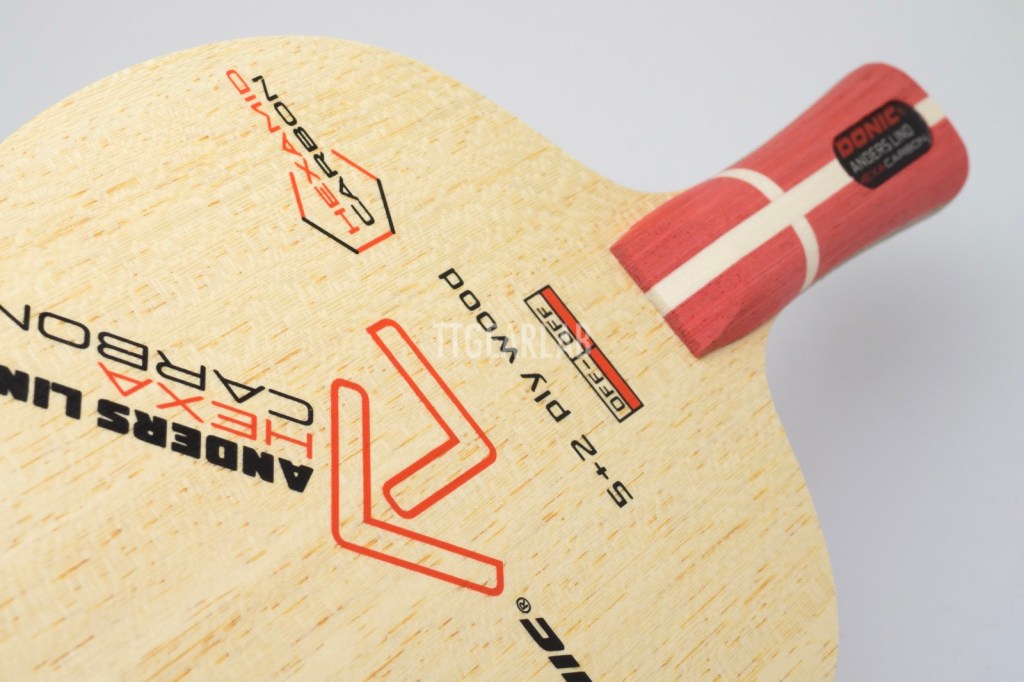
- ‘Anders Lind Hexa Carbon’ is an inner-type fiber blade whose characteristics are very similar to those of ‘Viscaria’ which is the representative of outer-type fiber blades.
- ‘Anders Lind Hexa Carbon’ is as elastic as outer-type fiber blades in primary elasticity (expressed as Ep), and its Ec/Ep is 0.92 which is a bit lower than 0.95 of ‘Viscaria’. So it hugs the ball more deeply than ‘Viscaria’ when the player hits the ball very strongly. But, the level of hug isn’t extreme because it is in the ‘Mild Hold (= Mild Hug)’ range.
- The vibration characteristics of ‘Anders Lind Hexa Carbon’ are also those of outer-type fiber blades. Its Vp (=1.31) is close to those of ‘Viscaria’ and ‘Freitas ALC’. But, because of relatively higher Vl/Vp, ‘Anders Lind Hexa Carbon’ transfers sharper ‘relative’ feeling to index finger when compared with ‘Viscaria’.
- If a player doesn’t want to give up the inner-type fiber blade but wants to increase the power, ‘Anders Lind Hexa Carbon’ can be one of the suitable blades. And, if a player prefers most of the characteristics of outer-type fiber blade with Koto top layer such as ‘Viscaria’ but doesn’t like the unnatural feeling of outer-type blades, ‘Anders Lind Hexa Carbon’ is strongly recommended.
4-2. KTS Forge 3K
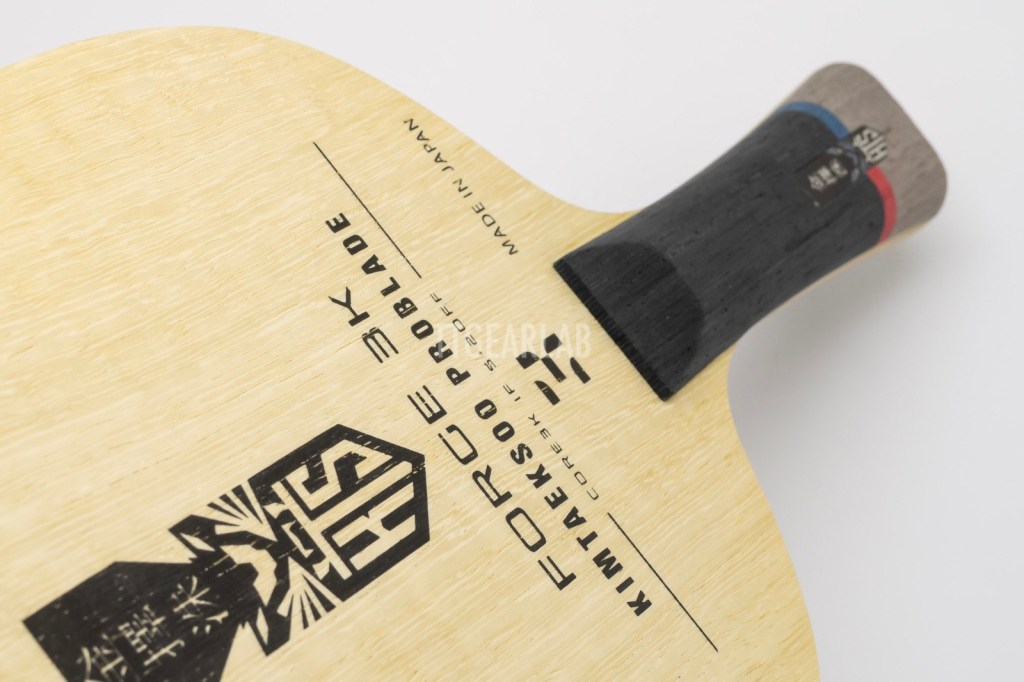
- ‘Forge 3K’ is an inner-type fiber blade that provides high power equivalent to that of outer-type fiber blades. Its characteristics are somewhat similar to those of outer-type fiber blades with Limba surface, such as ‘Freitas ALC’. But, it provides more natural feeling thanks to the artificial fiber which is placed at one step deeper position.
- ‘Forge 3K’ is as elastic as outer-type fiber blades in primary elasticity (expressed as Ep), and its Ec/Ep is 0.91 which is lower than 0.94 of ‘Freitas ALC’. So it hugs the ball more deeply than ‘Freitas ALC’ when the player hits the ball very strongly. But, the level of hug isn’t extreme because it is still in the ‘Mild Hold (= Mild Hug)’ range.
- The vibration characteristics of ‘Forge 3K’ are also those of outer-type fiber blades. Its Vp (= 1.35) is higer than those of ‘Viscaria’ and ‘Freitas ALC’, and is same as that of ‘Fan Zhendong ZLC’. But, because of relatively higher Vl/Vp, ‘Forge 3K’ transfers sharper ‘relative’ feeling to index finger when compared with three Butterfly outer-type blades.
- If a player doesn’t want to give up the inner-type fiber blade but wants to increase the power, ‘Forge 3K’ can be one of the suitable blades, together with ‘Anders Lind Hexa Carbon’. And, if a player prefers most of the characteristics of outer-type fiber blade with Limba top layer such as ‘Freitas ALC’ but doesn’t like the unnatural feeling of outer-type blades, ‘Forge 3K’ is strongly recommended.
4-3. Butterfly Ovtcharov InnerForce ALC
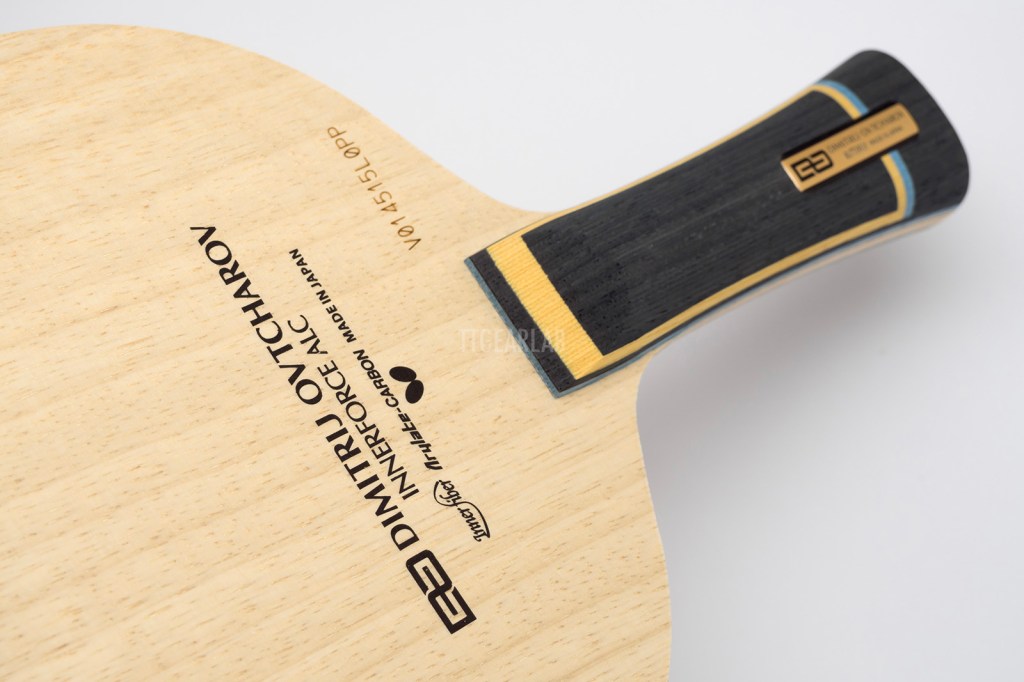
- ‘Ovtcharov InnerForce ALC’ is a blade adjusted to have higher primary elasticity than ‘InnerForce Layer ALC’ while hugging the ball more deeply when the player hits the ball very strongly. It is designed to have similar characteristics as ‘Korbel’, Butterfly’s representative 5-ply wood offensive blade, but with enhanced power.
- ‘Ovtcharov InnerForce ALC’ is as elastic as outer-type fiber blades in primary elasticity (expressed as Ep). Its Ec/Ep is 0.83 which is much lower than the values of Butterfly outer-type fiber blades, and is close to the value of ‘Carbonado 190’ and ‘Liam Pitchford’. It is located in the ‘Deep Hold (= Deep Hug)’ range. It hugs the ball very deeply when the player hits the ball very strongly.
- The vibration characteristics of ‘Ovtcharov InnerForce ALC’ are those of typical inner-type fiber blades, differently from the other three high-power inner-type blades in this comparison. Its Vp (=1.21) is close to those of ‘InnerForce Layer ALC’ and ‘Hurricane Long 5’. Its Vl (= 1.30) is close to those of ‘Hurricane Long 5’ and ‘Original No.1’. The overall vibration characteristics of ‘Ovtcharov InnerForce ALC’ are close to those of ‘Hurricane Long 5’. Because ‘Ovtcharov InnerForce ALC’ is keeping the characteristics as an inner-type blade, some players may think that ‘Ovtcharov InnerForce ALC’ isn’t that powerful.
- If a player has used 5-ply wood offensive blade such as ‘Korbel’ but want to switch to a fiber blade, ‘Ovtcharov InnerForce ALC’ is strongly recommended. And, if a player prefers the blade which hugs the ball very deeply when the impact strength is high, ‘Ovtcharov InnerForce ALC’ will be one of the optimum blades.
4-4. Stiga Inspira CCF
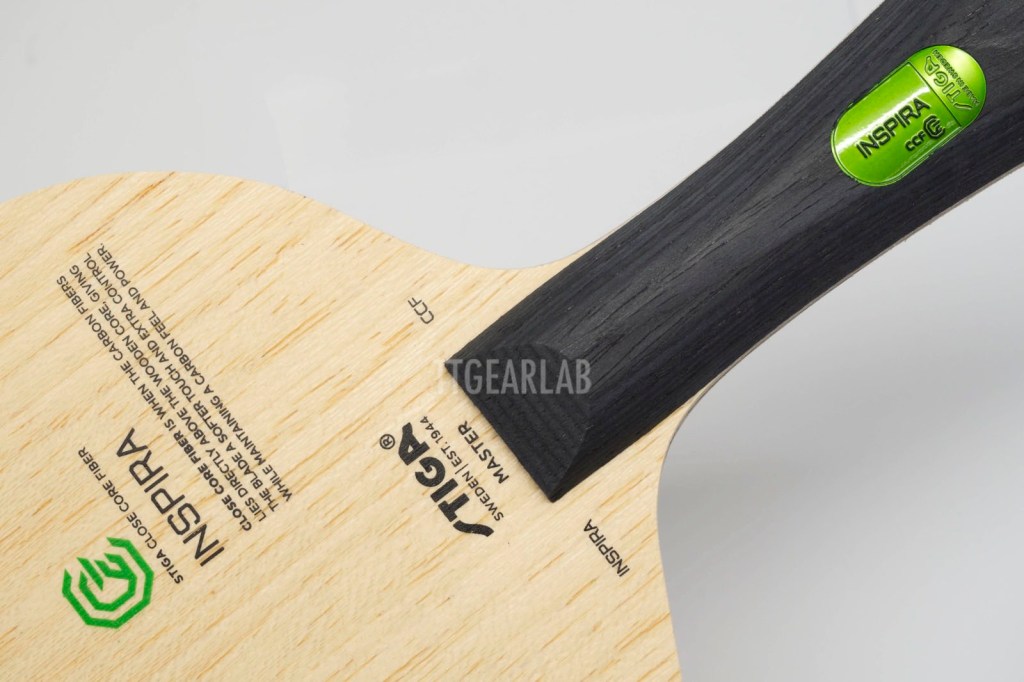
- ‘Inspira CCF’ is an inner-type fiber blade whose characteristics are very similar to those of ‘Carbonado 190’ which is the typical outer-type fiber blades from Stiga. It adopts an inner-type structure to achieve a more natural feel, while significantly increasing elasticity through the use of woven carbon fiber, Koto top layer, and thicker construction.
- ‘Inspira CCF’ is more elastic than most of outer-type fiber blades in primary elasticity (expressed as Ep), but its Ec/Ep is 0.88 which is much lower than those of four Butterfly outer-type blades. So it hugs the ball more deeply than four Butterfly outer-type blades when the player hits the ball very strongly. It is in the ‘Deep Hold (= Deep Hug)’ range. But, the level of hug isn’t as big as those of ‘Carbonado 190’ or ‘Liam Pitchford’.
- The vibration characteristics of ‘Inspira CCF’ are also those of outer-type fiber blades. Its Vp is close to those of four Butterfly outer-type blades. But, because of relatively higher Vl/Vp, ‘Inspira CCF’ transfers sharper ‘relative’ feeling to index finger when compared with four Butterfly outer-type blades.
- If a player wants a powerful blade but doesn’t like outer-type blade, ‘Inspira CCF’ and be a solution. And, if a player like the overall characteristics of Stiga ‘Cybershape Carbon’ but doesn’t like its unique shape, ‘Inspira CCF’ will be the best choice because it has the same blade construction as ‘Cybershape Carbon’ but its head shape is normal.
Although the four high-power inner-type fiber blades examined in this article appear to share similar concepts, yet each possesses its distinct characteristics. While the characteristic of high elasticity may seem contrary to the general concept of inner-type fiber blades, these blades were developed with specific purposes, making them excellent options when players are finding their best fits. Although TTGearLab’s Performance Indices cannot explain everything about a blade, they will be able to help players to some extent when selecting one. Please note that the Performance Indices are ‘general guidelines’ and may have deviations, and please use them for reference purposes only.
Please click here to return to top (table of contents)


Hi! Good work as always.
Can you test the DONIC Xtreme blade? I’ve seen many good reviews of it, and apparently, it is faster than the usual inner blades. It also has a unique composition that I can’t recall in any other blades: Limba – Limba – STC carbon – Kiri – STC carbon – Limba – Limba.
LikeLike
I think that I will be able to get the samples in near future. 🙂
LikeLike
DONIC has a new Zhang Jike True Carbon blade with the same composition as Xtreme. There is no info on its thickness at the moment, so maybe they are a little different. Also, the handle doesn’t look like a typical Soulspin handle.
LikeLike
Thank you for information.
LikeLike
I need a new blade for medium pips, but with good forehand control. My current Stiga Clipper wood (not CR or CC) is having a hard time playing topspin on the forehand. Would the Bernadette Szocs Signature 1 be a good choice, or are they practically the same blades? Which would you recommend?
LikeLike
I’m not sure whether Tibhar Bernadette Szöcs Signature 1 will be the best choice. However, anyway it will be better than your current Clipper Wood for forehand topspin, if the thickness of your Clipper Wood is 6.7~7.0mm. (I have to mention the thickness because the thickness of some very old Clipper Wood was only 6.0mm.)
LikeLike
Hey everyone! Is the Instagram profile @ttgearlab officially yours?
LikeLike
Right. But, I have forgot the fact that I made instagram account. I have to do something on instagram.
LikeLike