| Table of Contents | 1. Introduction – Fan Zhendong series 2. Comparison by Performance Indices ……. 2-1. Elasticity Indices ……. 2-2. Vibration Indices 3. Summary |
Update Notice (12th October 2023) : The data of ‘InnerForce Layer ALC’ has been changed from that of 2018 version to newer 2023 version. ‘InnerForce Layer ALC’s measured in 2023 are thicker, heavier and more elastic than those measured in 2018. TTGearLab will deal with those two versions as different blades.
Update Notice (18th July 2023) : The performance indeces of ‘Fan Zhendong ALC’ has been changed a bit by additional measurement.
1. Introduction – Fan Zhendong series
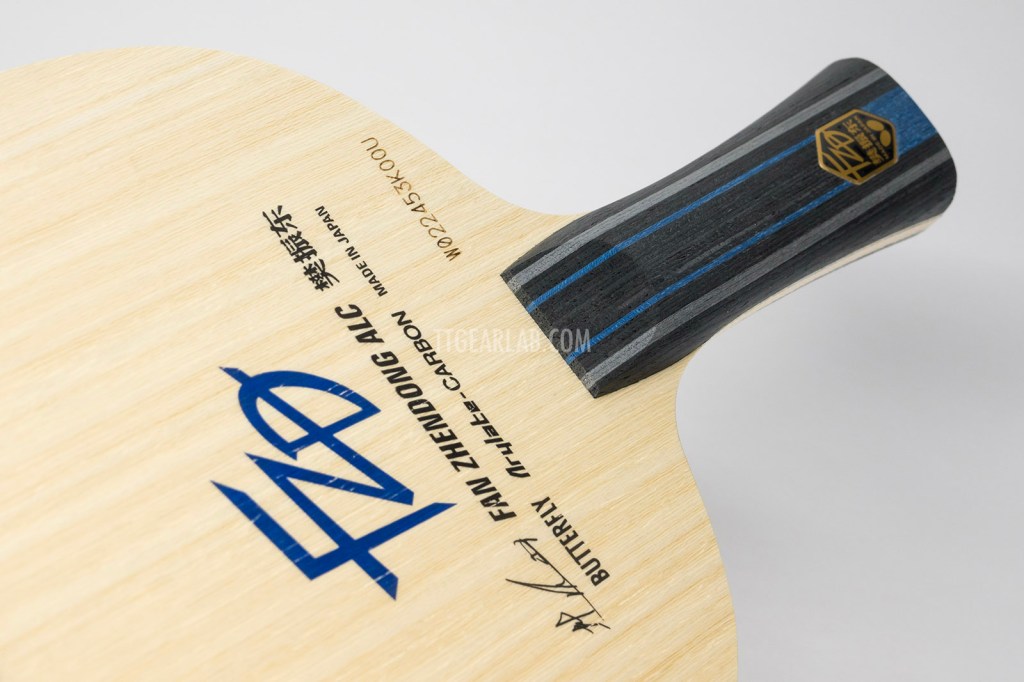
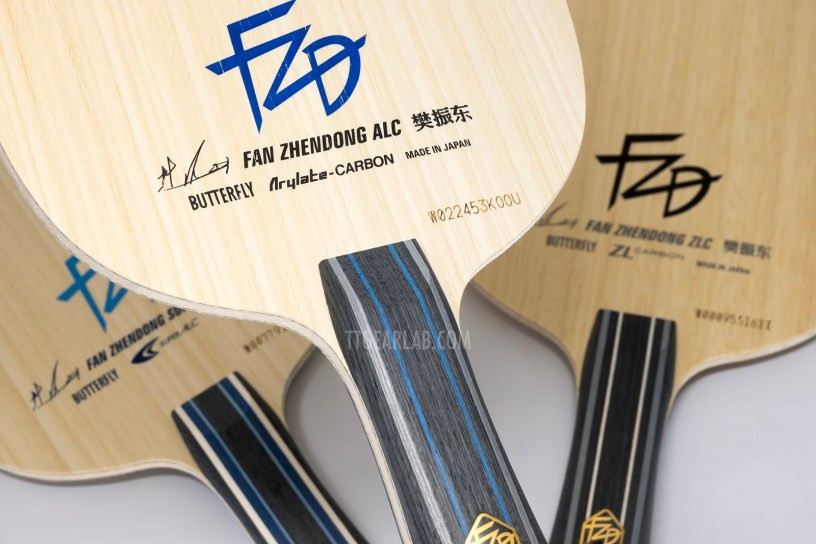
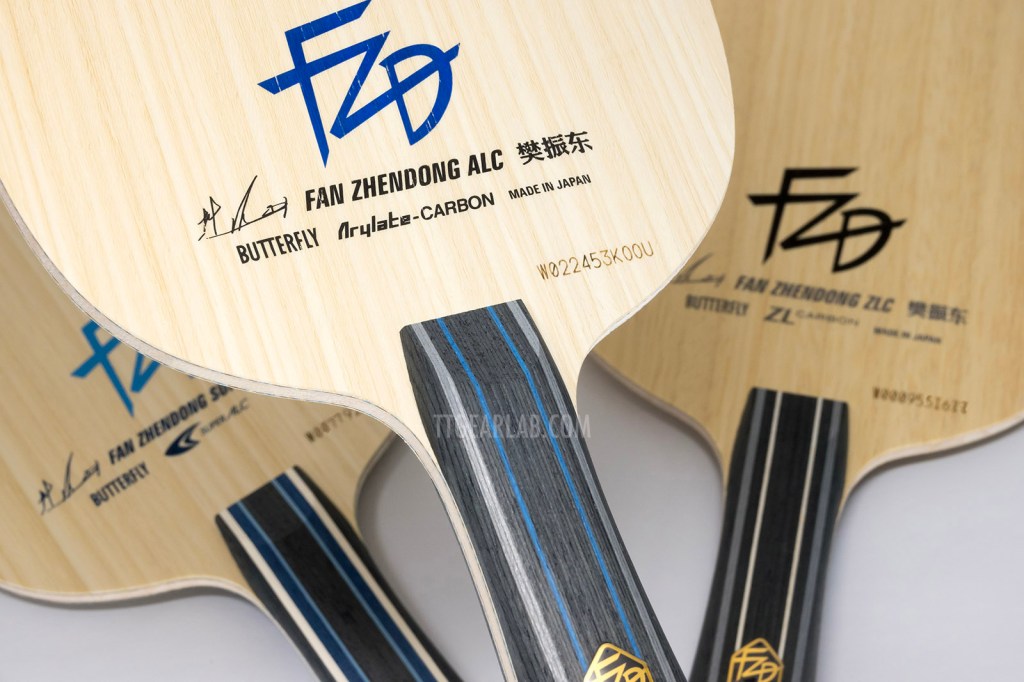
Butterfly ‘Fan Zhendong’ series announced in September 2022 is Butterfly’s new top blade family named after new leader of Chinese Men’s National Team – Fan Zhendong. Like the previous ‘Zhang Jike’ series, ‘Fan Zhendong’ series is also based on the structure and shape of Viscaria, and consists of various 5+2 ply outer fiber models with changes in fiber. Five different fiber are applied to new ‘Fan Zhendong’ series – ALC, Super ALC, ZLC, Super ZLC and CNF. All five models share the head shape and handle shape. The size of head is 157mm x 150mm which is the regular head size of Butterfly blades. The length of handle is 100mm. The FL handle is the semi-wide handle which is based on the FL handle of recent Viscaria. The width is around 34mm at the end of handle, and around 27mm at the middle of handle. The same shape of FL handle is also applied to Zhang Jike series. It is a bit wider and flatter than ordinary FL handle that is applied to most of Butterfly blades such as Timo Boll series and InnerForce Layer series. The ST handle is rounded semi-wide handle (width = 28mm) which is currently the standard ST handle of Butterfly.
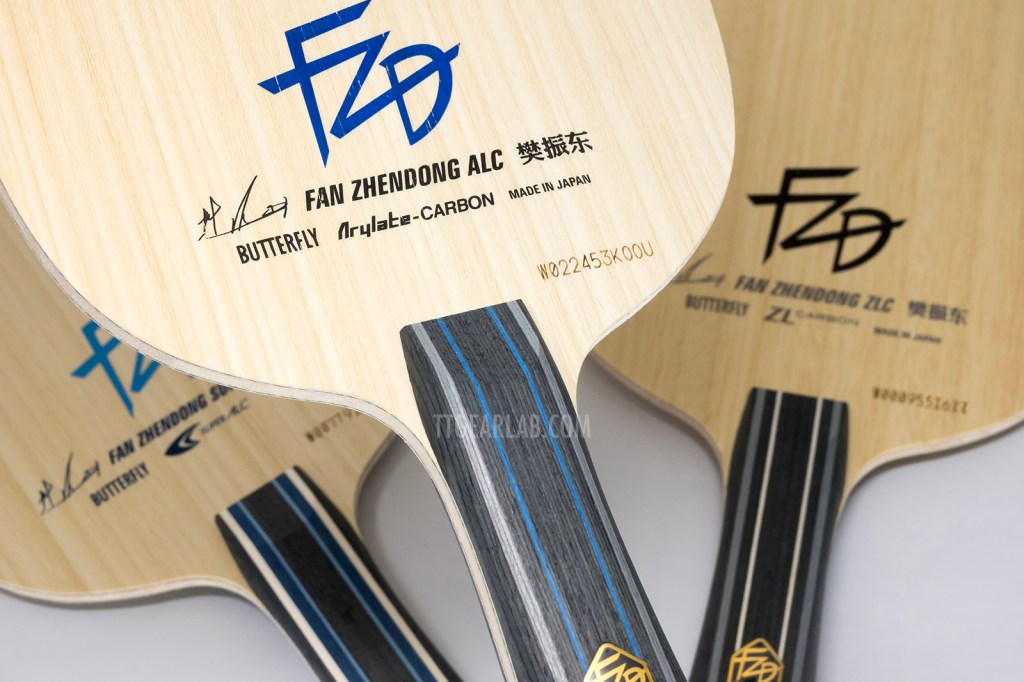
Article ‘Butterfly Fan Zhendong series – Photos‘ shows detailed picutes of three models – ‘Fan Zhendong ALC’, ‘Fan Zhendong Super ALC’ and ‘Fan Zhendong ZLC’.
Following is the basic information of the five models of Fan Zhendong series
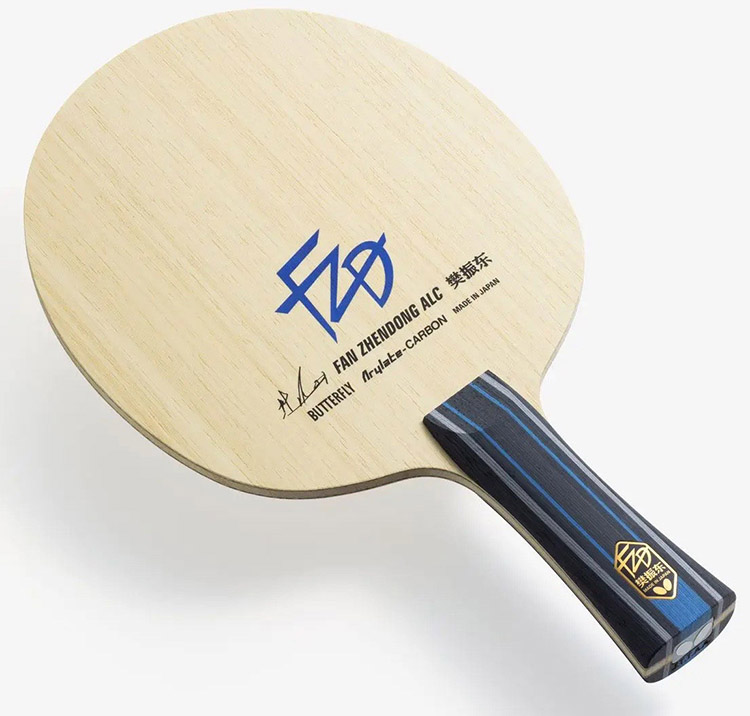
‘Fan Zhendong ALC’ is the most important model in this family. It is the redesigned version of ‘Zhang Jike ALC’ and current ‘Viscaria’. Everything except for the graphic design is identical to that of ‘Viscaria’. Some players are saying that the FL handle of ‘Fan Zhendong ALC’ is a bit thicker than that of ‘Zhang Jike ALC’. But, still we don’t know whether there has been the modification of the thickness of handle or the difference is just due to the deviation by production lot.
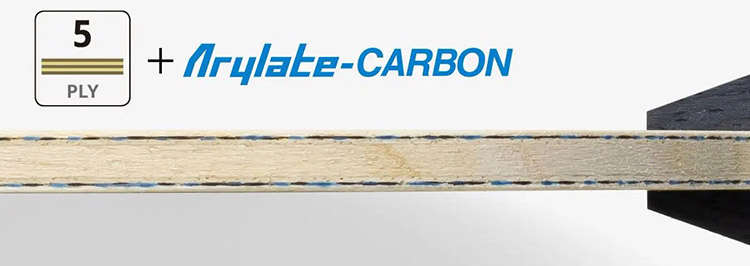
Blade construction of ‘Fan Zhendong ALC’ is of course same as that of ‘Viscaria’ which was launched in late 1993. ALC(= Arylate Carbon) is placed directly under the top layer of 5-ply wood blade. Top layer is Koto. Middle layer is Ayous, and center layer is Kiri. That is the formula of 5+2 ply outer-fiber construction. Overall thickness is around 5.8mm. That is identical to the thickness of current version of ‘Viscaria’.
(Originally the thickness of ‘Viscaria’ had been 5.7mm until mid-term version with Ayous handle. But the thickness of current version of ‘Viscaia’ was increased to 5.8mm. The thickness had been already 5.8mm on the catalog, but actualy specification change was done much later. At the same time with current version of ‘Viscaria’, the specification of ‘Zhang Jike ALC’ was also changed. The thickness of ‘Zhang Jike ALC’ until ‘Q’ serial number is 5.7mm. However, the thickness of ‘Zhang Jike ALC’ from ‘R’ serial number is 5.8mm. And, ‘Fan Zhendong ALC’ follows the specification of ‘Zhang Jike ALC’ from ‘R’ serial number.)
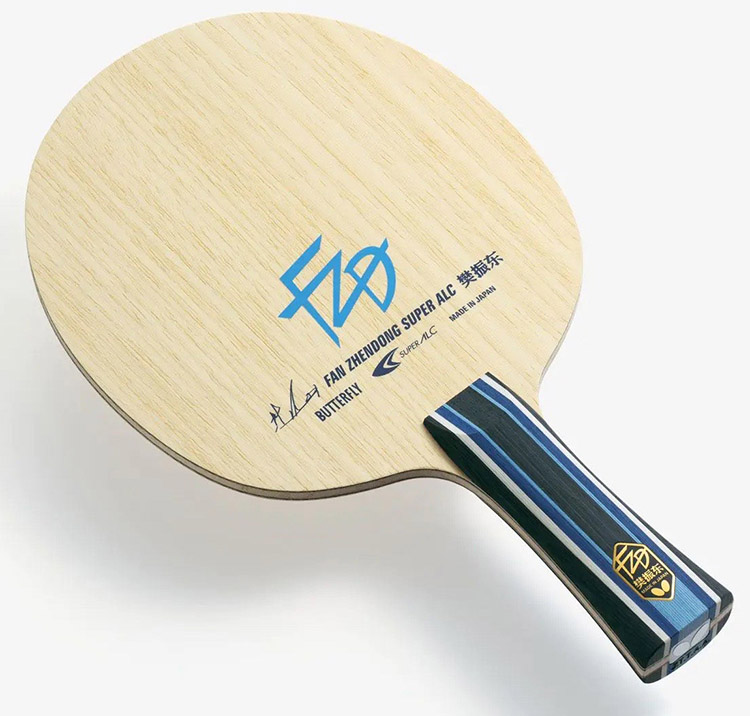
‘Fan Zhendong Super ALC’ is based on ‘Viscaria Super ALC’. Everything except for the graphic design is identical to that of ‘Viscaria Super ALC’.
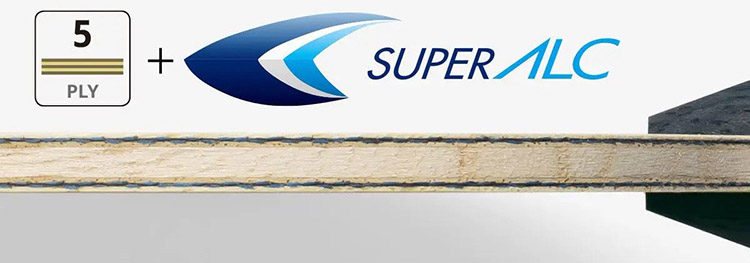
Blade construction of ‘Fan Zhendong Super ALC’ is same as that of ‘Viscaria Super ALC’. It is based on the construction of ‘Viscaria’. But, the thickness has been increased to 5.9mm from the 5.7mm of ‘Viscaria’, and new ‘Super ALC’ is inserted instead of ‘ALC’. ‘Super ALC’ is also a kind of Arylate Carbon. But, its woven structure is different from the ALC that is used for ‘Viscaria’. Because of different woven structure of fiber and increased thickness, ‘Fan Zhendong Super ALC’ gives different feeling and performance from ‘Fan Zhendong ALC’.
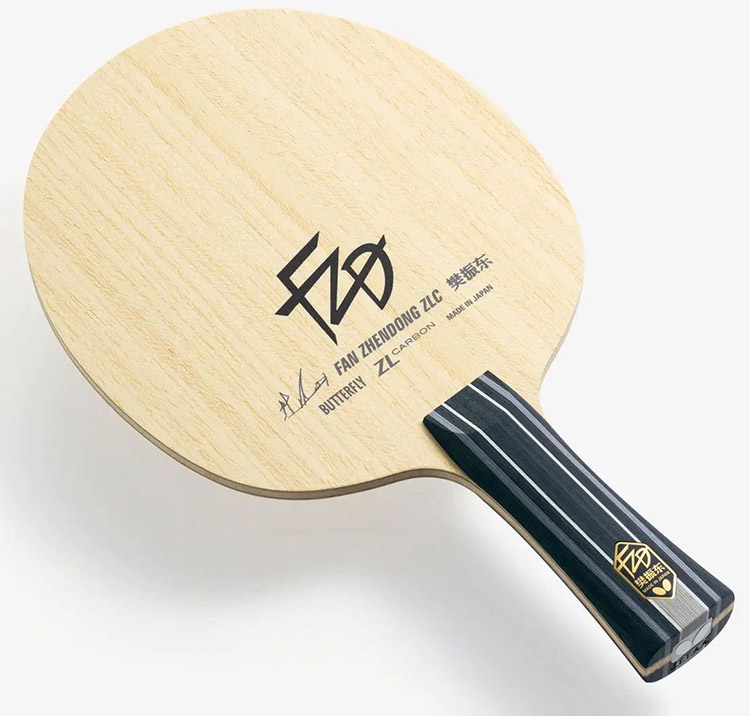
‘Fan Zhendong ZLC’ is the redesigned version of ‘Zhang Jike ZLC’. Everything except for graphic design is identical to that of ‘Zhang Jike ZLC’.
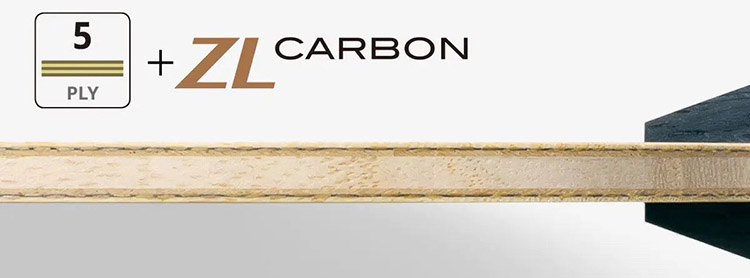
Blade construction of ‘Fan Zhendong ZLC’ is same as that of ‘Zhang Jike ZLC’. Thickness is around 5.5mm. ZLC (PBO Carbon) is placed directly under the Koto top layer. Middle layer is Ayous, and center layer is Kiri.
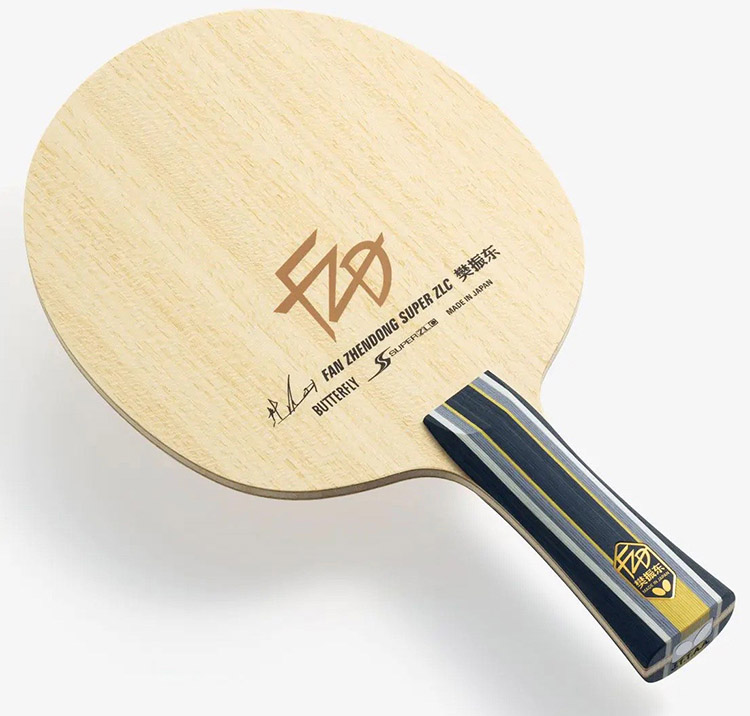
‘Fan Zhendong Super ZLC’ is the redesigned version of ‘Zhang Jike Super ZLC’. Everything except for graphic design is identical to that of ‘Zhang Jike ZLC’.
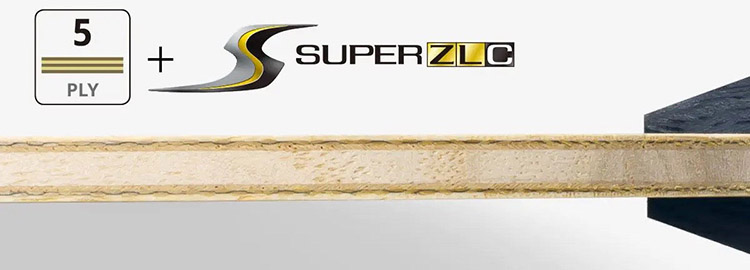
Blade construction of ‘Fan Zhendong Super ZLC’ is same as that of ‘Zhang Jike Super ZLC’. It is based on the construction of ‘Zhang Jike ZLC’ or ‘Timo Boll ZLC’. But, the thickness has been increased to 5.6~5.7mm from the 5.5mm of ‘Zhang Jike ZLC’, and new ‘Super ZLC’ is inserted instead of ‘ZLC’. ‘Super ZLC’ is also a kind of PBO Carbon. But, its woven structure is different from the ZLC that is used for ‘Zhang Jike ZLC’. Because of different woven structure of fiber and increased thickness, ‘Fan Zhendong Super ZLC’ gives different feeling and performance from ‘Fan Zhendong ZLC’.
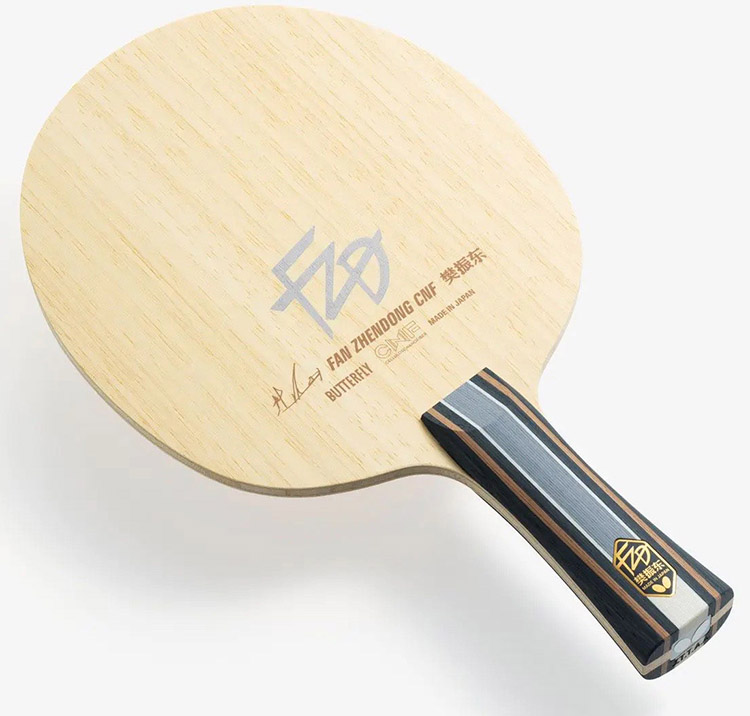
‘Fan Zhendong CNF’ is based on ‘Revoldia CNF’. Everything except for the graphic design is identical to that of ‘Revoldia CNF’.
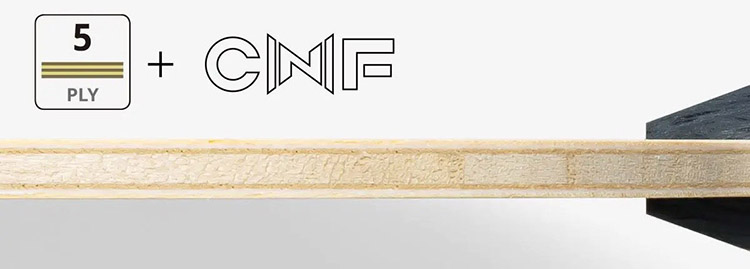
The construction is also based on that of ‘Viscaria’. Top layer is Koto, middle layer is Ayous and center layer is Kiri. But, the fiber that is directly placed under the top layer is replaced from ALC to new CNF – cellulose nano fiber. Overal thickness is around 5.7mm.
Please click here to return to top (table of contents)
2. Comparison by Performance Indices
‘Fan Zhendong’ series consists of five outer-fiber blades. So we can compare some famous outer-fiber blades from Butterfly and other brands. And, some inner-fiber blades can also be compared with ‘Fan Zhendong’ series. Regarding ‘Fan Zhendong’ series, TTGearLab couldn’t measure ‘Fan Zhendong CNF’ at this time, and hasn’t measured ‘Revoldia CNF’ yet. Therefore, the comparison doesn’t include the result of ‘Fan Zhendong CNF’. The result of ‘Fan Zhendong CNF’ will be added in the future if there is a chance of measuring it.
Folloing is the list of the outer-fiber blades to be compared with ‘Fan Zhendong’ series :
- Butterfly ‘Mizutani Jun Super ZLC’ : Fiber is (Super) ZLC, and top layer is Limba
- Butterfly ‘Mizutani Jun ZLC’ : Fiber is ZLC, and top layer is Limba
- Stiga ‘Carbonado 290’ : Fiber is high-density TeXtreme, and top layer is Limba
- Stiga ‘Carbonado 190’ : Fiber is mid-density TeXtreme, and top layer is Limba
- Stiga ‘Dynasty Carbon’ : Fiber is TeXtreme, and top layer is Koto
- Tibhar ‘Cedric Nuytinck’ : Fiber is ZLC, and top layer is Limba
Folloing is the list of the inner-fiber blades to be compared :
- Butterfly ‘InnerForce Layer ZLC’ : inner ZLC
- Butterfly ‘InnerForce Layer ALC’ : inner ALC – 2023 version which is thicker, heavier and faster than 2018 version
- Stiga ‘Cybershape Carbon’ : inner Carbon Fiber, thick construction
- DHS ‘Hurricane Long 5X’ : inner ALC, thick construction
- DHS ‘Hurricane Long 5’ : inner ALC, standard thickness
Comparison will be done by performance indices. Concerning the detail of four performance indices, please refer to following articles in ‘About TTGearLab’ section :
- Performance indices : the way to evaluate blade by measurement
- The example of comparison by performance indices
2-1. Elasticity Indices
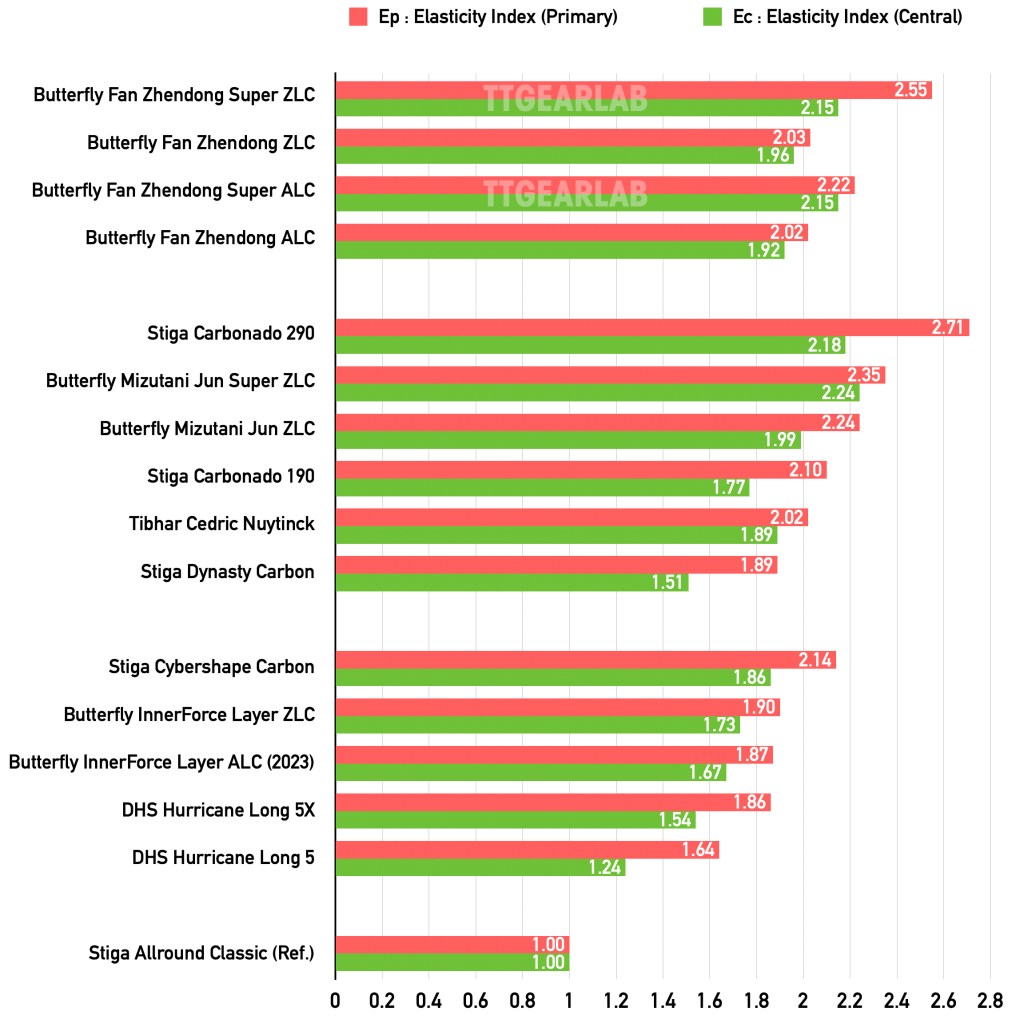
Fig.02 shows the comparison graph of Elasticity Indices.
Ep (Primary Elasticity Index) is directly concerned with the rebound speed of blade. Ec (Central Elasticity Index) is concerned with additional ‘kick’ when player hits ball very hard.
The first group of the graph shows four blades of ‘Fan Zhendong’ series. ‘Fan Zhendong Super ZLC’ (Ep = 2.55, Ec = 2.15) is the most elastic model in the series. ‘Fan Zhendong ZLC’ (Ep = 2.03, Ec = 1.96)’ is less elastic than ‘Fan Zhendong Super ZLC’, but still it is a very fast blade. ‘Fan Zhendong Super ALC’ (Ep = 2.22, Ec = 2.15) is the second most elastic model. And, the Ep of ‘Fan Zhendong ALC’ ( = 2.02) is a bit lower than that of ‘Fan Zhendong ZLC’. And, the Ec of ‘Fan Zhendong ALC’ (= 1.92) is also a bit lower than that of ‘Fan Zhendong ZLC’. From the values, we can notice that the models with ‘Super’ fibers are faster than the models normal fibers. However, it isn’t only because of the higher elasticity of fibers but also because of the thicker constructions of ‘Super’ models.
Interestingly, if we lool at the relationship between Ep anc Ec, we can notice that ‘Fan Zhendong Super ALC’ looks like the faster version of ‘Fan Zhendong ZLC’, while ‘Fan Zhendong Super ZLC’ looks like the much faster version of ‘Fan Zhendong ALC’. It is expected that ‘Fan Zhendong Super ALC’ can’t be the speed upgrade from ‘Fan Zhendong ALC’ because those two blades show different relationships between Ep and Ec.
The second group shows the data of outer-fiber blades. We can find the blade that is comparable with each blade of ‘Fan Zhendong’ series. First, Stiga ‘Carbonado 290’ is comparable with ‘Fan Zhendong Super ZLC’. Both of its Ep and Ec (= 2.71 and 2.18 respectively) are a bit higher than those of ‘Fan Zhendong Super ZLC’, and the relationship between Ep and Ec is similar to that of ‘Fan Zhendong Super ZLC’. And, Mizutani Jun Super ZLC is comparable with ‘Fan Zhendong Super ALC’ although its top layer and fiber are different from those of ‘Fan Zhendong Super ALC’. So, we can think that ‘Mizutani Jun Super ZLC’, ‘Fan Zhendong Super ALC’ and ‘Fan Zhendong ZLC’ are the blades with similar characteristics and a bit different speed. On the contrary, with the Ep comparable with that of ‘Fan Zhendong Super ALC’ and the Ec comparable with that of ‘Fan Zhendong ZLC’, ‘Mizutani Jun ZLC’ shows unique characteristic that can’t match any model of ‘Fan Zhendong’ series. And, ‘Cedric Nuytinck’ shows simialr characteristics as ‘Fan Zhendong ALC’ and ‘Fan Zhendong ZLC’. ‘Dynasty Carbon’ is the slowest outer-fiber blade in this comparison, and its characteristic is unique. Its Ec is noticeable lower than that of any other outer-fiber blade in this comparison.
The third group shows inner-fiber blades. The average elasticity of this group is definitely lower than that of second (= outer-fiber) group. The fastest one in this group is Stiga ‘Cybershape Carbon’ whose Ep is 2.14 and Ec is 1.86. It is even more elastic than ‘Fan Zhendong ALC’. That is because of its thick construction and highly elastic woven carbon fiber. All the other blades in this group is less elastic than all models of ‘Fan Zhendong’ series.
Examining Ec/Ep is an easier way to understand the characteristics of blade concerned with elasticity. Fig.03 shows the relationship between Ec/Ep and Ep.
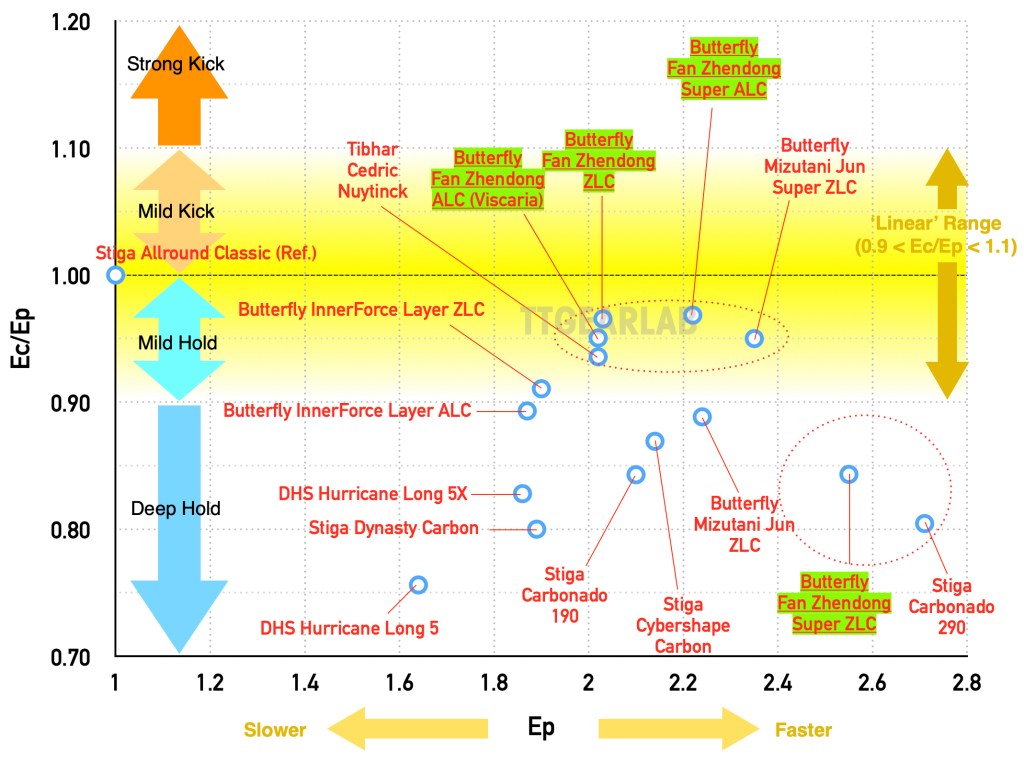
Ec/Ep expresses the ‘tendency’ of the elasticity of blade. By examining Ec/Ep and Ep at the same time, we can easily understand the behavior of blades.
On the graph, all blades except for reference blade are in ‘Hold’ range (Ec/Ep < 1.0). And, among ‘Fan Zhendong’ series,
Among ‘Fan Zhendong’ series, ony one model – ‘Fan Zhendong Super ZLC’ is placed in ‘Deep Hold’ rage (Ec/Ep < 0.9). It means that ‘Fan Zhendong Super ZLC’ holds ball very deep when player hit the ball very strongly. That makes continuous topspin at close-to-table area very easy and stable. The blade close to ‘Fan Zhendong Super ZLC’ is Stiga ‘Carbonado 290’. Although those two are a bit different from each other, two blades can be categorized into one group – Very fast & deep hold.
Other three models of ‘Fan Zhendong’ series – ‘Fan Zhendong ALC’, ‘Fan Zhendong ZLC’ and ‘Fan Zhendong Super ALC’ – are placed close to the ‘Linear’ line (Ec/Ep = 1.0). Although those two are in ‘Mild Hold’ range (0.9 < Ec/Ep < 1.0), we can think that the elasticity characteristics of those two blades are almost linear. That kind of blades are suitable for all-round play because the player control most of techniques very precisely. And, we can consider ‘Fan Zhendong Super ALC’ as the faster replacement of ‘Fan Zhendong ZLC’ if we don’t think about the difference of feeling. (If the player doesn’t like the ‘metalic’ feeling of ‘Fan Zhendong ZLC’, ‘Fan Zhendong Super ALC’ can be the proper solution because it doesn’t give that uncomfortable feeling.) Also, ‘Mizutani Jun Super ZLC’ can enter the same category as those two blades, and can be considered as the fastest one in this category.
If the player who has used ‘InnerForce Layer ALC’ and is finding the faster replacement in the ‘Fan Zhendong’ series, the solution can be ‘Fan Zhendong ALC’. And, if curent blade of the player is ‘Hurricane Long 5’ or ‘Hurricane Long 5X’, ‘Fan Zhendong Super ZLC’ will be the optimum solution as the faster replacement. And, if the player frequently use smash and block, ‘Fan Zhendong ZLC’ and ‘Fan Zhendong Super ALC’ are expected to be the proper choice.
Then next, let’s compare Vibration Indices. Fig. 04 shows the comparison graph of Vibration Indices.
Please click here to return to top (table of contents)
2-2. Vibration Indices
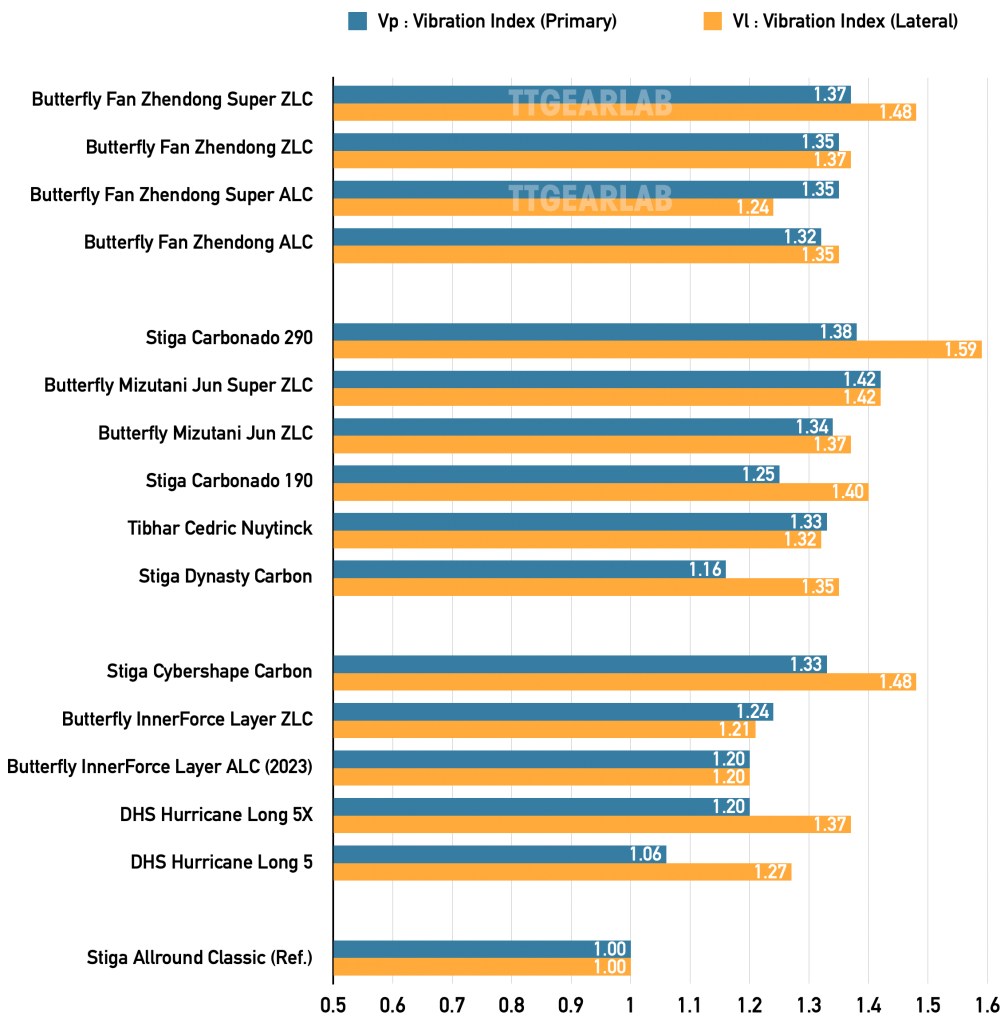
Vibration Indices are concerned with feeling. Vp indicates primary feeling which is transferred to player’s palm. And, Vl is the feeling at the wing of a blade. It is felt by player’s index finger or middle finger.
The first group of the graph shows four blades of ‘Fan Zhendong’ series. We can notice that the Vp’s of ‘Fan Zhendong Super ZLC’, ‘Fan Zhendong ZLC’ and ‘Fan Zhendong Super ALC’ are almost similar. (And, the Vp of ‘Fan Zhendong ZLC’ and ‘Fan Zhendong Super ALC’ are identical to each other.) But, the difference is in Vl. The Vl of ‘Fan Zhendong Super ZLC’ is much higher than the Vp. The Vl of ‘Fan Zhendong ZLC’ is close to the Vp. And, the Ec of ‘Fan Zhendong Super ALC’ is much lower than the Vp. Therefore the player will feel those three blades quite different. And, the Vp of ‘Fan Zhendong ALC’ is smaller than that of the other three blades.
The second group shows the values of comparable outer-fiber blades. ‘Carbonado 290’ which is comparable with ‘Fan Zhendong Super ZLC’ in elasticity also shows the vibration indices those can be comparable with those of ‘Fan Zhendong Super ZLC’. But, the Vl is noticeably higher than that of ‘Fan Zhendong Super ZLC’. So the players will feel that ‘Carbonado 290’ is sharper than ‘Fan Zhendong Super ZLC’ at the area of index finger. We can see the similar result from the comparison between ‘Fan Zhendong ALC’ and ‘Carbonado 190’. And, it is interesting that ‘Mizutani Jun ZLC’ shows similar values as ‘Fan Zhendong ZLC’ although there are differences in the top layer. The players will feel that ‘Mizutani Jun ZLC’ is definitely different from ‘Fan Zhendong ZLC’. However, that isn’t because of vibration factors but probably because of the elasticity factors. Finally, we can notice that Stiga ‘Dynasty Carbon’ is noticeably softer than all the other outer-fiber blades in this comparison. ‘Dynasty Carbon’ can be compared with inner-fiber baldes although it is an outer-fiber blade.
The third group shows the values of inner-fiber blades. Again, Stiga ‘Cybershape Carbon’ shows the values comparable with ‘Fan Zhendong’ sereis. Its Vp is a bit lower than the Vp of ‘Fan Zhendong ZLC / Super ALC’, and its Ec is identical to that of ‘Fan Zhendong Super ZLC’. The Vp’s of all the other inner-fiber blades are noticeably lower than those of ‘Fan Zhendong’ series. But, the Vl of ‘Hurricane Long 5X’ can be compared with the Vl’s of ‘Fan Zhendong ZLC’ and ‘Fan Zhendong ALC’. The players who are sensitive to the feeling at the index finger will feel the similarity among those three blades.
Examining Vl/Vp is an easier way for the comparison of the tendency of feeling. Fig.05 shows the relationship between Vl/Vp and Vp for easier comparison.
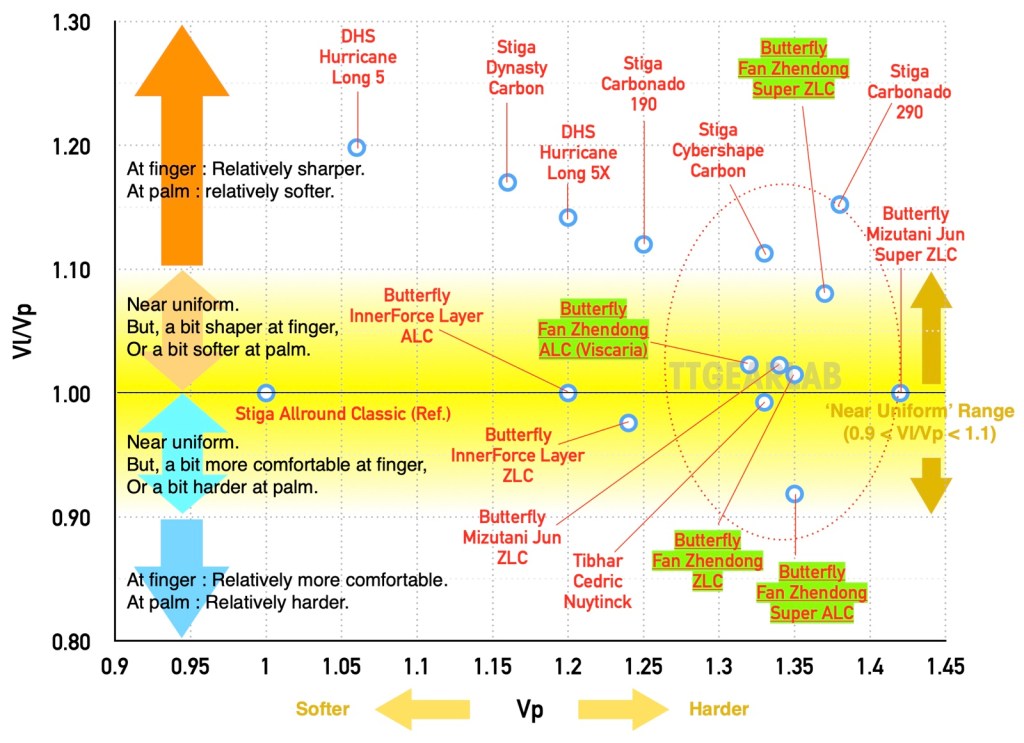
On the graph, most of the blades in this comparison are placed in ‘relatively sharper at finger’ range (Vl/Vp > 1.0). Among the four blades of ‘Fan Zhendong’ series, three models are in that range. And, one model – ‘Fan Zhendong Super ALC’ – is placed in ‘relatively more comfortable at finger’ range (Vl/Vp < 1.0). But, none of four model is placed outside the ‘Near Uniform’ range (0.9 < Vl/Vp < 1.1). Especially ‘Fan Zhendong ZLC’ is very close to ‘Uniform’ line (Vl/Vp = 1.0). ‘Fan Zhendong ALC’ is also close to that line. No model shows extreme value of Vl/Vp. And, in fact, all Butterfly blades in this comparison are in ‘Near Uniform’ range, while all Stiga blades except for the reference blade are in somewhat extreme range that Vl/Vp’s are higher than 1.1. Here we can see the difference of the concept between Butterfly and Stiga. (DHS blades are also in the same range as Stiga blades.) Among four models of ‘Fan Zhendong’ series, what is comparable with Stiga blades is ‘Fan Zhendong Super ZLC’.
If we just see Vp, four models of ‘Fan Zhendong’ series are placed at the right side of the graph. It means that the feeling of ‘Fan Zhendong’ series is hard. It is a matter of course because all blades of ‘Fan Zhendong’ series are outer-fiber blades equipped with relatively hard top layer and highly elastic fibers.
From the graph, we can again notice that ‘Fan Zhendong ALC’ (and ‘Viscaria’) can be the faster and harder replacement from ‘InnerForce Layer ALC’, because the Vl/Vp’s of those two are close to each other.
It is interesting that ‘Mizutani Jun ZLC’ and Tibhar ‘Cedric Nuytinck’ are very close to ‘Fan Zhendong ZLC’. Actually there are difference in feeling because of the difference of top layer and middle layer. But, we can notice that the difference isn’t because of vibration but because of elasticity.
‘Fan Zhendong Super ALC’ looks quite unique on the graph. If the player doesn’t like sharp feeling at index finger, ‘Fan Zhendong Super ALC’ may be the best choice. And, there isn’t any blade in this comparison whose feeling is comparable with that of ‘Fan Zhendong Super ALC’. But, we remember the blade which is placed near the position of ‘Fan Zhendong Super ALC’. That is old Stiga ‘Clipper CR’ which is thicker and heavier than current version of ‘Clipper CR’. The characteristics of ‘Fan Zhendong Super ALC’ is very close to those of old ‘Clipper CR’ in both of elasticity and vibration. Therefore, ‘Fan Zhendong Super ALC’ will be very good replacement of old thick & heavy ‘Clipper CR’ or ‘Clipper Wood’.
Please click here to return to top (table of contents)
3. Summary
Butterfly ‘Fan Zhendong’ series are new outer-fiber blade family suggested by Butterfly, and is replacing ‘Zhang Jike’ series. Four models among the five models of ‘Fan Zhendong’ series are measured. The result can be summarized as follows:
- ‘Fan Zhendong Super ZLC’ is fastest in the series. And, it holds the ball very deep when players hit the ball very hard. Also, among four models it provides the sharpest feeling at index finger. The characteristics of ‘Fan Zhendong Super ZLC’ can be compared with fiber blades from Stiga and DHS.
- ‘Fan Zhendong ZLC’ is a blade whose elasticity characteristics is almost linear and vibration characteristic is almost uniform. Therefore it is suitable for all-round play that lay emphasis on the precision of ball control, although it is a fast & hard blade.
- ‘Fan Zhendong Super ALC’ can be considered as the faster variation of ‘Fan Zhendong ZLC’. But, it provides much milder feeling than ‘Fan Zhendong ZLC’ at index finger. The characteristics of ‘Fan Zhendong Super ALC’ is very similar to those of traditional thick & heavy 7-ply wood blade. Therefore, it can be direct replacement of thick 7-ply wood blade of ‘Clipper’ type.
- ‘Fan Zhendong ALC’ which is identical to ‘Viscaria’ except for the graphic design and is considered as the ‘standard’ fiber blade is placed near ‘Fan Zhendong ZLC’. Although the actual feeling of ‘Fan Zhendong ALC’ is quite different from that of ‘Fan Zhendong ZLC’, we can notice that there isn’t significant difference in fundamental characteristics. Anyway, because of its position on the graph, it can be the first consideration when the player is finding the faster replacement of inner-ALC or 5-ply wood blade.
Please click here to return to top (table of contents)
 TTGearLab
There has been mistake in the second paragraph under Fig.02. I have just corrected it.
LikeLike
Thanks for this post (and all others on this site) on the FZD series of blades. Apologies if I’ve missed, but has this and prior lab tests determined whether there is a true difference between the equivalent ALC/ZLC/Supers, etc among the various player series and Viscaria within the Butterfly line? We already know that they have the same compositions, with allowance for variation due to manufacturing and natural materials used. But this post references FZD being identical to Viscaria several times, so I’m not sure if you are implying that there is none, and that Butterfly is simply reintroducing the same exact blade with different cosmetics.
LikeLike
It is good question.
Of course there is allowance, and those two are identical even though we consider the allowance (or deviation). In fact, there isn’t any reason for Butterfly to make FZD ALC different from Viscaria. That is because Fan Zhendong has use Viscaria for long time. And, even on the home page of Butterfly, the data of FZD ALC and that of VISCARIA are 100% same with each other.
More correctly speaking, Fan Zhendong ALC is same as ‘current’ Viscaria. I have used Viscaria for around 30 years, and still I have some pcs. of ‘historical’ Viscaria including the early model produced in 1993 (or probably early 1994). And, I have old Viscaria whose serial # is starting from M. BTW, the blade thicknesses of old Viscarias is around 5.7mm. However, the blade thickness of current Viscaria and FZD ALC is around 5.8mm. Even there is difference in handle shape (exactly speaking, thickness and width). So I can’t say that Fan Zhendong ALC is same as the Viscaria that has actually been used by Fan Zhendong. However, anyway ‘current mass produced Viscaria’ is same as ‘Fan Zhendong ALC’ except for the graphic design.
Besides FZD series, Butterfly has produced many blades those are almost same but with different cosmetics. It is faster for us to find the exceptions.
One of the exceptions is Ovtcharov InnerForce ALC. It is based on InnerForce Layer ALC, but everything from thickness and head shape is different from that of original InnerForce Layer ALC. And, Korbel is different from Adolescent. And, Freitas ALC is different from original M.Maze OFF. But, Fan Zhendong ALC is same as Viscaria.
LikeLike
Great article on the Dan Zhendong series blades and as usual, very informative. The timing of your article is excellent as I am about to purchase a Butterfly Viscaria blade. With your performance data I can make a better decision on whether the ALC or the Super ALC is more suitable for my game.
Thank you for sharing your knowledge and expertise with us.
LikeLike
Thank you a lot for comment.
And, it is really good that my article is helpful for you.
It is interesting that the relationship between those two is similar to the relationship between 5-ply offensive blade and thick 7-ply wood of classic construction. 🙂
LikeLike
Thanks for the review of different blades not only the FZD series. I hope you review the LYJ SZLC too
LikeLike
Thank you for comment. LYJ SZLC is basically same as FZD SZLC but with lower weight range. Because of lower weight, it is expected that its Ep is lower than that of FZD SZLC. But, because the difference in weight range isn’t extreme, probably there will not be significant difference in playing characteristics.
If I can get the sample of LYJ SZLC I will check its performance and try to prove above expectation.
LikeLiked by 1 person
Great overview of the FZD series and comparison. Nice that you also took innerfibre into account. Greatly appreciate all the work you put into this.
LikeLike
Thank you a lot for your appreciation. 🙂
LikeLike
Please can you do Joola blades? The Trinity is becoming pretty popular…
LikeLike
I’m considering to get some Joola blades and write reports. However, I’m not sure whether I can get Trinity or not.
LikeLike
Bjr Pour un joueur niveau regional recherchant vitesse et surtout spin élevé pour conseilleriez quel bois chez butterfly et en autre marque ?J ai apprécié stigma carbonado 190 avec victas 15 extra et limber et viscaria avec tenergy 05.
Merci
LikeLike
I highly appreciate your in-depth racket analysis. This might be the only website in the world that evaluates rackets based on scientific standards (using measurement devices). Other review sites often rely on the personal feelings of their testers. The difference in the testers’ expertise and knowledge makes the information less reliable. To keep the information concise and for easy comparison, you could compile the specifications (EP, EC, VP/VL, etc.) of all the rackets you have tested into one list.
I believe that the results you provide are not influenced by sponsors. Thank you for your dedication and hard work.
LikeLiked by 1 person
Thank you a lot for appreciation.
I started this web site because I thought that the measurement is the best way for reducing human error in the evaluation of table tennis equipments. 🙂
And, in the result of measurement, there isn’t any influence of sponsers. In fact, the measured values are concerned with the ‘positions’ of blades, and there isn’t good or bad. So there isn’t any claim by TT makers. (BTW, currently there isn’t sponser.)
I’m considering to arrange the data to one list in near future.
LikeLike
Tengo una duda, estoy usando desde 2018 Mizutani SZLC y hoy me suge la duda de si debo cambiar a Lin Yun Ju SZLC y Fan Zendhong SZLC.
Tengo entendido que Limba muerde más la pelota, además que Mizutani su grosor es 5’8 y todas las capas excepto la exterior son idénticas a las otras SZLC. Además, en el gráfico buterfly, tanto vibración como reacción de Mizutani SZLC es mayor que Fan Zendhong o Zhang Jike o Lin Yun Ju, que las tres usas la misma estructura de Koto exterior, al contrario que Mizutani Que usa Limba. Si Limba muerde más que Koto la pelota, y Mizutani SZLC tiene grosor de 5’8 frente a los 5’7 o 5’8 de las otras fan Zendhong, Lin Yun Ju y Zhang Jike, ¿Por qué dices que la que más muerde la pelota es Koto, si es sabido que Limba sostiene más la pelota? Busco la madera que más potencia y efecto produzca. Es decir una pelota de calidad, que entiendo que es la bola perfecta: la que más spin y más velocidad produce.
¿Qué madera de las que mencionó sería esa?
SZLC, ALC, SALC?? Koto o Limba exterior??
Gracias.
LikeLike
If you are an all-round player and prefer playing at all area of court, I don’t recommend you to change. Mizutani Jun series are specialized for that kind of playing style.
But, if you play more aggressively, and at closer area to the table, changing to Lin Yun Ju SZLC or Fan Zhendong SZLC (those two are same blades with different graphics), without concerning the material of top layer.
The reason why they say that Limba catches the ball better is that Limba is softer than Koto. For that reason the touch of Limba is more comfortable in general. And, that is one reason why the blades those lay emphasis on control have Limba top layer, and why the blades those lay emphasis on aggressive play have Koto top layer. Of course that isn’t a rule, and there are many exceptions. But, at list Mizutani Jun series and LYJ/FZD SZLC are not exceptions.
LikeLiked by 1 person
I’ve seen a lot of reviews stating that the FZD ALC is somewhat different than the Viscaria (blade handle, speed, dwell time, control), is it true or just placebo?
LikeLike
In fact, therer are various Viscaria. Various thicknesses and various handle shapes. That is because Viscaria has been produced for so long time, and there have been two major design changes. Thickness was originally 5.7mm on the catalog, and 5.8mm now. The thickness of handle was officially changed only one time. But, there has been many small adjustments. However, after the major handle modification in 1997 (1998?) the basic shape of the hanle hasn’t been changed. From that time there have been many small adjustments or the deviation by production period. Regarding the blade construction, current Viscaria is different from the Viscaria of some years ago. The Ec of old Viscaria is much lower than that of current one.
Regarding the relationship between FZD ALC and Viscaria, the handle of FZD seems to be adjust a bit, but that isn’t the major change. Basic shape hasn’t been changed. Although the early ones of current Viscaria seem to have a bit narrower handle, that is difference by production period.
(In fact, the handle of Timo Boll ALC has some versions by production period – thinner ones and thicker ones.)
Currently the difference of handles isn’t out of the range of allowance of production. So, even though there is differences, I can’t write that those are different until I find clear evidence of the actual spec change.
LikeLike
How about Harimoto super zlc. Thanksss
LikeLike
I have just noticed that I didn’t upload it. Probably I have forgot it. I will check the data and pictures, and then post the article on it.
BTW, interestingly Harimoto SZLC provide lower Ep and higher Ec when compared with InnerForce Layer ALC.
LikeLike
Now I am playing FZD ALC with D-09c on FH and D-05 on BH. But when I loop forehand topspin harder, I hate feeling of my index finger. Maybe it’s sharp feeling. I wanna ask u something is ” Is there FZD ZLC feels like that too or not? “. Bcz, I’m planning to change FZD alc to ZLC. The feeling of ZLC and ALC are different right?
Thanks
LikeLike
The feeling of FZD ZLC and that of FZD ALC are different from each other. But, current version of FZD ALC is somewhat closer to FZD ZLC than the ‘old’ Viscaria.
And, your choice differs by the kind of feeling. If you felt that the blade becomes too stiff and therefore it doesn’t hold ball sufficiently deep, FZD ZLC will be even more uncomfortable. Although the indices aren’t that different. FZD ZLC is more sensitive to racket angle than FZD ALC, and therefore there is significant difference in feeling between the shot by open angle and the shot by closed angle. When the angle is closed and the player concentrates on ‘dragging’ the ball, FZD ZLC gives fantasitic feeling as if it the ball bites the surface of blade. The ball draws very beautiful arc. However, if the angle is somewhat open, the ball from FZD ZLC draws linear trajectory with astonishingly high speed.
If you just concentrate on ‘dragging’ the ball when you perform loop, FZD ZLC may be good. However, if your racket angle is more open and the swing goes more forward, FZD Super ZLC may be the better choice.
LikeLike
Thanks , I’m afraid of controlling SZLC blade. Because, it is too fast right? Could you tell me the speed of ZLC and SZLC are noticably different in normal power drive or normal power loop? Because, now I’m lower intermediate level and still practicing every day with my coach. As I said before , I’m really afraid of can’t control the speed of SZLC.
Btw, great work and I appreciate your hard work.
LikeLike
For Fan Zhendong series, SZLC version is noticeably fast than ZLC version. (But, for Harimoto series, SZLC version is a bit slower than ZLC version.) That is because of the thickness. Fan Zhendong SZLC is noticeably thicker than Fan Zhendong ZLC. However, FZD SZLC holds ball very deep and softly when you hit the ball very hard with it, while FZD ZLC kicks the ball and gives the feeling like steel plate.
For thar reason Fan Zhendong SZLC isn’t as difficult to control as we can expect from its high speed. If you can control Fan Zhendong ALC or Viscaria, you will also be able to control Fan Zhendong SZLC.
However, I don’t recommend that kind of fast blade for intermediate player, regardless of its controllability. In my opinion the blade which is even slower than FZD ALC will be better. There are many blades those give better feeling at index finger when compared with current version of Viscaria or FZD ALC. For example Victas ZX-Gear Out or In, DHS Hurricane Long 5 and Xiom 36.5 ALXi. And, if you keep the speed of FZD ALC, Ovtcharov InnerForce ALC will be a good solution. It will give you much better feeling while providing the speed close to FZD ALC.
LikeLike
Thanks for your recommendation .
I wanna ask u something. What do you think Super ZLC + Chinese tacky rubber ( H 3 or H 3 Neo). I saw some post that were trend in china. They combine Unboosted Chinese Rubber on Super ZLC. I know Chinese rubbers have one weakness that is lack of speed ( need to boost). There has another problem that is need to repeat weekly or 2 times per week. So, they choose Super ZLC and combine with Chinese rubber bcz they don’t wanna boost weekly.
Have you test that trend? How about feeling? Maybe it’s work? Super ZLC is hard and Unbolted Chinese rubber fell hard too. So, is it like a brick?
LikeLike
I haven’t tested that trend yet. But, probably that is concerned with the ‘Deep Hold’ character of Zhang Jike / Fan Zhendong / Lin Yun-ju Super ZLC. (Not Harimoto Super ZLC. It gives us totally different result.)
At the moment of impact, the center of Zhang Jike / Fan Zhendong / Lin Yun-ju Super ZLC deforms significantly and holds the ball very deep. And, then it shoots the ball in the next moment. It isn’t feeling. That characteristics greatly alleviate the stiff feeling of the rubber.
On the contrary Zhang Jike / Fan Zhendong ZLC gives us even stiffer feeling when we hit the ball very strongly.
You will never be able to use unboosted Hurricane 3 with ZJK/FZD ‘ZLC’ because of the uncomfortable feeling. But, ZJK/FZD ‘SZLC’ will allow you to use Hurricane 3 without boosting. That is the main difference between SZLC model and ZLC model in ZJK / FZD series.
LikeLike
Dignics 09c is not a good pair for ALC blades. Try D05 instead
LikeLike
I think that it depends on the character of player. One important reason is its very hard sponge. For the players who like that hard feeling and sticky top layer, Dignics 09c can make good combination with Fan Zhendong ALC.
BTW, we can’t categorize the blades with ALC into one group. There are so many different ALC blades with so many different characteristics. So we can’t tell that a rubber doesn’t fit ‘ALC blade’. We have to always tell the exact name of blade.
LikeLiked by 1 person
like
LikeLike
best regards to my friend
LikeLike
Thank you, Bob!
LikeLike
As we all know, blades are made of 70-80% wood. But wood is a heterogeneous material. Even on the same tree, the density of capillaries in the core compared to the outside is different, and between the top of the tree and the base of the tree is also different. The way of sawing is also different so the wood grain surface sometimes looks very different. According to rumors, Ma Long was given nearly 100 blades by producer DHS so he could find a blade similar to the one Ma Long was playing. Ma Lin also had his blade repaired by Stiga to continue playing when it broke because in a short time they could not find a blade with equivalent feel. In many countries, old blades that are 10 or 15 years old are said to play very well and are very expensive. Of course, in my opinion, these are tips from local stores to raise product prices. After measuring with the device, could you please tell us if there is much difference between two blades of the same brand, same type, and same year of manufacture? I also bought 2 similar blades but the feeling is not completely the same. Thank you for reading !
LikeLike
As you mentioned, there is deviation by pc. for every table tennis blade because it is made of wood. We can’t avoid that problem.
It isn’t guaranteed that two pieces of the same model (same brand, same type, same production period) will be same. So the Performance Indices are ‘average’ values. I measure some pcs. and get the average. In case I can’t get many pcs. I try to measure the one which is close to the average of that model.
Top professional players are even more sensitive to the characteristics of the blade, and some players continue to use the same blades for long time. And, it is common for the top players to choose from many (near 100) pcs. when they replace the blade with new one. But, for amateur players, just selecting the blade with same weight will be sufficient in my opinion. There will still be difference between old one and new one. But, that is much safer way than selecting the same model with different weight.
LikeLike
Thank you TTGearLab for sharing your insights on measurement methods. It is an accepted fact for table tennis players that finding a copy of the blade we are playing with is extremely difficult. Synthetic fibers added to racket blades not only help increase speed and control but also make the products the most similar but it does not solve the problem completely. If you were the leader of ITTF, do you think we should make all table tennis blades out of synthetic fibers? It will not be affected by environment, humidity or temperature and is as environmentally friendly as the carbon fiber blades that DONIC has made. Haha. Respect your work!
LikeLike
Thank you for appreciation. I also think that we’d better make the blades out of synthetic fiber. That will be the only one way to reduce the deviation by piece. 🙂
LikeLike
I already order fzd alc and the thickness is 5.58 mm with 90.0 gr of weight. Approximately how much is the difference Ec, Ep, Vp, and Vl values from what you have measured?
LikeLike
If fact Viscaria and FZD ALC has quite big deviation. So, it isn’t easy to predict the position of one piece exactly.
Thinner but heavier one is a quite special case.
I expect that most of values will be lower than average, but I’m not sure.
LikeLike
H
LikeLike
Hi!
Great review as always!
I have some questions regarding short pips. Which blade is most suitable for short pips? I have tried Viscaria, TB ALC and Ovtcharov ALC. I’m curious about FZD ALC.
Or do you recommend one other blade from the FZD series?
Best regards
Karl Erik
LikeLike
I recommend FZD Super ALC for short pips.
If FZD ALC can be compared with 5-ply wood, FZD Super ALC can be compared with classic thick 7-ply wood blade. I think that FZD SALC is most suitable for short pips among five blades of FZD series.
And, in my opinion Ovtcharov InnerForce ALC isn’t suitable for short pips at all, and FZD ALC differs by player.
LikeLike
Hi! Could you explain to me, why did you remember viscaria in the context of ALC blades. But didn’t remember about Timo Boll ZLC in the context of ZLC blades? Is the Timo Boll ZLC similar to new ZLC blades like viscaria similar to new ALC blades?
LikeLike
That is because Timo Boll ZLC has different handle from Zhang Jike ZLC, while the handle of Viscaria is same as the handle of Zhang Jike ALC.
(In fact, Zhang Jike ALC is Viscaria with different graphic design. )
But, the construction of Zhang Jike ZLC is totally identical to that of Timo Boll ZLC. So, the values of ZJK ZLC can directly be applied to TB ZLC.
LikeLike
Hello. After reading this article of yours, I was greatly enlightened. No wonder I always felt it was very fast and unable to control when using salc. Now I want to change to an advanced baseboard that is a bit softer. Do you have any good recommendations?(I don’t want to use fan zhen dong alc or vis )
LikeLike
If you use Viscaria, you will immediately feel that it is more controllable than Viscaria/ZJK Super ALC. And, if you don’t want to use Viscaria, there are solutions – andro Synteliac VCO OFF and Tibhar MK Carbon. Those two are very close to Viscaria.
But, you may feel that Viscaria or those two alternatives are not sufficiently softer than Viscaria Super ALC. In that case even softer and even more controllable blades may be better choice. For example many inner type blades. However, one problem is that the shape of FL handles of most of inner type blades are quite different from that of Viscaria. The handles of most of inner type blades are narrower and taller than Viscaria FL handle, and you may feel it uncomfortable. One inner type blades whose FL handle is similar to that of Viscaria is Tibhar Libra ZAC. For that reason I strongly recommend Libra ZAC for you. It is much softer and much more controllable than Viscaria/ZJK Super ALC. You may feel that its ability of control is fantastic.
LikeLike
Hello coach.. First I read your explanation about many blades review and I like it thanks a lot. But I already mismatched
I want to ask about the elasticity indices point, I understand when you said that the blade hold deep the ball is that mean it has no catapult and if the blade does not hold deep or mild deep so it has a catapult because the ball will kick more. In my previous understanding i was thinking that if the blade have a catapult so it will hold deep the ball on the racket, so now I want to know what is the hold deep means and the relationship between the fast release of the ball from the racket and hold it on the racket. Because I have a problem with my blade I think it holds the ball and catapult it, so it doesn’t release so early or so fast.
I feel that I don’t have more gears when I change the speed in the shots and have to shot with power every shot so I hated this feeling and I want fast blade with fast release and has not catapult feeling in it so I can change the power easy without lacking from the blade.
Do you understand what I want to say..
so I want to change to timo boll alc or zhang jike alc to fix my problem on the other hand if I try tibhar vs unlimited do you think I will hate it or not because you said in the review that it has a catapult and kick the ball more and not good at continuous top spin at mid range.
please answer me with full answer 🙏
LikeLike
Thank you for comment. You may feel that the blades keep the ball for longer time in case it hugs the ball more deeply. If fact ‘keeping the ball for longer time’ is not scientifically correct. But, at least we feel in that way. On the contrary, you may feel that the blades release the ball earlier if it give additional kick.
But, actual ‘power’ is more concerned with the primary elasticity. Hug (hold) or kick is more concerned with the preference of player, and it is the issue of like or unlike.
So, what we have to first consider is your preference. If you like the blade whose Ec/Ep is under 1.0, Timo Boll ALC or Zhang Jike ALC will be good. But if you like the blade whose Ec/Ep is close to 1.0 or over 1.0, VS Unlimited will be better solution. (Of course we have to also consider Vp and Vl. But, if we just coniser elasticity, Ec/Ep will be the main criteria of the selection.)
If there is any information of the blades you like, then the selection between Timo Boll ALC and VS Unlimited will be easier. Which blade have you used so far?
LikeLike
I want to ask about the elasticity indices point, I understand when you said that the blade hold deep the ball is that mean it has no catapult and if the blade does not hold deep or mild deep so it has a catapult because the ball will kick more. In my previous understanding i was thinking that if the blade have a catapult so it will hold deep the ball on the racket, so now I want to know what is the hold deep means and the relationship between the fast release of the ball from the racket and hold it on the racket.
LikeLike
In fact, ‘catapult effect’ is mainly provided by rubber. We may also feel catapult effect from blade, but it can be somewhat different from what is provided by rubber.
If you use blade with low value of Ec/Ep (< 1.0), you will feel that the center of the blade deforms very deeply when you hit the ball very strongly. That is the meaning of deep hold or deep hug. On the contrary, if you use blade with high value of Ec/Ep (> 1.0) you will feel that the center of the blade doesn’t deform deeply, and instead it kicks the ball very strongly. I think that you will be able to understand if you try more blades with somewhat extreme values of Ec/Ep. (If the values are at the point near the border, what the player will fell may differ by player.)
Ec/Ep is related with performance. But, for the player, it works as a kind of feeling.
Release time doesn’t vary by rubber or blade. It is always same. What we feel as release time or dwelling time is no more than the residual vibration after the ball has already left the racket surface. So the ‘deep hold’ means that we feel as if the blade hugs the ball deeply, and the ‘kick’ means that we feel ‘as if’ the blade kicks the ball strongly.
LikeLike
I didn’t use any on of them timo boll alc or vs unlimited
LikeLike
I don’t like the feeling of the impact of zlc
LikeLike
The feeling of the ZLC is related with the internal damping of ZLC. Current Performance Indices doesn’t have any factor that can explain it.
If we hit the ball very strongly ZLC becomes very hard, like a stone. Probably that is the feeling you ZLC you don’t like.
And, that is the reason why Super ZLC was introduced. The characteristics of Super ZLC is closer to that of ALC. And, it doesn’t give us very hard feeling as stone.
LikeLike
I want a blade with solid feel with the impact point with the ball while spinning it and without catapult just fast release and soft feeling and have good power because my hand is weak
LikeLike
Timo boll zlc was nice but there is an empty feeling with impact the ball and a catapult feeling make the blade hold the ball and release slow little bit with more power
LikeLike
and please again.. Read my comment finely and answer me and if there is a WhatsApp number it will more comfortable than site thank you my number is +20 1126636822
LikeLike
I tried that number at WhatsApp but failed to connect.
LikeLiked by 1 person
I think that it is somewhat different from ‘Empty’ feeing. The blade that gives us ’empty’ feeling isn’t Timo Boll ZLC but Timo Boll ALC, if the meaning of what you mention as ’empty’ is not different from what I think.
And, in general, ‘catapult’ means that the racket (blade or rubber) once hugs the ball very deeply and release the ball with very high speed at next moment. ‘Once hugging the ball very deeply’ is a very important factor of ‘catupult’. And, if there isn’t that kind of phenomenon or feeling, it can’t be called as ‘catapult’.
So ‘Strong kick’ or ‘Additional kick’ in my explanations are much different from catapult feeling or catapult effect.
For that reason it is difficult to say that ‘Timo Boll ZLC’ gives us ‘catapult feeling’. It just kicks the ball very strongly, and it doesn’t hugs the ball deeply before it kicks the ball.
On the contrary, ‘Timo Boll ALC’ gives us distinct feeling of ‘catapult’. But, the problem of ‘Timo Boll ALC’ is that the feeling when it hugs the ball very deeply is far from natural, and sensitive players may feel as if the center of the blade is empty.
LikeLiked by 1 person
So still, will dhs hurricane 3 rubber work on Lin Yun-Ju Super ZLC or not? After all, the top layers of Koto are stiff, they should be able to squeeze through the Chinese rubber!
LikeLike
I think that Hurricane 3 or Neo Hurricane 3 will make very good combination with Lin Yun-Ju Super ZLC or Fan Zhendong Super ZLC. Its top layer is a bit hard Koto, and it hugs the ball very deeply when the player hits the ball very strongly. Further its higher elasticity level compensates for the relatively low speed of Chinese sticky rubbers.
LikeLike
Thank you.
LikeLike
And, you may also be able to consider slower ones such as Xiom Hugo HAL or Hayabusa ZL Pro. Or Butterfly Timo Boll ZLF. (And, KTS Foundation GF.K is also that kind of blade – Koto top layer blade which fits for the combination with Chinese sticky rubbers.)
LikeLike
This is excellent information. I use D09-C on my Fan Zhendong Super ZLC and find it quite hard to control. The ball seems to bounce off without me being able to control it. What is your advice for rubbers?
LikeLike
Do you have the experience of using sticky rubber with hard sponge? For the players who don’t have experience, Dignics 09c isn’t an easy-to-use rubber, although its performance is excellent in case the player can utilize it. Further, the deep hugging characteristics of FZD Super ZLC will not be good for some players for the combination with sticky rubber with hard sponge. That is purely the issue of personal preference.
So the answer varies by your experience and preference. Anyway, one good solution is first using Glayzer 09c before trying Dignics 09c. We can consider Glayzer 09c is the softer and the easier to use version of Dignics 09c.
LikeLike
Really valuable infomation and comparison!
Though I read your article about why choosing the Stiga all-round blade as a benchmark, as you mentioned Viscaria is a more standard carbon fiber blade today.
So I hope to see more graph unified by Viscaria as standard outer layer blade, and Hurrican 5 as standard inner layer blade.
LikeLike
Thank you. You are right. I will include those two blades whenever I deal with outer-type blades and inner-type blades.
LikeLike
I’m looking to change my current setup my current setup wich is a premade racket from dhs the dhs h8002 (hurricane 3 fh and hurricane 8 bh).I’m a pretty advanced intermediate player that has been playing for 3 years that just hasn’t changed his setup .My blade choices are the FZD alc and Harimoto alc, I was going to choose the FZD but I wasn’t sure and I’m still not conviced, I just need some advise.My rubber combo will be DHS hurricane 3 neo fh and hurricane 8-80.What I’m worried about is that the harimoto alc will give very good spin but not enough speed and that the fan zhendong alc will not give me enough spin.
LikeLike
Basically I don’t recommend you to change the blade. Although I don’t have a sample of H8002, in the picutre it looks like very well made blade, and probably its performance will not be worse than more expensive blades. You have been accustomed to the characteristics of H8002, and you will be able to perform the technics precisely with it. There isn’t any guarentee that Harimoto ALC or FZD ALC will give you better result.
But, if you choose from those two, I recommend FZD ALC because of its top layer and expected overall feeling. Harimoto ALC may feel somewhat strange for you. FZD ALC is a fater blade but it will give sufficient spin performance in my opinion.
And, there is another solution – Donic Anders Lind Hexa Carbon. I expect that it can be the best solution for you because it provides the speed of FZD ALC and the controllability of Harimoto ALC.
LikeLike
Ok thank you for the advice
LikeLike
@TTGearlab First off, excellent review. I really appreciate the depth of analysis and the methodical approach you take in evaluating the performance indices.
I have a question and I’m hoping to get your guidance, because I’ve been struggling with equipment matching for a long time. I come from a tennis background (15+ years) and got hooked on table tennis about three years ago.
I started with a Viscaria and have used Dignics 09C on the backhand since day one. On the forehand, I experimented with a lot of rubbers and eventually stabilized on 09C there as well. Over time, though, I felt the Viscaria lacked an extra “kick” or finishing threat in certain situations. Ironically, my best overall feel and touch was Viscaria + 09C (BH) + boosted commercial Hurricane (FH).
Later I moved to the Fan Zhendong ZLC. After a few weeks of adjustment, my backhand really started to shine—compact, punchy, and effective off the bounce, with the option to add spin when needed. Forehand was tougher: the ZLC seemed to reward compact, direct contact and punish my larger, full-arm loop. The rebound feels immediate, and it is quite sensitive to blade angle. When I fully commit and accelerate, it’s direct and stable; when I hesitate or “half commit,” the quality drops significantly.
I also tested the Fan Zhendong Super ALC. It felt very crisp and pronounced in the hand, but at higher impact the response felt more “geared” and catapult-like than what I’m comfortable with, and the thicker feel was less comfortable for me.
Recently, I purchased the Fan Zhendong Super ZLC because I thought the larger sweet spot and the “deep hold” characteristic you describe (Ec/Ep < 0.9) might better match my style—more of a passive counterpuncher and mid-distance counterlooper—especially since I tend to hit hard and sometimes feel like the standard ZLC “releases” energy very quickly unless I keep my stroke compact.
After a few days with the Super ZLC, here’s what I’m noticing: with softer hands and controlled contact, it can feel very safe and the blade does a lot of the work. However, when I add power, it can jump into a higher gear and become difficult to manage—especially on the forehand with 09C. It feels like the catapult “door opens” at inconsistent times relative to my stroke, and I haven’t found the right window yet.
Two questions for you:
As a side note: the Super ZLC I received is also quite heavy (mine is ~88g). With two sheets of 09C, the setup becomes very head-heavy and approaches ~190g total, which may also be contributing to timing and control differences versus my ZLC setup (which feels more balanced).
Appreciate any insight you can share.
LikeLike
Thank you a lot for comment! And, also thank you a lot for sharing your experience while asking the proper combination.
Being suddenly sensitive and stiff is the characteristics of ZLC blades. Super ZLC reduces that phenomenon significantly by changing the method of weaving. However, it is still a kind of ZLC, and that phenomenon hasn’t been completely removed. If you are experiencing that problem, the best solution I think is the return to Viscaria or Fan Zhendong ALC. But, if you want to keep current blade, I recommend you first try the rubber with softer sponge and watch the result. An example of that kind of rubbers is Butterfly Glayzer 09c which is close to the softer version of Dignics 09c.
LikeLike