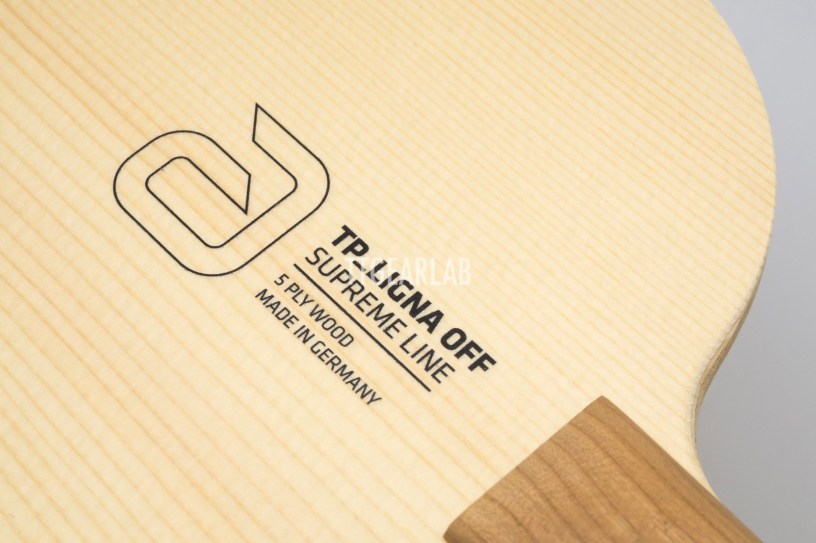
andro ‘TP_Ligna’ series is a 2018 update of andro’s German-made blade line, ‘Ligna’ series. In 2018, andro renewed its long-used logo mark, and reorganized its blade range at the same time. andro divided its blades into three groups – ‘Supreme Line’, ‘High Line’ and ‘Basic Line’, and applied a unified graphic design to all products. ‘TP_Ligna’ series is one of the ‘Supreme Ling’ product families. The important characteristics of the blades in ‘TP_Ligna’ series are very refined appearance that brings out the feel of natural wood and the smooth handle shape. The naming system of old ‘Ligna’ series was refined to fit the new naming system. 2nd name after the series name indicates the construction and kind of fiber, and 3rd name indicates the speed sign under andro standard, for example OFF or ALL. 2nd name ‘CO’ means ‘carbon outer’, and ‘CO’ means ‘carbon inner’. All-wood blade in this series doesn’t have 2nd name. ‘TP_Ligna CO OFF’ means that this blade is a pure wood blade and its speed level is OFF class. ‘TP_Ligna CO OFF’ plays a role as the basic blade of ‘TP_Ligna’ series.
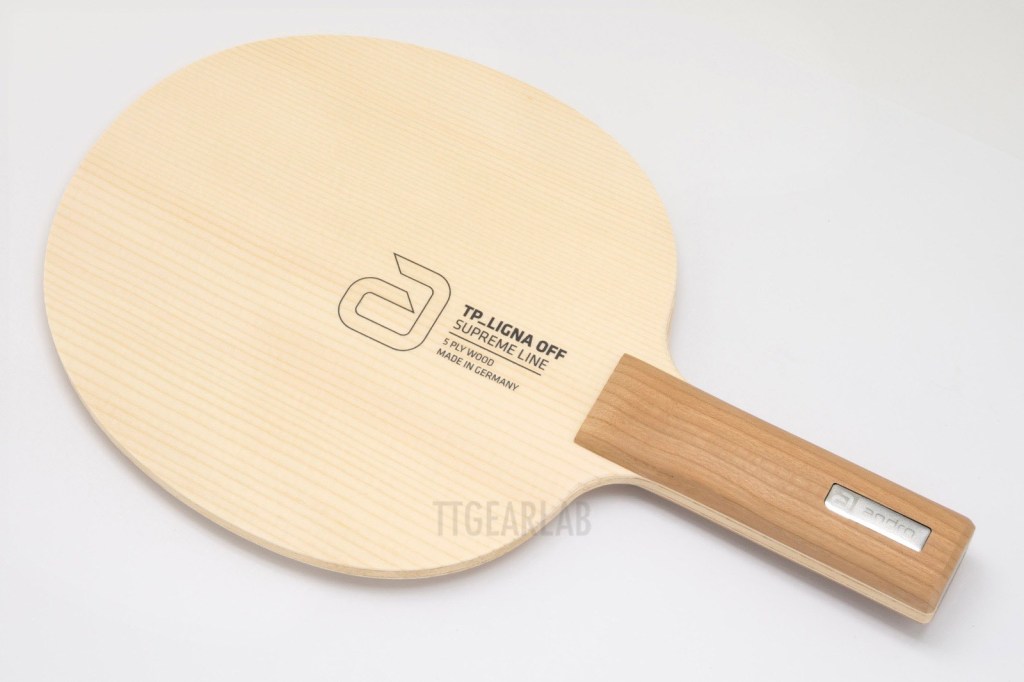
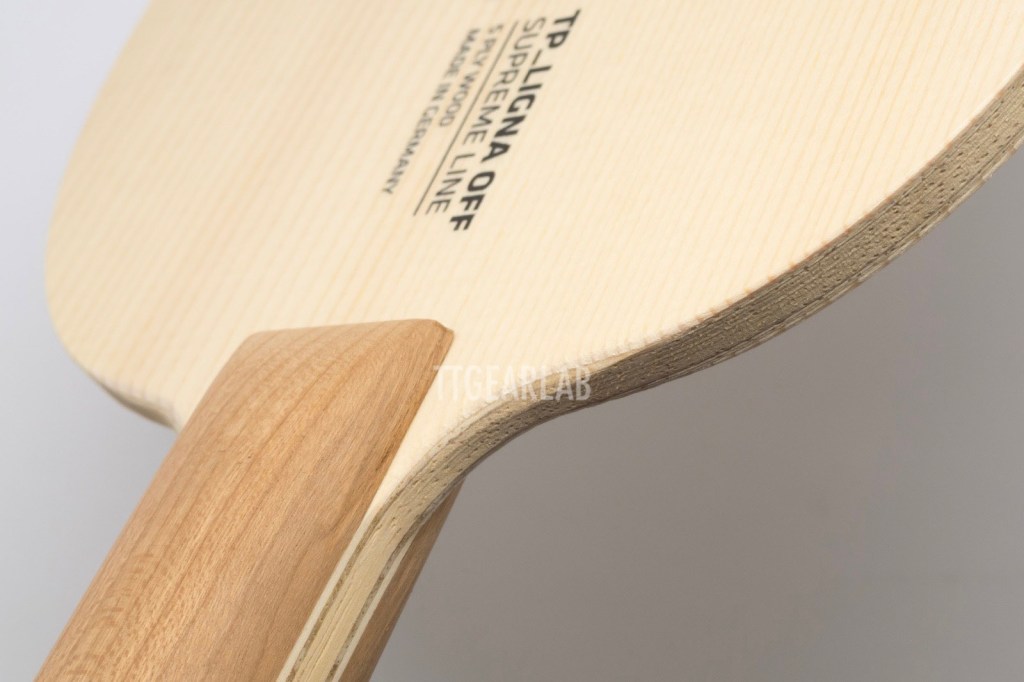
‘TP_Ligna OFF’ which is a 5-ply wood blade with Spruce top layer can be considered as the basic blade in andro ‘TP_Ligna’ series. Regarding design, what is first noticeable is the handle that is made of pure wood instead of dyed fineline wood. And then we can notice that the handle is very smooth and there isn’t angle between the thumbrest and body. andro is explaining this shape as ‘ergonomic 3D shape’.
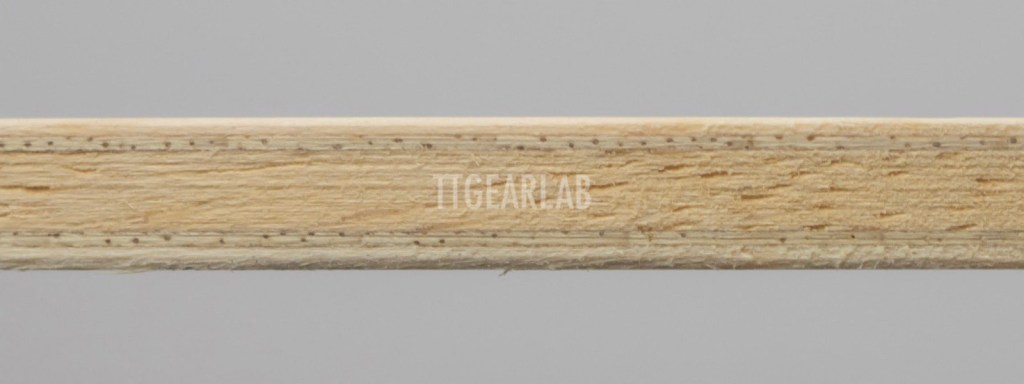
The top layer is Spruce. The middle layer is Limba, and the center layer is Ayous. Overall thickness is around 6.5mm.
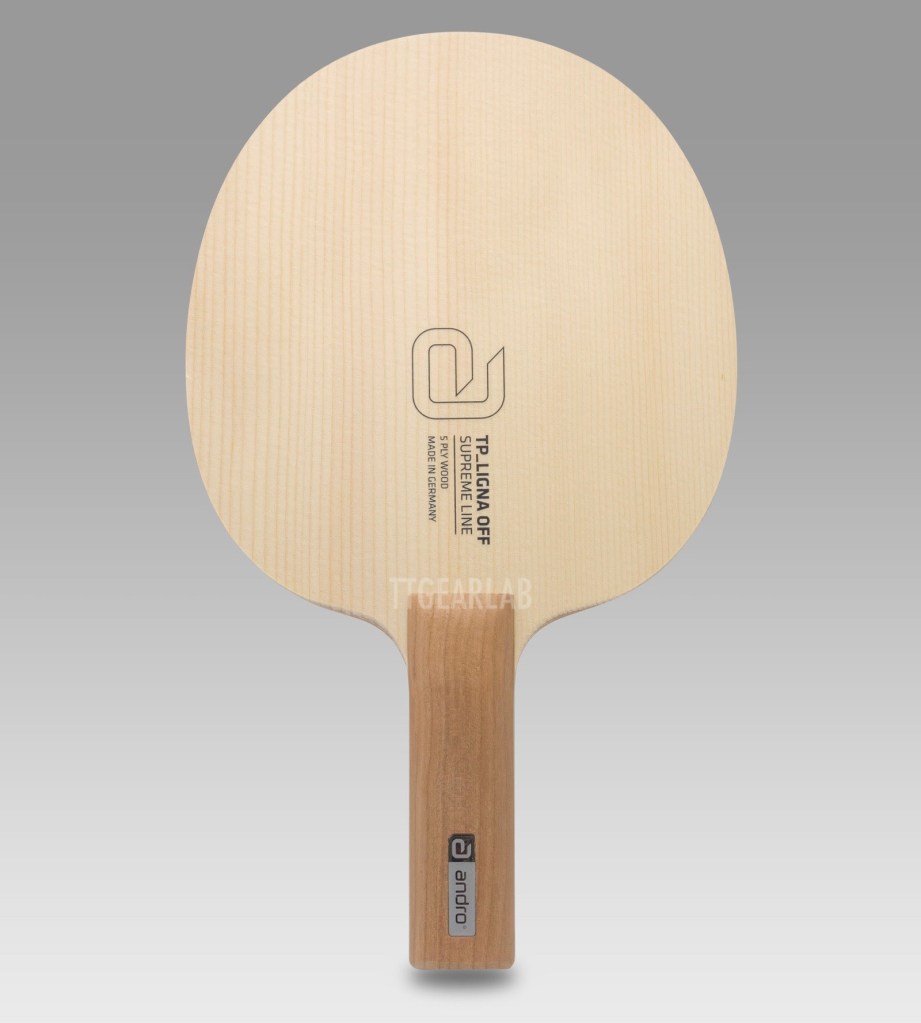
The size of the head actually measured is around 157mm x 152mm. The overall shape of head is somewhat different from the general shapes those we can see from other blades.
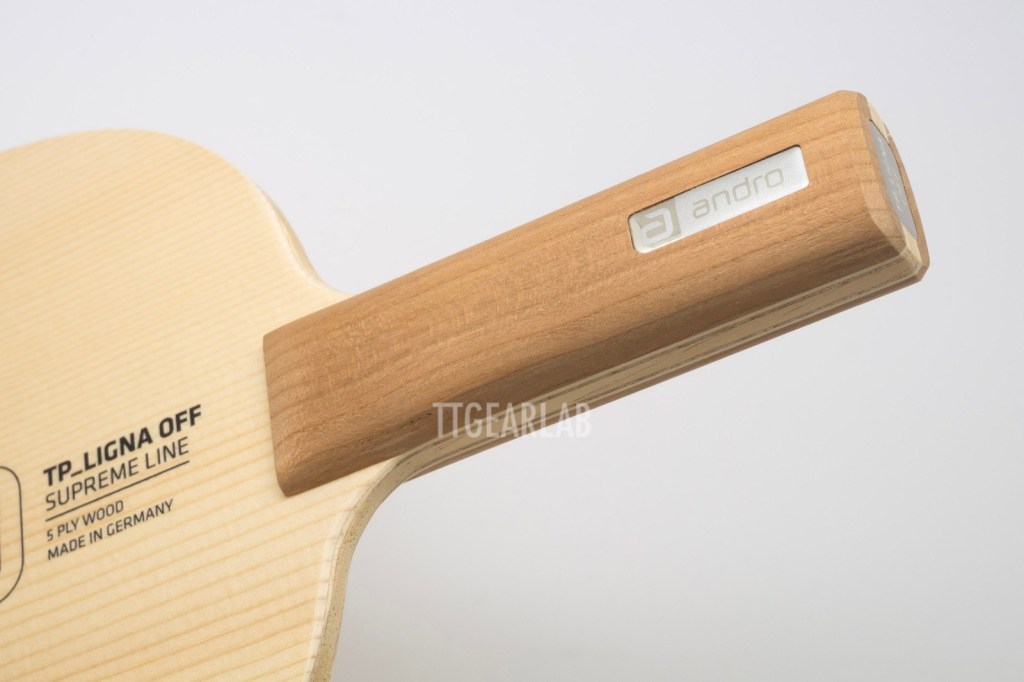
The size of ST handle is around 28mm (width) x 22.5mm (height). This ST handle is also very smooth, and there isn’t clear border between thumbrest and the main body surface of handle.
The width of FL handle (no picture) is around 26mm (at top) ~ 27.5mm (at bulge) ~ 25.5mm (at narrowest point) ~ 33mm (at the end), and its height (thickness) is around 22.5mm (at thumb) ~ 28mm (at the end).
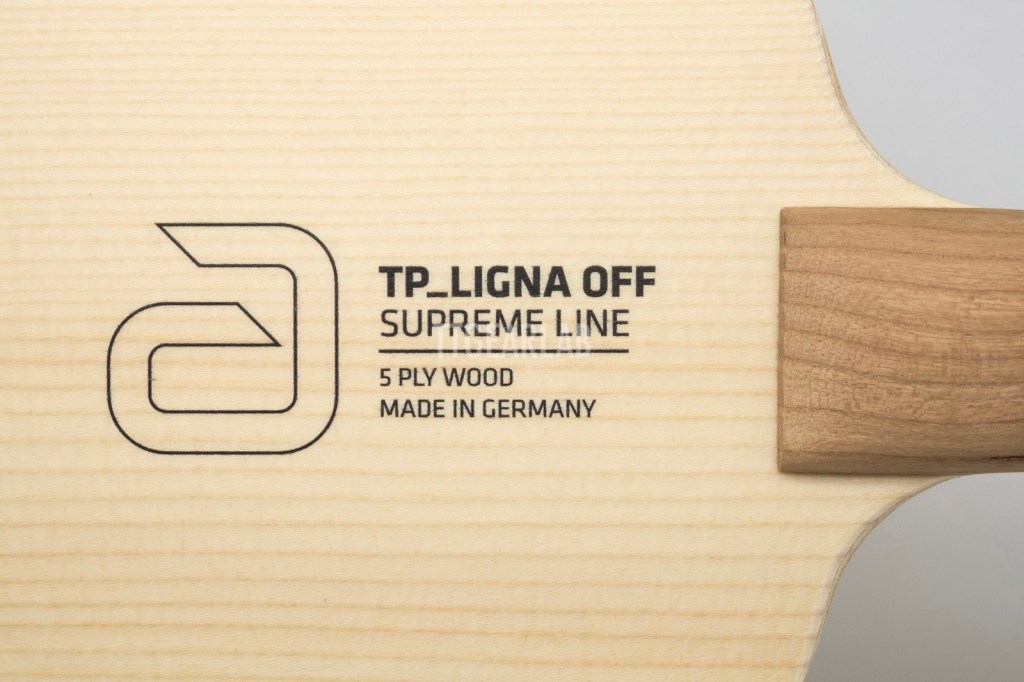
On the bottom center of the foreside of head, the common graphic which is applied for all andro blades released in 2018 is printed. It includes big ‘a’ logo, the name of product (= ‘TP_Ligna OFF’), the name of group (= ‘Supreme Line’), the construction of plywood and the origin.
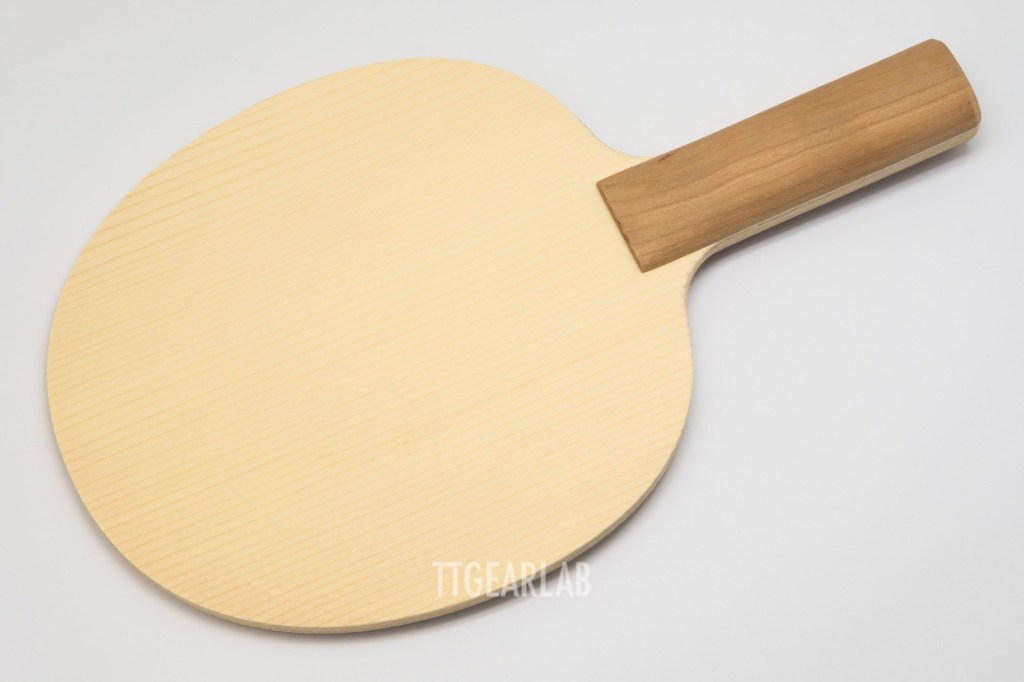
There isn’t any printing or lens at the backside of the blade.
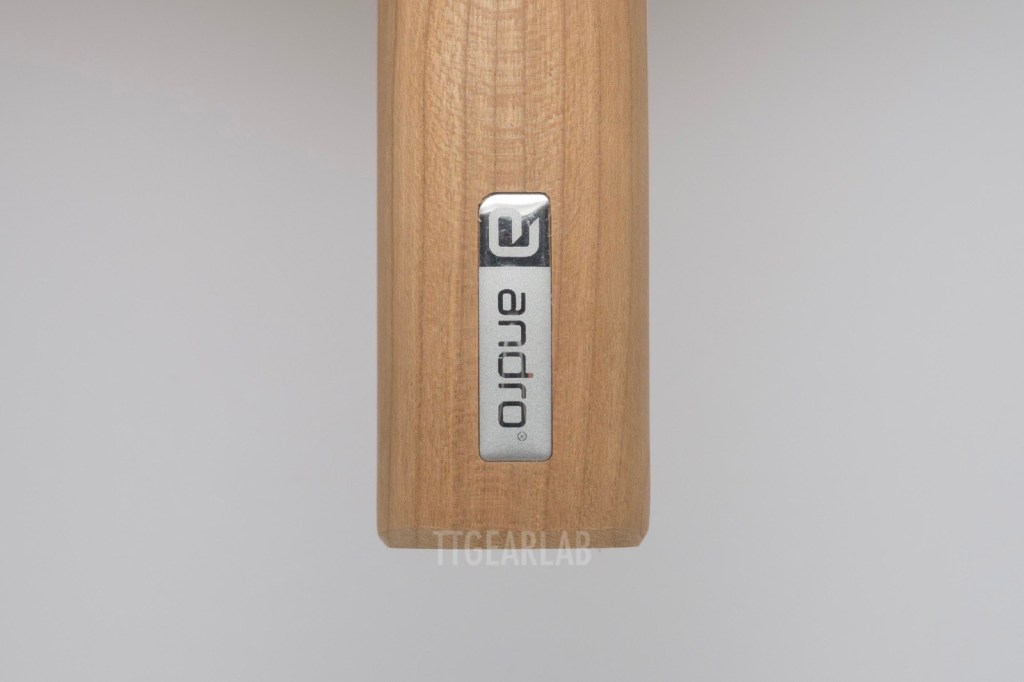
At foreside of handle squared logo panel is applied. This logo panel is the common one that is applied to most of andro blades.
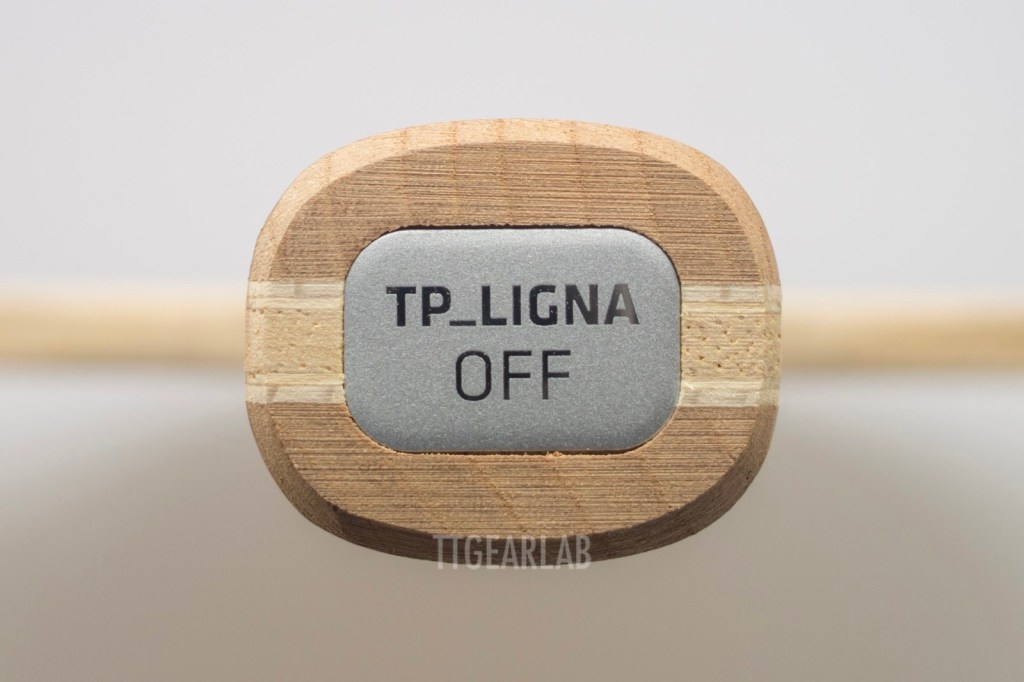
At the end of handle, aluminum panel including the name of product is applied.
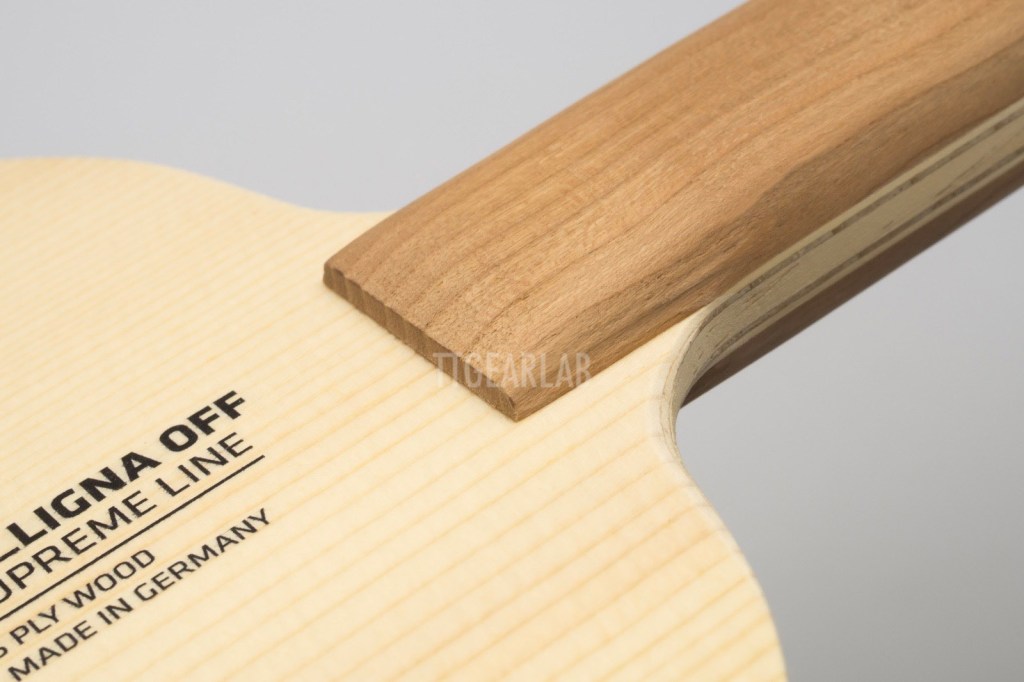
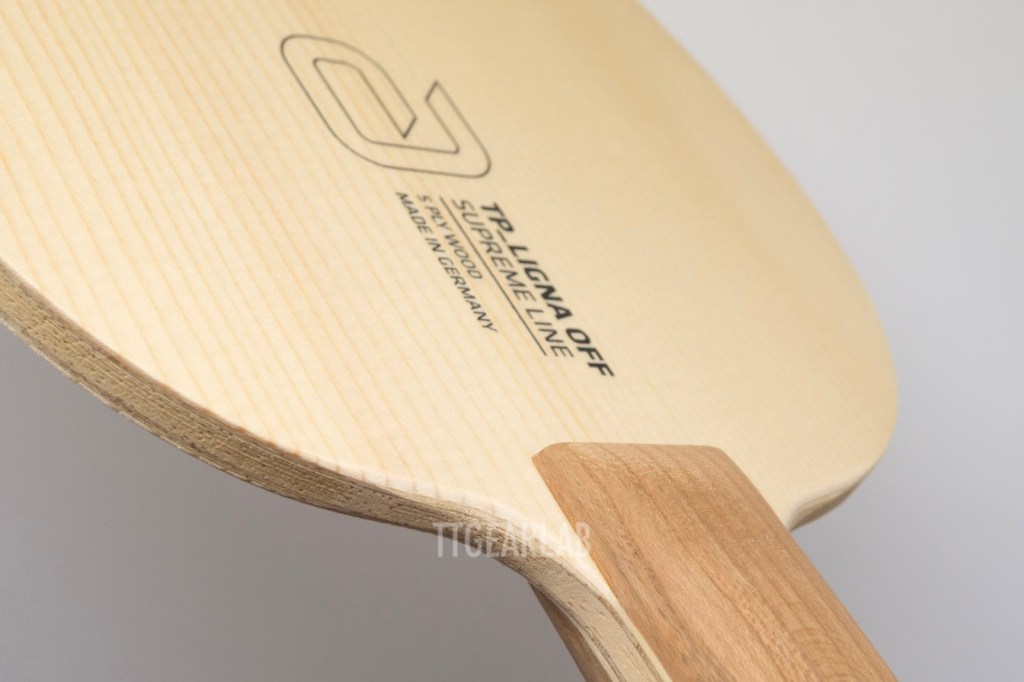
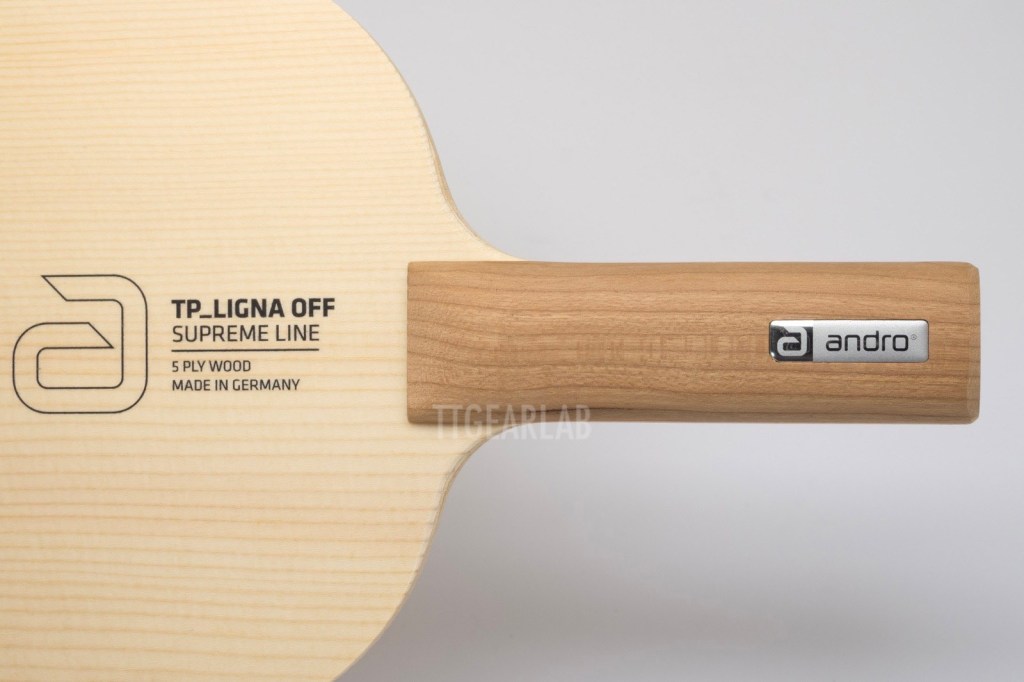
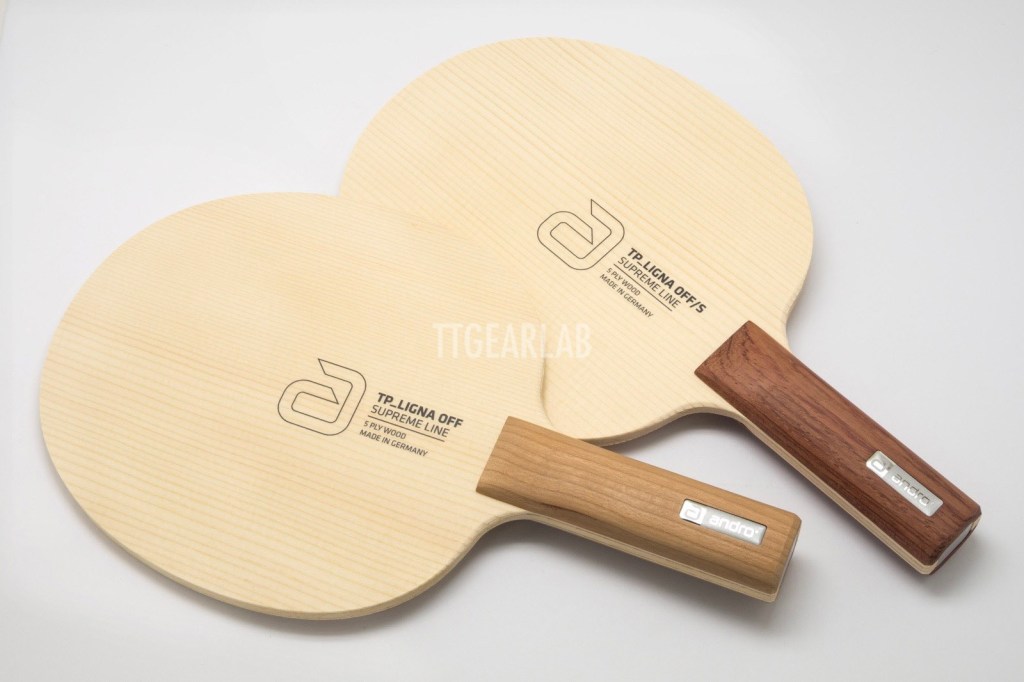
There are two models – ‘OFF’ and ‘OFF/S’ – of 5-ply wood offensive blades in ‘TP-Ligna’ series. Two models can be distinguished by the color of the wood of handle.
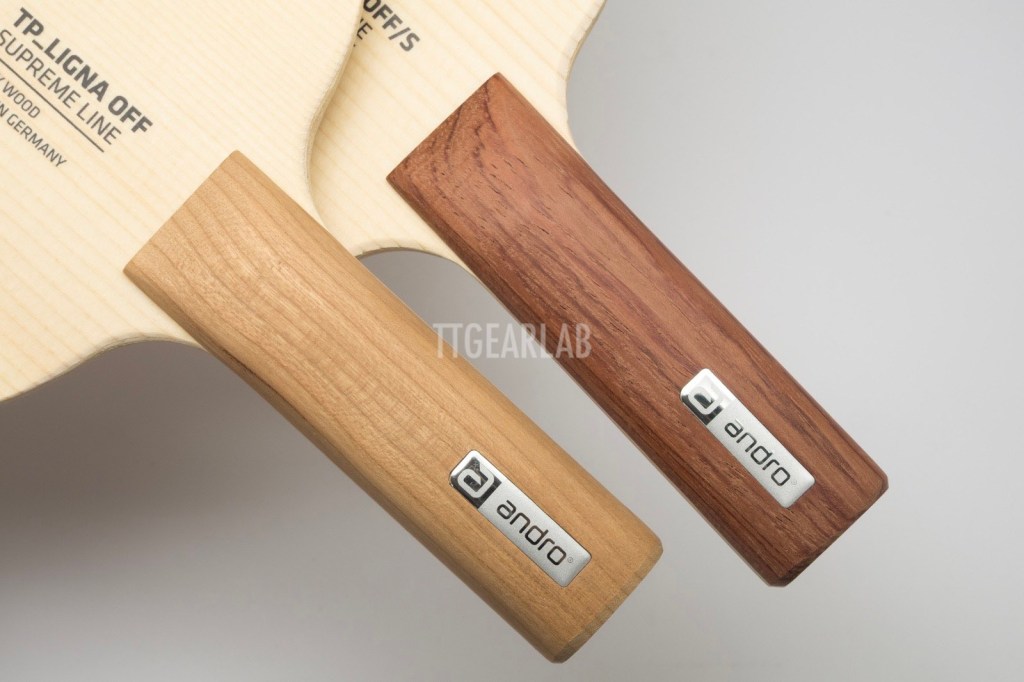
The wood of lighter color is applied for the handle of ‘TP_Ligna OFF’, and the wood of darker color is applied for the handle of ‘TP_Ligna OFF/S’.
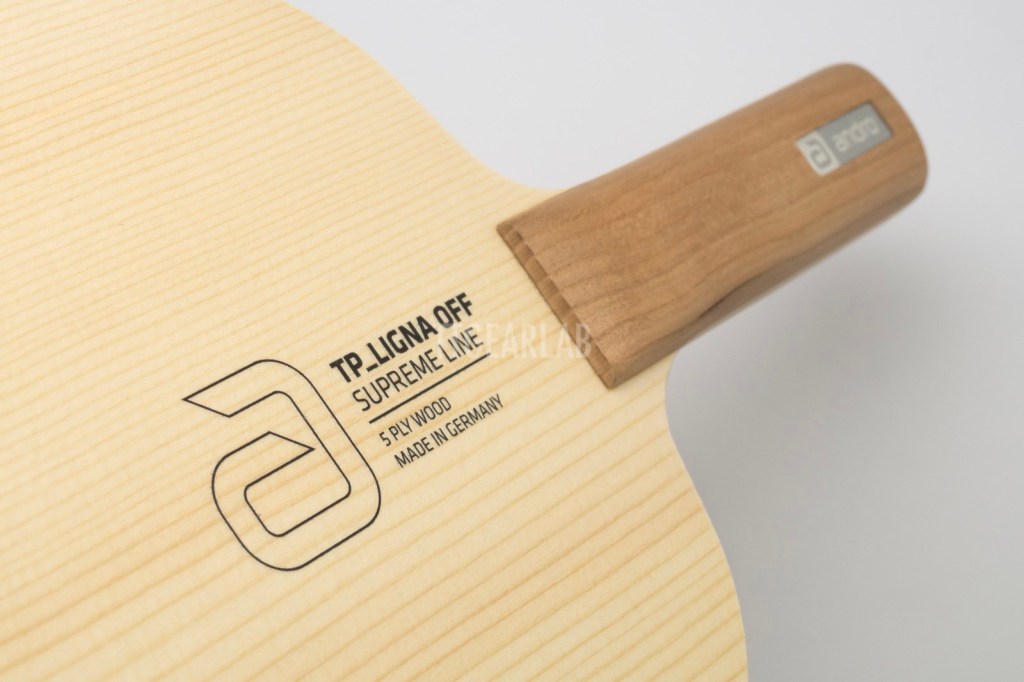
‘TP_Ligna OFF’ is a high class pure wood blade that is made in Germany. Because of the natural wood that is used for handle, it looks like a hand-made blade like the blades in ‘Wanokiwami’ series which is another high class blade family made in Japan. (But, differently from ‘Wanokiwami’ series that doesn’t consist of fiber blade, ‘TP_Ligna’ series includes fiber blades such as ‘TP_Ligna CO OFF’.) The Spruce that is used as top layer of ‘TP_Ligna’ series is more similar to Hinoki when compared with other wood materials, but it provides quite different characteristics from Hinoki. The harmony between Spruce top layer and artificial material which is placed directly under the top layer makes good harmony to provide superb hitting feeling. The players may feel the smooth handle shape strange. But, players may spend less time than expected to be accustomed with this shape because the handle shape itself isn’t that unique except for the smoothness. ‘TP_Ligna OFF’ is recommended for players who want to play with various skills including smash and block. When compared with its fiber version, relatively lower price and a bit higher elasticity are the advantages of ‘TP_Ligna OFF’.
Following are the performance indices of andro TP_Ligna OFF (avg.weight = 83.9) :
– Ep = 1.72
– Ec = 1.82 (Ec/Ep = 1.06)
– Vp = 1.32
– Vl = 1.21 (Vl/Vp = 0.92)
Please note that above are average values and can be updated by further measurement.
Unauthorized use and/or duplication of this material without express and written permission from this website’s author and/or owner is strictly prohibited. Excerpts and links may be used, provided that full and clear credit is given to TTGearLab with appropriate and specific direction to the original content.
 TTGearLab
Hi, Thank you for your great work. You mentioned that spruce and hinoki, I know that Darker has stopped making hinoki blade and start using spruce instead. What is the difference between these two as top layer?
LikeLiked by 1 person
From my experience of playing with both types of blades
Hinoki: Butterfly Sardius, Butterfly Primorac carbon, Butterfly Reygundo, Victas Hino carbon power, Double day Kiso Hinoki inner ALC&ZLC
Spruce: Andro TP_Ligna CI OFF
Hinoki has a very springy feel, with the ball shooting off the blade, while spruce gives you a very delicate feel of the ball. What the effect translates to game play: Hinoki increases speed and springy feel(At the cost of losing spin and control), while spruce increase dwell time and produces spin(At the minor cost of speed). The Spruce blade is much better at close to the table blade. Keep in mind this might be caused by the difference in blade structure as well.
In short: Hinoki for speed, Spruce for spin
LikeLike
Thank you for sharing your experience. It becomes very important information for readers.
By the way, we have to consider one thing. That is what you have already mentioned as ‘the difference in blade structure’.
In many cases the blade with Hinoki top layer are thick blade whose construction includes woven carbon fiber. For that reason the high speed and springy feel is mostly because of the carbon fiber and thick construction. If the construction becomes thinner and the artificial material is removed or replaced by softer one, the result will become different.
The good example is Butterfly ‘Jonyer-H’ which is a thin 5-ply wood blade whose all layers are Hinoki. Its elasticity isn’t high, and it gives sticky feel when we try to put rotation to the ball. The ‘sticky feel’ is one important characteristics of Hinoki. And, that is the reason why thick carbon blades have Hinoki top layer. If the top layer of those blades isn’t Hinoki, the feeling will be stiffer and the control will be worse. Those Hinoki wood is used for ‘reducing’ speed and ‘improving’ the feeling of grabbing ball.
And, we can also observe 1-ply wood penholder blades. Most of those blades are made of Hinoki wood. But, some low cost 1-ply wood blades are made of Spruce. If the thickness is identical, Spruce 1-ply is sitffer and faster than Hinoki 1-ply. Hinoki 1-ply blade is also very fast, but it is used for topspin. But, Spruce 1-ply wood of same thickness is better for fast attack than topspin because it gives less feeling of ‘grabbing’ ball.
LikeLike
Thank you very much for sharing the important information!
LikeLike
May I add the Andro TP Ligna All and the Andro Timber 5 All/S to your wish list for blade tests? As you could not get the TP Ligna CI and the Timber series enjoy a wide distribution in Germany, you would find a lot more thankful test followers and could expand your coverage of current allround blades. Thank you for your valuable tests, reports and recommendations which furthered my and others’ understanding of table tennis. For some reason the TP Ligna OFF is not even available in Germany (not sure, if in Europe at all)
LikeLike
Thank you for comment. Those two are already on wish list. But, I’m not sure whether I can get those two in short time or not. 🙂
LikeLike
Can you tell us the differences between Andro ligna off two versións diferences vs Andro ligna all wood?
LikeLike
Unfortunately I couldn’t have got the sample of Ligna ALL.
LikeLike
Hi!
Thanks for all the reviews and measurements, it’s really an interesting way of comparing blades.
I can inform that the middle layer is actually limba, not ayous. I know because I let Soulspin make a copy of TP_ligna OFF for mer. Here is the specification:
AYOUS 3.4 mm – Limba 0.55 mm – Spruce 0.9 mm
LikeLiked by 1 person
Thank you! Then I will correct it.
(By the way, I have just noticed that my record is also saying that it is Limba. ‘Ayous’ is mistake during editing. In fact, it doesn’t look like Ayous. It seems that ‘is Limba,’ was deleted from original text.)
LikeLike
Great!
I have a question regarding TP_ligna OFF and OFF CO:
What is the reason OFF has higher Ep and Ec than OFF CO? From the measurements it looks like TP_ligna OFF is a faster blade than OFF CO?
LikeLike
There isn’t any special reason. The speed signs are determined by maker, and probably they concluded that both of those two are the blades of ‘OFF’ level. That isn’t the result of objective measurement, but the result of subjective judgement.
Further, sometimes the fiber blades with lower elasticity give higher power when we try powerful topspin. That is because of higher energy efficiency of fiber materials. And, sometimes the combination with rubber gives different result. So elasticity is the fundamental characteristic of a blade, but that doesn’t say all of the power of that blade.
LikeLike