
‘Avalox’ is a brand of Swedish blades specially made for Chinese players. At the beginning of 1980’s, Chinese National Team was trying to adopt European topspin technics into the playing style of Chinse players. However, it was revealed that the domestic blades those were used by Chinse players were not suitable for topspin of European style. Therefore Chinese National Team wanted to supply European-made blades to its players, but it couldn’t work out smoothly because of the circumstances at that time. To solve that situation, in 1987, three persons from Sweden, Japan and Malaysia collaborated to make specially made blades for Chinese National Team, and established ‘Avallo Malaysia’ which is the company that deal with new products for Chinese National Team under the new brand – ‘Avalox’. At the beginning two models were developed – ‘P500’ for topspin with pimples-out rubber and ‘P700’ for fast attack with pimples-out rubber. Those blades have been used by many famous Chinese players such as Ma Wenge, Kong Linghui, Want Nan and Want Tao, and have achieved excellent result in international competitions until the late 1990s. (Currently the official name of the brand isn’t ‘Avalox’ but ‘Avallo AVX’. That is because of the trademark dispute in Chinese market. To continue the business in Chinese market Avallo Malaysia had to change the brand from Avalox to Avallo AVX. Currently the name ‘Avalox’ is only used for the Swedish blades. And, new brand ‘Avallo AVX’ is applied for all models including Swedish blades. For that reason we can see two brands – ‘Avalox’ and ‘Avallo AVX’ those are printed on the head of ‘P700’.)
Swedish blades of Avalox are manufactured using Sweden’s traditional blade manufacturing method, in which the adhesive slowly seeps into the wood in an environment where temperature and humidity are strictly controlled. Another feature is the very luxurious finish that the entire edge of the head is rounded. Currently the P series consists of ‘P500’ which is a 5-ply plywood, ‘P700’ which is a 7-ply plywood, and ‘P900’ which is a 9-ply plywood. Among those three ‘P900’ has different design because it is a model added later. All of those blades make good combination with Chinese sticky rubbers, and provide high efficiency when played at close-to-table area.
‘P700’ is well known as the blade used by Chinese player Wang Tao, and was originally developed as the blade suitable for fast attack with pimples-out rubber. But, that was a story long time ago, and in the meantime many changes occurred in table tennis, for example the adoption of 40mm ball, the ban of speed glue and the changes in the material of ball. And, now ‘P700’ can be considered as the blade better suited for topspin with pimples-in rubbers on both sides rather than fast attack with pimples-out rubber. It is one of strongly recommended 7-ply wood blades for modern both-hand topspin.
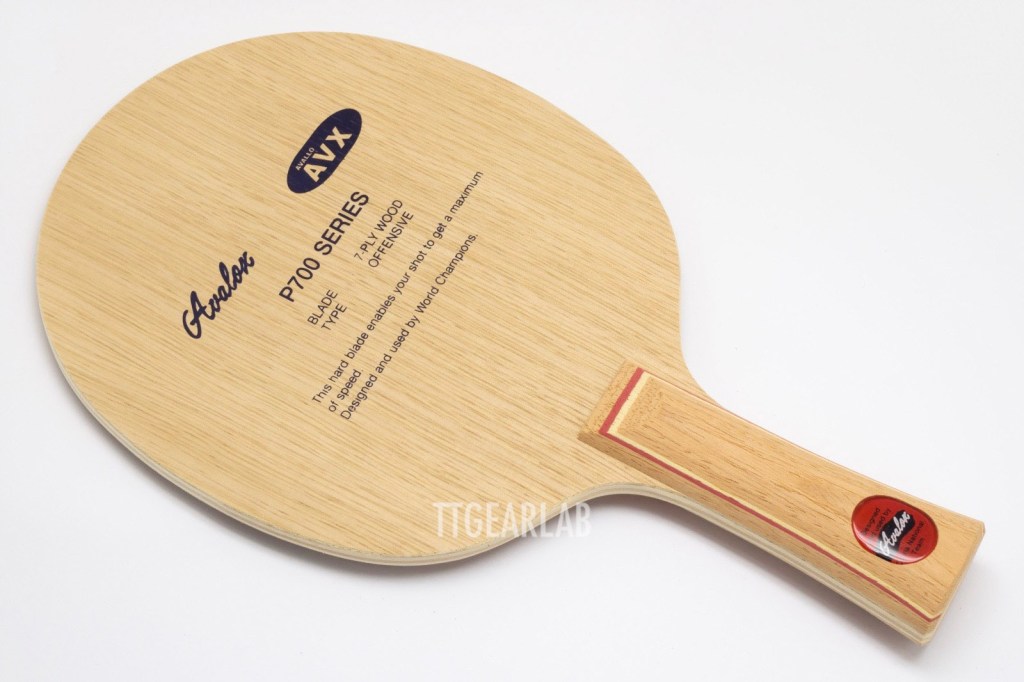
‘P700’ which is famous as the blade of Wang Tao is one of seriously considerable 7-ply wood blades in poly ball era.
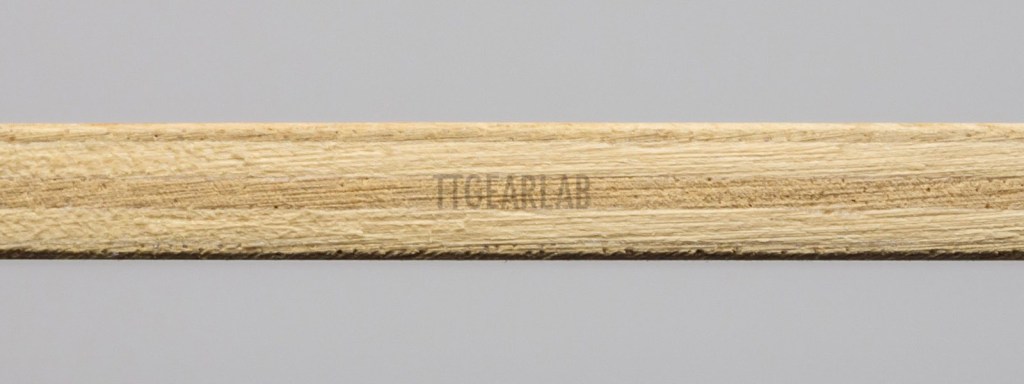
The construction looks similar to that of traditional 7-ply construction of ‘Clipper’ type. However, it is much thinner than traditional 7-ply wood blades, and there isn’t any dyed layer. Further, the middle layer is different from that of ‘Clipper’ series. The top layer is Limba, the second layer is Meranti, and the center layer is Ayous. Overall thickness is around 6.2mm.
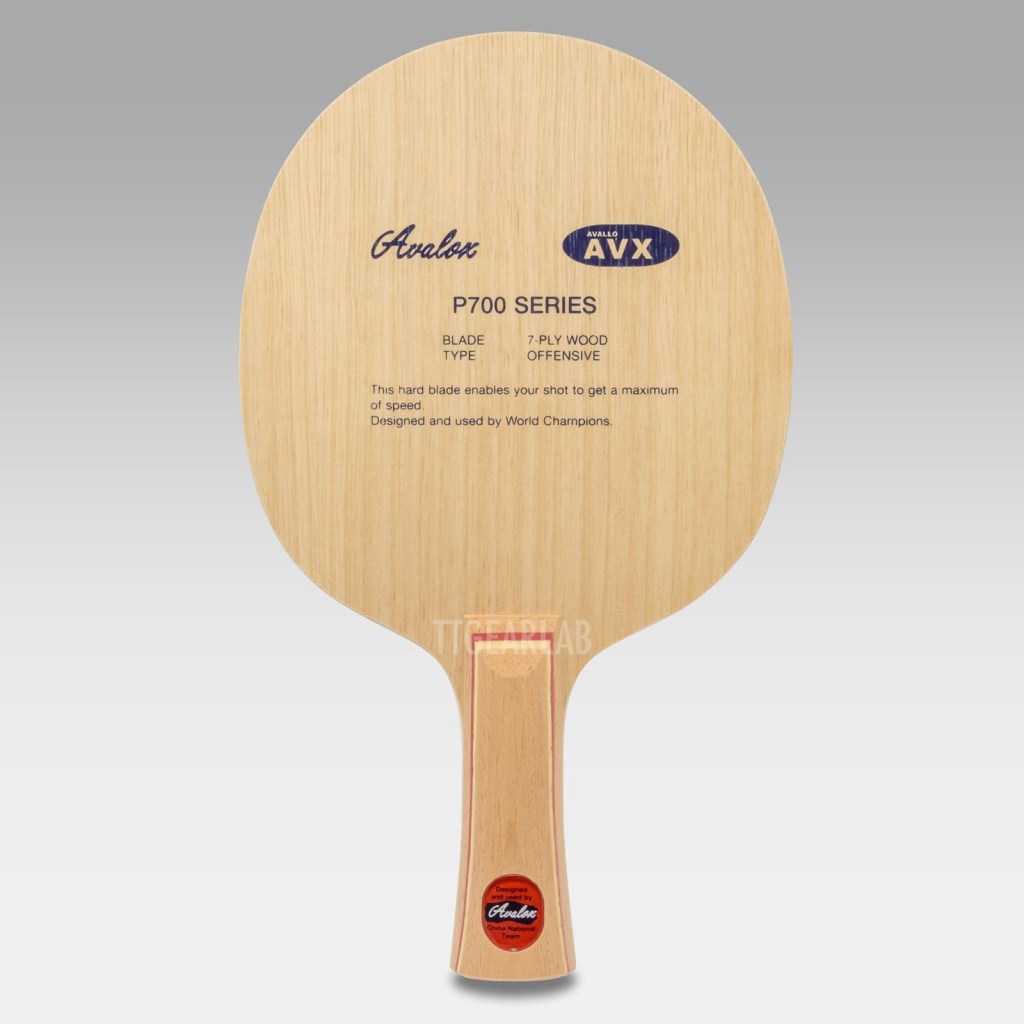
The head size is 158mm x 150mm.

Simple description is printed on the foreside of blade head. The name ‘P700’ is shown only here, but it is written not as just ‘P700’ but as ‘P700 series’. The reason why it is called as a ‘series’ is that the handle type of this blade was originally indicated by the second digit. In the past, the actual name was called differently depending on the type of handle. ST (straight) handle version is ‘P710’, and FL (flared) handle version is ‘P720’. As time has passed, it seems that original naming system has been forgotten, and those are simply called as ‘P700 ST’ and ‘P700 FL’.
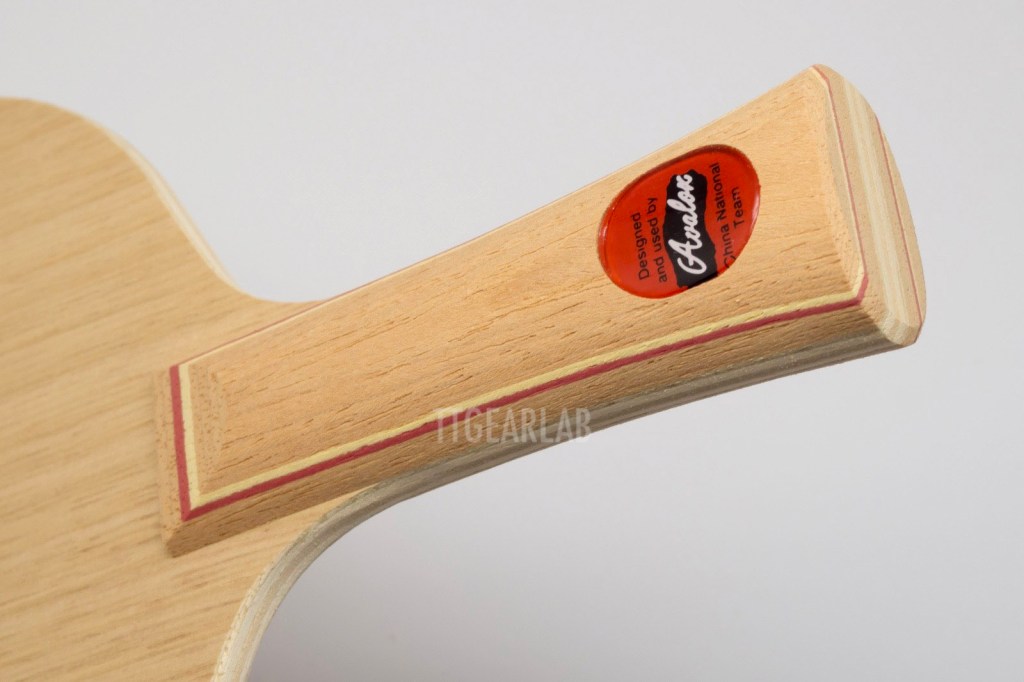
The width of FL (flared) handle is around 27mm (at head side) ~ 28mm (at the middle of handle) ~ 35mm (at the end), and the thickness of FL handle is round 22mm (at thumb) ~ 25mm (at the end). The size of ST (straight) handle which isn’t shown in the picture is around 28mm (width) x around 23mm (thickness). The transparent lens at handle looks similar to that of Stiga, but a bit smaller. ‘Avalox’ logo and the text that this blade is made for Chinese National Team are shown in the lens. But, the name of blade isn’t shown.

There isn’t metal plate or plastic lens at the end of handle.
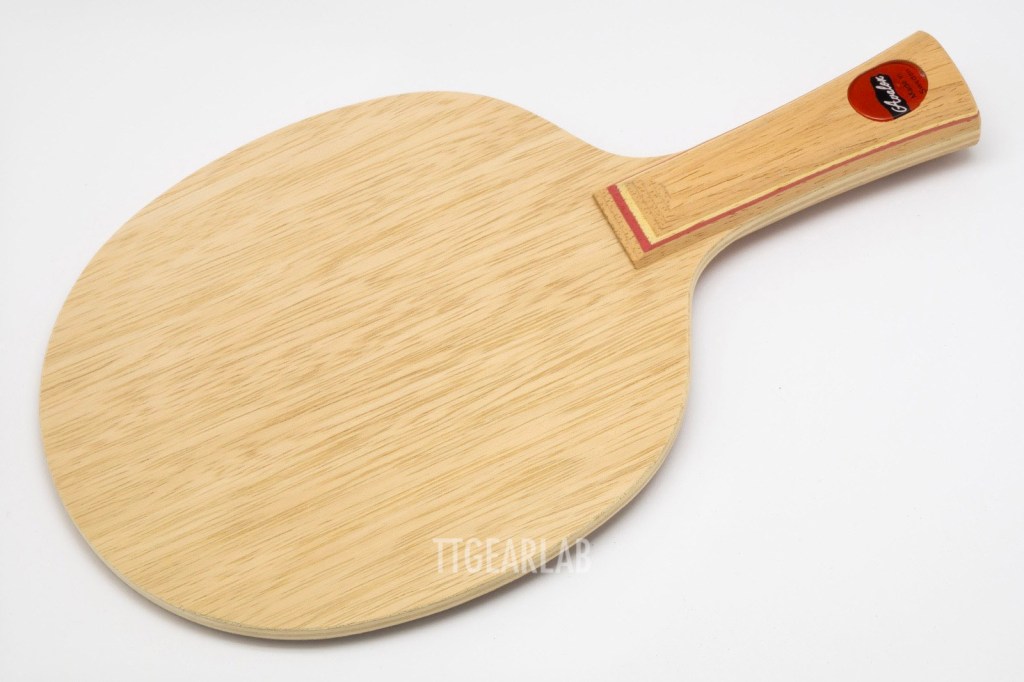
Printing isn’t applied at the backside of head. However, at the backside of handle, there is the lens that is very similar to the lens at foreside of handle.
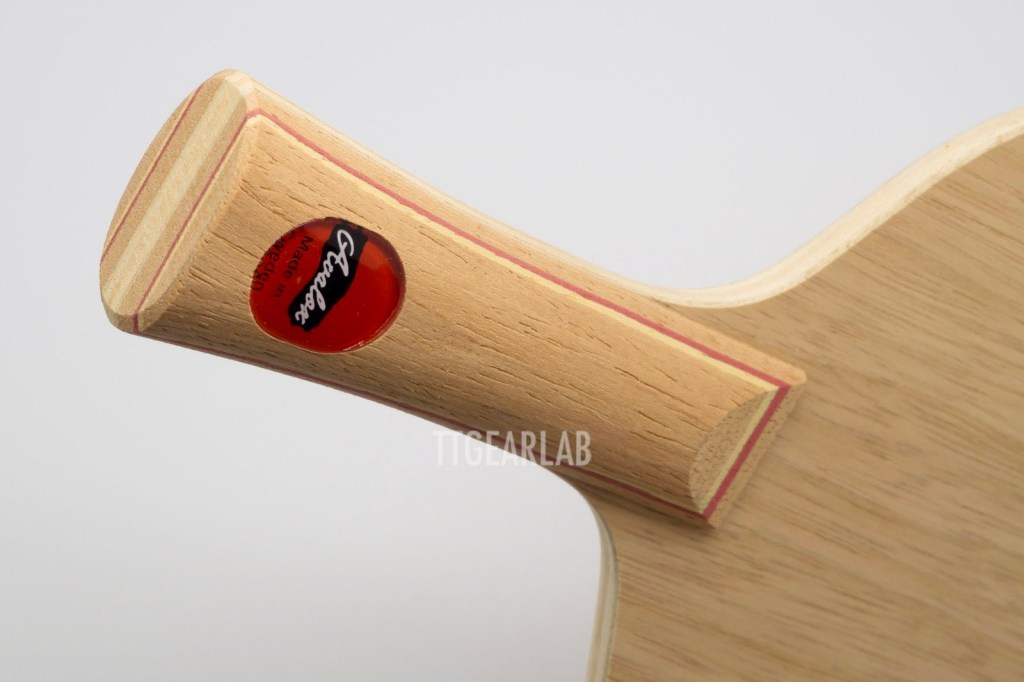
‘Made in Sweden’ is printed in the backside lens.
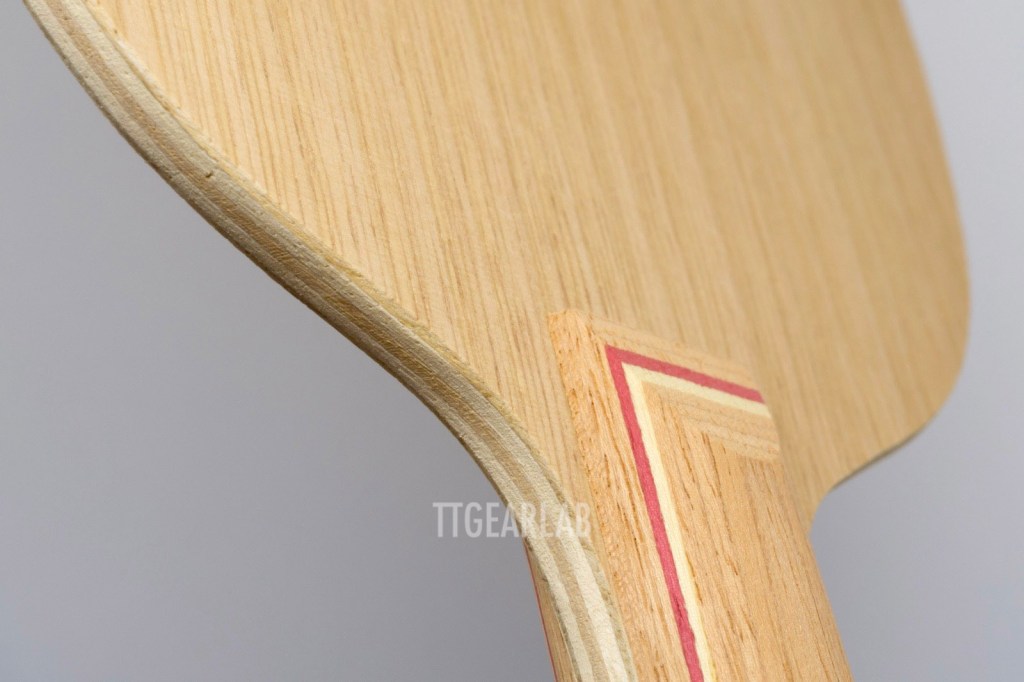
One important feature of Avalox blade is that entire edge of head is smoothly rounded. That luxurious finish is also seen at the Swedish blades of Yasaka.
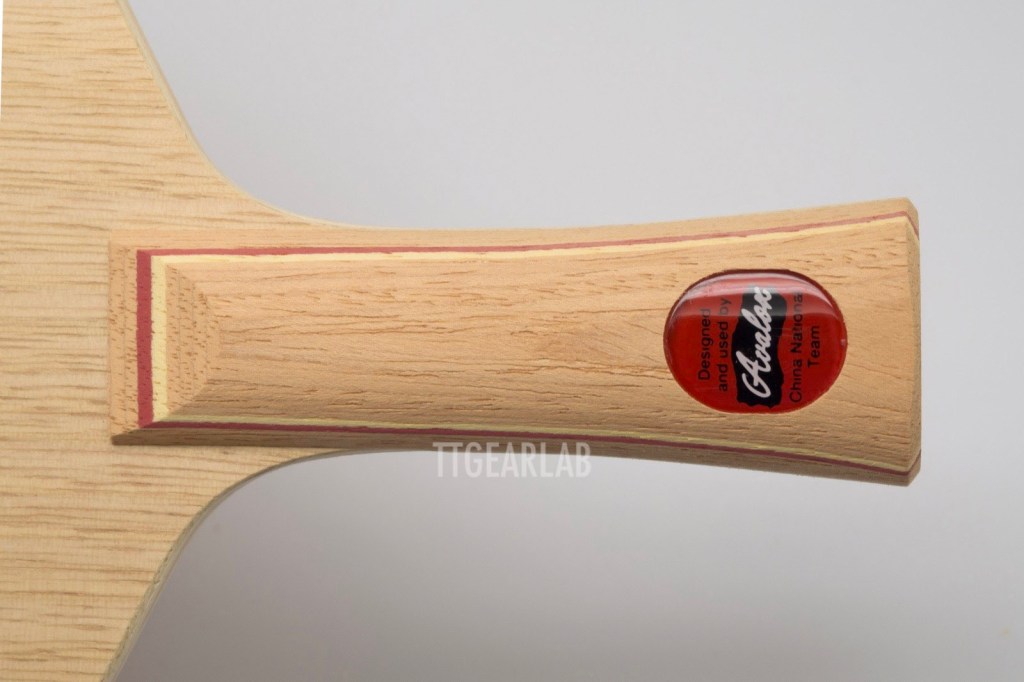
The shape of FL handle is different from that of Butterfly or Stiga. The bulge near the thumb isn’t clearly shown, and therefore the width at bulge is smaller than the width at the middle of handle.
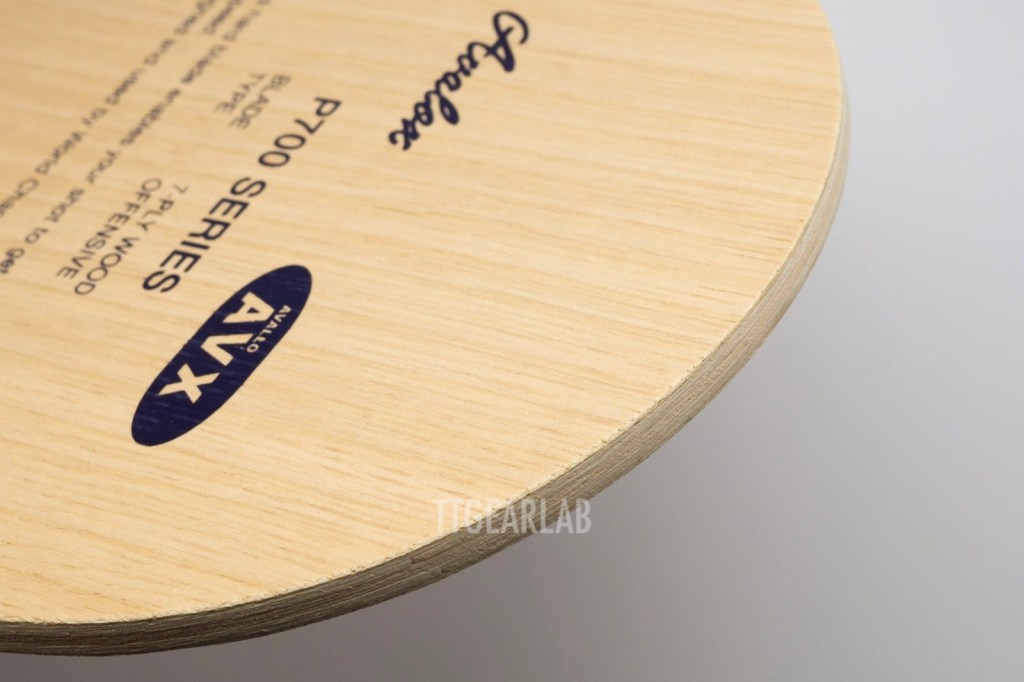
‘Avalox’ is also called as ‘AVX’. (In fact current official name of brand ‘AVX’ or ‘Avallo AVX’.)
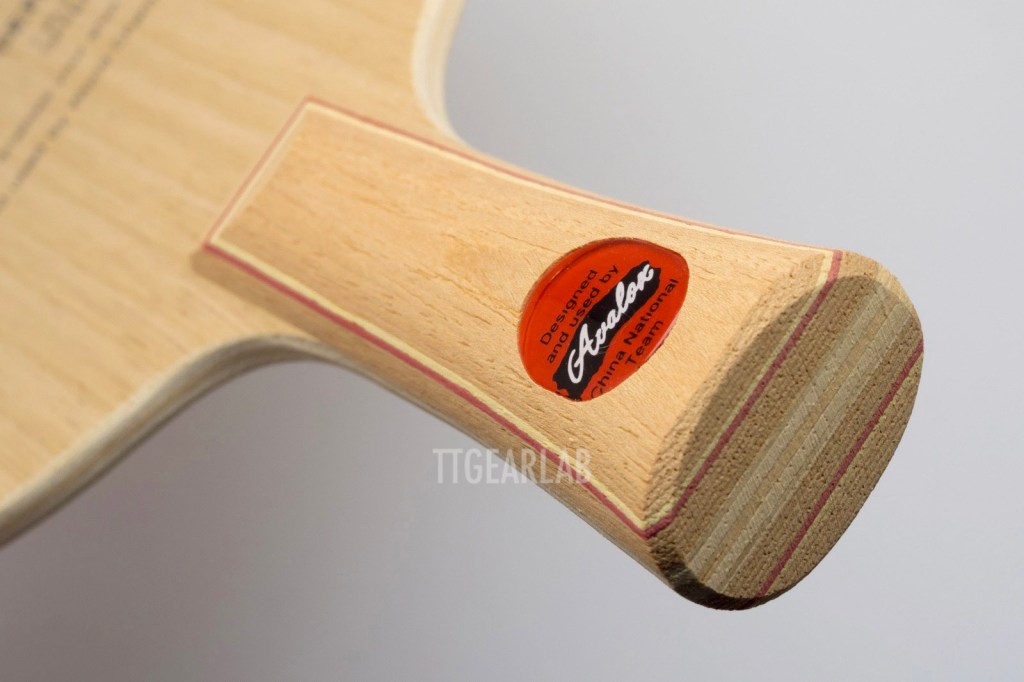
Many 7-ply wood blades such as Avalox ‘P700’ are seriously considerable as the pure wood blades of poly-ball era because the elasticity of those blades are comparable with inner-ALC blades and the feeling is more natural. The heavy ones of ‘P700’ whose weight is over 90g are suitable for skilled players who require power, and the light ones of ‘P700’ whose weight is under 90g are suitable for entry level players.
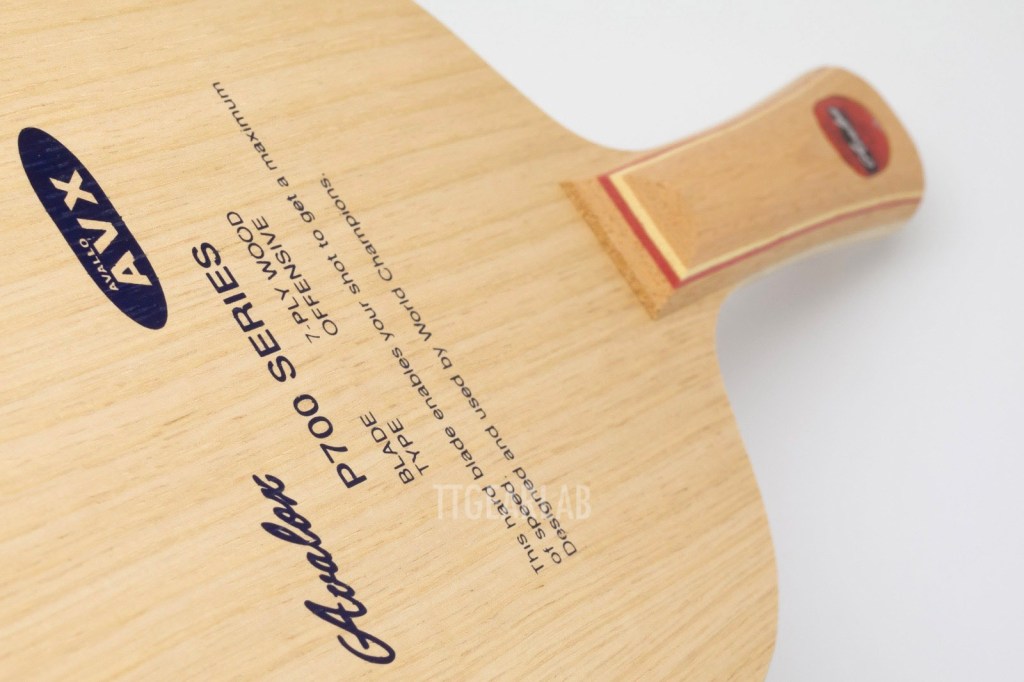
Following are the performance indices of Avalox P700 (avg.weight = 91.8g) :
– Ep = 1.71
– Ec = 1.48 (Ec/Ep = 0.87)
– Vp = 1.13
– Vl = 1.13 (Vl/Vp = 1.00)
Please note that above are average values and can be updated by further measurement.
Unauthorized use and/or duplication of this material without express and written permission from this website’s author and/or owner is strictly prohibited. Excerpts and links may be used, provided that full and clear credit is given to TTGearLab with appropriate and specific direction to the original content.
 TTGearLab
I would only say that the P700 composition Is different from the other Clipper like blades
The second ply is Meranti instead of ayous
LikeLike
Thank you very much for comment!. I knew it but have forgot when I wrote the article. I will correct the article.
LikeLike