| Table of Contents | 1. Overview 2. Performance Indices 3. Comparison by Performance Indices ……. 3-1. Elasticity Indices ……. 3-2. Vibration Indices 4. Field Test 5. Summary |
Update Notice (12th October 2023) : The data of ‘InnerForce Layer ALC’ has been changed from that of 2018 version to newer 2023 version. ‘InnerForce Layer ALC’s measured in 2023 are thicker, heavier and more elastic than those measured in 2018. TTGearLab will deal with those two versions as different blades. ‘Harimoto Tomokazu InnerForce ALC’ has been removed from this article becuase its characteristics are not much different from 2023 version of ‘InnerForce Layer ALC’.
From the successful debut of ‘InnerForce’ series in 2009, Butterfly has been forcing on inner-fiber blades under the name of ‘InnerForce’. After getting confidence on inner fiber construction in the poly-ball age, Butterfly announced ‘InnerForce Layer’ series which is basically the renewal of the original ‘InnerForce’ series. And, various signature blades based on ‘InnerForce Layer’ series have been introduced. Butterfly ‘Ovtcharov InnerForce ALC’ which was launched on July 1st 2021 is one of those signature blades. It is the blade developed under the cooperation with Dimitrij Ovtcharov who is one of the main members of German Men’s National Team. It is based on ‘InnerForce Layer ALC’, but elasticity has been greatly enhanced by the application of thicker center layer. In general, inner fiber blades provide softer feeling and better control, but less powerful, when compared with outer fiber blades. However, we can expect that ‘Ovtcharov InnerForce ALC’ will provide higher power than ordinary inner fiber blades.
In this article, TTGearLab will analyze ‘Ovtcharov InnerForce ALC’ through Performance Indices and compare it with some existing blades. Further, TTGearLab will also check the actual characteristics of ‘Ovtcharov InnerForce ALC’ by field testing at table tennis court.

1. Overview
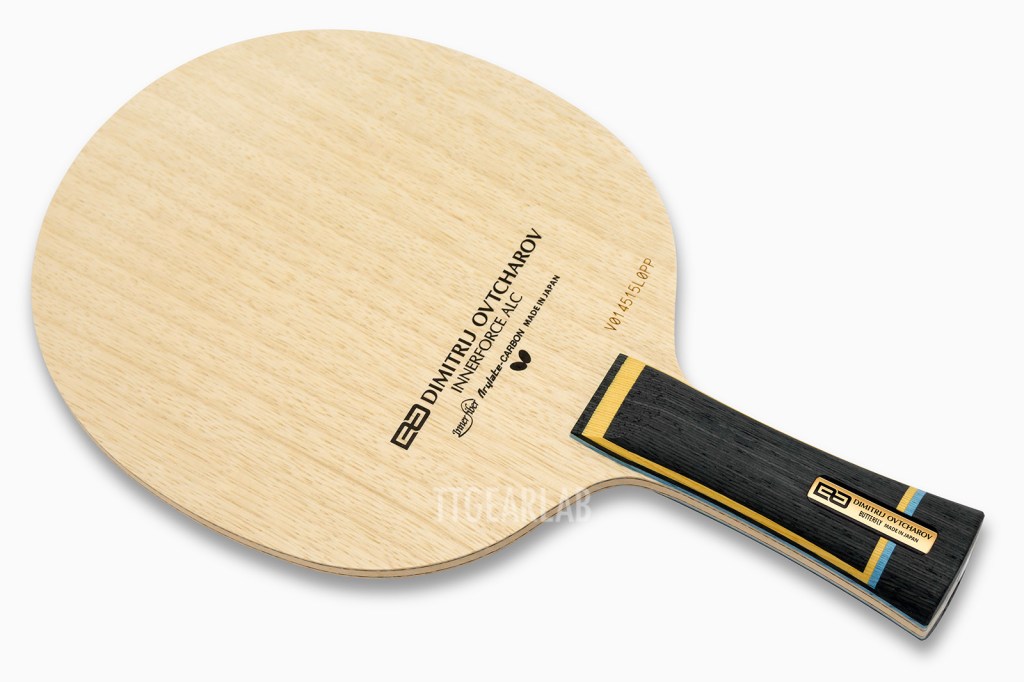
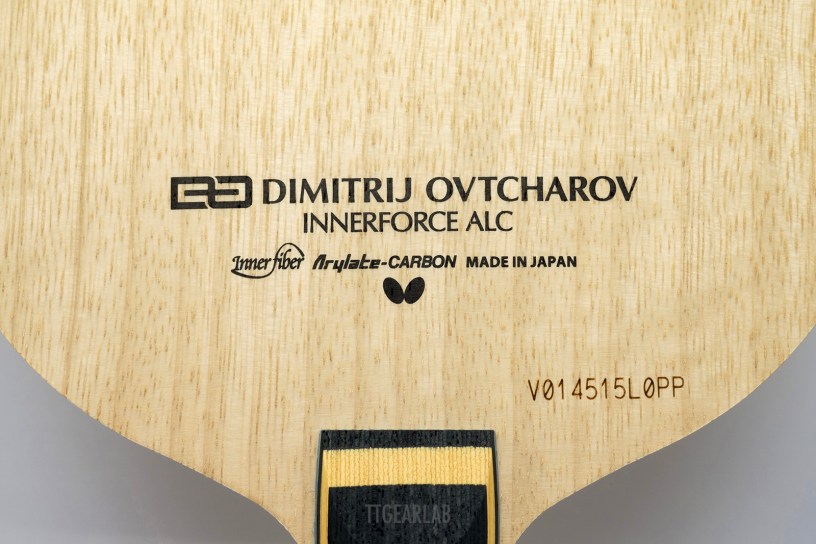
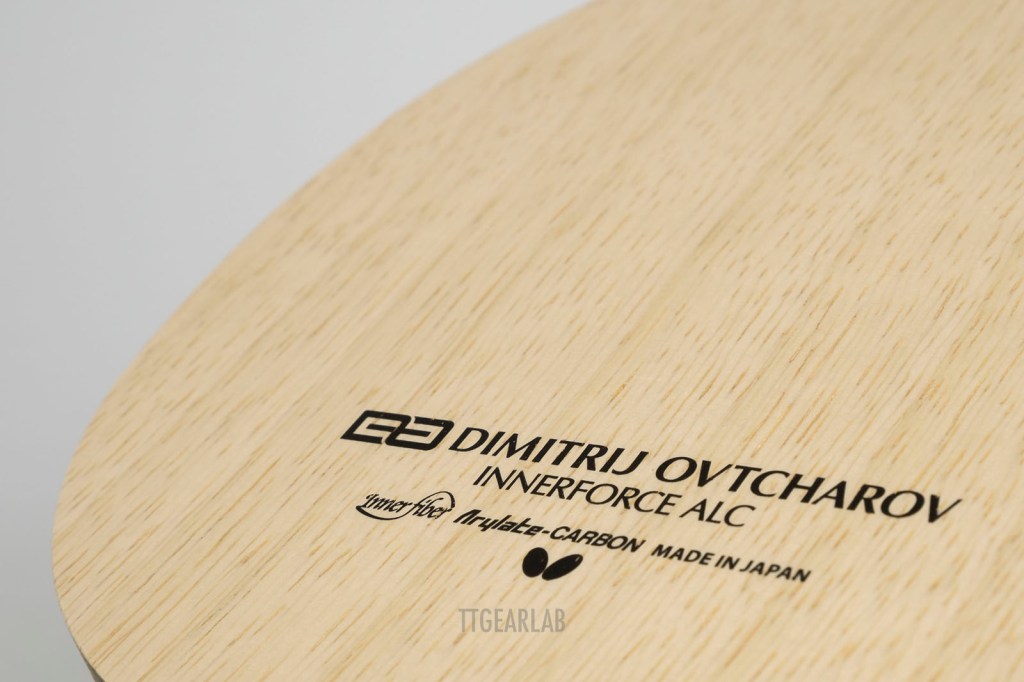
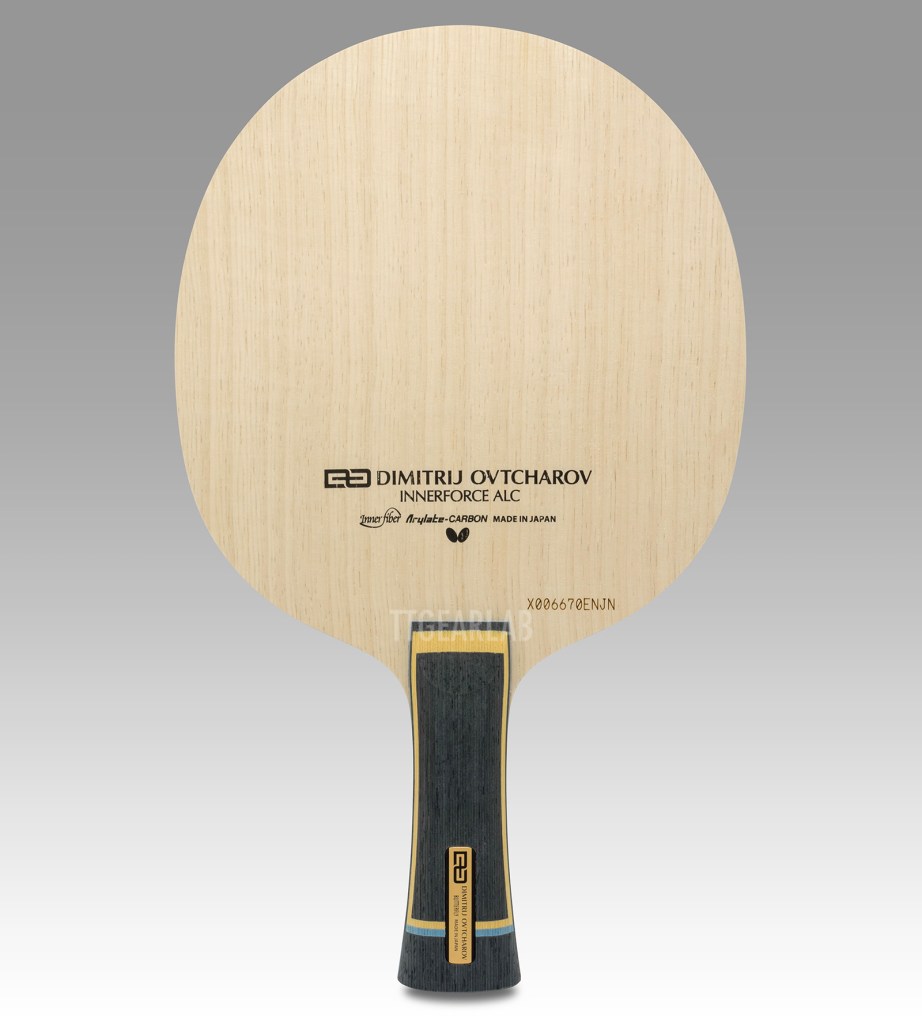
‘Ovtcharov InnerForce ALC’ is the blade developed by the cooperation with Dimitrij Ovtcharov, and exclusive design for Dimitrij Ovtcharov is applied to it.
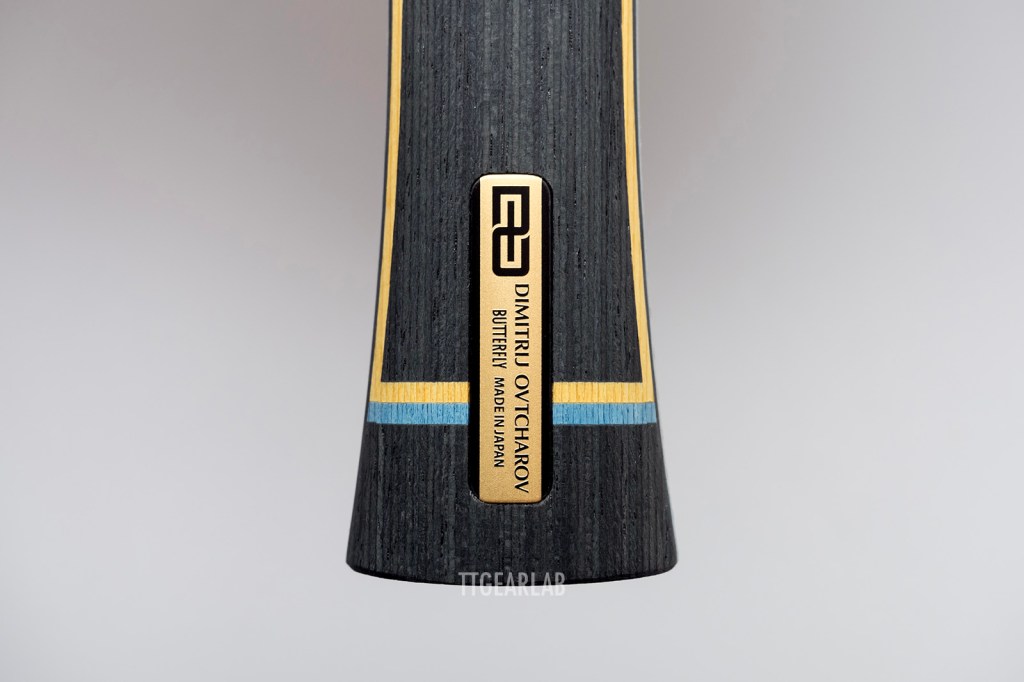
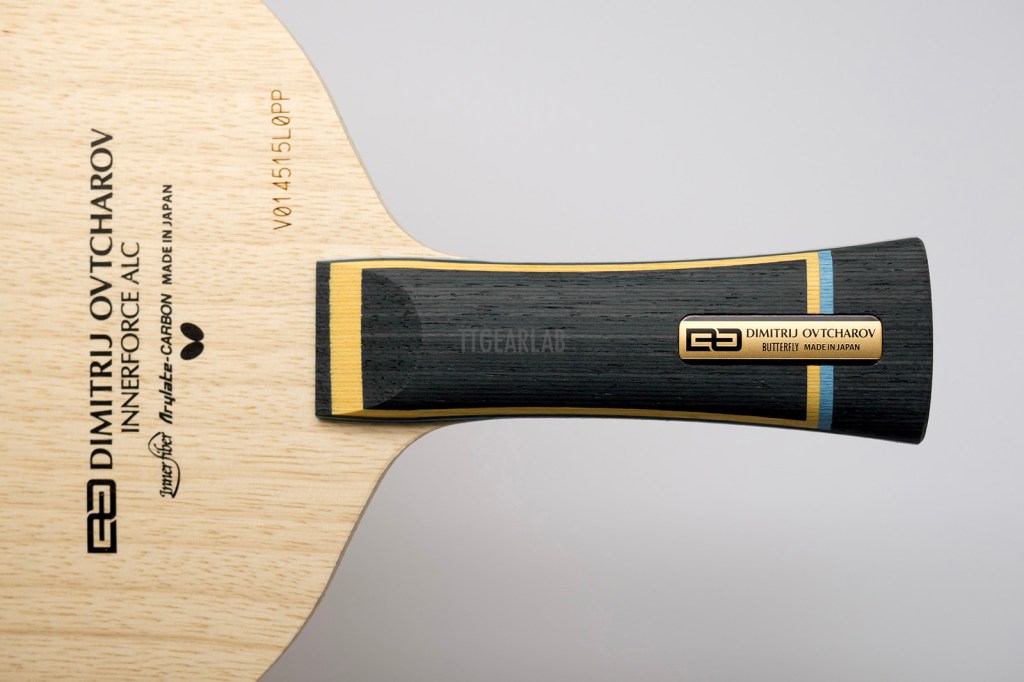
The exclusive logo expresses ‘∞ (infinity)’ and the initials of Dimitrij Ovtcharov (D & O) at the same time. It represents the unlimited possibilities. The main color of the handle is black, and accent colors are light blue that represents ALC and gold that symbolizes victory. Gold is also applied to the Aluminum panel at the foreside of handle. It is expected that this graphic design will be also applied to the other blades of ‘Ovtcharov’ series if those are launched in the future.
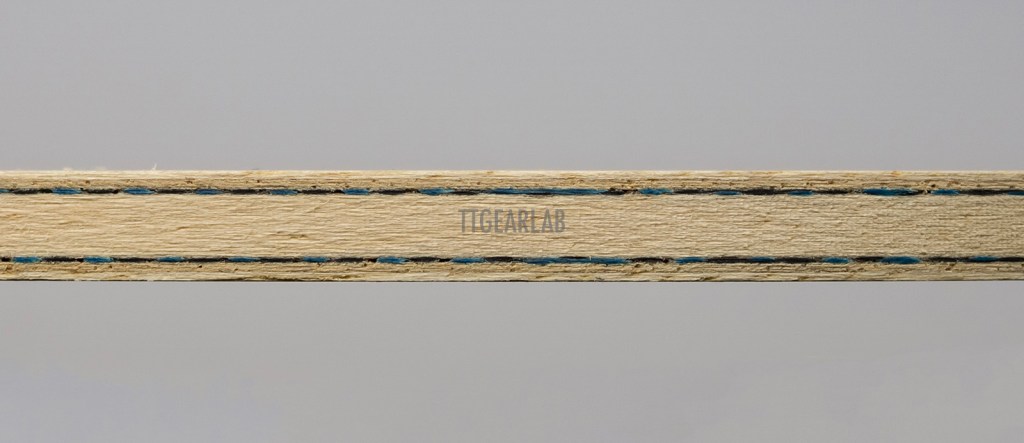
‘Ovtcharov InnerForce ALC’ based on ‘InnerForce Layer ALC’, but many factors has been changed for the improvement of power. Overall thickness has been increased to 6.2mm from 5.9mm of ‘InnerForce Layer ALC’. (Note : The thickness of ‘InnerForce Layer ALC is written as 6.0mm on Butterfly home page. However, its actual thickness measured in 2023 is around 5.9mm. The thickness was 5.7~5.8mm when TTGearLab measured it in 2018. Current version is thicker, heavier and faster than 2018 version.) The size of head is 158mm x 152mm which is enlarged from 157mm x 150mm of ‘InnerForce Layer ALC’. The enlarged head is same as that of ‘Korbel’. The average weight of measured pcs. is 89.2g. (This average weight is lower than that of current ‘InnerForce Layer ALC’.)
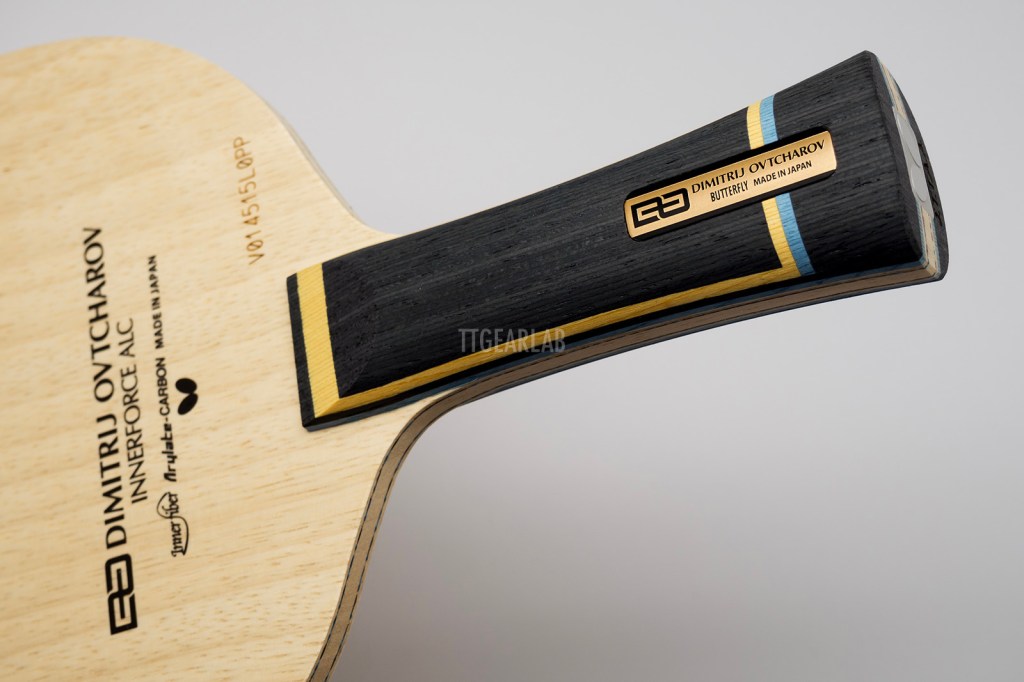
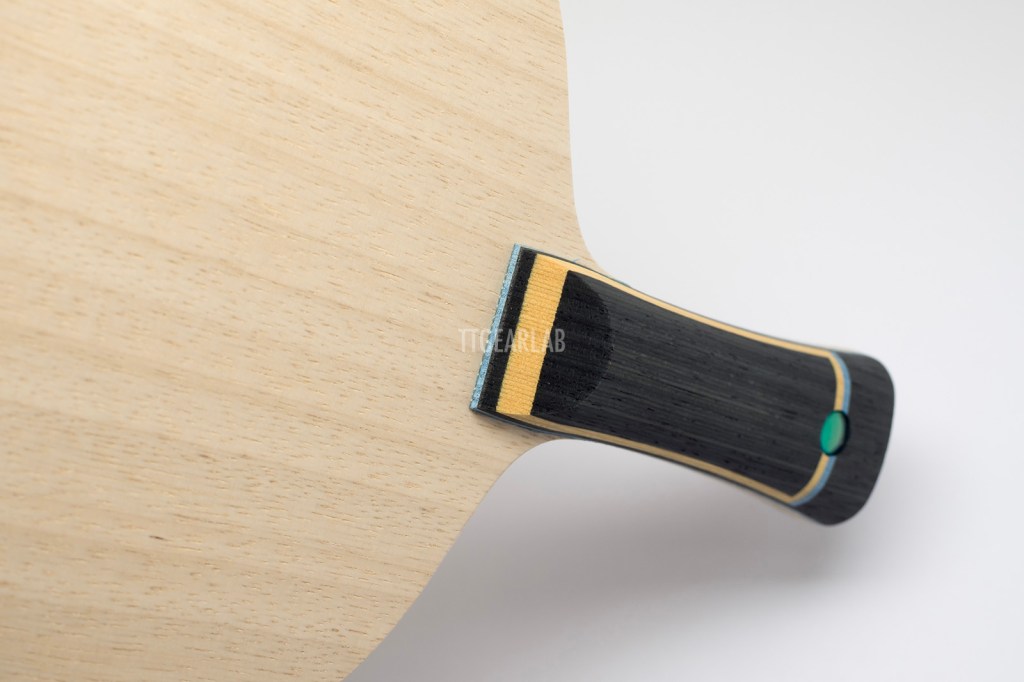
Three kinds of handles – FL (flared), ST (straight) and AN (anatomic) – are available. But, TTGearLab couldn’t get the AN handle version. The FL handle of ‘Ovtcharov InnerForce ALC’ is the standard FL of Butterfly which is also applied to ‘Timo Boll’ series or ‘InnerForce Layer’ series. It is different from the semi-wide FL which is applied to ‘Viscaria’ or ‘Fan Zhendong’ series. Its width is 26.5mm ~ 27.5mm (at bulge) ~ 25.6mm (at the narrowest point) ~ 34mm from the head side to handle end. Its thickness is around 24mm at thumb and around 25mm at the end.
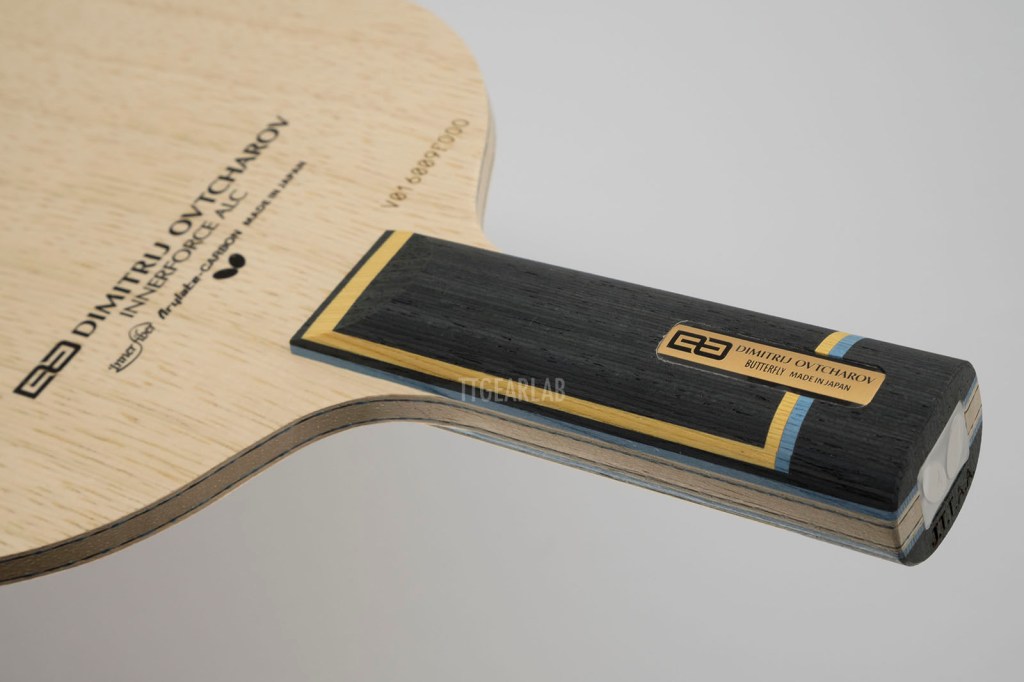
The ST handle of ‘Ovtcharov InnerForce ALC’ is the standard ST of Butterfly which is applied to most of Butterfly blades. It is the semi-wide ST handle whose cross section is a bit rounded. And, it is very similar to the ST handle of ‘InnerForce’ series. Its width is around 28mm, and its thickness is around 23mm.
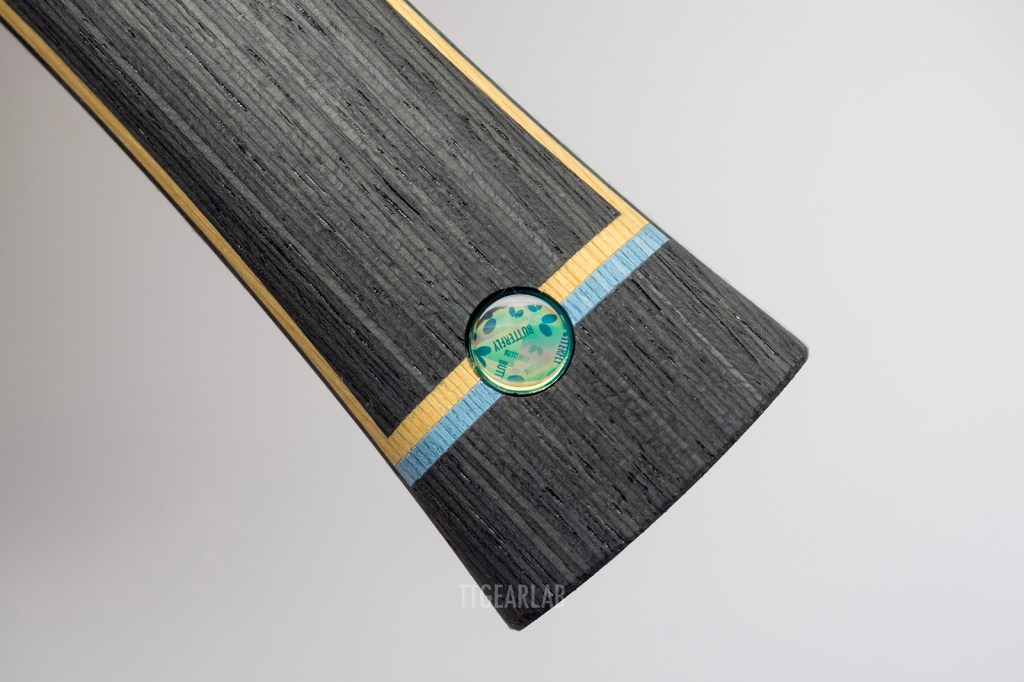
There is small hologram lens at the backside of handle. This small lens started to be applied to Butterfly blades in 2014, and has become one of the identity of Butterfly blades.
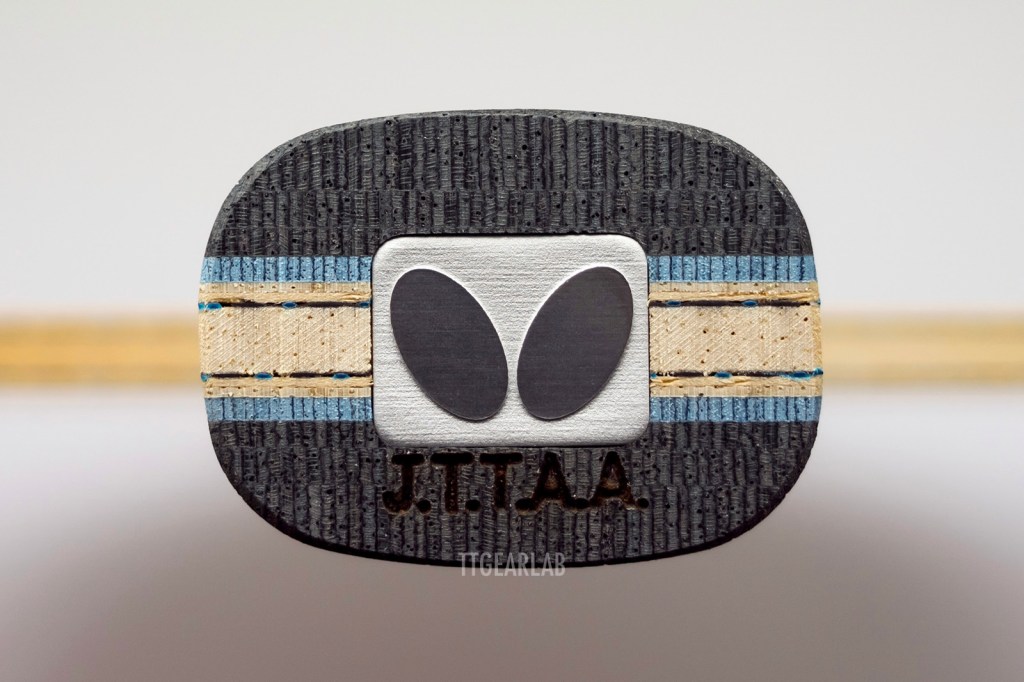
At the end of handle there is a squared logo plate. The new logo without the text ‘Butterfly’ has been applied from 2014.
Then, let’s check the characteristics of ‘Ovtcharov InnerForce ALC’ by Performance Indices and compare with some existing blades.
Please click here to return to top (table of contents)
2. Performance Indices
Performance Indices are measured objective values to represent the characteristics of table tennis gears. Concerning the detail of four performance indices, please refer to following articles in ‘About TTGearLab’ section:
- Performance indices : the way to evaluate blade by measurement
- The example of comparison by performance indices
The performance indices of ‘Ovtcharov InnerForce ALC’ are as follows:
Ovtcharov InnerForce ALC (average weight = 89.2g)
Ep = 2.02
Ec = 1.68 (Ec/Ep = 0.84)
Vp = 1.21
Vl = 1.30 (Vl/Vp = 1.07)
‘Ovtcharov InnerForce ALC’ is an inner-ALC blade as its name indicates. However its primary elasticity index (Ep) exceeds 2.0. It means that ‘Ovtcharov InnerForce ALC’ is much more elastic than standard inner-ALC blades, and looks as fast as many known outer-fiber blades.
Ec/Ep is lower than 0.9. It means that ‘Ovtcharov InnerForce ALC’ holds ball very deeply when the player hits the ball very strongly. It is expected that this characteristics will provide high level of stability under the situation of the rally by topspin.
Vp (Primary Vibration Index) is 1.21. It is noticeably lower than the values of outer-fiber blades such as ‘Viscaria’. Although ‘Ovtcharov InnerForce ALC’ is highly elastic blade, it doesn’t give that hard feeling. And, Vl/Vp (= 1.07) is higher than 1.0, but not extremely high. We can expect that the feeling transferred to index finger is sharper than the primary feeling transferred to palm, but the difference is moderate.

Please click here to return to top (table of contents)
3. Comparison by Performance Indices
Then we can compare ‘Ovtcharov InnerForce ALC’ with some other blades in the market. The purpose of the comparison is to observe how ‘Ovtcharov InnerForce ALC’ is distinguished from existing inner-ALC blades. For that reason most of blades selected for comparison are inner-ALC blades. And, some other kinds of blades – outer ALC, inner carbon, inner ZLC and 5-ply wood – are additionally selected.
Following is the list of the blades to be compared :
Inner Fiber blades (with Limba top layers)
- Butterfly ‘InnerForce Layer ALC’ (avg. weight = 91.2g) : The standard model of inner-ALC blades – 2023 version which is thicker, heavier and faster than older version measured in 2018
- Tibhar ‘Shang Kun Hybrid AC’ (avg.weight = 88.8g) : Inner-ALC blade that is comparable with ‘InnerForce Layer ALC’
- DHS ‘Hurricane Long 5X’ (avg. weight = 87.6g) : Based on ‘Hurricane Long 5’ (old type) but thicker and faster
- DHS New ‘Hurricane Long 5’ (avg.weight = 88.1g) : Another bestseller of inner-ALC blades
- Xiom ‘36.5 ALXi’ (avg.weight = 87.1g) : Inner-fiber variation of Xiom ‘36.5’ series
Outer Fiber blades (with Koto top layer)
- Butterfly ‘Viscaria’ (avg. weight = 87.1g) : The representative of outer-ALC blade
- DHS ‘506X’ (avg. weight = 87.7g) : Similar construction as ‘Viscaria’
Others
- Stiga ‘Inspira CCF’ (avg.weight = 87.3g) : Inner-Carbon blade which is the base model of ‘Cybershape Carbon’
- Butterfly ‘InnerForce Layer ZLC’ (avg.weight = 89.8g) : Representative of inner-ZLC blades
- Butterfly ‘Korbel’ (avg. weight = 88.7g) : The standard of 5-ply wood offensive blades
3-1. Elasticity Indices
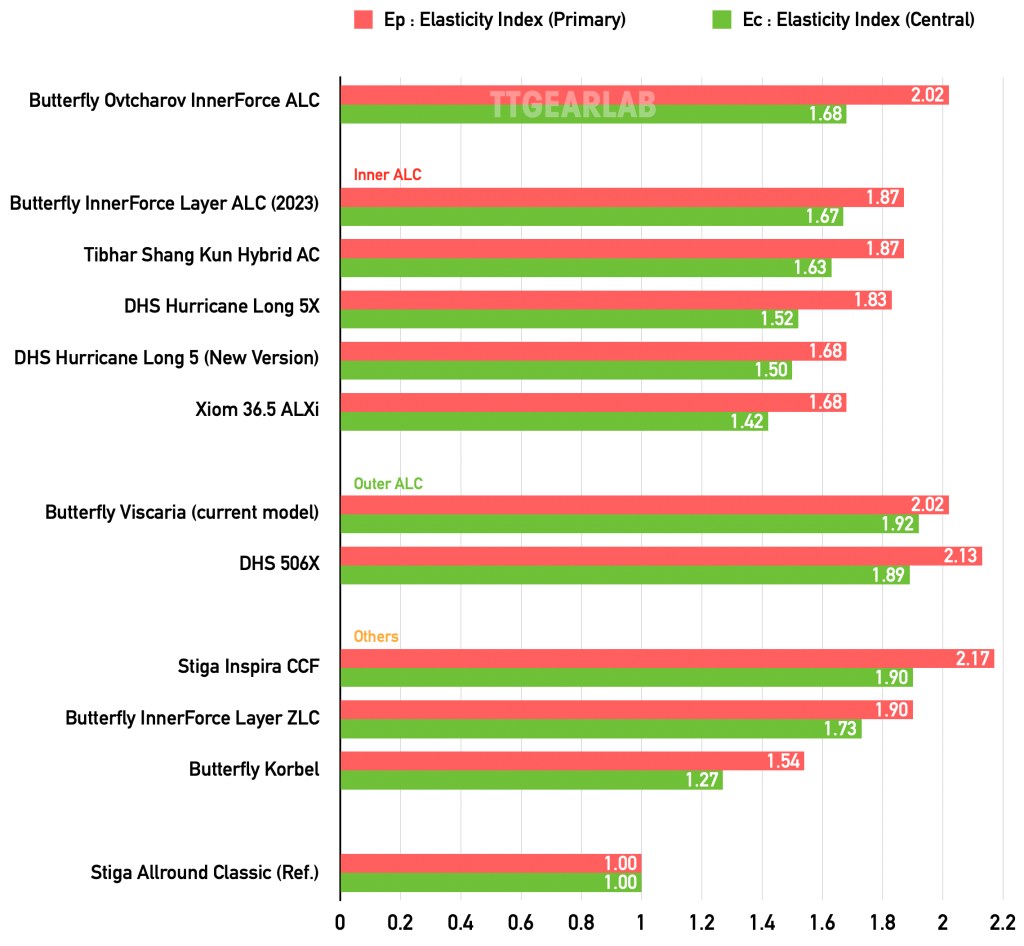
Fig.11 shows the comparison graph of Elasticity Indices.
Ep (Primary Elasticity Index) is directly concerned with the rebound speed of blade. Ec (Central Elasticity Index) is concerned with additional ‘kick’ when player hits ball very strongly.
The first group to be compared is ‘Inner ALC’ group that includes fiver inner ALC blades with Limba top layer. The Ep’s and the Ec’s of the all blades in this group are lower than the Ep and the Ec of ‘Ovtcharov InnerForce ALC’. ‘Ovtcharov InnerForce ALC’ is more elastic than all the inner ALC blades in this comparison. Especially the difference of Ep is noticeable. However, we can notice that the Ec of ‘Ovtcharov InnerForce ALC’ is just a bit higher than the Ec’s of ‘InnerForce Layer ALC’ (2023 version) and ‘Shang Kun Hybrid AC’.
The second group to be compared is ‘Outer ALC’ group that includes two blades – ‘Viscaria’ and ‘506X’. The Ep of ‘Viscaria’ is same as that of ‘Ovtcharov InnerForce ALC’. And, the Ep of ‘506X’ is a bit higher than that of ‘Ovtcharov InnerForce ALC’, but the difference isn’t that significant. We can see that ‘Ovtcharov InnerForce ALC’ provides the same level of the primary elasticity as outer ALC blades. However, the Ec’s of ‘Viacaria’ and ‘506X’ are much higher than that of ‘Ovtcharov InnerForce ALC’. That will be the major difference between outer ALC blades and ‘Ovtcharov InnerForce ALC’.
The third group includes various kinds of blades. ‘Inspira CCF’ is an inner-fiber blade. However, its top layer is Koto while most of inner ALC blades have Limba top layer. And, its fiber isn’t ALC but woven carbon fiber. As a result, its Ep and Ec are even higher than those of ‘Ovtcharov InnerForce ALC’. Although it is an inner-fiber blades, its Elasticity Indices look like those of outer-ALC blade. ‘InnerForce Layer ZLC’ is also an inner-fiber blade, and its artificial material is ZLC (= PBO Carbon) which is more elastic than ALC. However the Ep of ‘InnerForce Layer ZLC’ is noticeably lower than that of ‘Ovtcharov InnerFroce ALC’. But, the Ec of ‘InnerForce Layer ZLC’ is higher than that of ‘Ovtcharov InnerFroce ALC’. Finally, ‘Korbel’ is a 5-ply wood blade. Its Ep can Ec are much lower than all the blades in this comparison (except for the reference blade). But, its Ec is significantly lower than its Ep, and this relationship between Ec and Ep looks similar to that of ‘Ovtcharov InnerForce ALC’.
Examining Ec/Ep is an easier way to understand the characteristics of blade concerned with elasticity. Fig.12 shows the relationship between Ec/Ep and Ep.
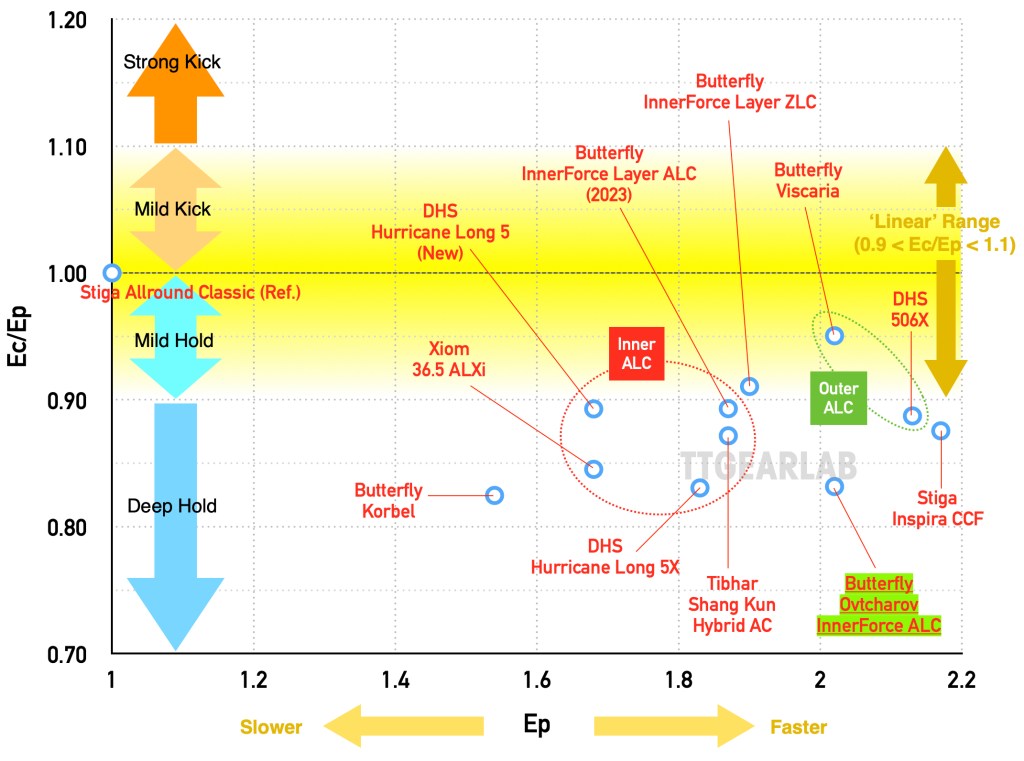
Ec/Ep expresses the ‘tendency’ of the elasticity of blade. By examining Ec/Ep and Ep at the same time, we can easily understand the behavior of blades.
On the graph, all blades in this comparison excluding reference blade are in ‘Hold’ range (Ec/Ep < 1.0). And most of the blades including ‘Ovtcharov InnerForce ALC’ are in ‘Deep Hold’ range (Ec/Ep < 0.9). It means that those blades hold ball very deeply when the player hits the ball very strongly.
We can observe the positions of ‘Ovtcharov InnerForce ALC’ and Inner ALC’ group. Inner ALC’ group is placed at the left side, and ‘Ovtcharov InnerForce ALC’ is at the right side. ‘Ovtcharov InnerForce ALC’ is noticeably more elastic than the blades of ‘Inner ALC’ group. Regarding Ec/Ep, ‘Ovtcharov InnerForce ALC’ is at the same level as ‘36.5 ALXi’ and ‘Hurricane Long 5X’, but at a bit lower position than the other three – ‘InnerForce Layer ALC’ (2023 version), ‘Hurricane Long 5 (New version)’, and ‘Shang Kun Hybrid AC’. We can notice that ‘Ovtcharov InnerForce ALC’ is keeping the ‘Deep Hold’ characteristics of inner ALC blades, although its elasticity is much higher than the other inner ALC blades.
The primary elasticity of the ‘Ovtcharov InnerForce ALC’ is as high as those of outer ALC blades. On the graph, ‘Outer ALC’ group lies directly over the position of ‘Ovtcharov InnerForce ALC’. However, there is significant difference in Ec/Ep. ‘Outer ALC’ group and ‘Ovtcharov InnerForce ALC’ are quite apart in the vertical direction. It means that although ‘Ovtcharov InnerForce ALC’ provides the same level of primary elasticity as outer ALC blades, it holds ball more deeply then outer ALC blades when the player hits the ball very strongly. And, outer ALC blades such as ‘Viscaria’ provides more additional kick in the same situation.
‘Ovtcharov InnerForce ALC’ is basically even more elastic than ‘InnerForce Layer ZLC’, but holds ball more deeply when the player hits ball very hard. Among fast ALC, ‘Harimoto ALC’ and ‘Shang Kun Hybrid ALC’ are closer to ‘InnerForce Layer ZLC’ than ‘Ovtcharove InnerForce ALC’. (But, there is significant difference in feeling which will be observed in following section.) ‘Inspira CCF’ is very close to ‘506X’ which is an outer ALC blade. It provides higher primary elasticity and more additional kick than ‘Ovtcharov InnerForce ALC’.
‘Korbel’ lies at the almost same level of Ec/Ep as ‘Ovtcharov InnerForce ALC’ (and also at the same level as ‘36.5 ALXi’ and ‘Hurricane Long 5X’). It means that ‘Ovtcharov InnerForce ALC’ can be seriously considered when the player like the behavior of ‘Korbel’ but wants to significantly increase the elasticity of blade. If the player wants to increase the elasticity of blade just a bit, ‘36.5 ALXi’ will be better solution.
Then next, let’s compare Vibration Indices.
Please click here to return to top (table of contents)
3-2. Vibration Indices
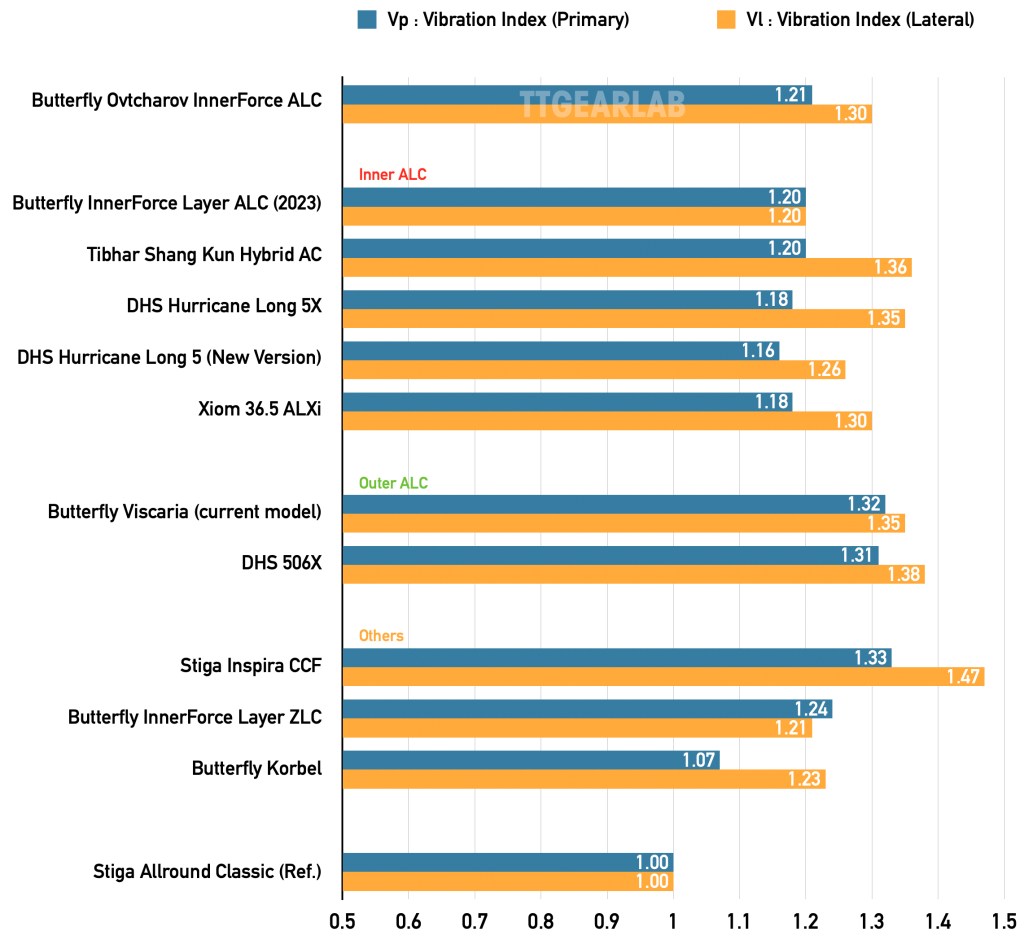
Fig.13 shows the comparison graph of Vibration Indices. Vibration Indices are concerned with feeling. Vp indicates primary feeling which is transferred to player’s palm. And, Vl is the feeling at the edge of the wing – the lower side of blade head. It is felt by player’s index finger or middle finger.
The five blades in the first group (=’Inner ALC’ group) shows a bit lower Vp’s than ‘Ovtcharov InnerForce ALC’, but there is only tiny difference. Regarding Vl, only the Vl of InnerForce Layer ALC’ is noticeably lower than that of ‘Ovtcharov InnerForce ALC’. The Vl’s of the other four models are similar to or higher than that of ‘Ovtcharov InnerForce ALC’. Although there are differences, the vibration characteristics of ‘Ovtcharov InnerForce ALC’ look quite close to those of the other inner ALC blades (excluding ‘InnerForce Layer ALC’ whose graph shape looks somewhat different.) So we are able to tell that ‘Ovtcharov InnerForce ALC’ is as soft as the standard inner ALC blades.
But, the Vp’s of the two blades in ‘Outer ALC’ group are apparently different from that of ‘Ovtcharov InnerForce ALC’. We can notice that ‘Ovtcharov InnerForce ALC’ is much softer than outer ALC blades. And, the Vl of ‘Ovtcharov InnerForce ALC’ is also lower than those of outer ALC blade. The difference isn’t big, but noticeable.
‘Inspira CCF’ and ‘InnerForce Layer ZLC’ are quite different from ‘Ovtcharov InnerForce ALC’ in this comparison. ‘Inspira CCF’ is noticeably harder than ‘Ovtcharov InnerForce ALC’ in every aspect. Its Vl is even higher than those of outer ALC blades. ‘InnerForce Layer ZLC’ shows a bit higher Vp and much lower Vl than ‘Ovtcharov InnerForce ALC’. Basically it is a bit harder than ‘Ovtcharov InnerForce ALC’, but the players who are more sensitive to lateral feeling will think that ‘InnerForce Layer ZLC’ is softer.
Examining Vl/Vp is an easier way for the comparison of the tendency of feeling. Fig.14 shows the relationship between Vl/Vp and Vp for easier comparison.
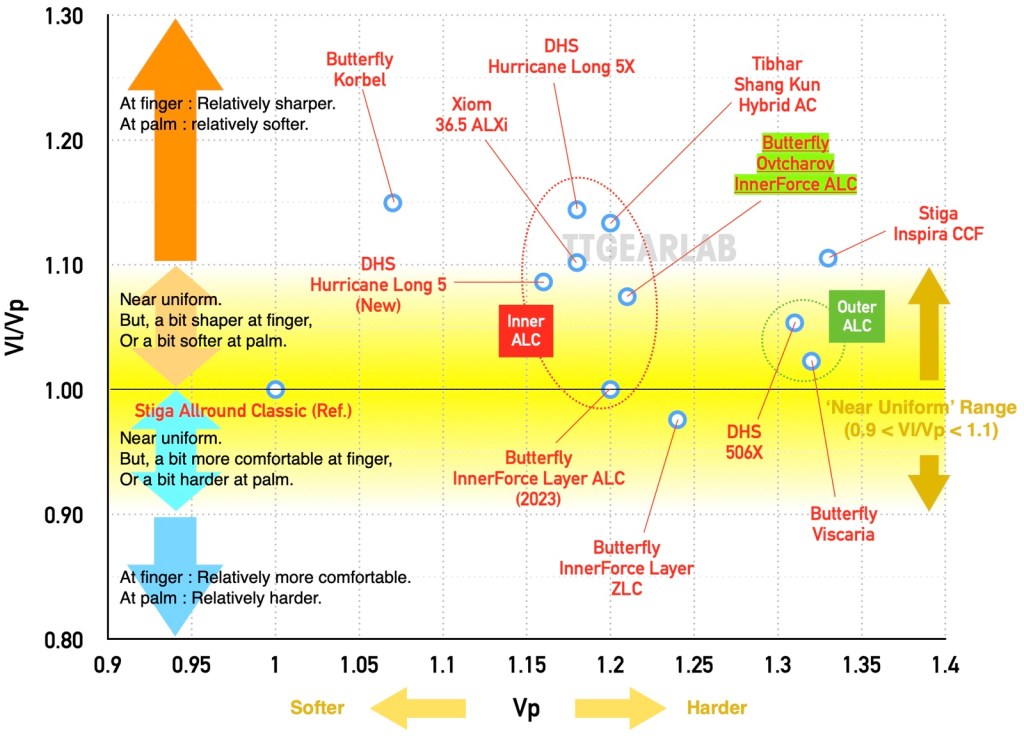
On the graph, all blades excluding two (including reference blade) in this comparison are placed in upper part of the graph – ‘Relatively sharper at finger’ range.
‘Ovtcharov InnerForce ALC’ is located in the middle of the upper part (Vl/Vp > 1.00). That position is in the range of ‘Inner ALC’ group. In ‘Inner ALC’ group, the blades are vertically distributed, while the differences in lateral position are small. ‘Ovtcharov InnerForce ALC’ is located under ‘Hurricane Long 5X’ and ‘Shang Kun Hybrid AC’ and over ‘InnerForce Layer ALC’ (2023 version). So there will be many players who feel that ‘Ovtcharov InnerForce Layer’ is more comfortable than ‘Hurricane Long 5X’ and ‘Shang Kun Hybrid AC’, and sharper than ‘InnerForce Layer ALC’ (2023 version). And, we can also observe that the Vl/Vp of ‘Ovtcharov InnerForce ALC’ is at the same level as those of ‘Hurricane Long 5’ (new version) and ‘36.5 ALXi’. Although the primary feeling of ‘Ovtcharov InnerForce ALC’ is a bit harder than those two blades, there will be many players who feel that ”Ovtcharov InenrForce ALC’ is as comfortable as ‘Hurricane Long 5’ (new version) and ‘36.5 ALXi’.
‘Outer ALC’ group lies far to the right of ‘Ovtcharov InnerForce ALC’. The primary feeling of outer ALC group is much harder than that of ‘Ovtcharov InnerForce ALC’. Although the Vl/Vp’s of outer ALC blades are lower than that of ‘Ovtcharov InnerForce ALC’, players will clearly feel that ‘Ovtcharov InnerForce ALC’ is much softer than outer ALC due to the big difference of Vp.
‘Inspira CCF’ is a much harder than ‘Ovtcharov InnerForce ALC’. And, its Vl/Vp is also higher than that of ‘Ovtcharov InnerForce ALC’. That is because of its harder top layer and harder fiber material. And, ‘InnerForce Layer ZLC’ is harder than ‘Ovtcharov InnerForce ALC’ but its relative feeling at finger is more comfortable than ‘Ovtcharov InnerForce ALC’. If a player want to enhance the elasticity of ‘InnerForce Layer ALC’, ‘Inspira CCF’ may be too excessive and ‘InnerForce Layer ZLC’ gives much different relative feeling. But, ‘Ovtcharov InnerForce ALC’ can be the optimum solution for that player.
Please click here to return to top (table of contents)
4. Field Test
‘Ovtcharov InnerForce ALC’ has been briefly tested at table tennis court. The test wasn’t an intensive one, and not many kinds of rubbers were combined. However, it was sufficient to find out the basic characteristics of the blade. The rubbers used for the testing are ‘Tenergy 05’, ‘Dignics 05’ and some other rubbers with harder or softer sponges. The sticky rubbers such ‘Glazer 09c’ and ‘Hybrid K3’ have also been used.
The hitting feeling of ‘Ovtcharov InnerForce ALC’ is a bit harder than that of standard inner ALC blade such as ‘InnerForce Layer ALC’. However, it is much softer than the feeling of outer fiber blades such as ‘Viscaria’. And, ‘Ovtcharov InnerForce ALC’ provides very clear and pleasant feeling like ‘Hurricane Long 5’ (new version). Further, there isn’t any sense of incongruity that can be sometimes felt by ‘Viscaria’ or ‘Timo Boll ALC’. So the overall feeling of ‘Ovtcharov InnerForce ALC’ is very good. However, because it is much thicker than ‘InnerForce Layer ALC’ or ‘Viscaria’ whose thicknesses are 5.7~5.8mm, the precise control of the on-table techniques can be somewhat difficult for some time after the change to ‘Ovtcharov InnerForce ALC’ from thinner blade. Of course, that problem can be solved by adapting over time because it isn’t excessively thick.
The speed of the ball is quite high even in light hitting at close-to-table area. The player can make quite fast ball without effort. And, there isn’t any difficult of control thanks to the soft and stable feeling. Further, there isn’t the need of careful adjustment of the angle of racket. On the contrary, the ability of precise control of ball placing is somewhat questionable. That is the common result from various kinds of rubbers. Anyway, thanks to its excellent stability and safety,iIt is expected that even the entry level players will be able to easily use ‘Ovtcharov InnerForce ALC’.
Topspin from mid-distance area is very powerful. The ball easily draws long trajectory, and stretches out strongly after the bounce. And, the feeling of holding the ball firmly and releasing it gives a great sense of security. Therefore, the rally of topspin against topspin at mid-distance area is comfortable. The ability of topspin at mid-distance area is much higher than that of standard inner ALC blades such as ‘InnerForce Layer ALC’. It is expected that top players or skilled amateur players who lay emphasis on power of topspin will like ‘Ovtcharov InnerForce ALC’.
The topspin at close-to-table area is also good. ‘Ovtcharov InnerForce ALC’ makes more powerful ball than standard inner ALC blades when performing fast topspin. In case the player performs high loop at close-to-table area, ‘Ovtcharov InnerForce ALC’ also gives good feeling and puts ample rotation to the ball, although the feeling is less clear and the amount of spin is smaller if compared with standard inner ALC blades. There is little room for complaint in the topspin technique, regardless of type of topspin and the position of player. But, because the ability of fast topspin is so good, there will not be much reason to frequently use high loop. Probably, the playing style of Dimitrij Ovtcharov who always try to take the initiative of the rally by powerful ball is reflected in the characteristics of the blade.
When performing block against topspin, ‘Ovtcharov InnerForce ALC’ tends to once catch the ball and shoots it strongly next moment. So the player can put pressure to the opponents, but the problem is that the precise ball placement is somewhat difficult. The solution is to put topspin to the ball actively. By putting topspin to the ball, the player can greatly increase the stability and the control of block. It is also good to actively use counter-topspin instead of block if the skill level of the player is high.
The smash is more effective than that from existing inner ALC blades. So the player will be able to actively use smash as finishing stroke. The ‘Deep Hold’ characteristics of ‘Ovtcharov InnerForce ALC’ isn’t a problem because the primary elasticity of ‘Ovtcharov InnerForce ALC’ is very high, and it just adds the stability of smash. Overall feeling of smash by ‘Ovtcharov InnerForce ALC’ is much more pleasant than that by existing inner ALC blades.
Push is normal. That is because ‘Ovtcharov InnerForce ALC’ isn’t a blade that focuses on the ability of dragging ball. Therefore the push by ‘Ovtcharov InnerForce ALC’ isn’t especially sharp. However, the good point is that the control and the stability of push is better than that by outer ALC blades. Stop is also normal. It isn’t especially easy or difficult. There will not be any problem in performing stop if the player has basic skill of stop. Differently from push and stop, flick shows very strong character. Flick from ‘Ovtcharov InnerForce ALC’ is highly safe, and it is easy to make fast ball. Therefore the player can easily take the initiative of the rally by pre-emptive attack. Here we can again understand that ‘Ovtcharov InnerForce ALC’ is the blade for the aggressive offensive player.
Regarding the combination, the new generation tension rubbers those focuses on spin and equipped with medium hard sponges (= 45~50° in German standard & 34~38 in Butterfly standard) are recommended first. For example ‘Tenergy 05’ or ‘Evolution MX-P’. And, the players will be able to adjust to different rubbers following the personal preference or playing characteristics. In case the player is highly skilled and at the same time requires more power, recent top models such as ‘Dignics 05’, ‘Evolution MX-D’ or ‘Rasanter R53’ will be considerable. And, if the player needs better control, the rubbers with softer sponges can be considerable. One advantage of ‘Ovtcharov InnerForce ALC’ is the freedom of combination. TTgearLab couldn’t have found the rubber that especially cause trouble with ‘Ovtcharov InnerForce ALC’. Although not all existing rubbers have been used for the testing, it is expected that the players will only have to pay attention to the characteristics of the rubber itself.
Recent sticky tension rubbers are also seriously considerable. The examples are ‘Dignics 09c’, ‘BlueStar’ and ‘Hybrid K3’. When combined with ‘Ovtcharov InnerForce ALC’, those rubbers make the topspin at close-to-table area or mid-distance very easy and at the same time powerful. Further, the precision of control of push and stop is noticeably enhanced. Those new sticky rubbers can be attached not only to the forehand side but also to the backhand side. In case those rubbers are attached to the backhand side of ‘Ovtcharov InnerForce ALC’, the speed of block is reduced, but that is good point because it makes the block easier. In fact, the precision of control isn’t as good as the case that those rubbers are combined with outer ALC blades such as ‘Viscaria’ or ‘506X’. But, the combination with ‘Ovtcharov InnerForce ALC’ gives more secure feeling because of the softness of ‘Ovtcharov InnerForce ALC’.
The overall impression of ‘Ovtcharov InnerForce ALC’ is that it provides power and secure feeling at the same time. It makes the player easily take the initiative of rally by continuous powerful attack. Of course there are some aspects sacrificed to realize such characteristics with inner fiber construction – for example the rotation of high loop. But, those are all within acceptable range, and don’t become a problem if we consider the purpose of this blade. So it can be concluded that ‘Ovtcharov InnerForce ALC’ is a very well adjusted blade for the intended playing style.
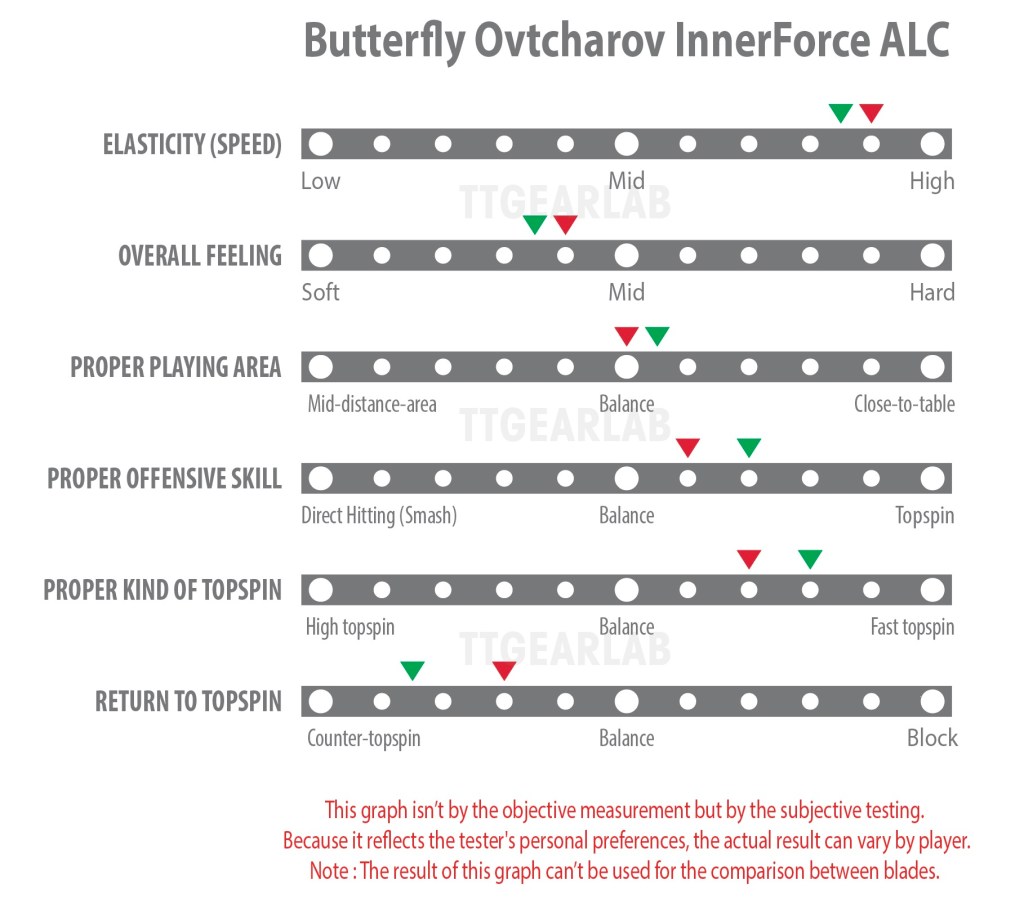
Below is the testers’ opinions on the ‘Ovtcharov InnerForce ALC’. Testers are distinguished by the color of indicator. (Red and green.) Please don’t forget that this evaluation can’t be used for the comparison with the other blades, because the result is influenced by the characteristics of testers, and the condition of testing always varies.
Please click here to return to top (table of contents)
5. Summary
Butterfly ‘Ovtcharov InnerForce ALC’ is the blade specially developed for Dimitrij Ovtcharov. As its name indicates, its artificial material is ALC (= Arylate Carbon) which is inserted between the middle layer and the center layer.
Thanks to its thickened construction ‘Ovtcharov InnerForce ALC’ provides higher speed than existing inner ALC blades, and is as fast as outer ALC blades. However, it holds the ball very deeply when the player hits the ball very hard, like existing inner ALC blades or 5-ply wood blades.
The feeling of ‘Ovtcharov InnerForce ALC’ is just a bit harder than existing inner ALC blades, and is much softer than that of outer ALC blades. And, the distribution of feeling is near uniform. The feeling at index finger is a bit sharper than the primary feeling transferred to the palm.
In actual testing at court, the topspin at close-to-table area or from mid-distance area is very powerful and at the same time safe & secure. Therefore the player can keep the initiative of rally by continuing powerful attack by topspin.
‘Ovtcharov InnerForce ALC’ makes good harmony with various kinds of rubbers. For that reason, the player can select rubber just following the personal preference or playing style. Recent sticky tension rubbers will also make good combination with ‘Ovtcharov InnerForce ALC’.
PROS :
- As powerful as outer ALC blades, and at the same time as controllable as inner ALC blades.
- Despite its thick construction, it isn’t much heavier than standard inner ALC blades.
- Good harmony with various kinds of rubbers.
CONS :
- Because its head is a bit bigger than standard size, the center of weight may shift more towards the head after attaching rubbers.
- At the beginning, the precise control of on-table-techniques may be somewhat difficult because of its thicker construction than standard inner ALC blades or outer ALC blades.
- High topspin is less satisfactory than fast topspin.
VERDICT :
- A blade that provides high power and good control at the same time.
RECOMMENDATION :
- The players who need a fast blade but couldn’t have selected proper one due to hard feeling.
Please click here to return to top (table of contents)
[AD] You can buy Butterfly ‘Ovtcharov InnerForce ALC’ at megaspin.net :
Please click here to return to top (table of contents)


Another great review, thanks! It seems like an interesting option, considering that it matches with various rubbers. I wondered how this compares with the Ovtcharov Donic series, but it seems it is way faster and more powerful.
LikeLike
I haven’t checked the Donic version yet. If I have a chance I want to check Donic Original No.1 once.
LikeLiked by 1 person
Thanks for this great review. Really like this new setup.
Blade looks amazing, but it’s also too fast for me.
LikeLike
I love this blog, thanks for this awesome review. You could make a comparison between Harimoto ALC, Ovtcharov ALC and Innerforce Layer. Which is faster ?
LikeLike
Thank you for comment.
When Harimoto ALC was released, I compared it with InnerForce Layer ALC at that time, and Harimoto ALC was thicker than InnerForce ALC.
However, I checked InnerForce ALC in this year. And, noticed that current InnerForce ALC isn’t different from Harimoto ALC except for the head size. So, Harimoto ALC can be considered as InnerForce ALC with enlarged head now. Then there isn’t much difference in speed. Because of the higher position of center of weight due to bigger head, Harimoto ALC can be somewhat faster although there isn’t difference in elasticity. However, there isn’t noticeably difference in elasticity.
On the contrary, Ovtcharov InnerForce ALC is thicker and faster than InnerForce Layer ALC. The difference may be smaller than expected. However, anyway It is fundamentally faster than InnerForce Layer ALC in case the weight is identical.
LikeLike
Excellent. The comparison is very clear to me. I appreciate your time to answer my question. thank you
LikeLike
Thank you a lot for visiting this HP and leaving your question. 🙂
LikeLike
Is there a comparison with the harimoto alc?
LikeLike
Originally the comparison was done with Harimoto ALC. However, becasue current (2023) version of InnerForce Layer ALC isn’t much different from Harimoto ALC, I replaced Harimoto ALC with InnerForce Layer ALC.
The blade construction of Harimoto ALC is identical to current InnerForce Layer ALC, and if the weight is similar there isn’t meaningful difference in elasticity and feeling. A bit different. But, it falls withing the margin of deviation by piece. One advantage/disadvantage of Harimoto ALC is that it becomes more heavy when rubbers are attached because of bigger head even though in case the weight of blade is same. It will make it a bit more powerful when the player with sufficient physical power uses it.
To make everything more clear, I will get new pcs. of Harimoto ALC and compare it with InnerForce Layer ALC again. But, it will take some time, and I wonder whether it will be meaningful or not.
LikeLike
Thank you again for your extremely good and helpful work.
There is one little thing that I am missing and what would make your work the most powerful tool to choose tabletennis-equipment, especially blades: a table or a chart which contains all already tested and measured blades.
Some reference-blades are visible in all of your charts, but some disappear, I guess because of the complexity of the charts. This makes it sometimes more difficult to compare them, when they appear in different reviews. Two single charts about all (one for the E-values, one for the V-values) or a table of all measured values would make it much easier to compare.
LikeLiked by 1 person
Sorry for another question, but it might be important:
What “Korbel”-blade is your reference-blade? Is it the european or the japanese version? The japanese version is a little bit faster than the european version (resource: Butterfly catalogue).
Thanks again for your great work.
LikeLike
All pcs. of Korbel I have are Japanese. I don’t have European version of Korbel.
And, the table of all measured values are under construction. You will be able to see it soon. Remaining issue is just the structure of home page. I haven’t decided to the menu structure for showing that information.
LikeLike
Thank you very much for your praise! I’m glad you found my blog comments to be the most professional and objective you’ve come across.
Regarding your question about the feeling of the Ovtcharov ALC and Viscaria blades, the comment mentioned that the grip feeling of the Ovtcharov ALC is higher than that of the outer ALC series. However, based on my own experience, I clearly feel that the Ovtcharov ALC is stiffer compared to the various outer ALC series, and the grip feeling is not as pronounced as in the outer ALC series. Do you have similar feelings about this?
LikeLike
Interesting that it seems to have a lot in common with the W968 from dhs. I’m glad I went with this when I made a recent purchase.
LikeLike
Ovtcharov InnerForce ALC is one of the first recommended blades in TTGearLab. (But, not for the players who don’t like its slightly bigger head than regularly sized blades.)
BTW, Donic Original No.1 has more common features with W968. That model is even produced by DHS. 🙂 It will be even more interesting if you compare Donic Original No.1 with Ovtcharov InnerForce ALC.
LikeLike
que combinación de gomas creen que andarían bien en un Ovtcharov? Use la xiom Omega VII Pro y no me gustó nada, siento que salta mucho, en cambio la Tibhar EL-P mejoro mucho mi revés.
Saludos
LikeLike
In fact, Omega VII Pro makes a very good combination with Ovtcharov InnerForce ALC. But, not for all players. Although Ovtcharov InnerFroce ALC hugs the ball very deeply, its basic elasticity is quite high, and may be too high for some players.
There isn’t right answer, and I don’t know your characteristics. But, if Evolution EL-P is satisfactory when you combine it for backhand side, probably the rubber with medium soft sponge will be good solution. I recommend you to once use EL-P also for forehand side and check the result.
LikeLike
Justice Cane
I recently assembled a Dimitri Ovtcharov ALC (ST) paired with Dignics 09c on my forehand and Dignics 05 on backhand.My initial impression when I first tested the blade as compared to the one i have already been using, the Zhang Jike ALC with Tenergy 80 and Dignics 09c, Ovtcharov ALC really feels stiff and faster compared to my zhang jike set up.
Sir, is my observation correct? Do you have suggestions as to how to adjust properly with this blade?
Thank you and more power!
LikeLike
Thank you for comment. In fact the result of combination depends on the preference or character of each player. Especially between the blades with similar speed (for example Zhang Jike ALC and Ovtcharov InnerForce ALC) the result can dramatically vary by player. Ovtcharov InnerForce ALC is a fast blade, and it is as fast as Zhang Jike ALC. But, we can’t say that it is ‘definitely’ faster than Zhang Jike ALC or Viscaria.
In my personal opinion, the combination of Dignics 09c and Zhang Jike ALC fits for the playing style that lays emphasis on the precision of ball placement, while the combination of Dignics 09c with Ovtcharov InnerForce ALC fits for the playing style that lays emphasis on the flying distance of ball. So it is possible that many players will feel that the combination with Ovtcharov InnerForce ALC is faster than the combination with Zhang Jike ALC. But, not all players will agree with it.
In my personal opinion, what can determine your adjustment will be the playing distance from table. If you play at close-to-table area I recommend Zhang Jike ALC. But, if you mainly play at mid-distance area, probably Ovtcharov InnerForce ALC will be better. This recommendation can’t be applied for every player. But, I think that it can be a good criteria at least for you.
LikeLike
Hi! What do you think of this blade for pimple players? Is the deep hold good for control, or will the ball rebound too quickly?
LikeLike
Basically the ‘Deep Hold’ isn’t good for shorp pips.
If you want to use short pips, InnerForce Layer ZLC will be better than this blade in my opinion.
LikeLike
great works! great review!
Is the thickness of the FL handle a bit more thicker than timoboll alc?
I found from the website that timoboll alc is 24 mm thick and Ovtcharov innerforce alc is 25 mm thick.
LikeLiked by 1 person
Thank you for comment.
I have had some samples of Timo Boll ALC and Ovtcharov InnerForce ALC in FL handles. And, Ovtcharov InnerForce ALC FL is a bit thicker than Timo Boll ALC FL.
The thickness of Ovtcharov InnerForce ALC FL is over 25.0mm at the end, and over 24.0mm at thumb, while the thickness of Timo Boll ALC FL is around 24.0mm at the end.
Please note that both of those two are based on same shape (= Butterfly standard FL), and the actual thickness can change by the period of production. So, there may be Ovtcharov InnerForce ALC FL whose handle thickness is under 25mm at the end. However, I expect that it will still be thicker than Timo Boll ALC FL.
LikeLike
Thank you for your response!
I have a few questions about the blade dimensions: Do the Timo Boll ALC and Ovtcharov ALC handles share the same width? Also, are they identical in width to the Innerforce Layer ALC and Harimoto ALC? From what I understand, the main difference between these blades is their thickness, with Innerforce ALC, Harimoto ALC, and Ovtcharov ALC being equal in thickness, while the Timo Boll ALC is slightly thinner. Could you please confirm if this is correct?
Thanks again for your help!
LikeLike
Basically all the blades you mentioned share the shape of FL handle. That is the standard FL handle of Butterfly which has tall and narrow cross section.
So the width is all the same if the production is perfectly controlled. But, the actual values can differ by piece becuase there is always deviation by piece.
But, there can be differences in design of thickness. That is because of the differences in blade thickness. Makers try to adjust the thickness of handle part for keeping the total thickness same if there isn’t the needs for making the handle thicker. That is the reason why the FL handle thickness of Ovtcharov InnerForce ALC and that of InnerForce Layer ALC are same although those two are differnt in blade thickness. (The handle part is Ovtcharov InnerForce ALC is thinner, while the blade part of it is thicker.)
I don’t know the reason but the FL handle of Timo Boll ALC is thinner. Catalog is saying that Timo Boll ALC has thinner FL handle (by 1mm). And, it is actually thinner than the FL handles of InnerForce Layer ALC or Ovtcharov InnerForce ALC.
The FL handle of Harimoto ALC is same as that of InnerForce Layer ALC. (The difference betwen those two blades is only in the head size.)
LikeLike
Have you thought of comparing Ovtcharov ALC with Donic JO Waldner Gold Edition? They look kind of similar, even the colour scheme. The price differs for sure. From region to region it could vary much. That could be helpful.
The former is assembled in Korea & they’re putting green arylate in it, which resembles the fiber Joola is using in Vyzaryz/ZHQ line.
BTW bought Ovtcharov in May, after reading your article & looking at your photos)) Totally second every word of your conclusions. Powerful. Soft feeling with Battle 3. Backhand is the strongest(speed to control ratio) of my all blades. Very enjoyable. It does lack surgical precision after Avalox Monoset & Joola Freeze Hard, but using power & spin one can make that simply irrelevant. Thanks!
LikeLiked by 1 person
Thank you for giving information and sharing your experience. Donic J.O.Walnder Gold Edition look similar to andro Synteliac VCI OFF. I have the check whether there is difference in thickness or not. But, if there isn’t difference in actual thickness, probably it will not be meaningfully different from Synteliac VCI OFF. 🙂 (Currently I’m hesitating to get the sample becuase its price is quite high.) And, both of J.O.Walnder Gold Edition and Synteliac VCI OFF are thinner than Ovtcharov InnerForce ALC.
And, it is good to hear that you enjoy your Ovtcharov InnerForce ALC. It is also one of my favorite blades. 🙂 It is really good blade.
LikeLike