| Table of Contents | 1. Overview 2. Performance Indices 3. Comparison by Performance Indices ……. 3-1. Elasticity Indices ……. 3-2. Vibration Indices 4. Summary |
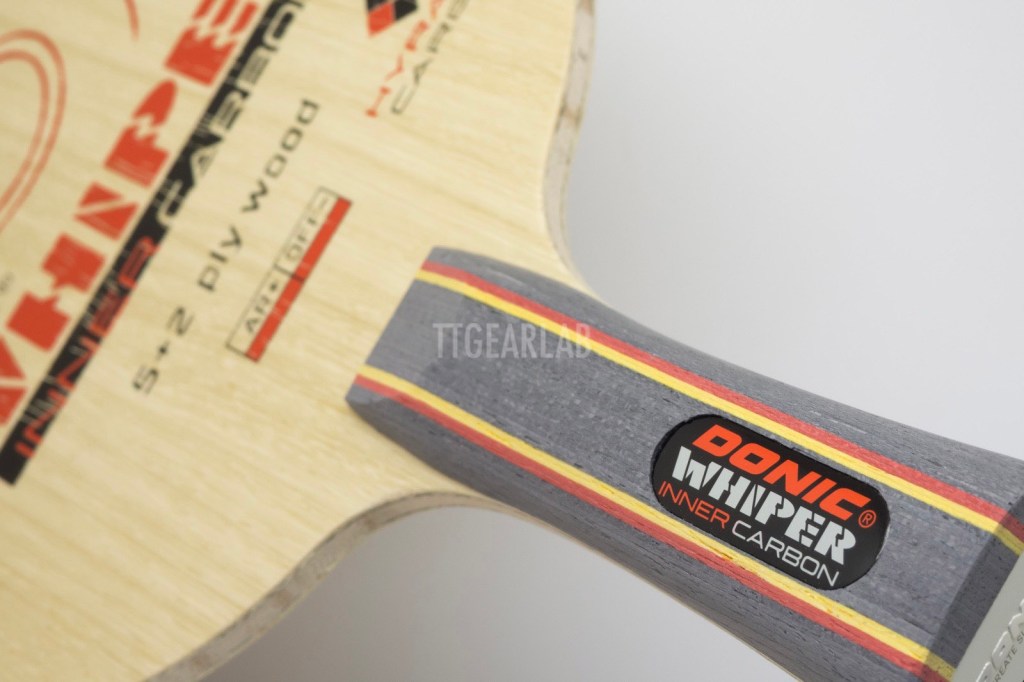
Donic ‘Whiper’ series, released in 2024, is the fiber blade family with the concept of providing professional-level performance at a reasonable price. It consists of two variations using a new artificial material called ‘Hyramid Carbon’. The two products are distinguished by the location of the artificial material – outer and inner. The outer version which has artificial material placed directly under the top layer is ‘Whiper Outer Carbon’, and the inner version which has artificial material placed between the middle layer and the center layer is ‘Whiper Inner Carbon’.
In this article, TTGearLab will analyze two models by Performance Indices, and for further understanding compare those two with some other blades in the market.

1. Overview
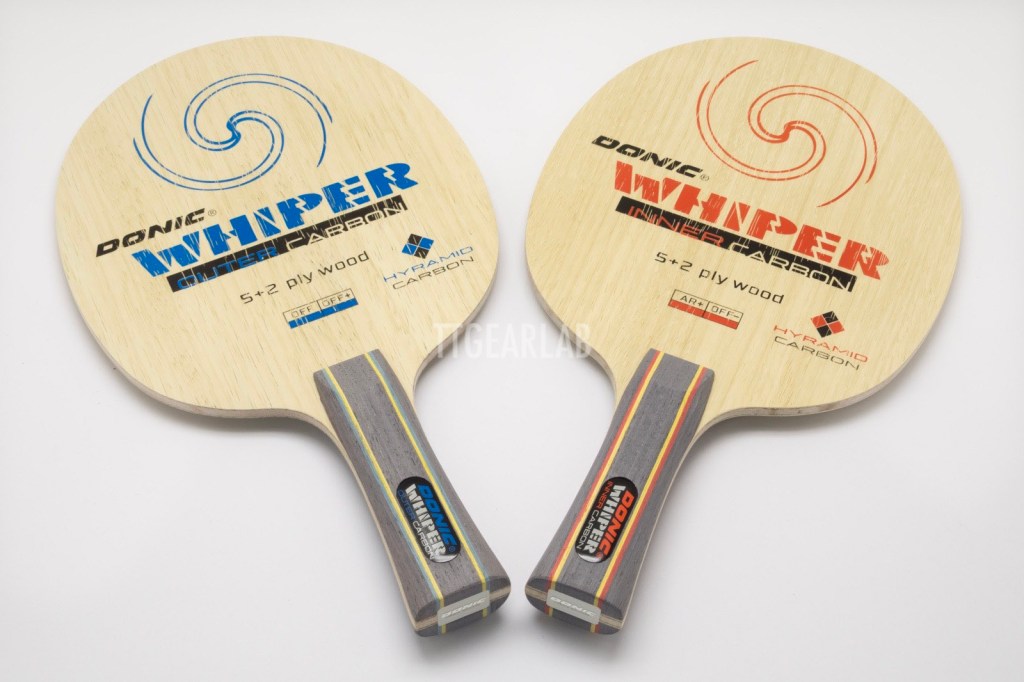
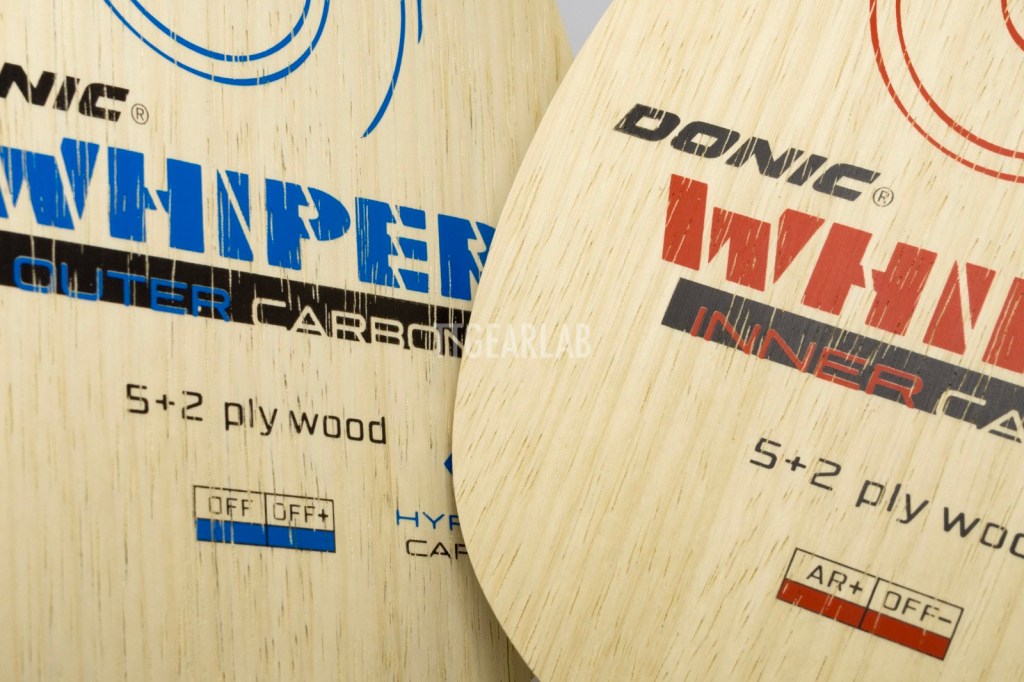
Fig.01 Donic ‘Whiper Outer Carbon’ (left) and ‘Whiper Inner Carbon’ (right)
Donic ‘Whiper’ series is the high cost-performance blade family with the concept of providing professional-level performance at a reasonable price. Two variations –outer-type and inner-type – are available. Left is ‘Whiper Outer Carbon’ which has artificial material directly under its top layer, and right is ‘Whiper Inner Carbon’ which has artificial material between its middle layer and center layer.
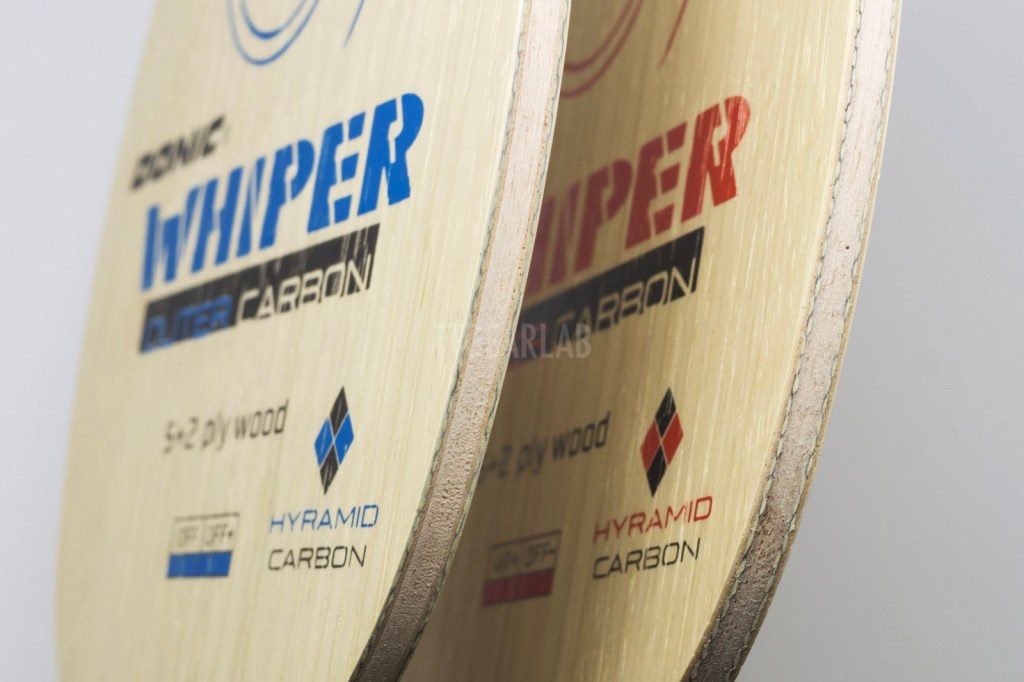
‘Whiper Outer Carbon’ (left) and ‘Whiper Inner Carbon’ (right) share the basic plywood construction (before inserting artificial material), and are distinguished by each other just by the position of artificial fibers.
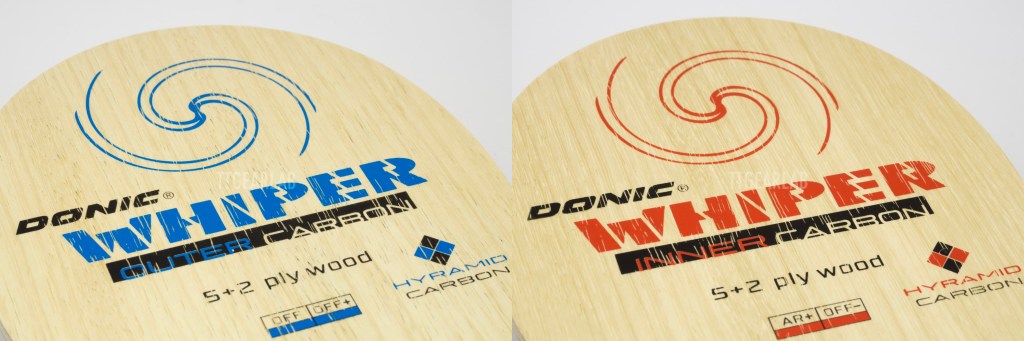
Two models share the design concept, and are distinguished from each other by theme color. The theme colors are blue for ‘Whiper Outer Carbon’ and red for ‘Whiper Inner Carbon’.
1-1. Whiper Outer Carbon
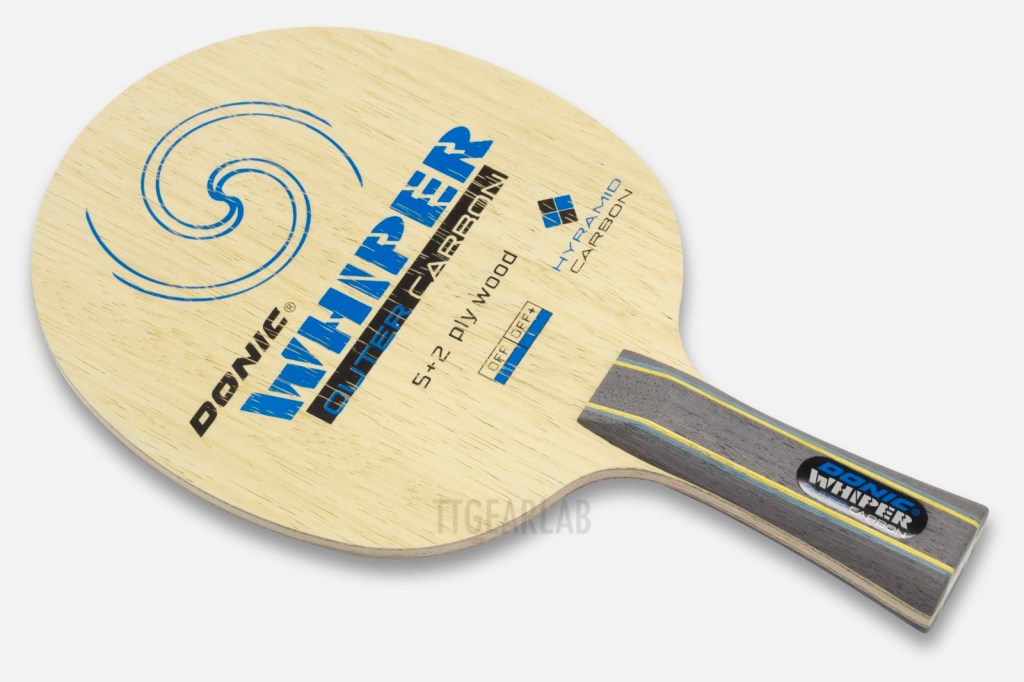
As its name expresses, ‘Whiper Outer Carbon’ is the ‘outer version’ of ‘Whipper’ series. Between two models of ‘Whiper’ series, ‘Whiper Outer Carbon’ is more biased to power.
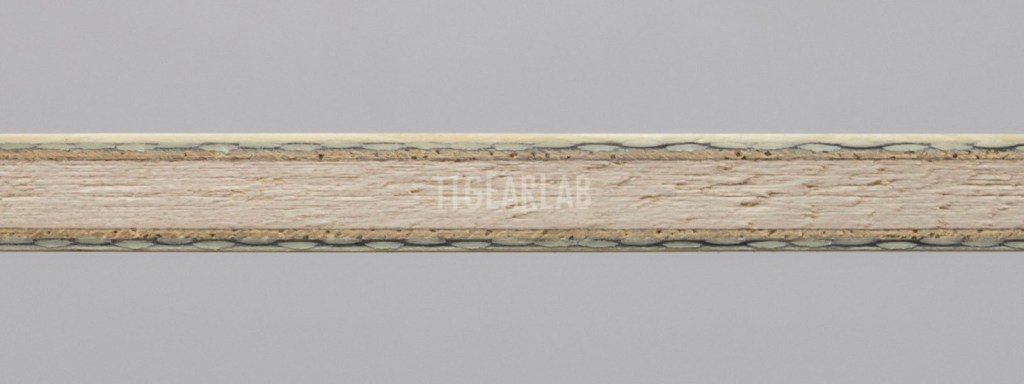
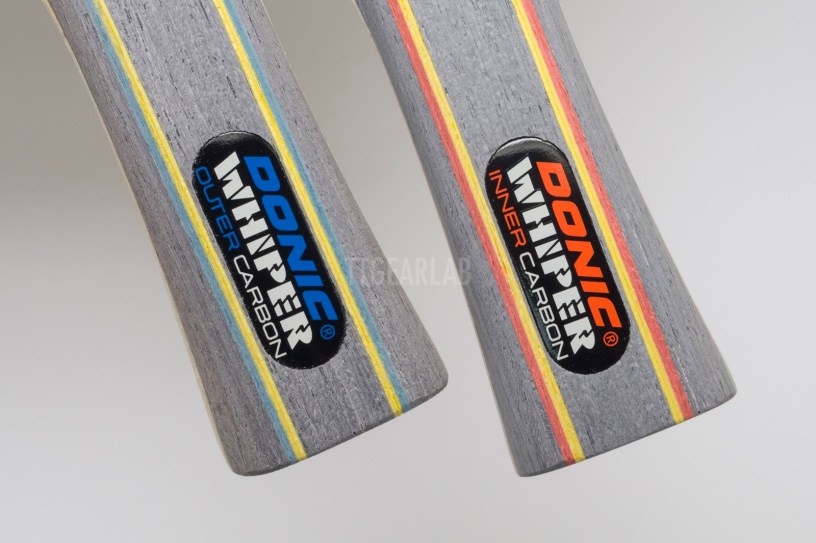
The construction of ‘Whiper Outer Carbon’ is an ‘outer-type’ construction. The top layer is Limba, the middle layer is Ayous, and the center layer is Kiri. Hyramid Carbon, which is the mixed woven of Hyramid fiber (= a kind of aramid fiber) and carbon fiber, is inserted directly under the top layer. Overall thickness is around 5.7mm. (It is actually measured value. The official thickness is also 5.7 mm.)
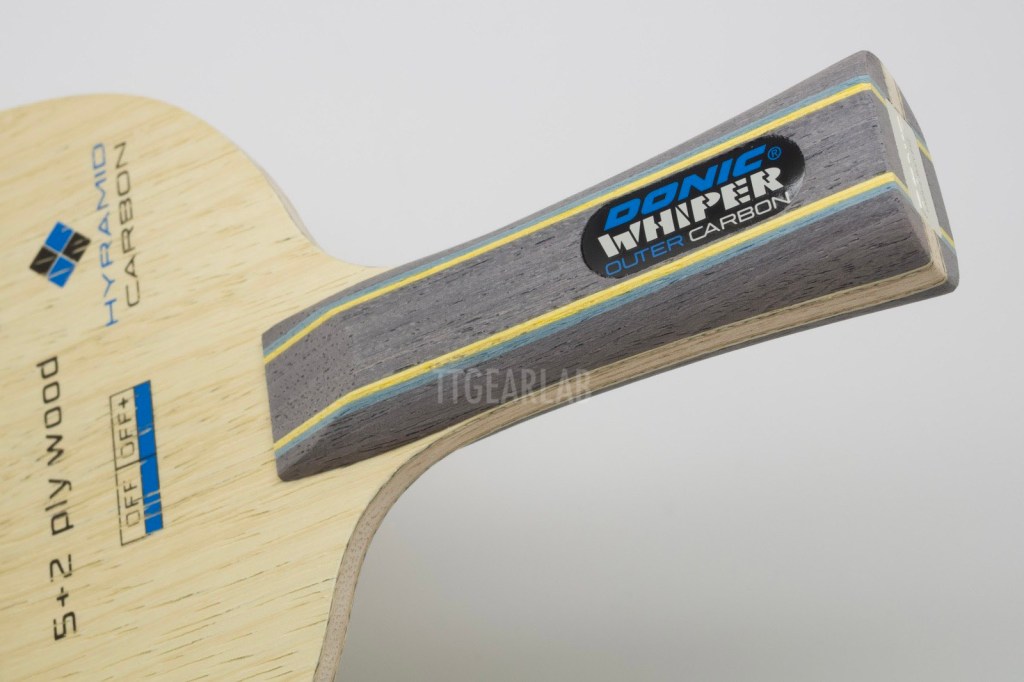
The shape of FL (flared) handle is close to semi-wide type, but it doesn’t feel wide in the hand. The width of FL (flared) handle is around 24mm (at head side) ~ 27.5 mm (at bulge) ~ 26mm (at narrowest point) ~ 33mm (at the end). And, the thickness of FL handle is around 22.5mm (at thumb) ~ 25mm (at the end). The size of ST hasn’t been measured yet.
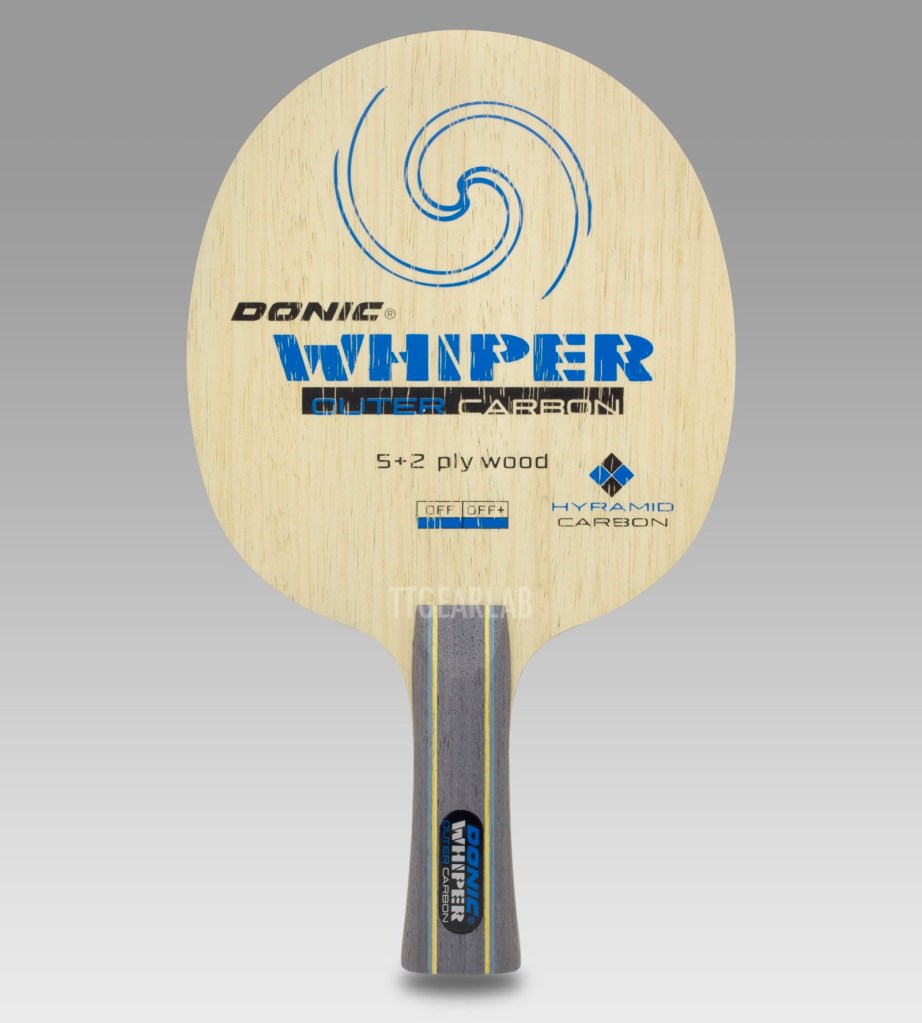
The size of head is around 157mm x 150mm which is the common head size of most of recent offensive blades.
1-2. Whiper Inner Carbon
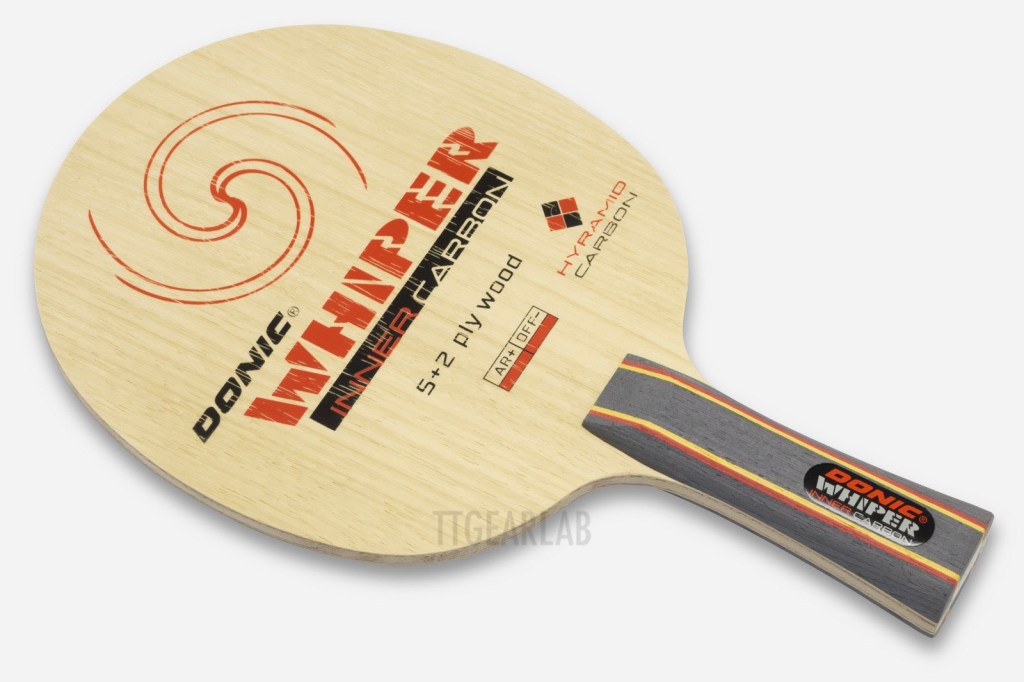
As its name expresses, ‘Whiper Inner Carbon’ is the ‘inner version’ of ‘Whipper’ series. Between two models of ‘Whiper’ series, ‘Whiper Inner Carbon’ is more biased to control.
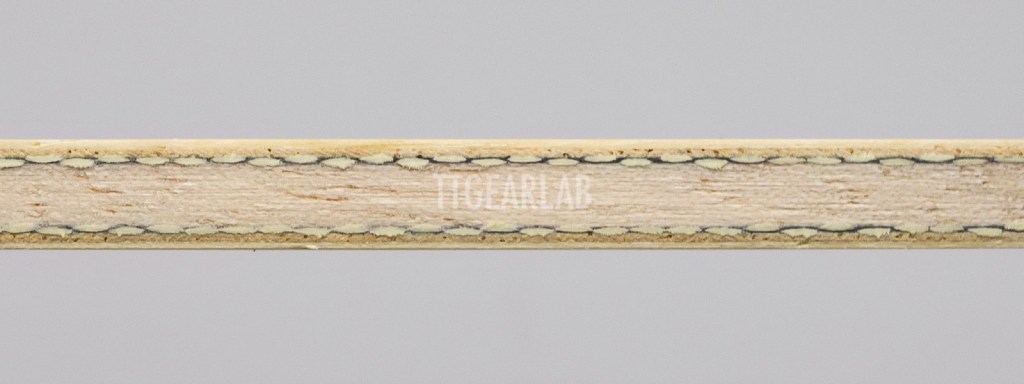
The construction of ‘Whiper Inner Carbon’ is an ‘inner-type’ construction. The top layer is Limba, the middle layer is Ayous, and the center layer is Kiri. Hyramid Carbon, which is the mixed woven of Hyramid fiber (= a kind of aramid fiber0 and carbon fiber, is inserted between the middle layer and the center layer. Overall thickness is around 5.8mm. (It is actually measured value. The official thickness is 5.7 mm.)
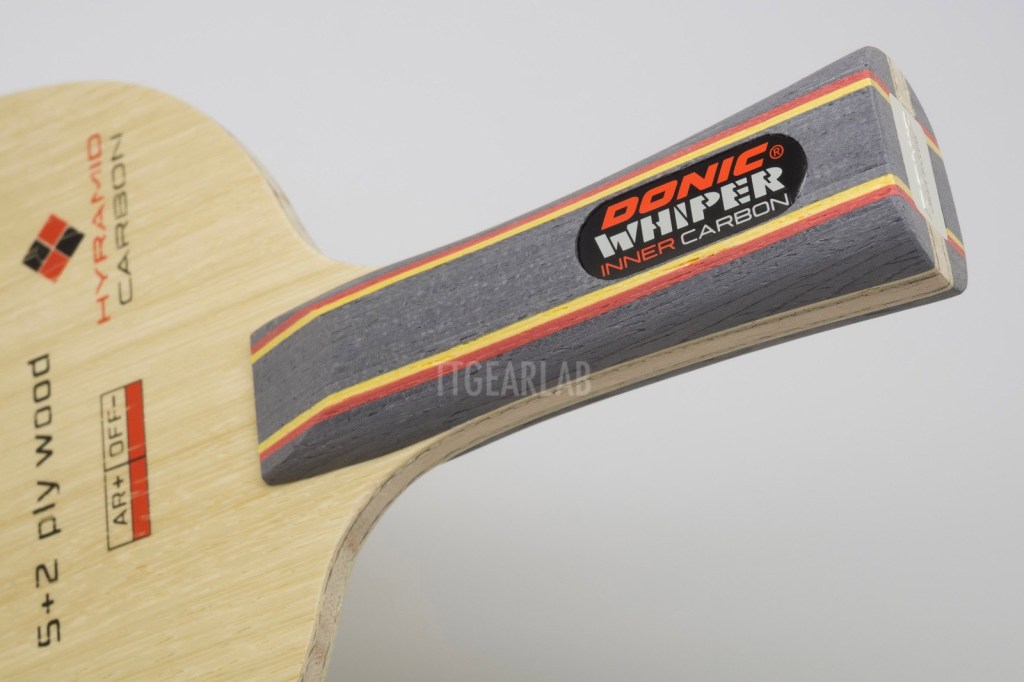
The shape of FL (flared) handle is close to semi-wide type, but it doesn’t feel wide in the hand. The width of FL (flared) handle is around 24mm (at head side) ~ 27.5 mm (at bulge) ~ 26mm (at narrowest point) ~ 33mm (at the end). And, the thickness of FL handle is around 22.5mm (at thumb) ~ 25mm (at the end). The size of ST hasn’t been measured yet.
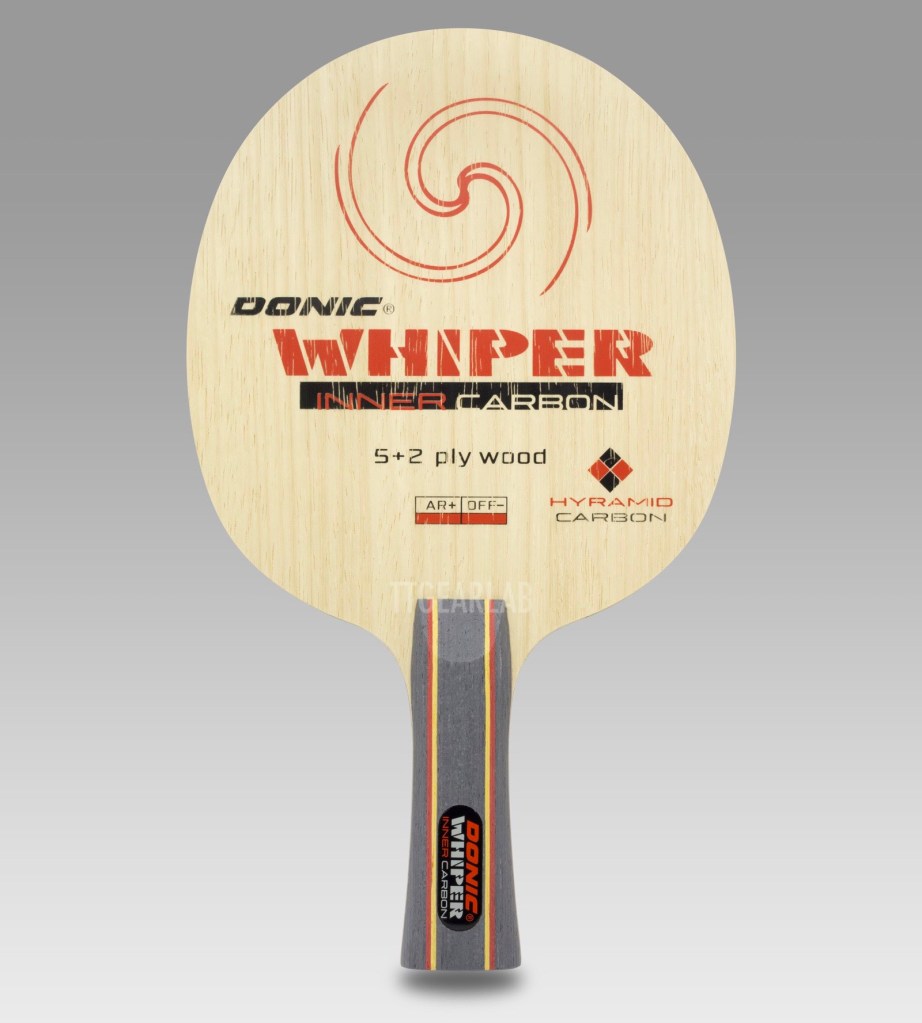
The size of head is around 157mm x 150mm which is the common head size of most of recent offensive blades.
Then let’s check the characteristics of ‘Whiper Outer Carbon’ and ‘Whiper Inner Carbon’ by Performance Indices and then compare with some existing blades.
Please click here to return to top (table of contents)
2. Performance Indices
Performance Indices are measured objective values to represent the characteristics of table tennis gears. Concerning the detail of four performance indices, please refer to following articles in ‘About TTGearLab’ section :
- Performance indices : the way to evaluate blade by measurement
- The example of comparison by performance indices
2-1. Whiper Outer Carbon
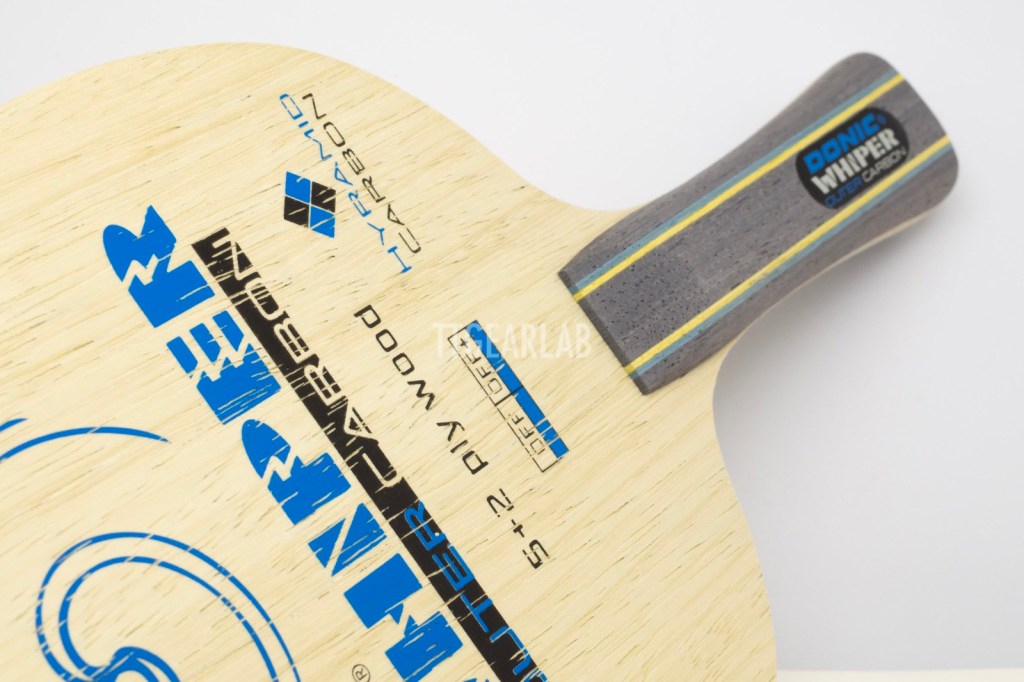
| Name | Avg.Wt (g) | Ep | Ec | Ec/Ep | Vp | Vl | Vl/Vp |
| Donic Whiper Outer Carbon | 84.1 | 2.03 | 1.97 | 0.97 | 1.37 | 1.36 | 0.99 |
‘Whiper Outer Carbon’ is an outer-type fiber blade as its name expresses. And, its Ep (=2.03) is a high value that we can expect from ordinary outer-type blades. It slightly exceeds 2.0 which is the criteria of ‘very fast’ blade. Further, its Ec (= 1.97) is also very high. As the result the ratio – Ec/Ep – (= 0.97) is close to 1.0. It means that ‘Whiper Outer Carbon’ doesn’t hug ball deeply when the player hits the ball very strongly. Because there are so many blades whose Ec/Ep is quite low, the player may feel that ‘Whiper Outer Carbon’ gives additional kick when the player hits the ball very strongly.
Regarding Vibration Indices, the Vp of ‘Whiper Outer Carbon’ (= 1.37) is a quite high value, and its Vl (= 1.36) is also high. Those values are in the range that we can expect from ordinary outer-type blades. The ratio – Vl/Vp (= 0.99) – is close to 1.0. The feeling transferred to the player’s index finger is not especially sharper or milder than the primary feeling. Players may feel that ‘Whiper Outer Carbon’ isn’t a blade that gives stiff feeling, although actually it is a hard blade.
From the values, we can expect that ‘Whiper Outer Carbon’ fits for power play that uses a variety of offensive skills.
2-2. Whiper Inner Carbon
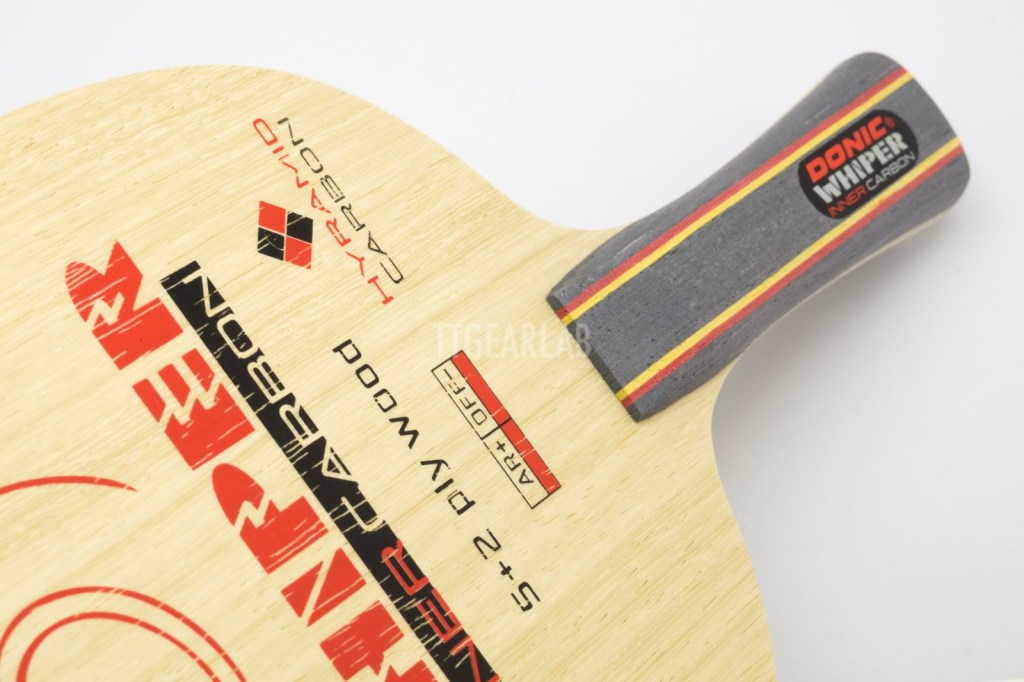
| Name | Avg.Wt (g) | Ep | Ec | Ec/Ep | Vp | Vl | Vl/Vp |
| Donic Whiper Inner Carbon | 85.2 | 1.75 | 1.81 | 1.04 | 1.30 | 1.20 | 0.93 |
‘Whiper Inner Carbon’ is an inner-type fiber blade as its name expresses. Its Ep (= 1.75) is what we can expect from ordinary inner-type fiber blades. But, its Ec (= 1.80) is higher than what we can expect from ordinary inner-type blades. As the result the ratio Ec/Ep (= 1.03) is over 1.0 which is the border between ‘Hold’ range and ‘Kick’ range. ‘Whiper Inner Carbon’ gives additional kick when the player hits the ball very strongly. Because the value is still much lower than 1.1, the level of kick is not high. However, the players who have used the blades with much lower Ec/Ep will feel that ‘Whiper Inner Carbon’ gives strong kick. And, some players may feel that the response characteristic of ‘Whiper Inner Carbon’ is close to linear because the Ec/Ep is close to 1.0.
Regarding Vibration Indices, the Vp of ‘Whiper Inner Carbon’ (= 1.30) is higher than what we can expect from ordinary inner-type fiber blades. It is close to those of outer-type blades or especially fast inner-type blades. But, the Vl (= 1.20) is just what we can expect from inner-type blades. As the result the ratio – Vl/Vp (= 0.92) is lower than 1.0. The feeling transferred to the player’s index finger is milder than the primary feeling. The players will feel that this blade is very soft.
From the values, we can expect that ‘Whiper Inner Carbon’ provide soft feeling and the ability of precise control. That fits for modern all round play.
‘Whiper Outer Carbon’ and ‘Whiper Inner Carbon’ shows the characteristics those are a bit distinguished from ordinary outer-tpye and inner-type blades. Probably that is because the playing characteristics of entry ~ intermediate players is reflected in the design of two blades.
Two blades will be compared with some existing blades by graphs in next Chapter.
Please click here to return to top (table of contents)
3. Comparison by Performance Indices
‘Whiper Outer Carbon’ and ‘Whiper Inner Carbon’ are categorized as outer-type fiber blade and inner-type fiber blade respectively. So we will compare those two with some well-known outer-type and inner-type blades.
Following is the list of the blades to be compared:
Outer type
| Name | Average Weight | Feature |
| Butterfly Viscaria | 87.1g | Outer ALC with Koto top layer |
| Butterfly Freitas ALC | 87.4g | Outer ALC with Limba top layer |
| andro Treiber CO OFF/S | 83.9g | Outer KVL Carbon with Limba top layer |
| Donic Skachikov Carbon | 82.5g | Outer Aramid Carbon with Koto top layer |
| Stiga Carbonado 190 | 92.4g | Outer Carbon fiber (TeXtreme) with Limba top layer |
Inner type
| Name | Average Weight | Feature |
| Butterfly InnerForce Layer ALC | 91.2g | Inner ALC with Limba top layer / Recent version |
| Butterfly Hurricane Long 5 | 88.1g | Inner ALC with Limba top layer / Recent version |
| Donic Original No.1 | 88.7g | Inner Acryl Carbon with Limba top layer |
| Victas Fire Fall VC | 81.8g | Inner ALC with Limba top layer / Thick construction |
| andro Treiber CI OFF | 84.0g | Inner KVL Carbon with Limba top layer |
All wood blades (including reference blade)
| Name | Average Weight | Feature |
| Butterfy Korbel | 88.7g | The representative of 5-ply wood offensive blade. |
| Stiga Allround Classic (Reference) | 84.3g | The representative of 5-ply wood allround blade. |
3-1. Elasticity Indices
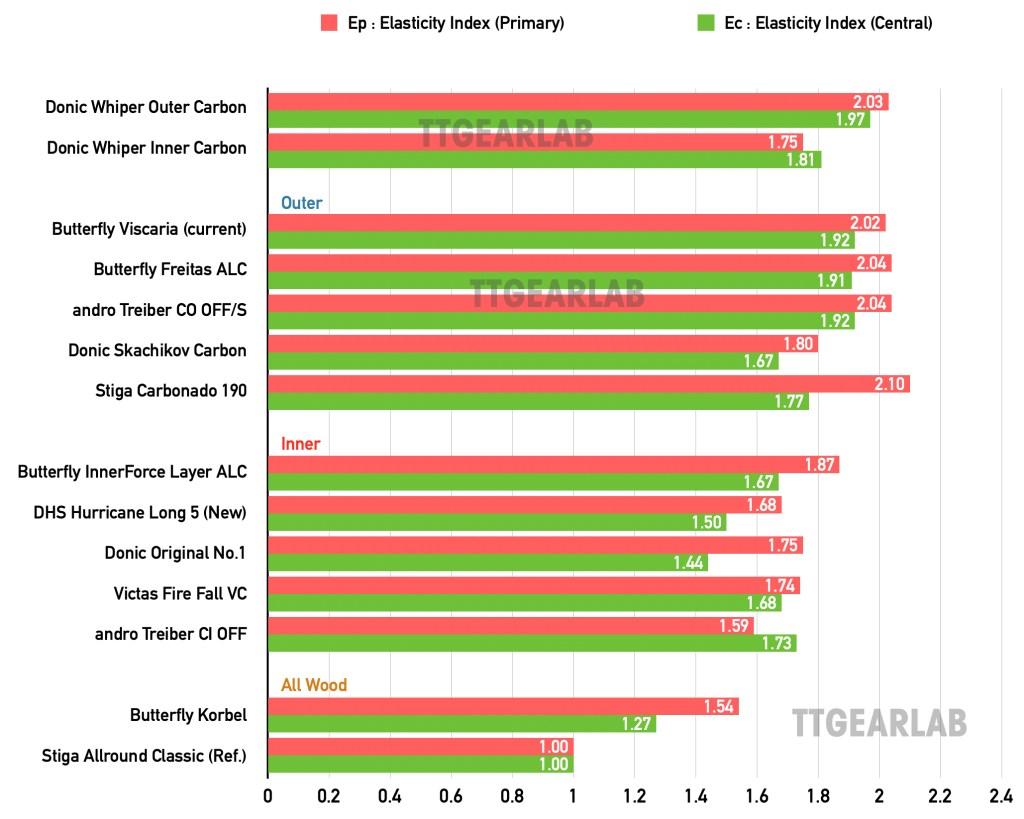
Fig.15 shows the comparison graph of Elasticity Indices.
Ep (Primary Elasticity Index) is directly concerned with the rebound speed of blade. Ec (Central Elasticity Index) is concerned with additional ‘kick’ when player hits ball very strongly. We can observe that the overall elasticity level of ‘Whiper Outer Carbon’ is noticeably higher than that of ‘Whiper Inner Carbon’.
Then we can compare two models of ‘Whiper’ series with some existing outer-type and inner-type blades .
[Outer]
‘Whiper Outer Carbon’ is included in this group.
- The overall elasticity level of ‘Whiper Outer Carbon’ looks close to the average of the elasticity levels of outer-type blades in this group. Especially the Ep of ‘Whiper Outer Carbon’ is very close to those of standard outer-type models – ‘Viscaria’, ‘Freitas ALC’ and ‘Treiber CO OFF/S’. And, the Ec of ‘Whiper Outer Carbon’ is higher than those of ‘Viscaria’, ‘Freitas ALC’ and ‘Treiber CO OFF/S’. Although the gap is not significant, sensitive players will note that ‘Whiper Outer Carbon’ gives a bit stronger kick when the player hits the ball very strongly.
- The elasticity characteristics of ‘Skachikov Carbon’ are noticeably different from those of ‘Whiper Outer Carbon’ and three standard outer-type blades. ‘Skachikov Carbon’ is noticeably less elastic than ordinary outer-type blades. In fact, the characteristics of ‘Skachikov Carbon’ are close to those of inner-type blades.
- The Ep of ‘Carbonado 190’ is one step higher than that of ‘Whiper Outer Carbon’ while the Ec of ‘Carbonado 190’ is significantly lower than that of ‘Whiper Outer Carbon’.
[Inner]
‘Whiper Inner Carbon’ is included in this group.
- The Ep of ‘Whiper Inner Carbon’ is close to those of three models – ‘Hurricane Long 5’, ‘Original No.1’ and ‘Fire Fall VC’ – in ‘Inner’ group. It is close to the average value of Ep in this group. We can think that the average Ep of inner-type blades is around 1.75. The Ep of ‘InnerForce Layer ALC’ (current model) is noticeably higher than this value, and that of ‘Treiber CI OFF’ is noticeably lower than this value.
- The Ec of ‘Whiper Inner Carbon’ is higher than those of all models in this group. It is close to the Ec’s of outer-type blades. So we can expect that the elasticity characteristics of ‘Whiper Inner Carbon’ are significantly different from those of other models in inner-type group. Especially ‘Hurricane Long 5’ and ‘Original No.1’ will be totally different from ‘Whiper Inner Carbon’.
- The one whose overall elasticity characteristics look close to those of ‘Whiper Inner Carbon’ is ‘Fire Fall VC’. Some players may feel similarity between ‘Whiper Inner Carbon’ and ‘Treiber CI OFF’ because of Ec’s those are relatively higher than Ep’s.
[All Wood]
All wood blades can be observed as references.
- The graph shape of ‘Korbel’ looks totally different from those of ‘Whiper Outer Carbon’ and ‘Whiper Inner Carbon’.
- On the contrary, the graph shape of ‘Allround Classic’ looks similar to those of ‘Whiper Outer Carbon’ and ‘Whiper Inner Carbon’ whose gaps between Ep and Ec are very small. We may be able to consider ‘Whiper’ series as the more powerful replacement of ‘Allround Classic’.
Examining Ec/Ep is also an easier way to understand the characteristics of blade concerned with elasticity. Fig.16 shows the relationship between Ec/Ep and Ep.
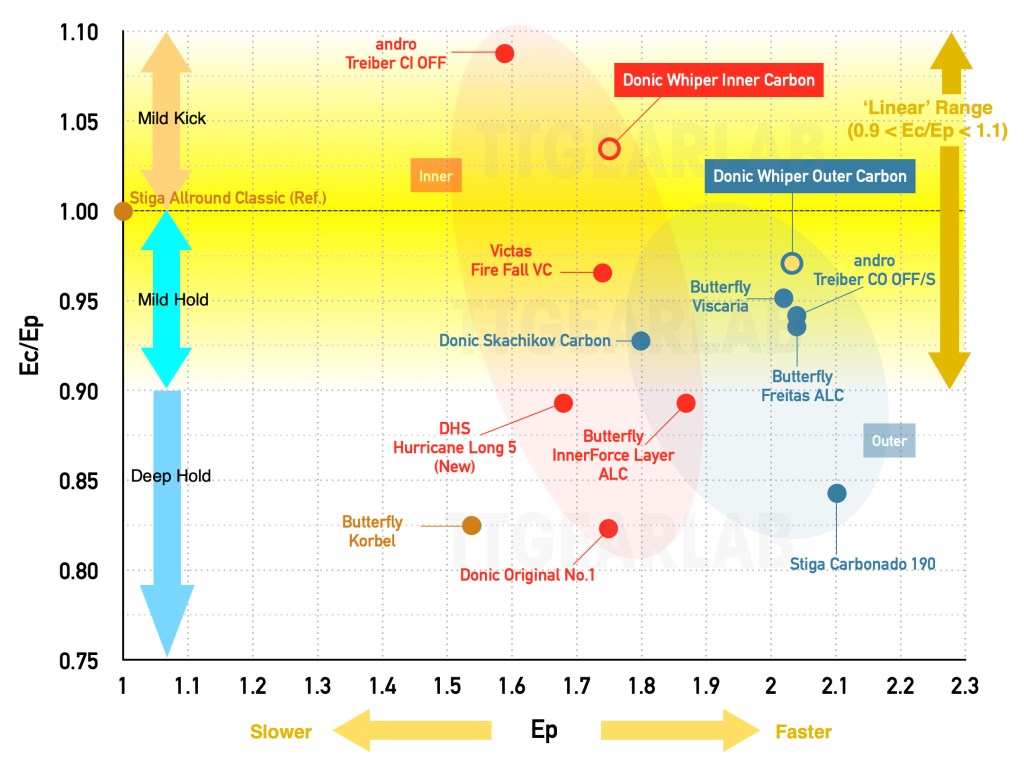
Ec/Ep expresses the ‘tendency’ of the elasticity of blade. By examining Ec/Ep and Ep at the same time, we can understand the behavior of blades more easily.
On the graph, most of the blades in this comparison are located in ‘Hold’ range (Ec/Ep < 1.0). Just two models in this comparison are in ‘Kick’ range (Ec/Ep > 1.0), but one of those two is ‘Whiper Inner Carbon’. On the graph, ‘Outer’ group is located at right side, and ‘Inner’ group is located at left side. ‘Outer’ group and ‘Inner’ group are overlapped because of some blades such as ‘Skachikov Carbon’ and ‘InnerForce Layer ALC’. But, none of two models of ‘Whiper’ series is in the overlapped area, because the Ep’s of those two are the typical values as that of an outer-type blade and that of an inner-type blade respectively. Then let’s observe each model of ‘Whiper’ series along with the group to which that model belongs.
‘Whiper Outer Carbon’ can be observed together with ‘Outer’ group. What we can see from the graph can be summarized as follows :
- ’Whiper Outer Carbon’ is located at the top position in the ‘Outer’ group. This position is close to the border line between ‘Hold’ range and ‘Kick’ range. So, we can expect that the response of ‘Whiper Outer Carbon’ to the change of impact strength is almost linear. Because this position is still in ‘Hold’ range, ‘Whiper Outer Carbon’ hugs the ball a bit when player hits the ball very strongly. However, the level of hug is small, and the players who have been accustomed to the blades at lower positions will think that ‘Whiper Outer Carbon’ gives additional kick when the ball is hit by stronger impact.
- The distance between ‘Whiper Outer Carbon’ and three typical outer-type blades – ‘Viscaria’, ‘Freitas ALC’ and ‘Treiber CO OFF/S’ – is close. Therefore we can think that ‘Whiper Outer Carbon’ is also one of typical outer-type blades and group it together with three typical models. However, there is small but noticeable difference between ‘Whiper Outer Carbon’ and those three blades. If a player has been using one of the three typical models – ‘Viscaria’, ‘Freitas ALC’ and ‘Treiber CO OFF/S’ – and want to improve the performance of direct hitting a bit, ‘Whiper Outer Carbon’ will be one of good solutions.
- ‘Skachikov Carbon’ which is another Donic outer-type blade is located to lower left of ‘Whiper Outer Carbon’, and the distance between two blades is quite big although both of two models are outer-type blades from the same company – Donic. If the player prefer softer and more controllable blade, ‘Skachikov Carbon’ will be better than ‘Whiper Outer Carbon’ But, if the player lay emphasis on speed, ‘Whiper Outer Carbon’ will be better choice.
‘Whiper Inner Carbon’ can be observed together with ‘Inner’ group. What we can see from the graph can be summarized as follows :
- ’Whiper Inner Carbon’ is located at upper position in the ‘Inner’ group. Because that position is close to the border line between ‘Hold’ range and ‘Kick’ range, and therefore we can expect that the response of ‘Whiper Inner Carbon’ to the change of impact strength is almost linear. But, because it is in ‘Kick’ range and there are more blades those are in ‘Hold’ range, most of players will think that ‘Whiper Inner Carbon’ gives strong additional kick when the ball is hit by stronger impact.
- Another model which is in ‘Kick’ range is ‘Treiber CI OFF’. It is located to upper left of ‘Whiper Inner Carbon’. Because the distance between ‘Treiber CI OFF’ and ‘Whiper Inner Carbon’ isn’t small, players will feel clear difference between two – ‘Treiber CI OFF’ is less elastic but gives more kick for stronger impact. But, the players who are accustomed to the blades with much less Ec/Ep may feel that there isn’t much difference between those two.
- The other four models in this group are in ‘Hold’ range. ‘FireFall VC’ whose Ec/Ep is compared with those of typical outer-type blades is also at much lower position than ‘Whiper Inner Carbon’ and ‘Treiber CI OFF’. The players may feel that ‘Whiper Inner Carbon’ gives very strong additional kick when impact strength becomes higher.
- ‘Original No.1’ which is another Donic inner-type blade is located at the bottom of this group. So its elasticity characteristics are totally different from those of ‘Whiper Inner Carbon’ although the constructions of those two look similar to each other. ‘Original No.1’ fits for continuous topspin while ‘Whiper Inner Carbon’ fits for the mixture of topspin and smash. ‘Hurricane Long 5’ and ‘InnerForce Layer ALC’ are not at extremely low position as ‘Original No.1’, and are considered as more ‘balanced’ inner-type blades. But, if we compare those two with totally different blade such as ‘Whiper Inner Carbon’ or ‘Treiber CI OFF’, those two can be categorized together with ‘Original No.1’ into the blade group specialized for continuous topspin. In that case ‘Fire Fall VC’ which is somewhat biased to hard hitting looks like the inner-type blade with average characteristics.
Both of ‘Whiper Outer Carbon’ and ‘Whiper Inner Carbon’ are biased to the playing style which uses more hard hitting, and that may be the reason why those two fits for ordinary players. ‘Whiper Outer Carbon’ is just a bit different from typical outer-type blades, and it is probably because the speed of this kind of blade is already sufficient and therefore there isn’t much need to increase additional kick. But, ‘Whiper Inner Carbon’ is significantly different from typical inner-type blades, and it is probably because there is a need to significantly improve the additional kick for increasing ball speed of hard hitting. The players who don’t just play with topspin but want to also use smash, it is expected that ‘Whiper Outer Carbon’ or ‘Whiper Inner Carbon’ can be a good solution.
Then next, let’s compare Vibration Indices.
Please click here to return to top (table of contents)
3-2. Vibration Indices
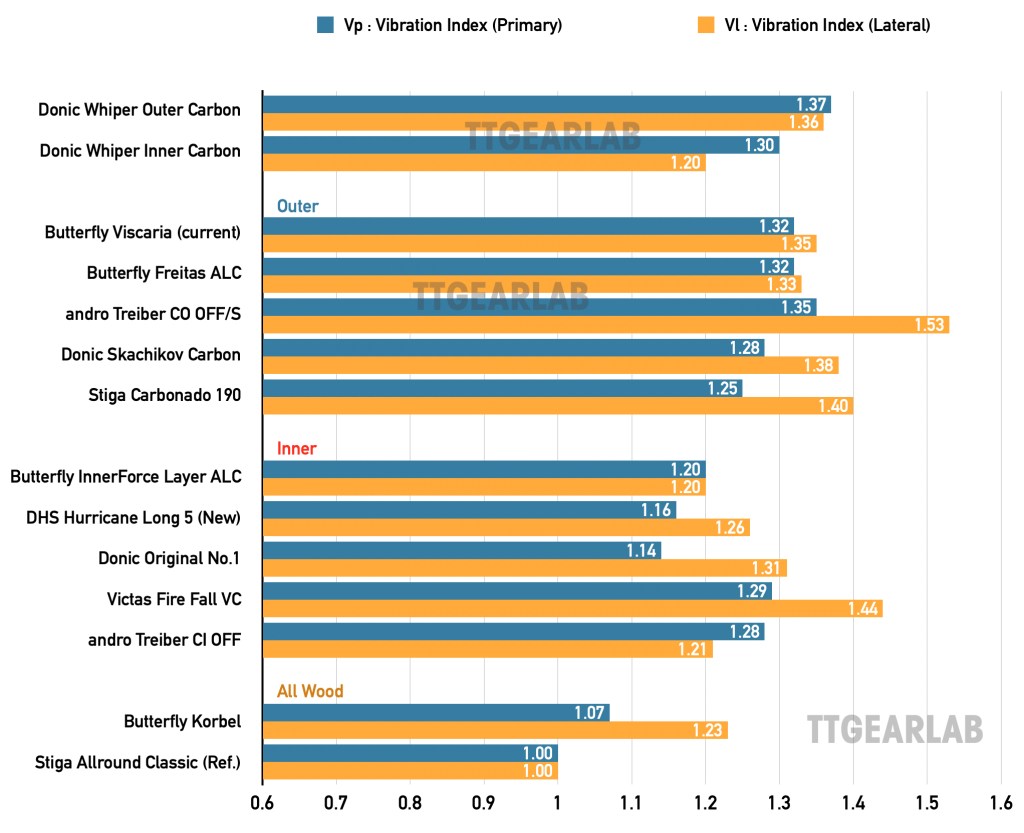
Fig.17 shows the comparison graph of Vibration Indices. Vibration Indices are concerned with feeling. Vp indicates primary feeling which is transferred to player’s palm. And, Vl is the feeling at the edge of the wing – the lower side of blade head. It is felt by player’s index finger or middle finger. The values of ‘Whiper Outer Carbon’ is higher than those of ‘Whiper Inner Carbon’, but we can also notice that the gap of Vp’s of two versions is not significant because the Vp of ‘Whiper Inner Carbon’ is quite high. It means that ‘Whiper Inner Carbon’ is a quite unique one as an inner-type blade.
Then we can compare two models of ‘Whiper’ series with some existing outer-type and inner-type blades .
[Outer]
‘Whiper Outer Carbon’ is included in this group.
- The Vp of ‘Whiper Outer Carbon’ is a higher than those of all other outer-type blades in ‘Outer’ group. But, the difference from the values of three typical blades – ‘Viscaria’, ‘Freitas ALC’ and ‘Treiber CO OFF/S’ – isn’t big. And, the Vl of ‘Whiper Outer Carbon’ is close to the average value of the Vl’s of this group. So, it is difficult to say that ‘Whiper Outer Carbon’ is a very unique blade in feeling. But, although small, there are differences.
- If we compare the Vl and the Vp of ‘Whiper Outer Carbon’, we can notice that the Vl is just a bit higher than the Vp. But, for ordinary outer-type blades, the Vl is lower than the Vp. We may be able to say that it is the uniqueness of ‘Whiper Outer Carbon’. But again, the difference from typical blades is not significant. We can just think that the Vp and the Vl of ‘Whiper Outer Carbon’ are almost same as each other.
- Some players may feel that there isn’t much difference in feeling between ‘Whiper Outer Carbon’ and ‘Freitas ALC’ although ‘Freitas ALC’ is a bit softer than ‘Whiper Outer Carbon’/
- ‘Treiber CO OFF/S’ is more unique blade in feeling because its Vl is significantly higher than those of other models in the group. It will give much different feeling (= much sharper feeling at the index finger) from ‘Whiper Outer Carbon’, ‘Freitas ALC’ and ‘Viscaria’. And, if we observe the graph shapes, ‘Skachikov Carbon’ and ‘Carbonado 190’ show similar graph shapes as ‘Treiber CO OFF/S’.
[Inner]
‘Whiper Inner Carbon’ is included in this group.
- The Vp of ‘Whiper Inner Carbon’ is higher than those of typical inner-type blades – ‘InnerForce Layer ALC’, ‘Hurricane Long 5’ and ‘Original No.1’. And, the blades whose Vp’s are close to that of ‘Whiper Inner Carbon’ are ‘Treiber CI OFF’ and ‘Fire Fall VC’. The Vp around 1.30 is what we can expect not from ordinary inner-type blades but from outer-type blades. 1.30 is not much lower than 1.32 of ‘Viscaria’ or ‘Freitas ALC’.
- On the contrary, the Vl of ‘Whiper Inner Carbon’ is same as that of ‘InnerForce Layer ALC’. And, it is lower than those of the other four models in ‘Inner’ group. Because the Vl is lower than the Vp, the graph shape of ‘Whiper Inner Carbon’ is totally different from those of four among five models in ‘Inner’ group. Especially the graph shape of ‘Original No.1’ shows extreme difference from that of ‘Whiper Inner Carbon’. Only ‘Treiber CI OFF’ shows the graph shape which is similar to that of ‘Whiper Inner Carbon’.
[All Wood]
All wood blades can be observed as references.
- The overall values of all-wood blades are significantly lower than those of ‘Whiper’ series. The one exception is the Vl of ‘Korbel’ which is higher than that of ‘Whiper Inner Carbon’.
- The graph shape of ‘Korbel’ is totally different from those of both of ‘Whiper Outer Carbon’ and ‘Whiper Inner Carbon’. It is close to the graph shape of ‘Original No.1’. So the players who have been accustomed to ‘Korbel’ may feel that the feeling of ‘Whiper’ series is much different from that of ‘Korbel’.
- The graph shape of ‘Allround Classic’ looks similar to that of ‘Whiper Outer Carbon’. It means that much stiffer ‘Whiper Outer Carbon’ can be the replacement of ‘Allround Classic’. And, the intermediate step from ‘Allround Classic’ to ‘Whiper Outer Carbon’ is ‘InnerForce Layer ALC’ because its graph shape is also similar to those of the two.
Examining Vl/Vp is easier way for the comparison of the tendency of feeling. Fig.18 shows the relationship between Vl/Vp and Vp for easier comparison.
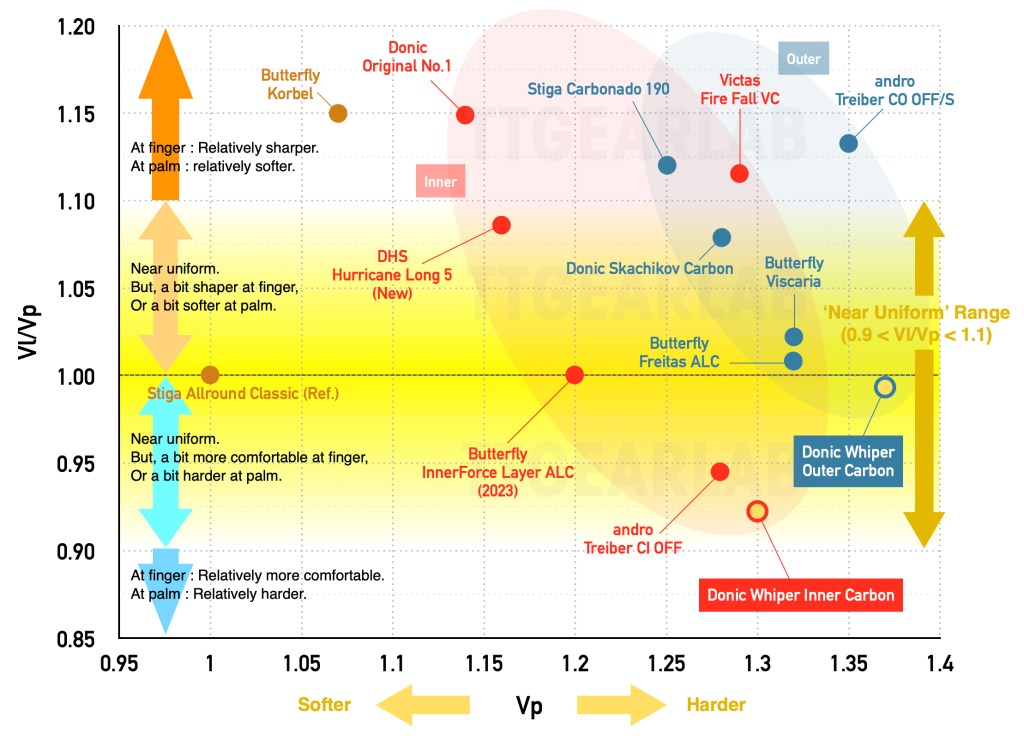
On the graph, nine blades in this comparison are located in upper part of the graph – ‘Relatively sharper at finger’ range (Vl/Vp > 1.0). And three are in lower part – ‘Relative more comfortable at finger’ range (Vl/Vp < 1.0). But, two among those three are ‘Whiper Outer Carbon’ and ‘Whiper Inner Carbon’. Therefore we can understand that those two blades are unique ones in feeling. Both of two transmits ‘relatively more comfortable’ feeling to the index finger. And, ‘Outer’ group is located to right of ‘Inner’ group. It means that outer-type is harder than inner-type in general. But two groups are largely overlapped because of ‘Fire Fall VC’ whose characteristics are close to those of outer-type blades. (There will not be overlap if ‘Fire Fall VC’ is removed from this comparison.) Then let’s observe each model of ‘Whiper’ series along with the group to which that model belongs.
‘Whiper Outer Carbon’ can be observed together with ‘Outer’ group. What we can see from the graph can be summarized as follows :
- ’Whiper Outer Carbon’ is located at the lower right end of ‘Outer’ group. It means that the primary feeling of ‘Whiper Outer Carbon’ is the stiffest in the group but ‘Whiper Outer Carbon’ transmits the most comfortable (relative) feeling to the index finger.
- The position of ‘Whiper Outer Carbon’ is a bit lower than the position of ‘Freitas ALC’ whose construction is similar to that of ‘Whiper Outer Carbon’. There for ‘Freitas ALC’ transmits a bit sharper feeling to index finger. However, because the gap in vertical direction is small and the gap in horizontal direction is big, many players will feel that ‘Whiper Outer Carbon’ is harder than ‘Freitas ALC’ in overall feeling.
- ‘Treiber CO OFF/S’ whose construction is similar to that of ‘Whiper Outer Carbon’ is located at top of the group. It transmits relatively sharper feeling to index finger. The gap between ‘Treiber CO OFF/S’ and ‘Whiper Outer Carbon’ is large. Although the difference in primary feeling is small, players will feel that those two blades are totally different from each other in feeling.
- ‘Whiper Outer Carbon’ is located near the border line between ‘Relatively sharper’ range and ‘Relatively more comfortable’ range. We can see that ‘Allround Classic’ which is a 5-ply wood all-round blade and ‘InnerForce Layer ALC’ which is the representative inner-type blade are on that border line. Therefore, if the player who have used ‘Allround Classic’ but want to increase the power of the blade, ‘InnerForce ALC’ and ‘Whiper Outer Carbon’ will be solution.
‘Whiper Inner Carbon’ can be observed together with ‘Inner’ group. What we can see from the graph can be summarized as follows :
- ’Whiper Inner Carbon’ is located at the lower right end of ‘Inner’ group. It means that the primary feeling of ‘Whiper Inner Carbon’ is the stiffest in the group but ‘Whiper Inner Carbon’ transmits the most comfortable (relative) feeling to the index finger.
- ‘Treiber CI OFF’ is located close to ‘Whipper Inner Carbon’. Although there are small differences, players may feel the similarity between ‘Treiber CI OFF’ and ‘Whiper Inner Carbon’. In every aspect those two blades can be considered as the rival of each other.
- ‘Original No.1’ which is another blade from Donic is located at the left top of ‘Inner’ group. That position is opposite to the position of ‘Whiper Inner Carbon’. The primary feeling of ‘Original No.1’ is the softest in the group, but ‘Original No.1’ transmits the sharpest (relative) feeling to the index finger. Although those two blades have similarity in their blade constructions, those two blades are totally different from each other.
- ‘Fire Fall VC’ is close to ‘Whiper Inner Carbon’ in primary feeling, there is large vertical gap between those two blades. Because players are more sensitive to relative feeling (= Vl/Vp) in general, many players will feel that ‘Whiper Inner Carbon’ is much softer than ‘Fire Fall VC’.
- It is questionable whether ‘Whiper Inner Carbon’ can be the replacement of ‘Allround Classic’ or not because the gap between ‘Whiper Inner Carbon’ and the border line whose Vl/Vp = 1.0 is not small. But, if the player likes soft feeling at index finger, ‘Whiper Inner Carbon’ is seriously considerable.
Both of ‘Whiper Outer Carbon’ and ‘Whiper Inner Carbon’ provides the most comfortable relative feeling in each group. Therefore the players who like the sharp feeling transmitted to finger will not like ‘Whiper’ series. But, fot the players who are searching for the blades those can provide comfortable feeling at finger, ‘Whiper’ series will be seriously considerable.
Please click here to return to top (table of contents)
4. Summary
Donic ‘Whiper’ series is a blade family of high-performance fiber blades those are optimized not for top players but for ordinary players. It consists of two variations – inner type and outer type – using a new artificial material called ‘Hyramid Carbon’. The characteristics of two models can be summarized as follows.
4-1. Whiper Outer Carbon
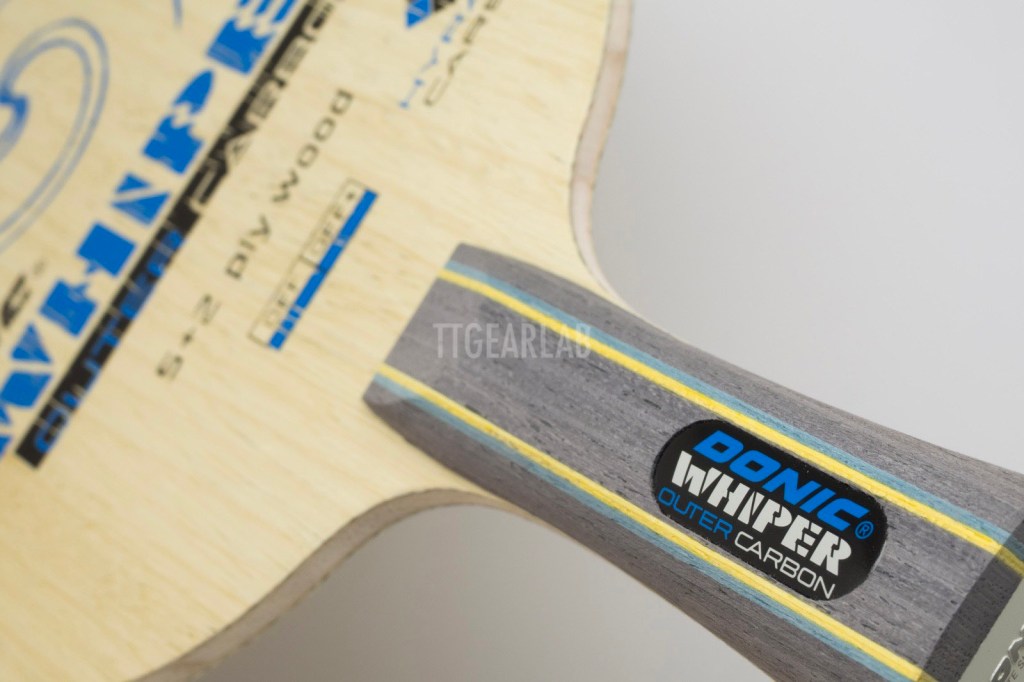
- ‘Whiper Outer Carbon’ is the outer-type version of ‘Whiper’ series which is the blade family that uses ‘Hyramid Carbon’ as its artificial material.
- ‘Whiper Outer Carbon’ provides high elasticity that is expected from an ordinary outer-type fiber blades. And, it hugs the ball a bit when the player hits the ball very strongly. However, because the hug level is smaller than that of other outer-type blades, the players may feel that ‘Whiper Outer Carbon’ gives more kick than other outer-type blades.
- Regarding feeling, its primary feeling is stiffer than that of other outer-type blades. But, because the relative feeling transmitted to index finger is comfortable differently from the other outer-type blades, players may feel that ‘Whiper Outer Carbon’ is softer than other outer-type blades.
- The overall characteristics of ‘Whiper Outer Carbon’ are similar to those of a classic 5-ply wood all-round but with significantly increased elasticity. It can be also considered as the alternative of thick classic 7-ply wood blades.
- ‘Whiper Outer Carbon’ is recommended for the players who want to use a variety of technics but at the same time lay emphasis on power.
4-1. Whiper Inner Carbon
- ‘Whiper Inner Carbon’ is the inner-type version of ‘Whiper’ series which is the blade family that uses ‘Hyramid Carbon’ as its artificial material.
- ‘Whiper Inner Carbon’ provides moderate elasticity that is expected from an ordinary inner-type fiber blade. And, it gives the ball additional kick when the player hits the ball very strongly, differently from most of inner-type blades. For that reason, players may feel that ‘Whiper Inner Carbon’ is much more elastic than most of other inner-type blades. And, that makes ‘Whiper Inner Carbon’ good for smash, like classic 7-ply wood blades with thick constructions.
- Regarding feeling, its primary feeling is stiffer than that of other inner-type blades. But, because the relative feeling transmitted to index finger is much more comfortable than that of the other inner-type blades, players may feel that ‘Whiper Inner Carbon’ is much softer than other inner-type blades.
- The overall characteristics of ‘Whiper Inner Carbon’ fits for modern all-round play. But, when compared with other blades for modern all-round play, ‘Whiper Inner Carbon’ is somewhat more biased to speed. For that reason ‘Whiper Inner Carbon’ reminds us classic 7-ply wood blades with thick construction, but it is much thinner and lighter than 7-ply wood blades.
- ‘Whiper Inner Carbon’ is recommended for the players who want to use a variety of technics including smash but don’t like the very high elasticity of outer-type fiber blades.
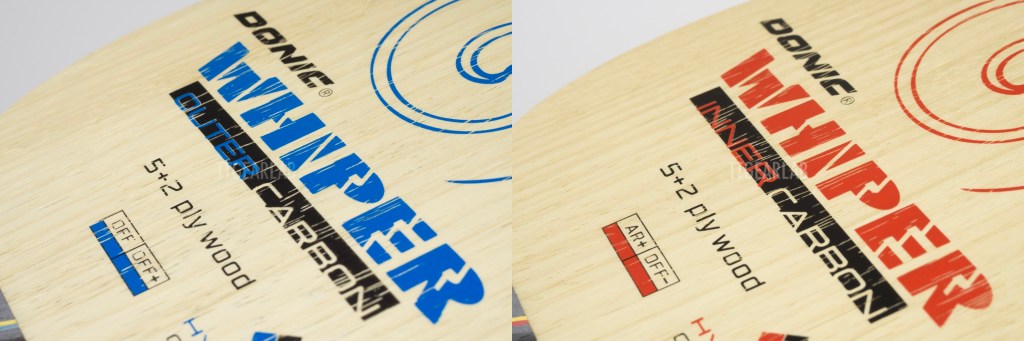
Fig.21 Donic ‘Whiper Outer Carbon’ (left) and ‘Whiper Inner Carbon’ (right)
The characteristics of ‘Whiper Outer Carbon’ and ‘Whiper Inner Carbon’ can be summarized as ‘more kick and more comfortable feeling’. By those characteristics ‘Whiper Outer Carbon’ and ‘Whiper Inner Carbon’ are distinguished from other outer-type and inner-type blades. Those characteristics may be far from the preference of current professional players, but those can be the best fit for amateur players who don’t play just with continuous topspin but tend to frequently use smash and block. ‘Whiper Outer Carbon’ and ‘Whiper Inner Carbon’ are seriously considerable if the player is searching for the blade than can make fast ball more easily than ordinary blades those are basically designed for professional players.
Please click here to return to top (table of contents)
 TTGearLab
Please do the latest Xiom blades, especially the inner ones ❤
LikeLike
If I can get the samples. 🙂
LikeLike
Hi, Woud this blade comparable to Xiom 36.5 alxi (my blade) and Hina Hayata H2 ? I recently bought H2 in order to replace 36.5 alxi with a little more speed but with the same ec/ep, it is really a great blade but the wings are too poeminents for my small hand, i need a similar blade with smaller wings, can you advise me please, thank you very much for your excellent and precious job
LikeLike
Although the construction looks similar, Whiper Inner Carbon is quite different from the two blades you mentioned.
In this case, please consider Tibher Zodiac Libra ZAC once. Its values are quite close to those of 36.5 ALXi and Hayata Hina H2.
Please refer to following article:
https://ttgearlab.com/2024/02/15/tibhar-zodiac-libra-zac-full-review/
LikeLike
Xiom has launched new blade serie IACT, Indeed, Artemis, Chrome and Tetra, inner TMXi, it would be great if you could mesure their performances and quality
LikeLiked by 1 person
Good information! BTW, those blades look like the renamed once of existing models. It will be good that we make comparison table with old models. 🙂
LikeLike
It sounds like the Donic whipper outer is more focused on speed rather than control?? How would they compare with Freitas or outerforce alc. Been close to 1 would that mean it is less controllable in the short game??
The timboll spirit I think is 0.83 that sounds like to hugs the ball more would that be better in the short game. How would they compare speed wise? Thanks
LikeLike
Whiper Outer Carbon is quite close to Freitas ALC. Although it is a bit faster and harder, some players feel that the differences are not noticeable. On the contrary, there are significant differences between Whiper Outer Carbon and OuterForce ALC. OuterForce ALC is noticeably slower and softer. That is because OuterForce ALC is designed as the blade between outer type and inner type. 🙂
Old Timo Boll Spirit is based on the Viscaria of old times which has low value of Ec/Ep. Current Viscaria shows much higher Ec/Ep. I’m not sure whether current Timo Boll Spirit will show that low value or not. The low Ec/Ep makes it easier for us to perform very aggressive topspin at close-to-table area. BTW, if we don’t hit the ball with large angle and very strong power, the Ec/Ep isn’t concerned with the speed that much. 🙂 For that reason the difference in Ec/Ep affects the speed more when we play at mid-distance area.
LikeLike
Many thanks – very helpful. Have you also tried the blade? Does the blade have heaps control and dwell like freitas (it sounds like its softer and more dwell) ? Or more focused on speed – (as closer to 1) looks like a hard blade??. I haven’t seen any reviews of this blades so its hard to get any opinions. Its cheap here under 1/2 the price of the butterfly equivalents. Thanks
LikeLike
Sorry to clarify I mean – would the Donic outer have less dwell than Freitas – due it been harder and (perhaps stiffer) so potentially less control in close to the table play? Have you tried the blade ? Thanks
LikeLike
I have just tried it briefly, but I couldn’t feel significant difference in overall performance, althogh not exactly same.
By the way, dwell time we feel is no more than the feeling by residual vibration after the ball had already left the surface of rubber. The contact time between ball and rubber is only 1/1000 second, and what we feel is much longer than 1/1000 second. The soft Limba wood of the blade and some other features makes us to feel the long dwell time. We feel as if the ball dwells longer than it actually dwells. 🙂
LikeLike
Well, its about 40% price of butterfly equivalent here – its a bargain.
I got a 88g whipper outer version approx 5.8mm. Only played briefly with it so far – its got more speed and spin than the FDZ ALC and Freitas Alc. Harder and slightly less feeling than FZD/Freitas. The quality of the blade is good too. Its a gem of a blade. If Donic keeps making blades like this they will do very well.
Thanks for the recommendation. 🙂
LikeLike
Hello,
I’m currently looking for a new blade that is less spin sensitive than my current one (Xiom Hayabusa ZL Pro), and have thus been looking at outer fibre blades (like the Viscaria or Whiper Outer Carbon).
Which measurement (or combination of measurements) would you say correlate the best with spin sensitivity (especially light to medium power strokes)?
My assumption so far is that Ep correlate the most with light to medium and Ep/Ec at harder strokes.
By the way, this site is an absolute gem.
BR
LikeLike