| Table of Contents | 1. Overview 2. Performance Indices 3. Comparison by Performance Indices ……. 3-1. Elasticity Indices ……. 3-2. Vibration Indices 4. Summary |
Yasaka ‘Falck’ series is the Swedish blade family named after Mattias Falck – the member of Swedish Men’s National Team. It is a product line that continues the tradition of ‘Gatien’ series and ‘Ma Lin’ series those are made in Sweden. It consists of two models – ‘Falck Carbon’ and ‘Falck W7’. ‘Falck Carbon’ is an inner-fiber blade developed of Mattias Falck, and ‘Falck W7’ is a 7-ply wood blade for the players who like the natural feeling of pure wood blade.
In this article, TTGearLab will analyze two models by Performance Indices, and for further understanding compare those two with some other blades in the market.
1. Overview
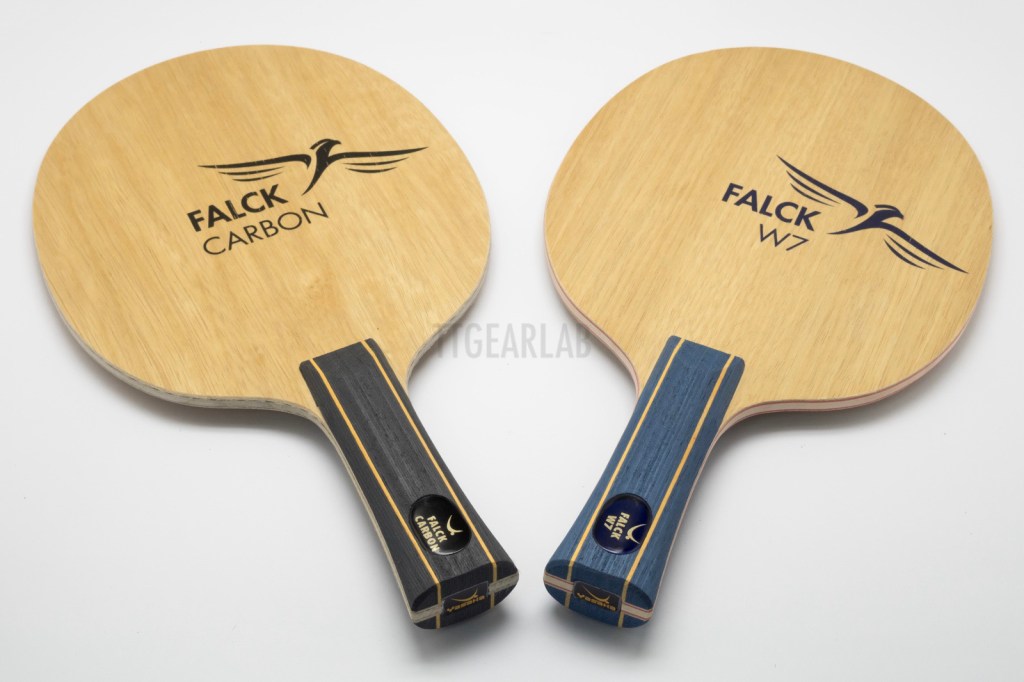
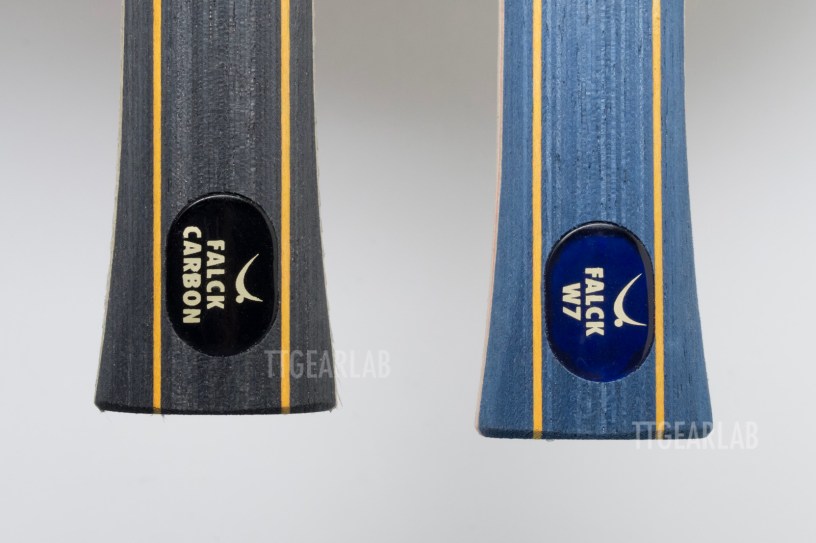
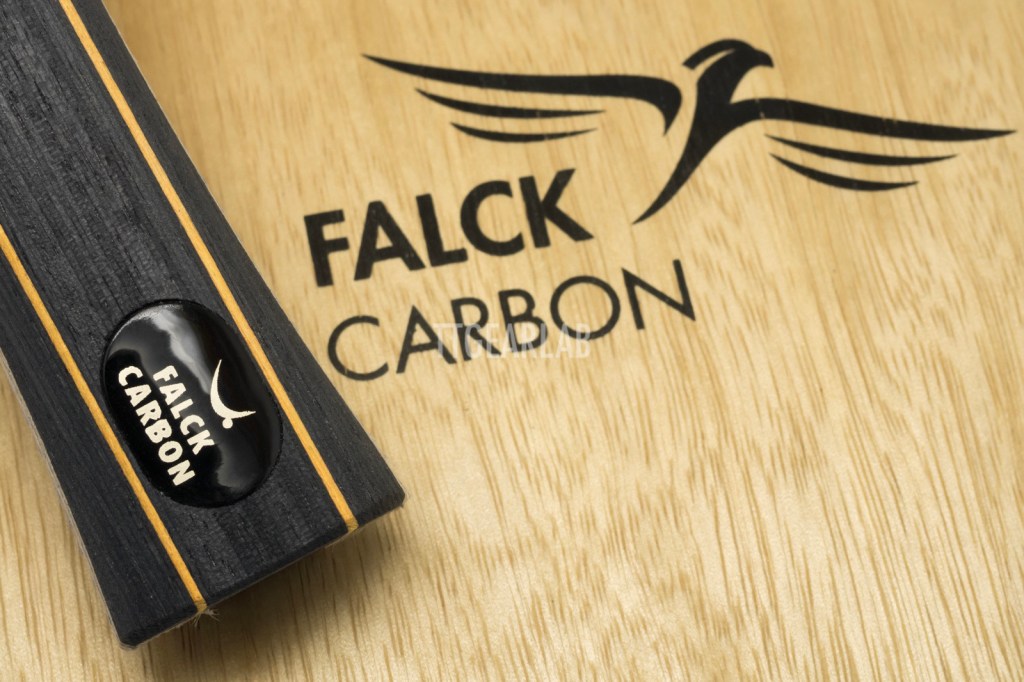
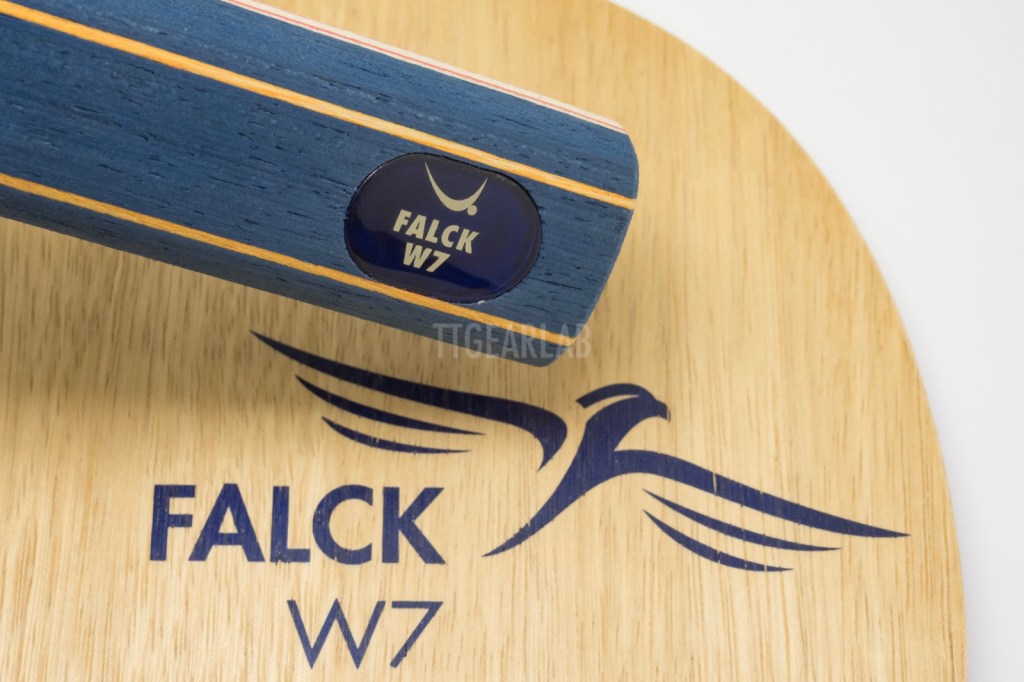
Above picture shows ‘Falck Carbon’ which is a fiber blade and ‘Falck W7’ which is a pure 7-ply wood blade. Two models share the design concept because those are the variations in the same ‘Falck’ series. At a glance, two models are distinguished by each other by the theme color of handle – black for ‘Falck Carbon’ and blue for ‘Falck W7’.
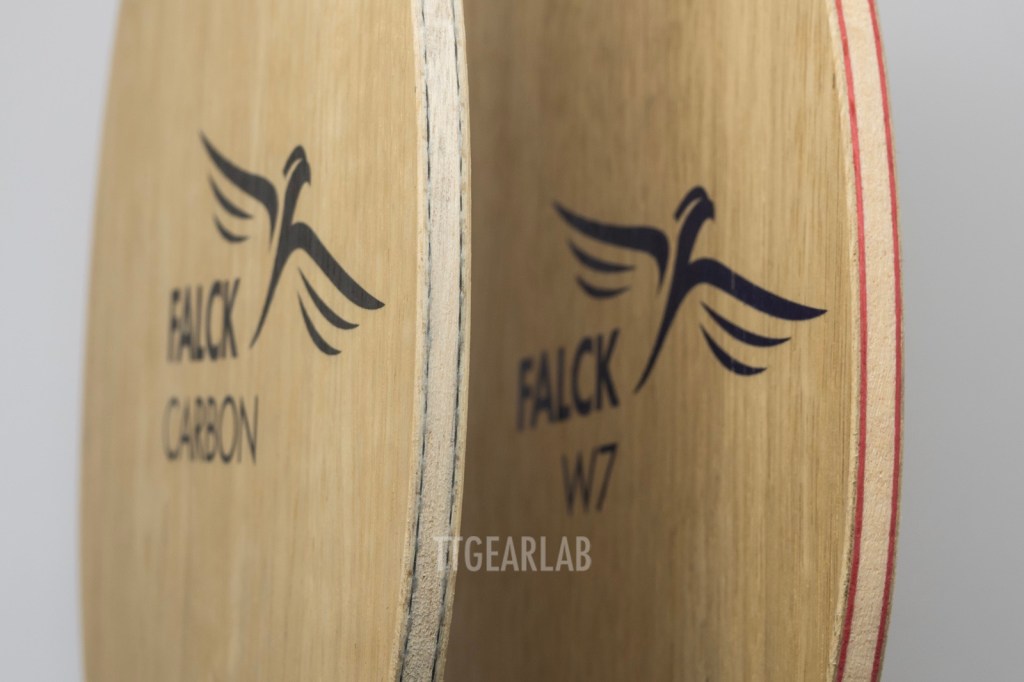
‘Falck Carbon’ is a fiber blade while ‘Falck W7’ is a pure wood blade, although those two are the variations in the same blade family. However, from above picture we can notice that the construction of ‘Falck W7’ is similar to that of an inner-type fiber blade whose fiber is replaced by dyed thin wood layer.
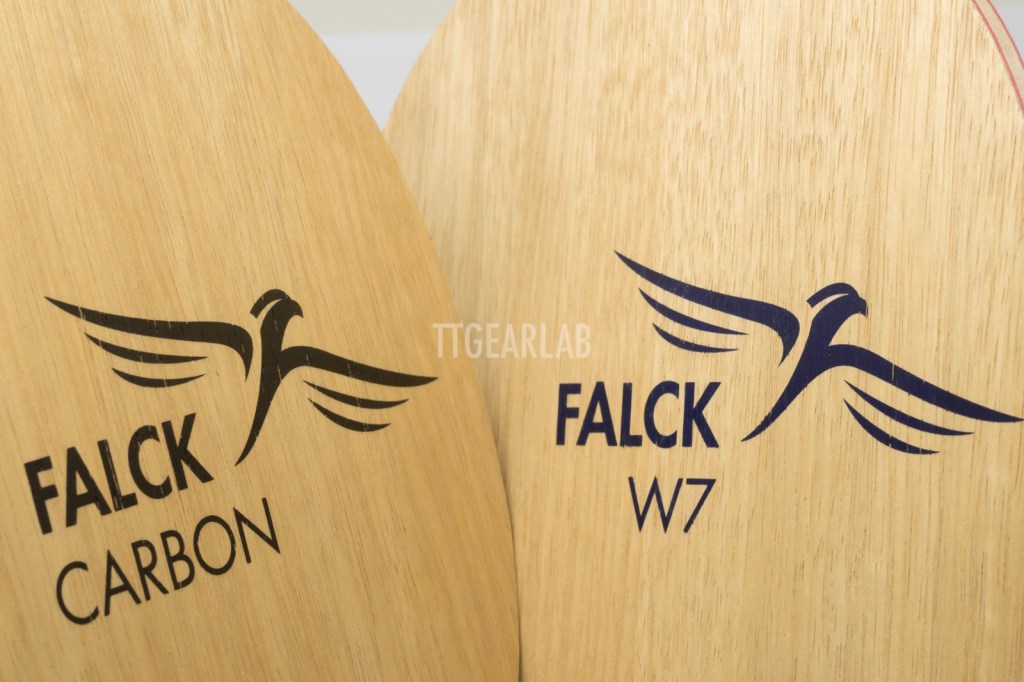
The graphic which expresses ‘Falck’ series is printed at the right side of the front face of blade head. Differently from former Yasaka blades made in Sweden, speed symbol such as OFF or OFF+ isn’t included in the head printing.
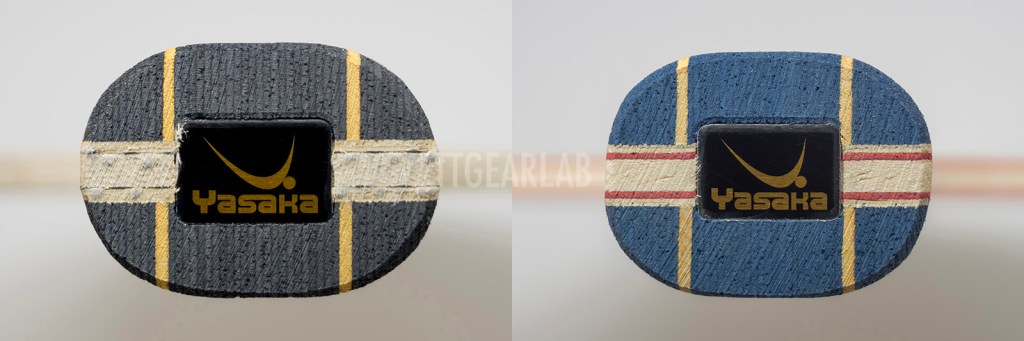
Recent Yasaka blades have squared plastic lens at the end of handle, instead of old metal sticker. The logo of Yasaka is printed in gold color on the black background.
1-1. Falck Carbon (inner JPC)
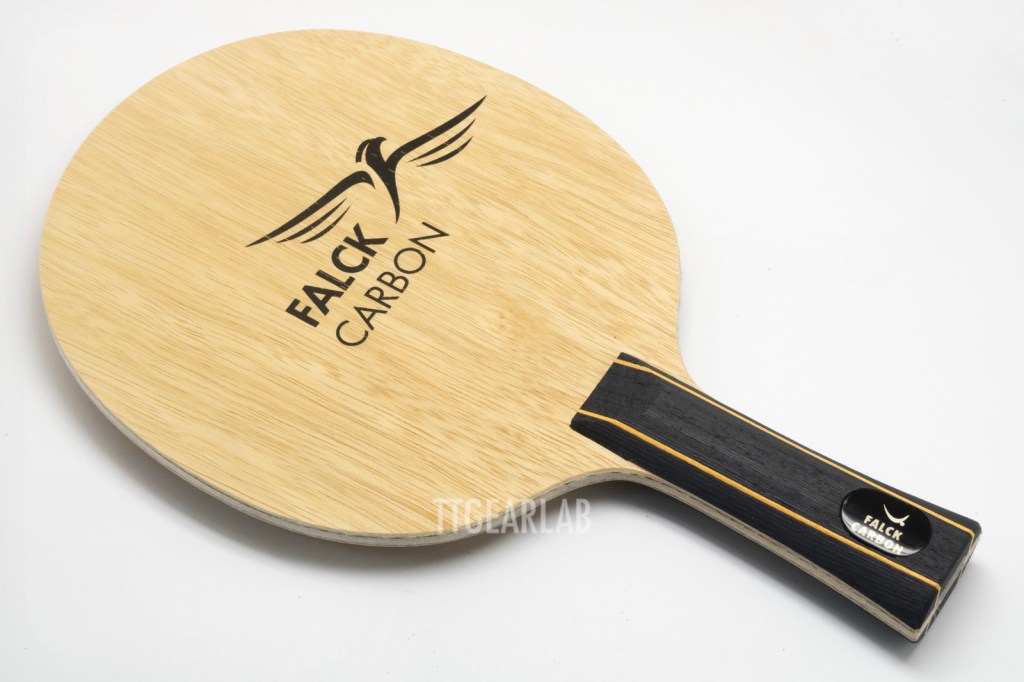
‘Falck Carbon’ is an inner-fiber blade of Mattias Falck. Before using this blade, Mattias Falck had used ‘Ma Lin Soft Carbon’, and he had improved his World ranking steadily with that blade. But, afterwards he required a little bit faster blade which still provides good ball feel. Yasaka tried various constructions with various artificial materials, and the result is the inner fiber construction whose artificial material is JPC (Japanese Premium Carbon – more correctly, it isn’t just woven carbon fiber but mixed woven fiber). Mattias Falck proved the ability of this blade by winning silver medal in WTTC 2019, and gold medal in Men’s Doubles during WTTC 2021.
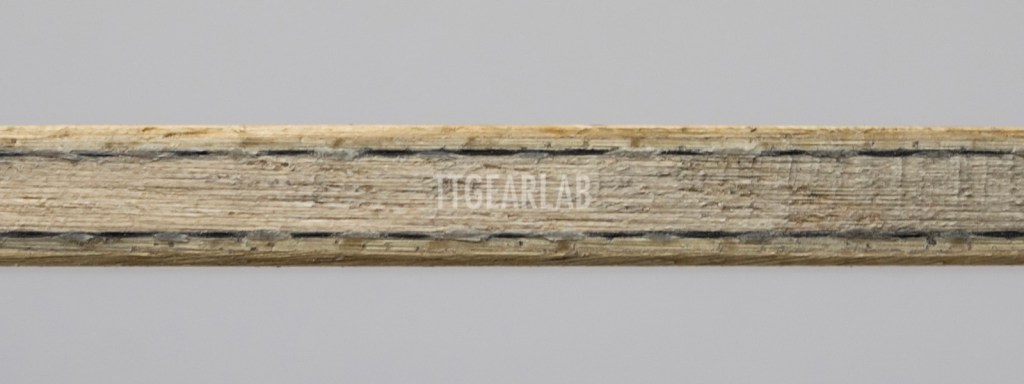
The construction of ‘Falck Carbon’ is a 5+2 ply inner fiber construction. Top layer is Limba. The middle layer looks like Limba, and the center layer looks like Kiri. (Not confirmed. So the materials of middle layer and center layer can be difference ones.) Artificial material is inserted between the middle layer and the center layer. Yasaka calls the artificial material for ‘Falck Carbon’ as JPC (Japanese Premium Carbon). But, actually it is an mixed woven fiber that includes Carbon fiber and other kind of fiber. Overall thickness is 5.8~5.9mm.
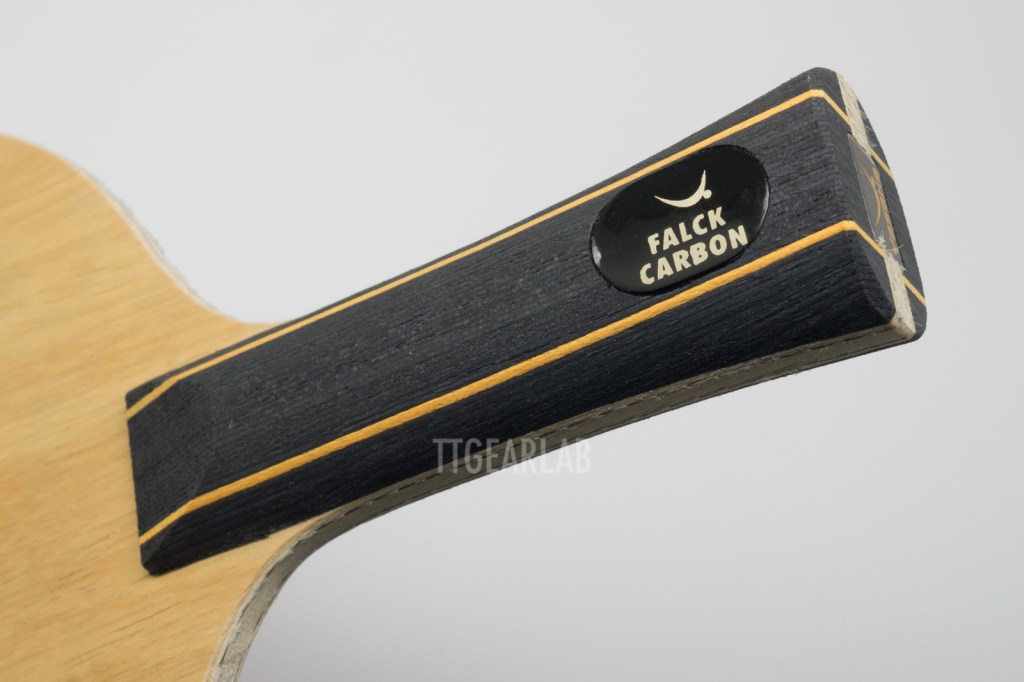
The width of FL (flared) handle is around 26.5mm (at head side) ~ 27.5mm (at the middle of handle) ~ 35mm (at the end), and the thickness of FL handle is round 22.5mm (at thumb) ~ 24.5mm (at the end).

The size of ST (straight) handle which isn’t shown in the picture is around 29.5mm (width) x around 22mm (thickness). It is a very wide handle. But, because it isn’t thick the handle fits into palm without problem. The top and the bottom of handle is almost flat. (Not perfectly flat.) So it feels like squared handle.
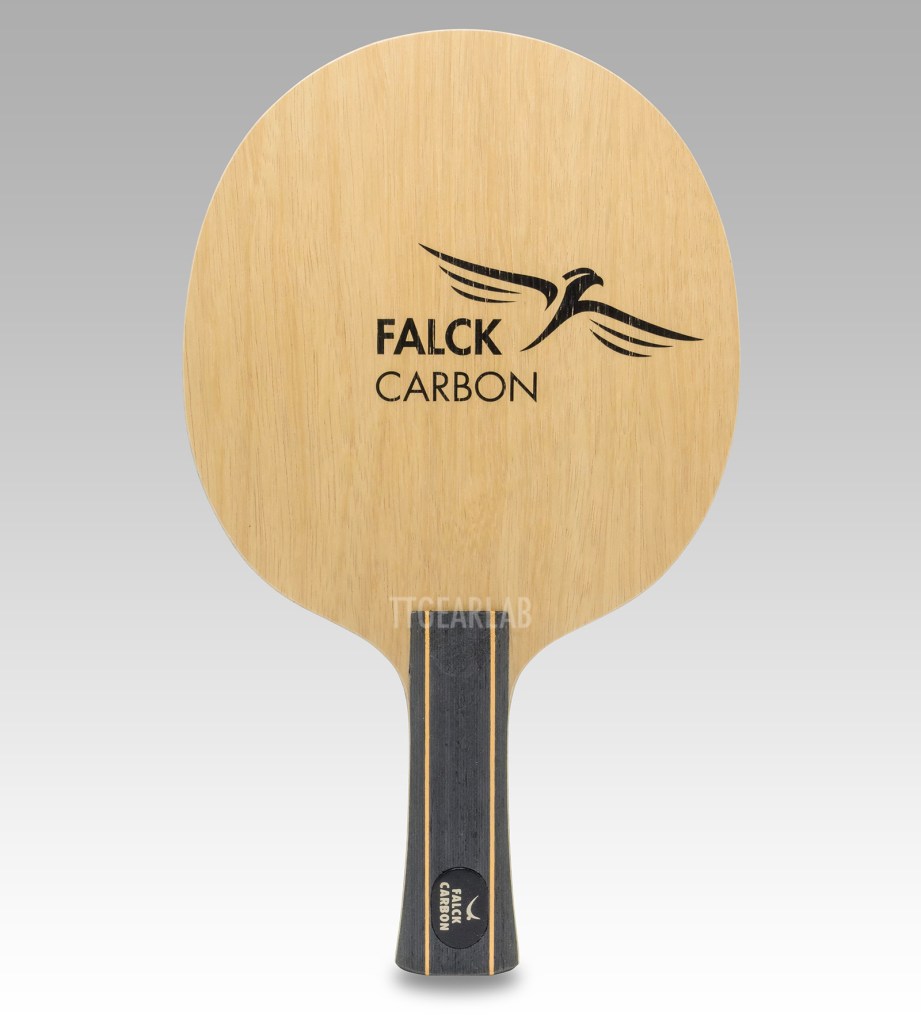
The head size is around 157mm x 151mm.
1-2. Falck W7 (7-ply wood)
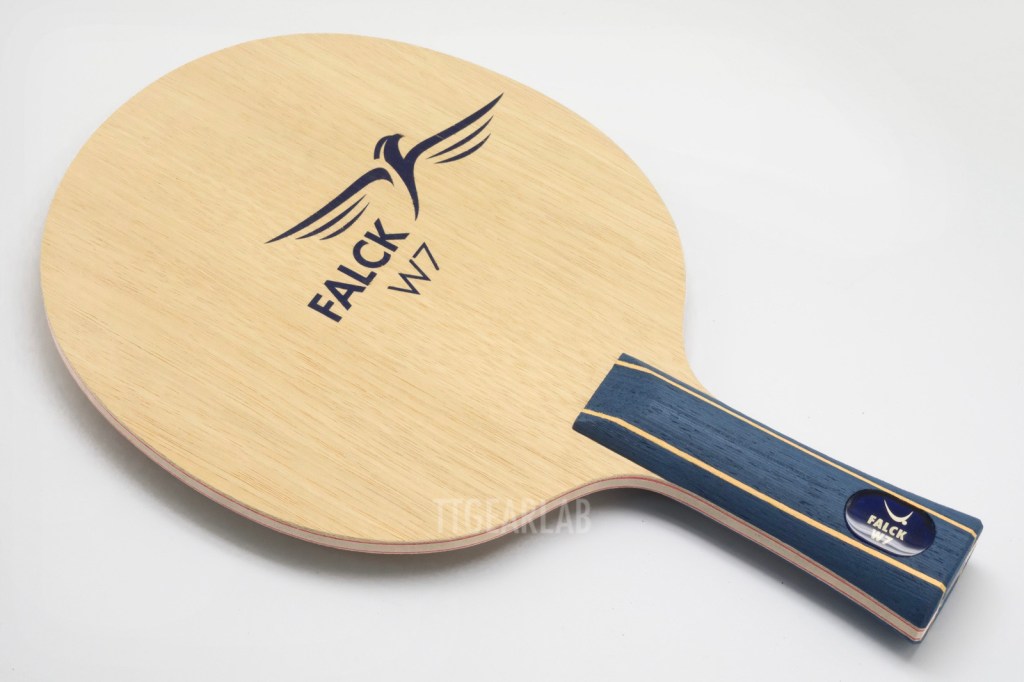
The construction of ‘Falck W7’ is different from 7-ply wood construction of ‘Clipper’ type although it also follows traditional Swedish wood processing method. Differently from ‘Clipper’ type which has three moderately thick layers at the center, it has one thick core layer and three thinner outer layers at both sides. One important advantage of ‘Falck W7’ is that it provides very stable weight around 85 grams thanks to individual hand selection of the veneers.
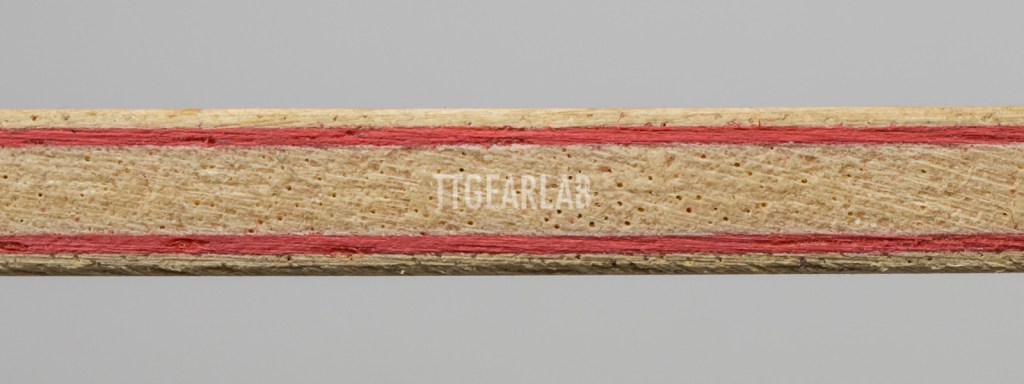
‘Falck W7’ is a 7-ply wood blade. Differently from ‘Clipper’ type which has three moderately thick layers at the center, it has one thick core layer and three thinner outer layers at both sides. Top layer is Limba. The second layer under layer is assumed to be Limba, and the dyed layer below it is assumed to be Ayous. The center layer is Ayous. Overall thickness is around 6.3mm. Average weight is around 85 gram.
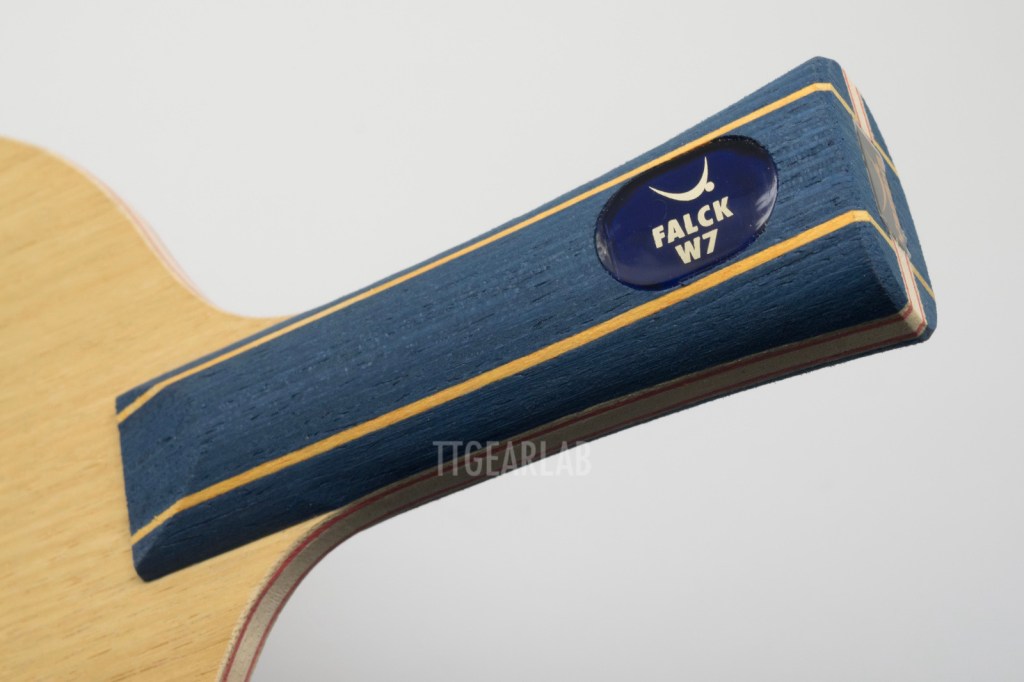
The width of FL (flared) handle is around 26.5mm (at head side) ~ 27.5mm (at the middle of handle) ~ 35mm (at the end), and the thickness of FL handle is round 23mm (at thumb) ~ 25.5mm (at the end).
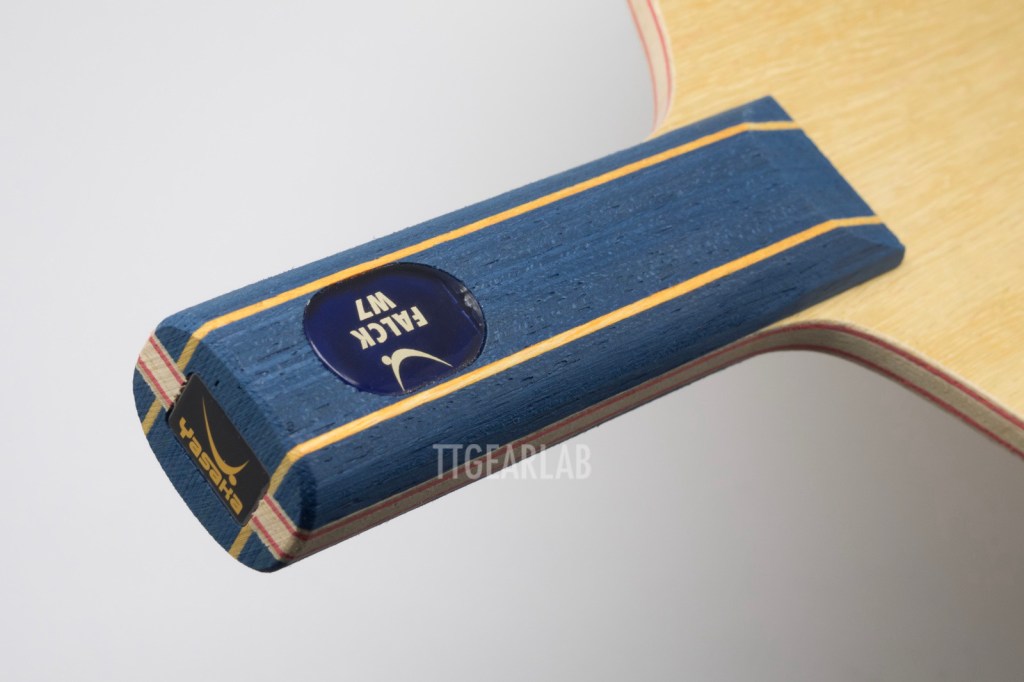
The size of ST (straight) handle which isn’t shown in the picture is around 29.5mm (width) x around 22.5mm (thickness). It is a very wide handle. But, because it isn’t thick the handle fits into palm without problem. The top and the bottom of handle is almost flat. (Not perfectly flat.) So it feels like squared handle.
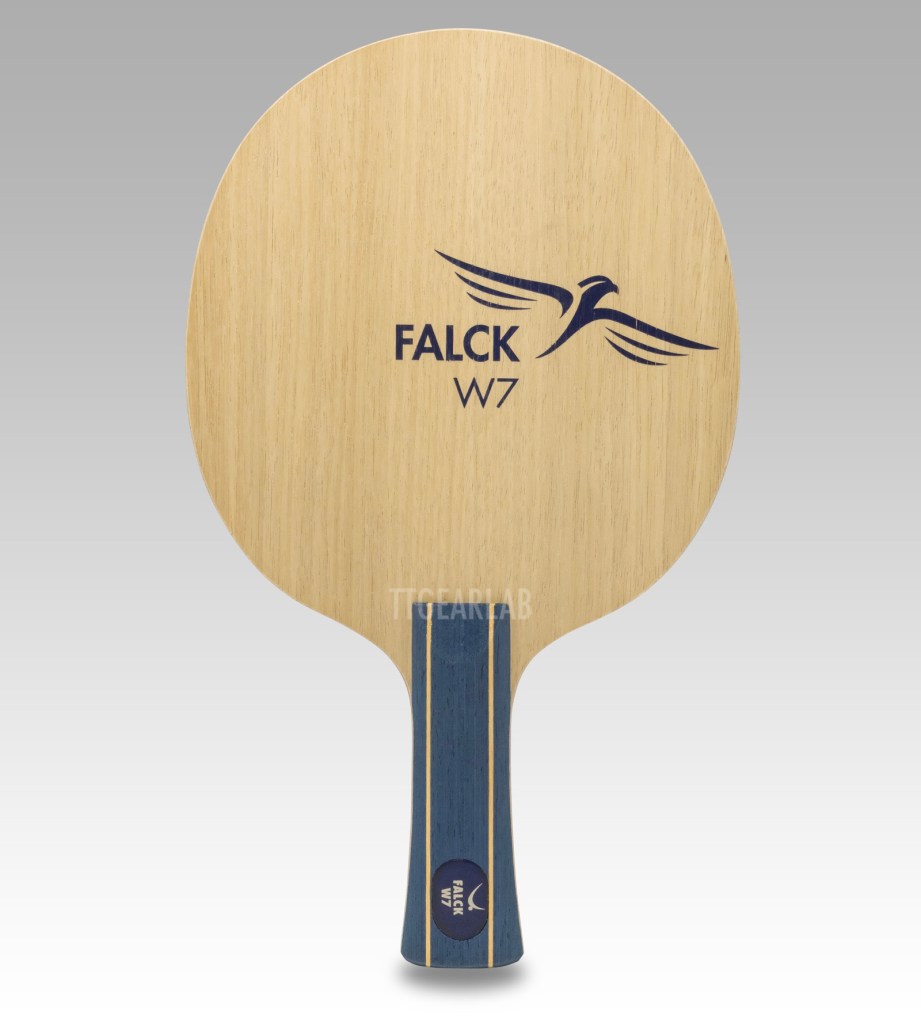
The head size is around 157mm x 151mm.
Then let’s check the characteristics of ‘Falck Carbon’ and ‘Falck W7’ by Performance Indices and then compare with some existing blades.
Please click here to return to top (table of contents)
2. Performance Indices
Performance Indices are measured objective values to represent the characteristics of table tennis gears. Concerning the detail of four performance indices, please refer to following articles in ‘About TTGearLab’ section :
- Performance indices : the way to evaluate blade by measurement
- The example of comparison by performance indices
The performance indices of ‘Falck Carbon’ and ‘Falck W7’ are as follows:
Yasaka Falck Carbon(average weight = 87.6g)
Ep = 2.04
Ec = 1.93 (Ec/Ep = 0.95)
Vp = 1.33
Vl = 1.39 (Vl/Vp = 1.04)
Yasaka Falck W7 (average weight = 85.3g)
Ep = 1.65
Ec = 1.34 (Ec/Ep = 0.81)
Vp = 1.13
Vl = 1.33 (Vl/Vp = 1.17)

‘Falck Carbon’ is a kind of inner-type fiber blade. But its Ep (= 2.04) is much higher than the values of many inner-type blades in the market. And its Ec (= 0.95) is also very high as that of an inner-type blade. The ratio – Ec/Ep is 0.95. Because it is between 0.9 and 1.0, We can think that ‘Falck Carbon’ hugs the ball but not deeply when the player hits the ball very strongly. It is expected that the player will feel that ‘Falck Carbon’ doesn’t hug the ball much or give noticeable additional kick.
Regarding Vibration Indices, the Vp of ‘Fire Fall VC’ is also higher than what we can expect form an ordinary inner-type blade. ‘Falck Carbon’ is stiffer than most of inner-type blades. And its Vl (= 1.39) is also higher than the values of ordinary inner-type blades (= around 1.30~1.35 for inner-ALC blades). However, because the difference between Vp and Vl is not significant, its Vl/Vp (= 1.04) is close to 1.0. The feeling transferred to the player’s index finger is sharper than the primary feeling, but the difference is not significant. There will be players who feel that the feeling of this blade is evenly distributed.
The values of ‘Falck Carbon’ reminds us of the values of classic thick 7-ply wood blades for fast attack. It is expected that ‘Falck Carbon’ fits for the playing style that frequently uses block and smash at close-to-table area. But, because it is a thin inner-type blade, probably ‘Falck Carbon’ is also expected to be a good blade for topspin players who required more power for powerful play from mid-distance area.

‘Falck 7’ is a 7-ply wood blade, but its characteristics are quite different from those of classic 7-ply wood blades of ‘Clipper’ type. Its Ep (= 1.65) looks somewhat low as a value of 7-ply wood blade but is still in the range that we can expect from 7-ply wood blades. But its Ec (= 1.34) is very low as that of a 7-ply wood blade, and is much lower than its Ep. As the result the Ec/Ep of ‘Falck W7’ is 0.8 which is dealt as an extremely low value. We can expect that ‘Falck W7’ hugs ball very deeply when the player hits the ball very strongly.
Regarding Vibration Indices, the Vp of ‘Falck W7’ is 1.13. It is the value that can be compared with those of typical 5-ply wood offensive blades. And it is quite low as that of a 7-ply wood blade. Players will feel that this blade is quite soft. But its Vl (= 1.33) is not that low. As the result, its Vl/Vp (= 1.17) is high. It means that the feeling transferred to the player’s index finger is much sharper than the primary feeling.
The values of ‘Falck W7’ reminds us of the values of classic 5-ply wood offensive blades. It is expected that ‘Falck W7’ fits for the playing style whose main weapon is continuous topspin. Differently from thick 7-ply wood blades, ‘Falck W7’ will not fit for fast attack which frequently uses block and smash. If the player plays at close to table area with ‘Falck W7’, counter-topspin will be more effective than block.

From the Performance Indices, we can understand the characteristics of ‘Falck Carbon’ and ‘Falck W7’ clearly. ‘Falck Carbon’ is expected to fit for hard hitters or fast attackers who frequently uses block and smash. On the contrary ‘Falck W7’ is expected to fit for the topspin players who play with continuous topspin.
Two blades will be compared with some existing fiber blades and all-wood blades by graphs in next Chapter.
Please click here to return to top (table of contents)
3. Comparison by Performance Indices
Then we can compare ‘Falck Carbon’ and ‘Falck W7’ with some other blades – mainly inner-type blades and 7-ply wood blades.
Following is the list of the blades to be compared :
Inner ALC (or similar) blades:
- Butterfly ‘Ovtcharov InnerForce ALC’ (avg. weight = 89.2g) : Limba top layer + ALC. Thicker, bigger and faster than ‘InnerForce Layer ALC’.
- Butterfly ‘InnerForce Layer ALC’ (avg. weight = 91.2g) : Limba top layer + ALC. The standard of inner-ALC blades. (Current version measured in 2023.)
- DHS ‘Hurricane Long 5’ (avg. weight = 88.1g) : Limba top layer + ALC. Current representative of inner-ALC blades. (2022 version.)
- andro Synteliac VCI OFF (avg. weight = 88.6g) : Limba top layer + ALC. Extremely similar to ‘InnerForce Layer ALC’.
- KTS Problade Core ALC (avg. weight = 84.5g) : Limba top layer + ALC. (New ‘made in Japan’ version introduced in October 2024.)
- Victas ‘Fire Fall VC’ (avg. weight = 81.8g) : Limba top layer + ALC. Thicker than ordinary inner ALC blades.
Inner Carbon & inner ZLC blades:
- KTS ‘Problade Forge 3K’ (avg. weight = 84.4g) : Limba top layer + Woven Carbon fiber. Very fast inner-type blade.
- Stiga ‘Inspira CCF’ (avg. weight = 87.3g) : Koto top layer + Woven Carbon fiber. Very fast inner-type blade.
- Butterfly ‘InnerForce Layer ZLC’ (avg. weight = 89.8g) : Limba top layer + ZLC. The standard of inner-ZLC blades.
- Butterfly ‘Harimoto Tomokazu InnerForce Super ZLC’ (= for short ‘Harimoto Super ZLC’) (avg. weight = 86.3g) : Limba top layer + Super ZLC. A bit thicker, but the center layer is softer Kiri.
Outer type fiber blades:
- Butterfly ‘Viscaria’ (avg. weight = 87.1g) : Koto top layer + ALC. Reference of all outer ALC blade. Current version..
- Butterfly ‘Freitas ALC’ (avg. weight = 87.4g) : Limba top layer + ALC. Direct competitor of ‘Treiber CO OFF/S’.
7-ply wood blades :
- Stiga ‘Clipper Wood’ (avg. weight = 93.0g) : The classic of 7-ply wood blade. (Thick version whose thickness is 6.8mm.)
- Butterfly ‘SK7 Classic’ (avg. weight = 90.6g) : Thick 7-ply wood blade of classic construction. Similar to Clipper series but a bit different.
- DHS ‘Hurricane Long 3’ (avg. weight = 89.0g) : Modern 7-ply wood blade for continuous topspin.
5-ply wood blades :
- Butterfly ‘Korbel’ (avg. weight = 88.7g) : The standard of 5-ply wood offensive blades.
- Yasaka ‘Gatien Extra’ (avg. weight = 87.1g) : The 5-ply wood offensive blades for very aggressive topspin.
- Stiga ‘Allround Classic’ (avg. weight = 84.3g) : The standard of 5-ply wood all-round blades. Reference of Performance Indices whose all indices are 1.0.
3-1. Elasticity Indices

Fig.18 shows the comparison graph of Elasticity Indices.
Ep (Primary Elasticity Index) is directly concerned with the rebound speed of blade. Ec (Central Elasticity Index) is concerned with additional ‘kick’ when player hits ball very strongly.
[Inner ALC or similar]
‘Falck Carbon’ is an inner-type fiber blade which looks similar to inner-ALC blades. Therefore, it can be first compared with the inner ALC blades or the inner-type blades whose artificial materials are similar to ALC. The result of comparison can be summarized as follows:
- Most of inner-ALC blades are noticeably less elastic than ‘Falck Carbon’. Both of the Ep and the Ec of ‘Falck Carbon’ are much higher than those of inner-ALC blades. The only one inner-ALC blade which can be compared with ‘Falck Carbon’ in elasticity is ‘Ovtcharov InnerForce ALC’. Its Ep is very close to that of ‘Falck Carbon’. However, its Ec is significantly lower than the Ec of ‘Falck Carbon’.
- We may be able to find the similarity in graph shapes between ‘Falck Carbon’ and some inner-ALC blades, for example ‘Fire Fall VC’. So we will be able to say that ‘Falck Carbon’ can be a good solution in case the player who have used those inner-ALC blades but requires much higher elasticity to make faster ball.
- When compared with ‘Falck W7’, all blades in this group are more elastic than ‘Falck W7’ in both of primary elasticity and central elasticity.
[Inner Carbon & Inner ZLC]
Because ‘Falck Carbon’ is a very fast inner-type blade, we can compare it with inner-Carbon or inner-ZLC blades those are in general more elastic than inner-ALC blades. The result of comparison can be summarized as follows:
- ‘Problade Forge 3K’ and ‘Inspira CCF’ are more elastic than ‘Falck Carbon’ in primary elasticity, but the gap is not significant. But, the central elasticities of these two are similar to or lower than that of ‘Falck Carbon’. We will be able to group ‘Falck Carbon’ together with these two blades into ‘Fast Inner’ group in next chapter.
- Two inner-ZLC blades – ‘InnerForce Layer ZLC’ and ‘Harimoto Tomokazu InnerForce Layer Super ZLC’ (= ‘Harimoto Super ZLC’) are one step less elastic than ‘Falck Carbon’.
[Outer ALC]
Because ‘Falck Carbon’ is a very fast blade, it will be also meaningful that we compare it with outer-ALC blades.) The result of comparison can be summarized as follows:
- The values of two typical outer-ALC blades – ‘Viscaria’ and ‘Freitas ALC’ – are very close to those of ‘Falck Carbon’.
- Therefore, we can understand that ‘Falck Carbon’ is an inner-type blade which has the characteristics of outer-type blade.
[7-ply wood]
We can compare two classic 7-ply wood blade and one modern 7-ply wood blade with ‘Falck W7’ and additionally with ‘Falck Carbon’.
- Two classic 7-ply wood blades are as elastic as ‘Falck Carbon’. There aren’t much differences in primary elasticity, and we can observe the differences just in central elasticity. ‘Clipper Wood’ is more elastic and ‘SK7 Classic’ is less elastic at the center when compared with ‘Falck Carbon’.
- ‘Falck W7’ is much less elastic than two classic 7-ply wood blades. But, ‘Hurricane Long 3’ which is a modern 7-ply wood blade is quite close to ‘Falck W7’ in elasticity. We will be categorize ‘Falck W7’ and ‘Hurricane Long 3’ together into a same category – The 7-ply wood blades those are close to 5-ply wood blades.
[5-ply wood]
We can also compare some 5-ply wood blades with ‘Falck W7’. The result of comparison can be summarized as follows:
- As we could find similarity between the graph of ‘Falck W7’ and that of ‘Hurricane Long 3’, we can also find similarity between that of ‘Korbel’ and that of ‘Falck W7’ – the primary elasticity of intermediate level and much lower central elasticity. This kind of blades fits for stable offensive play by continuous topspin because the center of blade hugs the ball very deeply when the player hits the ball very strongly. But, those blades don’t fit for fast attack that frequently uses block and smash.
- ‘Gatien Extra’ is also the blade with similar graph shape. But, the overall elasticity level of ‘Gatien Extra’ is much lower than ‘Korbel’ or ‘Falck W7’. Because it is slower blade, ‘Gatien Extra’ provides even higher stability in extremely aggressive topspin.
- Anyway we can understand that ‘Falck W7’ provides the characteristics of 5-ply wood blades for topspin strategy.
- ‘Allround Classic’ will be somewhat different. It fits for the play that lays more emphasis on the precise control than the stability of aggressive topspin. In graph shape, ‘Falck Carbon’ is more similar to ‘Allround Classic’ than ‘Falck W7’. If the player wants increase power from ‘Allround Classic’, ‘Falck Carbon’ may be better solution than ‘Falck W7’.
Examining Ec/Ep is also an easier way to understand the characteristics of blade concerned with elasticity. Fig.19 shows the relationship between Ec/Ep and Ep.
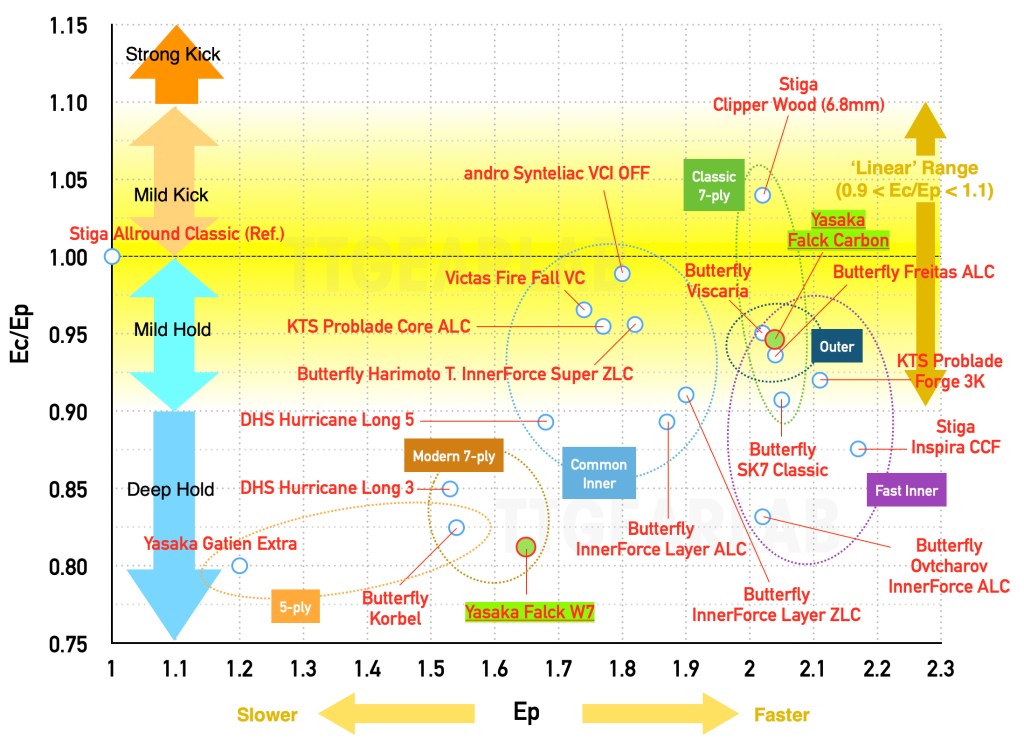
Ec/Ep expresses the ‘tendency’ of the elasticity of blade. By examining Ec/Ep and Ep at the same time, we can easily understand the behavior of blades.
On the graph, most of blades in this comparison are in ‘Hold’ range (Ec/Ep < 1.0). And, in ‘Hold’ range, the blades are widely distributed up, down, left and right within that range. And, for better understanding we can categorize the blades into different groups from what we categorized in former section. The result of the comparison can be summarized as follows
[‘Falck Carbon’ & ‘Fast Inner’ group & ‘Outer’ group]
- ‘Falck Carbon’ is an inner-type blade whose Ep is over 2.0. It can be categorized into ‘Fast Inner’ group which includes ‘Ovtcharov InnerForce ALC’, ‘Inspira CCF’ and ‘Problade Forge 3K’. The blades in this group can be compared with two outer-type blades in ‘Outer’ group – ‘Viscaria’ and ‘Freitas ALC’.
- In ‘Fast Inner’ group, ‘Falck Carbon’ is located at the top of the group. It means that ‘Falck Carbon’ doesn’t hug the ball as deeply as the other blades in the group when the player hits the ball very strongly. In general the high elasticity of the inner-type blades in this group is somewhat compensated by the deep hugging for high impact strength. But, we can’t expect that level of deep hugging from ‘Falck Carbon’. Please note that this doesn’t mean that ‘Falck Carbon’ will not hug the ball. ‘Falck Carbon’ is located at the middle of ‘Mild Hold’ range. ‘Relatively high Ec/Ep’ is no more than the result of the comparison with the other fast inner-type blades.
- ‘Falck Carbon’ is locate at very close position to two blades of ‘Outer’ group. So we can understand that ‘Falck Carbon’ provides the elasticity characteristics similar to those of typical outer-type blades.
[‘Classic 7-ply’ group & ‘Common Inner’ group]
- Thick and heavy 7-ply wood blades of classic thick construction can be categorized into ‘Classic 7-ply’ group. Two blades in this group – ‘Clipper Wood (6.8mm medium-weight version)’ and ‘SK 7 Classic’ – are as elastic as the blades of ‘Outer’ group in primary elasticity. Because these blades are pure wood blades, the deviation by piece is somewhat bigger than that of fiber blades. And, even though those two have similar constructions, ‘Clipper Wood’ and ‘SK7 Classic’ shows quite different level of Ec/Ep. But, interestingly the center of the group seems to be quite close to the location of ‘Falck Carbon’ and two blades of ‘Outer’ group. We may be able to think that ‘Falck Carbon’ has some similarities with classic thick 7-ply wood blades those had mainly been used for fast attack with pimple out rubbers.
- ‘Common Inner’ group includes typical inner-ALC blades and inner-ZLC blades. We can observe that the primary elasticity of those blades are between 1.6 and 2.0. The group is located noticeably to the left of ‘Outer’ group and ‘Falck Carbon’.
- We can see that the Ec/Ep’s of many blades in this group are similar to or higher than that of ‘Falck Carbon’. Therefore, ‘Falck Carbon’ can be good solution if the player want to replace those blades to faster one.
[‘Falck W7’ and ‘Modern 7-ply’ group and ‘5-ply’ group]
- ‘Falck W7’ is a modern 7-ply wood blade whose construction is much thinner than classic 7-ply construction. So it can be categorized into ‘Modern 7-ply’ group together with ‘Hurricane Long 3’.
- The range of ‘Modern 7-ply’ group is overlapped with the location of ‘Korbel’ which is a typical 5-ply wood offensive blade. Therefore we will be able to consider modern 7-ply wood blades like ‘Falck W7’ as the solution in case the player wants to replace the 5-ply offensive blade with a bit faster one but doesn’t like fiber blade. If the player requires even higher elasticity, inner-type blades will be the solution. But, in most cases the player should try to be accustomed to higher Ec/Ep of most of inner-type blades.
Then next, let’s compare Vibration Indices.
Please click here to return to top (table of contents)
3-2. Vibration Indices
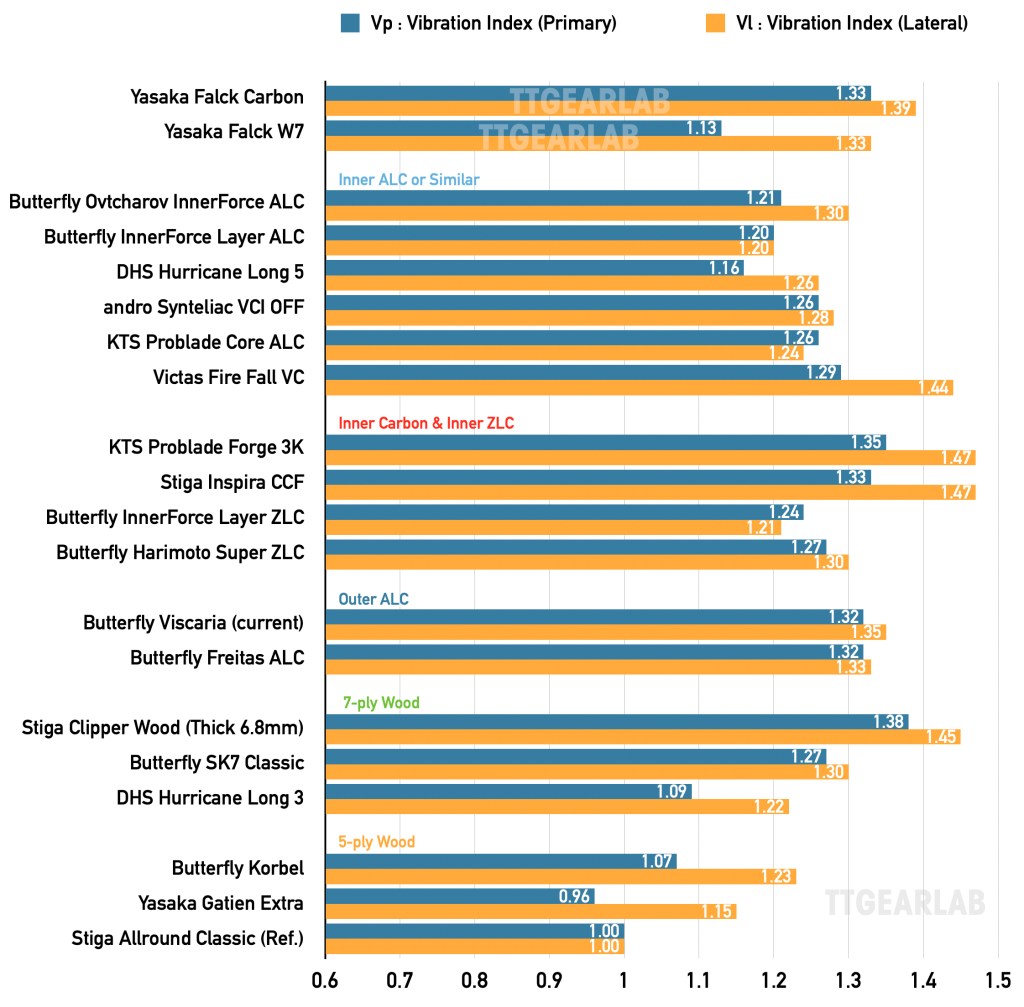
Fig.20 shows the comparison graph of Vibration Indices. Vibration Indices are concerned with feeling. The bigger the value the harder the feeling. Vp indicates primary feeling which is transferred to player’s palm. And, Vl is the feeling at the edge of the wing – the lower side of blade head. It is felt by player’s index finger or middle finger.
The indices of ‘Falck Carbon’ are higher than those of ‘Falck W7’. But, we can observe that there isn’t significant difference between the Vl’s of those two while the Vp of ‘Falck Carbon’ is much higher than that of ‘Falck W7’.
[Inner ALC or similar]
‘Falck Carbon’ is an inner-type fiber blade which looks similar to inner-ALC blades. Therefore, it can be first compared with the inner ALC blades or the inner-type blades whose artificial materials are similar to ALC. The result of comparison can be summarized as follows:
- The Vp of ‘Falck Carbon’ is higher than those of all blade in this group. And, the Vl of ‘Falck Carbon’ is higher than those of most of blades in this group. The exception is the Vl of ‘Fire Fall VC’ which is much higher than the Vl of ‘Falck Carbon’. In most cases, ‘Falck Carbon’ is stiffer than inner-ALC or similar blades. ‘Falck Carbon’ is quite stiff in both of primary (vertical) direction and lateral direction.
- The Vp of ‘Falck W7’ is lower than those of all blade in this group. On the contrary, the Vl of ‘Falck W7’ is higher than the Vl’s of most of blades in this group except for ‘Fire Fall VC’. ‘Falck W7’ is very soft in primary direction, and quite stiff in lateral direction.
- The graph shapes of ‘InnerForce Layer ALC’, ‘Synteliac VCI OFF’ and ‘Problade Core ALC’ look different from that of ‘Falck Carbon’. It means that the players will feel ‘Falck Carbon’ different from those three blades.
[Inner Carbon & Inner ZLC]
Because ‘Falck Carbon’ is a very fast inner-type blade, we can compare it with inner-Carbon or inner-ZLC blades those are in general more elastic than inner-ALC blades. The result of comparison can be summarized as follows:
- ‘Problade Forge 3K’ and ‘Inspira CCF’ are similar to ‘Falck W7’ in Vp which indicates primary feeling. But, the Vl’s of those two are much higher than that of ‘Falck W7’. Although there are similarities in primary feeling, players will feel that ‘Falck W7’ is different (milder) than those two.
- Two inner-ZLC blades – ‘InnerForce Layer ZLC’ and ‘Harimoto Tomokazu InnerForce Layer Super ZLC’ (= ‘Harimoto Super ZLC’) are noticeably softer than ‘Falck Carbon’.
- None of blades in this group is close to ‘Falck W7’.
[Outer ALC]
Because ‘Falck Carbon’ is a very fast blade, it will be also meaningful that we compare it with outer-ALC blades.) The result of comparison can be summarized as follows:
- Like we observed from the graph of Elasticity Indices, two typical outer-ALC blades – ‘Viscaria’ and ‘Freitas ALC’ – show very similar values to ‘Falck Carbon’ also in this comparison of Vibration Indices, although the Vl of ‘Falck Carbon’ is a bit higher than the Vl’s of those two.
- Therefore, we can understand that ‘Falck Carbon’ has the characteristics like outer-type blade in every aspect.
[7-ply wood]
We can compare two classic 7-ply wood blade and one modern 7-ply wood blade with ‘Falck W7’ and additionally with ‘Falck Carbon’.
- The values of ‘Falck W7’ is much lower than those of ‘Clipper Wood’. But, the values of ‘Falck Carbon’ is a bit lower than those of ‘Clipper Wood’. We can notice that ‘Falck Carbon’ is much closer to ‘Clipper Wood’ when compared with ‘Falck W7’.
- ‘Falck W7’ is also much softer than ‘SK7 Classic’ in primary direction expressed by Vp. On the contrary, in lateral direction (expressed by Vl) ‘Falck W7’ is a bit stiffer than ‘SK7 Classic’. The difference is tiny. The graph shape of ‘SK7 Classic’ looks totally different from that of ‘Falck W7’. It looks similar to that of ‘Falck Carbon’.
- ‘Falck W7’ shows a bit higher value than ‘Hurricane Long 3’ both in primary direction and in lateral direction, but the differences are not significant. The graph shape of ‘Hurricane Long 3’ also looks similar to that of ‘Falck W7’. So, it will be all right that we consider ‘Falck W7’ and ‘Hurricane Long 3’ are similar blades in every aspect.
[5-ply wood]
We can also compare some 5-ply wood blades with ‘Falck W7’. The result of comparison can be summarized as follows:
- The Vp and the Vl of ‘Falck W7’ are higher than those of ‘Korbel’ or ‘Gatien Extra’. But, the differences don’t look significant. And, the graph shapes of ‘Korbel’ and ‘Gatien Extra’ look similar to that of ‘Falck W7’ or ‘Hurricane Long 3’. We can understand that ‘Falck W7’ is close to 5-ply wood offensive blade also in vibration characteristics.
- It is expected that players will be able to replace 5-ply wood offensive blade like ‘Korbel’ with ‘Falck W7’ without problem.
Examining Vl/Vp is easier way for the comparison of the tendency of feeling. Fig.21 shows the relationship between Vl/Vp and Vp for easier comparison.
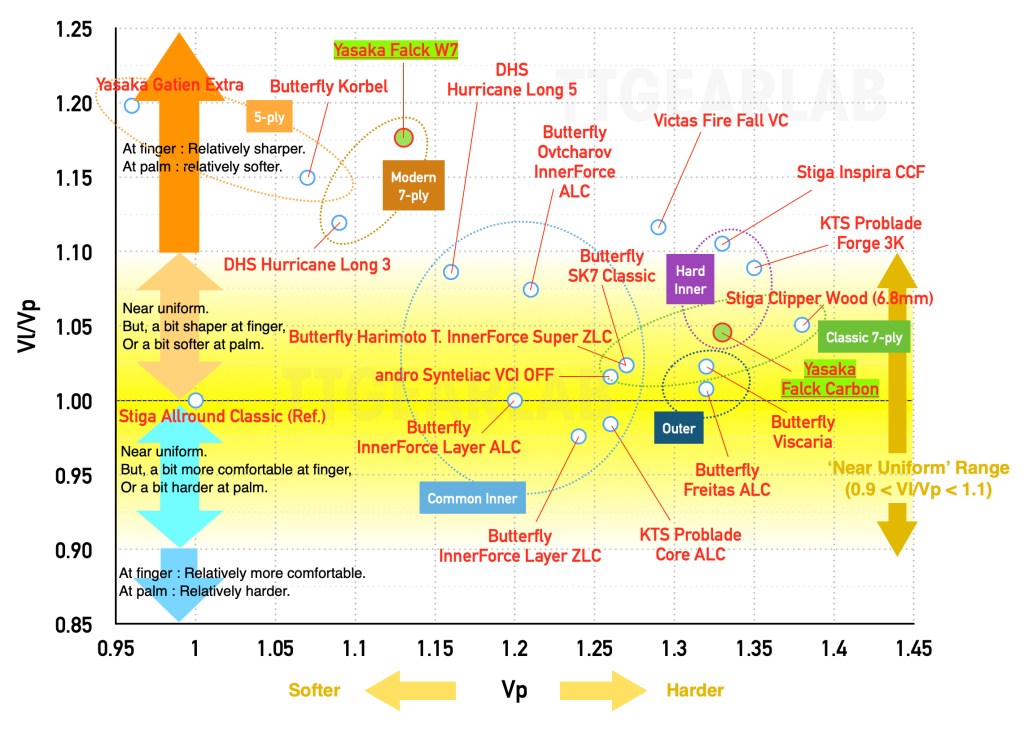
On the graph, most of blades in this comparison are located in ‘Relatively sharper at finger’ range (Vl/Vp > 1.0) = upper area. Two blades are on the border line (Vl/Vp = 1.0), and two blades are located in ‘Relatively more comfortable at finger’ range (Vl/Vp < 1.0) = lower area. So we can think that most of the blades in this comparison transmits relatively sharper feeling at index finger. However, if we observe the area near the border line (Vl/Vp = 1.0), we can also understand that many blades in this comparison are located near that line. So, there will be many players who feel that the feeling of those blades are almost uniformly distributed. Nevertheless we can compare the locations of the blades and observe which one is relatively upper position (= sharper at finger) and which one is relatively lower position (= milder at finger).
Both of two models of ‘Falck’ series – ‘Falck Carbon’ and ‘Falck W7’ – are located in the area that Vl/Vp > 1.1. So both of those two models transmit relatively sharper feeling to the index finger when compared with the feeling transferred to the palm. But, because ‘Falck Carbon’ and ‘Falck W7’ are far apart on the graph, players will feel significant difference between those two models.
For better understanding we can categorize the blades into different groups from what we categorized in former section. The result of the comparison can be summarized as follows:
[‘Falck Carbon’ & ‘Hard Inner’ group & ‘Outer’ group]
- ‘Falck Carbon’ is an inner-type blade whose Vp is over 1.3. So it can be compared with many outer-type blades those are stiffer than ordinary inner-type blades. On the graph, ‘Falck Carbon’ is located very close to ‘Outer’ group which includes two outer-type blades – ‘Viscaria’ and ‘Freitas ALC’. When compare with two outer-type blades, ‘Falck Carbon’ transmits relatively sharper feeling to index finger because its Vl/Vp is higher.
- Among inner-type blades, there are two models whose Vp’s are as high as that of ‘Falck Carbon’. Those two – ‘Inspira CCF’ and ‘Forge 3K’ – transmit relatively sharper feeling at index finger than ‘Falck Carbon’ because those two are located above ‘Falck Carbon’. Probably that is because the artificial material of those two is 3K carbon fiber which is much more elastic and much stiffer than mixed fiber materials such as ALC or ZLC. The Vp of those two could be much higher if the constructions of those two are not inner-type. We can categorize those two and ‘Falck Carbon’ into ‘Hard Inner’ group.
[‘Classic 7-ply’ group & ‘Common Inner’ group]
- Thick and heavy 7-ply wood blades of classic thick construction can be categorized into ‘Classic 7-ply’ group. The Vp’s of two blades in this group – ‘Clipper Wood (6.8mm medium-weight version)’ and ‘SK 7 Classic’ – are noticeably higher (= the case of ‘Clipper Wood’) or noticeably lower (= the case of ‘SK7 Classic’) than that of ‘Falck Carbon’. But, the Vl/Vp’s of those two are quite close to that of ‘Flack Carbon’. And, the center of the group is very close to the location of ‘Falck Carbon’, while the group itself is located far from ‘Falck W7’. We can understand that ‘Falck Carbon’ or the blades in ‘Outer’ group share some features with classic 7-ply wood blades. The advantage of ‘Falck Carbon’ or outer-type blades is that those blades are much thinner than classic 7-ply wood blades.
- Ordinary (or typical) inner-type blades can be categorized into ‘Common Inner’ group. ‘Falck Carbon’ is located to the right of this group, and the gap is quite large. We can understand that ‘Falck Carbon’ is much stiffer than common inner-type blades in primary feeling.
[‘Falck W7’ and ‘Modern 7-ply’ group and ‘5-ply’ group]
- ‘Falck W7’ and ‘Hurricane Long 3’ can be categorized into ‘Modern 7-ply’ group. This group is located to upper left of ‘Common Inner’ group. It is also located to upper left of ‘Classic 7-ply’ group or ‘Hard Inner’ group or ‘Outer’ group, and the gap is even larger. So, we can understand that modern 7-ply wood blades such as ‘Falck W7’ are much softer but transmit sharper relative feeling when compared with inner-type (common or hard) blade, outer-type blades and classic 7-ply wood blades.
- ‘Modern 7-ply’ group is located as high as ‘5-ply’ group. Both of those two groups are at ‘Relatively sharper at finger’ range (Vl/Vp > 1.1). Because ‘Modern 7-ply’ group is located a bit right to ‘5-ply’ group, modern 7-ply wood blades such as ‘Falck W7’ are stiffer than 5-ply wood blades such as ‘Korbel’ in primary feeling. But, because there isn’t much difference in Vl/Vp, the players will not experience difficulties when they try to replace their 5-ply wood offensive blades to modern 7-ply wood blades.
Please click here to return to top (table of contents)
4. Summary
Yasaka ‘Falck’ series which is named after Swedish top player – Matias Falck – is the new top blade family of Yasaka, and it consists of two models – ‘Falck Carbon’ which is an inner-type fiber blade and ‘Falck W7’ which is a thin 7-ply wood blade. Although those two are the variations in one blade family, those two are clearly distinguished from each other in characteristics. The characteristics of ‘Falck Carbon’ and ‘Falck W7’ can be summarized as follows.
4-1. Falck Carbon (inner JPC)
- ‘Falck Carbon’ is an inner-type blade which places JPC (= Japanese Premium Carbon) between the middle layer and the center layer. JPC is the mixed woven of carbon fiber and unknown fiber.
- ‘Falck Carbon’ provides the primary elasticity that we can expect from outer-type fiber blades such as ‘Viscaria’ or ‘Freitas ALC’. And, it hugs the ball when the player hits the ball very strongly, but not deeply. Because of high primary elasticity and moderate hug level, players will feel that ‘Falck Carbon’ is a highly elastic blade.
- Regarding feeling, its primary feeling is also as stiff as outer-type blades and classic thick 7-ply wood blades. But, the feeling transmitted to index finger is just a bit sharper than primary feeling.
- Overall characteristics which is somewhat close to those of classic 7-ply wood blade may be related with the playing style of Matias Falck who uses pimples out rubber on forehand side. It means that ‘Falck Carbon’ is a blade for fast attack which uses pimples out rubber on one side. It is expected that ‘Falck Carbon’ will fit for the players who aims at early timing and frequently uses block and smash.
- Because its relative parameters (Ec/Ep and Vl/Vp) are not much different from those of common inner-type blades, ‘Falck Carbon’ is expected to be a solution in case the players who have used ordinary inner-ALC or inner-ZLC blades but want to replace the blades with harder and faster one.
4-2. Fire W7 (7-ply wood)
- ‘Falck W7’ is a 7-ply wood blade of modern type. It is significantly different from classic 7-ply wood blades those are thick and heavy.
- The primary elasticity of ‘Falck W7’ is moderate, and it hugs the ball deeply when the player hits the ball very strongly.
- Regarding feeling, its primary feeling is much softer than that of classic 7-ply wood blades. In primary feeling ‘Falck W7’ is softer than most of fiber blades. It is just a bit stiffer than 5-ply wood offensive blades such as ‘Korbel’. And, it transmits much sharper feeling to index finger when compared with the primary feeling transmitted to palm.
- The overall characteristics of ‘Falck W7’ are very close to those of 5-ply wood offensive blade. ‘Falck W7’ is expected to be very easy to use, and fits for continuous topspin that lays emphasis on stability. It is also expected that ‘Falck W7’ fits for very aggressive topspin that aims at the rising of ball after the bounce.
- ’Falck W7′ will be a good solution for the players who want to replace their 5-ply offensive blades with a bit faster one but don’t like fiber blades.
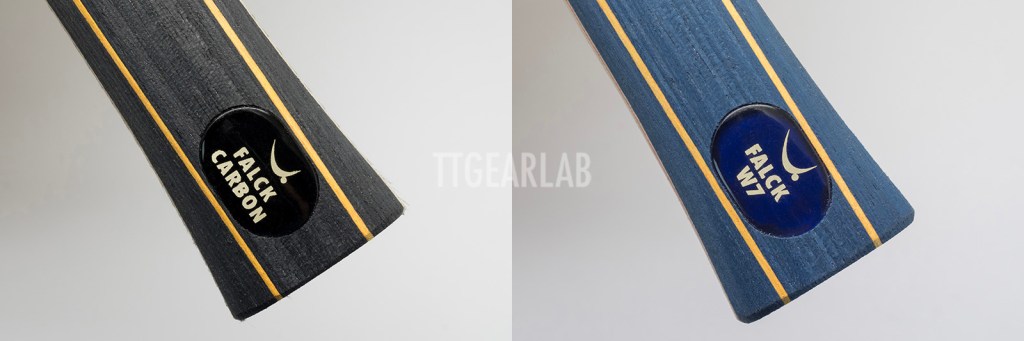
Fig.24 Yasaka ‘Falck Carbon’ (left) and ‘Falck W7’ (right)
‘Falck Carbon’ and ‘Falck W7’ are relatively new blades those are representing Yasaka. Both of ‘Falck Carbon’ and ‘Falck W7’ provide somewhat different characteristics from what we can expect from the constructions of those two – inner type and 7-ply wood. If a player wants to strongly hit the ball by inner-type blade, ‘Falck Carbon’ will be a good choice. ‘Falck Carbon’ can also be the solution for the players who are finding fast inner-type blade but don’t like the deep hug of ‘Ovtcharov InnerForce ALC’. ‘Falck W7’ is a 7-ply wood blade for continuous topspin, and it doesn’t fit for fast attack that frequently uses smash and block. ‘Falck W7’ will also be the solution in case the player who have used 5-ply wood blade like ‘Korbel’ wants to raise the speed a bit while keeping the other characteristics.
Please click here to return to top (table of contents)
You can buy Yasaka Falck Carbon & Falck W7 at megaspin.net. If you buy the products through following links, a part of profit is shared by TTGearLab. So it becomes a donation to TTGearLab.


 TTGearLab
Approximately how much time does it typically take you to measure a a blade?
LikeLike
If I try to full measurement and calculation it takes quite long time. But, simplified measurement doesn’t take that long time. (The time differs by case. And, it is difficult to say which case is typical.)
LikeLiked by 1 person
Thanks for the great reviews. I’ve learned a lot, but now I’m completely lost. I play Ma Lin Extra Offensive. I use short pips on my backhand, mainly for blocking. While I was playing with Stiga Radical pips, everything was fine. But now I don’t have those pips, and I can’t find a replacement, so I decided to change the blade. My main problem is that when blocking strong shots, the ball flies too fast, making it hard for me to hit the table. As I understand it, the Ec/Ep ratio determines the speed on strong shots. The lower the ratio, the slower the rebound. However, for blocking, you recommend a Falk Carbon blade rather than a Falk W7. Can you recommend a Yasaka blade?
LikeLike
Thank you for comment.
By the way, I think that Ma Lin Extra Offensive is not suitable for short-pips, although you had used it very well with short-pips. Probably the combination with Stiga Radical was very good. 🙂
Among Yasaka blades, what I basically recommend for the combination with short-pips is Falck Carbon. However, it seems that you don’t like the characteristics of blades for short-pips. In that case there is chance for Falck W7. But, the selection of blade for short-pips is an extremely sensitive issue, and I’m not sure whether it will be really good or not. I can just tell you that it is worth trying.
LikeLiked by 1 person
Always enjoying your analysis!
I recently switched form Clipper Wood (older 7mm Version) to the Innerforce ALC. I loved the bounciness of the Clipper, real looping machine. The IF ALC gave more stability though to my game (short pips BH/Dignics 09C FH), easier to smash due to the more direct feeling.
However, i miss the dynamic bouncy feel of the Clipper and don’t like the ST handle so much of the ALC.
The Falck Carbon sounds like an interesting alternative. Would my assumption be correct that this is likely more similar to Clipper than ALC, but still a bit more directness in flat hitting? Especially the short pips worked better on the ALC compared to the Clipper.
LikeLike
Thank you a lot for comment! 🙂
I think that Falck Carbon will be a good compromise between Clipper (thick and fast one) and InnerForce ALC.
And, I think that the ST handle of Falck Carbon will add stability in your play. I like that handle shape very much.
LikeLike
Thank you. I will definitely try it next week.
Yep, the straight handle has the exact same size as my old Clipper and this was the best handle I ever had for my big palm and long fingers. It fits my hand much much better than the butterfly.
LikeLike
It is a fantastic ST handle. 🙂
LikeLike
What does your Ep/Ec index really measure? YOu claim it measures elasticity, but I don’t think of a Clipper as an elastic blade, and you have the Clipper higher up in that metric than the Falck7, Gatien Extra and Korbel. I consider elasticity to be a property of how a blade flexes (not just how it kicks off the surface). For instance, Limba-Spruce-Ayous 5-ply blades tend to have high elasticity if they are thin (i.e. < 5.7mm), but not if they are thicker. Take the Stiga Offensive Classic (or classic Banda Waldner is even better)— they have really deep hold, but you can flex them (at the neck) if you hit hard. The newer Donic Dicon or Waldner Limited are also Limba-Spruce-Ayous (though, at 5.8mm, they are “nearly stiff” (per Donic’s description). They therefore have a really deep hold, with a relatively mild kick in my opinion. I argue therefore, that the thinner blades have higher ‘Elasticity’ – due to their hold matching their long elasticity, producing speed/spin. Shouldn’t your scale reveal this too? Hte higher the flex, the higher they out to be on the Elasticity scale?
LikeLike
Your observations are correct. But the author of this blog uses the term “elasticity” in the opposite sense. That is, the faster (less flexible) the blade, the higher the measured values of Ep and Es and vice versa.
LikeLike
(1) Ec/Ep (not Ep/Ec) is a ‘relative’ value that is the ration of central elasticity and primary (bending) elasticity. The stronger the impact the more important this value because it expresses the ‘response’ on the change of impact strength. And, it expresses how stronger the additional kick when it is compared with the primary elasticity. If the primary elasticity is low, the actual kick is not that strong even though Ec/Ep is very high. However, because the player is ‘accustomed to’ the primary elasticity, the player feel as if the blade gives very strong kick.
(2) The thicker the blade the higher the primary elasticity if the material is same. That is a scientific fact. However, the more elastic blade doesn’t always mean that the faster ball. That is because there is one more factor of table tennis – the rubber. Rubber is much more important in table tennis for making speed and spin. On the contrary, the role of blade is to make feeling. (To explain more extremely, even the elasticity factors such as Ec/Ep are concerned with feeling, although I’m just explaining it as elasticity. That is because it expresses the level of the feeling of hug or kick.)
LikeLike