
Nowadays, various special materials are being used in table tennis blades. However, if you ask the players which one represents the special materials, most of them will answer that it is ALC (or Arylate Carbon). Arylate Carbon which is a mixed woven of polyrylate fiber and carbon fiber was first introduced to table tennis blades in late 1993 with the launching of Butterfly ‘Viscaria’, and over the next 30 years it has gradually gained popularity and becomes the representative of special materials for table tennis blades. However, polyarylate fiber was not introduced in the form of Arylate Carbon from the beginning. Before the introduction of the blade with Arylate Carbon’, Butterfly announced a blade using only Arylate fiber. That is ‘Keyshot’ which was launched in late 1991.
Before the launching of ‘Keyshot’, the representative of the special material for table tennis blade had been woven carbon fiber which provides much higher elasticity than pure wood blade. But, there had been many players who didn’t like the feeling of woven carbon fiber because it transfers too stiff feeling to hand. For those players pure wood blades were the solution. However, the shortcoming of pure wood blades is that those blades transfer large vibration that doesn’t decrease quickly to the hand. There are also many players who doesn’t like that large and long vibration. And, the new blade with new Arylate fiber was introduced as the solution that can be a compromise between carbon blades and pure wood blades. ‘Keyshot’ which is equipped with new Arylate fiber is not as elastic as the blades with woven carbon fiber, but it is much more elastic than pure wood blades. And, the initial vibration of ‘Keyshot’ is as large as that of pure wood blade, but it is absorbed quickly. Although this kind of character is not necessarily considered as an advantage today, it attracted a log of attention in late 1991 as an innovative feature that the future blades would present. Currently, although the blades with pure fiber which isn’t mixed woven with Carbon fiber are not the mainstream of table tennis blades, that kind of blades are often released because of their softness and ease of use in the technics related with rotation.
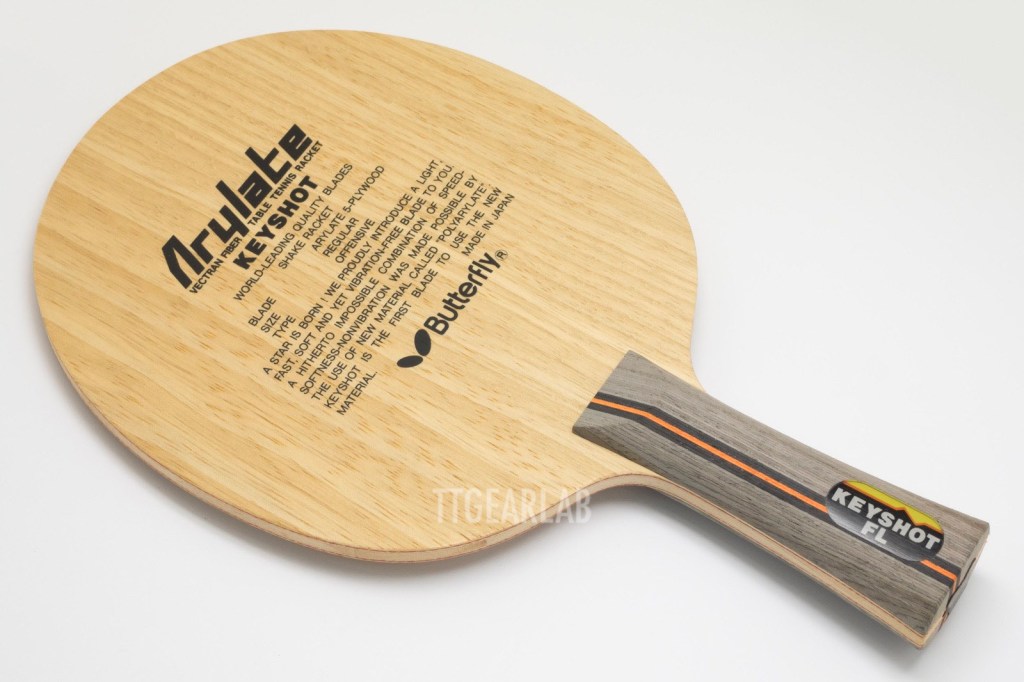
‘Keyshot’ was an innovative first equipped with Arylate fiber. The Arylate fiber for ‘Keyshot’ is ‘Vectran’ which is the arylate fiber produced by Kuraray. Although the name ‘Vectan’ isn’t directly shown on the ‘Keyshot’, we can see that name from the box of ‘Keyshot’ at that time and Butterfly 1992 catalog. The graphic design of handle and lens may not seem to be so attractive by today’s standards, but at the time of the launching of ‘Keyshot’ it was a quite flash and attractive design.

The construction of ‘Keyshot’ is the 5+2 ply outer construction. Top layer is Limba, middle layer is Ayous, and the center layer is Kiri. Woven Arylate fiber is placed between the top layer and the middle layer. Overall thickness is around 6.0mm which is thicker than many outer-type or inner-type blades of today. Thanks to its relatively thicker construction, ‘Keyshot’ provides quite high elasticity although it doesn’t include carbon fiber. For that reason many pimple out players who had used thick and fast ‘Clipper Wood’ replaced their blades with ‘Keyshot’. That is quite different from what ‘Keyshot’ aimed at when Butterfly develped it. Maybe that is the reason why Butterfly later released many models those are based on ‘Keyshot’ but with reduced elasticity by reduced thickness. For example, ‘Biside’ and ‘Timo Boll Spark’.

The shape of FL handle of ‘Keyshot’ is one that we can hardly find these days. That is the rounded version of classic FL handle which doesn’t have a noticeable bulge under the thumb. We can find that type of handle from some Butterfly blades of that time, for example ‘Sardius’. And, another character of the Butterfly blades of early 1990’s is very unique lenses. The lenses, made of transparent acrylic, was made to perfectly fit the shape of the handle’s surface, so there weren’t steps at all. The lens surface even had a wood grain pattern engraved on it, so there wasn’t any awkward feeling in the area around lens when holding it. The lenses of the Butterfly blades of that time felt almost like works of art or crafts, and were much more luxurious than the Aluminum plates commonly used today. However, Butterfly began to discontinue these luxurious plastic lenses and use general, cheap-looking clear plastic lenses in the late 1990s. Perhaps it is because these plastic lenses were expensive to manufacture. Even the later models of the ‘Keyshot’ had cheap plastic lenses instead of the ones in the photo.
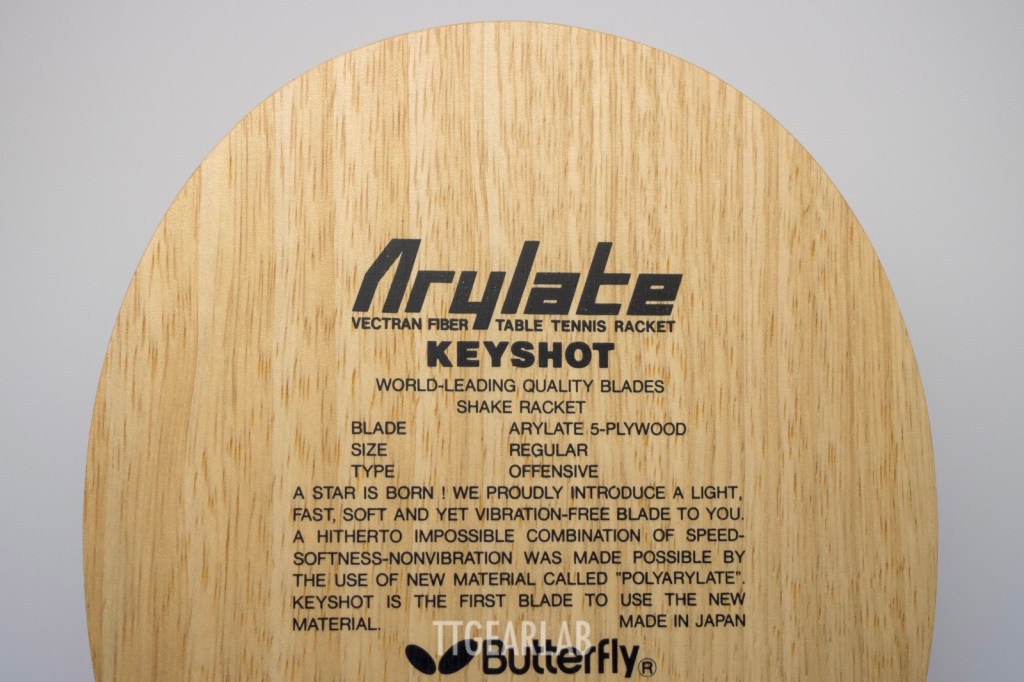
Because ‘Keyshot’ wasn’t the blade specially developed for European market, the speed sign which is shown in 7 steps from DEF to OFF+ is not printed on the head of blade. Instead simple description is printed on the head. Butterfly is introducing ‘Keyshot’ as the blade which realized three characteristics – speed, softness and non-vibration – at the same time by the use of new material ‘polyarylate’.

The brass Butterfly logo plate is applied to the end of handle since ‘Keyshot’ is the Butterfly blade of 1990s.
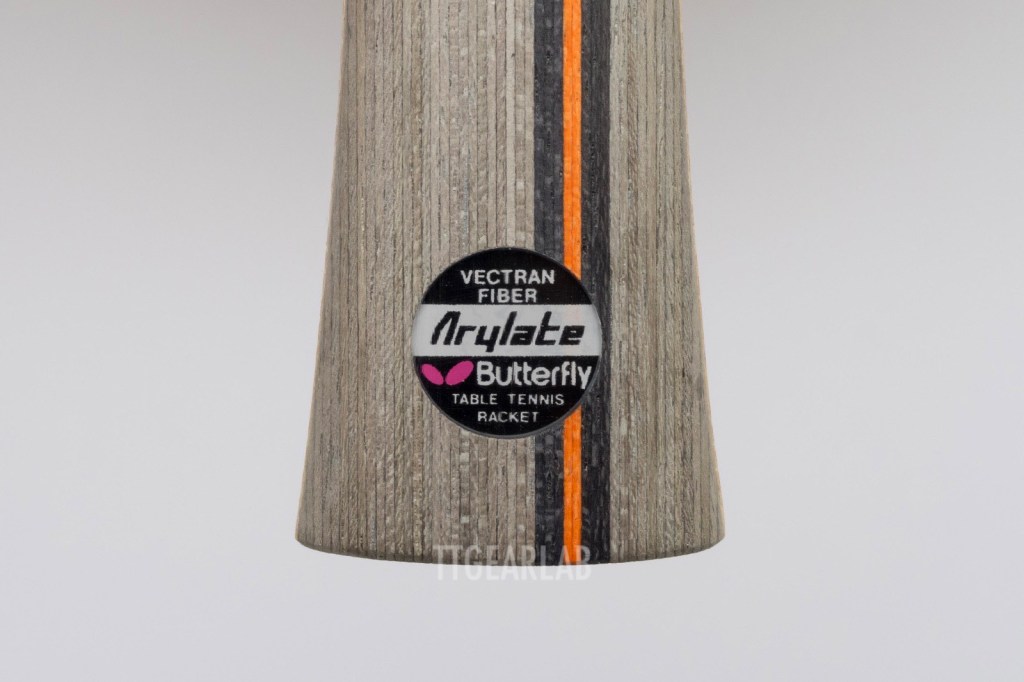
Small rounded plastic lens in which the name of special material is written is applied on the backside of handle. This backside lens was also made to match the shape of the handle surface completely and without any steps. It also had a wood grain pattern engraved on the lens surface, giving it a very luxurious look. However, this backside lens was also replaced by a general cheap-looking round clear plastic lens in the late 1990s.

There isn’t any printing on the backside of blade head. In the early 1990s when ‘Keyshot’ was launched, head printing started to be applied on the foreside of head, and there wasn’t even the concept that printing can also be applied on the backside of head.

Although ‘Keyshot’ couldn’t become a long seller, it attracted attention for its unique material and characteristics that were completely different from those of the table tennis blades before its launching, and ultimately became an important blade that will remain in the history of not only butterfly blades but the entire history of table tennis. The ‘Viscaria’ that was announced 2 years later received more attention from table tennis players around the world, but if there had not been ‘Key Shot’ before that, ‘Viscaria’ would not have existed either.
Following are the performance indices of Butterfly Keyshot (avg.weight = 89.8g) :
– Ep = 2.05
– Ec = 1.76 (Ec/Ep = 0.86)
– Vp = 1.26
– Vl = 1.30 (Vl/Vp = 1.03)
Please note that above are average values and can be updated by further measurement.
Unauthorized use and/or duplication of this material without express and written permission from this website’s author and/or owner is strictly prohibited. Excerpts and links may be used, provided that full and clear credit is given to TTGearLab with appropriate and specific direction to the original content.
 TTGearLab
Thank you so much for this insightful look into the past! Amazing post, thanks a lot.
LikeLike
Thank you a lot for comment!
LikeLike
Hi there – thank you for this excellent article. The level of detail and historical insight is impressive.
I wanted to ask whether you have any information (or opinion) about the 1995 Viscaria Red Line model. Some collectors believe it doesn’t actually exist as a standalone production year or version. I’d be very interested in any details, confirmation, or photos you might have encountered related to it.
Thanks again for your valuable work and contributions to the community!
LikeLike
Thank you a lot for comment!
I used Viscaria in mid 1990’s. However, at that time I couldn’t hear the name ‘Viscaria Red Line’. At that time, Viscaria was a good blade, but it was not as popular as it is now. And, there wasn’t any reason for Butterfly to produce that kind of special version.
I don’t think that Viscaria Red Line model was produces in 1995.
LikeLike
Hi there! First of all, thank you for your response. I do have a VIscaria Red Line and I have a confirmation by one of the well known BTY experts in Europe that indeed Viscaria Red Line was only produced for 3 months for the Japanses market starting in October 1995. It was a special batch of Viscarias at the time BTY was probably still testing the design in the various markets.
LikeLiked by 1 person
Thank you for information! Then it is a matter of course that I don’t know it. 🙂 This is the first time I hear that precious information.
LikeLike