| Table of Contents | 1. Overview 2. Performance Indices 3. Comparison by Performance Indices ……. 3-1. Elasticity Indices ……. 3-2. Vibration Indices 4. Summary |
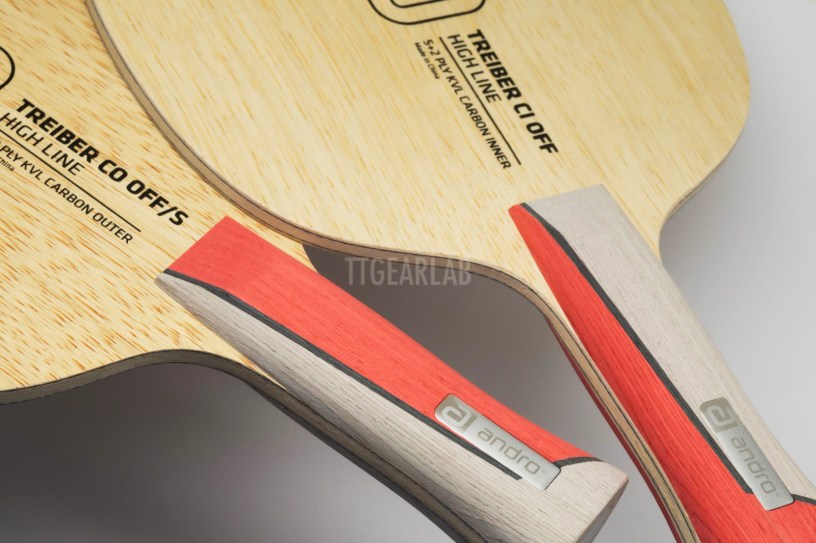
andro new ‘Treiber’ series is a 2018 update of andro’s old fiber blade line, ‘Treiber’ series which was announced in 2007. In 2018, andro renewed its long-used logo mark, and reorganized its blade range at the same time. andro divided its blades into three groups – ‘Supreme Line’, ‘High Line’ and ‘Basic Line’, and applied a unified graphic design to all products.
New ‘Treiber’ series consists of four products – CO, CI, TO and TI. ‘C’ stands for KVL carbon, and T stands for Texalium. And, ‘O’ and ‘I’ stand for outer fiber construction and inner fiber construction respectively. In this article, TTGearLab will analyze two models whose artificial material is KVL Carbon – ‘Treiber CO OFF/S’ and ‘Treiber CI OFF’ – by Performance Indices, and compare those four with some other inner fiber blades from other brands.
1. Overview
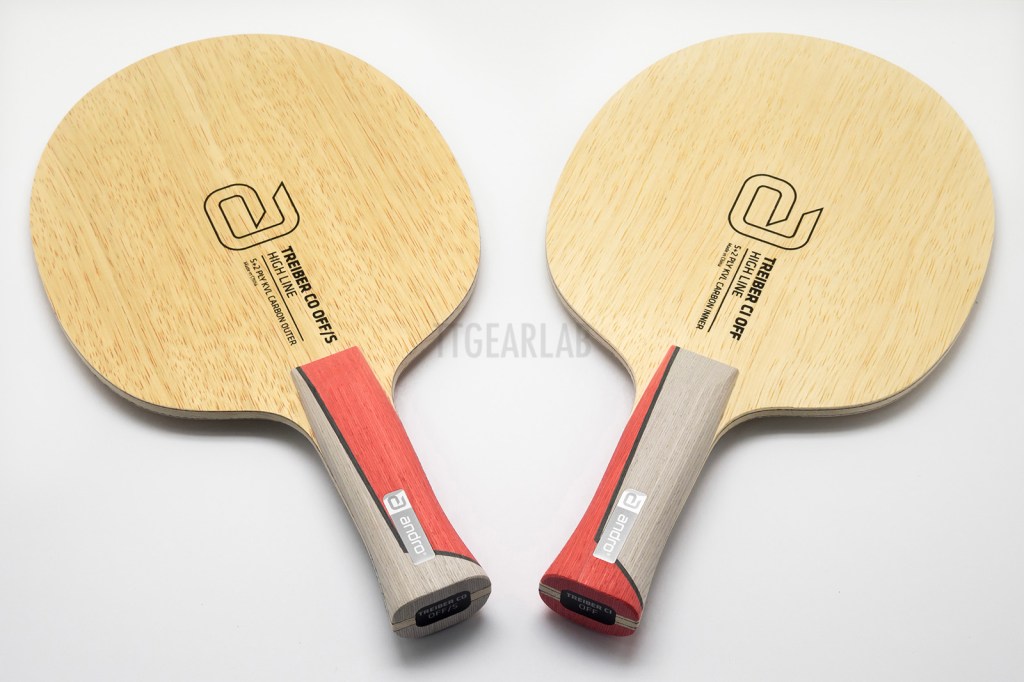
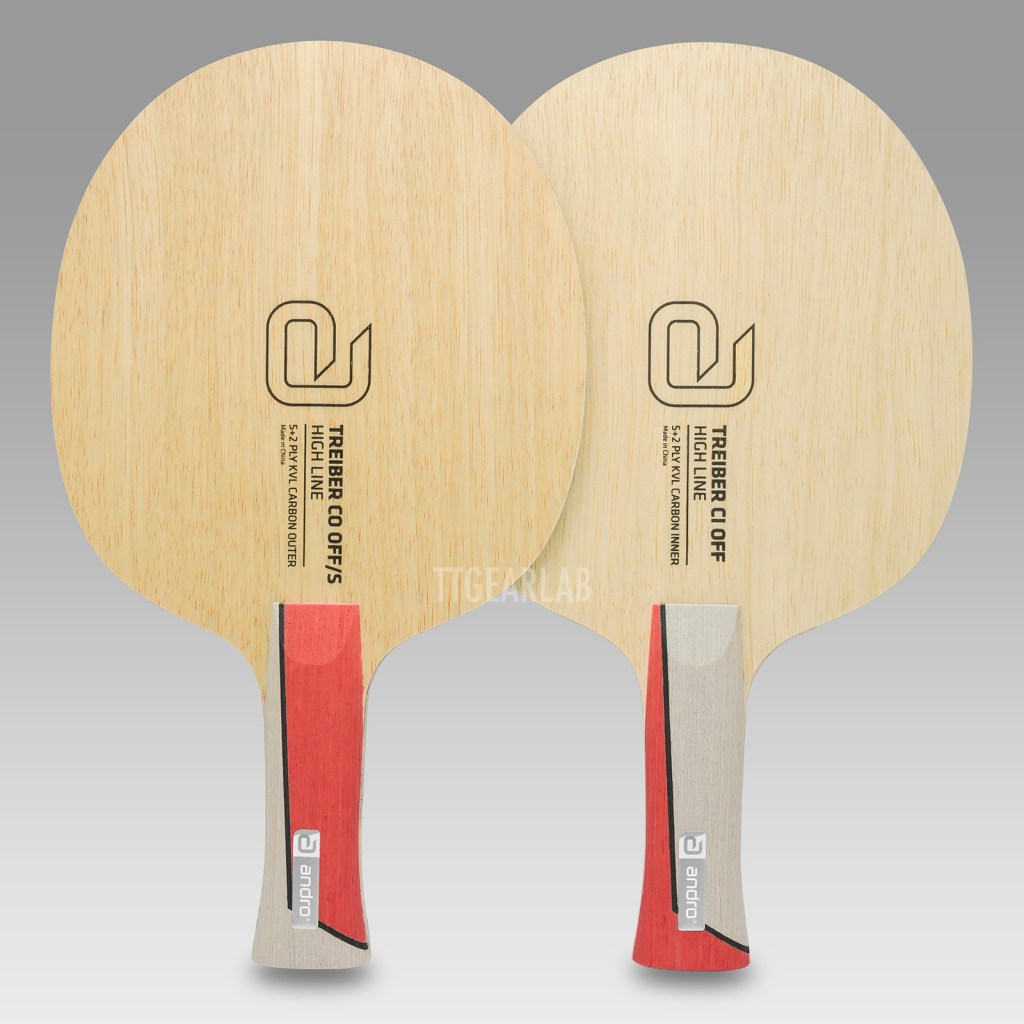
Above picture shows two models whose artificial material is KVL carbon. Left is ‘Treiber CO OFF/S’ which is the outer version, and right is ‘Treiber CI OFF’ which is the inner version’. These two share the overall design, and are distinguished by each other only by the color scheme of handle.
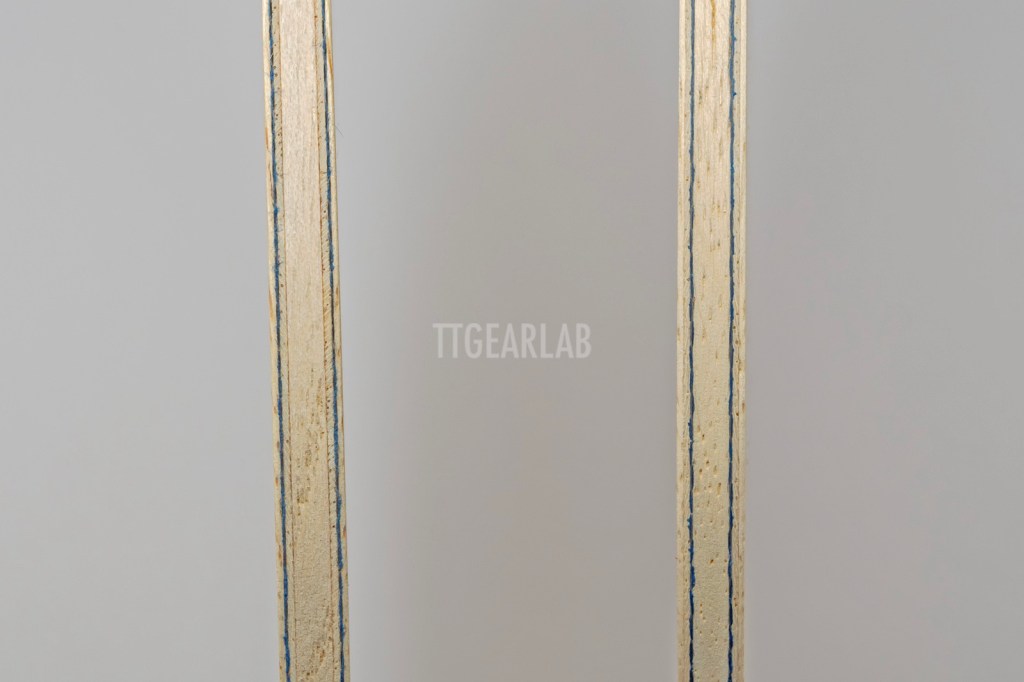
‘Treiber CO OFF/S’ (left) and ‘Treiber CI OFF’ (right) share the artificial material (= KVL carbon), but are distinguished from each other by the position of fiber.
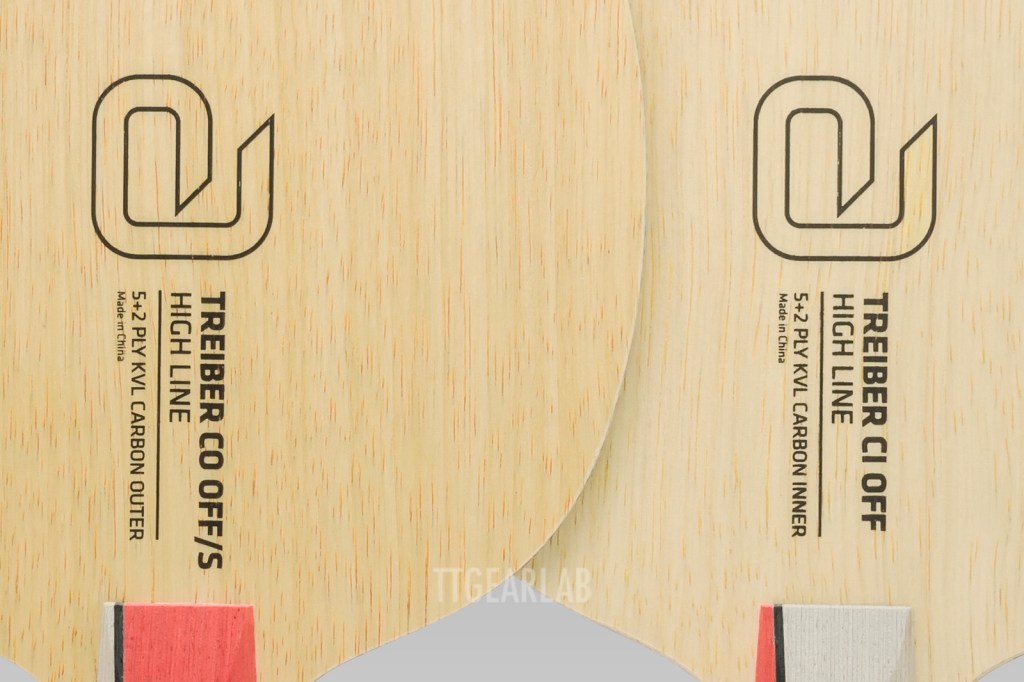
On the bottom center of the foreside of head, the common graphic which is applied for all andro blades released in 2018 is printed. It includes big ‘a’ logo, the name of product (= ‘Treiber CI OFF’), the name of group (= ‘High Line’), the construction of plywood and the origin.
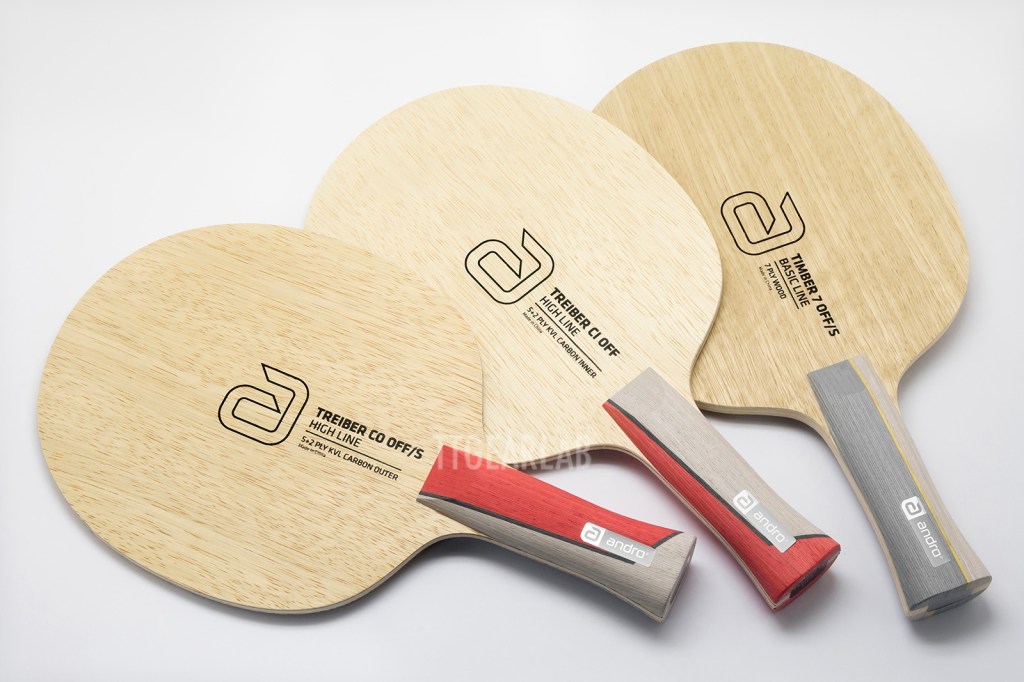
Because the design consistency of andro blades released in 2018s so strong, ‘Treiber’ series which is the fiber blade family and ‘Timber’ series which is the all-wood blade family appear to be one blade family, except for the difference in the design theme of handle wood block.
1-1. Treiber CO OFF/S (outer version)
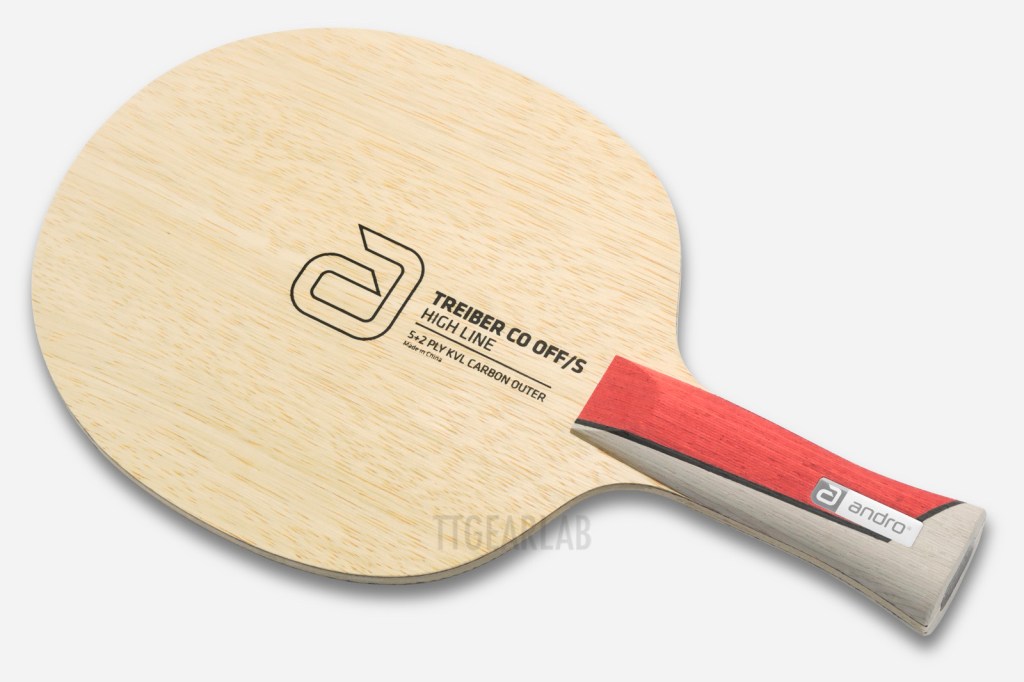
‘Treiber CO OFF/S’ (hereinafter the speed symbol ‘OFF/S’ will be omitted and it will be just called as ‘Treiber CO’) is an outer fiber blade whose artificial material is KVL carbon (= Kevlar carbon). Because its outer-fiber construction fully utilizes the elasticity of artificial material, ‘Treiber CO’ provides high power in a variety of offensive strokes. It is recommended for the offensive players who lay emphasis on the power and the speed of topspin.
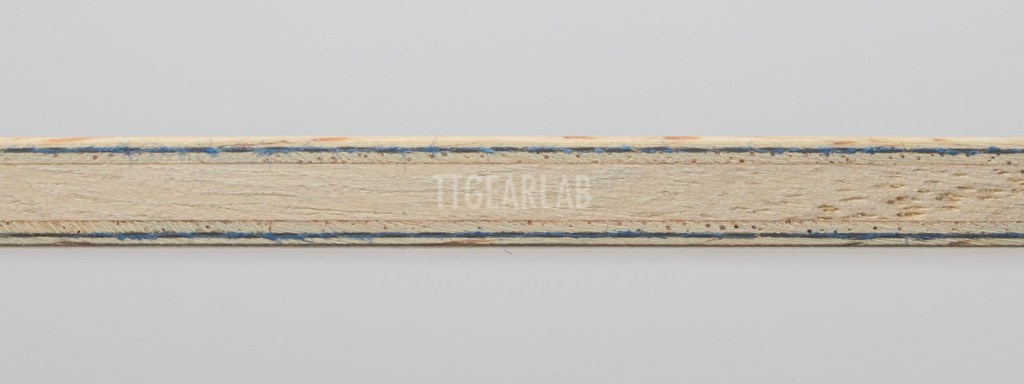
‘Treiber CO’ is an outer-type fiber blade as the character ‘O’ expresses. The top layer is Limba. The middle layer is also Limba, and the center layer is Kiri. Artificial material – KVL (Kevlar) carbon – is inserted directly under the top layer. Overall thickness is around 6.0mm. (It is thinner than the 6.1mm which is the official thickness written on andro catalog and home page.) KVL carbon is one of similar materials as ALC. Therefore, we can consider ‘Treiber CO’ as the andro blade that competes with outer ALC blades with Limba top layer from other table tennis manufacturers.
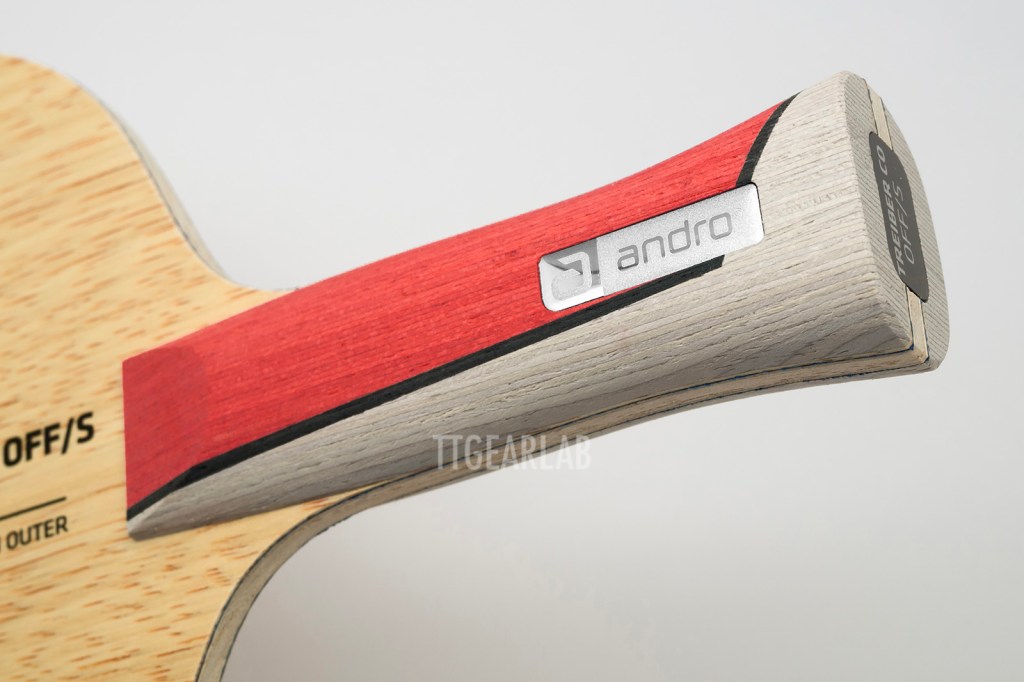
TTGearLab could get only AN (anatomic) handle version. The width of AN handle is around 24.5mm ~ 28mm ~ 26.5mm ~ 33.5mm from the head side to the end of handle. Its shape of one of the ideal shapes as those of AN handles, because the position of bulge section is appropriate and its semi-squared cross section provides high level of stability of grip. There are so many AN handles in the market, whose shapes are not proper. And, the AN handle of Treiber series is a good exception.
The width of FL (flared) handle which isn’t shown in the picture is around 26mm (at head side) ~ 28mm (at bulge) ~ 26mm (at the middle of handle) ~ 35mm (at the end), and the thickness of FL handle is around 23mm (at thumb) ~ 26mm (at the end). The size of ST (straight) handle which isn’t shown in the picture is around 28mm (width) x around 23mm (thickness).
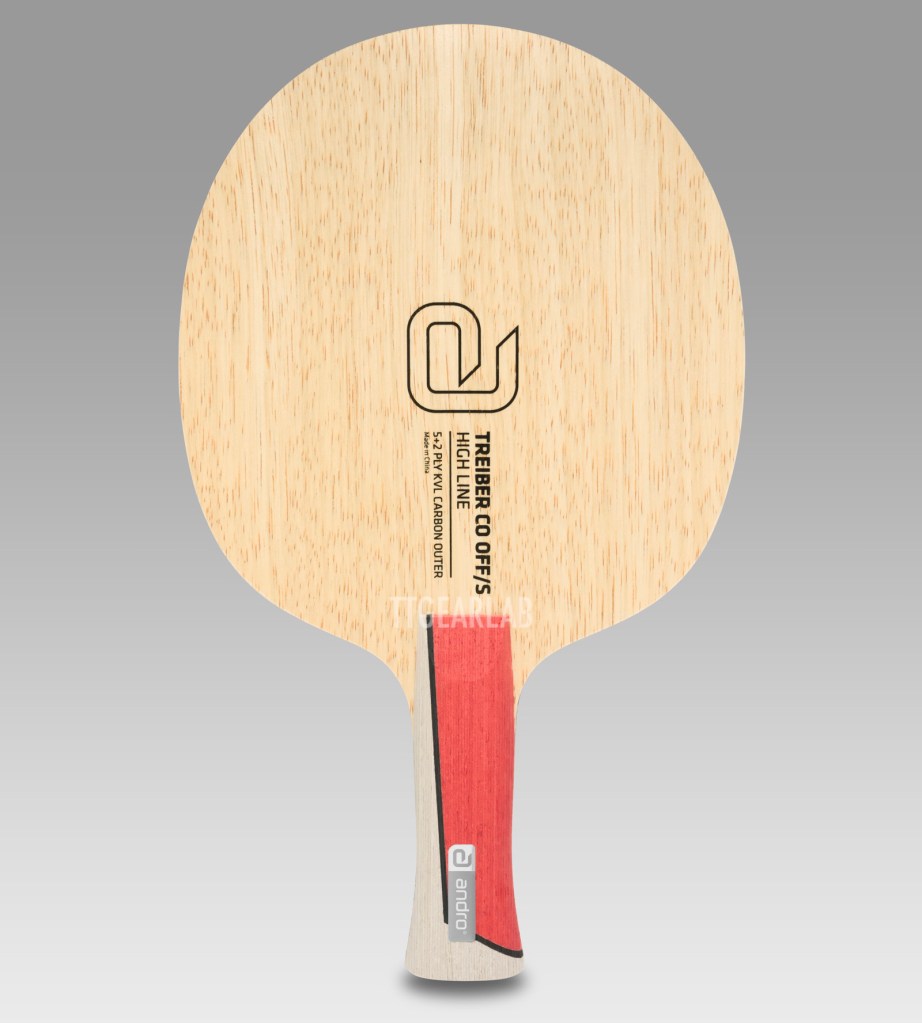
The size of the head is around 157mm x 150mm which can be called as the standard size of modern offensive blades.
1-2. Treiber CI OFF (inner version)
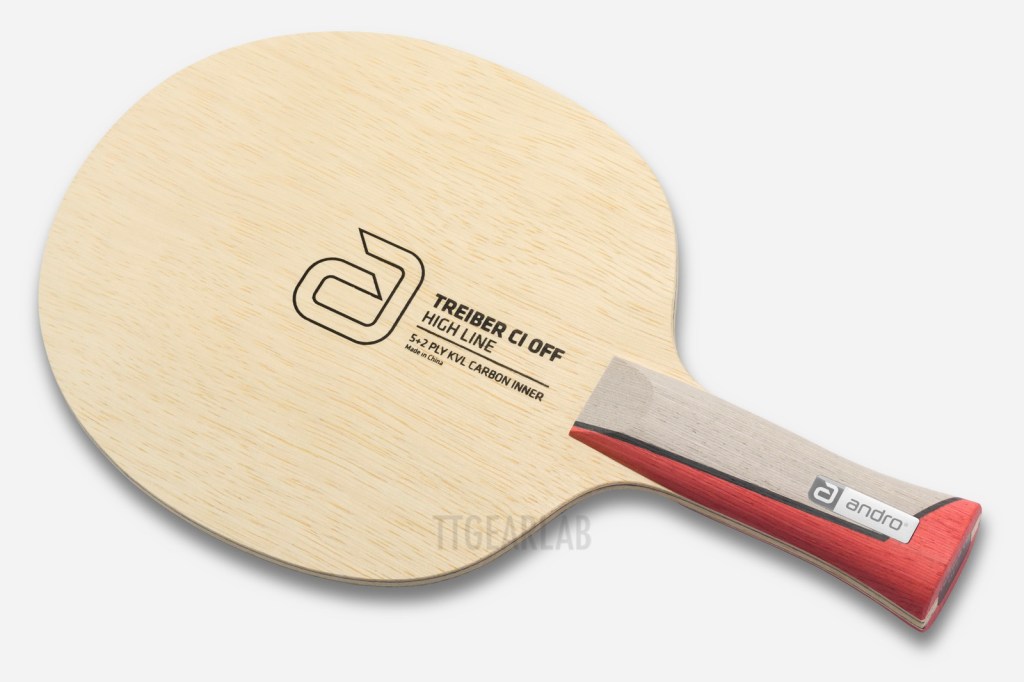
‘Treiber CI OFF’ (hereinafter the speed symbol ‘OFF’ will be omitted and it will be just called as ‘Treiber CI’) is an inner fiber blade whose artificial material is KVL carbon (= Kevlar carbon). It has the characteristic of keeping ball stably in soft shots and exhibiting higher repulsion force when the ball is hit strongly. It is suitable for modern all-round play that mixes various kinds of table tennis technics.
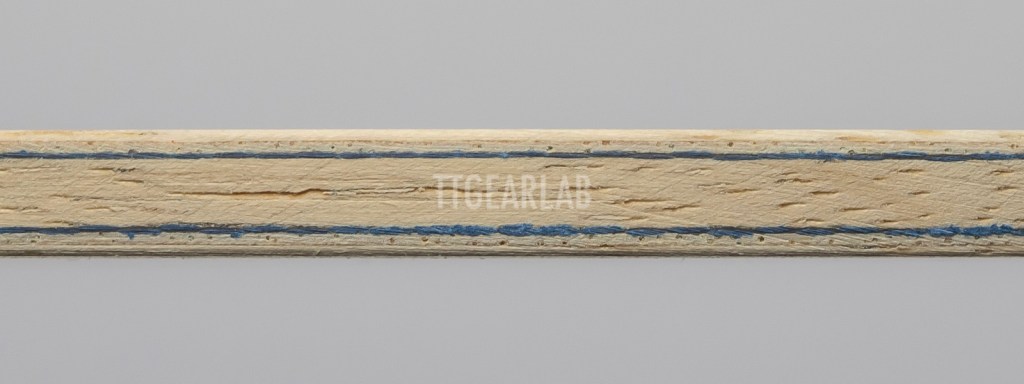
‘Treiber CI’ is an inner-type blade as the character ‘I’ expresses. The top layer is Limba. The middle layer and the center layer are Ayous. Artificial material – KVL (Kevlar) carbon – is inserted between the middle layer and the center layer. Overall thickness is around 5.9mm. (It is thinner than the 6.1mm which is the official thickness written on andro catalog and home page.) KVL carbon is one of similar materials as ALC. Therefore, we can consider ‘Treiber CI’ as the andro blade that competes with inner ALC blades from other table tennis manufacturers.
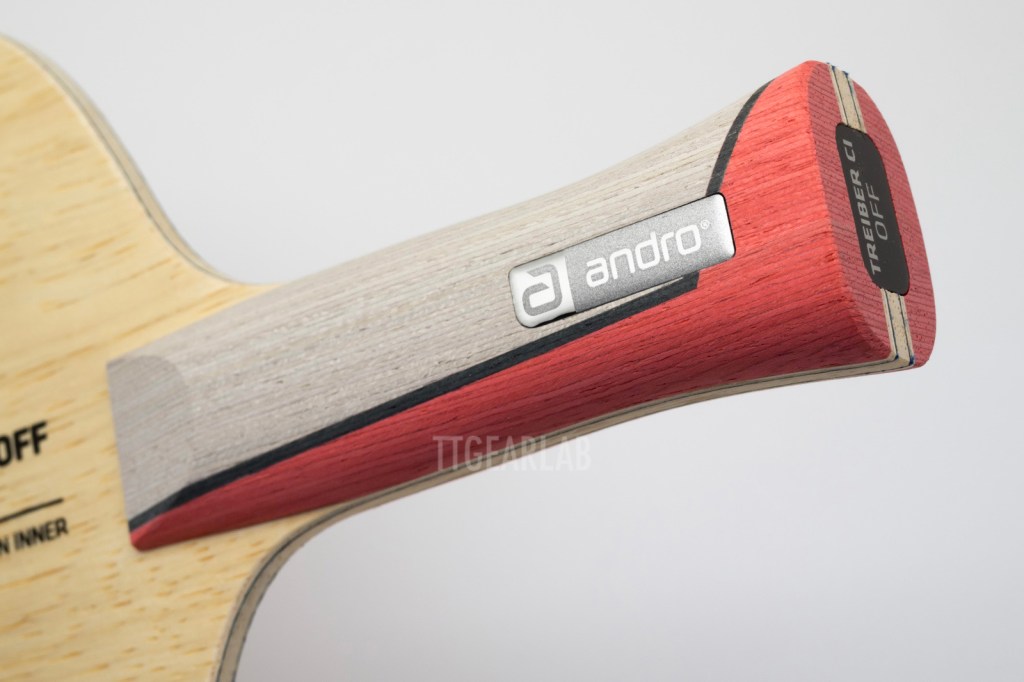
TTGearLab could get only AN (anatomic) handle version. The width of AN handle is around 24.5mm ~ 28mm ~ 26.5mm ~ 33.5mm from the head side to the end of handle. Its shape of one of the ideal shapes as those of AN handles, because the position of bulge section is appropriate and its semi-squared cross section provides high level of stability of grip. There are so many AN handles in the market, whose shapes are not proper. And, the AN handle of Treiber series is a good exception.
The width of FL (flared) handle which isn’t shown in the picture is around 26mm (at head side) ~ 28mm (at bulge) ~ 26mm (at the middle of handle) ~ 35mm (at the end), and the thickness of FL handle is around 23mm (at thumb) ~ 26mm (at the end). The size of ST (straight) handle which isn’t shown in the picture is around 28mm (width) x around 23mm (thickness).
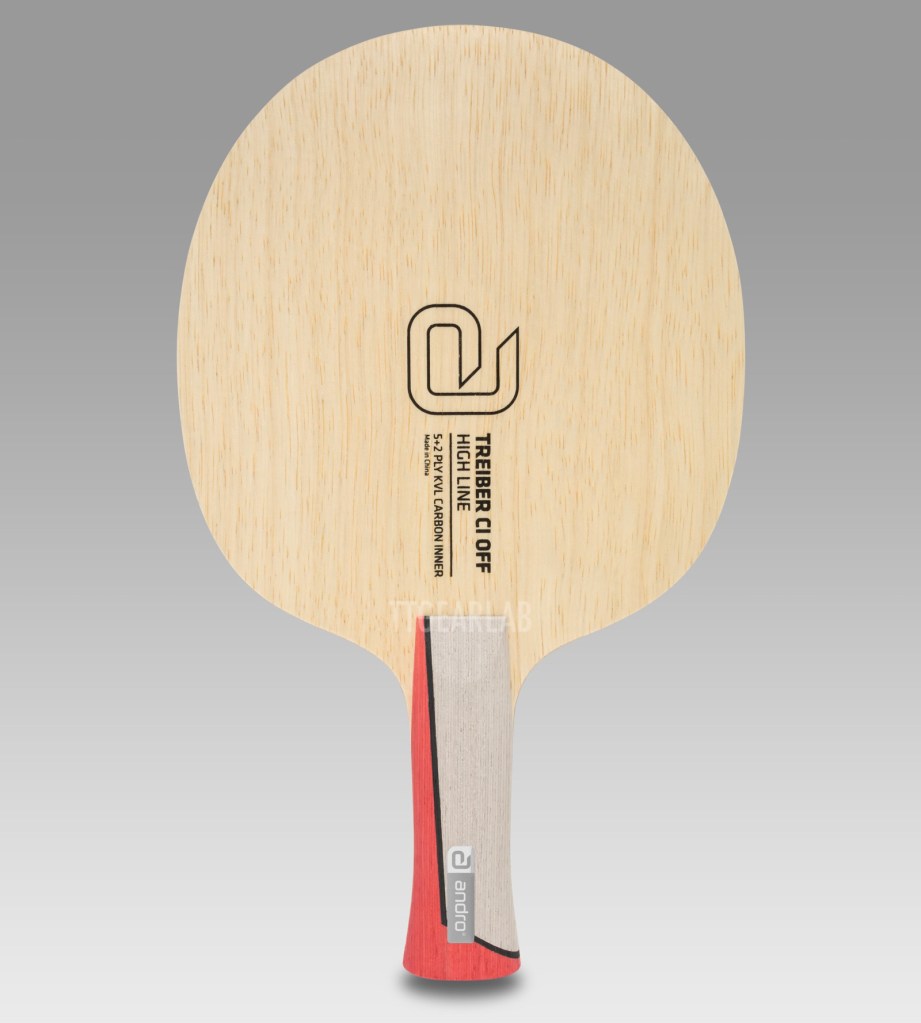
The head size is 157mm x 150mm, which is same as that of outer-fiber versioThe size of the head is around 157mm x 150mm which can be called as the standard size of modern offensive blades. We can see the cases that the head size of the inner version is different from the head size of the outer version in the same blade family, for example andro ‘Synteliac’ series. But, ‘Treiber’ series isn’t that case. ‘Treiber’ series unifies the head size within the series.n – ‘36.5 ALX’.
Please click here to return to top (table of contents)
2. Performance Indices
Performance Indices are measured objective values to represent the characteristics of table tennis gears. Concerning the detail of four performance indices, please refer to following articles in ‘About TTGearLab’ section :
- Performance indices : the way to evaluate blade by measurement
- The example of comparison by performance indices
The performance indices of ‘Treiber CO OFF/S ‘Treiber CI OFF’ are as follows:
Treiber CO OFF/S (average weight = 83.9g)
Ep = 2.04
Ec = 1.92 (Ec/Ep = 0.94)
Vp = 1.35
Vl = 1.53 (Vl/Vp = 1.13)
Treiber CI OFF (average weight = 84.0g)
Ep = 1.59
Ec = 1.73 (Ec/Ep = 1.09)
Vp = 1.28
Vl = 1.21 (Vl/Vp = 0.95)
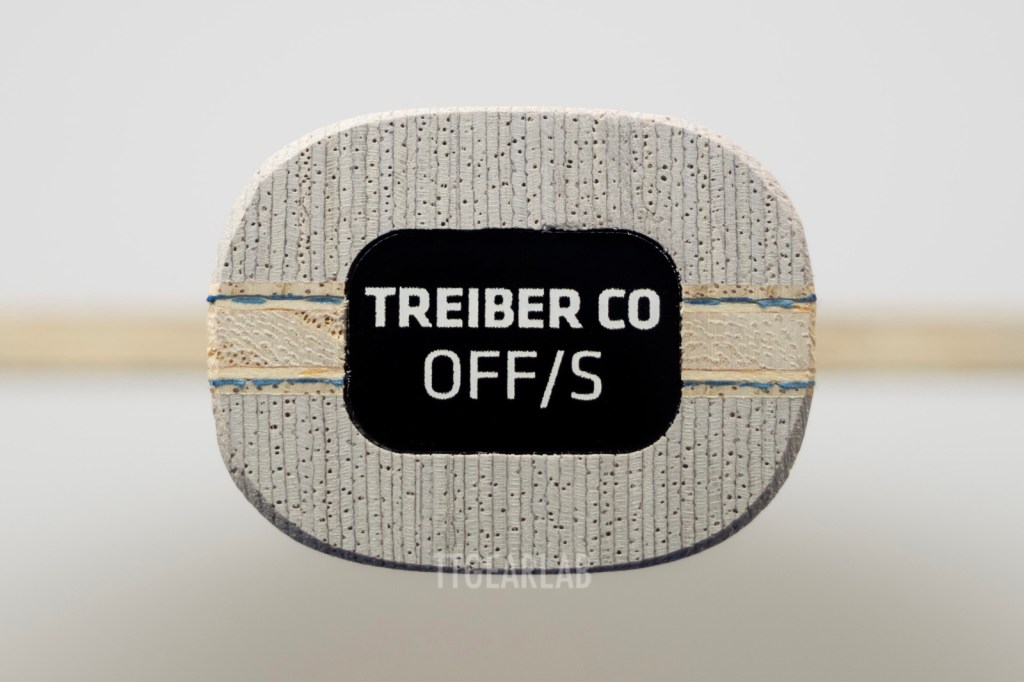
‘Treiber CO OFF/S’ is the outer KVL carbon version of this series. and it Ep (= 2.04) exceeds 2.0 which can be considered as the criteria of fast blade. So we can understand that ‘Treiber CO OFF/S’ is a fast blade. And, its Ec (= 1.92) is lower than its Ep, but not significantly. The ratio – Ec/Ep is 0.94 which is in the ‘Mild Hold’ range (0.9 < Ec/Ep < 1.0). It is expected that ‘Treiber CO OFF/S’ hugs the ball a bit (not deeply) when the player hits the ball very strongly.
Regarding Vibration Indices, the Vp of ‘Treiber CO OFF/S’ is 1.35. The Vp around 1.30 is what we can expect from standard outer-type blade with Koto top layer (for example ‘Viscaria’), and ‘Treiber CO OFF/S’ which is an outer-type blade with Limba top layer shows the value that exceeds 1.30. The Vl of ‘Treiber CO OFF/S’ (= 1.53) is much higher than its Vp. The Vl/Vp of ‘Treiber CO OFF/S’ is very high (= 1.13). So, the feeling transmitted to the player’s index finger will be much sharper than the primary feeling.
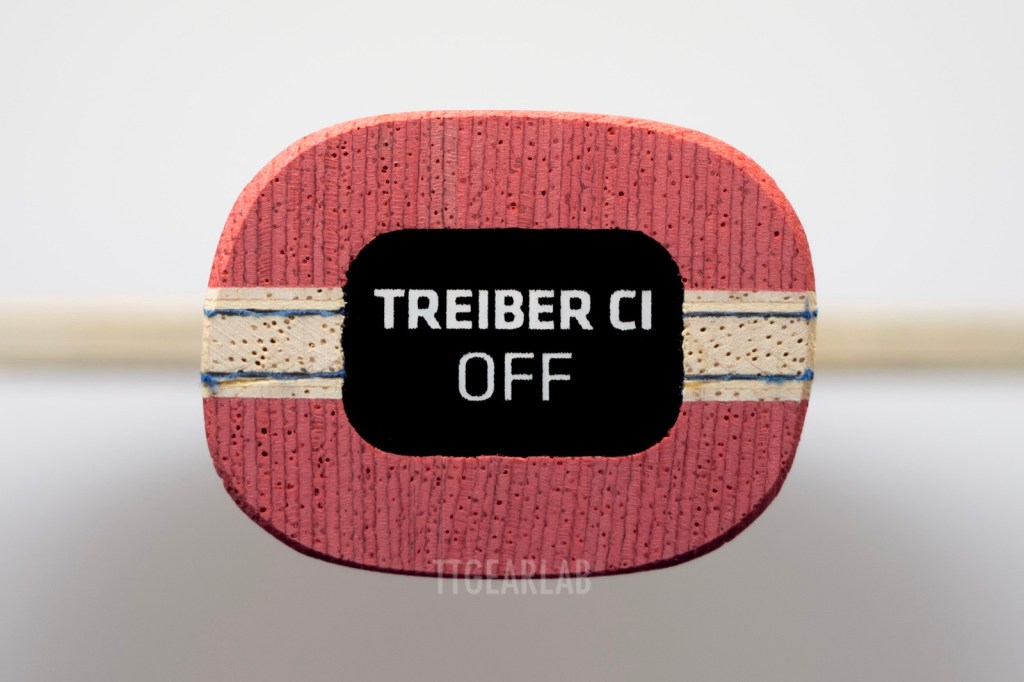
‘Treiber CI OFF’ is the inner KVL carbon version of this series. Its Ep (= 1.59) is a moderate value as that of an inner-type blade. But, it isn’t as high as what we can expect from recently released inner-type blade. However, its Ec (= 1.73) looks quite high as the value of an inner-type blade. As a result its Ec/Ep (= 1.09) is over 1.0. So it is expected that ‘Treiber CI OFF’ will kick the ball more strongly when the player hits the ball strongly.
Regarding Vibration Indices, the Vp of ‘Treiber CI OFF’ is 1.28. It is a much high value than we can expect from an inner-type blade. So as an inner-type blade, ‘Treiber CI OFF’ gives somewhat stiff primary feeling that is close to the primary feeling of outer-type baldes. However, its Vl (= 1.21) is what we can expect from an inner-type blade. So the ratio Vl/Vp is under 1.0. It means that the feeling transmitted to the player’s index finger is milder than the primary feeling, but not extremely milder. Therefore most of players who are more sensitive to the ratio than the primary feeling will not feel that ‘Treiber CI OFF’ gives hard feeling.
‘Treiber CO OFF/S’ and ‘Treiber CI OFF’ share the same artificial fiber. However, the characteristics of those two are clearly distinguished from each other. ‘Treiber CO OFF/S’ is a quite fast blade which hugs ball a bit when the player hits the ball strongly. On the contrary, ‘Treiber CI OFF’ is a blade with moderate speed which gives additional kick when the player hits the ball strongly. We can expect that ‘Treiber CO OFF/S’ fits for the power play by topspin from close-to-table area or mid-distance while ‘Treiber CI OFF’ fits for modern all-round play which utilizes a variety of technics. The characteristics of ‘Treiber CO OFF/S’ and ‘Treiber CO OFF/S’ will be compared by graphs with those of some known blades in next chapter.
Please click here to return to top (table of contents)
3. Comparison by Performance Indices
Then we can compare ‘Treiber CO OFF/S’ and ‘Treiber CI OFF’ with some other blades. For the comparison some well-known outer-type blades (mostly with Limba top layers), inner-type blades (all with Limba top layers) and all-wood blades (One 7-ply wood and three 5-ply wood) have been selected.
Following is the list of the blades to be compared :
Outer type
- Butterfly ‘Freitas ALC’ (avg. weight = 87.4g) : Limba top layer + ALC. Direct competitor of ‘Treiber CO OFF/S’.
- Butterfly ‘Mizutani Jun ZLC’ (avg. weight = 89.7g) : Limba top layer + ZLC
- Nittaku Acoustic Carbon (avg. weight = 90.8g) : Limba top layer + FE Carbon. Direct competitor of ‘Treiber CO OFF/S’.
- Stiga Carbonado 190 (avg. weight = 92.5g) : Limba top layer + TeXtreme (flat woven carbon fiber).
- Victas ZX-Gear Out (avg. weight = 87.1g) : Limba top layer + Zxion Carbon. Center layer is harder than ordinary outer fiber blades. Direct competitor of ‘Treiber CO OFF/S’.
- Butterfly ‘Viscaria’ (avg. weight = 87.1g) : Koto top layer + ALC. Reference of all outer ALC blade. Current version. This blade can also be compared with ‘Treiber CO OFF/S’ although there is difference in top layer.
Inner type
- Butterfly ‘InnerForce Layer ALC’ (avg. weight = 91.2g) : Limba top layer + ALC. The standard of inner-ALC blades. (Current version measured in 2023.)
- Andro Synteliac VCI OFF (avg. weight = 88.6g) : Limba top layer + ALC. Extremely similar to ‘InnerForce Layer ALC’.
- DHS ‘Hurricane Long 5’ (avg. weight = 88.1g) : Limba top layer + ALC. Current representative of inner-ALC blades. (2022 version.)
- Victas ‘ZX-Gear In’ (avg. weight = 88.0g) : Limba top layer + Zxion Carbon. Zxion Carbon a bit different from Vectran Carbon (ALC of Butterfly), but it is also a kind of ALC.
- Xiom ‘36.5 ALXi’ (avg. weight = 87.1g) : Limba top layer + ALC.
- Yasaka ‘Ma Lin Carbon’ (avg. weight = 88.6g) : Limba top layer + fleece carbon.
- Tibhar ‘Stratus Samsonov Carbon’ (avg. weight = 88.7g) : Limba top layer + Aramid Carbon. Center layer is softer than ordinary inner fiber baldes.
All wood
- Stiga ‘Clipper CR’ (avg. weight = 81.7g) : The classic of 7-ply wood blade. (Lightweight version whose thickness is 6.5mm.)
- Tibhar ‘E.Lebesson’ (avg. weight = 83.2g) : The 5-ply wood offensive blade with very unique construction. Good for modern all-round play.
- Butterfly ‘Korbel’ (avg. weight = 88.7g) : The standard of 5-ply wood offensive blades.
- Stiga ‘Allround Classic’ (avg. weight = 84.3g) : The standard of 5-ply wood all-round blades. Reference of Performance Indices whose all indices are 1.0.
3-1. Elasticity Indices
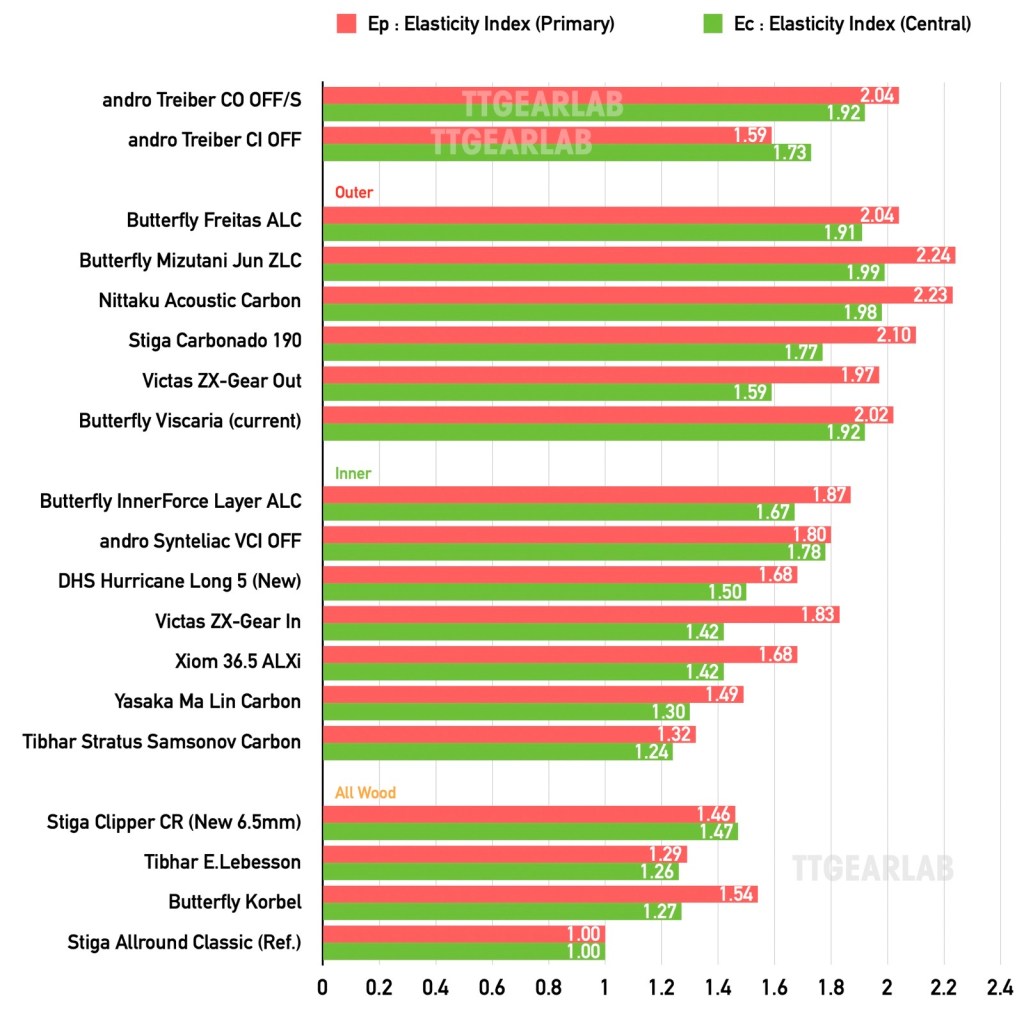
Fig.16 shows the comparison graph of Elasticity Indices.
Ep (Primary Elasticity Index) is directly concerned with the rebound speed of blade. Ec (Central Elasticity Index) is concerned with additional ‘kick’ when player hits ball very strongly.
[Outer type]
‘Treiber CO OFF/S’ is an outer Kevlar carbon blade, and it can be compared with the six blades in this group. The result of comparison can be summarized as follows:
- ‘Freitas ALC’ whose construction of ‘Freitas ALC’ is very similar to that of ‘Treiber CO OFF/S’ except for the kind of fiber (ALC vs. Kevlar Carbon) shows almost same characteristic as ‘Treiber CO OFF/S’. Both of ‘Freitas ALC’ and ‘Treiber CO OFF/S’ are very balanced ones as highly elastic blades.
- ‘Mizutani Jun ZLC’ and ‘Acoustic Carbon’ are one step more elaststic than ‘Treiber CO OFF/S’. But, the graph shapes of those two look very similar to that of ‘Treiber CO OFF/S’. For that reason, it is expected that the playing characteristics of those two will not be much different from that of ‘Treiber CO OFF/S’.
- The Ep’s of ‘Carbonado 190’ and ‘ZX-Gear Out’ are close to that of ‘Treiber CO OFF/S’. However, the Ec’s of those two are much lower than that of ‘Treiber CO OFF/S’. Therefore we can expect that the playing characteristics of these two will be different from those of other models in this group. Those two will hug the ball much deeper than the other models when player hits the ball very strongly. Especially ‘ZX-Gear Out’ hugs the ball even more deeply. Some players who uses direct hitting frequently may think that these two are slower than the other blades in this group. But, the players who mainly play with continuous topspin may prefer these two to the other models.
- ‘Viscaria’ is the only one model in this group whose top layer is not Limba. But, we can observe that its Elasticity Indices are not much different from those of ‘Treiber CO OFF/S’ or ‘Freitas ALC’ whose top layers are Limba which is less elastic than Koto. That is probably because ‘Viscaria’ has thinner construction.
[Inner type]
‘Treiber CI OFF’ is an inner Kevlar Carbon blade which is very similar to typical inner ALC blade with Limba top layer. Therefore, the blades of this group can be directly compared with ‘Treiber CI OFF’. The result of comparison can be summarized as follows:
- The primary elasticity of ‘InnerForce Layer ALC’ is much higher than that of ‘Treiber CI OFF’. On the contrary, the central elasticity of ‘InnerForce Layer ALC’ is noticeably lower than ‘Treiber CI OFF’. This means that ‘Treiber CI OFF’ is slower and more stable than ‘InnerForce Layer ALC’ when the player hits the ball softly but it becomes as elastic as ‘InnerForce Layer ALC’ in the situation that central elasticity becomes more important. The players will feel that ‘Treiber CI OFF’ gives more kick to the ball when they hit the ball very strongly.
- ‘Synteliac VCI OFF’ is more elastic than ‘Treiber CI OFF’ both in primary elasticity and in central elasticity. It is expected that players will feel that ‘Synteliac VCI OFF’ is faster than ‘Treiber CI OFF’ in all situations.
- ‘Hurricane Long 5’ is also more elastic than ‘Treiber CI OFF’ in primary elasticity and less elastic in central elasticity. That is similar to what we see from ‘InnerForce Layer ALC’, but the overall elasticity level of ‘Hurricane Long 5’ is lower than that of ‘InnerForce Layer ALC’. ‘ZX-Gear In’ and ‘36.5 ALXi’ show similar graph shapes, ‘ZX-Gear In’ shows more dramatic difference between Ep and Ec.
- ‘Ma Lin Carbon’ and ‘Stratus Samsonov Carbon’ are much less elastic than ‘Treiber CI OFF’, and graph shapes of those two are also much different from that of ‘Treiber CI OFF’.
- No blade in this group shows similar characteristics to ‘Treiber CI OFF’. We will be able to deal with ‘Treiber CI OFF’ as a very unique inner-type blade.
[All wood]
We can also compare various all-wood fiber blades with ‘Treiber CO OFF/S’ and ‘Treiber CI OFF’. The result of comparison can be summarized as follows:
- The Ep of ‘Clipper CR’ is very close to its Ec. Both of two values are lower than those of ‘Treiber CI OFF’. However, we can find one similarity between ‘Clipper CR’ and ‘Treiber CI OFF’ : Ec is higher than Ep. Maybe we will be able to deal with ‘Treiber CI OFF’ as the replacement of classic 7-ply wood blades such as ‘Clipper’ series. (But the difference between the Ec and the Ep of ‘Clipper CR’ is much smaller than that of ‘Treiber CI OFF’.)
- The graph shape of ‘E.Lebesson’ is similar to that of ‘Treiber CO OFF/S’. However, overall elasticity level of ‘E.Lebesson’ is much, much lower than that of ‘Treiber CO OFF/S’. Because the difference in elasticity level is too large, it will be difficult to actually compare between two blades.
- ‘Korbel’ is more elastic than ‘Clipper CR’ in primary elasticity, and as elastic as ‘E.Lebeson’ in central elasiticty. Its graph shape looks similar to those of ‘365 ALXi’ and ‘ZX-Gear In’. Its Ep is close to that of ‘Treiber CI OFF’, but its Ec is much lower. So if the player who has used ‘Korbel’ ‘Allround Classi’ shows similar graph shape as those of ‘Ckipper CR’ and ‘E.Lebesson’.
Examining Ec/Ep is also a easier way to understand the characteristics of blade concerned with elasticity. Fig.17 shows the relationship between Ec/Ep and Ep.
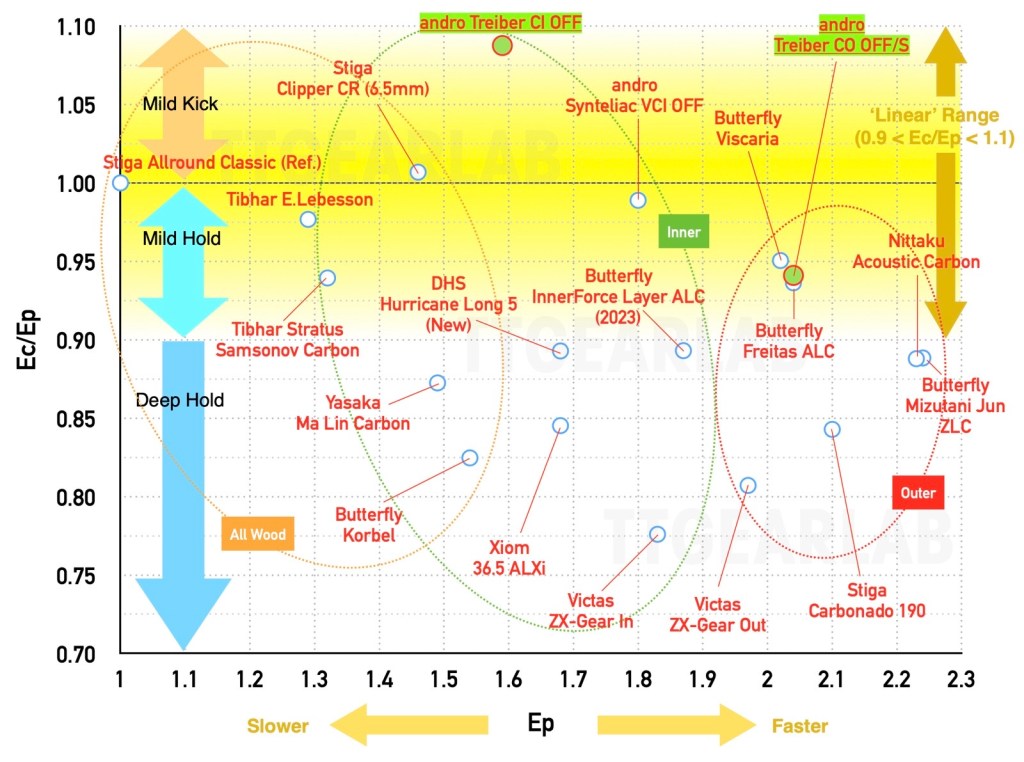
Ec/Ep expresses the ‘tendency’ of the elasticity of blade. By examining Ec/Ep and Ep at the same time, we can easily understand the behavior of blades.
On the graph, most of blades in this comparison are in ‘Hold’ range (Ec/Ep < 1.0). However, ‘Treibrer CI OFF’ which is one of the two models covered in this is in ‘Kick’ range (Ec/Ep > 1.0). Therefore, we can notice from the beginning that ‘Treiber CI OFF’ is a quite unique blade. And, in ‘Hold’ range, the blades are widely distributed up, down, left and right within that range. The result of the comparison can be summarized as follows:
[‘Treiber CO OFF/S’ in ‘Outer’ group]
- ‘Outer’ group including ‘Treiber CO OFF/S’ is located at right side of the graph. It means that the primary elasticities of ‘outer-type’ blades are higher than those of the blades of the other groups – especially ‘Inner’ group – in this comparison. Among seven blades in this group, four are in ‘Deep Hold’ range, and the other three including ‘Treiber CO OFF/S’ are in ‘Mild Hold’ range.
- ‘Treiber CO OFF/S’ is in ‘Mild Hold’ range. It means that ‘Treiber CO OFF/S’ moderately hugs the ball when the player hits the ball very strongly.
- ‘Freitas ALC’ is located very close to ‘Treiber CO OFF/S’. We can understand that at least the elasticity characteristics of ‘Freitas ALC’ are similar to those of ‘Treiber CO OFF/S’ although players will feel difference between those two because of the differences in feeling that will be dealt with in next section. And, ‘Viscaria’ is also very close to ‘Treiber CO OFF/S’. Although the top layer of ‘Viscaria’ is harder Koto, probably its thinner construction reduces the elasticity of ‘Viscaria’. Again, although the elasticity characteristics of ‘Viscaria’ is similar to those of ‘Treiber CO OFF/S’, players will feel difference between those two because of the differences in feeling.
- ‘Acoustic Carbon’ and ‘Mizutani Jun ZLC’ are located very close to each other, and that location is to lower right of that of ‘Treiber CO OFF/S’. It means that those two are more elastic than ‘Treiber CO OFF/S’ in primary elasticity but hugs ball more deeply when the player hits the ball very strongly.
- The primary elasticities of ‘Carbonado 190’ and ‘ZX-Gear Out’ are not much different from that of ‘Treiber CO OFF/S’. But, those two hugs the ball much more deeply than ‘Treiber CO OFF/S’ when the player hits the ball very strongly. If the player like ‘Deep Hold’ characteristics but needs high primary elasticity, those two will be good solutions.
- We can think that ‘Treiber CO OFF/S’ provide quite ‘standard’ elasticity characteristics as an outer type blade, like ‘Viscaria’ or ‘Freitas ALC’.
[‘Treiber CI OFF’ in ‘Inner’ group]
- ‘Inner’ group including ‘Treiber CI OFF’ is located at the middle of graph – the left side of ‘Outer’ group and the right side of ‘All wood’ group. It means that the primary elasticities of inner-type blades are lower than those of outer-type blades and higher than those of all-wood blades.
- ‘Treiber CI OFF’ is located at top of ‘Inner’ group. That location is near the border between ‘Mild Kick’ range and ‘Strong Kick’ range. And, all the other blades in ‘Inner’ group are located in ‘Hold’ range under the ‘Linear’ line (Ec/Ep = 1.0). It means that ‘Treiber CI OFF’ gives additional kick to the ball when the player hits the ball very strongly while the other blades hugs the ball in the same situation. So ‘Treiber CI OFF’ is a very unique inner-type blade that is not similar to any other inner-type blade in this comparison.
- If we just observe primary elasticity, most of blades in this group are more elastic than ‘Treiber CI OFF’. However, the players will not feel that those inner-type blades are especially faster than ‘Treiber CI OFF’, because the differences in Ec/Ep are significant. Especially two blades in ‘Deep Hold’ range – ‘ZX-Gear In’ and ‘36.5 ALXi’ – will be felt more slow.
- Among the inner-type blades in ‘Hold’ range, ‘Synteliac VCI OFF’ may be felt faster than ‘Treiber CI OFF’ because it is close to ‘Linear’ line. It doesn’t hug the ball deeply. We may be able to categorize it into the same sub-group as ‘Treiber CI OFF’.
- The blades in ‘Inner’ group can be also compared with the blades in ‘All Wood’ group. From the graph we can observe that ‘Treiber CI OFF’ is much different from ‘Korbel’ which is the representative of 5-ply wood offensive blades those hugs the ball very deeply when the player hits the ball very strongly. If the player requires an inner-type blade which hugs the ball as deeply as Korbel, ‘36.5 ALXi’ or ‘ZX-Gear In’ will be much better choice than ‘Treiber CI OFF’. But, those two can’t be the replacement of all-wood blade with higher Ec/Ep – for example ‘Allround Classic’, ‘E.Lebesson’ and ‘Clipper CR’. For the players who have used those blades, ‘Treiber CI OFF’ will be easier solution for increasing power while keeping overall playing characteristics.
Then next, let’s compare Vibration Indices.
Please click here to return to top (table of contents)
3-2. Vibration Indices
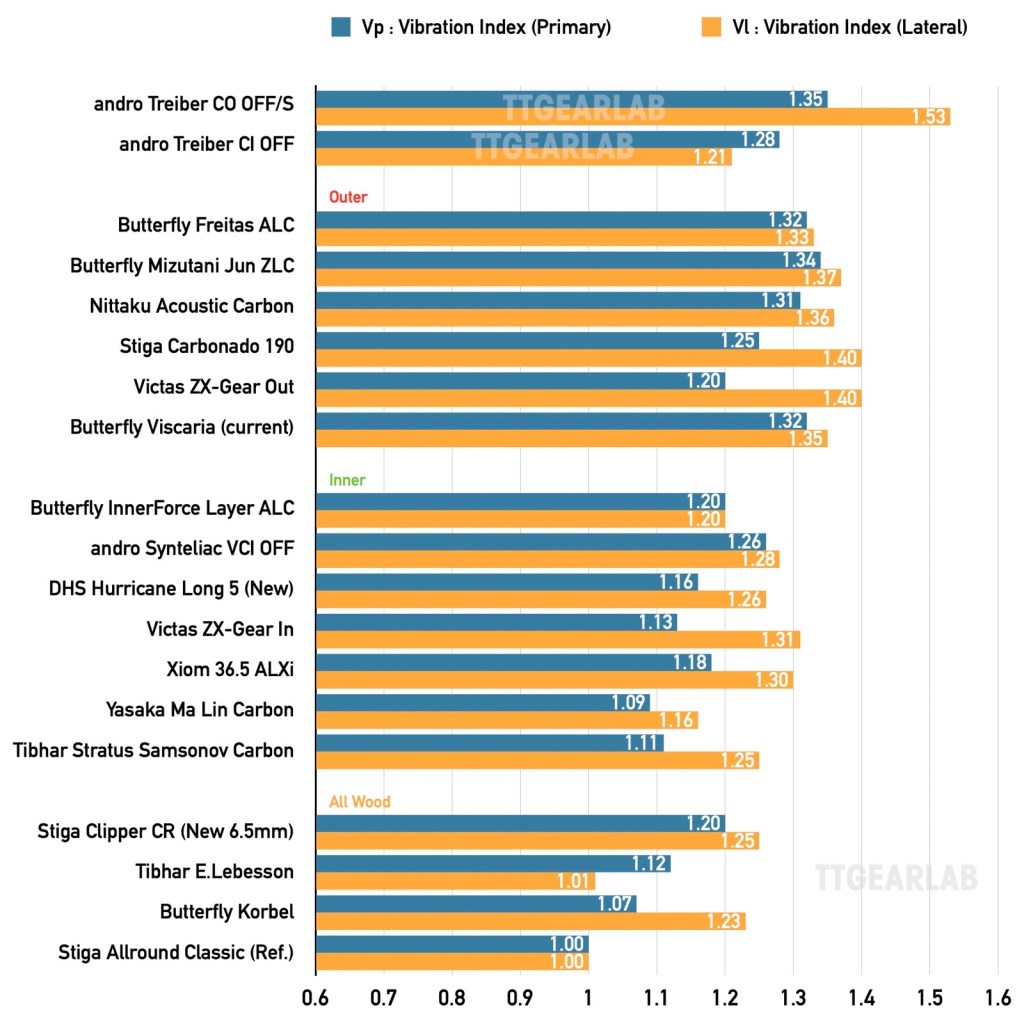
Fig.18 shows the comparison graph of Vibration Indices. Vibration Indices are concerned with feeling. Vp indicates primary feeling which is transferred to player’s palm. And, Vl is the feeling at the edge of the wing – the lower side of blade head. It is felt by player’s index finger or middle finger.
[Outer type]
‘Treiber CO OFF/S’ is an outer Kevlar carbon blade, and it can be compared with the six blades in this group. The result of comparison can be summarized as follows:
- The Vp of ‘Treiber CO OFF/S’ is not much different from those of ‘Freitas ALC’, ‘Mizutani Jun ZLC’ and ‘Acoustic Carbon’. So there isn’t noticeable difference in primary feeling that is transmitted to the palm. However, the Vl of ‘Treiber CO OFF/S’ is much higher than those of ‘Freitas ALC’, ‘Mizutani Jun ZLC’ and ‘Acoustic Carbon’. It means that ‘Treiber CO OFF/S’ transmits much sharper feeling to the index finger of the player. Because the difference is so big, players will feel that ‘Treiber CO OFF/S’ is much harder and sharper than the other outer-type blades.
- The Vp’s and the Vl’s of ‘Carbonado 190’ and ‘ZX-Gear Out’ are much lower than those of ‘Treiber CO OFF/S’. So those two are noticeable softer blades when compared with ‘Treiber CO OFF/S’. However, if we observe the graph shape – the relationship between Vp and Vl – we can notice similarity between the graph shapes of those to and the graph shape of ‘Treiber CO OFF/S’. Therefore, the players who are sensitive to the relative feeling (Vl vs. Vp) may feel that those two give similar feeling as ‘Treiber CO OFF/S’.
- The Vp and the Vl of ‘Viscaria’ is close to those of of ‘Freitas ALC’, ‘Mizutani Jun ZLC’ and ‘Acoustic Carbon’. We may be able to consider the Vp and the Vl around 1.35 as the standard values of outer-type blades.
[Inner type]
‘Treiber CI OFF’ is an inner Kevlar Carbon blade which is very similar to typical inner ALC blade with Limba top layer. Therefore, the blades of this group can be directly compared with ‘Treiber CI OFF’. The result of comparison can be summarized as follows:
- The Vp of ‘Treiber CI OFF’ is higher than the Vp’s of all the other models in this group. It is as high as the values of the blades in ‘Outer’ group. Only one blade whose Vp is comparable with ‘Treiber CI OFF’ is ‘Synteliac VCI OFF’. Both of ‘Treiber CI OFF’ and ‘Synteliac VCI OFF’ transmit quite hard feeling to player’s palm.
- However, the Vl of ‘Treiber CI OFF’ is in the range that we can expect from its inner-type construction. Further the Vl is lower than the Vp. Therefore, most of players who are more sensitive to Vl or Vl/Vp will feel that ‘Treiber CI OFF’ is a quite soft blade even though its Vp is quit high.
- We may be able to consider that the vibration characteristics of ‘InnerForce Layer ALC’ and ‘Synteliac VCI OFF’ are somewhat close to those of ‘Treiber CI OFF’. But, the other models in this group are totally different from ‘Treiber CI OFF’ in vibration characteristics. The other models look like the softer variation of outer-type blades such as ‘Treiber CO OFF/S’.
[All wood]
We can also compare various all-wood fiber blades with ‘Treiber CO OFF/S’ and ‘Treiber CI OFF’. The result of comparison can be summarized as follows:
- The overall level of the indices of ‘Clipper CR’ is comparable with that of ‘Treiber CI OFF’. When compared with the values of ‘Treiber CI OFF’, its Vp is a somewhat lower, and its Vl is a bit higher.
- The Vl of ‘E.Lebesson’ is higher than its Vp. So ‘E.Lebesson’ is only one model in this comparison whose graph shape looks similar to that of ‘Treiber CI OFF’. But, the gap between the Vl and the Vp is more significant in ‘E.Lebesson’.
- The graph shape of ‘Korbel’ looks similar to that of ‘Treiber CO OFF/S’ although the difference in overall level is significantly large.
- The Vl and the Vp of ‘Allround Classic’ are all 1.0 because ‘Allround Classic’ is the reference blade of Performance Indices. The blades whose graph shapes are same as or similar to that of ‘Allround Classic’ are ‘InnerForce Layer ALC’ and ‘Freitas ALC’. So those two can be considered as the step-up blades from ‘Allround Classic’. And, the other blades can be considered if the player wants to adjust the feeling transmitted to index finger. For example, ‘Treiber CI OFF’ will be considerable if ‘InnerForce Layer ALC’ transmits too sharp or too hard feeling to index finger, and ‘Treiber CO OFF/S’ will be considerable if the player feel that ‘Freitas ALC’ transmits too mild feeling to index finger.
Examining Vl/Vp is easier way for the comparison of the tendency of feeling. Fig.19 shows the relationship between Vl/Vp and Vp for easier comparison.
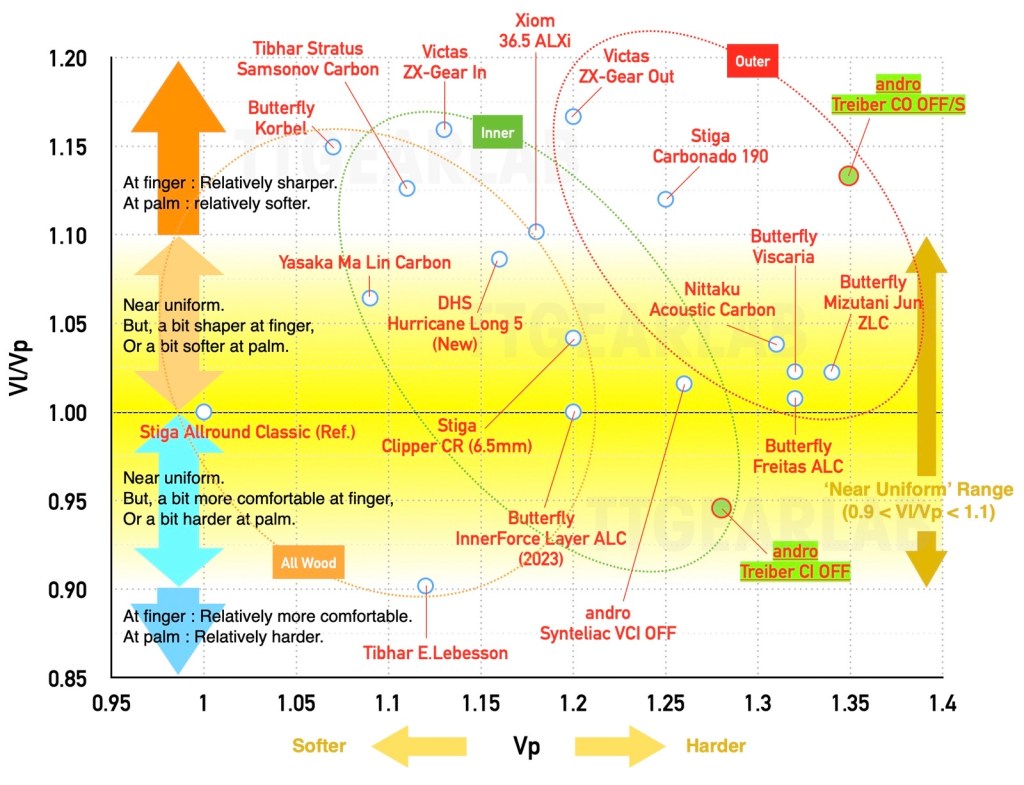
On the graph, most of blades in this comparison are located in upper part of the graph – ‘Relatively sharper at finger’ range. And, two including reference blade are on ‘Uniform’ line, and the other two are in lower part – ‘Relatively more comfortable at finger’. And, one between the two in ‘Relatively more comfortable at finger’ range is ‘Treiber CI OFF’. So, from the beginning we can notice that ‘Treiber CI OFF ‘ is a quite unique blade.
[‘Treiber CO OFF/S’ in ‘Outer’ group]
- ‘Outer’ group including ‘Treiber CO OFF/S’ is placed to right (or upper right) of ‘Inner’ group including ‘Treiber CI OFF’. It means that the outer-type blades are generally stiffer than the inner-type blades in primary feeling transmitted to palm.
- ‘Treiber CO OFF/S’ is located at the upper right side of the group. Its Vp is the highest in the group, and its Vl/Vp is the second highest in the group. Its primary feeling is harder than those of all blades in the group, and the feeling transmitted to index finger is also very sharp because its Vl/Vp is over 1.10.
- ‘Viscaria’, ‘Freitas ALC’, ‘Mizutani Jun ZLC’ and ‘Acoustic Carbon’ are close together on the graph. That location is to lower left of ‘Treiber CO OFF/S’. Those four will give less sharp feeling to the player’s index finger when compared to ‘Treiber CO OFF/S’
- ‘Carbonado 190’ and ‘ZX-Gear In’ are much softer than ‘Treiber CO OFF/S’ in primary feeling transmitted to palm. However, the Vl/Vp’s of those two are around 1.15 which is the same level as that of ‘Treiber CO OFF/S’. Therefore the three blades – ‘Treiber CO OFF/S’, ‘Carbonado 190’ and ‘ZX-Gear In’ – can be categorized into the same subsidiary group – ‘Sharp Outer-type blades’ – which is distinguished from the group of less sharp outer-type blades – ‘Viscaria’, ‘Freitas ALC’, ‘Mizutani Jun ZLC’ and ‘Acoustic Carbon’. (It helps the player when the player wants to replace the blade with a new one. The change of blade can be more smoothly done if the Vl/Vp of new blade is not much different from that of the old blade.)
- Futher, from other groups we can find the blades whose Vl/Vp’s are around 1.15 – ‘ZX-Gear In’, ‘Stratus Samsonov Carbon’ and ‘Korbel’. In this comparison, ‘Treiber CO OFF/S’ can be considered as the stiffest one that the player who prefer sharp feeling at index finger can select.
[‘Treiber CI OFF’ in ‘Inner’ group]
- ‘Inner’ group including ‘Treiber CI OFF’ is placed to left of ‘Outer’ group including ‘Treiber CO OFF/S’. It means that the inner-type blades are generally softer than the outer-type blades in primary feeling although there are exceptions. And, ‘Treiber CI OFF’ is one of the exceptions.
- ‘Treiber CI OFF’ is located at lower right end of the ‘Inner’ group. It means that the primary feeling of ‘Treiber CI OFF’ is the stiffest in the group, and ‘Treiber CI OFF’ transmits the most comfortable ‘relative’ feeling to player’s index finger.
- In primary feeling, ‘Treiber CI OFF’ is stiffer than two outer-type blades – ‘ZX-Gear Out’ and ‘Carbonado 190’. That is the same for another andro blade – ‘Synteliac VCI OFF’ whose Vp is quite high as that of inner-type blade.
- In relative feeling, ‘Treiber CI OFF’ transmits the most comfortable feeling in the group. It is the only one blade in this group which is located in ‘Relatively More Comfortable at Index Finger’ range (Vl/Vp < 1.0). All the other models in this group are located in ‘Relatively Sharper at Index Finger’ range (Vl/Vp >1.0) or on ‘Uniform’ line (Vl/Vp = 1.0). So we can understand that ‘Treiber CI OFF’ gives much different feeling from the other inner-type blades in this comparison.
- We may consider ‘InnerForce Layer ALC’ and ‘Synteliac VCI OFF’ as the ones those are close to ‘Treiber CI OFF’. When compared with the other inner-type blades, those two are relatively closer to ‘Treiber CI OFF’. The player who are not very sensitive to Vl/Vp will be able to replace between ‘InnerForce Layer ALC’ or ‘Synteliac VCI OFF’ and ‘Treiber CI OFF’.
- In other groups, ‘E.Lebesson’ shows similar level of Vl/Vp as ‘Treiber CI OFF’. Therefore, ‘Trieber CI OFF’ will be quite good solution in case the player who has used ‘E.Lebesson’ or the 5-ply wood blade with similar Vl/Vp wants to replace the blade with stiffer/faster one. But, the change from ‘Korbel’ to ‘Treiber CI OFF’ will be difficult because the difference in Vl/Vp is significant.
Please click here to return to top (table of contents)
4. Summary
andro New ‘Treiber’ series was introduced in 2018 as the blade family of ‘High Line’ group that is in charge of the waist of andro blade range. It inherits the name of former ‘Treiber’ series, but differently from older series it consists of the most essential and basic fiber blades. Among four models in ‘Treiber ‘series, two models whose artificial material is Kevlar Carbon – ‘Treiber CO OFF/S’ and ‘Treiber CI OFF’ – play an important role as standard fiber blades whose artificial material includes carbon fiber.
4-1. Treiber CO OFF/S (outer version)
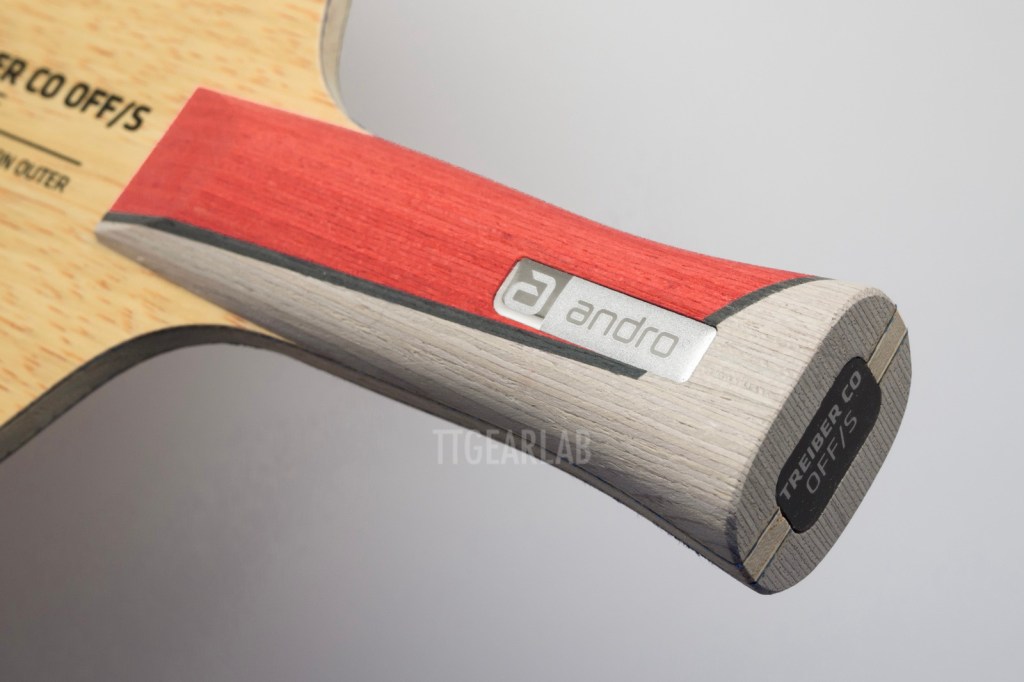
‘Treiber CO OFF/S’ is the outer KVL (Kevlar) Carbon version of andro ‘Treiber’ series. Its characteristics can be summarized as follows:
- ‘Treiber CO OFF/S’ is and outer-type fiber blade whose top layer is Limba and the fiber – Kevlar Carbon – is placed directly under the top layer. Its plywood construction is similar to outer ALC blades with Limba top layer, for example ‘Freitas ALC’.
- The primary elasticity and the central elasticity of ‘Treiber CO OFF/S’ are what we can expect from its standard outer-type construction. Its overall elasticity characteristics are close to those of ‘Viscaria’ or ‘Freitas ALC’. ‘Treiber CO OFF/S’ hugs ball moderately when the player hits the ball very strongly, but not very deeply.
- The feeling of ‘Treiber CO OFF/S’ are somewhat different from the other outer-type blades in this comparison. The primary feeling of ‘Treiber CO OFF/S’ is a bit stiffer than those of outer-type blade with similar elasticity characteristics. And, the lateral feeling of ‘Treiber CO OFF/S’ is much sharper than those of comparable blades. Players are more likely to feel that ‘Treiber CO OFF/S’ transmits sharp and clear feeling.
- In general the standard outer-type fiber blades suit for the players who mainly play with topspin at close-to-table area or from mid distance but lay more emphasis on power than control. And, ‘Treiber CO OFF/S’ is one of that kind of blades. ‘Treiber CO OFF/S’ is recommended for the player who likes the power of standard outer-type blades but wants sharper and more intense feeling.
4-2. Treiber CI OFF (inner version)
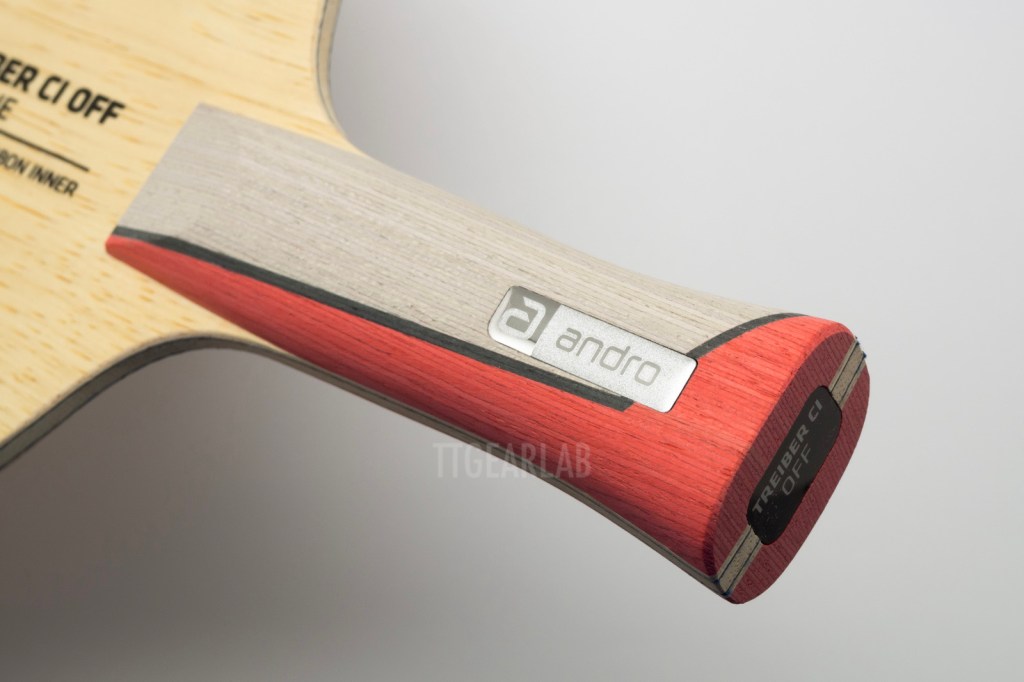
‘Treiber CI OFF’ is the inner Kevlar Carbon version of andro ‘Treiber’ series. Its characteristics can be summarized as follows:
- ‘Treiber CI OFF’ is and inner-type fiber blade whose top layer is Limba and the fiber – Kevlar Carbon – is placed between the middle layer and the center layer. Its construction looks similar to that of inner ALC blades with Limba top layer, for example ‘InnerForce Layer ALC’ or ‘Synteliac VCI OFF’.
- In primary elasticity, ‘Treiber CI OFF’ is somewhat less elastic than comparable inner ALC blades. However, in central elasticity it is more elastic than most of comparable inner-type blades. ‘Treiber CI OFF’ gives additional kick to the ball when the player hits the ball very strongly, while the other inner-type blades in this comparison hug the ball deeply.
- The primary feeling of ‘Treiber CI OFF’ is a bit stiffer than those of comparable inner-type blades. But, but because the lateral feeling of ‘Treiber CI OFF’ is softer than its primary feeling, the relative feeling transmitted to index finger is more comfortable than those of comparable blades. The players who are sensitive to that relative feeling may feel that ‘Treiber CI OFF’ is softer than the other inner-type blades.
- Among inner-type blades, ‘Treiber CI OFF’ is a unique one. It fits for playing style that uses a variety of technics, rather than continuous topspin. So, it is recommended for modern all-round player who requires more powerful blade than 5-ply wood all-round blades. Also it is expected that it fits for fast attack that uses block and smash frequently. If the fast attacker who has used thick & heavy 7-ply wood blade want to replace the blade with a thinner & lighter one, ‘Treiver CI OFF’ will be the solution.
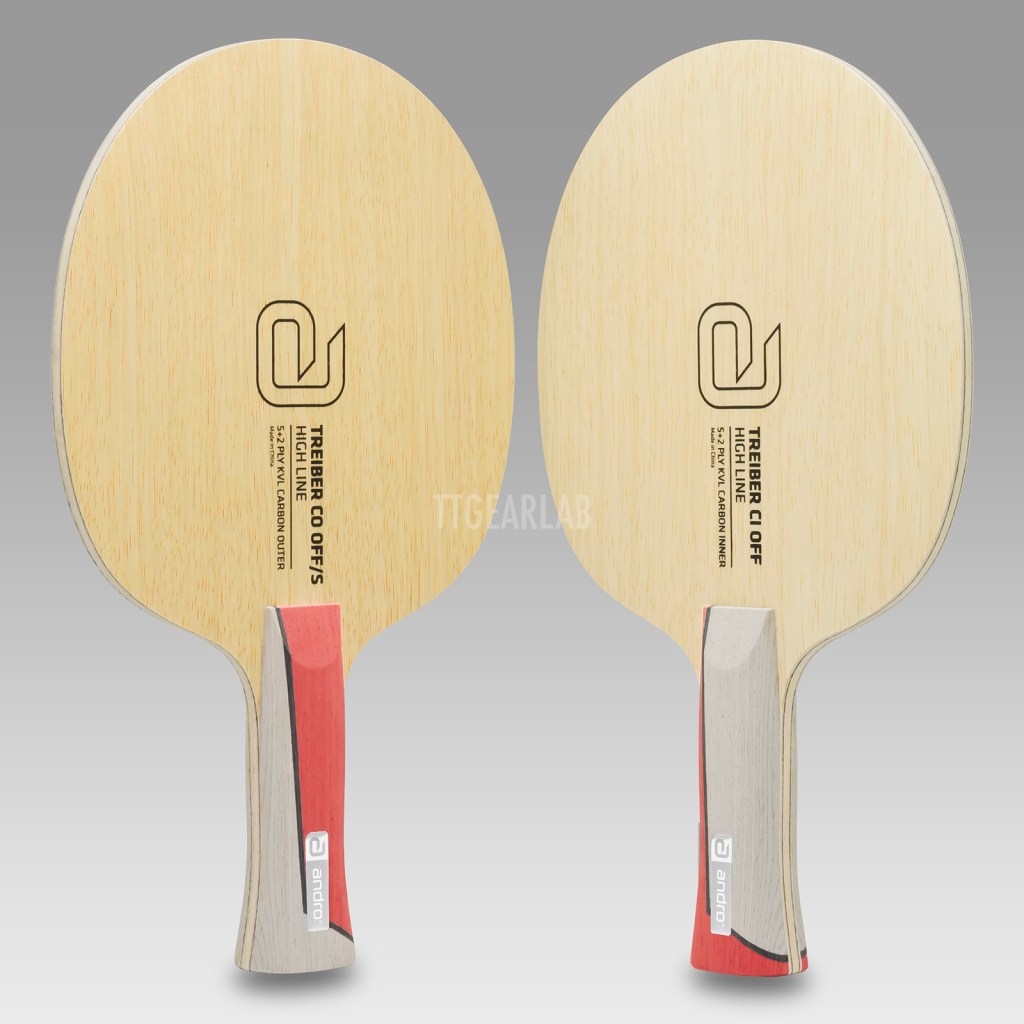
‘Treiber CO OFF/S’ and ‘Treiber CI OFF’ are the products in the same blade family and share the same top layer and the same artificial material, but the characteristics of the two products are very different. If the player lays emphasis on power, ‘Treiber CO OFF/S’ will be the basic choice. And, if the player lays emphasis on precise control, ‘Treiber CI OFF’ will be the proper choice. Further, ‘Trieber CO OFF/S’ is recommended for the players who have used the other outer-type blades so far but want a more distinct and intense feel. And, Treiber CI OFF’ is recommended for the players who have used the other inner-type blades so far but want to supplement the power of hard hitting.
Please click here to return to top (table of contents)
 TTGearLab
Which one (Treiber CO/Off & CI) will be suitable for long pimples (in backhand). I really find it very hard to control the opponent’s topspin to my b/hand (long pimples) and often balls bounces out of the table. I’ve a good f/hand. Need suggestions.
LikeLike
Between those two, I strongly recommend CI.
LikeLike
CI is closer to Allround S which you have been accustomed to.
LikeLike
Hi AK, I use a Treiber CI blade, and on my backhand, I use a 2.0mm short-point Victas VO103. It’s controllable, but with a Treiber CO blade, it bounces too much. I recommend using more Treiber CI blades than CO blades.
LikeLike
Thank you for sharing your experience. 🙂
LikeLike
i would like to know how is the
andro treibher FI off blade. It has TXL fibre with outer hinoki. Ive never tried hinoki and I’ve always wanted to try. Would it be like the treiber CI off with Ec > Ep. And what rubbers would be suited for it?
Also for treiber Ci off would R47 for forehand and Tenergy 05 for backhand be a good combination?
If a butterfly blade and tibhar blade has the same Ep/Ec would it perform the same or there would be a difference?
thanks always for your detailed posts.
LikeLike
Regarding Treiber FI, I can’t tell you right answer because there isn’t measured data. But, I think that it will be totally different from Treiber CI.
Rasanter R47 and Tenergy 05 will make a good combination. But, it differs by player or playing style, and therefore there isn’t a right answer. However, anyway I recommend you to start with that combination and then think about the adjustment after you get the result of the first combination.
More factors than Ec/Ep are required for comparing the characteristics of blades. The blades with same Ec/Ep can provide different performance. However, if the Ec/Ep is identical or very similar, changing from one blade to the other blade will be quite easy. It is even more important than Ec.
LikeLike