
‘Fire Fall’ series is a product line of inner-fiber blades that was announced in late 2012 which isn’t long after the Victas brand was born. At the end of 2012, Victas announced three models of ‘Fire Fall’ series – ‘Fire Fall AC’, ‘Fire Fall FC’ and ‘Fire Fall SC’. And, one year after the ‘Fire Fall’ series consisting of five models was completed by the addition of ‘Fire Fall VC’ and ‘Fire Fall LC’, and began to compete with Butterfly’s ‘InnerForce’ series. The appearance of ‘Fire Fall’ series was renewed in 2017 when the new C.I. of Victas was introduced. Still ‘Fire Fall’ series is one of very strong rivals of ‘InnerForce Layer’ series especially in Japanese market.

‘Fire Fall LC’ is a product added to the series in late 2013, and ‘LC’ stands for ‘Line Carbon’ which is also called as Uniaxial Carbon (ULC) or Unidirectional Carbon (UD Carbon). Butterfly is calling this material as ULC. But, the characteristics of ‘Fire Fall LC’ is somewhat different from those of Butterfly’s ULC blades. Victas adjusted ‘Fire Fall LC’ to give the feeling close to 5-ply wood offensive blade while keeping the high elasticity as a carbon blade. ‘Fire Fall LC’ gives unexpectedly soft feeling at light hitting, and hugs the ball very deeply when the player hits the ball very strongly. However, ‘Fire Fall LC’ shoot the ball with very high speed at next moment, thanks to the high energy efficiency of carbon fiber. ‘Fire Fall LC’ is recommended for the players who have used 5-ply offensive blade but want to replace the blade with fiber blade.

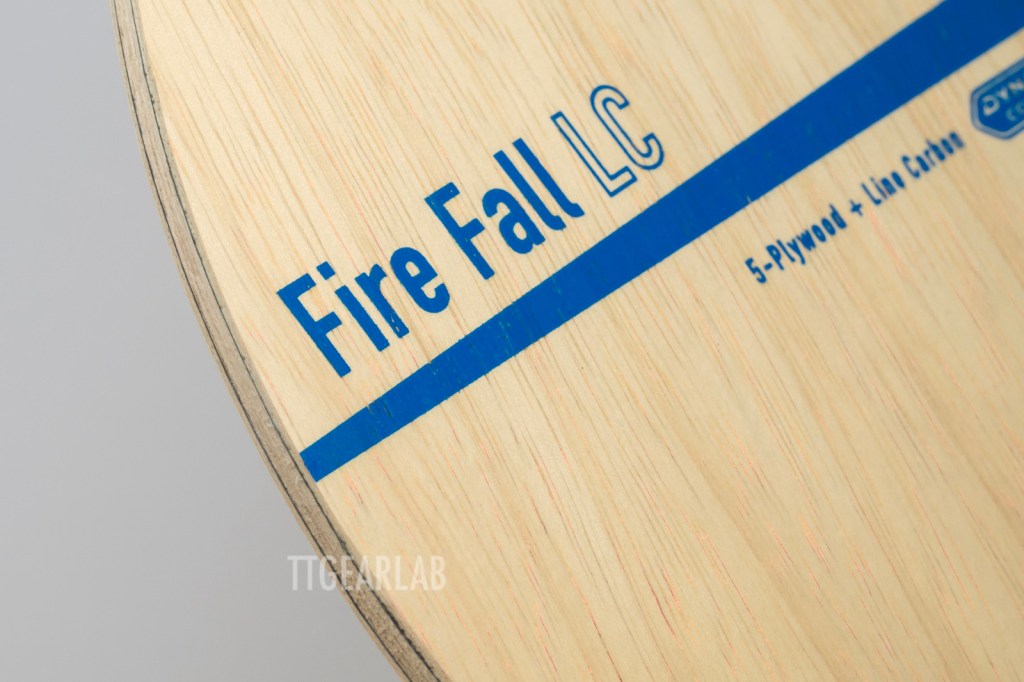
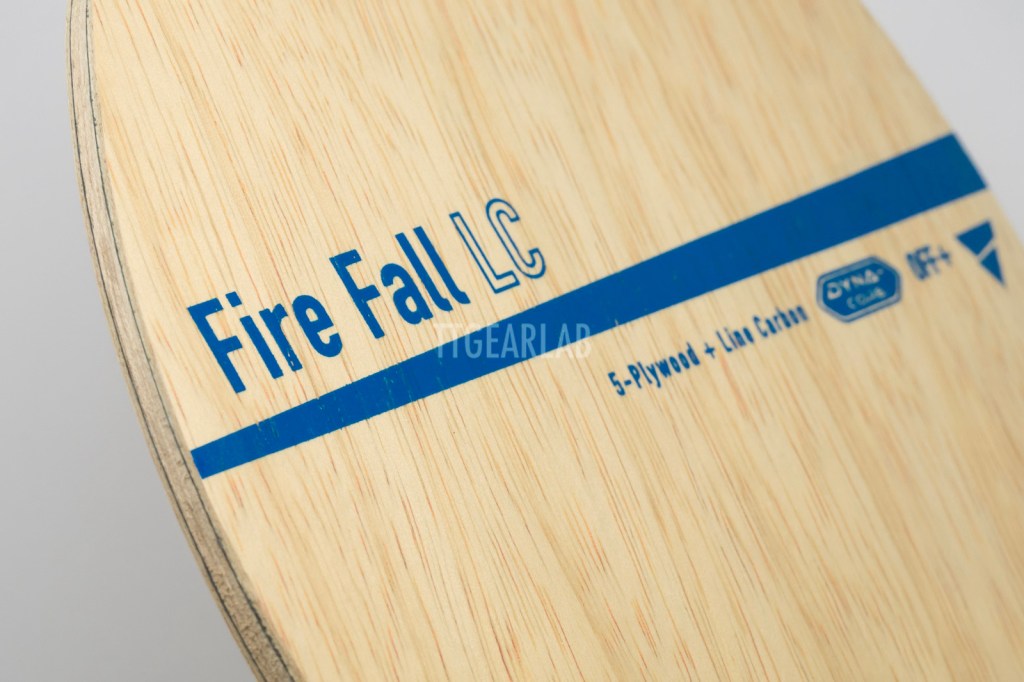
The new C.I. of Victas is being applied to current ‘Fire Fall’ series. The ‘splitting’ image is printed at the middle of the foreside of head. And, the name of product is printed above that splitting graphic. Below that splitting graphic, elasticity level and the information of construction are printed. The splitting graphic is also applied to handle. The same design concept of handle is also applied to ‘Quartet’ series and ‘ZX-Gear’ series. A very consistent graphic design is the characteristics of Victas blades.

‘Fire Fall LC’ is an inner fiber blade. Line Carbon(= Uniaxial Carbon) is placed between the middle layer and the center layer. The top layer is Limba. The middle layer is Ayous, and the center layer are Kiri. Overall thickness is around 5.9mm. This blade construction is reminiscent of currently discontinued adidas, and although the materials are same, the details of specification are slightly different.

The official size of head is around 157mm x 150mm. Actually measured size is a bit wider (= 157mm x 151mm) than the official size.
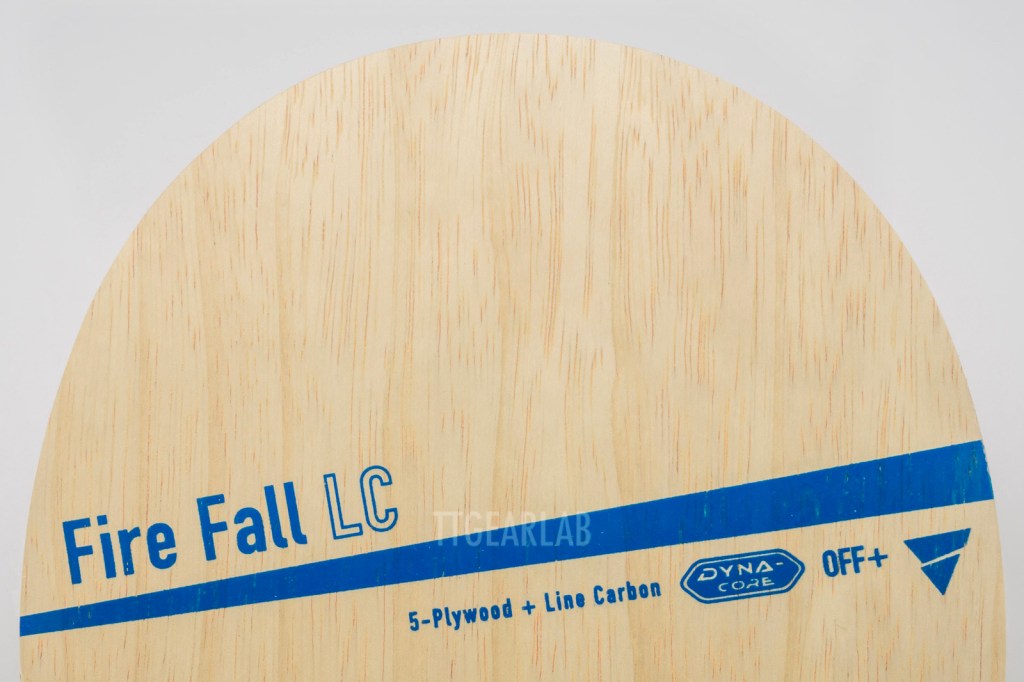
Same concept of the printing on the foreside of head is common to almost all Victas blades. The consistency is so strong that you can easily tell it’s a Victas blade at first glance. However, to distinguish individual products, you must check the product name. it is difficult to distinguish individual products. To distinguish individual products, you must look at their names.

The name of blade and the plywood construction (5-ply + Line Carbon) are printed over and under the left side of the splitting image respectively.
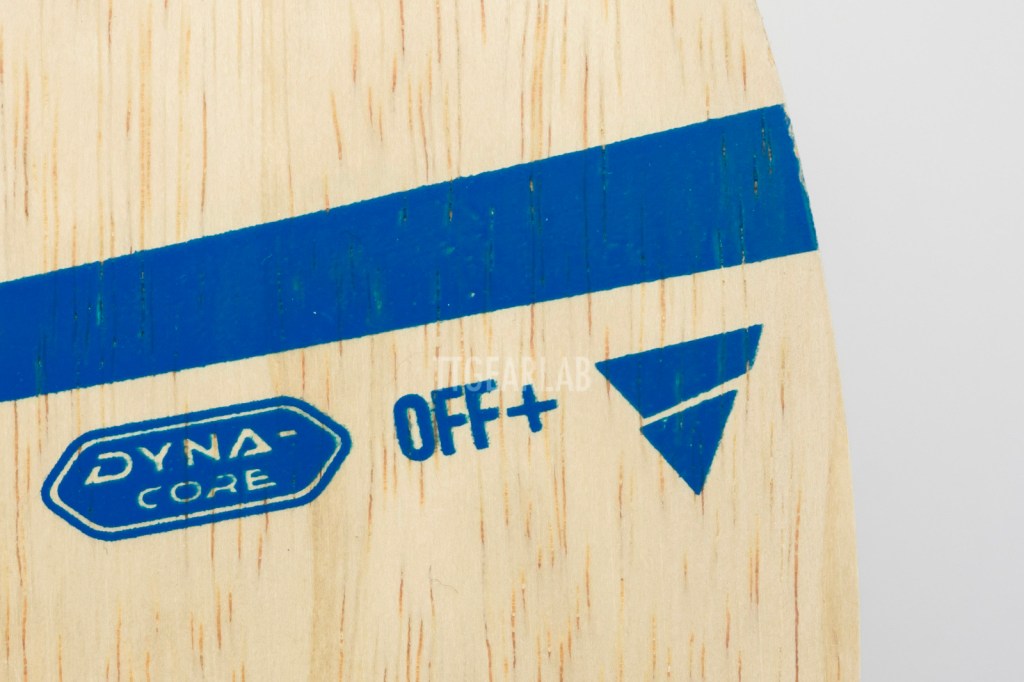
‘Dyna-core’ logo and speed sign is shown under the right side of the splitting image. ‘Dyna-core’ is the name used by Victas to indicate inner fiber construction. (Outer Fiber construction is called as ‘Dyna-shell’.)
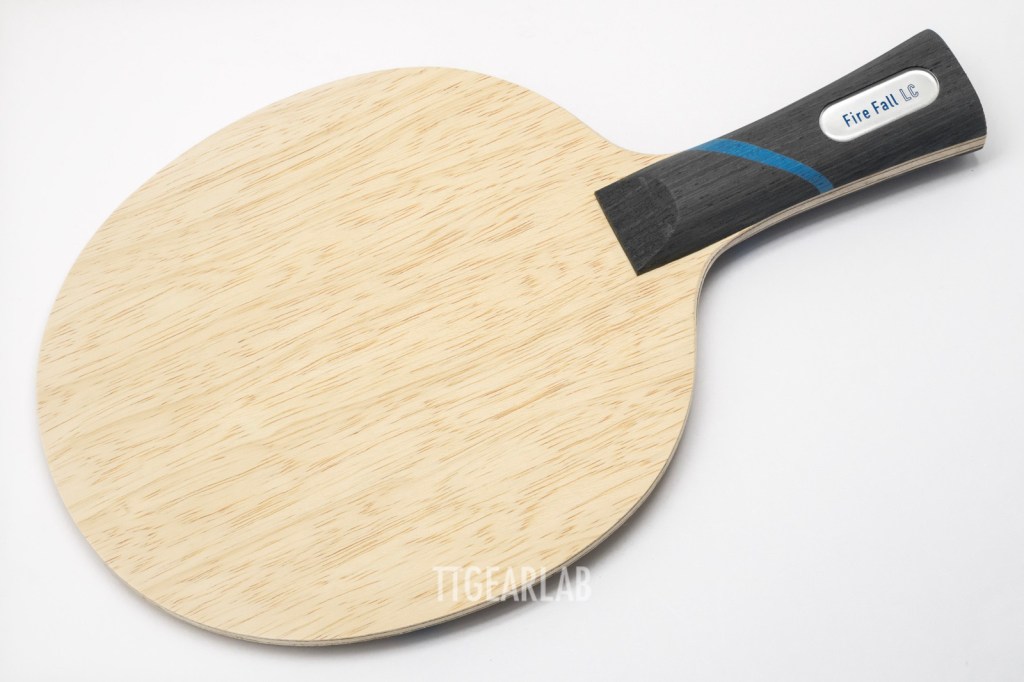
Nothing is printed on the backside of head. But, on the backside of handle there is a transparent plastic lens that indicates the name of blade.
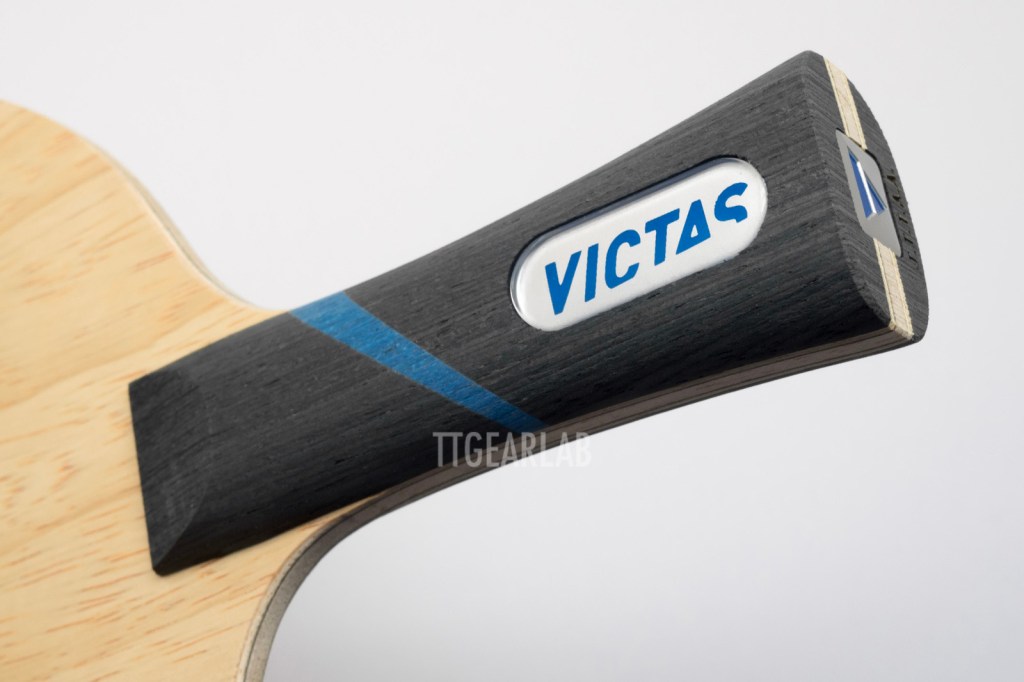
The width of FL (flared) handle is around 26mm (at head side) ~ 27mm (at bulge) ~ 26mm (at narrowest point) ~ 34mm (at the end). And, the thickness of FL handle is around 22.5mm (at thumb) ~ 24mm (at the end). The FL handle isn’t a wide handle, and it is somewhat thinner than ordinary FL handles. But, the stability of grip is good because the surfaces are relatively flat.
The size of ST (straight) handle is around 28mm (width) x 22mm (thickness). It is a squared handle whose foreside/backside surfaces are completely flat, like the ST handles of ‘Swat’ series.
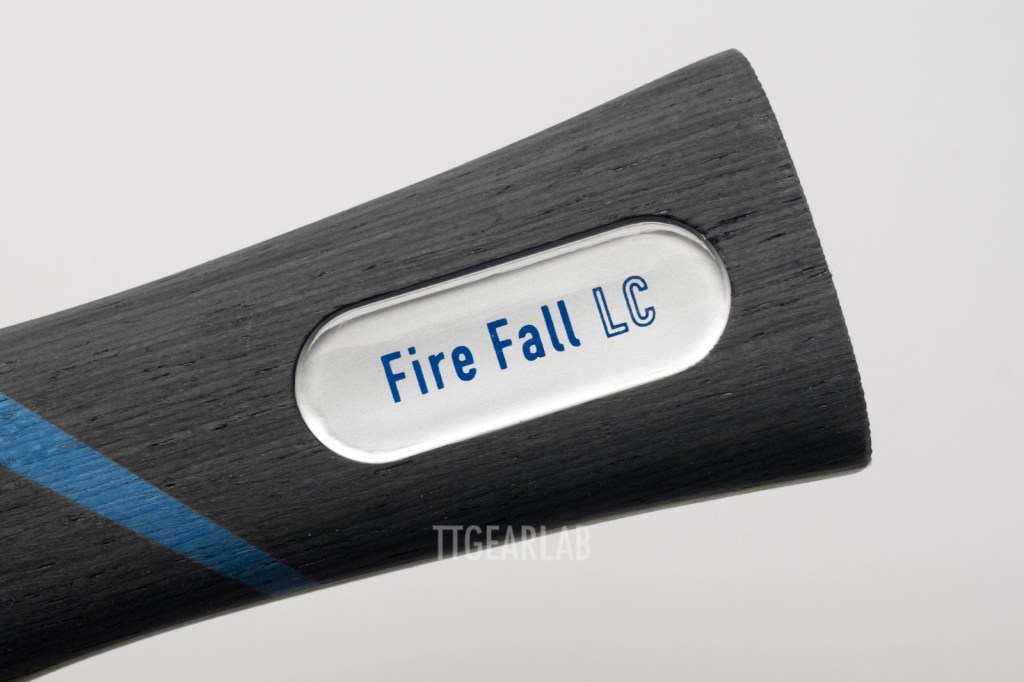
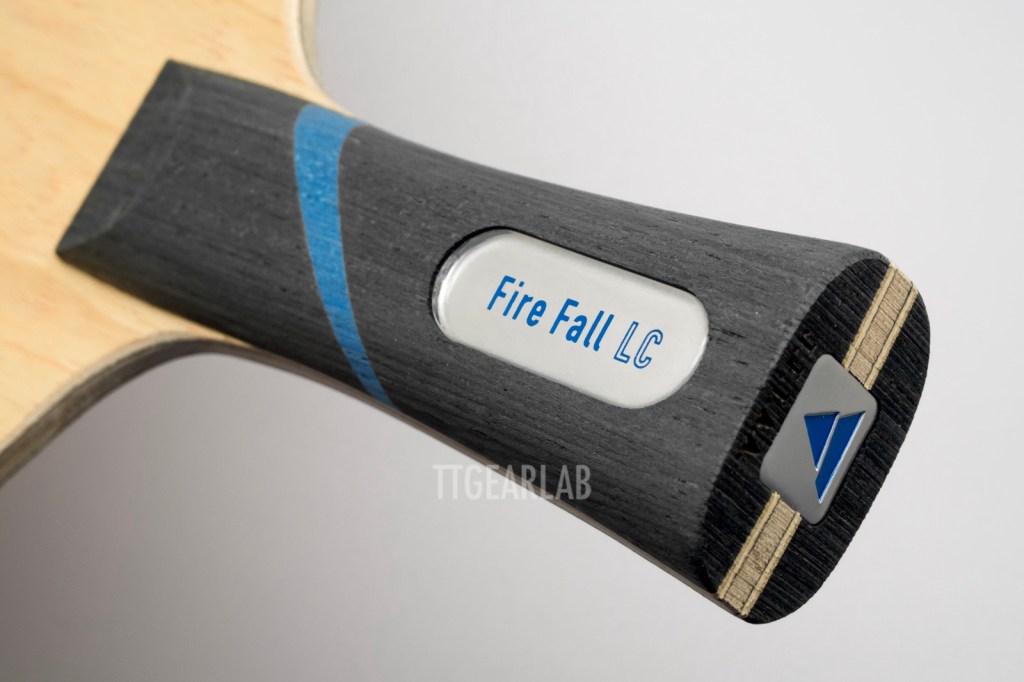
One of the characteristics of Victas blades is that the second lens is applied on the backside of handle. The size of the backside lens is same as that of foreside lens, and the name of the blade – ‘Fire Fall LC’ – is written in the backside lens.
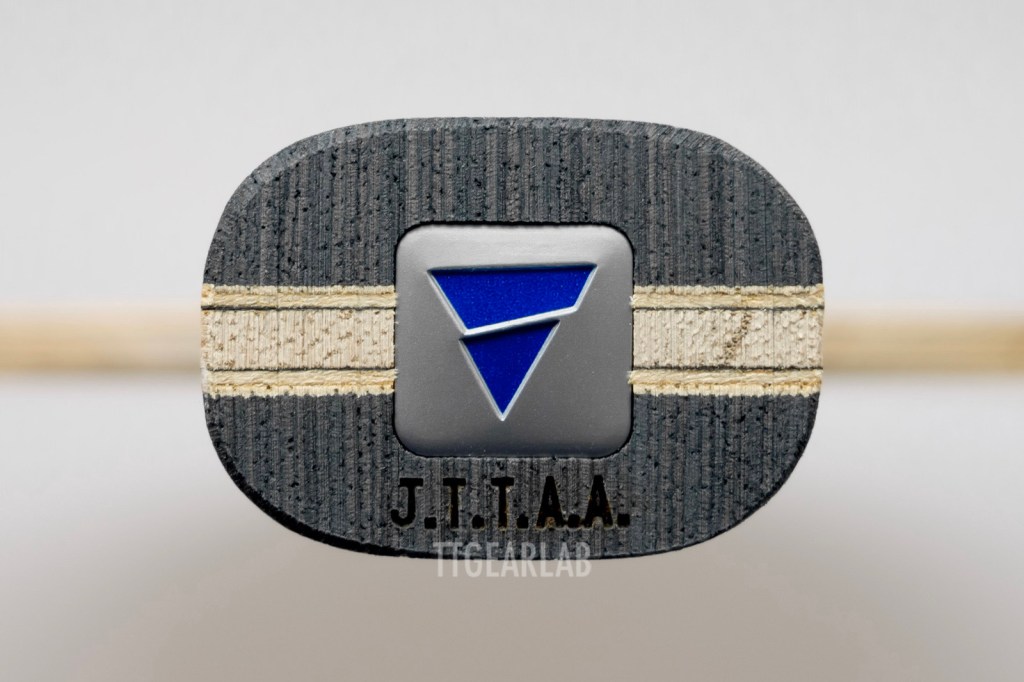
Small aluminum plate that includes engraved Victas logo mark is applied at the end of handle. This logo mark symbolizes the image of splitting V.
‘Fire Fall LC’ is one of the representative inner blades of Victas. Although its artificial material is ULC, ‘Fire Fall LC’ provides totally different characteristics from Butterfly’s ULC blades. The characteristics of ‘Fire Fall LC’ are very close to those of 5-ply wood offensive blades.


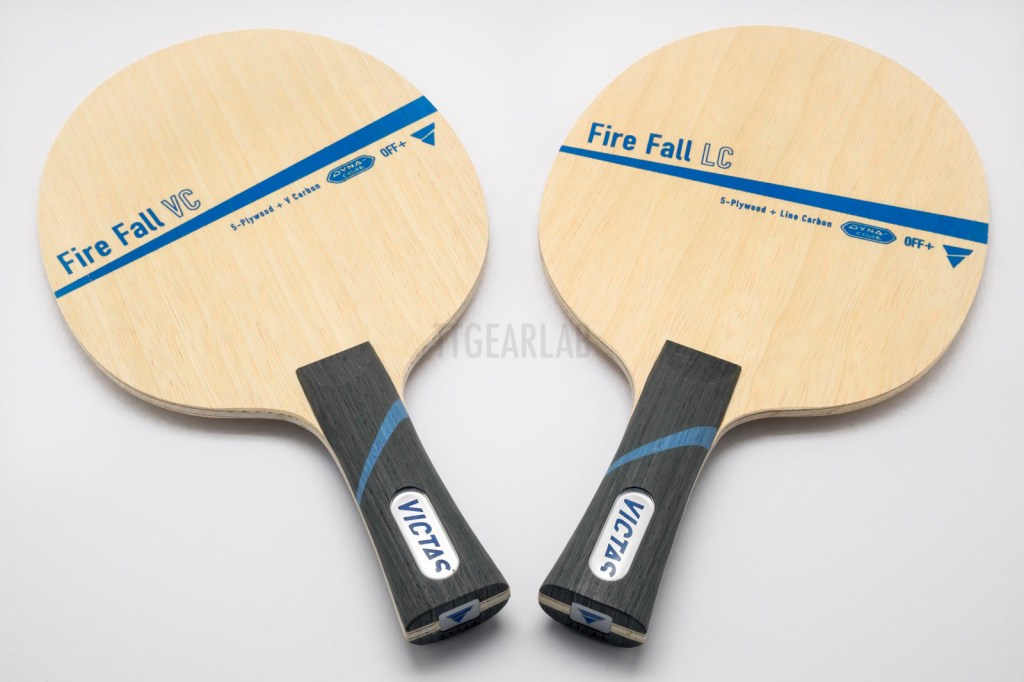
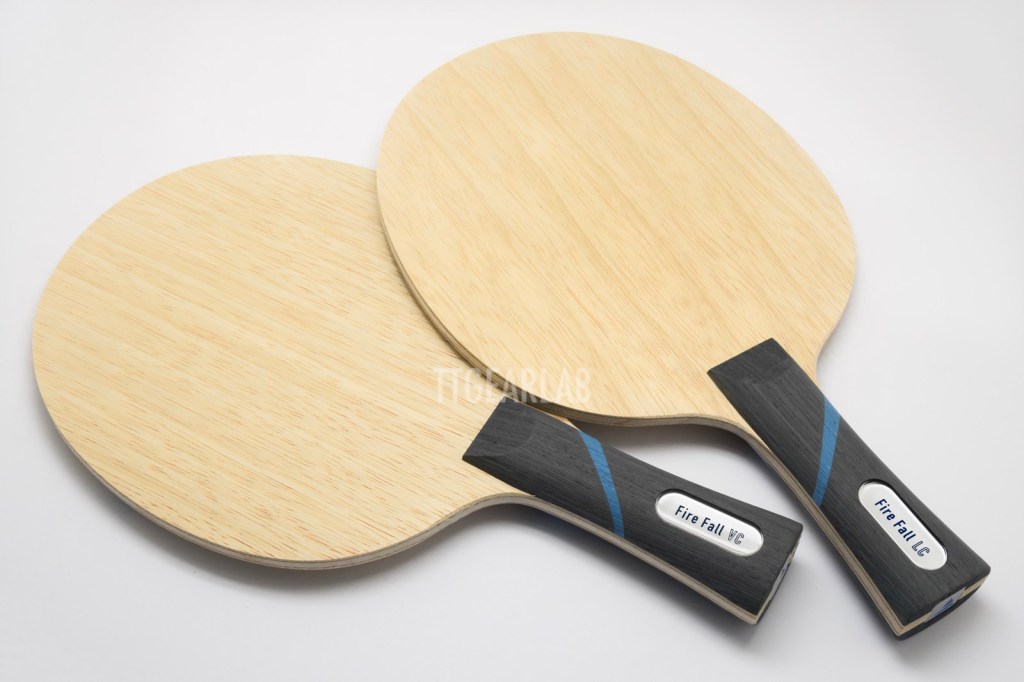
Above picture shows two products in ‘Fire Fall’ series those are released one year later than the announcement of the other three models in the series. Left is ‘Fire Fall VC’ whose artificial material is V Carbon (= Vectran Carbon = ALC), and right is ‘Fire Fall LC’ whose artificial material is Line Carbon (= uniaxial carbon fiber). Except for the product name and the name of artificial material , there isn’t any difference in graphic design between two blades.
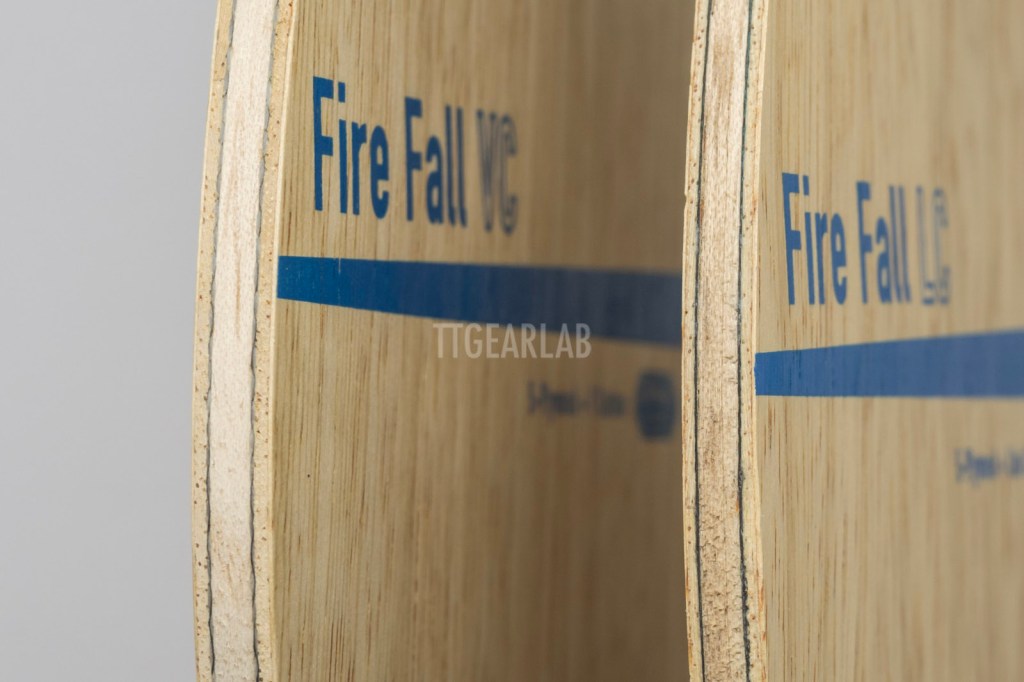
‘Fire Fall VC’ (left) and ‘Fire Fall LC’ (right) are inner blades those have something in common in that the center layers of both of two are not Ayous but Kiri. But, ‘Fire Fall VC’ is much thicker than ‘Fire Fall LC’ due to its thick middle layers.
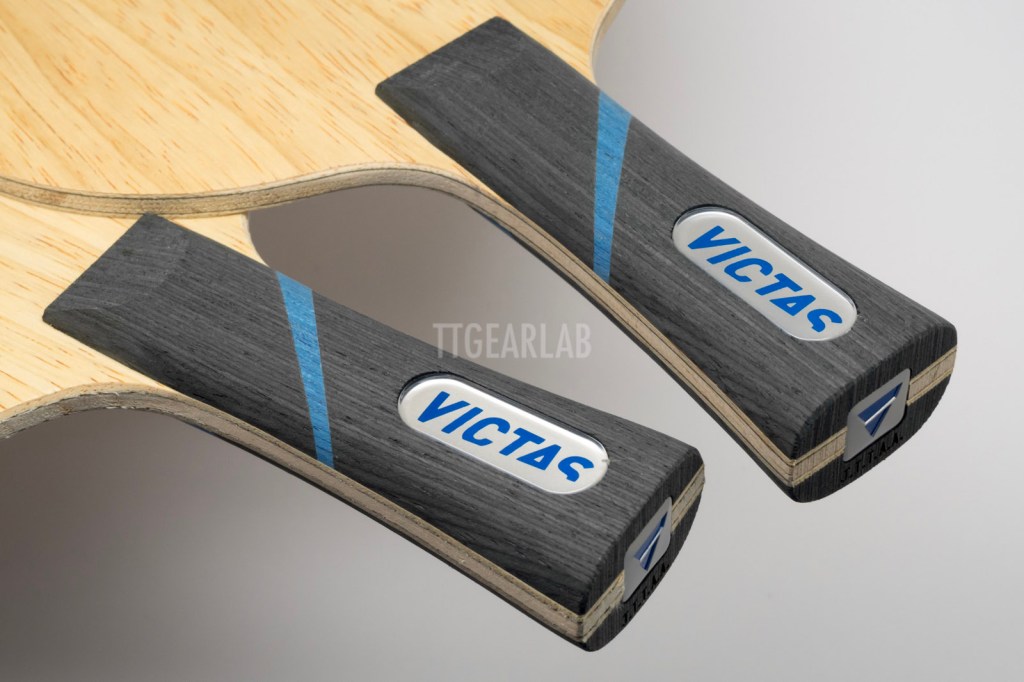
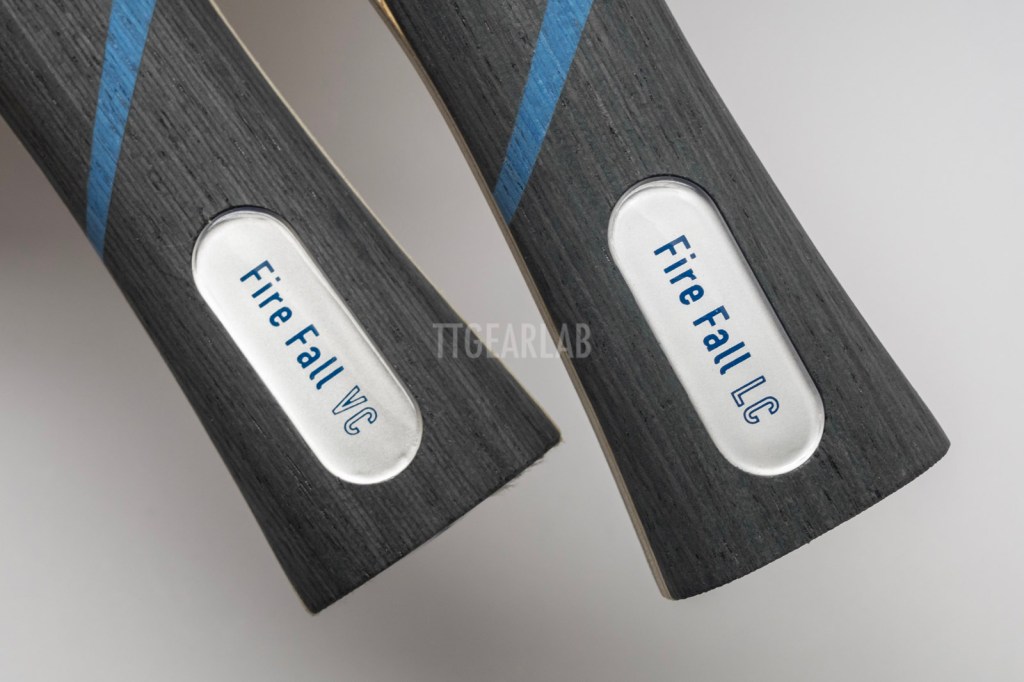
The handles of two models looks totally identical. If the rubber is attached, we can’t tell them apart until we look at the backside lens or the edge of the blade. (The one on the front is ‘Fire Fall VC’ and the one on the back is ‘Fire Fall LC’.) This extremely consistent way of design of Victas blades is intended to promote the name of the new ‘Victas’ brand rather than individual products.
The backside of ‘Fire Fall VC’ (left) and ‘Fire Fall LC’ (right). The names of two models are shown in the backside lenses.
‘Fire Fall VC’ (left) and ‘Fire Fall LC’ (right) are two most important models in ‘Fire Fall’ series which is the major inner blade family of Victas.
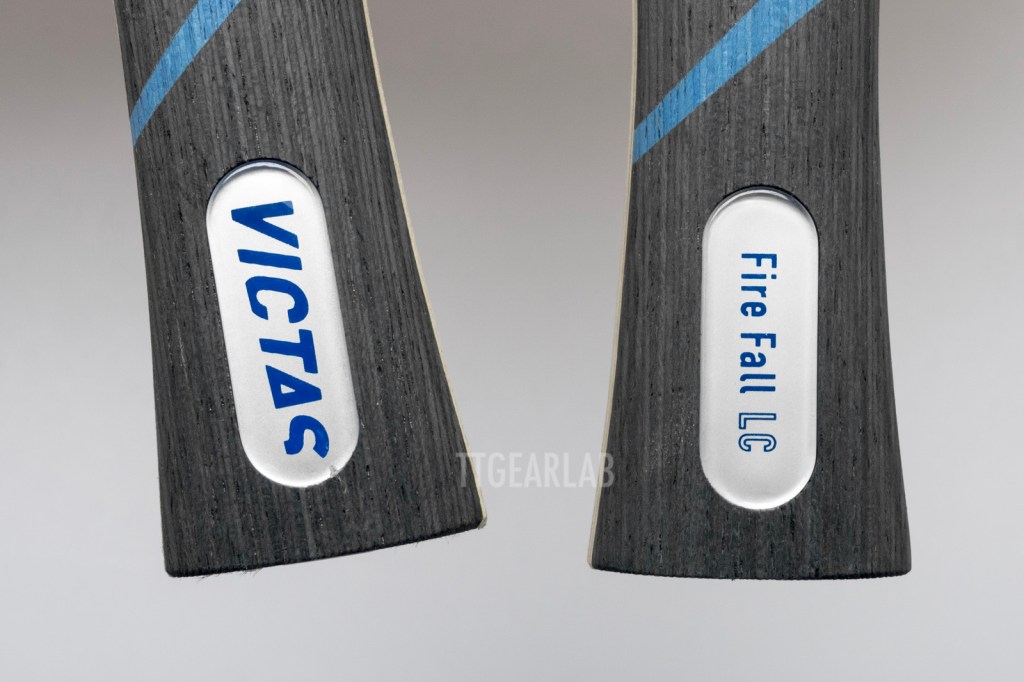
A characteristic of Victas blades is that lenses are applied to both sides of handle. However, the players who don’t like the feel of the lens on their fingers and therefore use the lens side as the backhand side will not like this design. For those players, Victas should make the lens (or Aluminum plate) much smaller than these ones. Fortunately, very small Aluminum plates are started to be applied for new models such as Koki Niwa ZC.
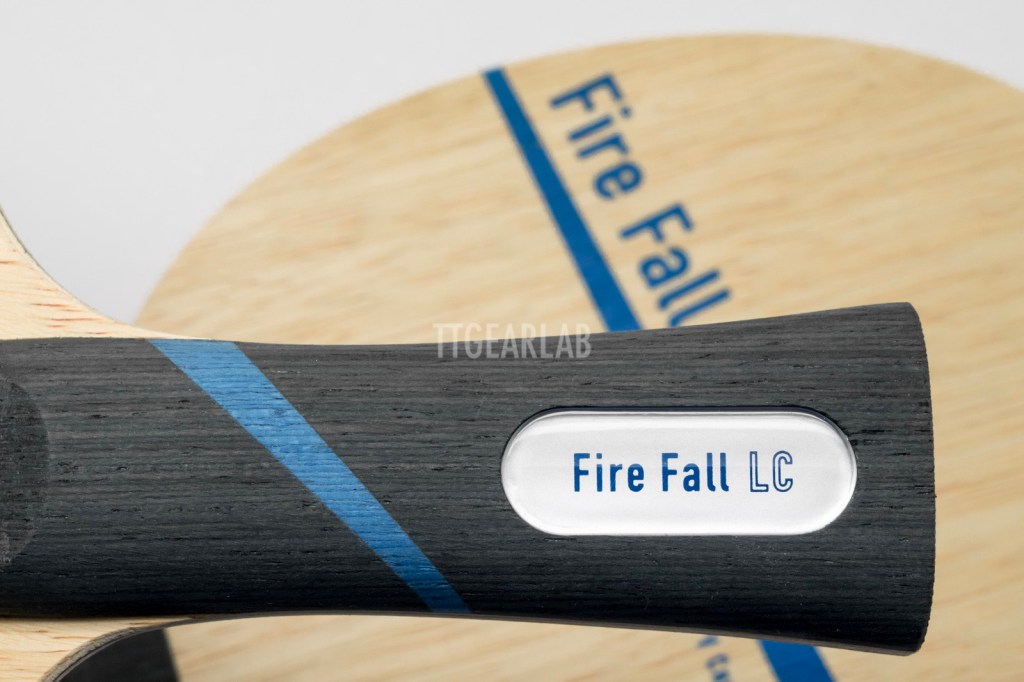
‘Fire Fall LC’ is an inner fiber blade which provides much different characteristics from ‘Fire Fall VC’ in the same series.
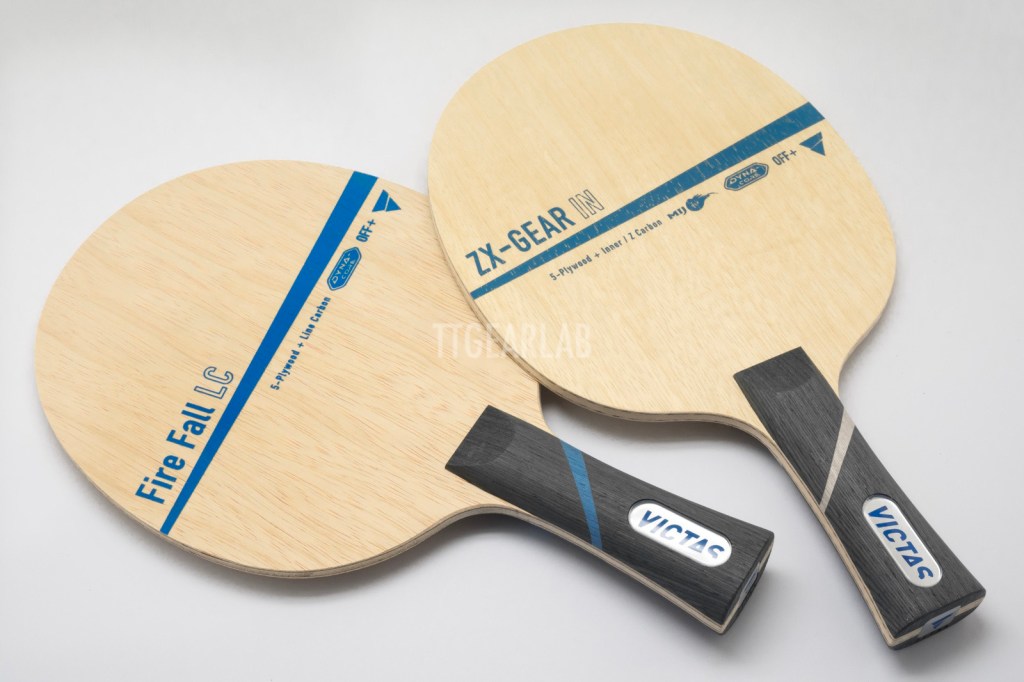
‘Fire Fall LC’ (left) and ‘ZX-Gear In’ (right) are similar in overall thickness. However, constructions of two blades are totally different from each other. And, most of all, two blades are using totally different artificial materials. However, in spite of the differences in construction, two blade share many characteristics – especially both of two hug the ball very deeply when the player hits the ball very strongly. Both of ‘Fire Fall LC’ and ‘ZX-Gear In’ are recommended for the players who have used 5-ply wood offensive blades. The players will not spend much time until they get used to new blade.

Following are the performance indices of Victas Fire Fall LC (avg.weight = 85.1g) :
– Ep = 1.87
– Ec = 1.29 (Ec/Ep = 0.69)
– Vp = 1.10
– Vl = 1.39 (Vl/Vp = 1.26)
Please note that above are average values and can be updated by further measurement.
Unauthorized use and/or duplication of this material without express and written permission from this website’s author and/or owner is strictly prohibited. Excerpts and links may be used, provided that full and clear credit is given to TTGearLab with appropriate and specific direction to the original content.
 TTGearLab
hi, i prefer to use powerful blade like stiga 290 , t5000 , how about stiga cc7 ? and there is a special multi-layered blade yasaka ydm17, what’s the ep , vp of them?(cc7,ydm17)
LikeLike
If you like the blades with high elasticity like Carbonado 290 and Timo Boll T5000, CC7 is considerable but not seriously. It isn’t as fast as Carbonado 290 or Timo Boll T5000. However, as an inner type blade it is a quite fast blade. It is as fast as Butterfly Ovtcharove InnerForce ALC.
However, because it is an inner type blade you may feel that it is slower than the outer type blades with similar Performance Indices. (Some players feel that Ovtcharov InnerForce ALC is not that fast. Outer type blades fit for that kind of players.)
Further the surface of CC7 is very weak. It is easily broken when we replace rubber. Among Stiga blades it has especially weak surface. Please also put it in consideration.
The values of CC7 is as follows :
average weight = 91.8g
Ep = 2.04
Ec = 1.70 (Ec/Ep = 0.83)
Vp = 1.24
Vl = 1.43 (Vl/Vp = 1.15)
Regarding Dynamic 17, there isn’t Performance Indices because I don’t have the sample of Dynamic 17. (I hope that I have chance of getting a sample.)
LikeLike
thanks for your reply ,the Performance Indices is helpful when i chose a suitable blade
LikeLike
my comment didn’t display in other article,,,,,I have doubts about DHS‘HL5,i have tried many different blades, Butterfly’s t5000 , vis, zjk szlc, gmax. Stiga’s 245 ,290 , dynasty ,clcr, 7.6 wrb, DHS’s hl5 ,hl5x , alphabet series, w968, golden slam, different fiber structure have different speeds ,but i have two questions ,inner blade ‘s material is inside ,they need you hit ball strongly can exert its power ,but According to your date ,why hl5’s ep is lower than ec?another question is A popular saying in social circles When you hit the ball with a strong force away from the table by an Ayus inside blade like the hl5 , the spin and rotation speed far exceeds outlay blade ,but i can’t see any information in your article ,and the Butterfly‘s Product Introduction Diagram also only provides elasticity and vibration coefficients?
LikeLike
Thank you for comment. BTW, the Ep of HL5 is not lower than its Ec. 🙂 Please check the data once more and let me know if there is any article that I input wrong data.
Spin is not directly concerned with the characteristics of blade. And, inner type blade doesn’t create more spin than outer type blade. Butterfly doesn’t show any blade’s parameter that is concerned with rotation because it isn’t scientific data. And, the reason why I don’t show that kind of data is same with it.
LikeLike
have you heard of the tests on various table tennis blades conducted by the Sports Engineering Laboratory in bremen ,Germany(in 2024)?
LikeLike
Not yet. I will check it.
LikeLike
I found this data from ai, because I believed that the power of the T5000 is greater than that of the 5 and 5+2 floor, based on the butterfly product drawing and your data, but ai believed that 5+2 should be more powerful when hitting the ball with more than 75% power at the further position. The reason is that in the test of the German Bremen Laboratory 2024, the test conditions are that the robot is hitting the ball 120N, the contact time is 5ms, the launch angle is 15 degrees, and there is no wind tunnel. The result is that the initial speed of the hard boards such as the stiga 76 and t5000 is faster than vis and oc, and the initial rotation is slightly lower, but according to the Magnus effect and air resistance, the final distance Vis and oc defeated t5000 more than 1m, but I can’t find this articles from the Internet
LikeLike
What I can show is just the fundamental elasticity of blade. The higher the elasticity the faster the blade. However, the faster doesn’t mean that the ball hit by that blade is always faster. Also, if the spin is reduced due to strong elasticity, that will also affect the speed of ball after launch. That is what we can see from the testing at Bremen. But, if the condition is different the result can be different. (Further, in actual condition we tend to always adjust our impact to fit our blade or rubber. That changes the condition. For that reason the condition can’t be the same in actual situation.)
LikeLike
is the uniaxial line carbon from Victas LC quite similar to Butterfly’s T5000 carbon ? They both look like thick carbon layers.
LikeLike
No. There is a clear difference between those two.
T5000 is woven carbon fiber, while LC isn’t woven, although both of those two are thick.
Probably those two will provide similar ‘performance’, mainly concerning bending deformation. But, the feeling of those two will be different from each other.
LC of Victas is similar to ULC of Butterfly if we ignore the difference in thickness.
LikeLike
Hello,
Thank you for this excellent article, which highlights the very low Ec/Ep of the Fire Fall LC.
In your opinion, which style of play does this favour ?
Does the fact that the center layer of the Fire Fall LC is kiri and not ayou (as with the ZX-GEAR IN) make it less flexible ?
Finally, if we’re hesitating between the ZX-GEAR IN and the Fire Fall LC, what do you think we should consider when deciding ? Which style of play is the ZX-GEAR IN better suited to, compared with the Fire Fall LC (although I understand they seem close) ?
Thank you very much !
LikeLike
Please also refer to this article : https://ttgearlab.com/2024/12/02/victas-fire-fall-vc-fire-fall-lc-lab-test-report/
I think that Fire Fall LC fits for very aggressive topspin at close-to-table area. The very low Ec/Ep is good for aiming at rising of the ball after the bounce.
Kiri is softer than Ayous. So if the Ayous center layer is replaced by Kiri, the blade becomes more flexible at center.
ZX-Gear In is also good for aggressive topspin. But, in my opinion, Fire Fall LC fits for ‘even more aggressive’ style. If the proportion of non-aggressive play is not ignorable, ZX-Gear In may be better than Fire Fall LC.
LikeLike
Many thanks for your informative reply.
I was mistaken, I thought that blades with a very low Ec/Ep provided a lot of security in the game and that those with a high Ec/Ep were better suited to a very aggressive game.
LikeLiked by 1 person
Thank you for comment.
By the way, we can be more aggressive when we use the blade with very low Ec/Ep because it gives high level of safety when we aim at very early timing of rising.
Because ‘aggressive’ can represent aiming at early timing, we may have to find another word for the blades with high Ec/Ep. (Descriping hust with words is very difficult. :-))
LikeLike
Hello,
Are the theoretical differences in performance between different rubbers less noticeable on blades with a low EC/EP than on blades with a high EC/EP (or vice versa) ?
Or does my question make no sense at all ?
Thank you.
LikeLike
The performance of rubber is more complex. But, in general, the differences in rubber performance is more noticeable on blades with higehr Ec and higher Ep. There are also many performance factors of rubbers. And, depending on Ec/Ep, it will be determined which performance factor is more noticeable. (I haven’t deeply thought about it.)
LikeLike