‘Rasanter’ series is the most successful rubber series in andro range so far. It is further divided into the original series that was initially released and the ‘EC’ series that was released after 2021. ‘EC’ is the abbreviate of ‘Energy Cell’, and newly developed ‘Energy Cell Sponge’ is being applied to the latest models of the ‘Rasanter’ series released after 2021. The naming system of the ‘Rasanter’ series is ‘Rasanter’ followed by one letter of the alphabet and two digits. The alphabet indicates the nature of the sub-series and the two digits indicate the hardness of the sponge in German standard. The original series is divided into the R series (= R50, R47, R42, R37) which focuses on spin, and the V series (= V47, V42) which focuses on speed. The latest ‘EC’ series was first launched in early 2022 with the new R series (= R53, R48, R45), and has been followed by the ‘sticky’ C series (C53, C48) in early 2023. The ‘EC’ series – new R series and C series – basically focuses on spin. The new R series and the C series have something in common in that they both can easily make strong rotational. But, they are distinguished by playing strategy. The R series is more suitable for active attak that utilizes high speed while the C series focuses on counterattack that utilizes its excellent controllability.
‘Rasanter R’ series is the family of new-generation tension rubbers focused on spin performance. ‘R’ means ‘rotation’. The original ‘R’ series consists of four variations – R50, R47, R42 and R37. (Numbers indicate sponge densities in German standard.) And, three models of new ‘R’ series – R53, R48 and R45′ – have been added as the top models of ‘Rasanter’ series. According to andro, the new ‘R’ series adapts new version of EC (Energy Cell) sponge whose feeling and energy efficiency have been improved. But, the overall appearance of ‘R’ series is somewhat confusing for the customers who don’t know andro rubber range very well because two different generations with similar numbers coexist in the same series. In my opinion, the new three models should have been named differently, for example ‘Rasanter P’ series. Then customers will easily distinguish between new ‘Rasanter P53/P48/P45’ and old ‘Rasanter P50/R47/R42/R37’. Anyway, please note that the ‘Rasanter R’ models whose numbers are 53 or 48 or 45 are the most advanced models of current German rubbers, and therefore give higher power than the models with but a bit different numbers respectively. (53 vs 50, 48 vs 47 and 45 vs 42).
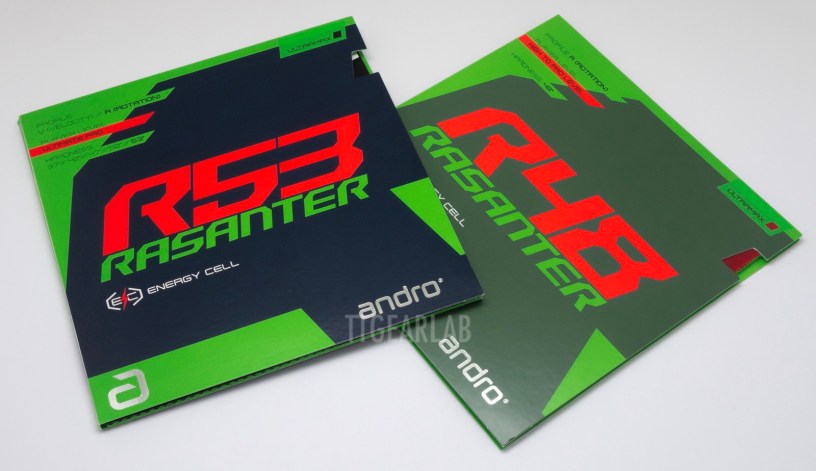
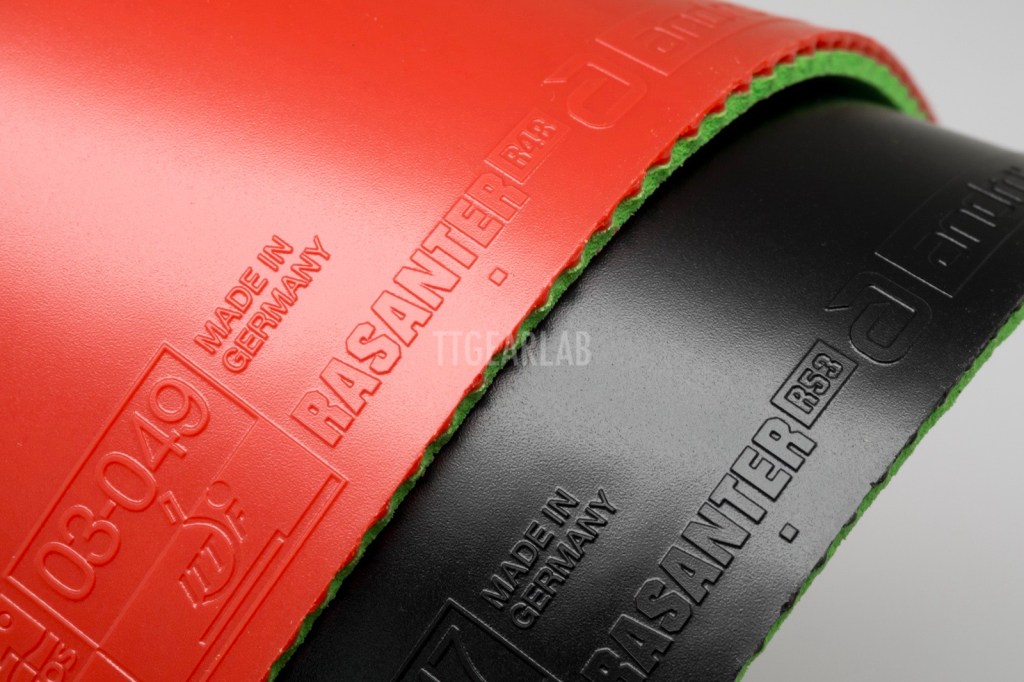
‘Rasanter R53’ and ‘Rasanter R48’ are respectively the hard sponge version and the medium sponge version of ‘New Rasanter R’ series which adapts new EC sponges. (Medium soft version – ‘Rasanter R45’ – isn’t shown in the picture.) We can consider that ‘Rasanter R53’ is more powerful version of old ‘Rasanter 50’ and ‘Rasanter R48’ is more powerful version of old ‘Rasnater R48’. Although new models have harder sponges, players may feel that new models are softer than old models, because of new more advanced sponges. However, the old models – ‘Rasanter R50’ and ‘Rasanter R47’ – are also very good rubber yet, and may be better selection for most of players because old models are cheaper than new models. TTGearLab recommends new models for highly skilled players, and old models for ordinary players.
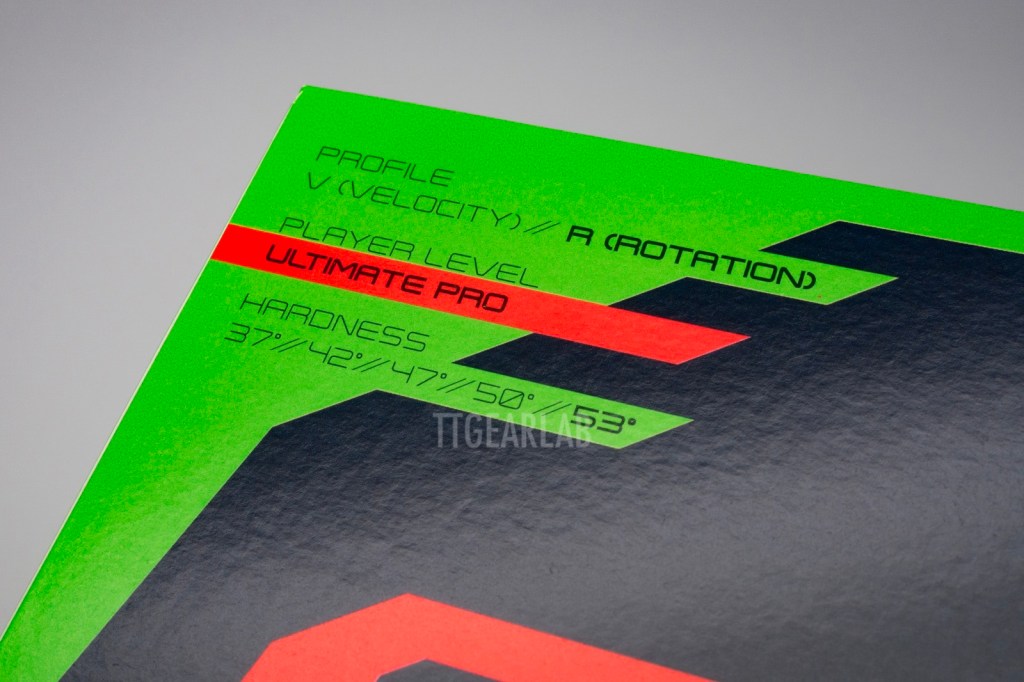
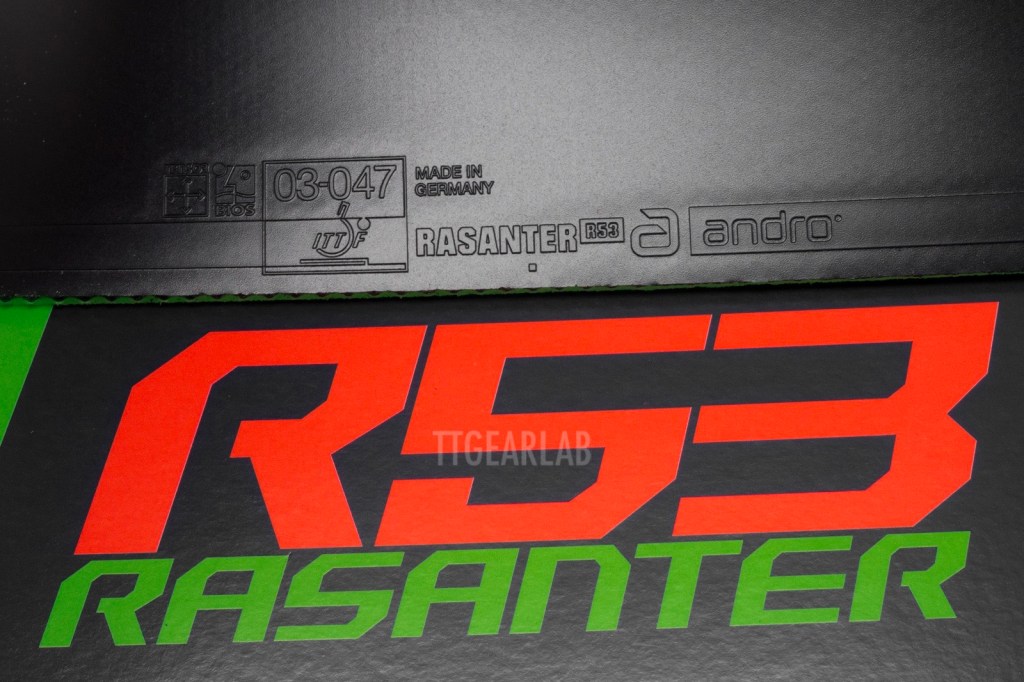
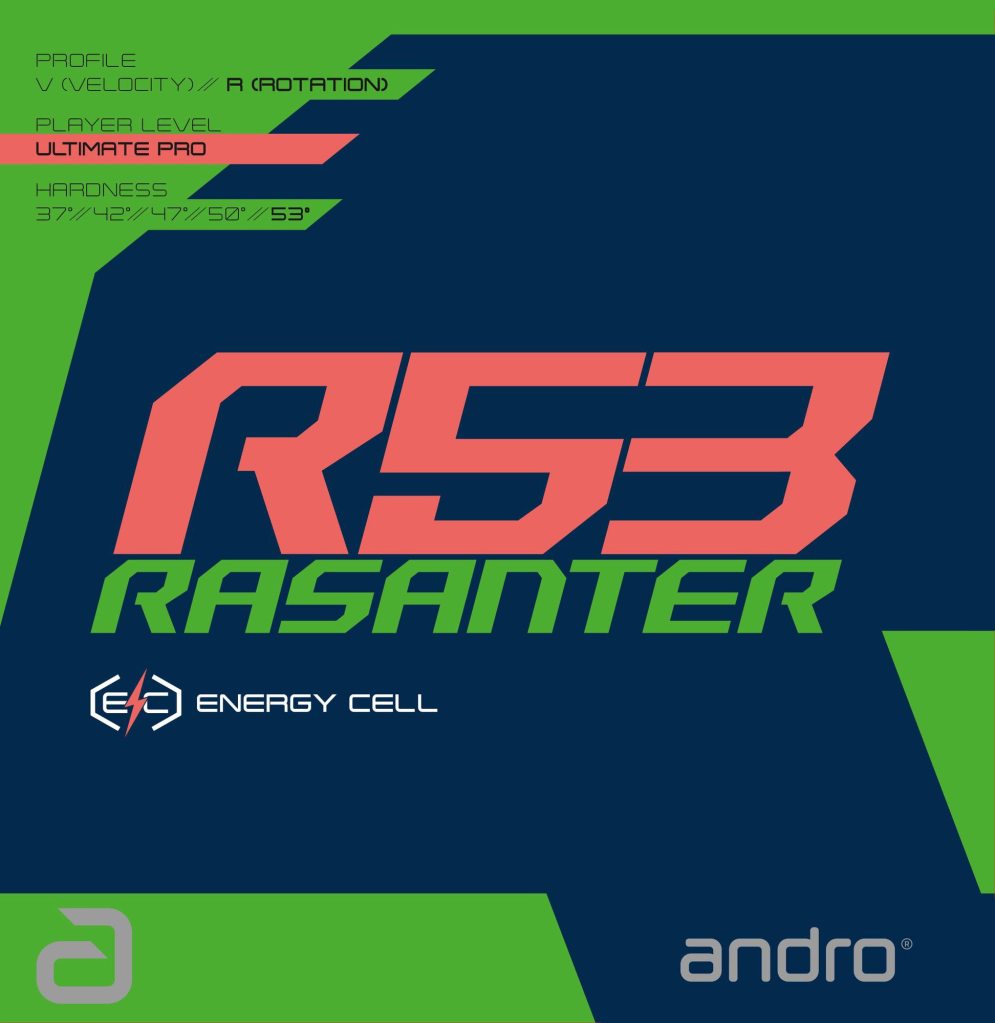
‘R’ is the initial of ‘Rotation’. When ‘Rasanter’ series was first introduces, there are two different kinds of ‘Rasanter’ series – ‘Rasanter V’ series which is focused on velocity and ‘Rasanter R’ series which is focused on rotation. The original ‘Rasanter R’ series had been released as four variations – ‘R50’, ‘R47’, ‘R42’ and ‘R37’. And, afterwards ‘R53’ which is equipped with more advanced sponge was added. So the package of ‘Rasanter R53’ shown in above picture shows five variations of ‘Rasanter R’ series including ‘R53’. (Until that time there wasn’t confusion. However, the problem is that two new variations with more advanced sponges – ‘R48’ and ‘R45’ – have been added. So currently there are seven variations – four old and three new – in ‘Rasnater R’ series. Especially the player who choose ‘Rasanter’ series for the first time will be concerned about the difference between ‘R47’ and ‘R48’.)
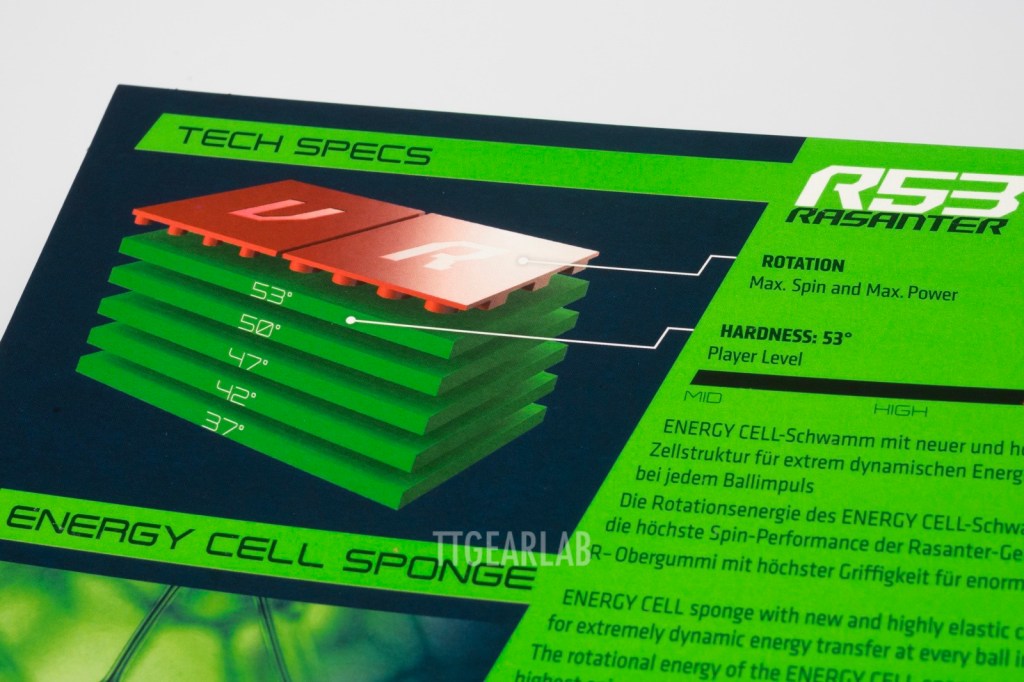
Above picture shows the back cover of the packaging of ‘Rasanter R53’. It is introducing ‘R53’ just as new harder variation of ‘Rasanter’ series. There isn’t any description that ‘Rasanter R53’ is more advanced one than the other four variations.
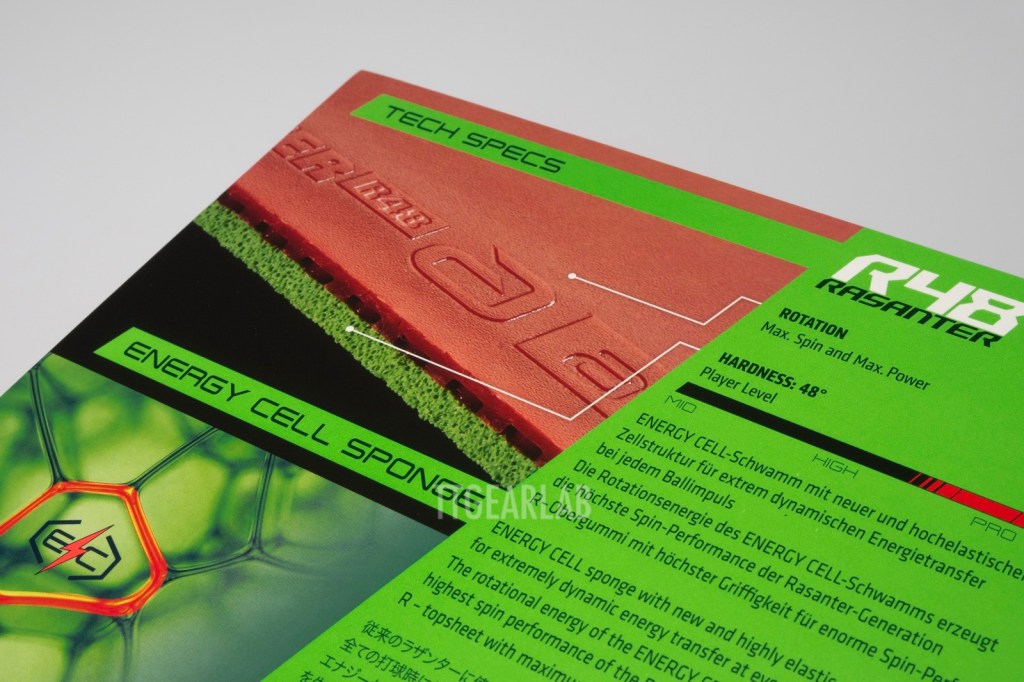
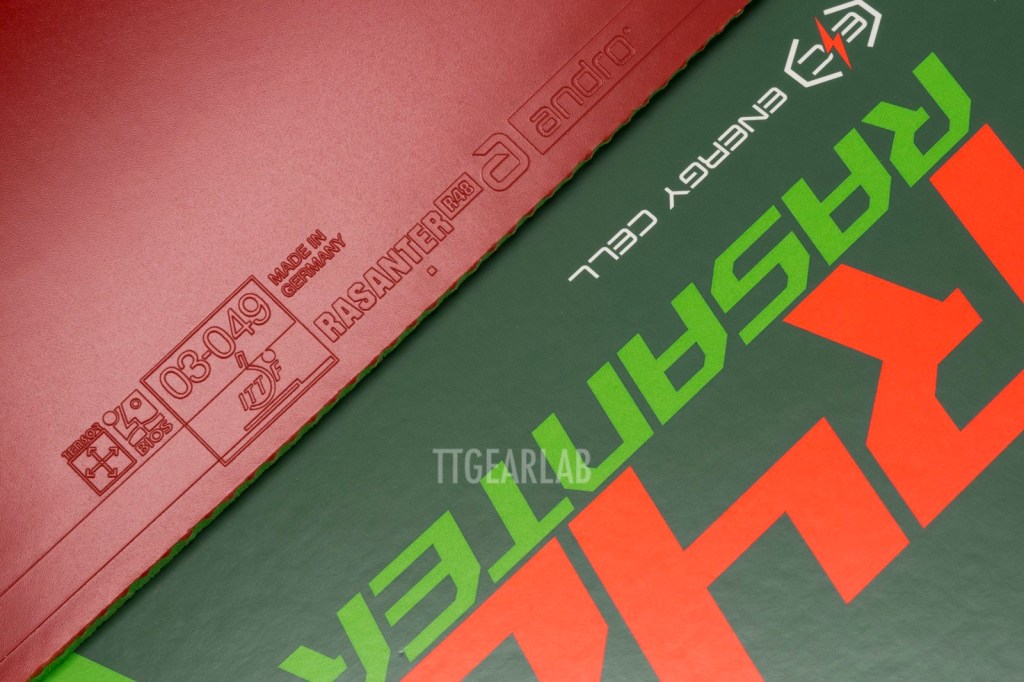
Above picture shows the back cover of the packaging of ‘Rasanter R48’. The picture including four old versions disappeared. And instead, ‘EC (Energy Cell)’ sponge is being emphasized.
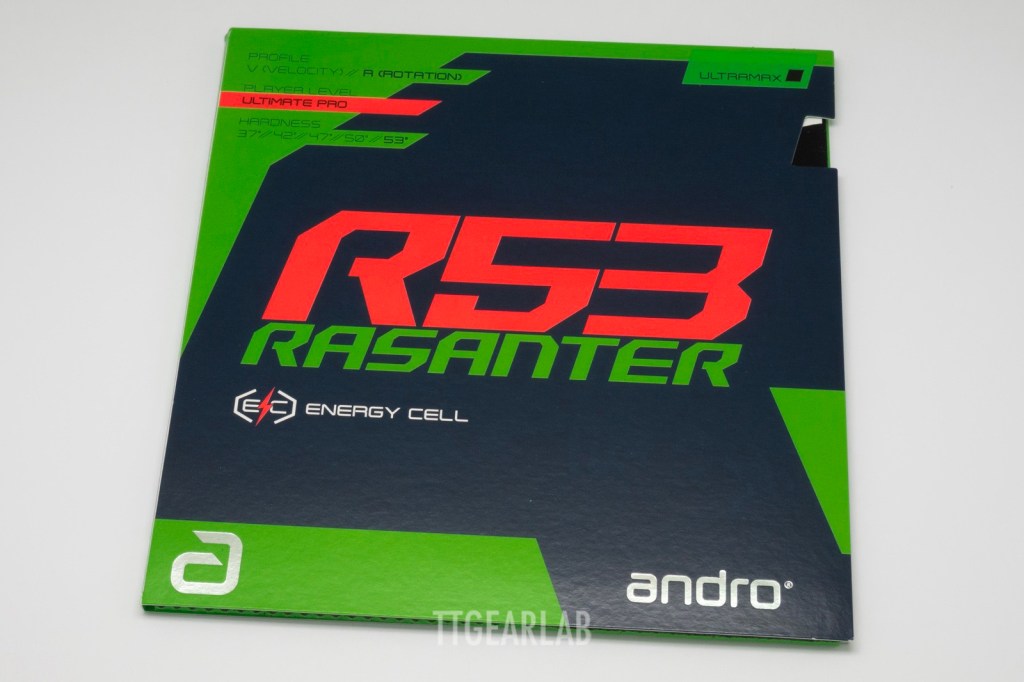
‘Rasanter R53’ is the hard sponge version of ‘New Rasanter R’ series. Because of more advanced sponge, its feeling may be softer than that of ‘Rasanter R50’ when the player hits the ball very strongly.
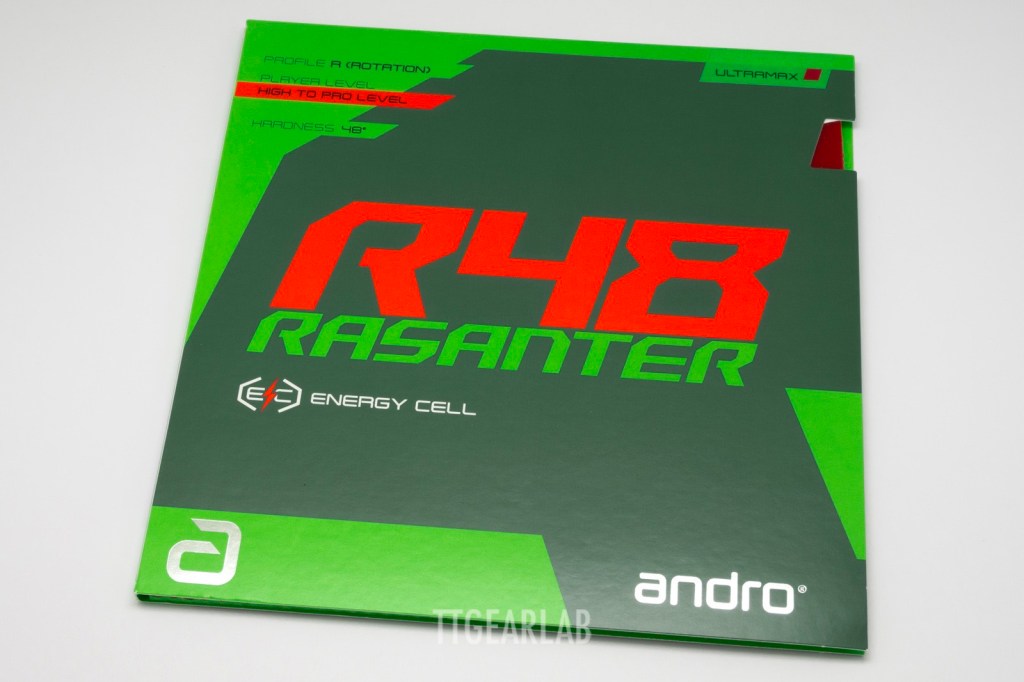
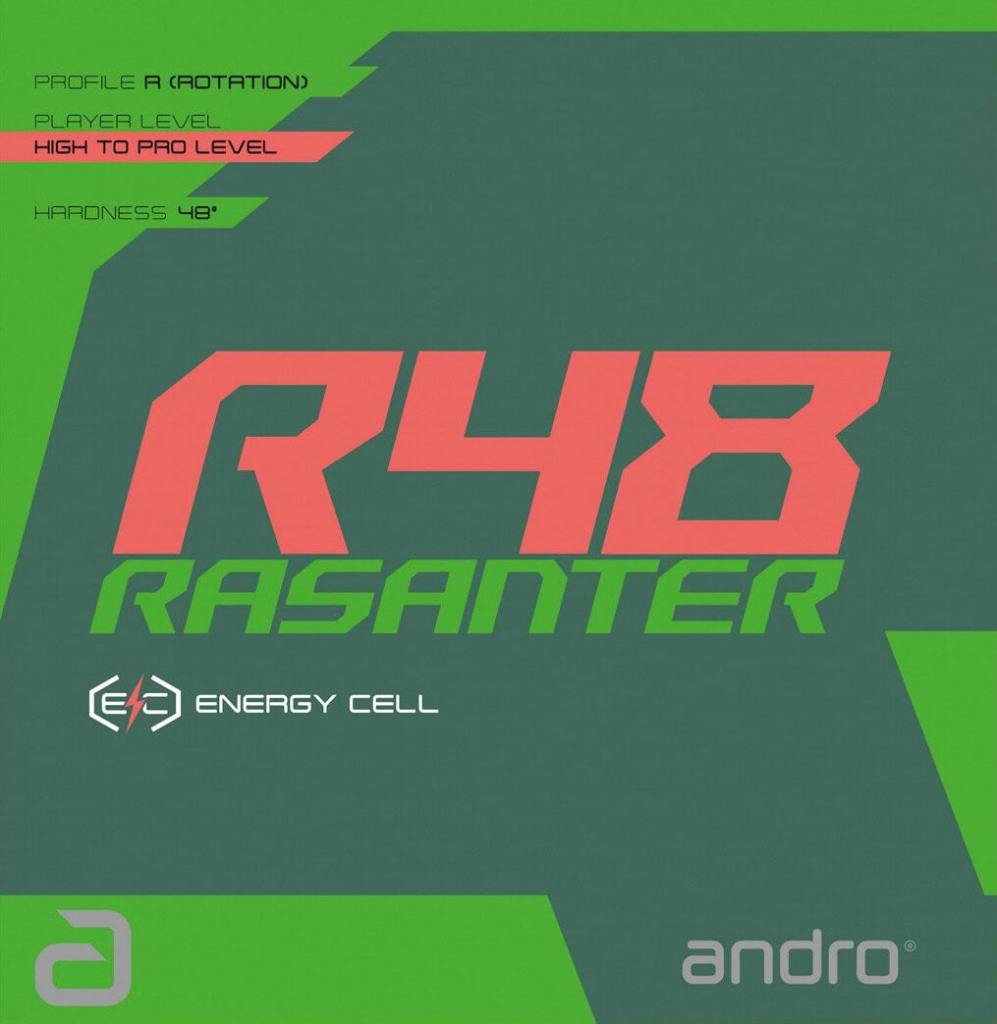
‘Rasanter R48’ is the hard sponge version of ‘New Rasanter R’ series. Because of more advanced sponge, its feeling is softer than that of ‘Rasanter R47’ when the player hits the ball very strongly.
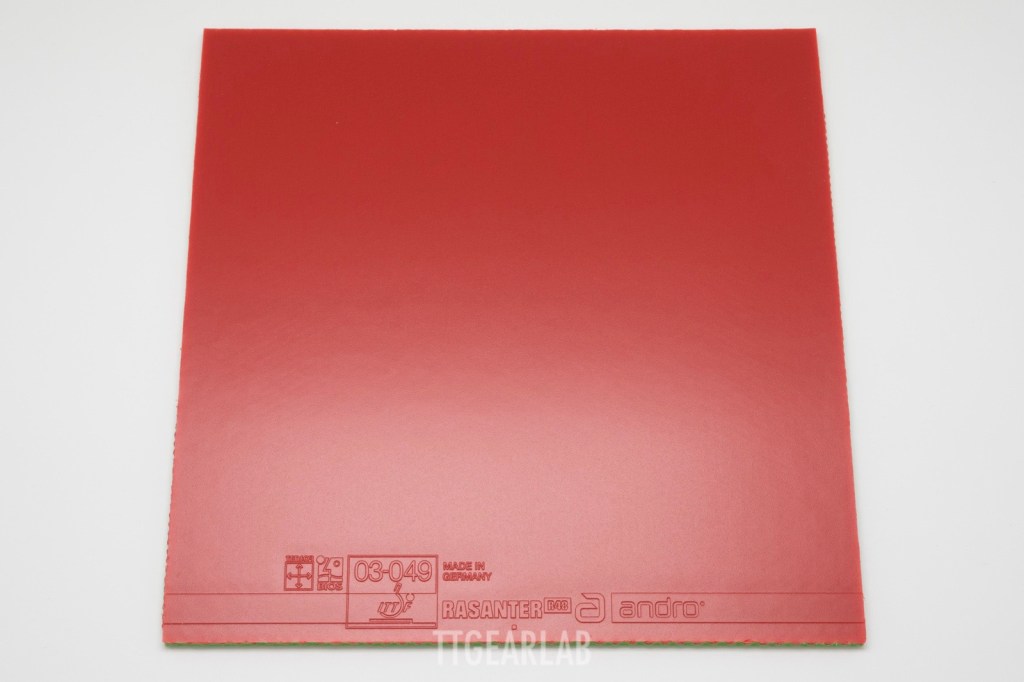
The top sheet of ‘Rasanter R’ series is not sticky. But it grips the ball very strongly.
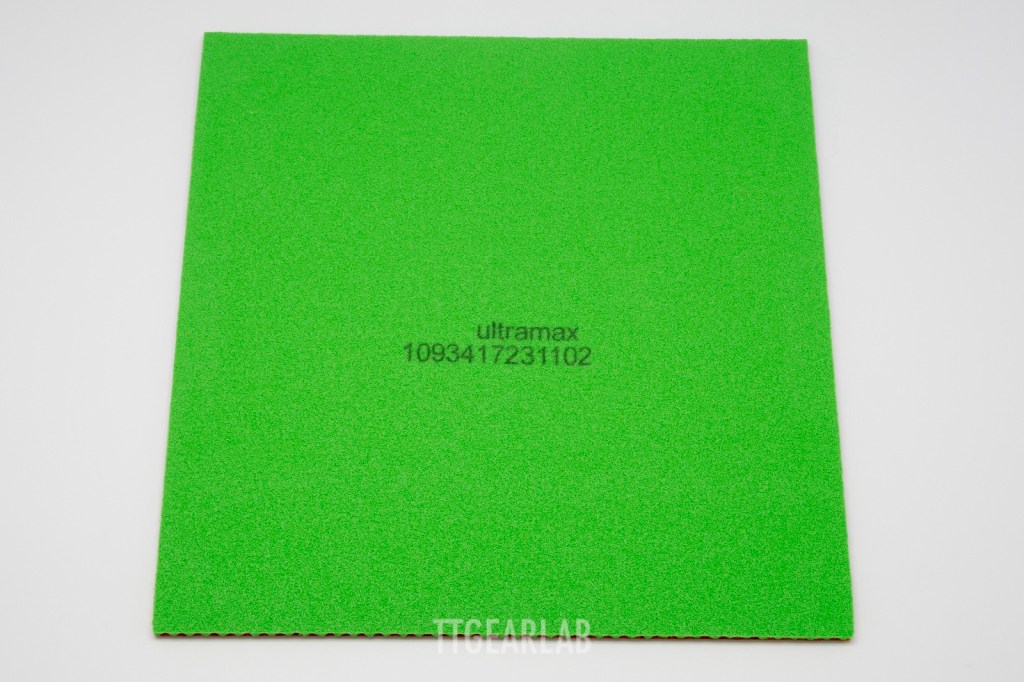
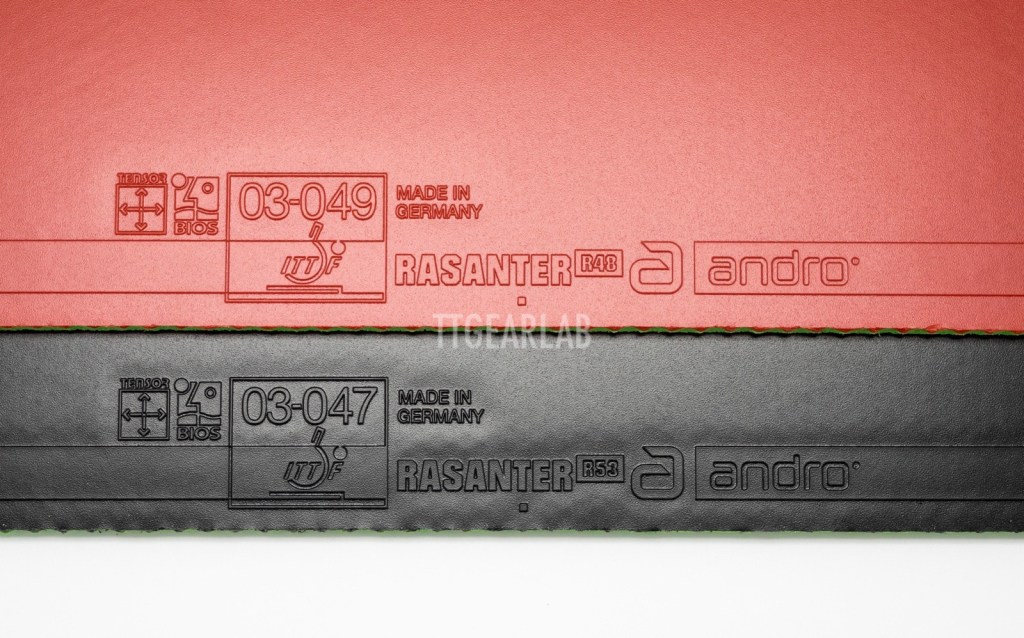
The very distinctive green sponge is a tradition from the ‘Rasant’ series that was released before ‘Rasanter’. andro has been pushing this ‘green’ strongly ever since it was chosen as andro’s representative color. The pores of sponge are so large that they are noticeable even in this photo. Sponge densities are 53° and 48° in German standard.
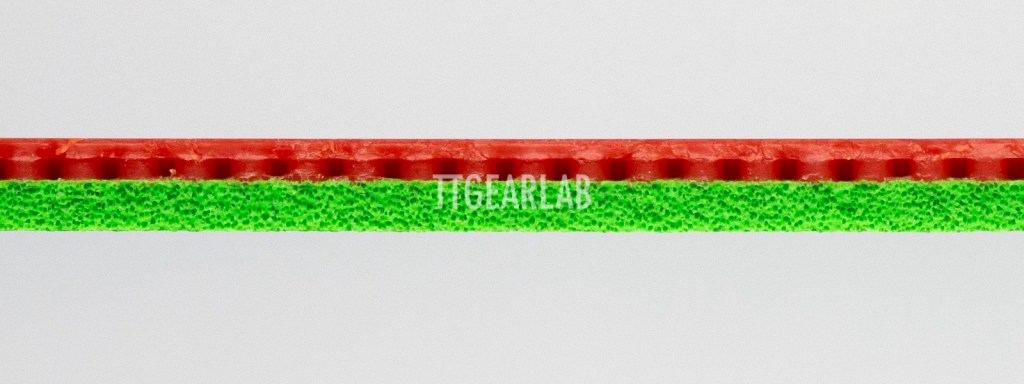
The pimple geometry is similar to that of ‘Tenergy 05’. The cylindrical pimples are arranged densely. This type of pimple geometry provides high ability of generating rotation. But, we can observe that the base of the top sheet is thinner than the height of pimple. Because the base of top sheet is thinner than that of ordinary rubbers, the sponge can be thicker. That is one of the most important features of ‘Rasanter’ series, and andro is calling the sponge which can be thicker than the maximum possible thickness of ordinary sponge as ULTRAMAX sponge.
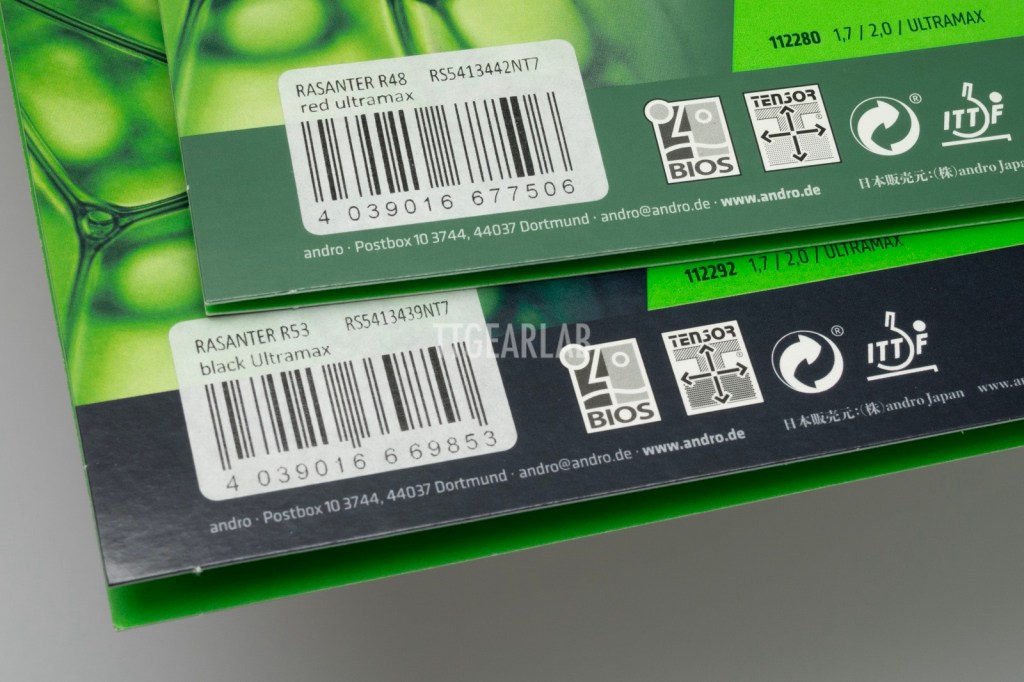
‘TENSOR BIOS’ mark is still being used. But current ‘TENSOR BIOS’ rubbers are totally different from the ‘TENSOR BIOS’ rubber until 2008 – for example ‘Roxon’.
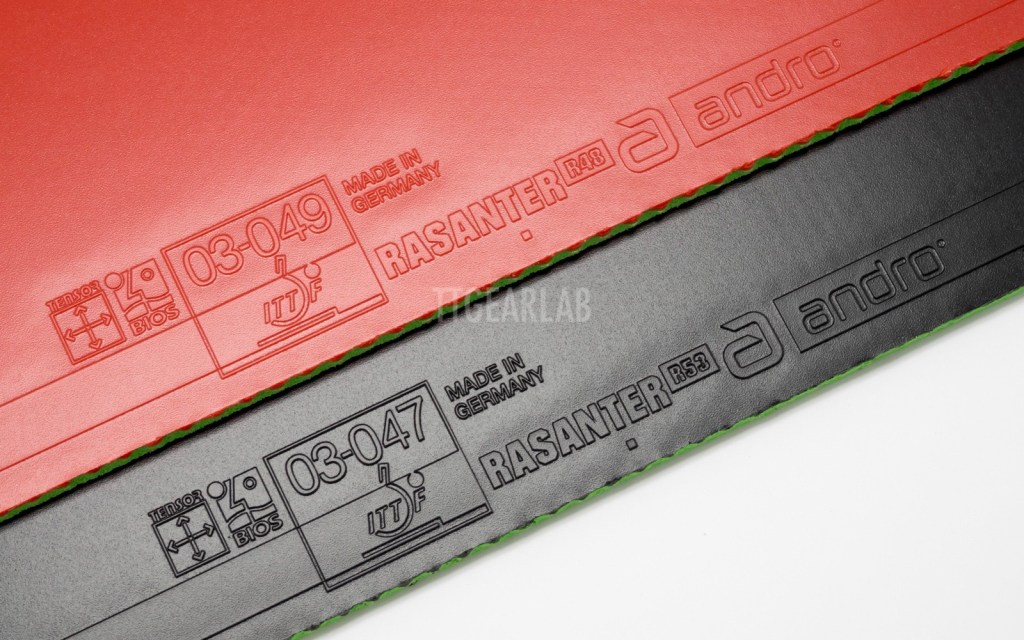
Three color variations – Red, Black and Green – are avaialbe for tho sheet. (Green isn’t shown in above picture.)
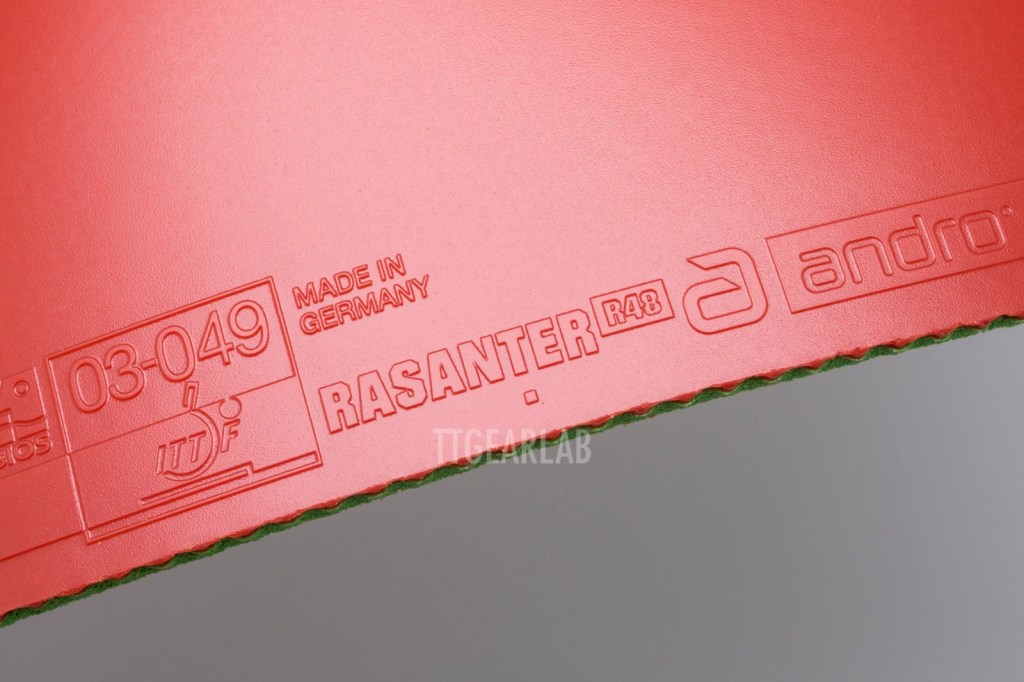
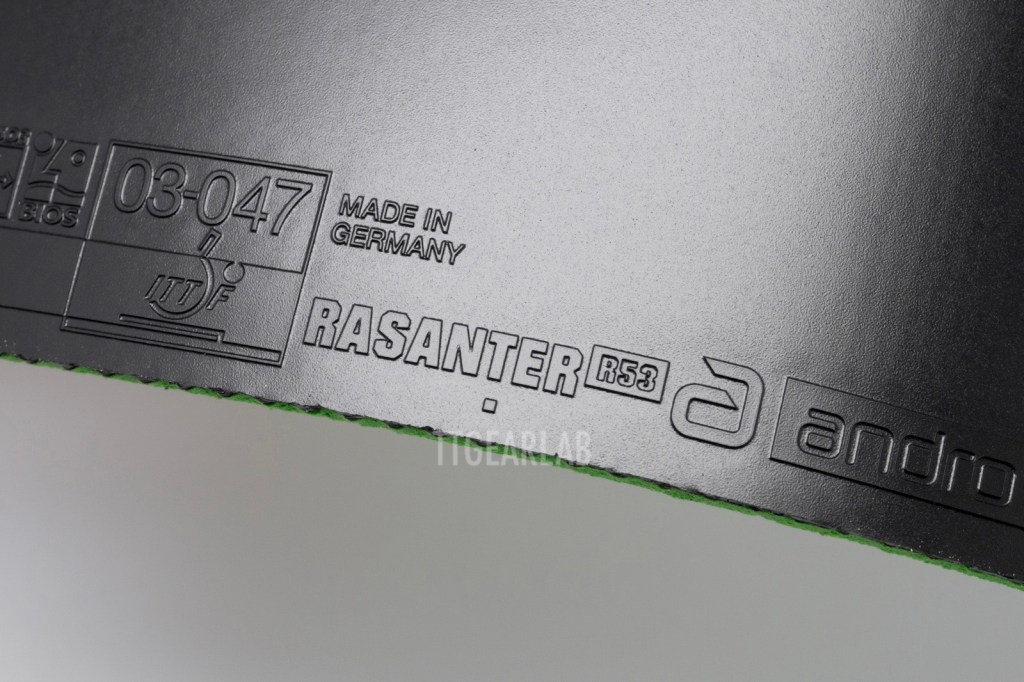
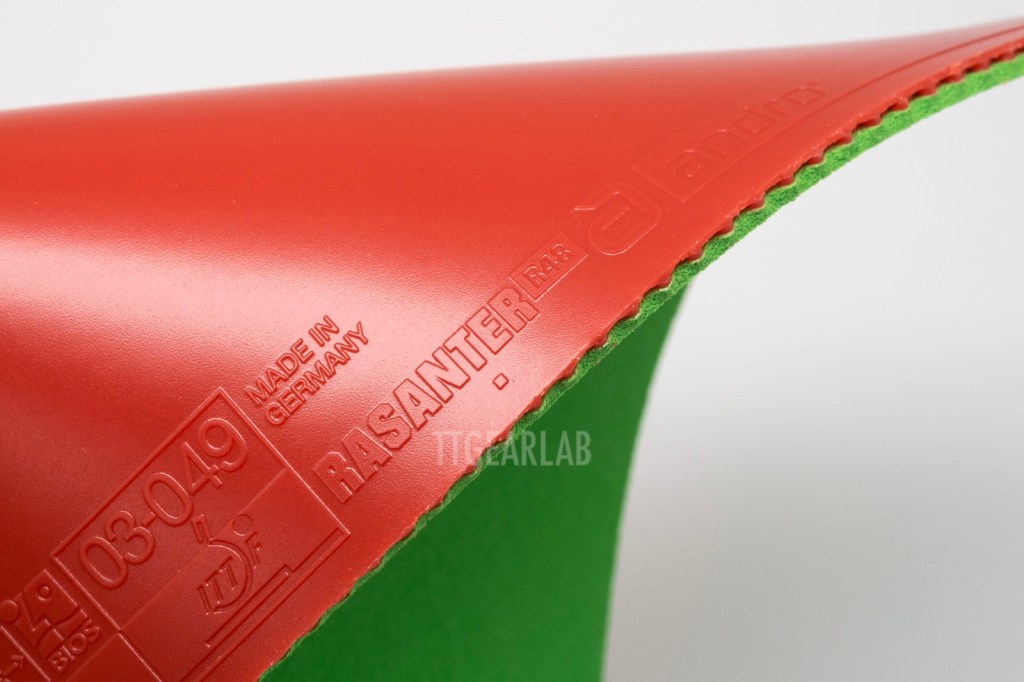
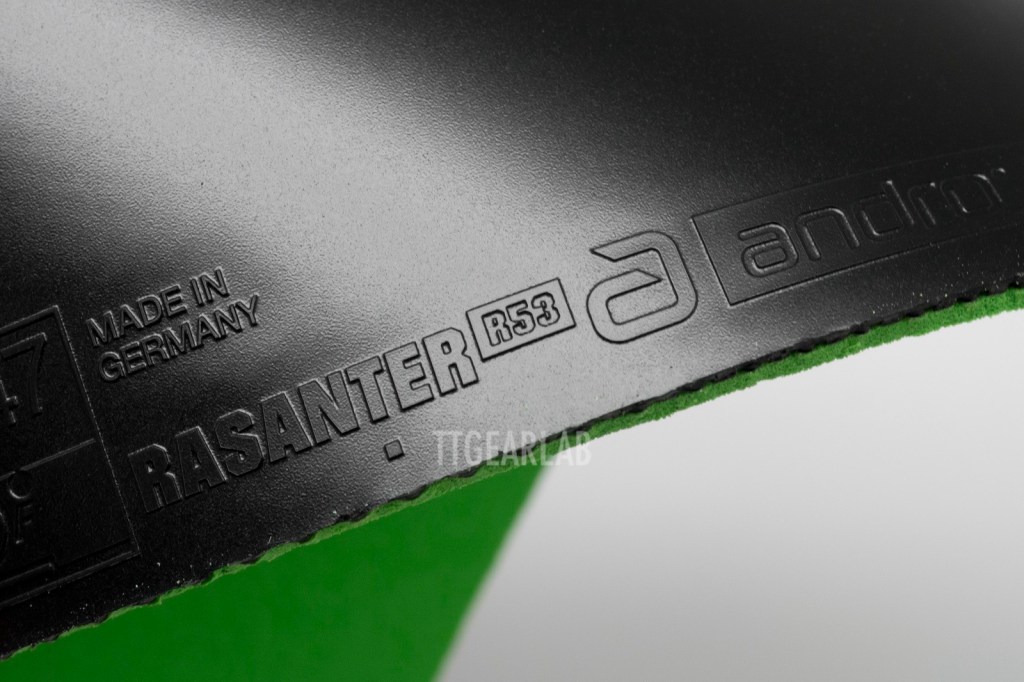
TTGearLab will use andro ‘Rasanter R53’ and ‘Rasanter R48’ for the field testing of various blades.
You can buy andro Rasanter R53 & Rasanter R48 at megaspin.net. If you buy the products through following links, a part of profit is shared by TTGearLab. So it becomes a donation to TTGearLab.
Unauthorized use and/or duplication of this material without express and written permission from this website’s author and/or owner is strictly prohibited. Excerpts and links may be used, provided that full and clear credit is given to TTGearLab with appropriate and specific direction to the original content.
 TTGearLab
What are the blade options those will be good to go with R53 & R48 or C48 for players Ranking in top 500 in England. Style of play aggressive Forehand topspin, Backhand topspin, Backhand Block & Jab, Forehand counter topspin? Could you please suggest.
LikeLike
In fact there isn’t any ‘right’ or ‘standard’ solution because the optimum combination differs by the preference of each player. But, if the player is a very skilled player (in ranking 500) and play with aggressive forehand topspin/counter topspin and backhand block, I recommend Synteliac VCO OFF. That is the blade for that kind of players. C48 and R48 may be proper for forehand side or backhand side. Or just using R48 for both sides will be also good in my opinion.
LikeLike
Bonjour, pourriez vous m’indiquer entre les revêtements suivants lequel dispose du plus haut potentiel de rotation ? Rasanter R48, Fastarc G1 ou Razka 7 (ou Z), en connaissez vous de meilleurs encore (Xiom) ?
J’exclue Tenergy 05 car son effet catapulte extrême me gêne et les Tibhar car ils sont peu durables
J’exclue également les collants chinois car je cherche une forte accroche mais peu collant
Merci pour votre retour
Jean François
LikeLike
I think that Razanter R48 will be your choice. But, in fact there isn’t much difference in potential itself. In most cases the difference of top class rubbers is only in the initial response. And, if the impact strength is high, the difference almost disappears.
One problem of Razanter R48 is that its catapult effect will not be smaller than that of Tenergy 05. But, you may be able to adjust by selecting the blade with high Ec/Ep. Or you will be able to select the rubber with harder sponge. For example Rasanter R53.
BTW the durability of Tibhar rubber isn’t worse than that of the rubbers from other companies. There are some Tibhar rubbers with bad durability, and at the same time there are other Tibhar rubbers with good durability. For example, the durability of Hybrid MK or Hybrid MK Pro will not be bad.
Which Tibhar rubber have you tried?
LikeLike
i have not tried tibhar recently, i only know old one but i often read bad things about durability of some of them. it seems that to get stong effect capability without strong catapult, it might be good to try chinese rubbers such as H3 neo. A lot of people say that it has to be boosted but i do not want to do that. Do you believe that H3 is a good idea ? is H3 Neo commercial (cheapest one) ok after beeing played a couple of hours without boost ? i want to get strong spin but small catapult in order to find the right actions on ball. With Tenergy, it was like my blade played for me, it was possible to loop only with forearm
LikeLike
If you don’t stick to big catapult effect and require the good capability of rotation, Chinese sticky rubber such as Hurricane 3 Neo may be good choice. Further it is the rubber you have to hit the ball by your own force. Anyway it is worth trying at least once, although I don’t know whether H3 Neo will be good for you or not. By the way, H3 Neo is boosted in factory. That is the reason why it is tightly sealed, while normal H3 is not sealed.
Regarding Tibhar rubber, most of Tibhar rubbers produced in the same factory with the same technology as most of Andro, Donic, Joola, Yasaka and Xiom. So basically the durability of Tibhar rubber is not much different from the same generation rubbers of other companies. If there are differences in the kind or the generation, there are differences in durability. So, probably the people who tells bad things on the durability Tibhar rubbers are comparing the rubbers of different generations. (In general they don’t know the generation or the type of rubber.)
Most of companies had already stopped selling very old generation rubbers. But, Tibhar is still selling the models of quite old times whose durability is bad. That may be one reason of the bad reputation on durability.
LikeLike