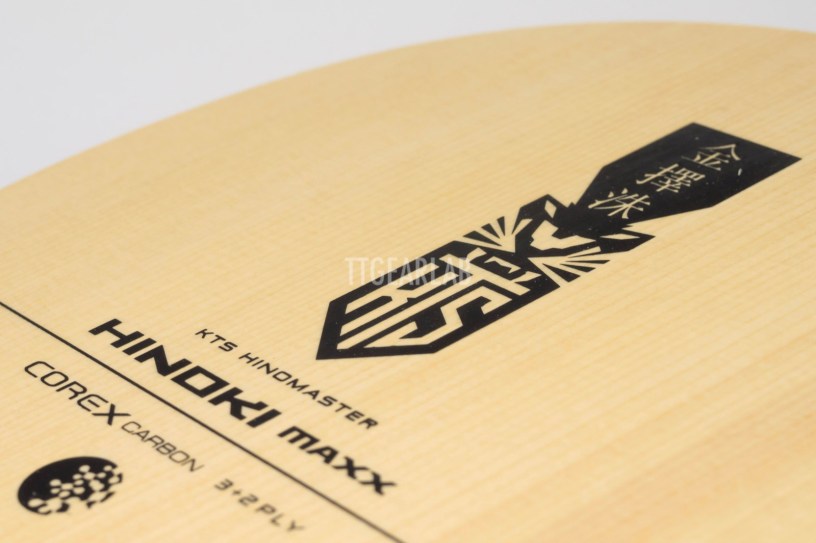
KTS (Kim Taek Soo) is the table tennis brand managed by T-Mount which is a Korean company. The fastest model in KTS blade range is ‘Hinoki MAXX’ which is a thick 3+2 ply Carbon blade whose top layer is Hinoki. KTS is explaining that ‘Hinoki MAXX’ provides high power even in case the player plays at mid or far distance area thanks to its very high elasticity but nevertheless it is very easy to use. ‘Hinoki MAXX’ enables the player whose physical power is not sufficient to perform powerful shot. And that has made ‘Hinoki MAXX’ one of the best sellers of KTS. (Another best seller of KTS is ‘Core ALC’ which is an inner ALC blade.)
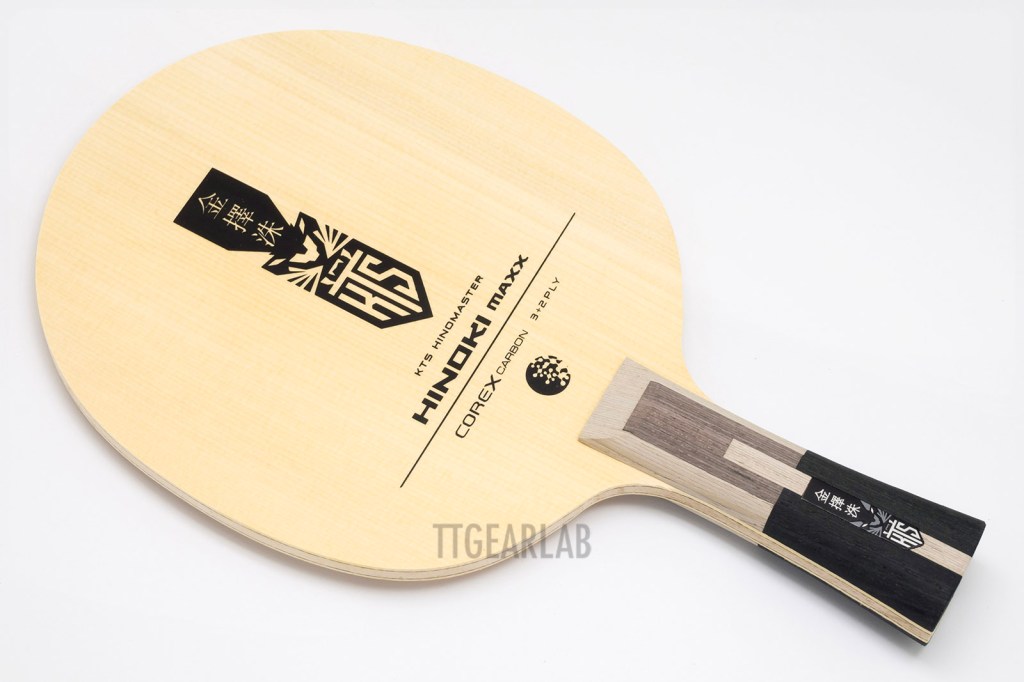
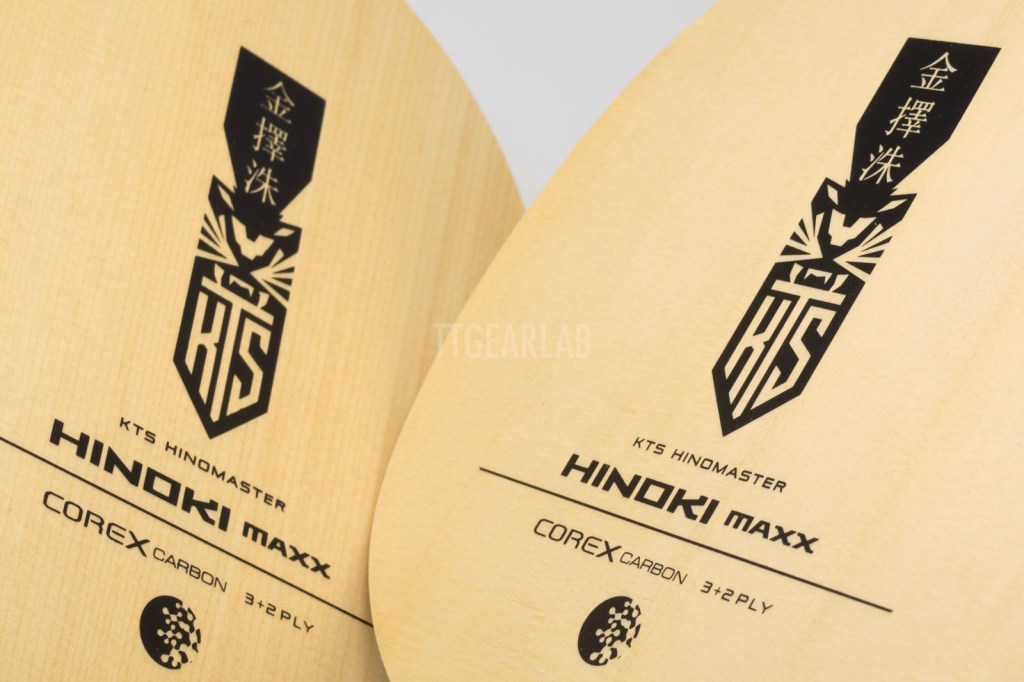
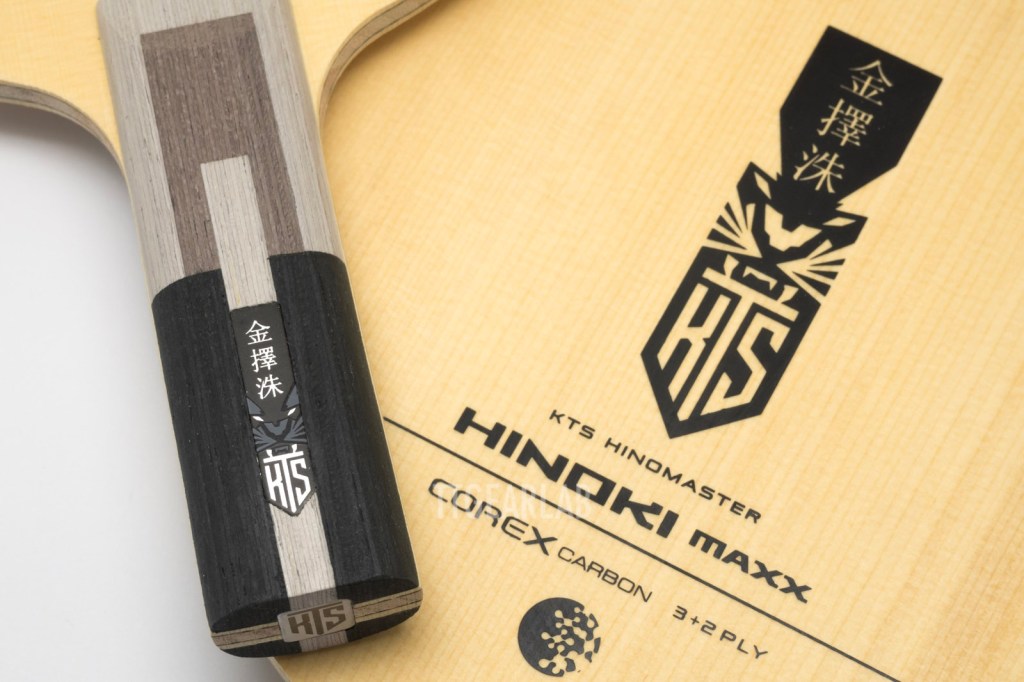
Like ‘Core ALC’, ‘Hinoki MAXX’ is one blades those represent the blade range of KTS. Because it is one of high class products in KTS blade range, ‘Tiger Face’ graphic is applied in the graphics of its head and handle.
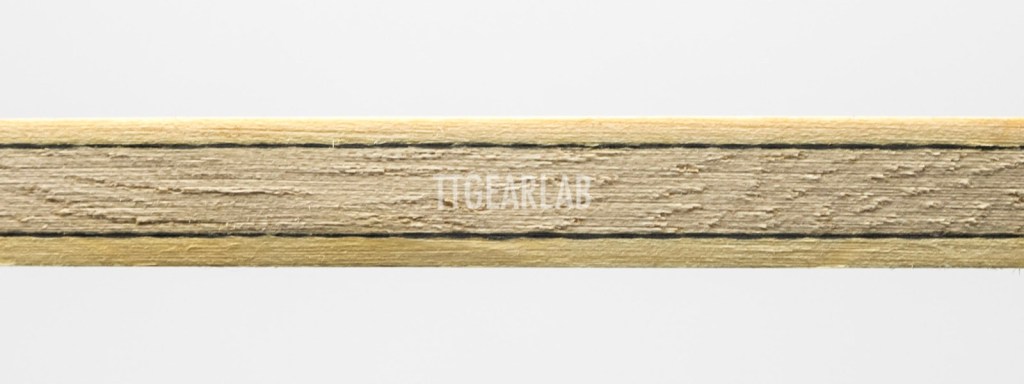
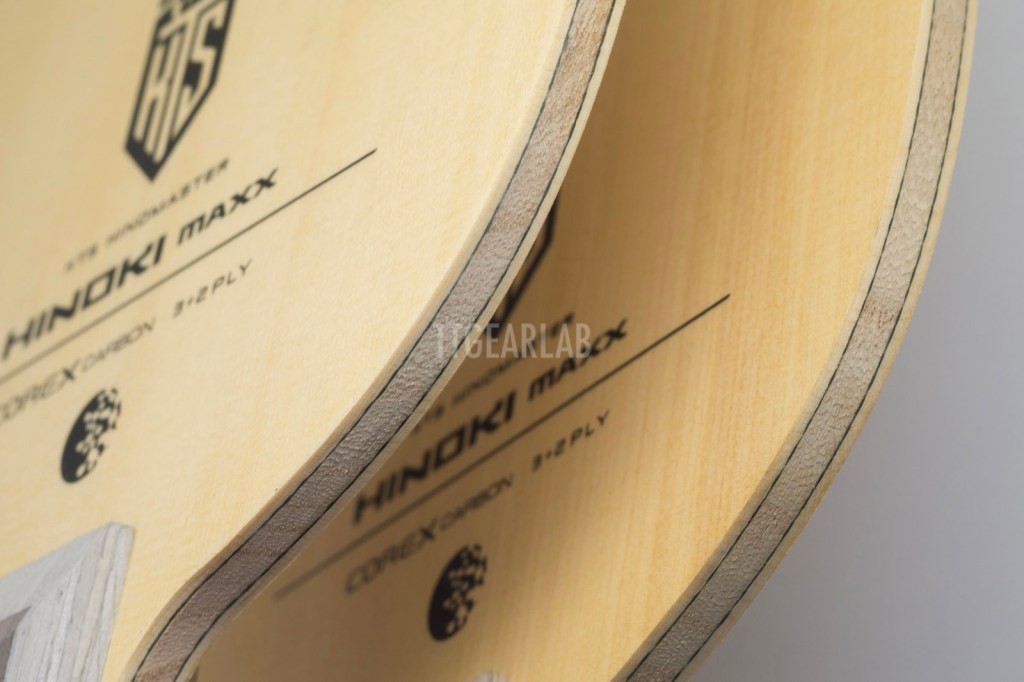
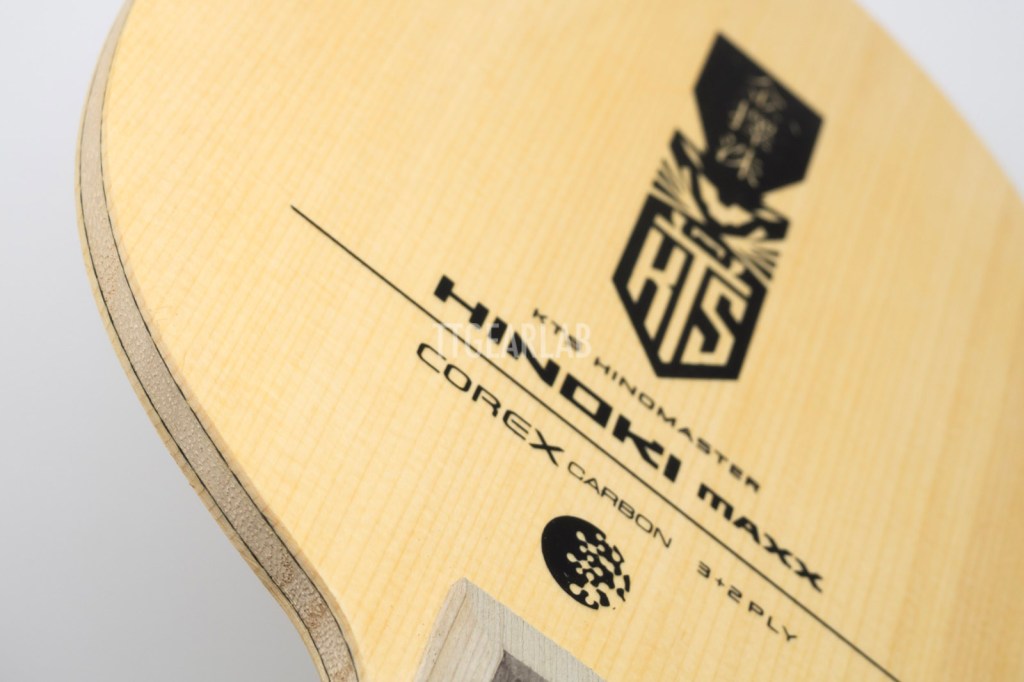
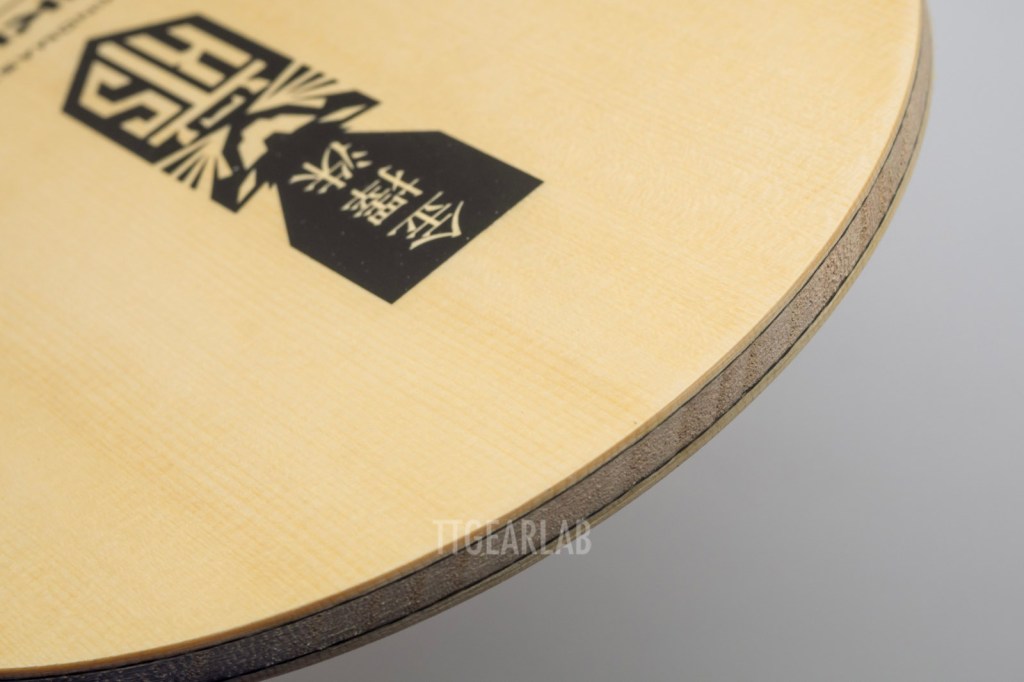
‘Hinoki MAXX’ is a fiber blade with thick 3+2 ply construction. The top layer is Hinoki, and the center layer is Kiri. Its artificial fiber which is inserted between the top layer and the center layer is woven 3K Carbon fiber. (KTS is calling this Carbon fiber as ‘Core X Carbon’ like Butterfly is calling its Carbon fiber as ‘Tamca 5000’.) Overall thickness is around 7.0mm.
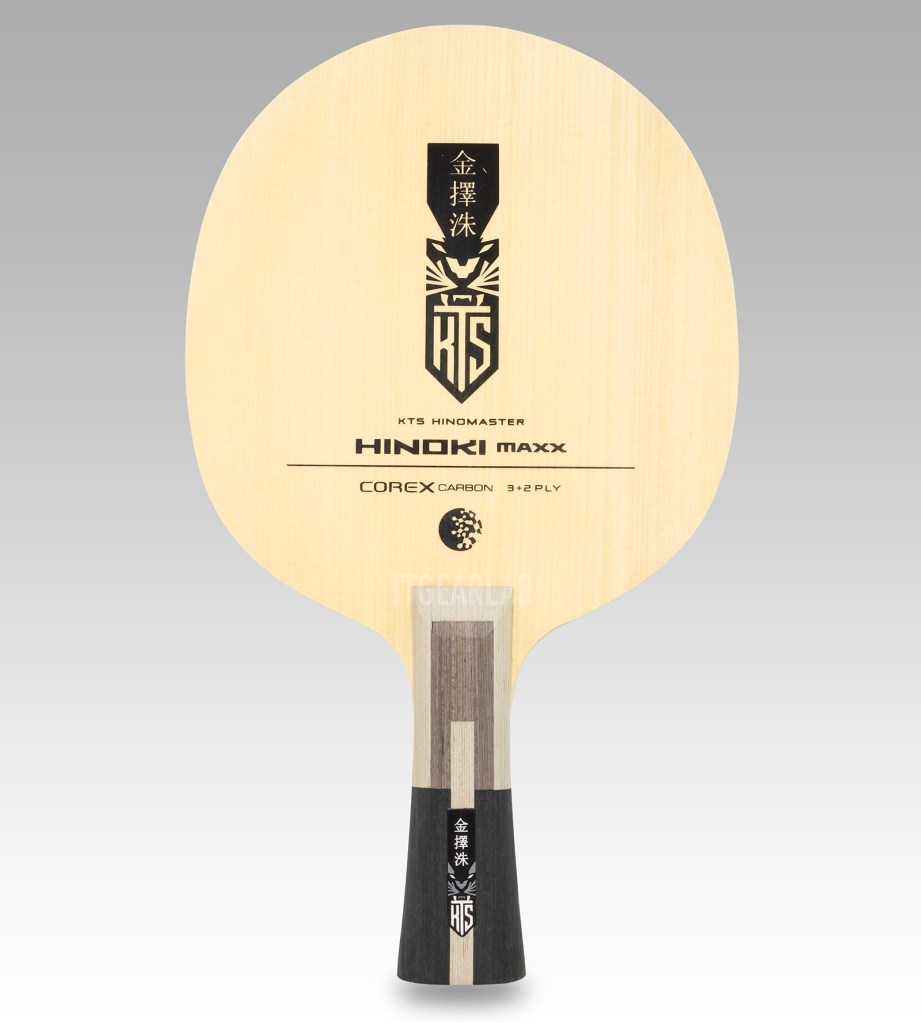
The size of head is around 157mm x 150mm.
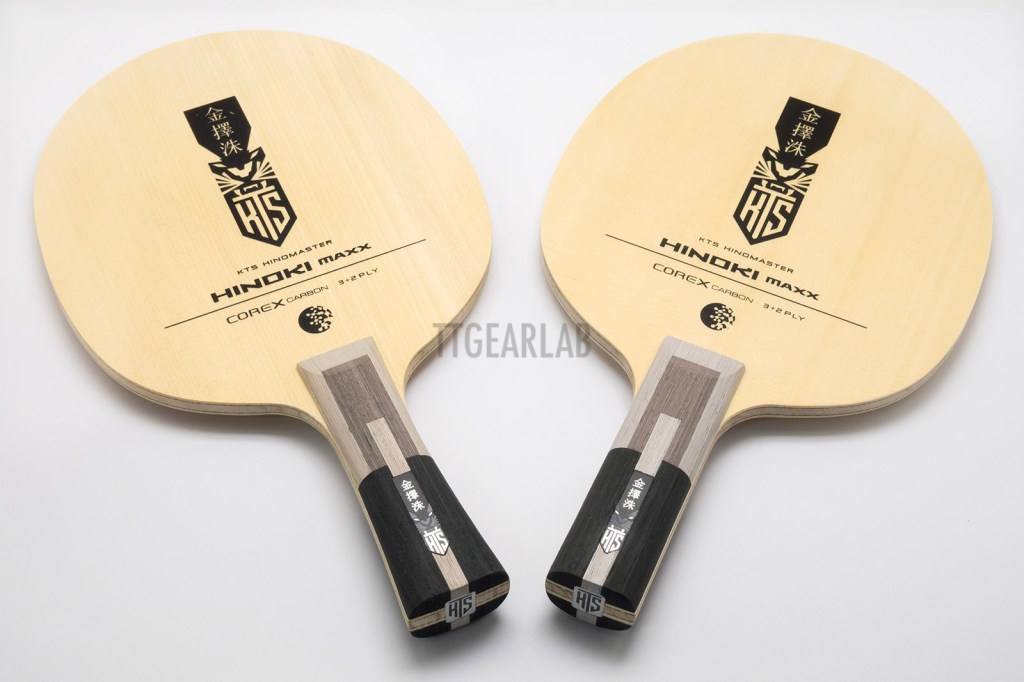
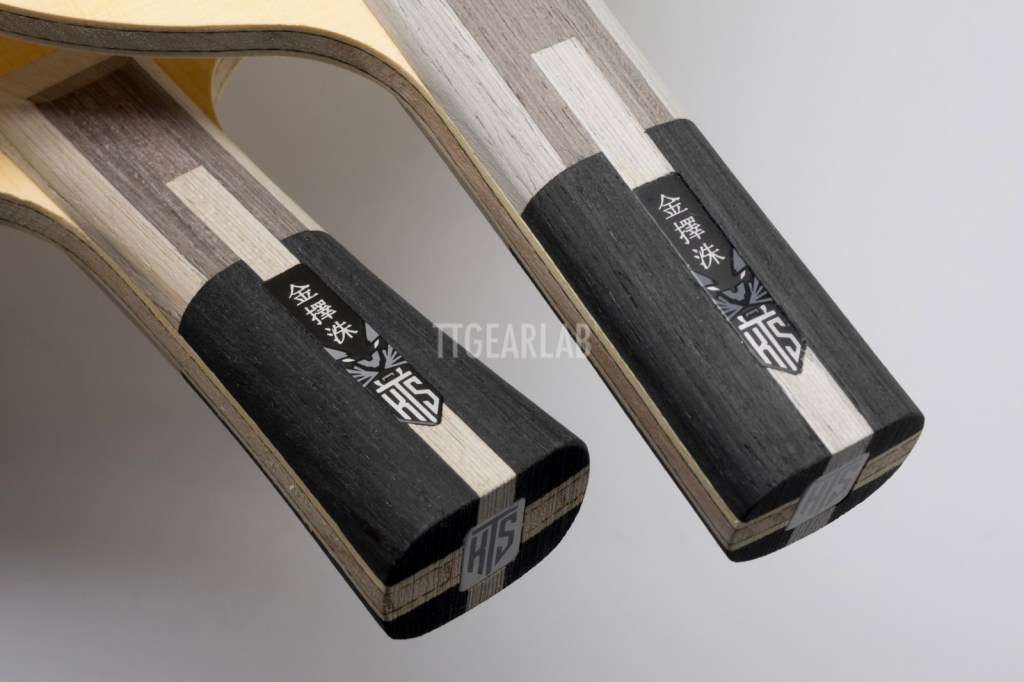
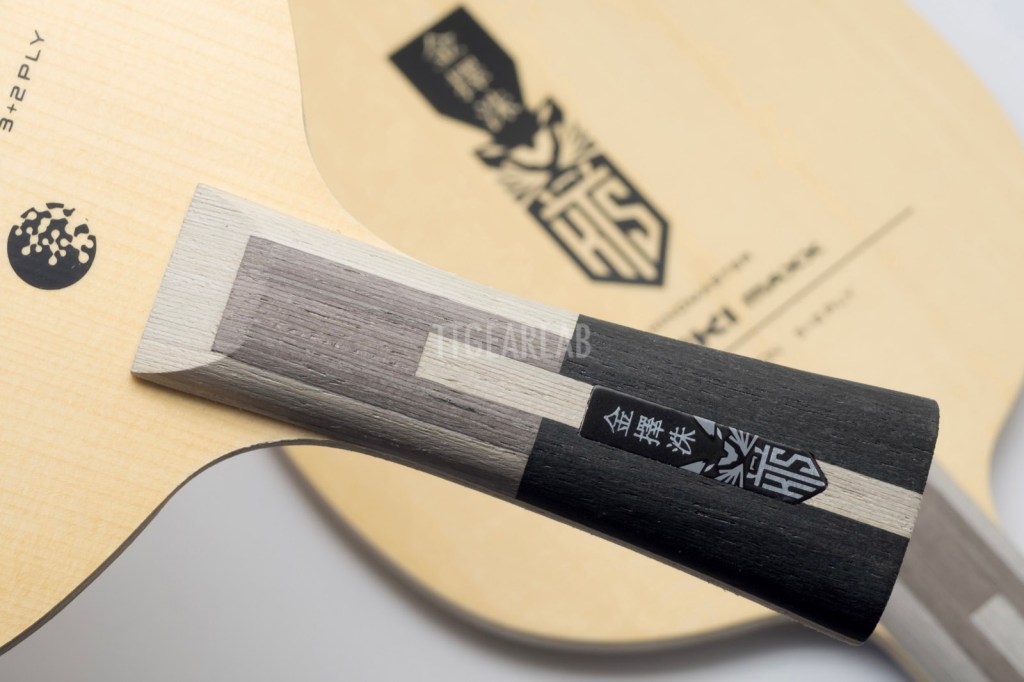
Left is FL (flared) handle version, and right is ST (straight) handle version. One of the biggest features of KTS blades is the shape of the handle.
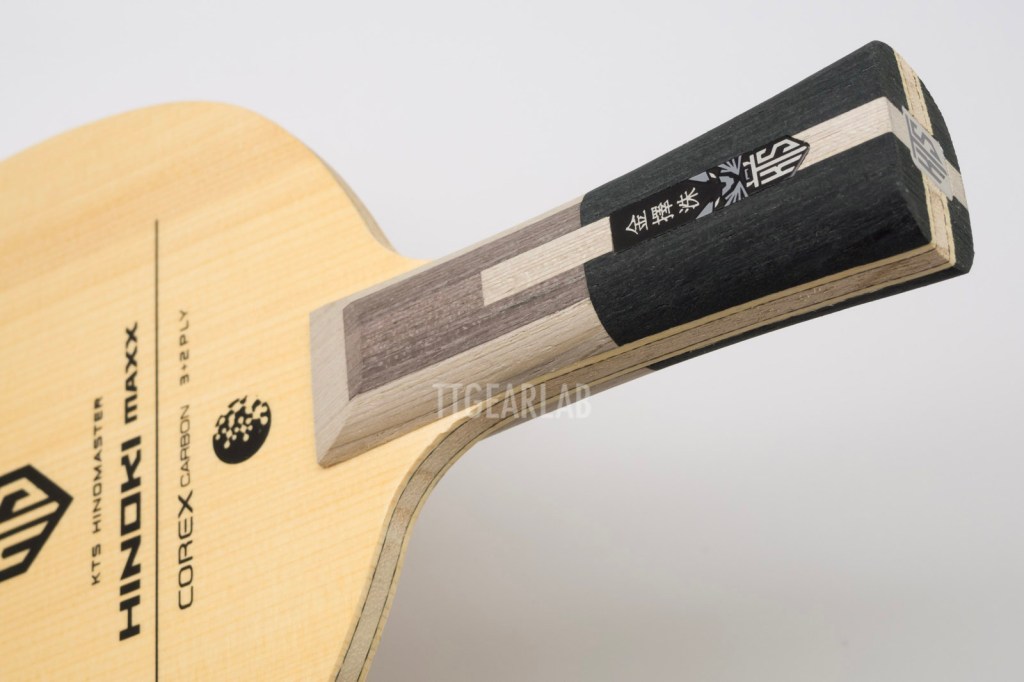
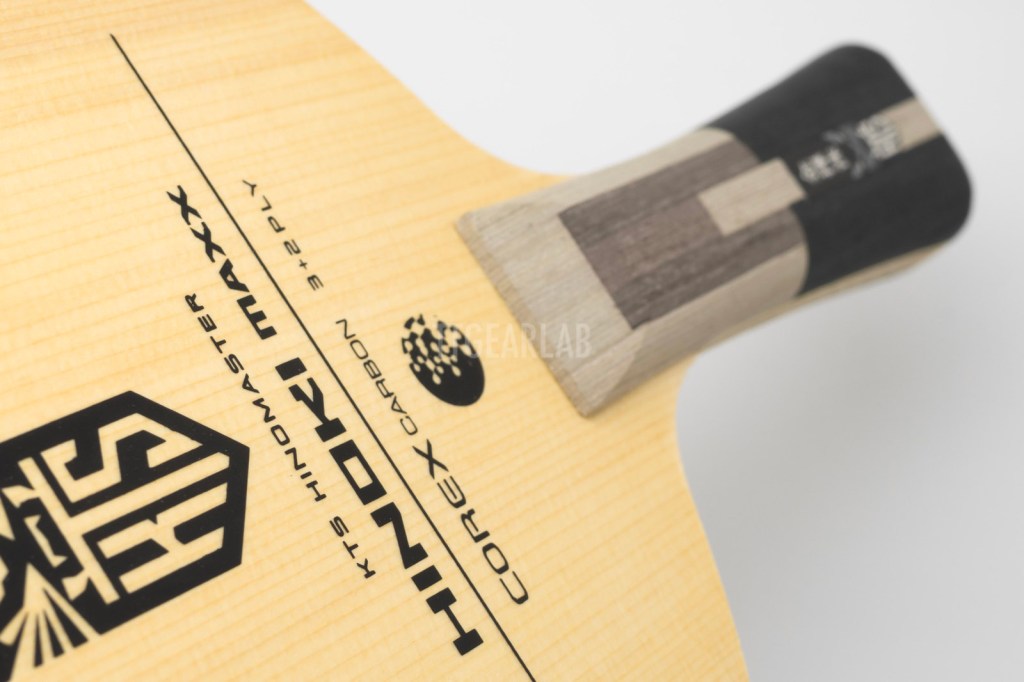
This FL handle is completely flat on the top and bottom, and doesn’t has bulged section between the root section and the narrowest section. The width of FL handle is around 25.4mm at the narrowest section, and around 34mm at the end. The thickness of handle is around 23mm at thumb, and around 24mm at the end. The unique FL handle whose top and bottom are completely flat reminds us the handle of old Butterfly blades such as ‘Gergely’ or ‘Primorac Carbon’, although the FL handle of ‘Hinoki MAXX’ is rounded at the edge differently from that of ‘Gergely’.
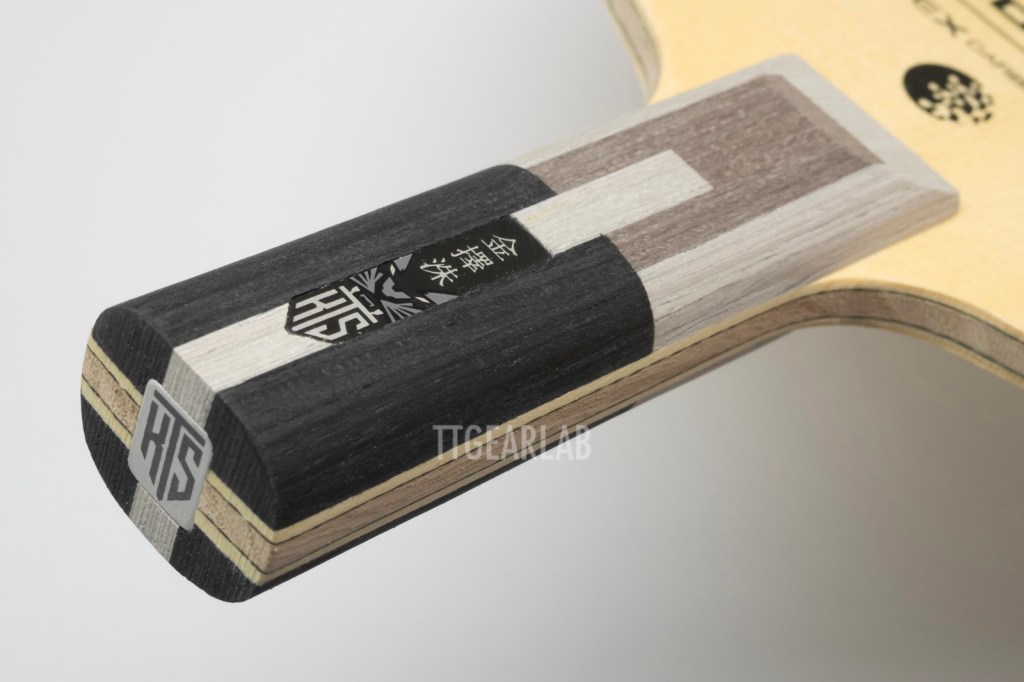
The ST handle is also somewhat squared and is almost flat on the top and bottom. Its width is around 28mm, and its thickness is around 23.4mm.
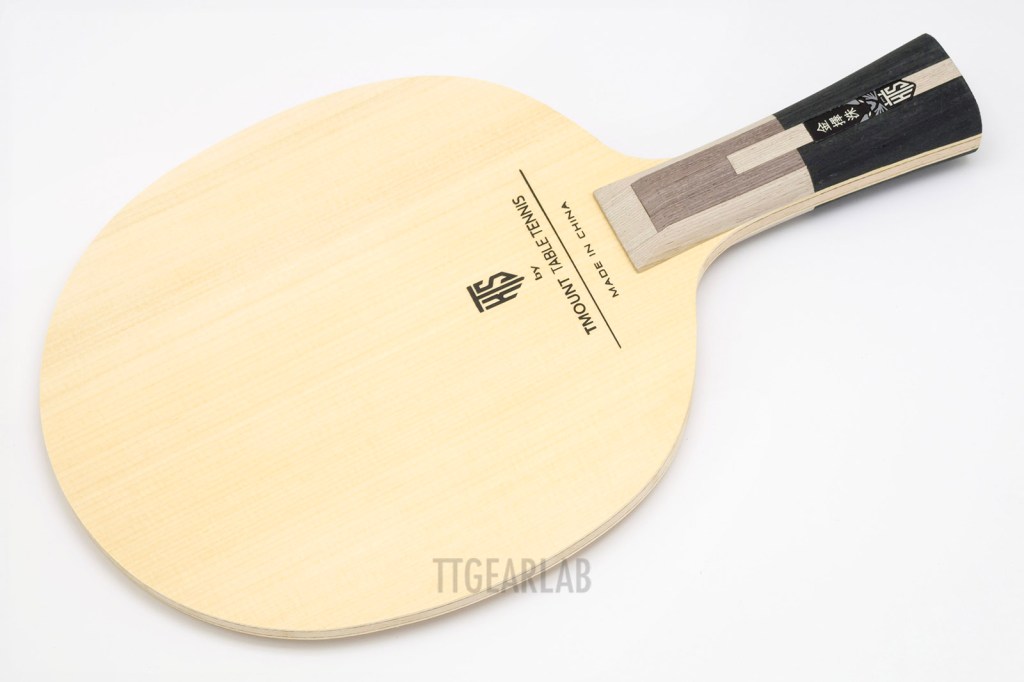
The information on brand and company is printed on the backside of head.
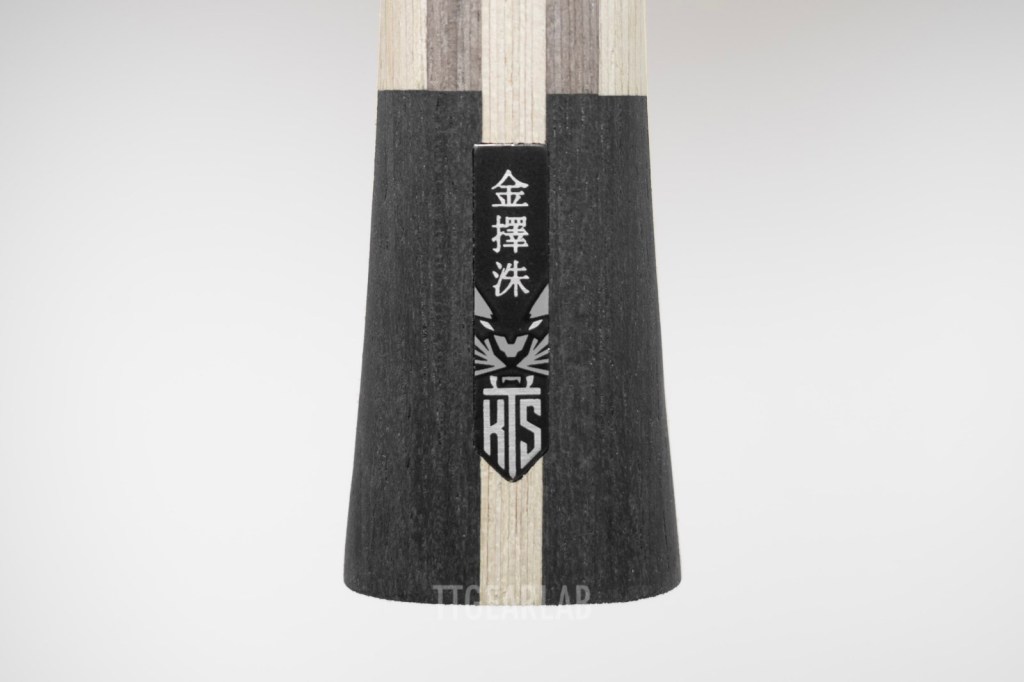
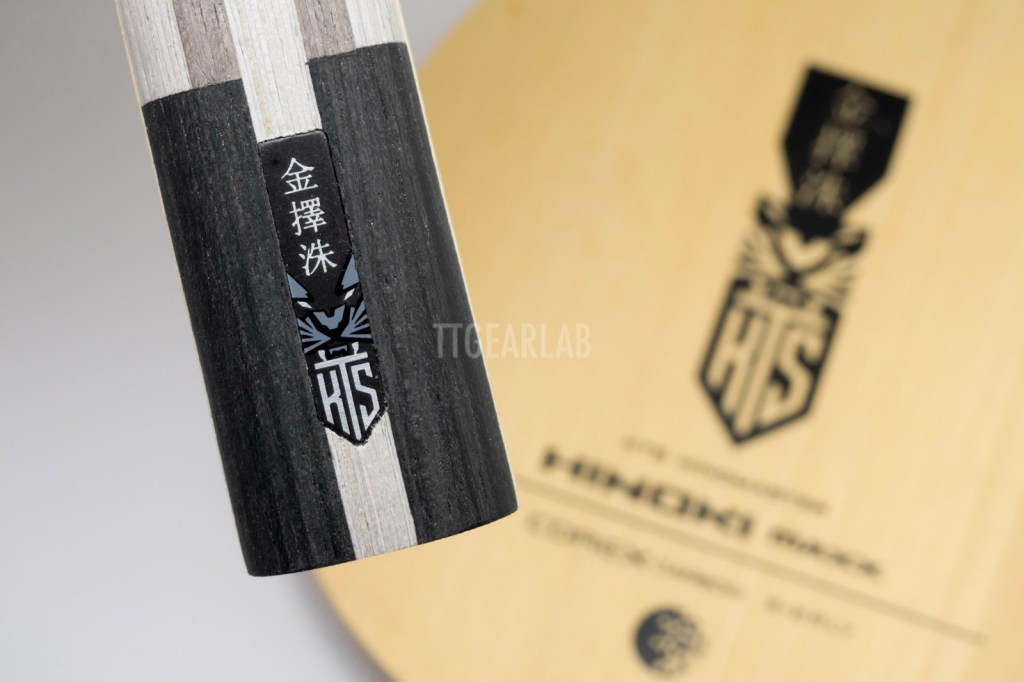
Same aluminum name plate is applied for both sides of handle. It includes KTS logo and ‘Tiber Face’ graphic.
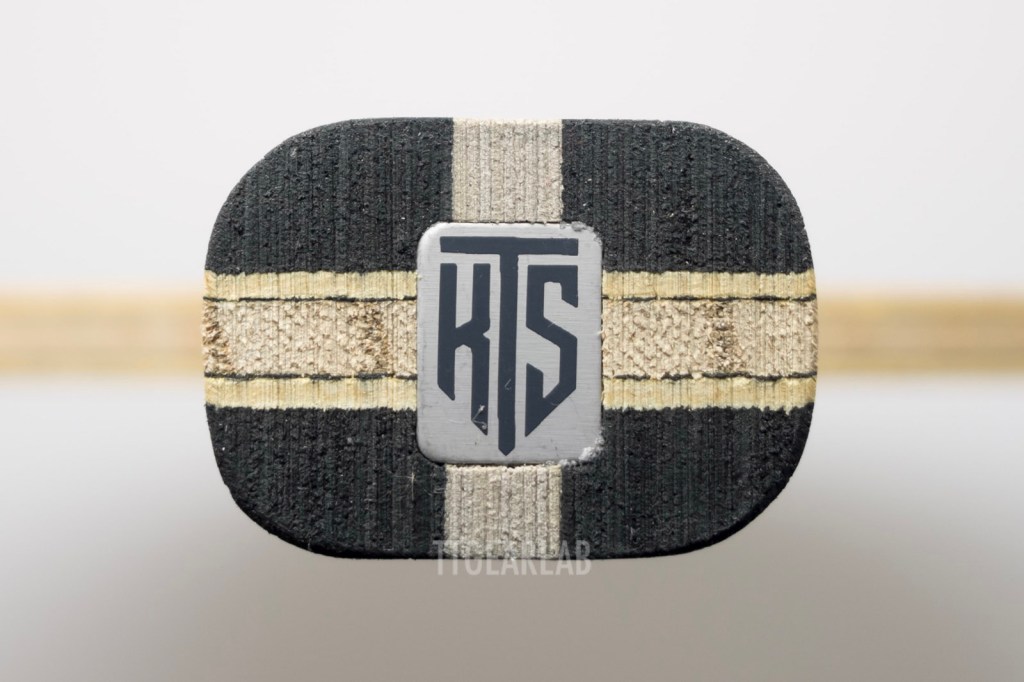
Aluminum logo plate that includes KTS logo is applied at the end of handle.
Because ‘Hinoki MAXX’ provides very high level of elasticity, even the player whose technic or physical power isn’t sufficient can easily make very fast ball. Although this kind of fast blades have different characteristics from the blades preferred by top players, those are still meaningful for amateur players. Especially the characteristics of ‘Hinoki MAXX’ is fine-tuned for the playing style that mixes hard hitting at close-to-table area and topspin at mid-distance area, and that fits for many amateur players especially in Asia.
Following are the performance indices of KTS Hinoki MAXX (avg.weight = 85.7g) :
– Ep = 2.15
– Ec = 2.66 (Ec/Ep = 1.24)
– Vp = 1.57
– Vl = 1.16 (Vl/Vp = 0.74)
Please note that above are average values and can be updated by further measurement.
Unauthorized use and/or duplication of this material without express and written permission from this website’s author and/or owner is strictly prohibited. Excerpts and links may be used, provided that full and clear credit is given to TTGearLab with appropriate and specific direction to the original content.
 TTGearLab
Speed demon!
LikeLike
Right. So the players who have been accustomed to all-round 5-ply wood blades will be astonished by its elasticity.
LikeLike
The Ec value is 24% higher than the Ep, does it mean the blade will not hold the ball at all when hitting hard? Although I heard about Hinoki, but have never try one because it is uncommon with the major table tennis equipment companies. What is the feel of a Hinoki top layer blade in general, how it compares to Lima and Koto top layers? What type of play would you recommend a Hinoki blade? Thank you.
LikeLike
If you hit the ball very strongly, you will not feel at all that this blade hugs the ball. You will just feel very strong kick. But, if you hit the ball in thin angle, you will feel that the Hinoki top layer grabs the ball firmly. The gap between thick impact and thin impact is really big.
The difference isn’t just because of the kind of top layer. The main reasons of the characteristics of this blade are its overall thickness and the thickness of top layer.
This blade fits for the players who mainly play with block and smash at close-to-table area. They also use topspin, but by the impact in thin angle at close-to-table area. Of course, the impact of topspin can be done in thicker angles at mid-distance area of far-distance area. But, even in case of mid or far distance play, it will give you much different experience than the other kinds of blades.
Anyway I don’t recommend this blade for you.
LikeLike
Is this a rebadge of T-Core Hinoki Pro?
By the way, edit the typo on the heading of the home page of spelling “TTGEARLAB Engineering & Graphic Design of Table Teenis Equipments” the TEENIS typo.
LikeLike
It seems that there are differences but I don’t know the details. I just know the recent models.
And, thank you for pointing out the mistyping. I will correct it.
LikeLike
You dont test very many hinoki blades, it seems and I know that you are bombarded with test demands, but it looks like you have the ability to get Yasaka stuff? Is it possible to test a Yasaka Masamune? this is an interesting 3 ply hinoki blade played by Satoshi Aida. If you’re not familiar with him, I encourage you to watch footage of his wild attack/chopping mix style. Really fun guy to watch. Thanks for the great reviews.
LikeLike
Most of Hinoki blades I checked are Butterfly, Xiom and Yinhe blades. But, I’m interested in Masamune. I’m considering to get it in near future.
LikeLike
That would be great. I know you’ve been designing and testing blades a long time. What kind of Ep and Ec numbers do you estimate an all kiso hinoki 7.2mm thick blade would make, anyway? Its 85 gm and 154×155.
LikeLike
It differs by internal construction. But, probably the values will be :
Ep is around 1.4 (or higher?)
Ec will be much higher than Ep (higher than 1.6)
Vp and Vc will be around 1.3.
Please note that above are no more than prediction. I don’t guarantee that the values will be close to actual data.
LikeLike
I understand, that sounds pretty reasonable. You cant really know til its tested, like you said. it def transmits almost no vibration. Honestly, I bought it for its amazing ST handle, but hinoki is weirdly addictive to play.
Anyway, thanks for taking the time to respond. Its really interesting learning about all these different materials and constructions.
LikeLike
Hinoki is a good material for table tennis. Especially because of its unique feeling. When we pull the ball by Hinoki blade we can feel as if the ball sticks to the surface, while it gives us very pleasant and strong feeling when we perform hard smash. 🙂
LikeLike
I bought a Masamune because of the thick Hinoki top layer to experience what Hinoki feels like for not too much money. I’d like to see its measurements too. It’s definitely quick when you flat hit! I put R7 min thickness rubber on it so the blade properties show through. Maybe not the best choice for a looper!
LikeLike
Thank you for information. Then probably its Ec/Ep is much higher than 1.0 as we can expect from the ordinary characteristics of Hinoki blades.
I also think that that kind of blade doesn’t fit for looper, even though it gives very good feeling when we perform loop with thin impact. We have to be careful to make the impact thin when we loop.
But, hard hitters will like it because it gives destructive speed when we hit by thick angle. 🙂
LikeLike
yes, i like to brush loop, so it feels great, smashes are especially destructive and slow spinny serves are good too. I’vve been playing around chopping a lot too. Its an awesome blade! Mine feels pretty quick, too. I’d love to see the numbers on it for reference, because im coming from inner alc limba outer blades. its so different, but soo fun.
LikeLike
Thank you for sharing your experience. (BTW, I couldn’t expected that it is even good for chopping. But, I have just remembered that I have seen some choppers who uses Butterfly Gergely.)
I’ll seriously consider to get Masamune next month.
LikeLike
Hi, have you tested any single ply hinoki blade? I was previously using cypress gmax but unfortunately it broke into two parts last week, and the price of cypress gmax goes very high currently. I am seeking for a cheap alternative of it. Is primorac carbon a good alternative? Thank you!
LikeLike
Although I’m a shakehand user, I have also tried 1-ply wood Japanese penholder blades. (But, I can only perform basic forehand offensive strokes with or without spin.)
If you want to change from 1-ply wood JP such as Cypress G-MAX to shakehand, ‘Primorac Carbon’ will be one of good solution. Of course you will feel differences. However, it will be much better than the other kinds of shakehand blades.
(You will also be able to try thick 1-ply wood shakehand from Juic or Tibhar. But, I don’t recommend those blades because those become too thick as shakehand blades.)
If you want to just stick to penholder, there are some cheaper but still good alternatives. For example KTS Hogeom (Tiger Sword) series. The problem is that currently the main market of 1-ply wood Japanese penholder is South Korea, and most of high-costperformance products of 1-ply wood JP are available only in South Korean market.
https://tshoptt.com/product/%EA%B9%80%ED%83%9D%EC%88%98-%ED%98%B8%EA%B2%80-%EB%A0%88%EB%93%9C-%ED%8E%9C%ED%99%80%EB%8D%94/440/category/32/display/1/
LikeLike
have you heard about ariex company?
ex-maker for butterfly 1 ply series from taiwan.
it also has premium 1 ply hinoki blades which are good as g-max or even slightly better.
LikeLike
I have once heard about that company. But, I heard from many penholder players that the quaility of Cypress G-Max isn’t good. It seems that the one used for the pictures of this home page was a very very special Cypress G-Max whose quality is extraordinarily good. They said that they have never seen the Cypress G-Max of that level. 🙂
LikeLike
Hi,
I want to ask point of comparison KTS Hinoki Maxx to KTS Ngineered HC.
Comparison good or bad KTS Hinoki Maxx to Primorac Carbon. Thank You
Your blog content is awesome!!
LikeLike
Thank you for comment! 🙂
In fact the actual difference between Hinoki Maxx and Ngineered HC isn’t big. Of course there is small differences. For example Ngineered HC gives a bit more kick for hard smash. And, its feeling is a bit more comfortable. But, I wonder whether players can actually notice the difference or not.
Regarding the comparison between Hinoki Maxx and Primorac Carbon, Primorac Carbon fits more for professional players, and Hinoki Maxx is purely for amateur players who frequently use smash. Primorac Carbon hugs the ball more deeply when the impact force is very strong, while Hinoki Maxx gives more kick to the ball in the same situation. Topspin is easier with Primorac Carbon, and smash is more destructive with Hinoki Maxx.
LikeLike
hello
I have been looking for this blade as I finally bought a few weeks ago a joola nobilis PBO which seems to be a very nice blade but lacks a bit of speed in my opinion. So would this blade be an equivalent, but slightly faster of the nobilis PBO ? I looked on the website of KTS and did not find this blade but a KTS hinoki force ? And last question , as I am really satisfied of that hinoki feeling, seems that lot of famous 3+2 hinoki blades are not made anymore so would you have some advices about similar blades ?
thank you for your job
best regards
LikeLike
I don’t have the sample of Joola Nobilis PBO, and therefore I don’t have data for it. However, it is expected that Nobilis PBO is a very fast blade although it gives quite soft feeling. Probably you feel that it lacks speed because of its feeling.
KTS Hinoki MAXX is an extremely fast blade. But, it isn’t expected that it is noticeably faster than Nobilis PBO.
However, if the feeling is an important factor, probably you will feel that Hinoki MAXX is faster than Nobilis PBO.
KTS Hinoki FORCE is a bit different from Hinoki MAXX, but there isn’t significant difference between those two. Hinoki MAXX is a bit better when beginners use it. Hinoki FORCE is for more skilled players. However, the difference is small. More important difference between two is the origin. Hinoki MAXX is made in China, and Hinoki FORCE is made in Japan.
Many famous 3+2 ply Hinoki Carbon blades are being continuously discontinued because that kind of blades is not popular all over the world. Tmount KTS continues to produce that kind of blades because 3+2 ply Hinoki Carbon is still very popular in the homeground of Tmount KTS.
If you like 3+2 ply Hinoki Carbon, any one between two models of Tmount KTS will be the best solution in my opinion. If you want to buy one but can’t buy in your country, please mail to ttgearlab@gmail.com. I’m managing a TT shop, and selling KTS Tmount products.
LikeLike
A good friend of mine is hunting to replace his long lost Schlager Carbon. However, as you know, these are very difficult to source and extremely expensive. What modern, easier to obtain blade, in your estimation, plays closest to a Schlager? Thanks for your time.
LikeLike
Schlager is a very special 3+2 ply Hinoki Carbon blade. Among all Hinoki Carbon blades, it is a very unique one because it is much thicker than most of already very thich (= around 7mm) Hinoki Carbon blades such as Primorac Carbon. Its thickness is around 7.3~7.5mm The other companies don’t make similar blades, one reason is that 6.8~7mm Hinoki Carbon is sufficiently fast and thicker one is not needed.
However, there is one model that can be compared with Schlager. That is Xiom Novus Axelo which is the Hinoki Carbon blade whose thickness is also over 7mm.
Please note that Axelo isn’t 100% similar to Schlager. So, I can’t guarantee that it will be satisfactory. Further, its head shape and handle shape are totally different from those of Schlager, and that may be uncomfortable to your friend. Further, it is a quite old model which was anounced in 2007.
LikeLike