| Table of Contents | 1. Overview 2. Performance Indices 3. Comparison by Performance Indices ……. 3-1. Elasticity Indices ……. 3-2. Vibration Indices 4. Summary |
KTS (Kim Taek Soo) is the table tennis brand managed by T-Mount which is a Korean company. T-Mount has its own blade factory, and is producing high-class products among KTS blades in-house. ‘Fury KC’ and ‘Fury LC’ those were released in autumn 2023 are also in-house products of KTS (T-Mount).
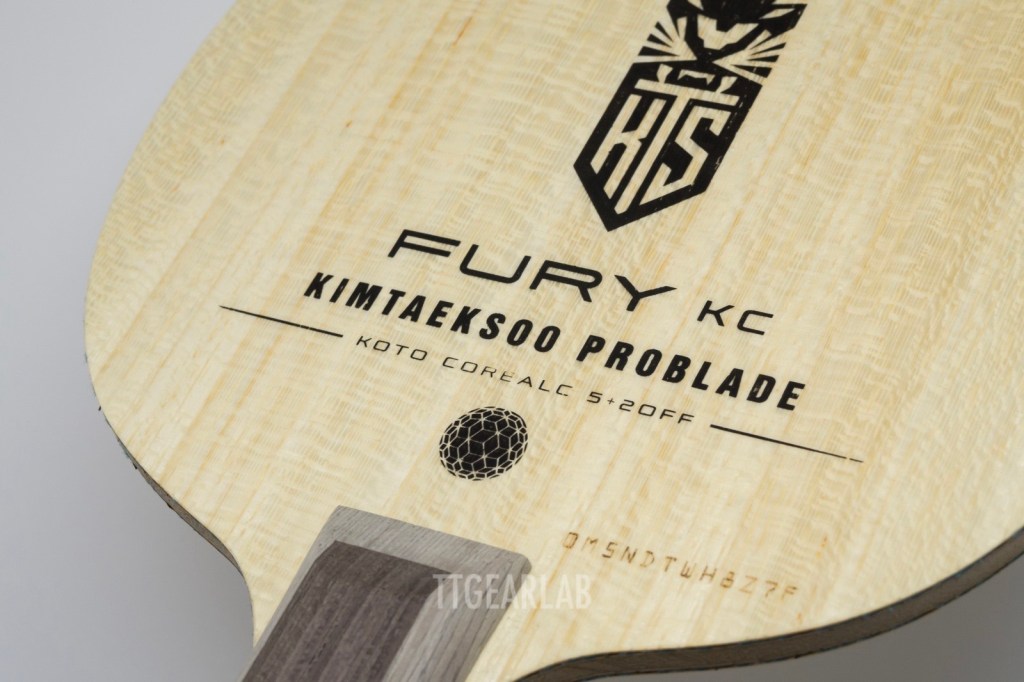
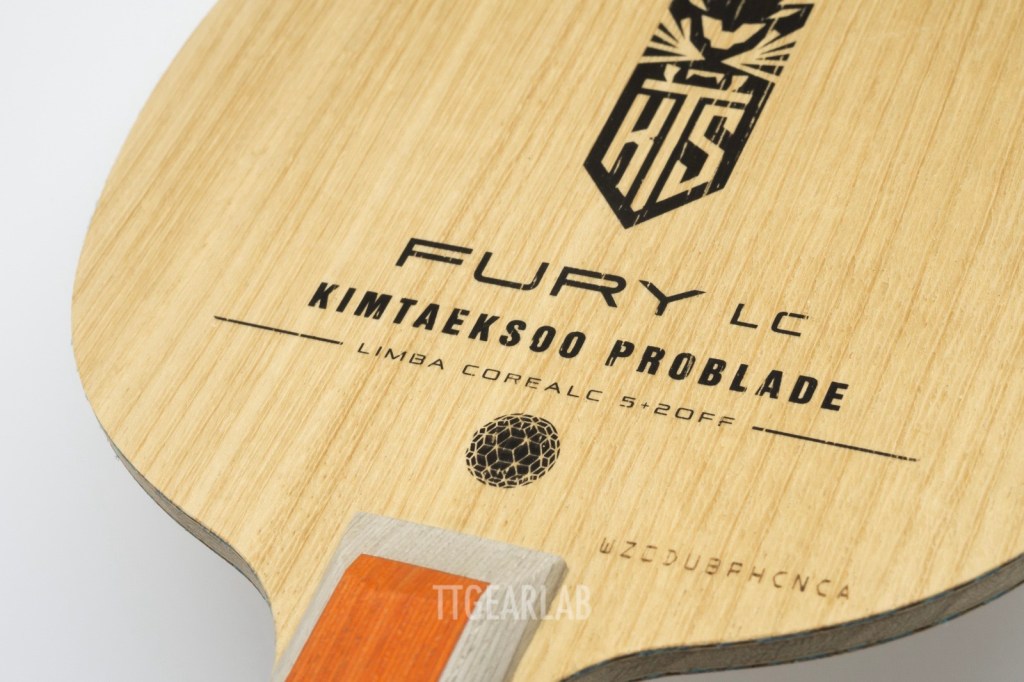
The official names of ‘Fury KC’ and ‘Fury LC’ are ‘Problade Fury KC’ and ‘Problade Fury LC’ respectively. And, the name of blade family is also ‘Problade Fury’ series. But, for simplicity, those blades will be called as ‘Fury KC’ and ‘Fury LC’ in this article. And, ‘Probalde Fury’ series will be called as ‘Fury’ series. Both of ‘Fury KC’ and ‘Fury LC’ are outer fiber blades whose artificial fiber is ‘CoreAL Carbon’. Two models in ‘Fury’ series are distinguished by the kind of top layer. ‘Fury KC’ is the ALC blade with Koto top layer, while ‘Fury LC’ is the ALC blade with Limba top layer. Although KTS doesn’t explaining the details of the naming of this series, it seems that ‘K’ means Koto and ‘L’ means Limba.
In this article, TTGearLab will analyze ‘Fury KC’ and ‘Fury LC’ by Performance Indices, and for further understanding compare those two with some other blades in the market.
1. Overview
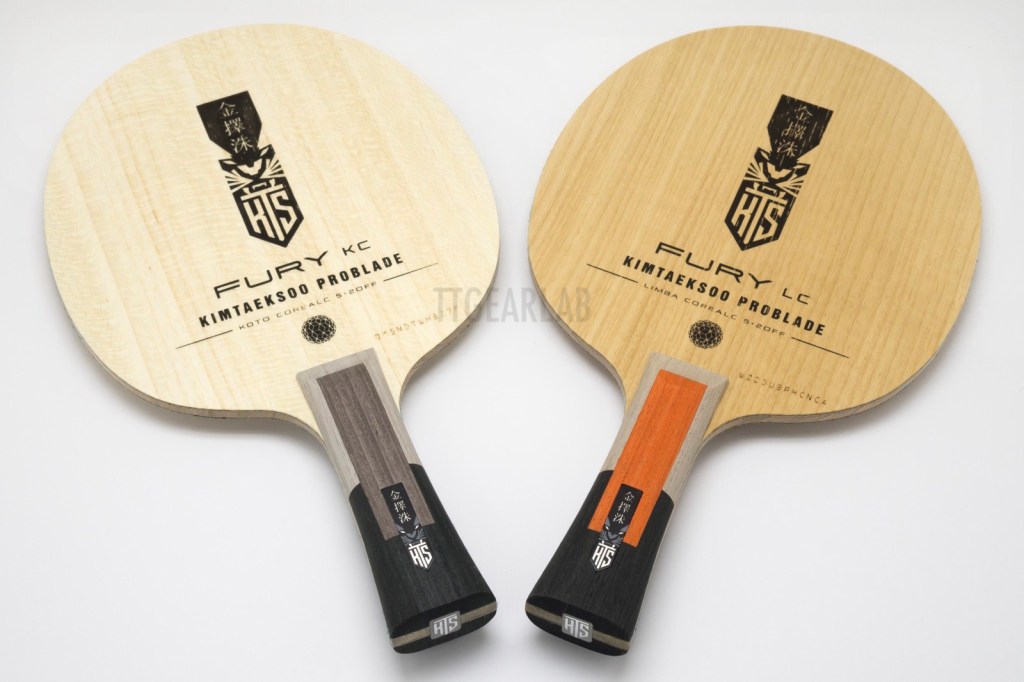
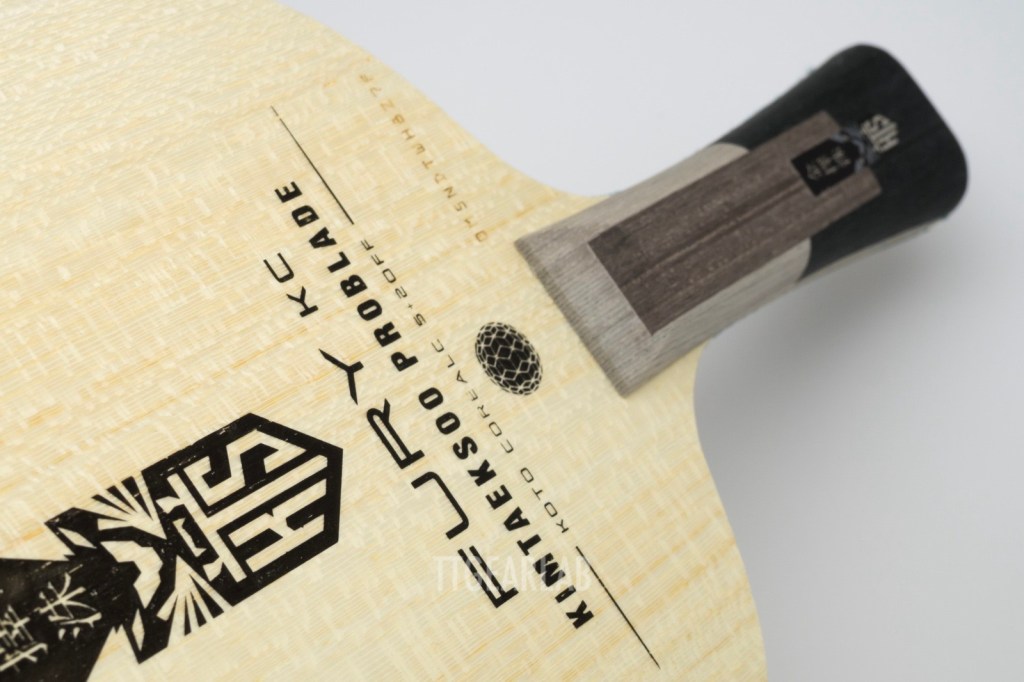
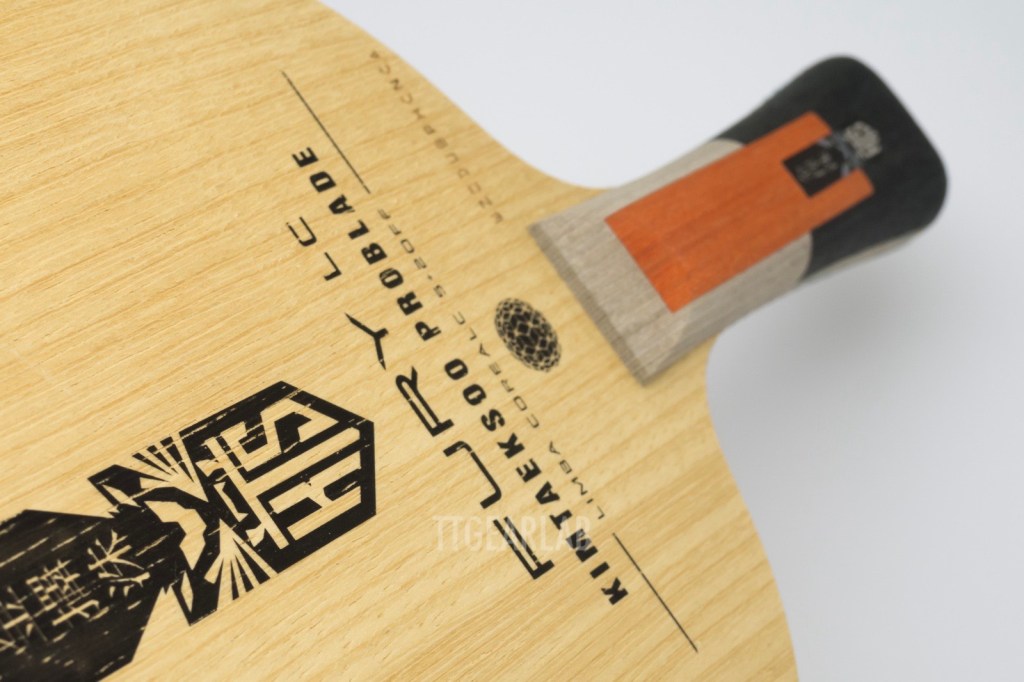
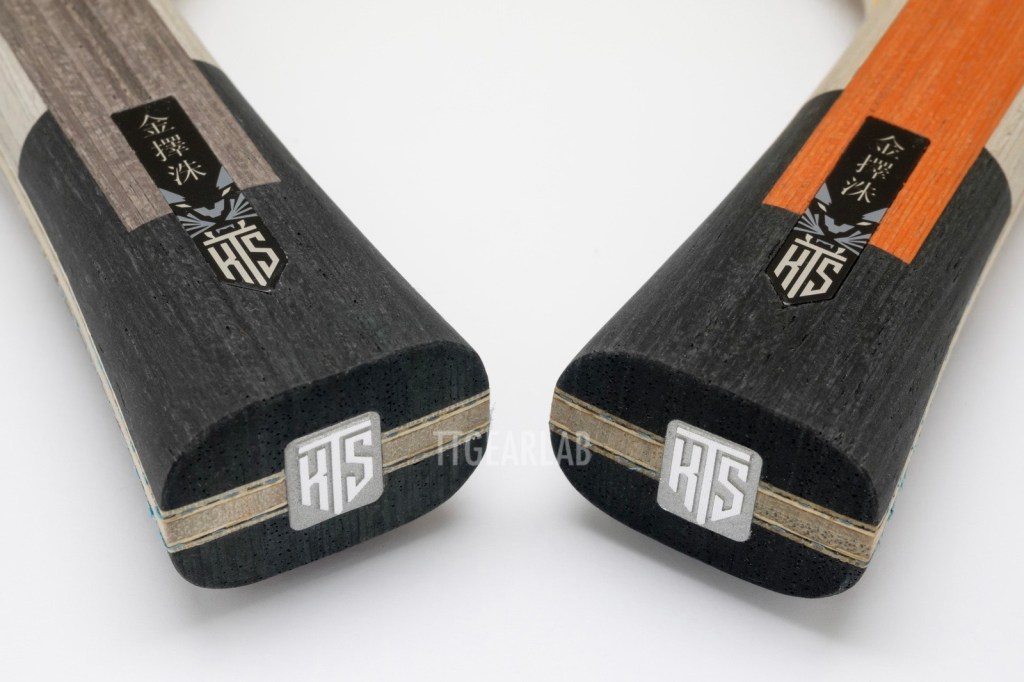
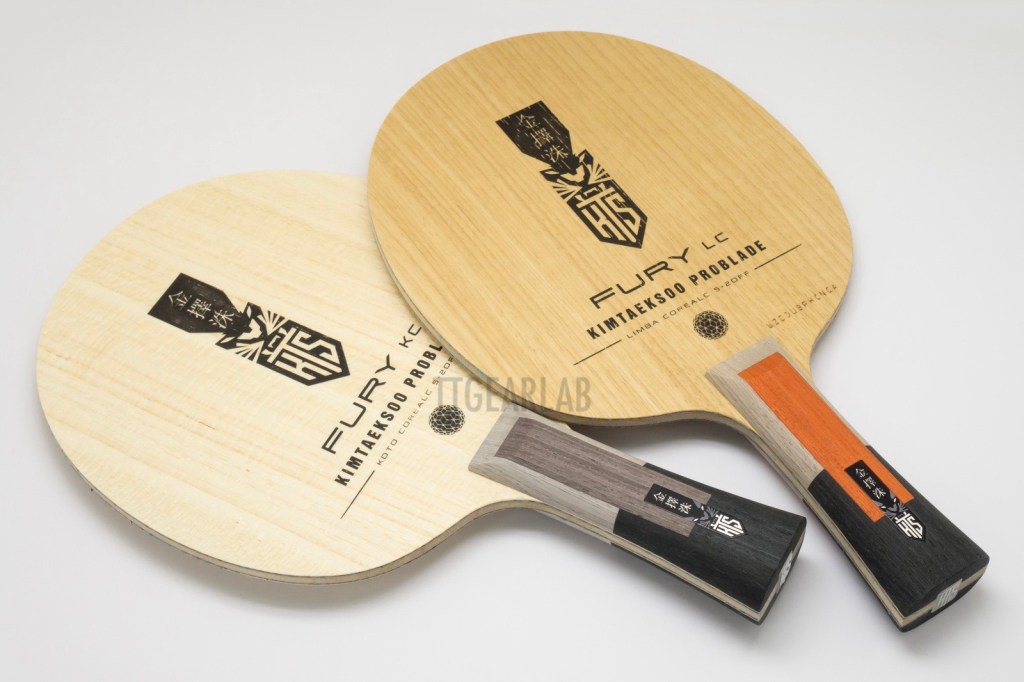
Above picture shows ‘Fury KC’ and ‘Fury LC’. Two blades share the graphic design, and are distinguished by the point color of the handle (dark gray vs. orange), the color and grain of top layer, and the name written on the head. The brand name – KTS – is written on the Aluminum plate at handle instead of the name of each product. It is the way of design that emphasizes the brand rather than individual products.
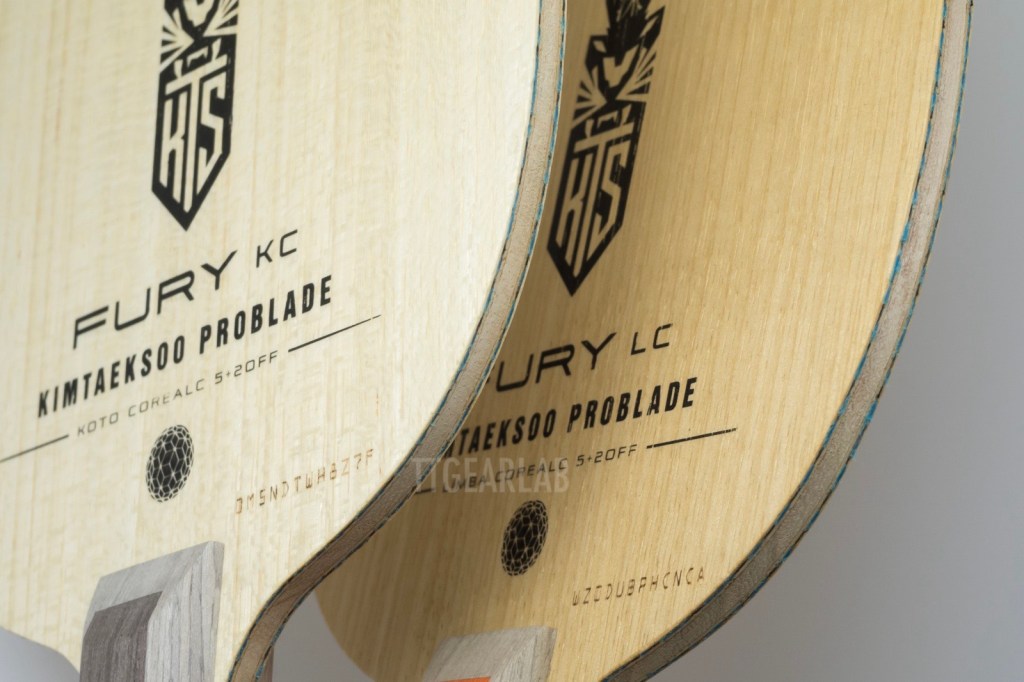
The constructions of ‘Fury KC’ and ‘Fury LC’ are almost identical except for the woods of top layers – Koto and Limba respectively. Both of those are typical 5+2 ply outer-fiber constructions, and the artificial material is CoreAL Carbon which is a kind of ALC used by KTS. KTS is explaining that ‘Fury KC’ is for sharp and precise attack by topspin & smash at close-to-table area, and ‘Fury LC’ is for powerful topspin with strong rotation from mid-distance.
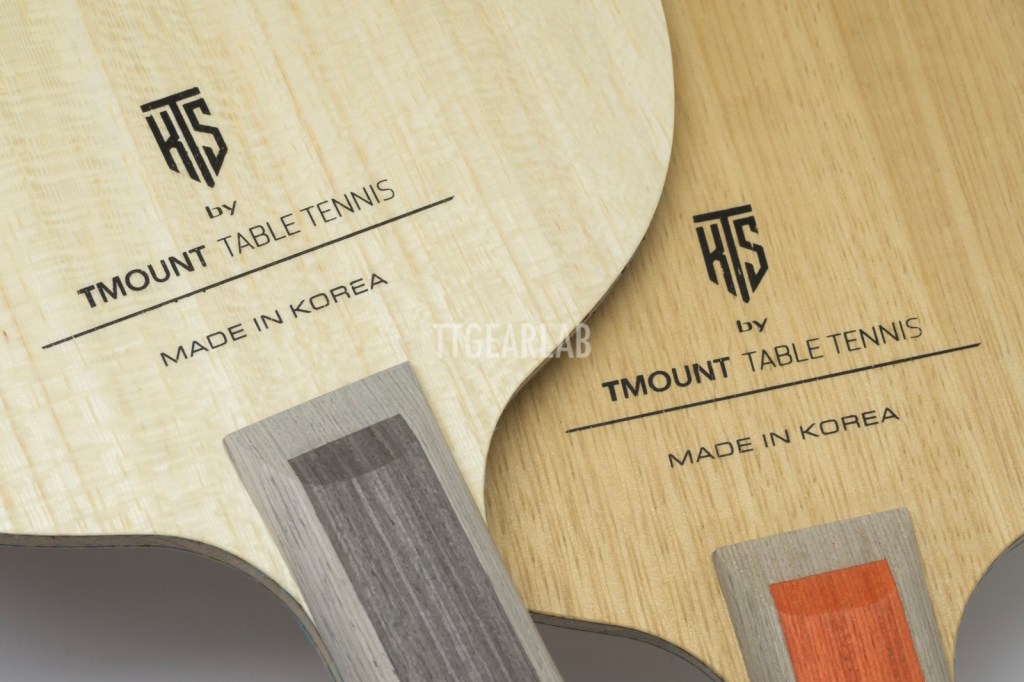
On backside of head, it is explained that T-Mount made these blades. ‘Fury’ series is produced in-house by KTS (T-Mount).
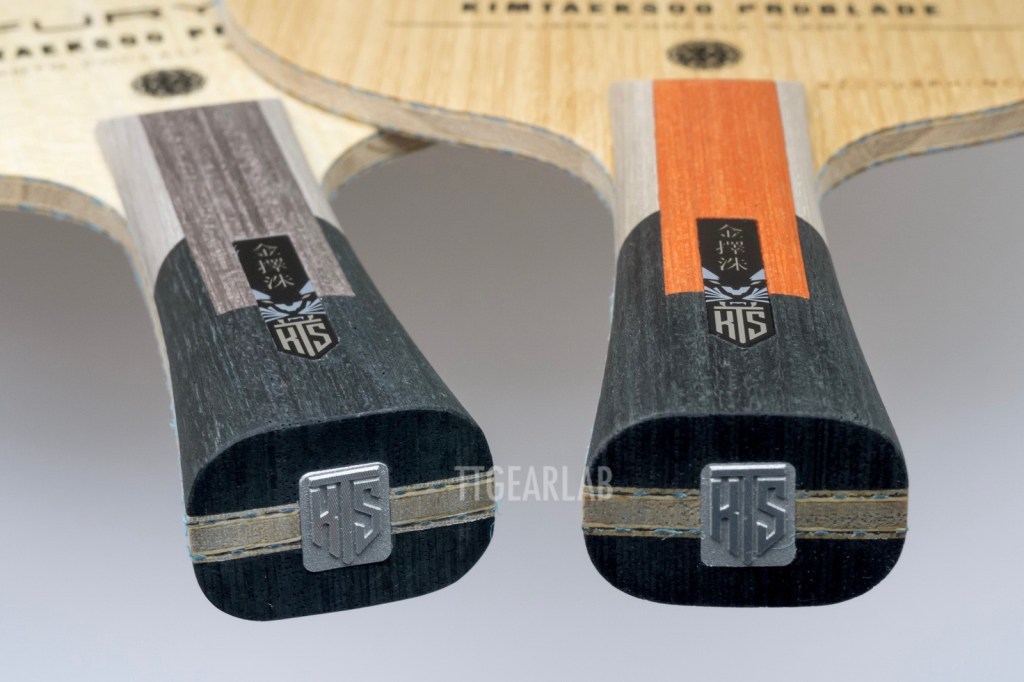
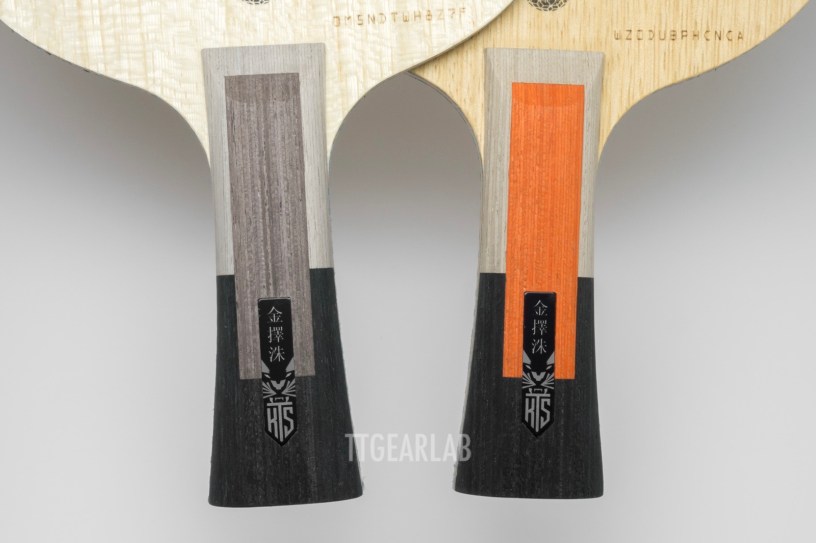
Small aluminum plate that includes embossed KTS logo mark is applied at the end of handle. This aluminum panel is applied for the high-end models of KTS. For lower cost models, the aluminum panel with printed KTS logo is applied.
1-1. Fury KC (Outer CoreAL Carbon with Koto top layer)
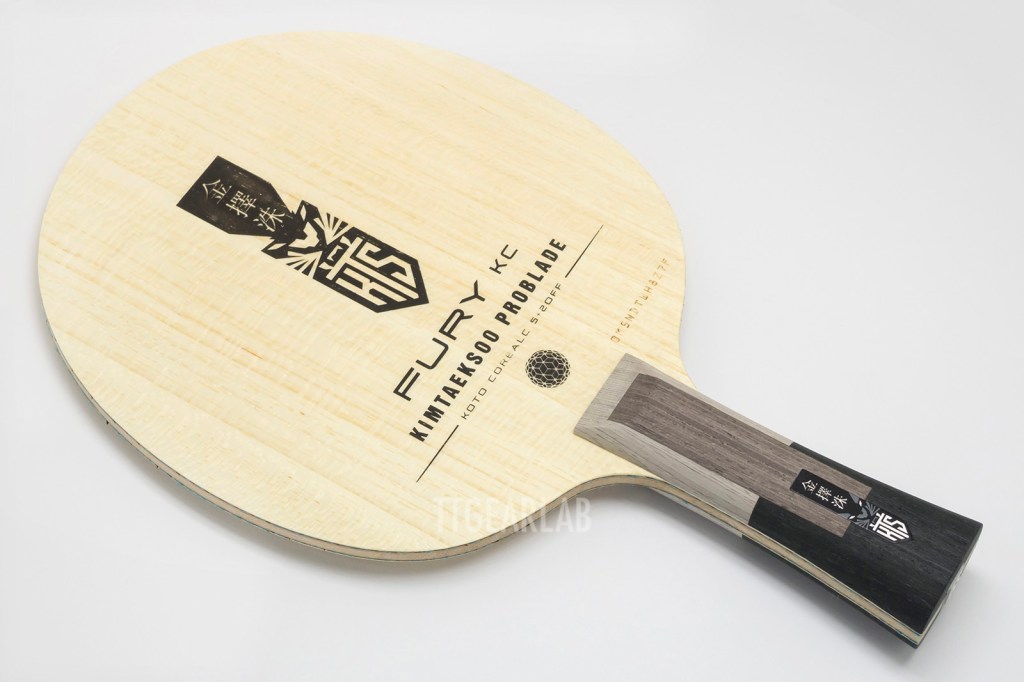
‘Fury KC’ is the Koto top layer version of ‘Fury’ series. It lays emphasis on the sharp and precise attack by topspin & smash. ‘Fury KC’ is harder than ‘Fury LC’, and fits for the playing style that puts pressure on the opponent by using a variety of techniques at close-to-table area.
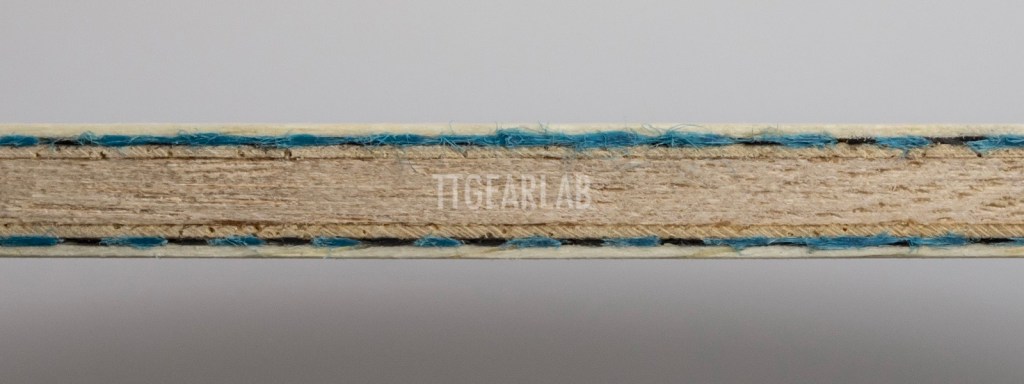
Above is the blade construction of ‘Fury KC’. CoreAL Carbon (= ALC) is placed directly under the top layer. The top layer is Koto, the middle layer is Ayous, and the center layer is Kiri. Overall thickness is around 5.9mm.
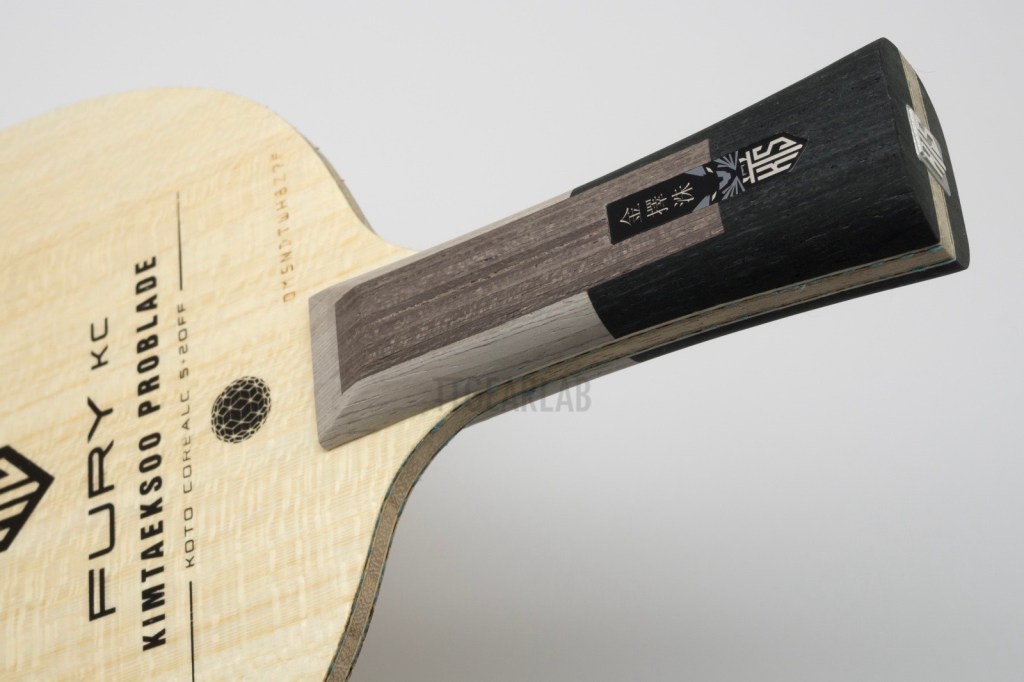
One of the biggest features of KTS blades is the shape of the handle. Currently only FL (flared) handle is available for ‘Fury KC’. This FL handle is completely flat on the top and bottom, and it doesn’t have bulged section between the root section and the narrowest section. The width of FL handle is around 25.5mm at the narrowest section, and around 34mm at the end. The thickness of handle is around 23mm at thumb, and around 24~25mm at the end. The unique FL handle whose top and bottom are completely flat reminds us the handle of old Butterfly blades such as Gergely, although the FL handle of ‘Fury’ series is rounded at the edge differently from that of ‘Gergely’. But, the drawback of ‘Fury’ series is that ST (straight) handle isn’t available, like most of DHS blades.
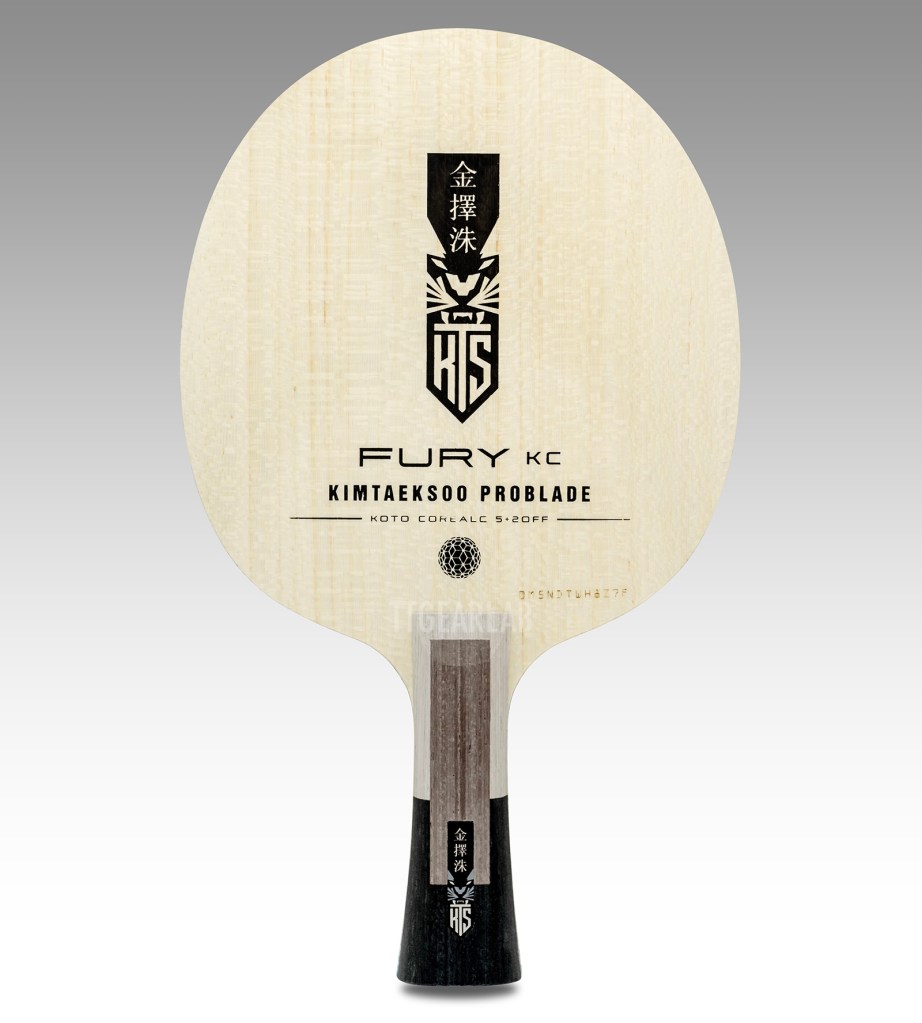
The head size of ‘Fury KC’ is around 158mm x 151mm. It is a little bit bigger size than that of regular 157mm x 150mm head.
1-2. Fury LC (Outer CoreAL Carbon with Limba top layer)
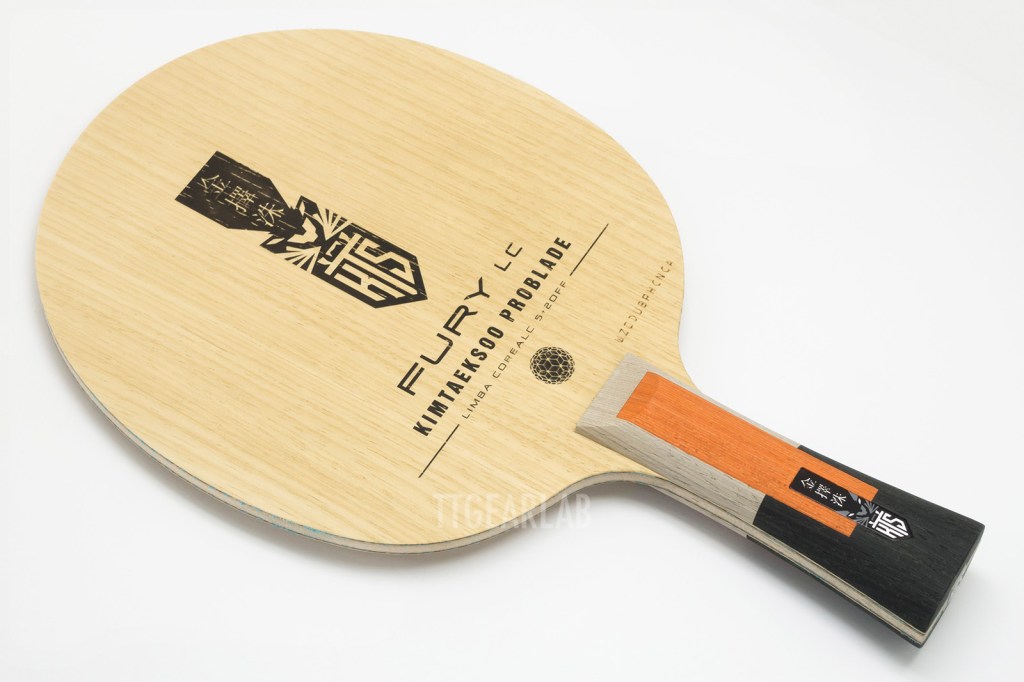
‘Fury LC’ is the Limba top layer version of ‘Fury’ series. It lays emphasis on powerful topspin with strong rotation. ‘Fury LC’ is softer than ‘Fury KC’, and fits for the playing style that focuses on continuous attack by powerful topspin from all areas of court.
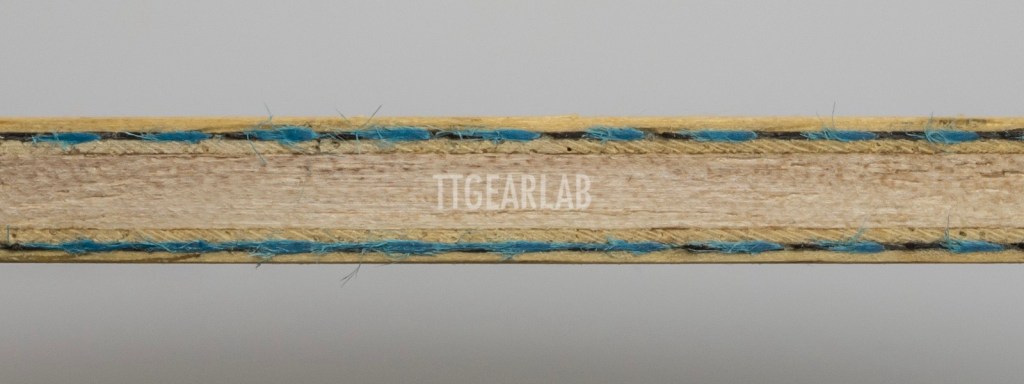
Above is the blade construction of ‘Fury LC’. CoreAL Carbon (= ALC) is placed directly under the top layer. The top layer is Limba, the middle layer is Ayous, and the center layer is Kiri. Overall thickness is around 5.8mm.
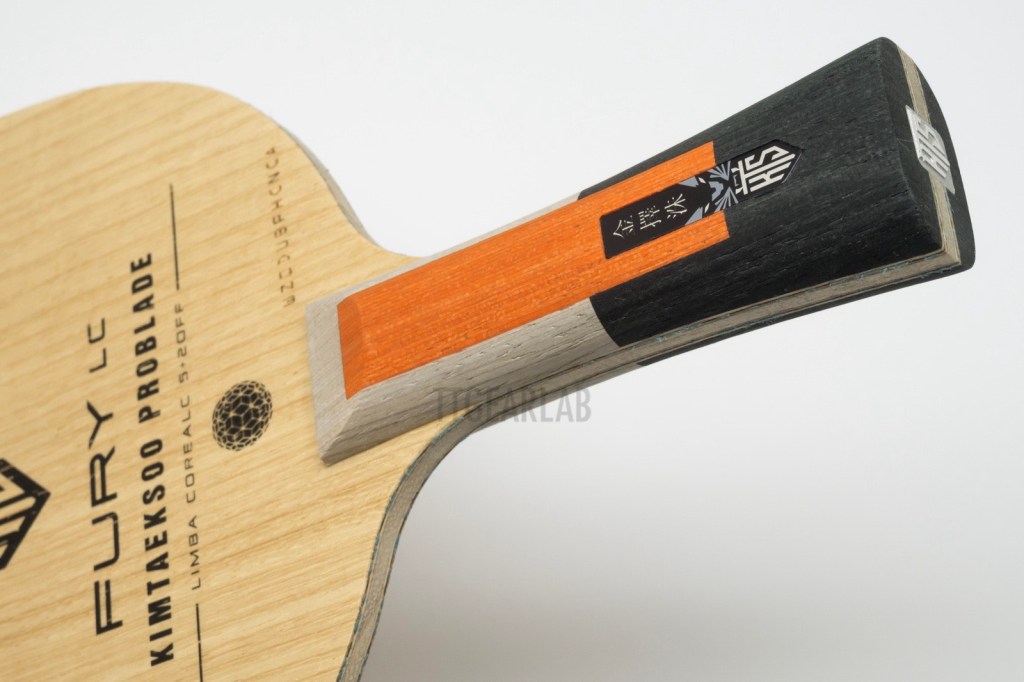
The handle shape of ‘Fury LC’ is identical to that of ‘Fury KC’. Currently only FL (flared) handle is available for ‘Fury LC’. This FL handle is completely flat on the top and bottom, and it doesn’t have bulged section between the root section and the narrowest section. The width of FL handle is around 25.5mm at the narrowest section, and around 34mm at the end. The thickness of handle is around 23mm at thumb, and around 24~25mm at the end.
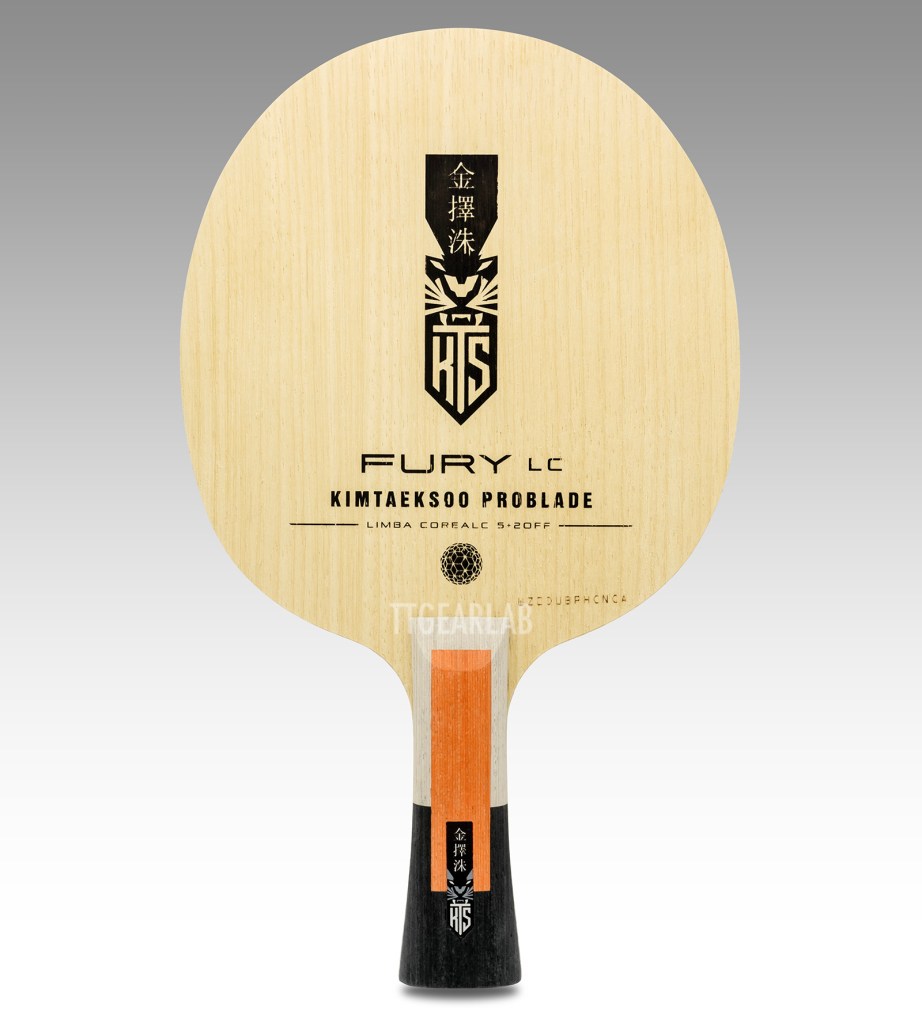
The head size of ‘Fury KC’ is around 158mm x 151mm. The head shape of ‘Fury LC’ is identical to that of ‘Fury KC’.
Then let’s check the characteristics of ‘Fury KC’ and ‘Fury LC’ by Performance Indices and then compare with some existing blades.
Please click here to return to top (table of contents)
2. Performance Indices
Performance Indices are measured objective values to represent the characteristics of table tennis gears. Concerning the detail of four performance indices, please refer to following articles in ‘About TTGearLab’ section :
- Performance indices : the way to evaluate blade by measurement
- The example of comparison by performance indices
The performance indices of ‘Fury KC’ and ‘Fury LC’ are as follows:
KTS Fury KC (average weight = 89.0g)
Ep = 2.15
Ec = 2.07 (Ec/Ep = 0.97)
Vp = 1.36
Vl = 1.35 (Vl/Vp = 0.99)
KTS Fury LC (average weight = 87.7g)
Ep = 2.14
Ec = 1.87 (Ec/Ep = 0.87)
Vp = 1.30
Vl = 1.34 (Vl/Vp = 1.03)
‘Fury KC’ is the Koto top layer version of ‘Fury’ series. It is a very elastic blade. Its Ep (= 2.15) exceeds 2.0 that can be considered as the criteria of fast blade. Its Ec (= 2.07) is lower than its Ep, but the gap isn’t big. Therefore, its Ec/Ep (= 0.97) is just a bit lower than 1.0. ‘Fury KC’ doesn’t hug the ball deeply when the player hits the ball very strongly. The players who have been accustomed to the blade that hugs the ball very deeply will feel that ‘Fury KC’ kicks the ball strongly when the impact strength is high.
Regarding Vibration Indices, the Vp of ‘Fury KC’ is 1.36, and it is somewhat higher than what we can expect from outer ALC blades. Its Vl ( = 1.35) is also very high, but is just a bit lower than its Vp. From the values, we can expect that most of players will feel ‘Fury KC’ very hard at palm but not especially sharp at players’ index fingers.
‘Fury LC’ is the Limba top layer version of ‘Fury’ series. Like ‘Fury KC’, it is also a very elastic blade. Its Ep (= 2.14) exceeds 2.0 that can be considered as the criteria of fast blade. However, its Ec (= 1.87) is much lower than its Ep. Therefore, its Ec/Ep (= 0.87) is even lower than 0.9. It is expected that ‘Fury LC’ hugs ball very deep when the player hits the ball very strongly.
Regarding Vibration Indices, the Vp of ‘Fury LC’ is 1.30, and it is in the range that we can expect from ordinary outer fiber blades. And, its Vl (= 1.34) is even higher than its Vp. So, the relative value – Vl/Vp (= 1.03) – exceeds 1.0 but not significantly. It means that the feeling transferred to the player’s index finger is sharper than the primary feeling, but not much.
‘Fury’ series is a quite unique blade family whose models are distinguished by their top layers. Both of two models in ‘Fury’ series show very high Primary Elasticity Indices. But. There are noticeable differences in the other performance indices. ‘Fury KC’ whose top layer is Koto doesn’t hug the ball deep when the impact strength is high, and it transmits very hard feeling to palm and less sharp feeling to index finger. On the contrary. ‘Fury LC’ whose top layer is Limba hugs the ball deep when the impact strength is high, and it transmits moderately hard feeling to palm and moderately sharp feeling to index finger. These characteristics coincide with the description by KTS – ‘Fury KC’ fits for the attack by topspin & smash and ‘Fury LC’ fits for continuous topspin. That will be the criterion of the selection between two blades If there isn’t any other special criteria of the player.
Please click here to return to top (table of contents)
3. Comparison by Performance Indices
Then we can compare ‘Fury KC’ and ‘Fury LC’ with some other blades. Both of ‘Fury KC’ and ‘Fury LC’ are outer-ALC blades, and those two are distinguished only by the kind of top layer. So, most of the blades selected for comparison are outer fiber blades with Koto top layers of Limba top layers. And, two inner-ALC blades and one carbon blade with 3+2 ply construction have been additionally selected for reference.
Following is the list of the blades to be compared :
Outer fiber blades with Koto top layer
- Butterfly ‘Viscaria’ (avg. weight = 87.1g) : Outer ALC blade with Koto top layer. Current version.
- Tibhar ‘MK Carbon’ (avg. weight = 85.4g) : Outer Crypto Carbon (a kind of ALC) blade with Koto top layer. Construction is very similar to that of ‘Viscaria’.
- Stiga ‘Dynasty Carbon’ (avg. weight = 89.9g) : Outer Mid-density TeXtreme blade with Koto top layer.
- Xiom ‘An Jaehyun TMX’ (avg. weight = 87.0g) : Outer Trimetrix (vertical ALC + horizontal ZLC) with Koto top layer.
Outer fiber blades with Limba top layer
- Butterfly ‘Freitas ALC’ (avg. weight = 87.4g) : Outer ALC blade with Limba top layer.
- Victas ‘ZX-Gear Out’ (avg. weight = 87.1g) : Outer Z Carbon (Zxion Carbon) blade with Limba top layer.
- Stiga ‘Carbonado 190’ (avg. weight = 90.8g) : Outer Mid-density TeXtreme blade with Limba top layer. TeXtreme (Carbon fiber woven flat by a special manufacturing method) is arranged in ordinary direction.
- Nittaku ‘Acoustic Carbon’ (avg. weight = 90.8g) : Outer FE Carbon blade with Limba top layer.
- Butterfly ‘Mizutani Jun Super ZLC’ (avg. weight = 90.0g) : Outer Super ZLC blade with Limba top layer.
- Butterfly ‘Mizutani Jun ZLC’ (avg. weight = 89.7) : Outer ZLC blade with Limba top layer.
Others
- Butterfly ‘Ovtcharov InnerForce ALC’ (avg. weight = 88.0g) : Thick inner-ALC blade. Faster than most of inner fiber blades.
- Butterfly ‘InnerForce Layer ALC’ (avg. weight = 91.2g) : The standard of inner-ALC blades. Current version measured in 2023. Thicker and more elastic than former ones measured in 2018.
- Butterfly ‘Schlager Light’ (avg.weight = 84.3g) : 3+2 ply carbon (Tamca 5000) blade with Hinoki top layer of relatively thin (= 6.2mm) construction. Much thinner than ‘Primorac Carbon’ which is the representative of 3+2 ply Hinoki-Carbon blades.
3-1. Elasticity Indices
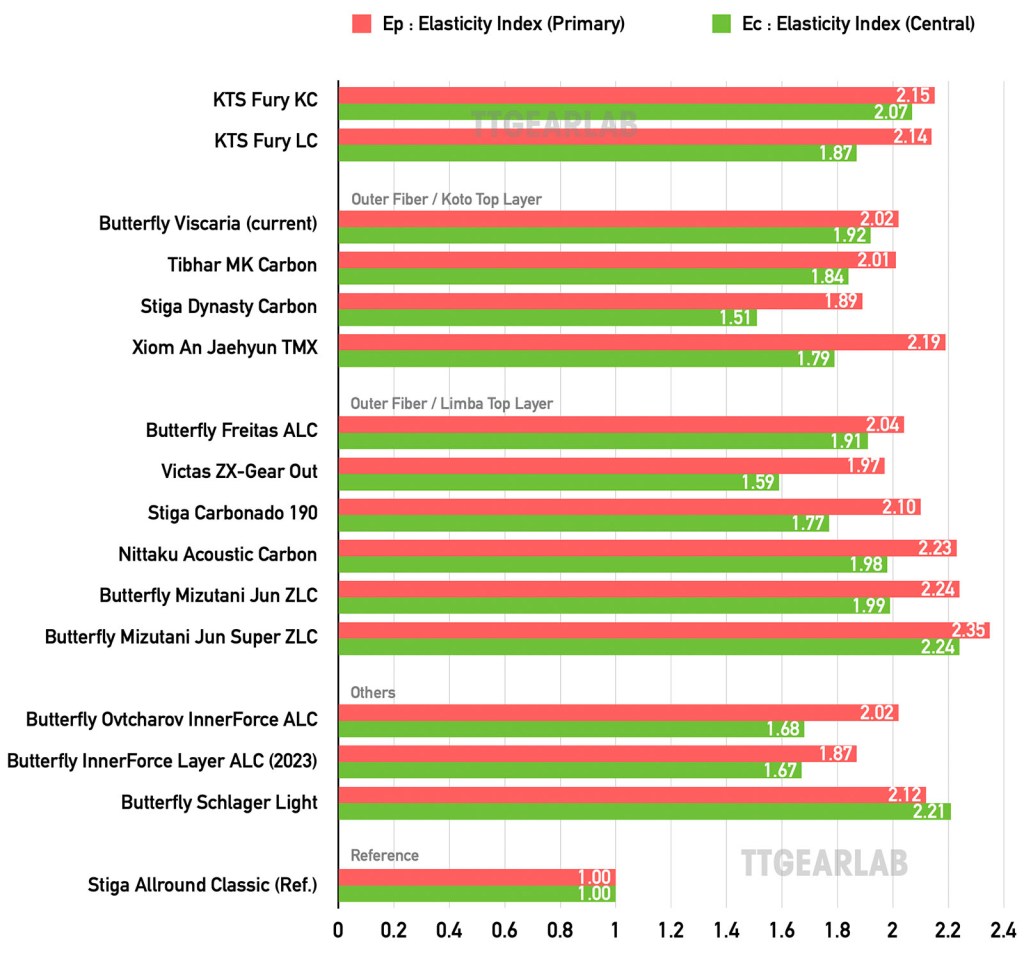
Fig.16 shows the comparison graph of Elasticity Indices.
Ep (Primary Elasticity Index) is directly concerned with the rebound speed of blade. Ec (Central Elasticity Index) is concerned with additional ‘kick’ when player hits ball very strongly.
As we observed in former chapter, the difference between ‘Fury KC’ and ‘Fury LC’ is in Ec. The Ep’s of those two are very close to each other. But, the Ec of ‘Fury LC’ is much lower than that of ‘Fury KC’. So, ‘Fury KC’ and ‘Fury LC’ will show quite different behavior when the when the impact strength is high, and that will be the criteria of selecting between ‘Fury KC’ and ‘Fury LC’.
Then, let’s compare other blades by group with two models ‘Fury’ series.
[Outer Fiber / Koto Top Layer]
The outer fiber blades with Koto top layers can be compared mainly with ‘Fury KC’. We can see that both of ‘Fury KC’ and ‘Fury LC’ are highly elastic blades. The Ep’s of ‘Fury KC’ and ‘Fury LC’ are higher than those of ‘Viscaria’, ‘MK Carbon’ and ‘Dynasty Carbon’. The only one blade in this group whose Ep is higher than those of ‘Fury’ series is ‘An Jaehyun TMX’. And, the Ec of ‘Fury KC’ is much higher than the Ec’s of all blades in this group. Even the Ec of ‘Fury LC’ is higher than those of three blades in this group.
[Outer Fiber / Limba Top Layer]
The outer fiber blades with Limba top layers can be compared mainly with ‘Fury LC’. Especially ‘Freitas ALC’ can be directly compared with ‘Fury LC’. But, the characteristics of ‘Freitas ALC’ is somewhat different from that of ‘Fury LC’. The Ep is one step lower while the Ec is is a bit higher when we compare ‘Freitas ALC’ with ‘Fury LC’. The graph shape of ‘Freitas ALC’ is more similar to that of ‘Fury KC’ rather than ‘Fury LC’. The blades whose graph shapes are somewhat similar to that of ‘Fury LC’ are ‘Carbonado 190’, ‘Acoustic Carbon’ and ‘Mizutani Jun’. Among those three, ‘Carbonado 190’ is a bit less elastic than ‘Fury LC’, and ‘Acoustic Carbon’ and ‘Mizutani Jun ZLC’ are one step more elastic than ‘Fury LC’. And, the graph shape of ‘Mizutani Jun Super ZLC’ is somewhat similar to that of ‘Fury KC’.
[Others – inner ALC & 3+2 ply Hinoki Carbon]
In this group, two inner ALC blades show noticeably lower elasticity characteristics than ‘Fury KC’ and ‘Fury LC’. And, ‘Schlager Light’ which is a hard & fast 3+2 ply Hinoki Carbon blade shows higher value of Ec than ‘Fury KC’. Two inner ALC models will be comparable with ‘Fury LC’ as slower replacements. And, ‘Schlager Light’ may be comparable with ‘Fury KC’ because of very high value of Ec. Examining Ec/Ep is an easier way to understand the characteristics of blade concerned with elasticity. Fig.17 shows the relationship between Ec/Ep and Ep.
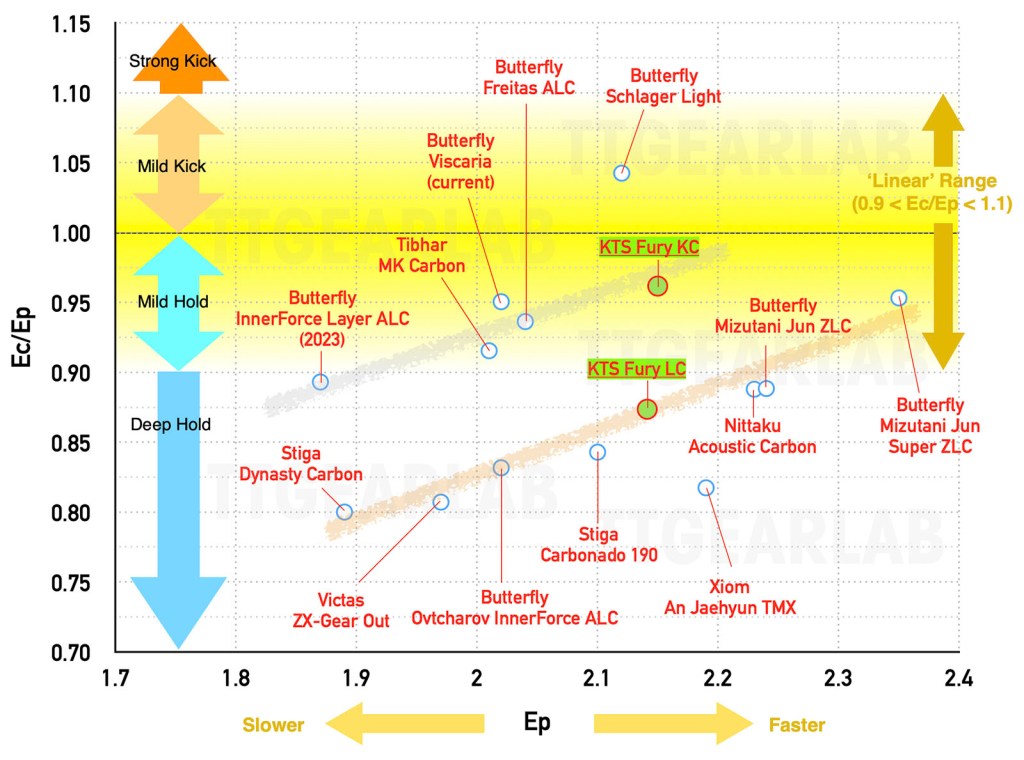
Ec/Ep expresses the ‘tendency’ of the elasticity of blade. By examining Ec/Ep and Ep at the same time, we can easily understand the behavior of blades.
On the graph, most of blades in this comparison (except for ‘Schlager Light’ and reference blade) are in ‘Hold’ range (Ec/Ep < 1.0). But, the blades are widely distributed up, down, left and right within that range.
We can observe that ‘Fury KC’ and ‘Fury LC’ are in ‘Mild Hold’ range and in ‘Deep Hold’ range respectively. And, we can also see that it is difficult to compare the blades group by group because the blades in one group is widely distributed in the graph. Instead of groups, we can draw two diagonal lines on the graph. One is a gray line from ‘InnerForce Layer ALC’ to ‘Fury KC’, and the other is an orange line from ‘Dynasty Carbon’ to ‘Mizutani Jun Super ZLC’. Most of blades in this comparison are located close to those two lines.
[Gray Line – Shallower Hold & Stronger Kick]
The blades on (or close to) gray line give stronger kick than the blades on (or close to) orange line. Because the line is inclined, there are difference in the level of hold among the blades on the line. However, in case the player wants to adjust the power of blade, adjusting along this line may be better way than adjusting just between blades with similar hold levels. Then adjusting from ‘InnerForce Layer ALC’ to ‘MK Carbon’ or ‘Viscaria’ will be smooth way of increasing power. Likewise, adjusting from ‘Viscaria’ or ‘MK Carbon’ to ‘Fury KC’ will also be smooth way of increasing power.
[Orange Line – Deeper Hold & Weaker Kick]
The same kind of adjustment can be done along orange line. The blades on (or close to) orange line hug the ball deeper than the blades on (or close to) gray line. If the player wants to easily adapt to new blade while increasing speed, it will be the proper way that the player selects the blade located to upper right along the line. So, ‘Fury LC’ can be the solution when the player wants to increase the power from ‘ZX-Gear Out’ or ‘Ovtcharov InnerForce ALC’. If the player think that it is too excessive adjustment, ‘Carbonado 190’ will be the solution. And, if the player wants to go further, ‘Acoutic Carbon’ or ‘Mizutani Jun ZLC’ can be considered. And, if the player wants to go extreme, the solution will be ‘Mizutani Jun Super ZLC’.
[The blades off the two lines]
‘Schlager Light’ and ‘An Jaehyun TMX’ are not on those two lines. ‘An Jaehyun TMX’ is located under the orange line, and ‘Schlager Light’ is located over the gray line. The Ep’s of those two are not much different from those of ‘Fury KC’ and ‘Fury LC’. So, the adjustment among those two and ‘Fury’ series is the case that the Ep is almost fixed and just the level of hug is adjusted. If the player thinks that the basic elasticity of ‘Schlager Light’ is proper but the gives too strong additional kick, the player can adjust by selecting ‘Fury KC’. We can think that ‘Fury KC’ is suitable as the entry outer ALC blade for those who have used 3+2 ply Hinoki-Carbon blades, because ‘Fury KC’ provides sufficient level of primary elasticity and additional kick those are needed for hard hitters who have been accustomed to very fast Hinoki-Carbon blades. And, if the player who are using ‘An Jaehyun TMX’ thinks that it hugs the ball too deeply and doesn’t provide sufficient kick, ‘Fury LC’ can be recommended for that player. ‘Fury LC’ gives sufficient level of hug, but not as extreme as ‘An Jaehyun TMX’. We may be able to draw a near-vertical line from ‘Schlager Light’ to ‘An Jaehyun TMX’. Then ‘Fury KC’ and ‘Fury LC’ will be placed near that line, and we will be adjust along that line. That is another way of adjustment, and similar to the case that we adjust between ‘Ovtcharov InnerForce ALC’ and ‘Freitas ALC’.
Please click here to return to top (table of contents)
3-2. Vibration Indices
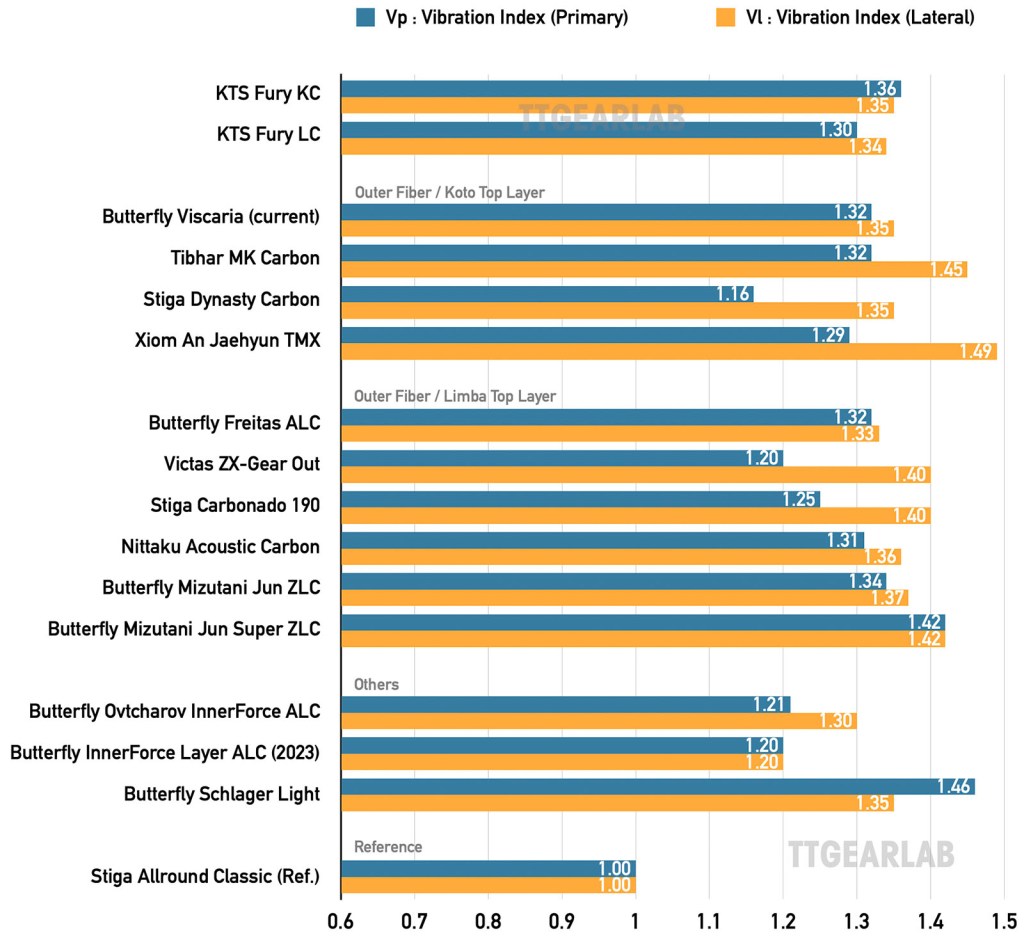
Fig.18 shows the comparison graph of Vibration Indices. Vibration Indices are concerned with feeling. The bigger the value the harder the feeling. Vp indicates primary feeling which is transferred to player’s palm. And, Vl is the feeling at the edge of the wing – the lower side of blade head. It is felt by player’s index finger or middle finger.
We can see that the Vp of ‘Fury KC’ is higher than that of ‘Fury LC’ while there isn’t meaningful difference in Vl. So, the graph shapes of those two blades are different from each other. And, players will feel much difference between two blades.
Then, let’s compare other blades by group with two models ‘Fury’ series.
[Outer Fiber / Koto Top Layer]
The outer fiber blades with Koto top layers can be compared mainly with ‘Fury KC’. The Vp of ‘Fury KC’ is higher than the Vp of any model in this group. It means that the primary feeling of ‘Fury KC’ is harder than those of the outer fiber blades in this comparison. But, the Vl’s of the outer fiber blades in this comparison are same as or higher than the Vl of ‘Fury KC’. Especially the Vl’s of ‘MK Carbon’ and ‘An Jaehyun TMX’ are much higher than the Vl of ‘Fury KC’. And, there isn’t any model whose Vl is lower than Vp like ‘Fury KC’. Vl is higher than Vp for all four models, and the values of ‘Viscaria’ is quite close to that of ‘Fury LC’.
[Outer Fiber / Limba Top Layer]
The outer fiber blades with Limba top layers can be compared mainly with ‘Fury LC’. Especially ‘Freitas ALC’ can be directly compared with ‘Fury LC’. The Vp and the Vl of ‘Freitas ALC’ are a bit higher and a bit lower than those of ‘Fury LC’ respectively. So, there is difference in feeling between ‘Fury LC’ and ‘Freitas ALC’, although the difference isn’t significant. Probably the players will feel that the feeling of ‘Acoustic Carbon’ or ‘Mizutani Jun ZLC’ is closer to that of ‘Fury LC’ because of similar type of graph shape. And, with much lower Vp’s and much higher Vl’s, ‘ZX-Gear Out’ and ‘Carbonado 190’ give significantly different feeling compare with ‘Fury LC’. Finally. ‘Muzutani Jun Super ZLC’ shows the highest values of Vp and Vl in this group. Because of the graph shape, ‘Mizutani Jun Super ZLC’ also gives significantly different feeling from ‘Fury LC’. But, probably there will be players who feel that the feeling of ‘Mizutani Jun Super ZLC’ is a bit harder than, but quite similar to the feeling of ‘Fury KC’.
[Others – inner ALC & 3+2 ply Hinoki Carbon]
Two inner ALC blades show much lower indices than ‘Fury LC’ or ‘Fury KC’. Especially the Vp’s of ‘Ovtcharov InnerForce ALC’ and ‘InnerForce Layer ALC’ are much lower than those of ‘Fury’ series. So, the primary feeling of ‘Ovtcharov InnerForce ALC’ or ‘InnerForce Layer ALC’ is much softer than that of ‘Fury KC’ or ‘Fury LC’. Regarding Vl, the Vl of ‘Ovtcharov InnerForce ALC’ is quite close to those of ‘Fury KC’ and ‘Fury LC’. So, there isn’t significant difference in the absolute feeling transmitted to index finger between ‘Ovtcharov InnerForce ALC’ and ‘Fury’ series. However, because the Vp is much lower than the Vl of ‘Ovtcharov InnerForce ALC’, many players who are more sensitive to the relative feeling will think that ‘Fury KC’ and ‘Fury LC’ doesn’t give the feeling as sharp as that of ‘Ovtcharov InnerForce ALC’. ‘Schlager Light’ which is a very hard/fast 3+2 ply Hinoki-Carbon blade shows very high Vp (= 1.46) which is the highest in this comparison, while the Vl of ‘Schlager Light’ is same as that of ‘Fury KC’ and is just a little bit different from that of ‘Fury LC’. Because Vl is much lower than Vp, probably there will be many players who doesn’t feel ‘Schlager Light’ very stiff. And, if the player wants to reduce the stiff primary feeling of ‘Schlager Light’ while keeping lateral feeling, ‘Fury KC’ will be the good solution.
Examining Vl/Vp is easier way for the comparison of the tendency of feeling. Fig.19 shows the relationship between Vl/Vp and Vp for easier comparison.
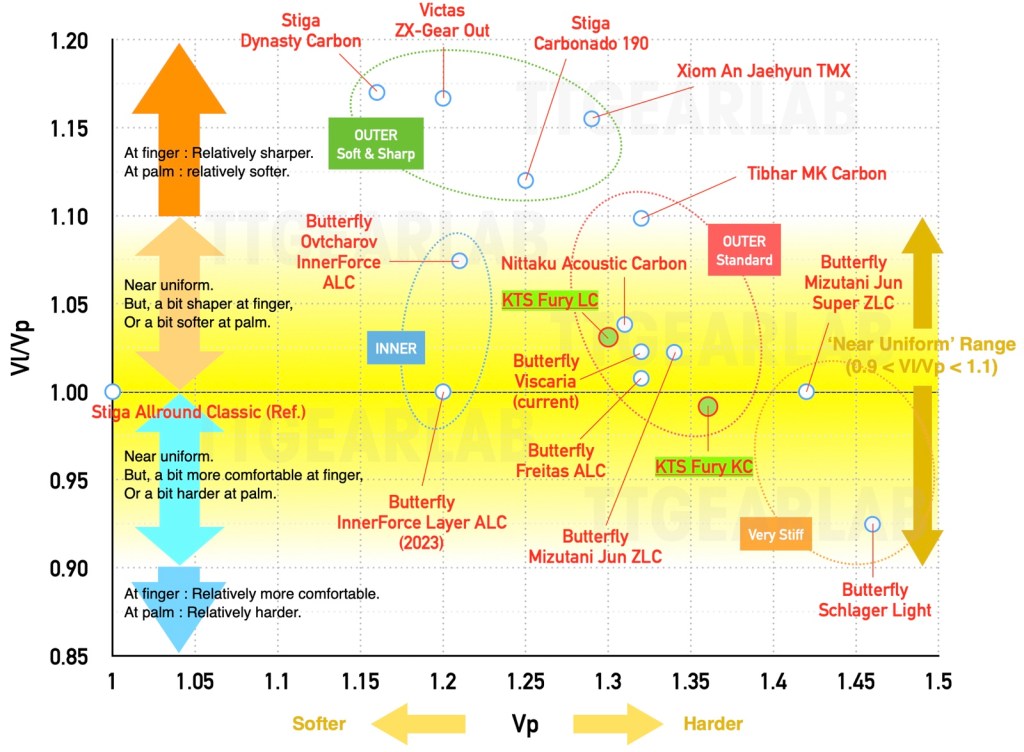
On the graph, most of the blades in this comparison are placed in upper part of the graph – ‘Relatively sharper at finger’ range. Two are in lower part of the graph – ‘Relatively more comfortable at finger’ range. And, three including reference blade are on uniform line.
Both of ‘Fury KC’ and ‘Fury LC’ are in ‘Near Uniform’ range (0.9 < Vl/Vp < 1.1). ‘Fury KC’ is located to lower right of ‘Fury LC’, and the gap between those two are not small. So the primary feeling of ‘Fury KC’ is harder than that of ‘Fury LC’. And, we observed that the lateral feeling of ‘Fury KC’ is also a bit higher than that of ‘Fury LC’. However, some players who are more sensitive to relative feeling will think that ‘Fury LC’ gives noticeably sharper feeling.
By the way, although there is meaningful gap between ‘Fury KC’ and ‘Fury LC’, we can see that those two are gathered in a relatively small area if we look at the graph as a whole. And some known blades such as ‘Viscaria’, ‘Freitas ALC’, ‘Acoustic Carbon’ and ‘Mizutani Jun ZLC’ are also in that area. All of those are outer-fiber blades, and we group the blades in that into ‘OUTER Standard’ group. The blades in this group can be considered as the outer-fiber blades of standard or regular type. If we set the group somewhat large, ‘MK Carbon’ can also be grouped into it. In this group, ‘Fury KC’ is located at bottom right, and ‘Fury LC’ is located at middle left.
‘OUTER Standard’ group can be compared with the group of inner-fiber blades. We can see the vertical locations of the blades in ‘INNER’ group (= the group that includes two representative inner ALC blades) are not much different from those of the blades in ‘OUTER Standard’ group. However, there are significant differences in Vp. ‘OUTER Standard’ group us located to right of ‘INNER’ group. It means that outer-fiber blades of regular type are harder than the inner ALC blades.
Among the blades in this comparison, there are outer fiber blades whose Vl/Vp’s are especially high. Those are in ‘Relatively sharper at index finger’ range (V/Vp > 1.1). And, because the Vp’s of those for are under 1.3, we can group those four as ‘OUTER Soft & Sharp’ group. Within this group, ‘An Jaehyun TMX’ is the hardest model, and ‘Dynasty Carbon’ is the softest model. No Butterfly or Nittaku blade is in that group. And, there are significant gaps between ‘Fury LC’ and one blade in this group. Although ‘Fury LC’ can be considered as a ‘soft & sharp’ blade in ‘OUTER Standard’ group, the softness and the sharpness of ‘Fury LC’ are not as extreme as those of blades in ‘OUTER Soft & Sharp’ group. ‘Fury LC’ is much closer to outer fiber blades of Butterfly and Nittaku.
‘Fury KC’ shows very high value in ‘OUTER Standard’ group. But, its Vp is not as high as those of ‘Mizutani Jun Super ZLC’ and ‘Schlager Light’. Those two can be categorized as ‘Very Stiff’ group. If the player think that those two are somewhat to stiff, ‘Fury LC’ can be good solution to reduce the stiffness. Because of the top layer, ‘Freitas ALC’ may be the better solution than ‘Fury LC’ for the adjustment from ‘Mizutani Jun Super ZLC’. But, when the player wants to change the 3+2 ply Hinoki Carbon blade such as ‘Schlager Light’ to outer-fiber (especially outer ALC) blade of standard type, ‘Fury KC’ will be better solution than another blade in that group.
Please click here to return to top (table of contents)
4. Summary
The ‘Fury’ series is a new top model outer-fiber blade family launched by KTS which doesn’t have outer-fiber model it its blade range so far. The two models in ‘Fury’ series – ‘Fury KC’ and ‘Fury LC’ – share most of features. Two models are distinguished by the kind of top layer. The characteristics of ‘Fury KC’ and ‘Fury LC’ can be summarized as follows.
‘Fury KC’ is the outer fiber blade whose artificial material is CoreAL Carbon (= ALD) and whose top layer is Koto. ‘Fury KC’ provides very high primary elasticity, and it doesn’t hug ball deeply when the player hits the ball very strongly. Players will feel that ‘Fury KC’ is a very fast blade and it gives more kick than ordinary outer fiber blades. Regarding feeling, the primary feeling of ‘Fury KC’ is harder than that of ordinary outer fiber blades. On the contrary, the feeling transmitted to index finger through the wing of blade is less hard than the primary feeling. These characteristics fit for hard hitters who want to finish the rallies by powerful topspin or destructive smash after taking the advantage of rally by preemptive attack by topspin. ‘Fury KC’ can be categorized as ‘Viscaria Type’ if we just see its construction, but its actual characteristics are somewhat different from those of ‘Viscaria’.
‘Fury LC’ is the outer fiber blade whose artificial material is CoreAL Carbon (= ALD) and whose top layer is Limba. Like ‘Fury KC’ which is the Koto top layer version, ‘Fury LC’ also provides very high primary elasticity. However, differently from ‘Fury KC’, ‘Fury LC’ hugs the ball deep when the player hits the ball very strongly. For that reason players may feel that ‘Fury LC’ is slower than ‘Fury KC’, but instead they will feel that ‘Fury LC’ provides higher stability and safety. Regarding feeling, ‘Fury LC’ is softer but transmits sharper feeling to index finger when compared with ‘Fury KC’. The overall feeling of ‘Fury LC’ is comparable to some known outer fiber blades of Butterfly and Nittaku, but ‘Fury LC’ is a bit softer in primary feeling. These characteristics fit for the players who play with continuous topspin at close-to-table area or from mid-distance. Finishing by powerful topspin or smash is sufficiently possible thanks to its very high elasticity level. And, it will be also easy to produce high power of topspin from mid-distance. However, because of high elasticity, a certain level of skill will be required if the player wants to aim at very early timing off the bounce for aggressive topspin. Between two models of ‘Fury’ series, ‘Fury LC’ can be regarded as the standard outer-ALC blade of KTS.
Both of ‘Fury KC’ and ‘Fury LC’ provide very high elasticity that we can expect from outer fiber blades. With ‘Fury KC’ or ‘Fury LC’, players will not fee the lack of speed or power. However, other than the commonality that both of those two are fast blades, the characteristics of those two are clearly distinguished from each other. If the player likes hard hitting, ‘Fury KC’ will be the proper choice between two. It can be a good choice in case the player who has used 3+2 ply Hinoki Carbon blade but want to change to outer-ALC blade. If the player lays emphasis on continuous attack by topspin, ‘Fury LC’ will be the better choice between two. And, ‘Fury LC’ will be good solution in case the player who has used inner ALC blade wants to increase the elasticity of blade.
Please click here to return to top (table of contents)
 TTGearLab
Bonjour. Il est vrai que certaines lames KTS ne sont disponibles qu’avec un manche concave à l’instar de DHS. Dans une revue précédente vous indiquiez que la série des bois DHS Hurricane 301 n’étaient disponible qu’avec un manche concave. Pourtant le distributeur TT11 propose Le DHS hurricane 301 avec un manche droit mais je n’ai vu nulle part que DHS proposait les 301Z, 301T, et 301X avec un manche droit.
https://www.tabletennis11.fr/dhs-hurricane-301
D’après le website de TMount, les deux références de la série KTS PROBLADE FURY sont disponibles avec un manche droit.
https://m.ttmount.com/category/kts-shakehand-blade/46/
Au vu de leur catalogue on pourrait penser que la série FURY est une mise à jour de lames déjà existantes chez TMount comme la “KTS Core ALC”ou bien encore la “KTS 760”
https://m.ttmount.com/product/kts-core-alc/15/category/46/display/1/
https://m.ttmount.com/article/qa/6/6/?spread_flag=T
https://m.ttmount.com/product/kts-760/41/category/46/display/1/
J’ai remarqué que certaines lames KTS étaient produites en Corée comme la série PROBLADE FURY et que d’autres comme la KTS 760 ou encore la 920 étaient elles produites en Chine, ce qui doit expliquer la différence de prix entre toutes ces références.
Par ailleurs, Vous comparez la série KTS PROBLADE FURY avec notamment le Nittaku Acoustic Carbon, je pense que les nouveaux bois Nittaku de la série IRODORI, “Gyo-En”et “So-Ten” serait de conception plus proche bien que d’une épaisseur moindre et d’un matériau composite différent “KVC3”. Je serais très intéressé par un test de ses deux lames.
https://www.nittaku.com/products/rackets/post-158
Encore merci pour votre travail et vos analyses remarquables.
LikeLike
Thank you a lot for comment and additional information!
Regarding H301 series, I have just remembered that original H301 has ST handle. I will correct that statement. Thank you a lot for pointing it out.
Regarding Fury series, I directly asked KTS on the availability of ST handle and have heard that ST isn’t available for Fury series. Probably you will notice that the stock of ST is zero when you try to buy it on that home page. Maybe ST will be added in the future, and then I will correct the article.
Regarding Nittaku blades, I’m considering to get Gyo-En and So-Ten. Those two are in-house blades of Nittaku.
LikeLike
Thank you for the article on the introduction of T-Mount blades because this is the first time I heard about this Korean company. It looks like Koto, Limba, Ayous and Kiri are proven wood used in most of the table tennis blades in the market. Harder wood like Ebony, Wenge or Walnut are seldom used in modern carbon blades now. Can you share your knowledge and characteristics of those harder wood as top layers?
I tried to search on more information on the KTS KC or LC and came up empty handed, so they must be very new. All I can find is the KC and LC blades are listed for $225 US in the company website and certainly aiming at the high end market.
LikeLike
In fact, the character of wood should be dealt with the whole blade because the wood of top layer alone can’t express the characteristics of blade, except for the ball touch of surface. (But, I think that the hardwood blades will increase along with the spread of sticky rubbers with hard sponge, because hardwood top layer fits very will with those rubbers.)
Fury KC and Fury LC are high end products made in-house by KTS. But, if you want the blades with higher cost-performance, you will be able to find KTS Ngneered series.
LikeLike
Hi, thank you for your article. Could you please compare the shape of the handle of both the Fury KC / LC to the shape of the handle on the Grubba Carbon and on the Viscaria-like blades?
Also, what is the balance of the Fury KC and Fury LC (head-heavy, balanced, handle-heavy)?
Thank you!
LikeLike
The FL handle shape of KTS blades is totally different from current standard FL shapes. It is like the classic handle of 1980~1990’s.
If you know Butterfly Gergely, you will be able to notice the similarity between Gergely FL handle and KTS FL handle. The handle top is completely flat. Although the edges are smoothed, we can feel that the handle has clear edge. It gives quite stable feeling even though the handle is not wide.
Regarding balance, I think that Fury KC and LC are balanced. There may be some players who feel that those are head heavy. (Especially in case they selects heavy ones.) At least those two are not handle heavy.
LikeLiked by 1 person
Thank you for your feedback!
LikeLike