Yasaka is one of top Japanese brands. But, for long time Yasaka has dealt with the blades made in Sweden. ‘J.P Gatien Extra’ that was launched in the middle of 1990’s is the first Swedish blade introduced by Yasaka. Afterwards Yasaka introduced new Swedish blades named after Ma Lin who had been one of the top Chinese players. Yasaka ‘Ma Lin Extra Offensive’ is the first model of new ‘Ma Lin’ series, and it became great hit after Ma Lin won a gold medal of Men’s Singles at the 2008 Olympic Games. And, Yasaka added more models such as ‘Ma Lin Carbon’. The blades of ‘Ma Lin’ series aren’t the representatives of Yasaka blade range now because those were launched more than 10 years ago. However, those are still serious considerable.
The representatives of ‘Ma Lin’ series are two early models – ‘Ma Lin Carbon’ and ‘Ma Lin Extra Offensive’. Regarding two models please refer to the article : “Yasaka Ma Lin Carbon & Ma Lin Extra Offensive [Full Review]“. After the release of two models more variations has been added to the series, and one of them is ‘Ma Lin Soft Carbon’ which is based on ‘Ma Lin Carbon’ but provides softer feeling and better control.
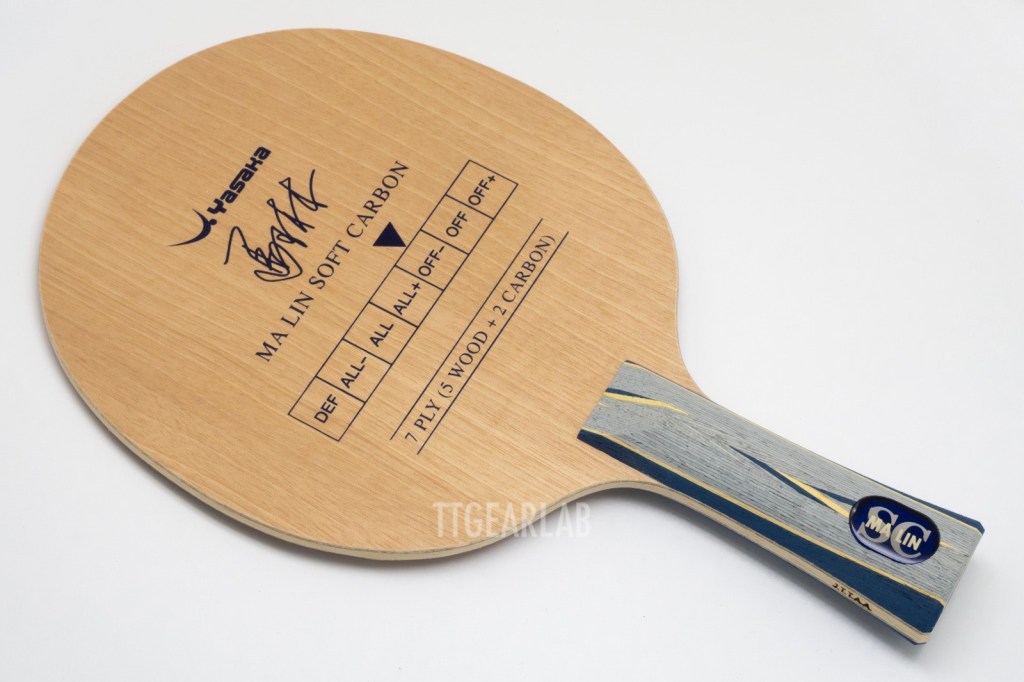
‘Ma Lin Soft Carbon’ is also made in Sweden, like the other blades in ‘Ma Lin’ series. ‘Ma Lin Soft Carbon’ is a bit slower than ‘Ma Lin Carbon’ but provides more safety and stability.
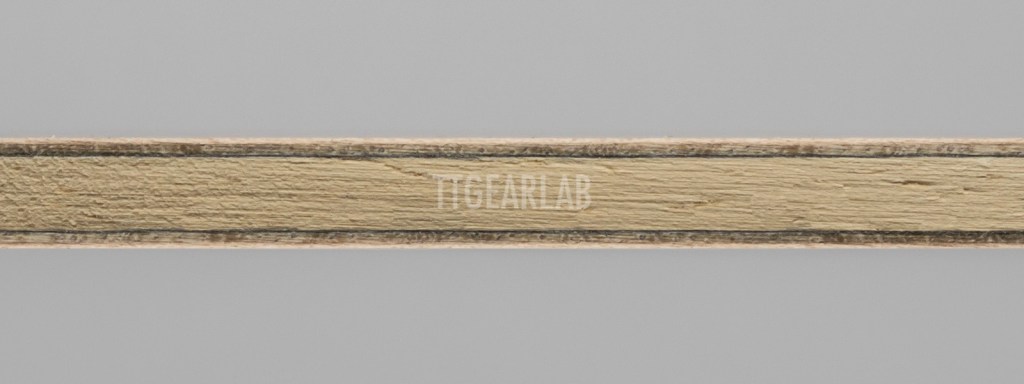
The construction of ‘Ma Lin Soft Carbon’ is an inner fiber construction tha Fleece carbon is inserted between the middle layer and the center layer. The top layer is Akazie, the middle layer is Limba and the center layer is Ayous. Overall thickness is around 5.5mm. This structure appears to have been swapped between the top layer and the middle layer of ‘Ma Lin Carbon’
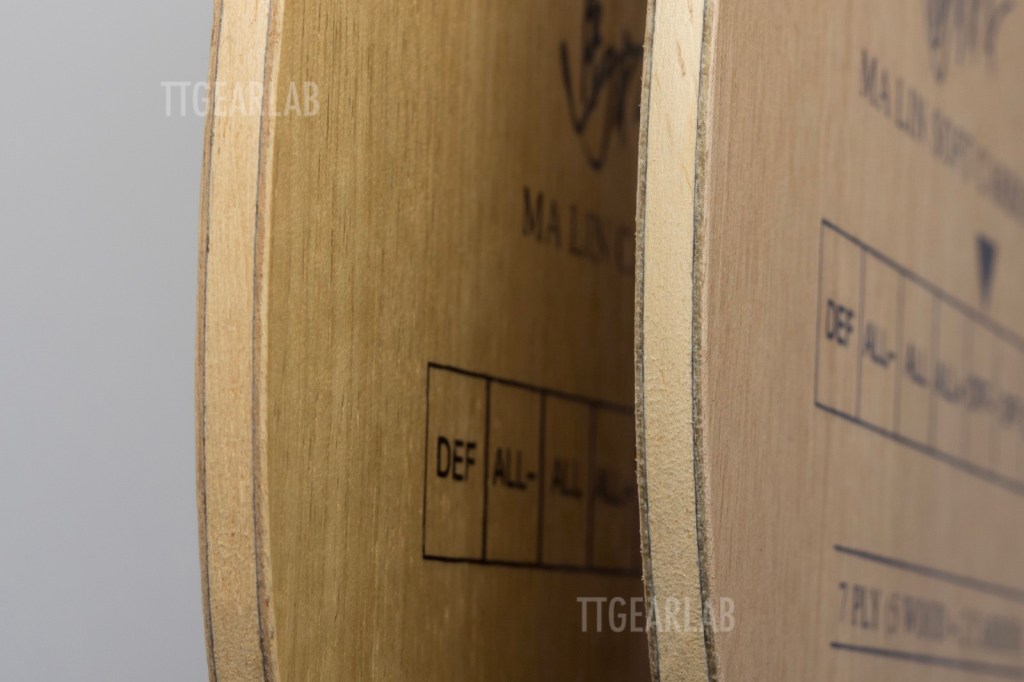
Left is ‘Ma Lin Carbon’ and right is ‘Ma Lin Soft Carbon’. We can see the difference in the top layer and the middle layer.

The size of head is 157.0mm x 150.0mm. It is the standard size for many shakehand blades.

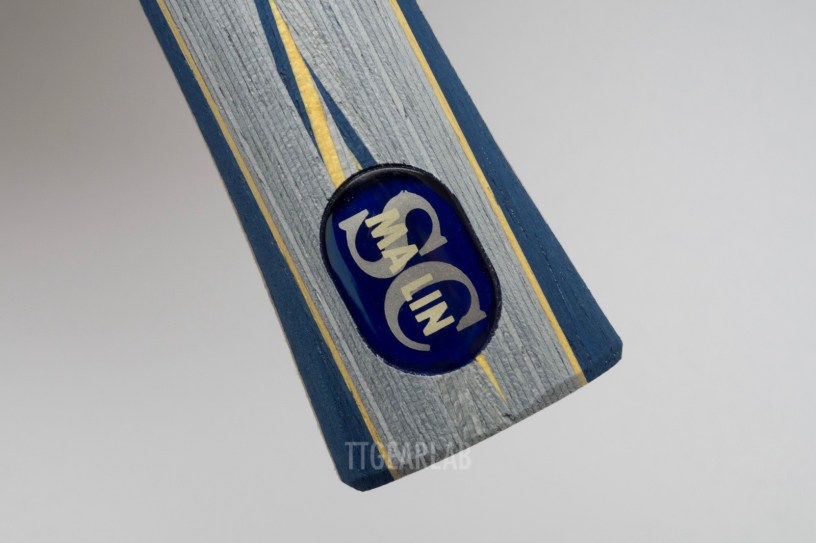
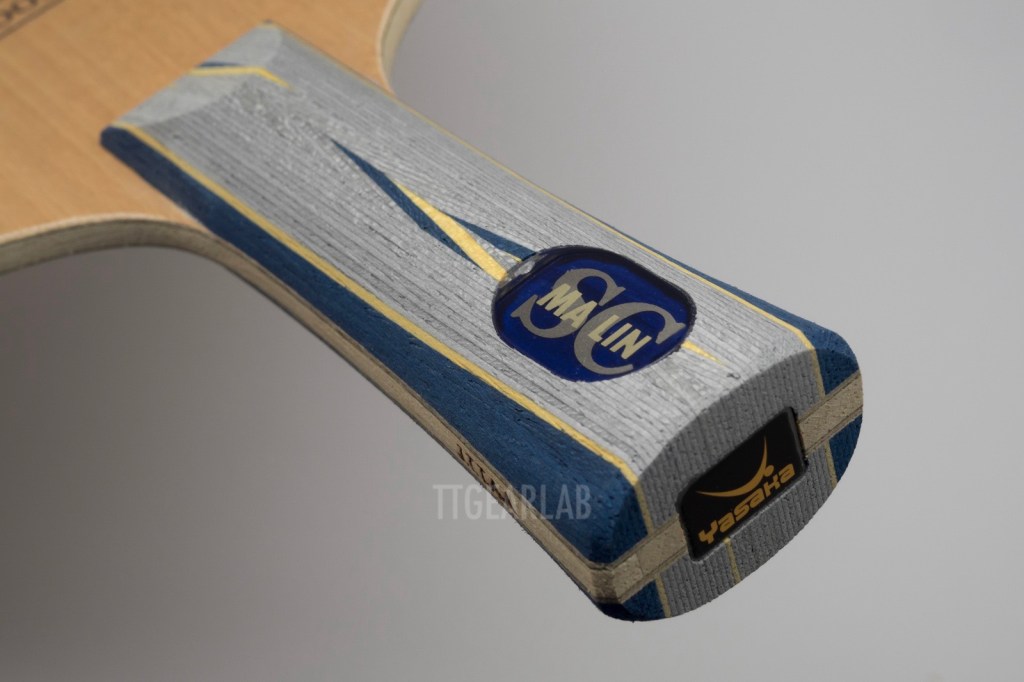
The garphic design of handle inherits that of ‘J.P.Gatien’ series that is the representative blade family of Yasaka in 1990’s, but the addition of two yellow lines makes the impression somewhat different. The FL (flared) handle is shown in above picture. Its width is around 27mm (at top) ~ 28mm (at bulge) ~ 27mm (at waist) ~ 34.5mm (at the end), and its thickness is around 23mm (at thumb) ~ 25mm (at the end). The cross section of the FL handle is somewhat rounded when compared with the standard FL of Butterfly, but it gives firm and comfortable grip. The size of ST (straight) handle which isn’t shown in the picture is around 29.5mm (width) x 22mm (thickness). The ST handle is somewhat flat, and gives extremely stable grip.
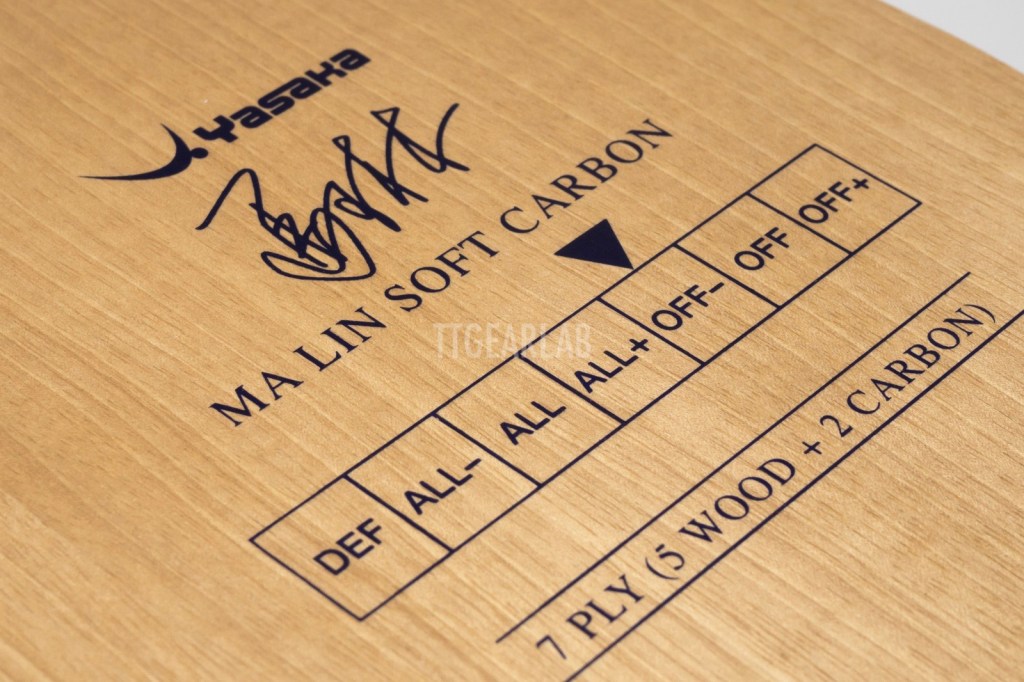
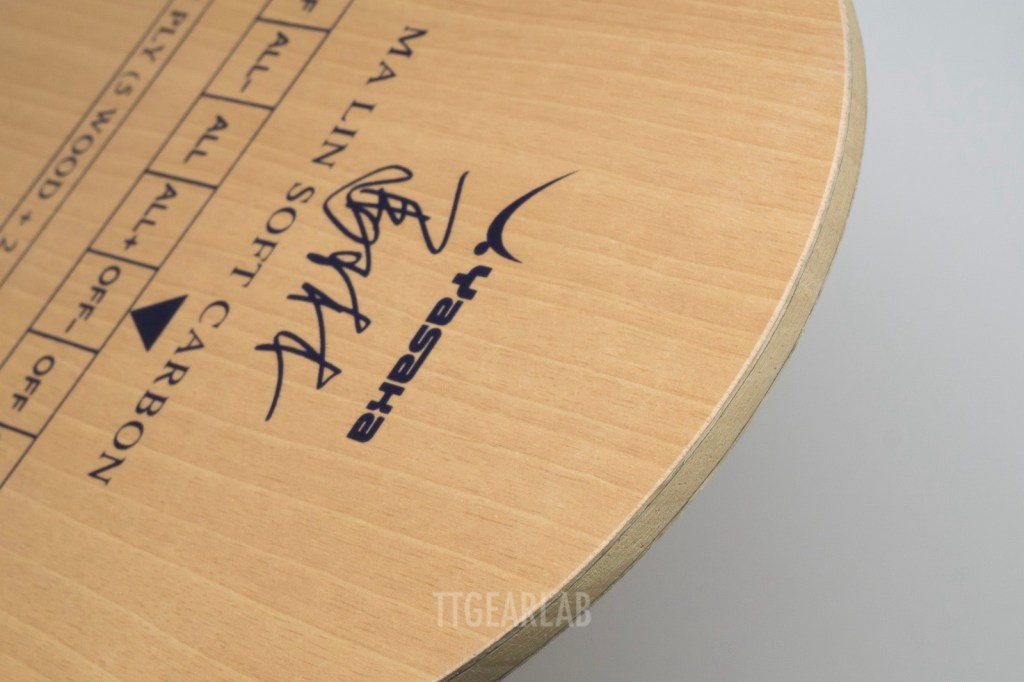
The speed sign in the indicator which is printed on the foreside of head is ‘OFF-‘. That is one step lower than ‘OFF’ which is the speed sign of ‘Ma Lin Carbon’. This difference doesn’t appear in light hitting, but it becomes clear when the player hits the ball strongly.

The foreside lens of ‘Ma Lin Soft Carbon’ is distinguished from that of ‘Ma Lin Carbon’. There isn’t the text ‘OLYMPIC GOLD MEDALIST’ which is written in the foreside lens of ‘Ma Lin Carbon’ or ‘Ma Lin Extra Offensive’
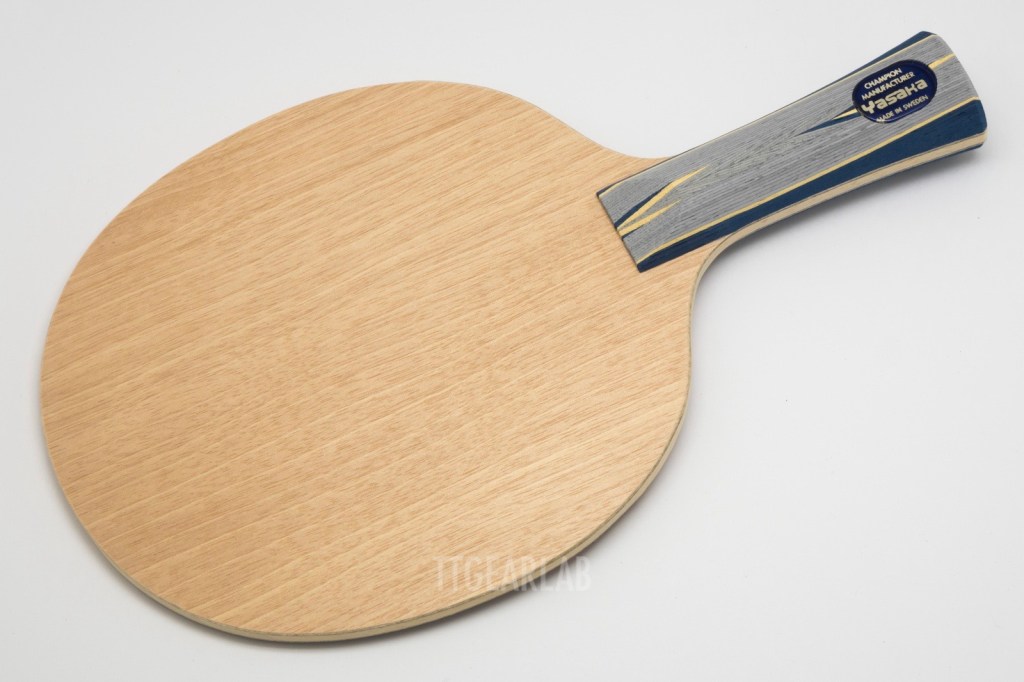
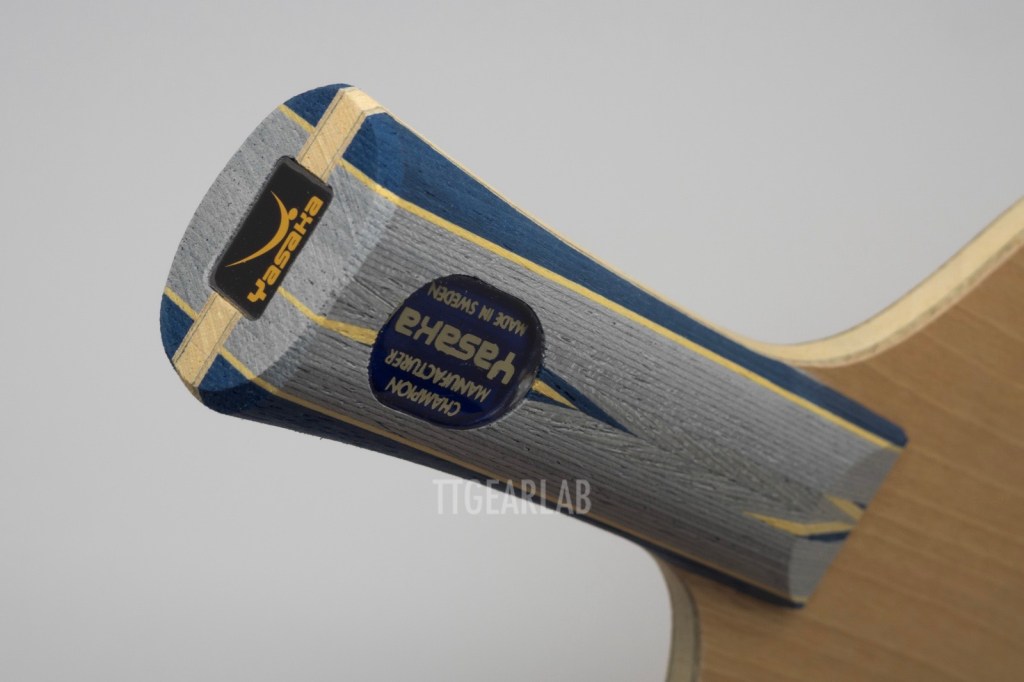
There isn’t printing on the backside of head. But, on the backside of handle, there is the plastic lens whose size is same as that of the foreside lens.
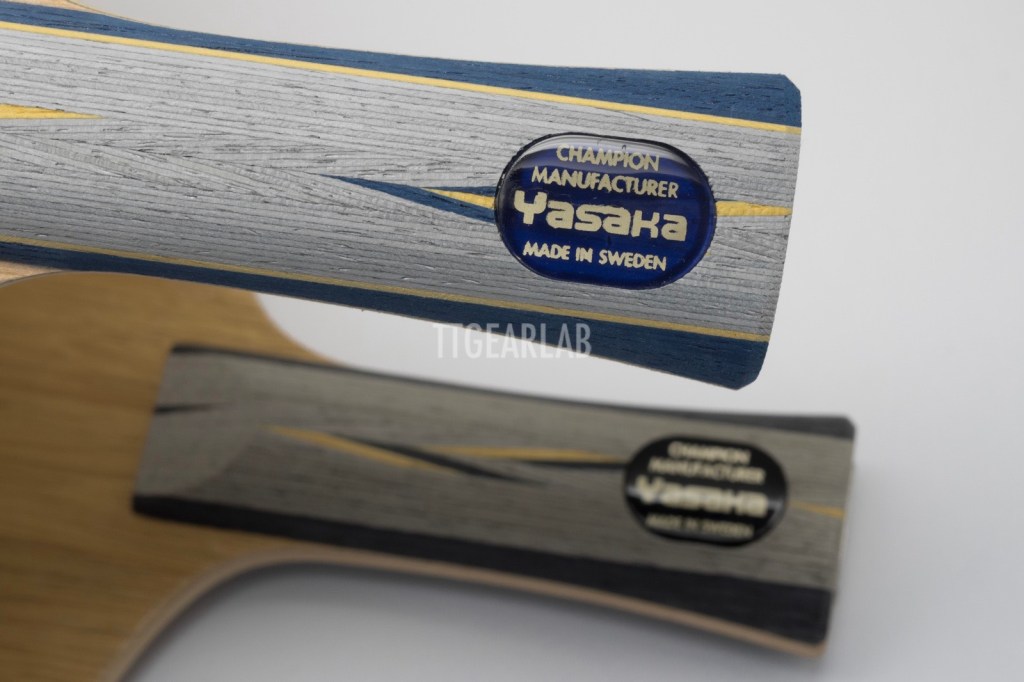
The backside lens is same as that of ‘Gatien Extra 3D’. Its design is basically same as that of ‘Ma Lin Carbon’ shown in the background of above picture. (Only the color is different.)
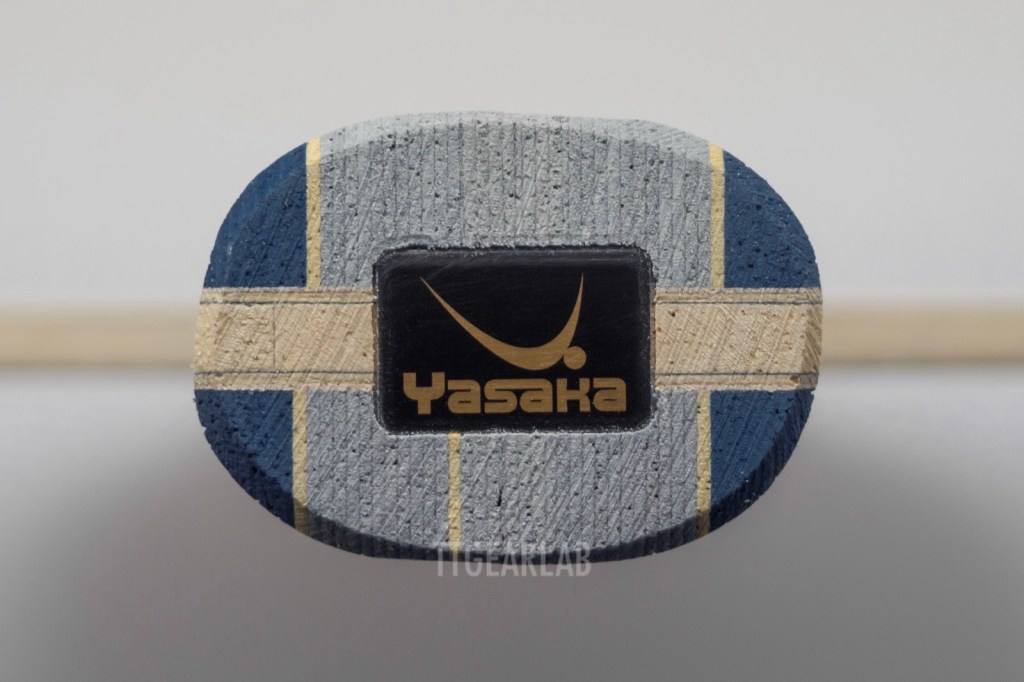
Recent Yasaka blades have squared plastic lens at the end of handle, instead of old metal sticker. The logo of Yasaka is printed in gold color on the black background.
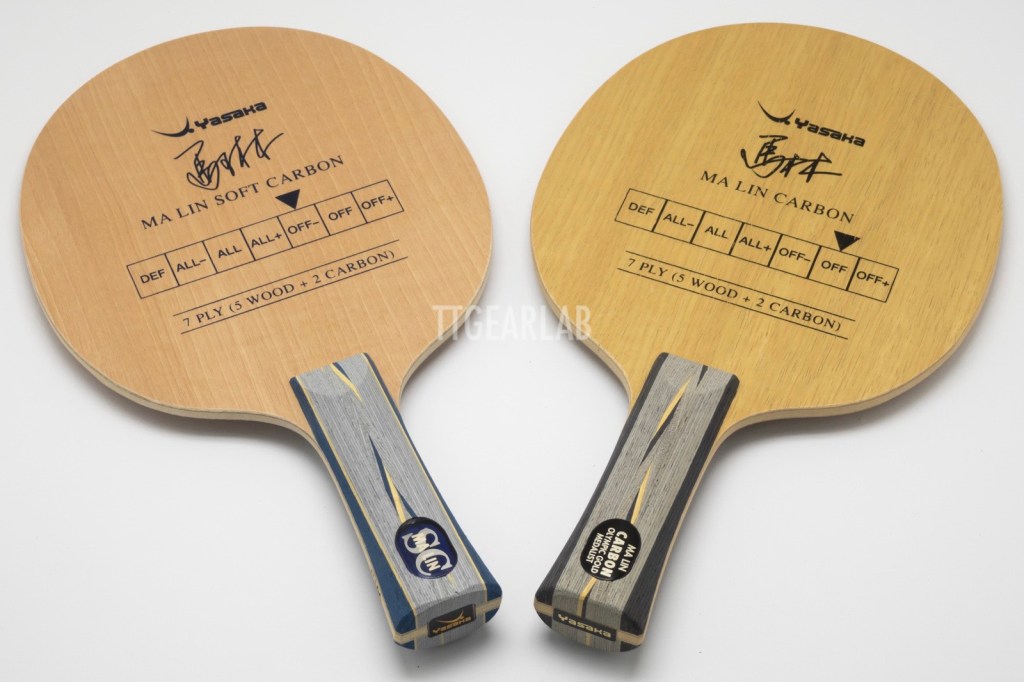
Left is ‘Ma Lin Soft Carbon’, and right is ‘Ma Lin Carbon’.
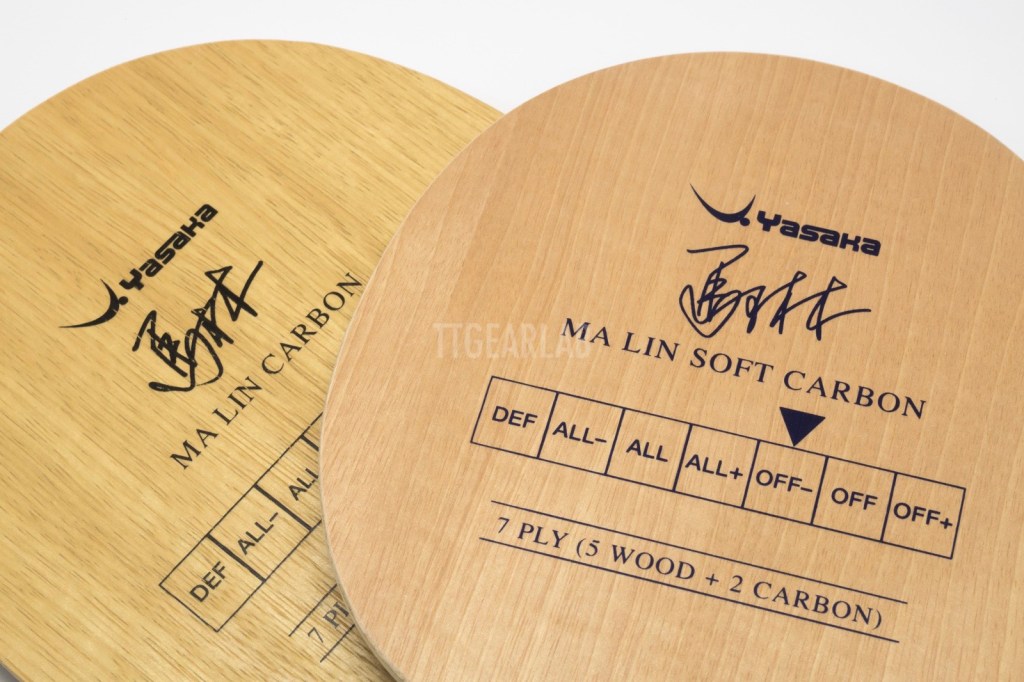
We can see the difference in top layer. The Akazie which is the middle layer of ‘Ma Lin Carbon’ is used as the top layer of ‘Ma Lin Soft Carbon’. Instead, the Limba which is the top layer of ‘Ma Lin Carbon’ is placed one step inside at ‘Ma Lin Soft Carbon’.
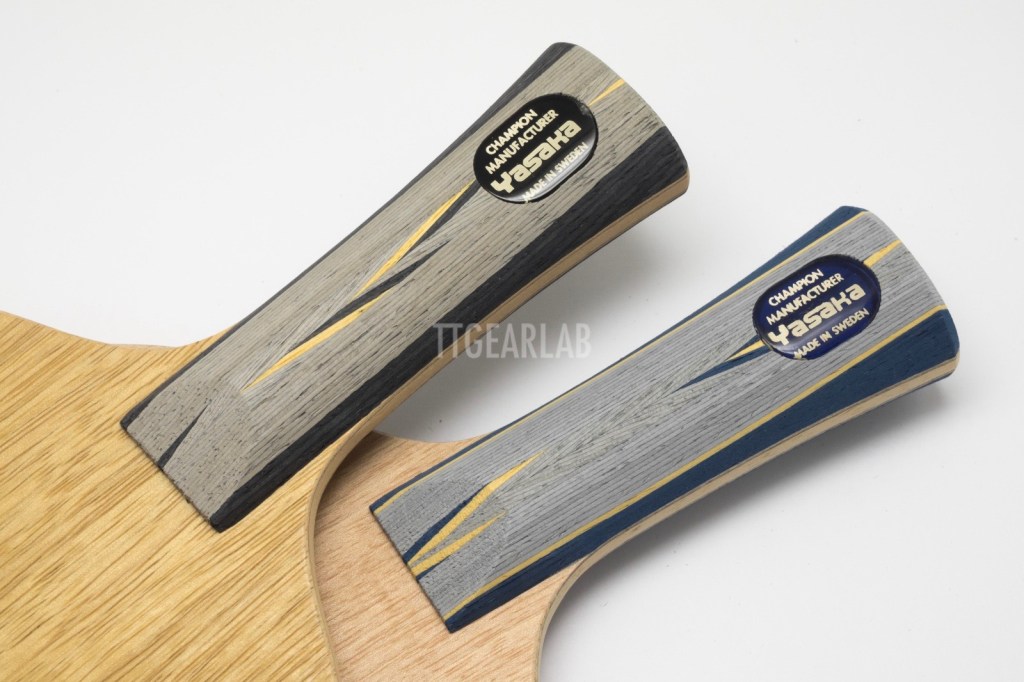
The backside of handles of ‘Ma Lin’ series. Left is ‘Ma Lin Soft Carbon’, and right is ‘Ma Lin Carbon’. This design concept has been around for nearly 30 years since ‘Gatien Extra’. Both of two models are recommended for the players who lay emphasis on softness and stability but need a bit higher energy efficiency than 5-ply wood blades.
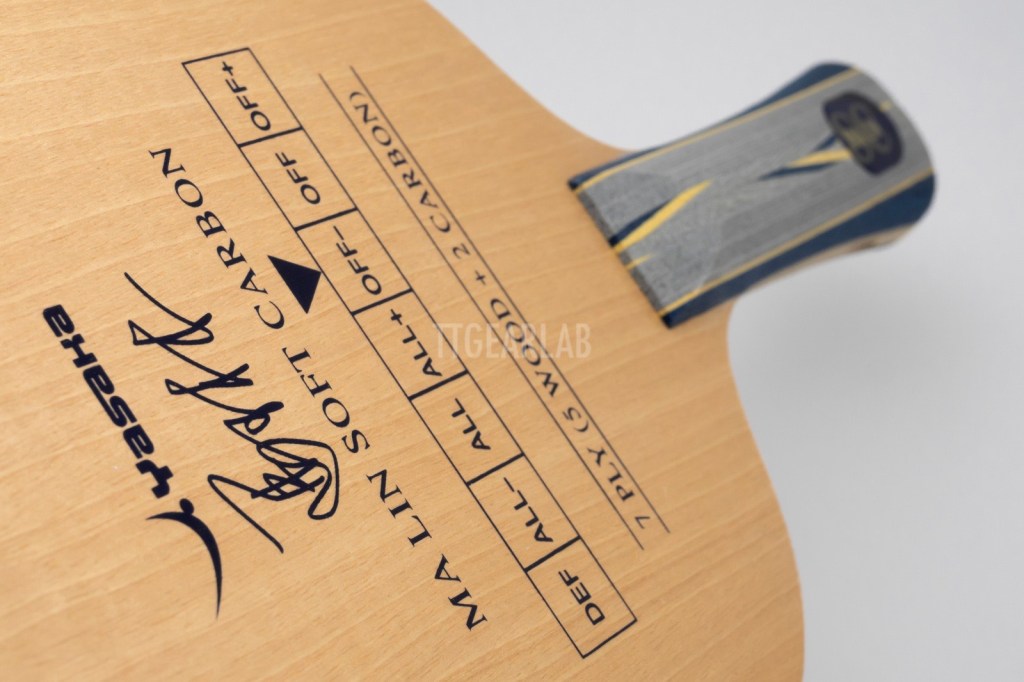
Following are the performance indices of Ma Lin Soft Carbon (avg.weight = 90.1g) :
– Ep = 1.49
– Ec = 1.07 (Ec/Ep = 0.72)
– Vp = 0.97
– Vl = 1.16 (Vl/Vp = 1.20)
Please note that above are average values and can be updated by further measurement.
Unauthorized use and/or duplication of this material without express and written permission from this website’s author and/or owner is strictly prohibited. Excerpts and links may be used, provided that full and clear credit is given to TTGearLab with appropriate and specific direction to the original content.
 TTGearLab
nice, what a low ep/ec. kind of like a little slower original hurricane long 5. with modern hard rubbers and good technique could be nice.
LikeLike
I also think so. 🙂
LikeLike
So, it is better to use this blade with sticky chinese-type rubbers than with tensor rubbers with soft or medium-soft sponge (40-45 ESN)?
LikeLike
It differs by player. But, in my opinion original Ma Lin Carbon will be better for play with non-sticky tensor rubbers.
If you use non-sticky tensor rubber, I recommend you the rubbers which is focused on rotation and has hard sponge. It will provide better balance. (However, please don’t forget that there isn’t right answer in the selection of TT equipment. The solution differs by player.)
LikeLike
Thank you for quick response. Currently I play with Nittaku Factive and Nittaku Flyatt Soft both in max thickness on “Neottec Voodoo Classic” blade. This is my first setup with tensor rubbers. My FH shots was improved but BH, seems, need completly different technic skills (no matter what side of racket I used). Also I used briefly “Yasaka Ma Lin Carbon” with Yinhe Mercury 2 rubbers (both sides) and doesn’t impressed of this combination perfomance, since I also was used Yinhe Mercury 2 rubbers (both sides) on Yasaka Sweden Extra before. So I am looking for a blade, which is sutable with tensor on FH and sticky rubber on BH side.
LikeLike
I have this blade with Rakza 7 soft max both sides. It’s very easy to loop with but short pushes tend to pop up. I assumed this was down to the rubber.
But am I also right to deduce from the measurements that the blade is relatively fast for soft shots compared to hard shots and so with limited skill this makes the short pushes more difficult?
LikeLike
The combination of soft blade and rubbers with soft sponges tends to make the short push pops up.
If that case happens, more forward movement of racket is needed to raise the stability of short push.
(Or we’d better attack more aggressively instead of performing short push.)
LikeLike
Any chance you’ll have values for the Yasaka Extra Offensive 7 Power sometime soon ?
I started to really appreciate some characteristics of the YEO (coming from a Zetro Quad) and am wondering if the 7 Power is a good pick for more speed, especially away from the table. Either that or a more expensive ALC blade.
Thanks for the reviews btw !
LikeLike
Thank you for comment. Extra Offensive 7 Power is on the list of blades to be tested. I don’t know timing that I will get the sample, but I will anyway deal with that blade.
(But, I’m not sure whether the 7-ply wood blade will fit for the play at mid-far distance area.)
LikeLike
Hi,
it is a bit a site question, do you have Ec Ep Vl Vp for Yasaka Sweden Extra, just for my reference point. Thanks
LikeLike
I don’t have Sweden Extra. But, probably it is almost same as Gatien Extra. Following is the data of Gatien Extra.
Avg.weight = 87.1g
Ep = 1.20
Ec = 0.96 (Ec/Ep = 0.80)
Vp = 0.96
Vl = 1.15 (Vl/Vp = 1.20)
But, this is the data measured long time ago. So I need to newly get the sample of Sweden Extra and check measure its performance.
LikeLike
thank you
LikeLike
hi, i have ma lin sc, but the thickness is 5.8 mm, and i look in website the thickness is 5.8 mm to
LikeLike
Probably there will be difference by pieces. The thicknesses of my pieces are 5.5~5.6mm.
LikeLike
Dear TTGearlab, can you provide measured values for the lightest samples of Ma Lin Soft Carbon? I think that 90 grams for this blade is quite high value.
LikeLike
Not much different from the average. All pieces weigh around 90g. And I don’t have meaningfully light pieces.
Probably the values will be lowered if I can get lighter pieces and update the data.
LikeLike
Please, excuse me, but i had info, that top layer is Anegeria , not Akazie. Wood pattern and soft touch of that blade are also for Anegeria… Akazie is quite hard wood. Of cause, i can be wrong.
Also, i would like said you Great Thanks for your reports and statistics – they are really helpful !
LikeLike
Thank you a lof for comment. This kind of comment is very valuable.
In fact, when the wood used for table tennis blade is called as Akazie, it is same as Anegre. And, it is softer than Limba. I’m not sure whether that is right or not, but that is common for some table tennis factories. When I developed adidas FiberTec Classic, the top layer was sometimes called as Akazie and sometimes as Anigre. That wasn’t hard wood.
Please note that I’m not wood specialist. If you are more special than me on the kinds of wood, probably I have to learn from you. 🙂
Regarding the correct name of the top layer for Ma Lin SoftCarbon, I will ask the factory which produces that blade.
LikeLike
Thanks for your reply.
For my view, anegeria is harder, than limba and softer, than koto and more “ductile” and chip resistant, than both of them.
As for me, that wood is one of the best solutions for spin oriented blades.
For my understanding, dwell time and spin production ability of wood is connected to ratio of longitual shear modulus to longitual modulus of elasticity Glr/Elr
Now best ones:
Nortern white cedar (Thuya Occidentalis) – 0.210
Black Cherry 0.147
Mapple red (soft) 0.133
Mapple sugar (hard) 0.111
Ash, white 0.109
Pine Ponderossa 0.138
Pine Sugar 0.124
Spruce, Endelman 0.124
Unfortunatelly, i can’t find values of shear modulus for anegeria and mansonia – according to structure and properties last one is also looks promising.
And, rosewood and venge from hardwoods, just according to your statistics.
LikeLike
Thank you for information. But, the dwelling time is purely decided by the material of table tennis ball. And, it doesn’t vary by the characteristics of rubber (in case its kind is pimples in) and the characterstics of blade. If the ball is same, dwelling time is always same. What we ‘feel’ as if the ball dwells on the racket is just because of the residual vibration after the ball has already left the racket.
LikeLike
Are you sure about that? Consider: if the bat were made of stone , then the bounce characteristics would be dominated by the ball; but if the bat were made with a feather filled cushion, the soft cushion would dominate and give a much longer time and distance bounce. Real rubbers and blades fall in between of course but range from “hard” to “soft” too.
Andrew.
LikeLike
I can’t say any more about it because that is not the result of my research. That is just the scientific fact proven by other researchers through precise measurement with laser devices and cameras in Germany. But, it doesn’t consider the extreme case as you mentioned. That research is considering only wood/fiber blades and pimple in rubbers those are approved by ITTF and the blade.
LikeLike
Can you give some links or references? Given the range of sponge hardnesses and thicknesses I find it hard to believe it makes no difference.
Wood outer veneer being more a matter of perception than mechanical effect I find more plausible but that’s only because it’s deflection/distortion during ball impact is much smaller than that of the rubber and sponge and ball.
Andrew.
LikeLike
anegre is harder than limba
LikeLike
you are right it is anegeria same like yasaka sweden extra and butterfly gruba all+ harder than limba (and I think softer than koto)
LikeLiked by 1 person
I think that it is softer than Koto. Koro is harder.
LikeLike