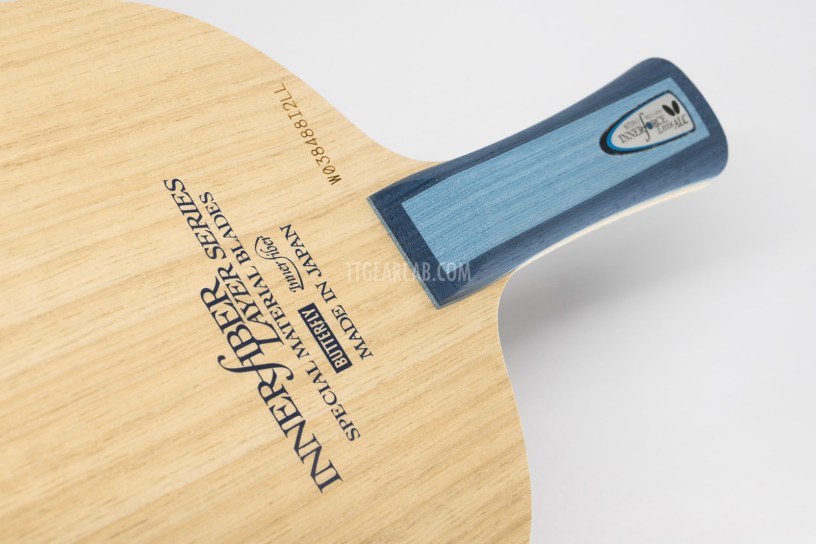
[Update 2023.09.30] At the beginning I thought that the thickness of recent ‘InnerForce Layer ALC’ is aroound 6.0mm. However, when I measured new samples by digital vernier caliper, I noticed that the actual thickness is around 5.9mm. So I modified the value in this article from ‘around 6.0mm’ to ‘around 5.9mm’. Anyway it has been increased from ‘5.7~5.8mm’ of older ones.
[Update 2023.10.02] Newly measure values have been addedd.
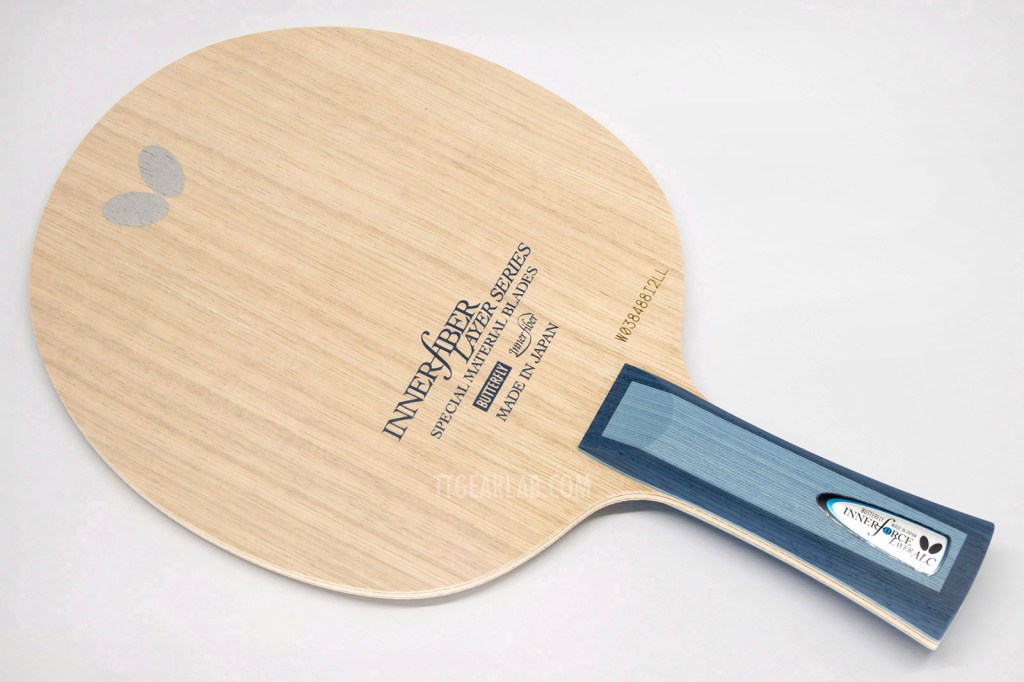
The thickness of Butterfly ‘InnerForce Layer ALC’ is written as 6.0mm on the home page of Butterfly. And, once I had thought that it is 6.0mm. However, so far the thicknesses of the pieces I have measured have been 5.7~5.8mm. (And, probably that is one of the reasons why the thickness of many ‘copy’ products of ‘InnerForce Layer ALC’ is 5.7~5.8mm.) For that reason I have written its thickness as 5.7~5.8mm in the articles on TTGearLab.
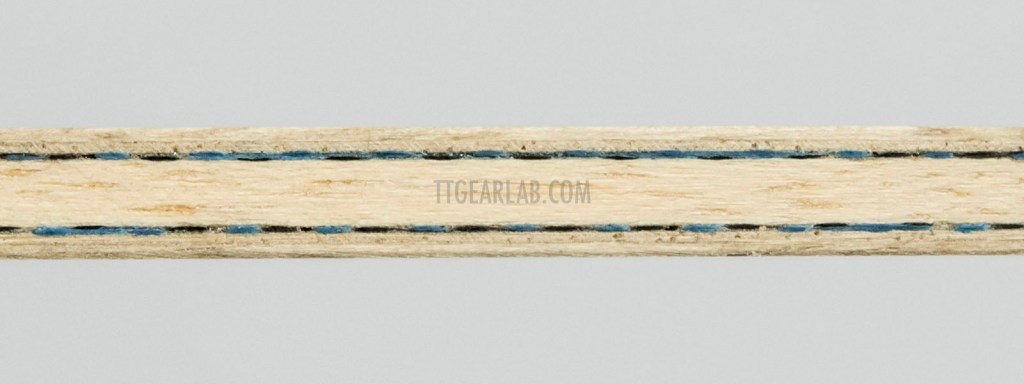
However, from the end of last year (I’m not sure the correct timing) ‘InnerForce Layer ALC’ became heavier. Some people have thought that it is just because heavier wood is currently being used for top players. However, during these some days I have checked the thicknesses of recently produced ‘InnerForce Layer ALC’, because the plywood looks thicker than those of old ones. And, as the result I noticed that the thickness is around 6.0mm around 5.9mm now. It may be just the deviation due to production period. But, there may be change of the Performance Indices.
For that reason I will get some pcs. of recently produced ‘InnerForce Layer ALC’ and measure them for getting I have got some recent pcs. of ‘InnerForce Layer ALC’ and measured to get new average values of Performance Indices. Following is the new data. I will gradually update former articles or add comments describing the values of recent ‘InnerForce Layer ALC’.
Recent version of Butterfly InnerForce Layer ALC (average weight = 91.2g, avg.thickness is around 5.9mm)
Ep = 1.87
Ec = 1.67 (Ec/Ep = 0.89)
Vp = 1.20
Vl = 1.20 (Vl/Vp = 1.00)
New data of ‘InnerForce Layer ALC’ is very similar to that of ‘Harimoto ALC (= Harimoto Tomokazu InnerForce ALC)’. That is a matter of course because there isn’t much difference of thickness now, and the average weight of measured pcs. of ‘InnerForce Layer ALC’ (= 91.2g) is higher than the average weight of measured ‘Harimoto ALC’ (= 88.0g). I expect that if the weight is same, ‘Harimoto ALC’ will be a bit more elastic than ‘InnerForce Layer ALC’. (But, because it doesn’t expected that there will be significant difference, it seems that ‘Harimoto ALC’ is meaningful only in case the player requires bigger head.)
Thanks to Brian S Davis. I could check this because of your comment.
 TTGearLab
Hello,
Great Observation!
Maybe if possible check also the thickness of the Innerforce Layer ALC S version.
Maybe they changed that one as well?
I remember many years ago there was an adjustment done to the Primorac to make the difference to Korbel clearer.
Maybe it is somerhing like that this time also.
LikeLike
I will measure the thickness of InnerForce Layer ALC.S sooner or later. However, I can get only recent once, and I can’t compare it with old ones.
LikeLike
Hello,
I can confirm the information on this. I was looking for a lighter Innerforce Layer ALC and the lightest one available from butterfly europe nowadays is 89 grams.
I am also interested on an analysis of ALC.s and looking forward to that !
Cheers
LikeLike
Thank you for comfirmation. And, the date for ALC.S will soon be available.
LikeLike
Yes. Same here. I’ve been told that one can try to order a lighter one. I’m considering doing that. According to BTY catalog, the “S” version is significantly slower. And since the veneers are also different, it could also mean a slightly different feeling, not just a smaller brother of the innerforce.
LikeLike
InnerForce Layer ALC.S is totally different from InnerForce Layer ALC. Top layer is different, and middle layer is also different. So everything is significantly different. 🙂
LikeLike
Can you share the Nittaku Acoustic Carbon inner’s data?
LikeLike
I couldn’t get the sample of inner version yet.
LikeLike
One more wish I would have: there are also other manufacturers that try to make similar blades like the innerforce ALC.
Kokutaku even names it ALC.
It would be really cool to have such a comparison here of the real alternatives. It’s probably very difficult to get all of those though …
LikeLike
ALC just means Arylate Carbon, and it doesn’t indicate any information about the details of woven fibers. So there can be many variations. One has the carbon fiber only in lateral direction and the arylate fiber only in vertical direction. Another has the carbon fiber and the arylate fiber both in lateral direction and vertical direction. And, there can be more variation by the # of fibers per bundle, the gap between bundle and bundle, weaving pattern, the color of the arylate fiber, the maker of arylate fiber and so on …… But, everything can be called as ALC.
So in my opinion the best way is to just check the performance indices of each product. 🙂
LikeLike
Amazing work as always! Do you have any information, since what series number the thickness change?
LikeLike
Thank you for comment. But, I couldn’t check the timing that the change has occurred. What I know is that current InnerForce Layer ALC is different from the old InnerForce Layer ALC. I was astonished when I checked the plywood of InnerForce ALC this year because it isn’t that of old InnerForce Layer ALC but that of Harimoto Tomokazu InnerForce ALC. 🙂
LikeLike
Interesting. I have a 2023 innerforce layer alc weighting 88-89g. So it’s properties should be more like you old review of the blade, or the new one? I guess 5g weight difference makes a big difference in blade properties?
LikeLike
Probably new one. You will be able to check it by the thickness of top and middle layer. If ‘top layer + middle layer’ looks somewhat thick, it is new version. I think that InnerForce Layer ALC has been new one from at least 2~3 years ago. (Or maybe 4 years ago?)
Regarding the weight difference, it differs by case.
I have seen many cases that it just affects the elasticity a little. Those are the cases that one is 2~3 g heavier than avg. or design weight and the other is 2~3 g lighter than avg. or design weight.
On the contrary, if the weigh is too different from design weight of avg. weight, the difference becomes more significant.
However, the case of InnerForce Layer ALC isn’t because of weight but because of thickness. IF Layer ALC of some years ago was noticeably different from Harimoto ALC. But, there isn’t difference between the construction of IF Layer ALC and that of Harimoto ALC.
(And, as I wrote in the article, I hadn’t noticed it until the end of this September. I was astonished that current IF Layer ALC is different from that of 2018, and I have been forced to modify all articles those include IF Layer ALC.)
LikeLike
Buna ziua.
Am gasit la Innerforce Layer ALC doua coduri diferite pe doua cutii diferite, si anume
36701 si 36704 . Produsul fiind acelasi.
Puteti da o explicatie. Poate unul e fabricat in Japonia si altul in Europa.
Multumesc.
LikeLiked by 1 person
Both are made in Japan. I don’t know InnerForce Layer ALC which is made in Europe.
The difference of code indicates the difference in handle shape.
36701 is the code for the FL handle, and 36704 is the code for the ST handle. Butterfly and some manufacturers use different codes for different types of handles.
LikeLiked by 1 person
https://fr.butterfly.tt/innerforce-layer-alc.html
La fabricant, se poate vedea unde sant facute Innerforce Layer ALC.
DECI NU IN JAPONIA !!!
LikeLike
Multumesc de informatii.
Codurile sant pentru lemn cu maner drept si celalalt pentru maner concav.
Pe saitul Butterfly din Franta, cred, , scrie ca Innerforce ALC se fabrica in Germania.
Pot trimite imaginea, dar nu stiu cum . Am facut print screan
Multumesc. Ganduri bune.
LikeLike