
| Table of Contents | 1. Overview 2. Performance Indices 3. Comparison by Performance Indices ……. 3-1. Elasticity Indices ……. 3-2. Vibration Indices 4. Summary |
Butterfly’s ‘OuterForce’ series, released in March 2025, is the blade family for intermediate level players which is recommended as the next step of entry-level blades. Therefore, ‘OuterForce’ series is easier to handle and lower in elasticity when compared to existing outer-type blades in Butterfly range. Of course, ‘OuterForce’ series is faster than that of Butterfly inner-type blades represented by ‘InnerForce Layer’ series, because artificial fiber is located directly under its top layer. ‘OuterForce’ series consists of three models – ‘OuterForce ZLC’, ‘OuterForce ALC’ and ‘OuterForce CAF’. Three models share a basic construction, differeing only in thickness and artificial materials.
In this article, TTGearLab will analyze those three models by Performance Indices, and compare those four with some other inner fiber blades from other brands.

1. Overview
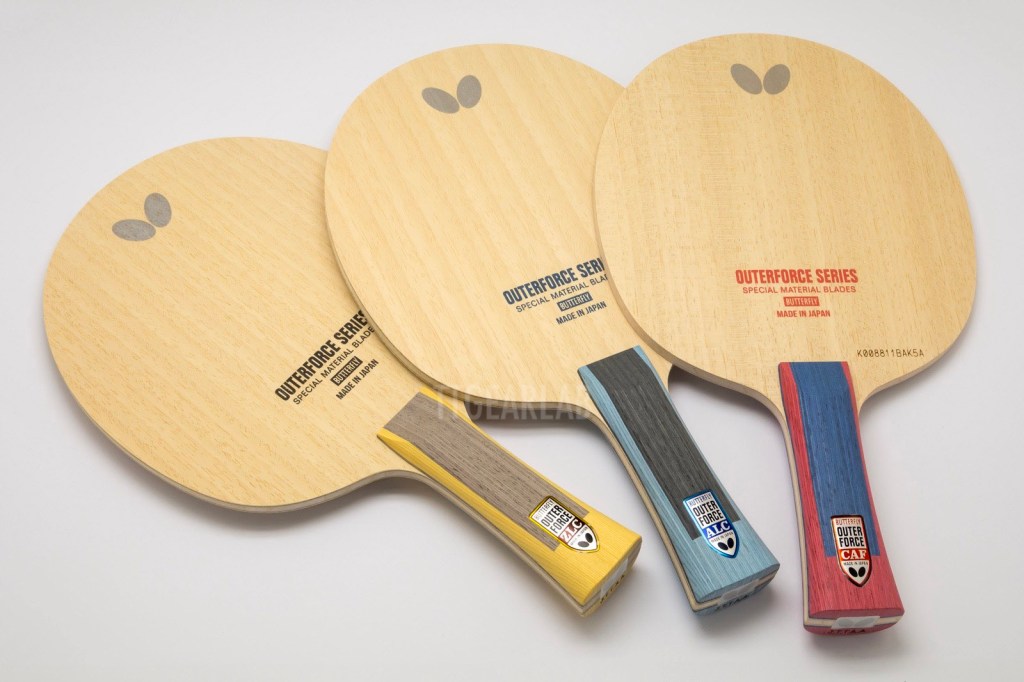
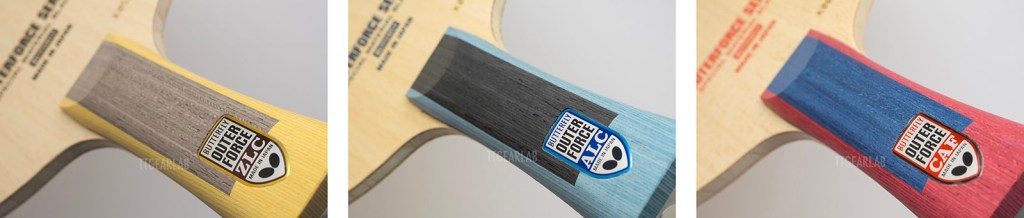
‘OuterForce’ series consists of three models – ‘OuterForce ZLC’ (left), ‘OuterForce ALC’ (middle) and ‘OuterForce CAF’ (right). Three models share a basic construction – 5+2 ply outer-type construction with Ayous top layer. It is very unusual that the name of each model isn’t printed on the head. Instead, only the series name is shown in the printing on the head.

All three models share the basic construction – 5+2 ply outer-type with Ayous top layer. However, the differences are in the kind of artificial fiber and the thickness. ‘OuterForce ZLC’ (left) is an outer ZLC blade of 5.8mm thickness (= around 5.9mm in actual measurement), ‘OuterForce ALC’ (middle) is an outer ALC blade of 6.2mm thickness (= around 6.1mm in actual measurement), and ‘OuterForce CAF’ (right) is an outer CAF blade of 6.3mm thickness. The size of head is around 157mm x 150mm. Not different from the head size of ‘Timo Boll’ series or ‘InnerForce Layer’ series
1-1. Butterfly OuterForce ZLC
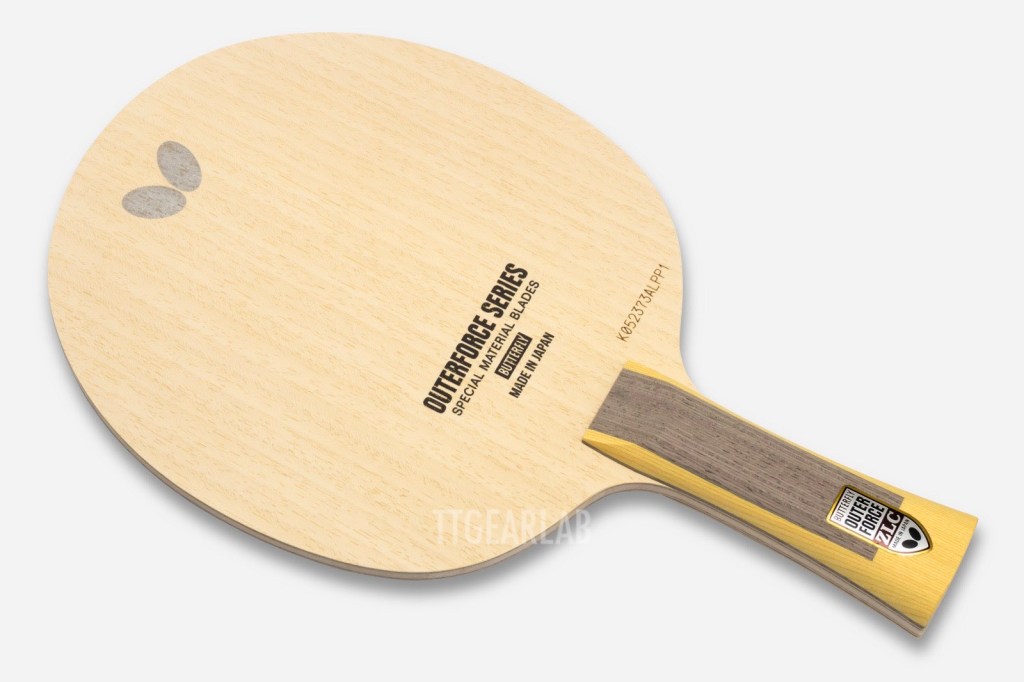
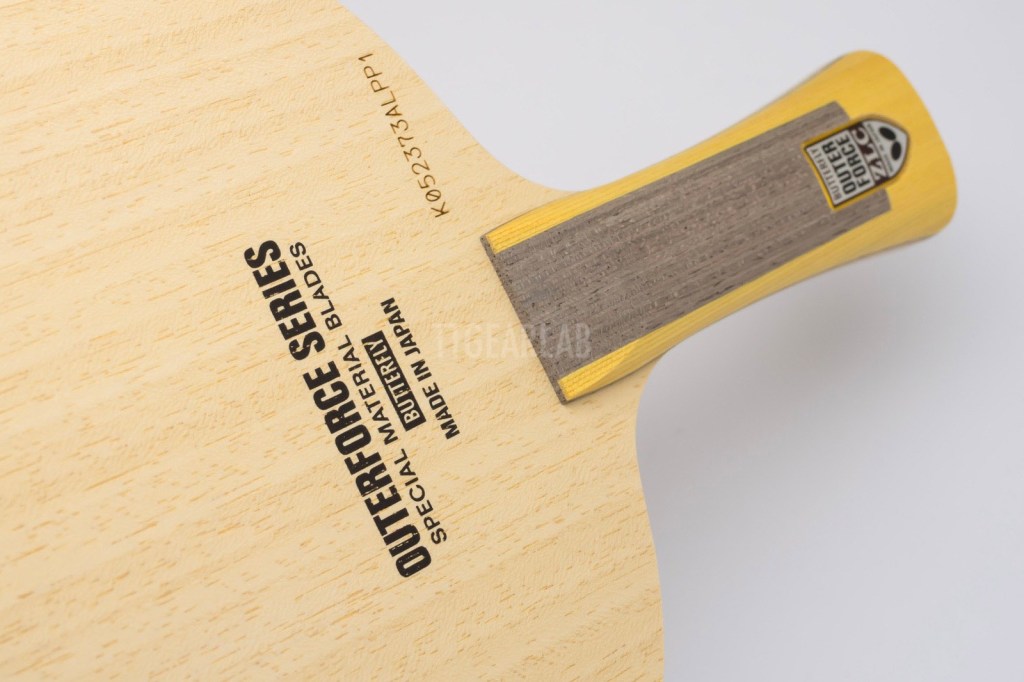
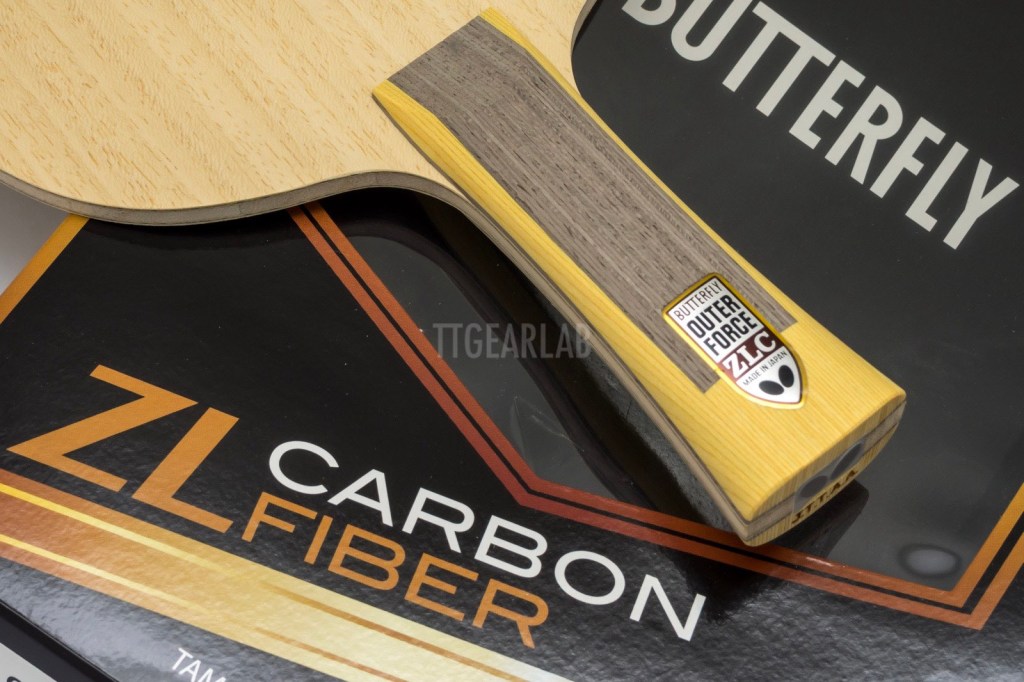
‘OuterForce ZLC’ is the most powerful blade among three models in ‘OuterForce’ series. Its artificial material is ZL Carbon (= Zylon Carbon), abbreviated as ZLC. ZLC is a material which has been used for Butterfly blades those require higher power than ALC blades in the same series. As always, Butterfly is recommending ‘OuterForce ZLC’ to players who require higher power than ‘OuterForce ALC’. Butterfly is explaining that ‘OuterForce ZLC’ fits for the players who want to make powerful shot not only from close-to-table area but also from mid-distance area.
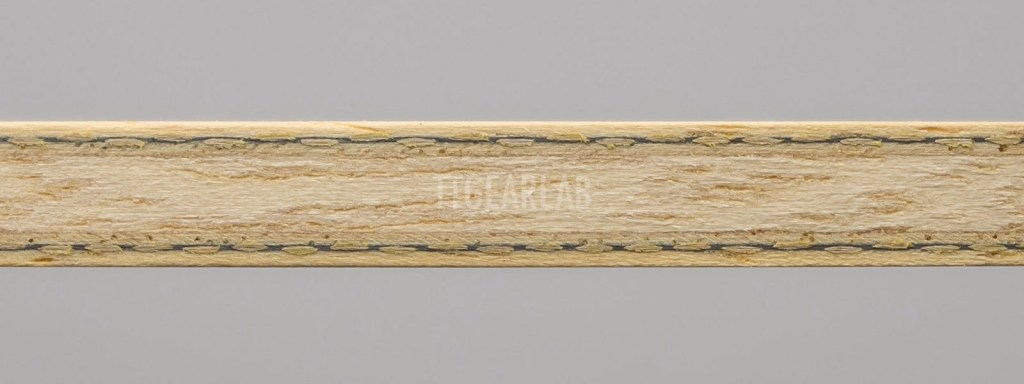
The construction of ‘OuterForce ZLC’ is 5+2 ply outer-type construction. But it is different from ordinary outer-type construction that can be seen from most of existing outer-type blades. The top layer is Ayous, and ZLC is placed directly under the top layer. The middle layer is Ayous, and the center layer is Kiri. Overall thickness is around 5.9mm. It is very unusual that the top layer isn’t Koto or Limba but Ayous. Its purpose seems to provide a soft hitting feeling and high controllability.
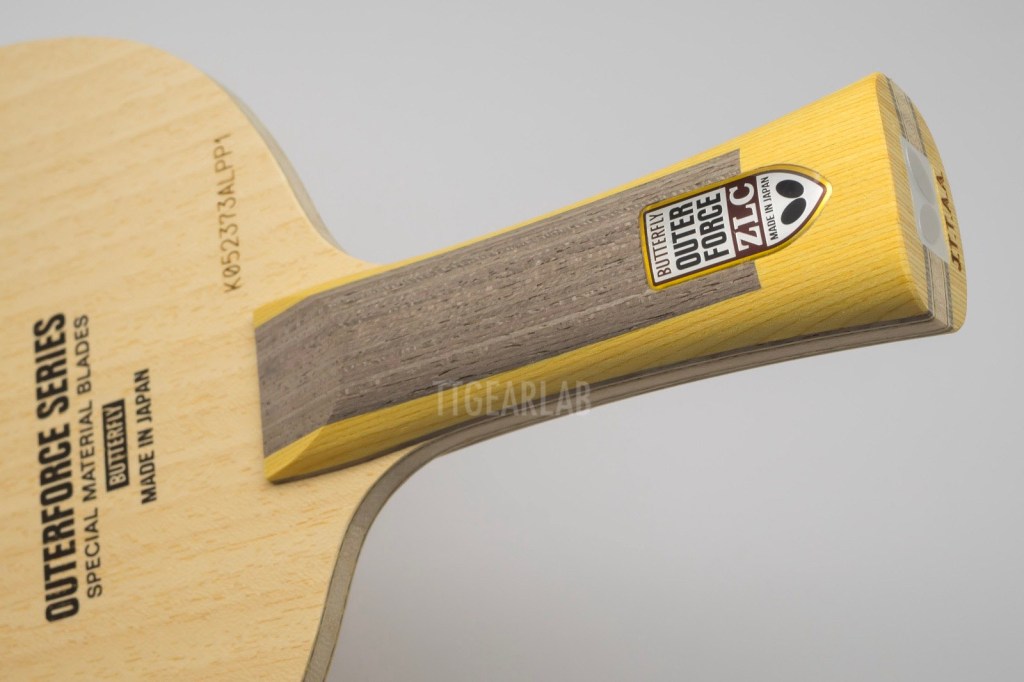
The FL (flared) handle is the standard FL handle of Butterfly, and basically identical to those of the other models in ‘Timo Boll’ series or ‘InnerForce Layer’ series. The width of FL (flared) handle is around 26.5mm (at head side) ~ 27.5mm (at bulge) ~ 26mm (at narrowest point) ~ 34mm (at the end). And, the thickness of FL handle is around 23mm (at thumb) ~ 24mm (at the end). The size of ST (straight) handle (not shown in pictures) is also the standard ST handle of Butterfly, and basically identical to those of the other models in ‘InnerForce Layer’ series. Its size is around 28mm (width) x 23mm (thickness).
1-2. Butterfly OuterForce ALC
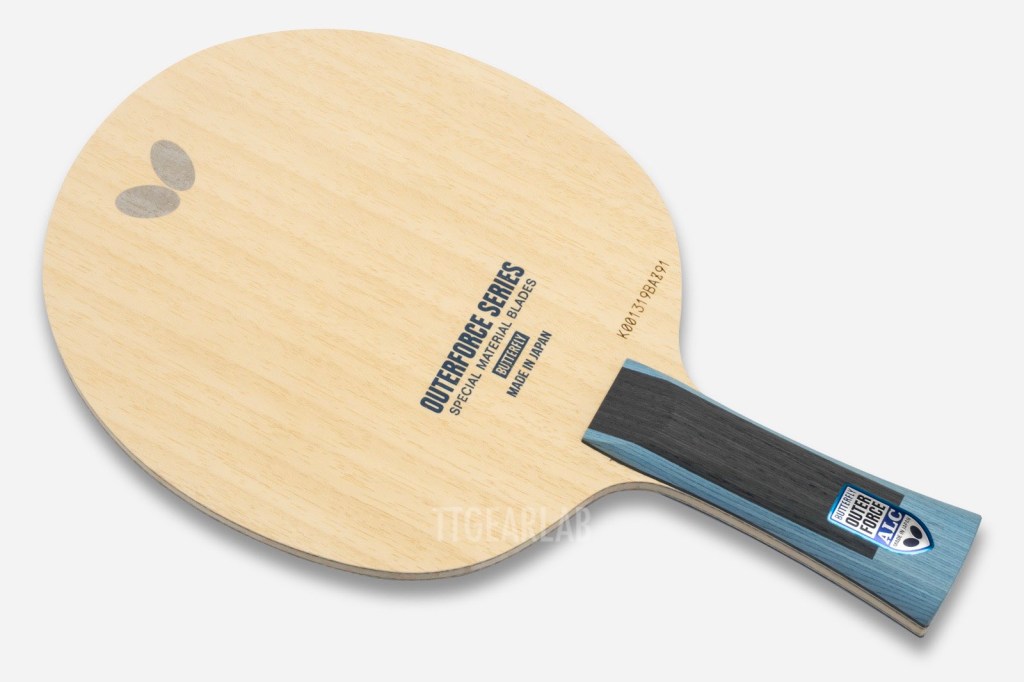
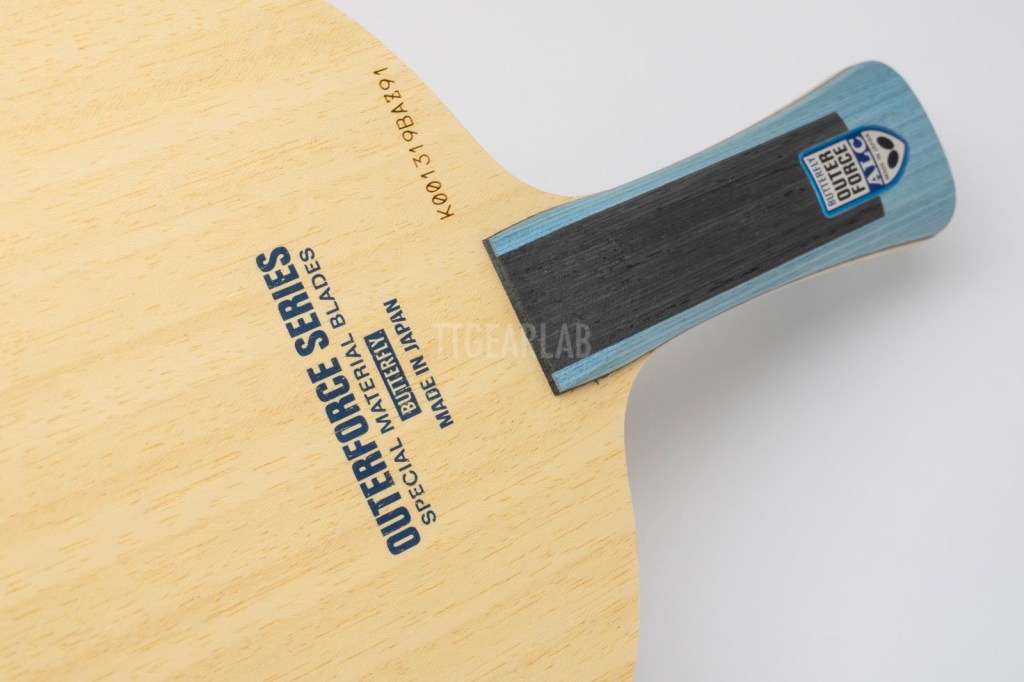
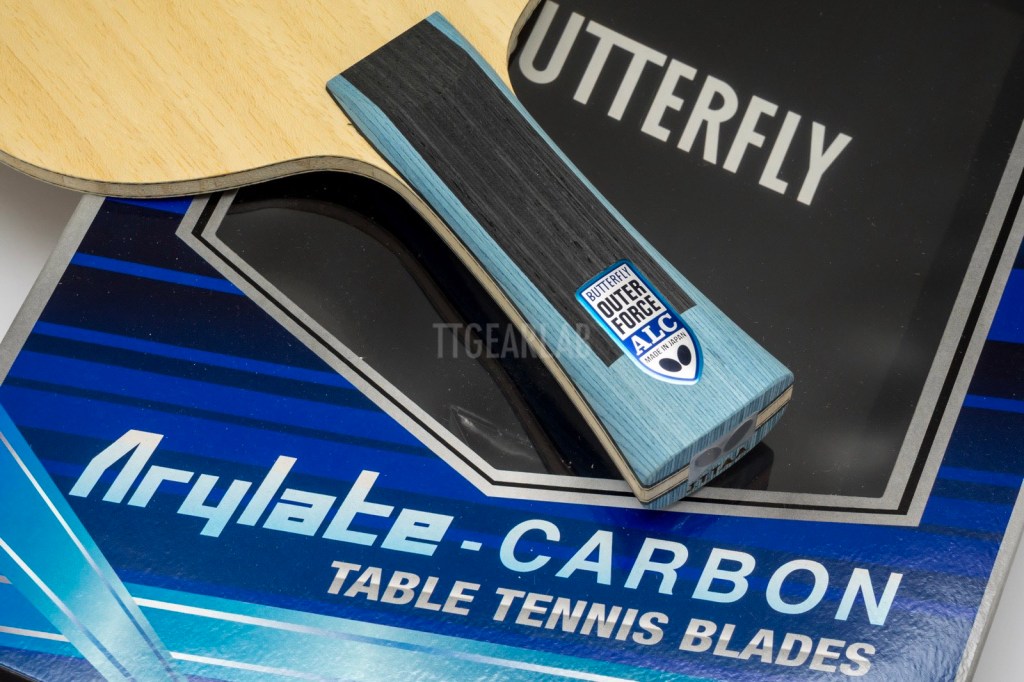
‘OuterForce ALC’ is the most balanced blade among three models in ‘OuterForce’ series. Its artificial material is Arylate Carbon, abbreviated as ALC. ALC is a material which has been widely used for table tennis blades since Butterfly adopted it for ‘Viscaria’ in 1993. ‘OuterForce ALC’ is a blade with an outer fiber construction that uses ALC. However, it is characterized by improved stability and balance by suppressing elasticity compared to existing blades of outer-ALC constructions. Butterfly is recommending ‘OuterForce ALC’ for the intermediate players.
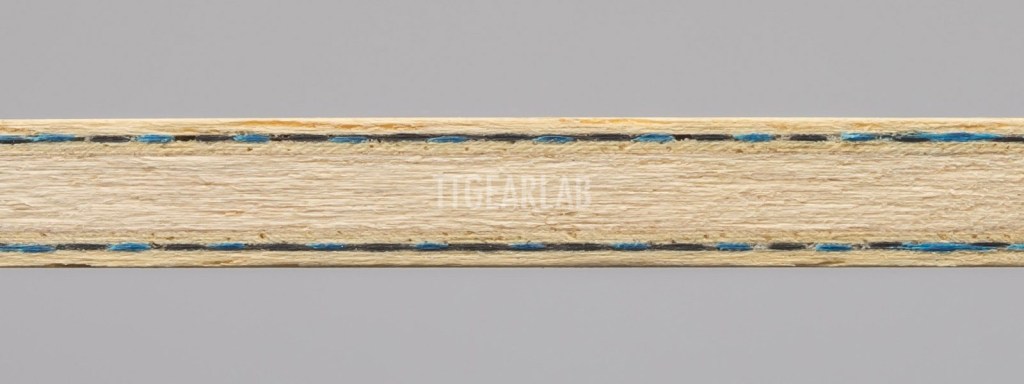
The construction of ‘OuterForce ALC’ is 5+2 ply outer-type construction. But it is different from ordinary outer-type construction that can be seen from most of existing outer-type blades. The top layer is Ayous, and ALC is placed directly under the top layer. The middle layer is Ayous, and the center layer is Kiri. Overall thickness is around 6.2mm. It is very unusual that the top layer isn’t Koto or Limba but Ayous. Its purpose seems to provide a soft hitting feeling and high controllability.
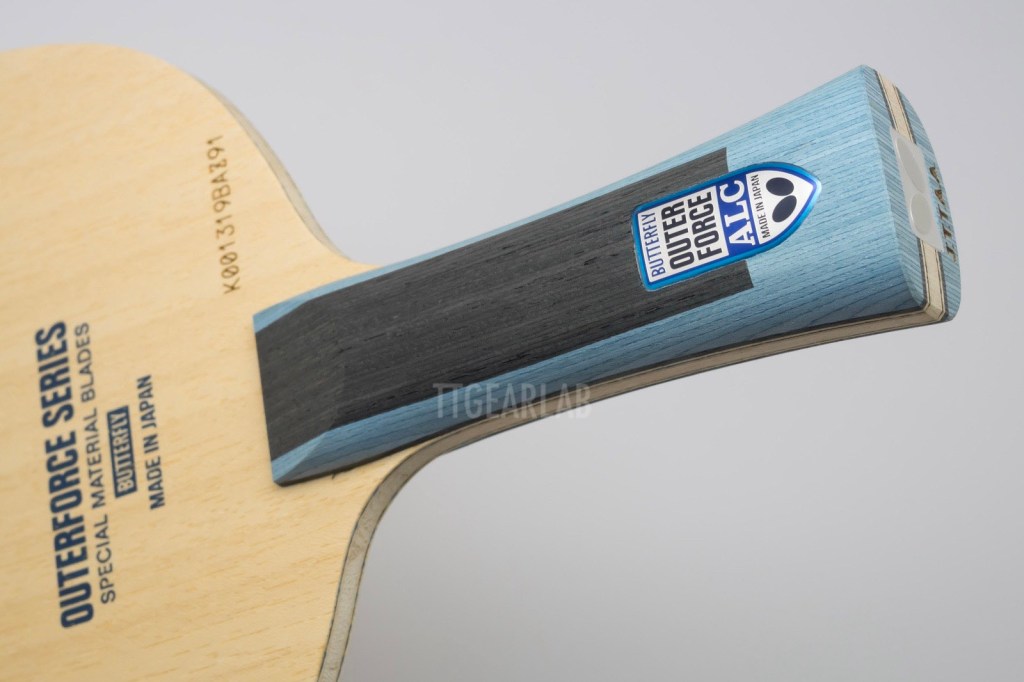
The specification of handle is basically same as that of ‘OuterForce ZLC’. The FL (flared) handle is the standard FL handle of Butterfly, and basically identical to those of the other models in ‘Timo Boll’ series or ‘InnerForce Layer’ series. The width of FL (flared) handle is around 26.5mm (at head side) ~ 27.5mm (at bulge) ~ 26mm (at narrowest point) ~ 34mm (at the end). And, the thickness of FL handle is around 23mm (at thumb) ~ 24mm (at the end). The size of ST (straight) handle (not shown in pictures) is also the standard ST handle of Butterfly, and basically identical to those of the other models in ‘InnerForce Layer’ series. Its size is around 28mm (width) x 23mm (thickness).
1-3. Butterfly OuterForce CAF
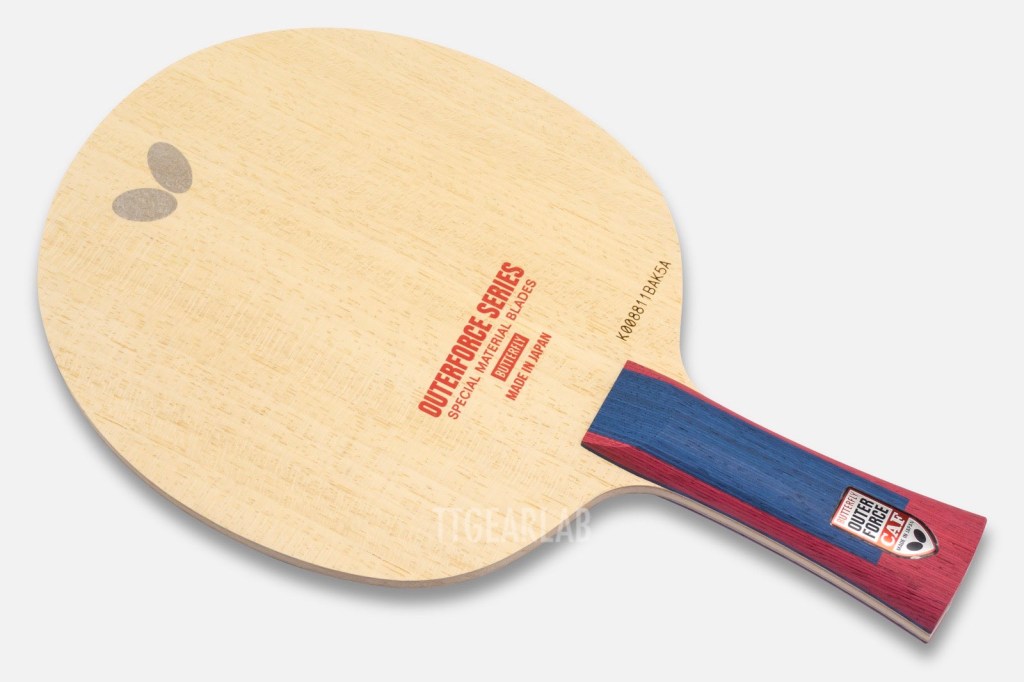
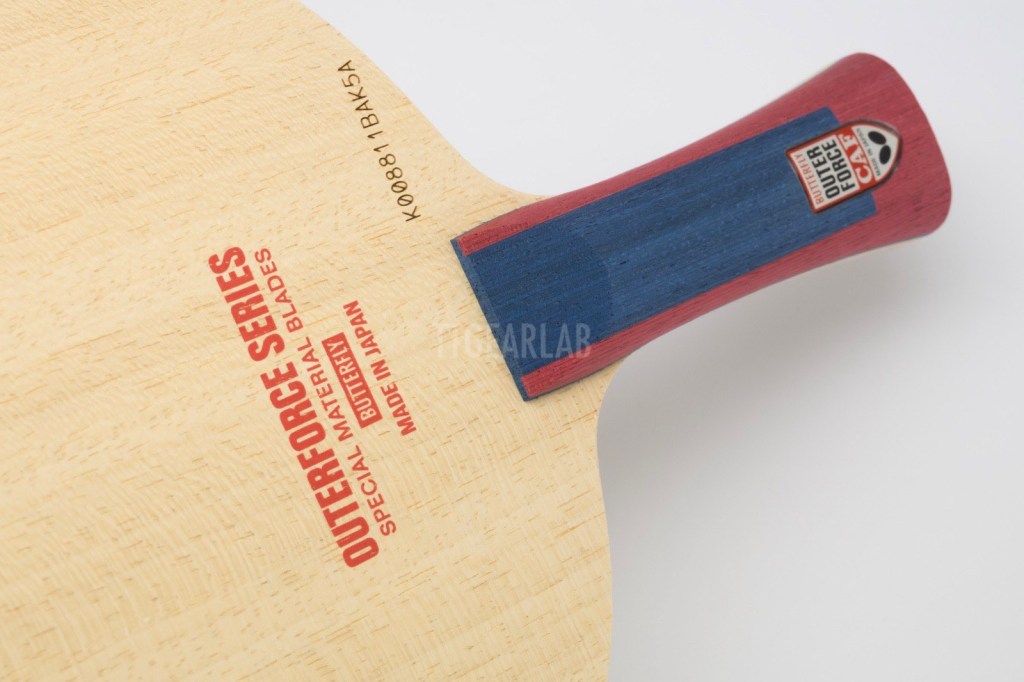
‘OuterForce CAF’ is the most controllable blade among three models in ‘OuterForce’ series. Its artificial material is CA fiber (Cellulose Acetate Fiber) which has already been applied to ‘Timo Boll CAF’. (It is different material from CNF which is more expensive and more elastic.) As we can see from the word ‘cellulose’, CA fiber is a fiber made from plants (mainly wood) and is a material widely used in packaging containers and filters. When used in table tennis blades, it is suitable as a special material of blade for players who want to switch from pure wood blade, because it provides more natural feeling than other fibers. While applying CAF to this model, Butterfly is calling it as ‘Control Assist Fiber’ to emphasis the high controllability provided by CAF. Because ‘OuterForce CAF’ is the most controllable and provides the closest feeling to natural wood blade, Butterfly is recommending it also as the first blade of entry players.
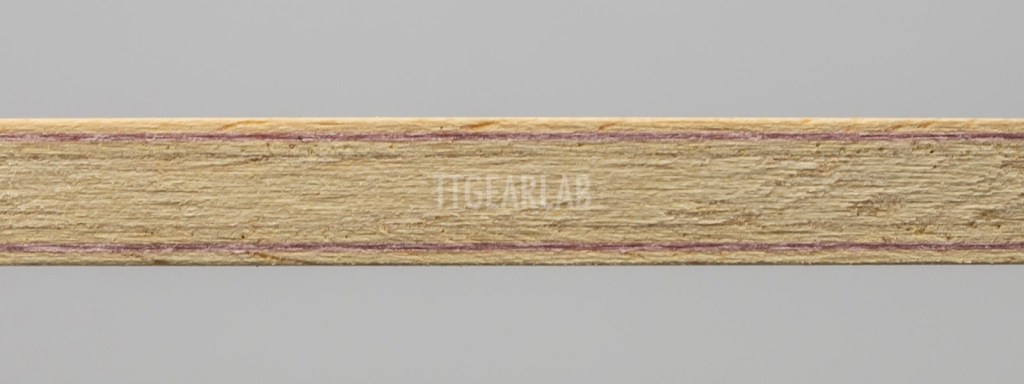
The construction of ‘OuterForce CAF’ is 5+2 ply outer-type construction. But it is different from ordinary outer-type construction that can be seen from most of existing outer-type blades. The top layer is Ayous, and CAF is placed directly under the top layer. The middle layer is Ayous, and the center layer is Kiri. Overall thickness is around 6.3mm. It is very unusual that the top layer isn’t Koto or Limba but Ayous. Its purpose seems to provide a soft hitting feeling and high controllability.
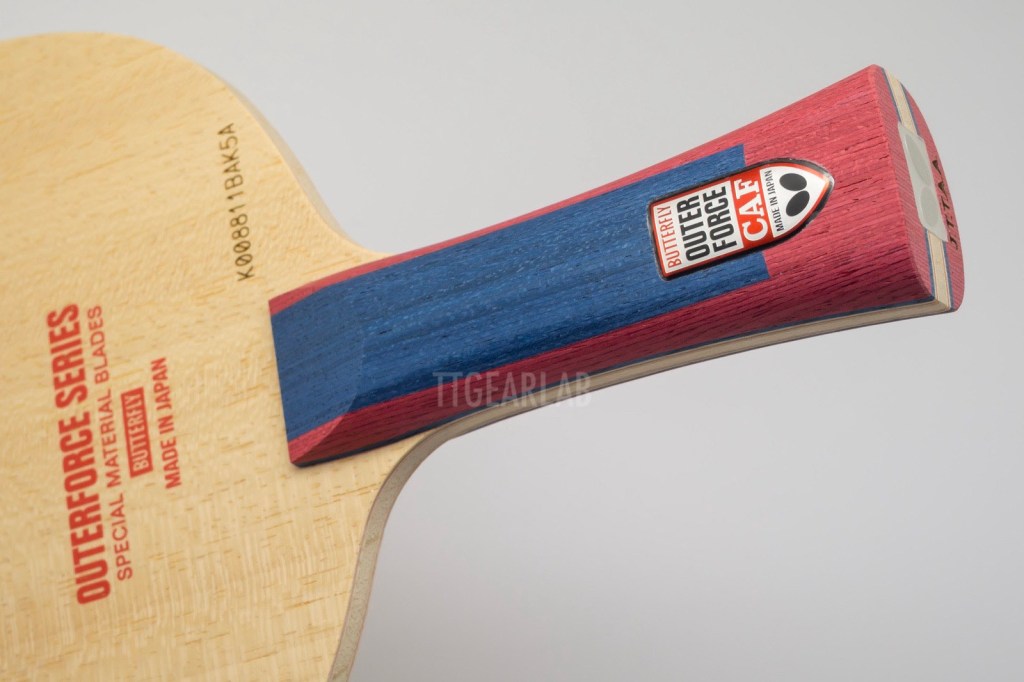
The specification of handle is basically same as those of ‘OuterForce ZLC’ and ‘OuterForce ALC’. The FL (flared) handle is the standard FL handle of Butterfly, and basically identical to those of the other models in ‘Timo Boll’ series or ‘InnerForce Layer’ series. The width of FL (flared) handle is around 26.5mm (at head side) ~ 27.5mm (at bulge) ~ 26mm (at narrowest point) ~ 34mm (at the end). And, the thickness of FL handle is around 23mm (at thumb) ~ 24mm (at the end). The size of ST (straight) handle (not shown in pictures) is also the standard ST handle of Butterfly, and basically identical to those of the other models in ‘InnerForce Layer’ series. Its size is around 28mm (width) x 23mm (thickness).
Then let’s check the characteristics of Butterfly ‘OuterForce’ series by Performance Indices and then compare with some existing blades.
Please click here to return to top (table of contents)
2. Performance Indices
Performance Indices are measured objective values to represent the characteristics of table tennis gears. Concerning the detail of four performance indices, please refer to following articles in ‘About TTGearLab’ section :
- Performance indices : the way to evaluate blade by measurement
- The example of comparison by performance indices
2-1. Butterfly OuterForce ZLC
| Name | Avg.Wt (g) | Ep | Ec | Ec/Ep | Vp | Vl | Vl/Vp |
| Butterfly OuterForce ZLC | 86.4 | 2.12 | 1.94 | 0.91 | 1.33 | 1.45 | 1.09 |
The primary elasticity index (Ep) of ‘OuterForce ZLC’ exceeds 2.0. It is what we can expect from outer-type blades. And, the Ep of ‘OuterForce ZLC’ is relatively higher than the values of the most of well-known outer-type blades. And, Ec/Ep is a bit higher than 0.9. It means that ‘OuterForce ZLC’ hugs the ball deeply when the player hits the ball very strongly, but not excessively.
Vp (Primary Vibration Index) is 1.33. It is very high value, and it is even higher than the values of most of outer-type blades. So, we can think that ‘OuterForce ZLC’ is a stiff blade. Vl/Vp (= 1.09) is higher than 1.0, but not extremely high. We can expect that the feeling transferred to index finger is noticeably sharper than the primary feeling transferred to palm, but the difference isn’t very big.
Butterfly is explaining that ‘OuterForce ZLC is a power-oriented model recommended for the players who lay emphasis on power. And, that characteristic can be seen from the Performance Indices. However, the characteristics of ‘OuterForce ZLC’ seem to somewhat deviate from what ‘OuterForce’ series is aiming for – intermediate characteristics between inner-type blade and outer-type blade.
2-2. Butterfly OuterForce ALC
| Name | Avg.Wt (g) | Ep | Ec | Ec/Ep | Vp | Vl | Vl/Vp |
| Butterfly OuterForce ALC | 85.2 | 1.90 | 1.75 | 0.92 | 1.28 | 1.38 | 1.08 |
The primary elasticity index (Ep) of ‘OuterForce ALC’ (= 1.90) is lower than 2.0. It means that its primary elasticity is somewhat lower than those of many know outer-type blades. But, it is still in the range that we can expect from outer-type blade. And, Ec/Ep is a bit higher than 0.9. It means that ‘OuterForce ALC’ hugs the ball deeply when the player hits the ball very strongly, but not excessively.
Vp (Primary Vibration Index) is 1.28. It is in the range that we can expect from outer-type blades. Vl/Vp (= 1.08) is higher than 1.0, but not extremely high. We can expect that the feeling transferred to index finger is noticeably sharper than the primary feeling transferred to palm, but the difference isn’t big.
From the values, we can think that ‘OuterForce ALC’ is a bit more focused on ease of use when compared with ‘Viscaria’ type blades of Butterfly. It represents the development concept of aiming for an intermediate character between Butterfly inner-type blade and Butterfly outer-type blade very well.
2-3. Butterfly OuterForce CAF
| Name | Avg.Wt (g) | Ep | Ec | Ec/Ep | Vp | Vl | Vl/Vp |
| Butterfly OuterForce CAF | 87.3 | 1.67 | 1.49 | 0.89 | 1.16 | 1.19 | 1.02 |
The primary elasticity index (Ep) of ‘OuterForce CAF’ (= 1.67) looks quite low as the value of an outer-type blade. Ec/Ep is a bit lower than 0.9. It means that ‘OuterForce CAF’ hugs the ball deeply when the player hits the ball very strongly.
Vp (Primary Vibration Index) is 1.16. It is also lower than what we can expect from an outer-type blade. Vl/Vp (= 1.02) is close to 1.0. It means that the feeling transferred to index finger is not much different from the primary feeling transferred to palm.
From the values, we can see that ‘OuterForce CAF’ is focused on safety and control. That coincides with what Butterfly is explaining on this blade.
Please click here to return to top (table of contents)
3. Comparison by Performance Indices
Then we can compare Butterfly ‘OuterForce’ series with some other blades. Following is the list of the blades to be compared :
Outer type
| Name | Average Weight | Feature |
| Butterfly Fan Zhendong ZLC | 85.1g | Outer PBO Carbon with Koto top layer |
| Butterfly Mizutani Jun ZLC | 89.7g | Outer PBO Carbon with Limba top layer |
| Butterfly Viscaria | 87.1g | Outer ALC with Koto top layer |
| Butterfly Freitas ALC | 87.4g | Outer ALC with Limba top layer |
| andro Treiber CO OFF/S | 83.9g | Outer Aramid Carbon with Koto top layer |
| Victas ZX-Gear Out | 87.0g | Outer Zxion Carbon with Limba top layer |
Inner type
| Name | Average Weight | Feature |
| Butterfly InnerForce Layer ZLC | 89.8g | Inner ZLC with Limba top layer |
| Butterfly InnerForce Layer ALC | 91.2g | Inner ALC with Limba top layer / Recent version |
| Butterfly Hurricane Long 5 | 88.1g | Inner ALC with Limba top layer / Recent version |
| Victas Fire Fall VC | 81.8g | Inner ALC with Limba top layer / Thick construction |
Outer type without Carbon (= artificial materials don’t include carbon fiber)
| Name | Average Weight | Feature |
| Xiom Hugo HAL | 88.0g | Outer Arylate fiber with Koto top layer |
| Butterfly Timo Boll ZLF | 84.7g | Outer PBO fiber with Koto top layer |
| KTS Foundation GF.K | 85.1g | Outer Glass fiber with Koto top layer |
All wood blades (including reference blade)
| Name | Average Weight | Feature |
| Stiga Clipper CR | 81.7g | Classic 7-ply wood blade / Light version |
| Butterfy Korbel | 88.7g | The representative of 5-ply wood offensive blade. |
| Stiga Allround Classic (Reference) | 84.3g | The representative of 5-ply wood allround blade. |
3-1. Elasticity Indices

Fig.15 shows the comparison graph of Elasticity Indices.
Ep (Primary Elasticity Index) is directly concerned with the rebound speed of blade. Ec (Central Elasticity Index) is concerned with additional ‘kick’ when player hits ball very strongly. We can observe that ‘OuterForce ZLC’ shows the highest values for both of Ep and EC, and ‘OuterForce CAF’ shows the lowest values for both of Ep and Ec. The values of ‘OuterForce ALC’ are lower than those of ‘OuterForce ZLC’ and higher than those of ‘OuterForce CAF’.
Then we can compare the blades of four groups with three ‘OuterForce’ models.
[Outer]
( ‘OuterForce ZLC’ and ‘OuterForce ALC’ belong to this group although we are observing those two separately at the top of graph.)
- Except for ‘Mizutani Jun ZLC’, the overall elasticity level of the blade in this group is a bit lower than that of ‘OuterForce ZLC’. So we can understand that ‘OuterForce ZLC’ is maintaining high elasticity which is generally expected from the outer construction. ‘OuterForce ZLC’ can be considered as one of typical outer-ZLC blades.
- On the contrary, the elasticity level of ‘OuterForce ALC’ is noticeably lower than those of most blades in this group. So we can expect that ‘OuterForce ALC’ will be slower than most of outer-type blades.
- The elasticity level of ‘OuterForce CAF’ is significantly lower than those of the blades in this group. We can expect it before this comparison because the artificial fiber of ‘OuterForce CAF’ doesn’t include carbon fiber.
[Inner (with carbon)]
(The inner-type blades in this comparison has carbon fiber in their artificial materials)
- All blades in this group are less elastic than ‘OuterForce ZLC’.
- Among four models in this group, two relatively more elastic models show similar elasticity levels as ‘OuterForce ALC’. That can be considered as the character of ‘OuterForce ALC’.
- Among four models in this group, two relatively less elastic models show similar elasticity levels as ‘OuterForce CAF’.
[Outer without Carbon]
(‘OuterForce CAF’ belongs to this group although we are observing it separately at the top of graph.)
- The primary elasticity of two models in this group is close to that of ‘OuterForce CAF’. One model shows lower primary elasticity than ‘OuterForce CAF’.
- Due to the absence of carbon fiber in artificial materials, the blades in this group are less elastic than the blades in ‘Outer’ group or ‘Inner (with carbon)’ group. But, the overall elasticity levels of the blades in this group is a bit higher than those of the blades in ‘All Wood’ group.
[All Wood]
(All wood blades are being compared just as reference.)
- The blades in ‘All Wood’ group are a bit less elastic than the blades in ‘Outer without Carbon’ group.
- ‘OuterForce CAF’ is a bit more elastic than ‘Korbel’. Because blades in ‘Outer without Carbon’ group including ‘OuterForce CAF’ don’t give the stiff feeling of carbon fiber, it is expected that the blades in ‘Outer without Carbon’ group can be good solution when the player wants to switch from all-wood blade.
Examining Ec/Ep is also a easier way to understand the characteristics of blade concerned with elasticity. Fig.16 shows the relationship between Ec/Ep and Ep.

Ec/Ep expresses the ‘tendency’ of the elasticity of blade. By examining Ec/Ep and Ep at the same time, we can easily understand the behavior of blades.
On the graph, all blades except for two all wood blades (= reference blade and ‘Clipper CR’) are located in ‘Hold’ range (Ec/Ep < 1.0). And, in that range, ‘Outer’ group is located at right side, and ‘Outer without Carbon’ group is located at left side. ‘Inner’ group is located between ‘Outer’ group and ‘Outer without Carbon’ group. ‘OuterForce ZLC’ and ‘OuterForce ALC’ belong to ‘Outer’ group, and ‘OuterFroce CAF’ belongs to ‘Outer without Carbon’ group. What we can understand from this graph can be summarized as follows :
- ’OuterForce ZLC’ is located to the right of the most blades in ‘Outer’ group. It means that the primary elasticity of ‘OuterForce ZLC’ is relatively higher even in ‘Outer’ group. Only ‘Mizutani Jun ZLC’ provides higher primary elasticity than ‘OuterForce ZLC’. The location of ‘OuterForce ZLC’ is lower than the locations of four models in this group. And, although its position is lower than those of four models in this group, ‘OuterForce ZLC’ is still in ‘Mild Hold’ range. It hugs ball deeper than ‘Viscaria’ or ‘Fan Zhendong ZLC’ when the player hits the ball very strongly, but not extremely deeply. Essentially, ‘OuterForce ZLC’ is a powerful blade, and it provides what we can expect from outer-type construction.
- On the contrary, ‘OuterForce ALC’ is located at the left end of ‘Outer’ group. Its position is even overlapped with ‘Inner’ group. ‘OuterForce ALC’ is noticeably less elastic than most of outer-type blade in this comparison, and it is located very close to ‘InnerForce Layer ZLC’ and ‘InnerForce Layer ALC’ those are relatively fast in ‘Inner’ group. Anyway, we can see from the graph that ‘OuterForce ALC’ is located between ‘Inner’ group and ‘Outer’ group.
- ‘OuterForce CAF’ is located between ‘Inner’ group and ‘Outer without Carbon’ group. It is less elastic than inner-type blades (with carbon fiber), but it is relatively fast in ‘Outer without Carbon’ group.
‘OuterForce’ series is explained as the transitional step between inner-type blade and outer-type blade. But, among three models in ‘OuterForce’ series, only ‘OuterForce ALC’ fits that description. It is somewhat difficult to consider ‘OuterForce ZLC’ and ‘OuterForce CAF’ as the blades for transition. ‘OuterForce ZLC’ can be considered as one of typical outer-type blades, and ‘OuterForce CAF’ can be dealt as the substitute of inner-type blades.
Then next, let’s compare Vibration Indices.
Please click here to return to top (table of contents)
3-2. Vibration Indices

Fig.17 shows the comparison graph of Vibration Indices. Vibration Indices are concerned with feeling. Vp indicates primary feeling which is transferred to player’s palm. And, Vl is the feeling at the edge of the wing – the lower side of blade head. It is felt by player’s index finger or middle finger. We can observe that ‘OuterForce ZLC’ shows the highest values and ‘OuterForce CAF’ shows the lowest values in ‘OuterForce’ series.
Then we can compare the blades of four groups with three ‘OuterForce’ models.
[Outer]
(‘OuterForce ZLC’ and ‘OuterForce ALC’ belong to this group although we are observing those two separately at the top of graph.)
- The Vp of ‘OuterForce ZLC’ is close to those of most blades in this group. On the contrary, the Vl of ‘OuterForce ZLC’ is noticeably higher than most blades in this group. (Only ‘Treiber CO OFF/S’ shows higher Vl than ‘OuterForce ZLC’.)
- The Vp of ‘OuterForce ALC’ is a bit lower than those of most blades in this group. The Vl of ‘OuterForce ALC’ is close to those of most blades in this group.
- ‘OuterForce CAF’ shows significantly lower Vp and Vl when compared with the blades in this group. Only the Vp of ‘OuterForce CAF’ can be compared with that of ‘ZX-Gear Out’.
- The graph shapes of ‘OuterForce ZLC’ and ‘OuterForce ALC’ look different from those of four other Butterfly blades in this group. For both of those two, Vl is significantly higher than Vp, while the difference between Vl and Vp isn’t big for four Butterfly models. That may distinguish ‘OuterForce ZLC’ and ‘OuterForce ALC’ from existing Butterfly outer-type blades. On the contrary the graph shape of ‘OuterForce CAF’ look similar to those of four Butterfly models.
[Inner]
(The inner-type blades in this comparison has carbon fiber in their artificial materials)
- The vibration indices of the blades in this group are lower than those of the blades in ‘Outer’ group. The exception is ‘Fire Fall VC’ whose Vl is higher than the Vl’s of most blades in’Outer’ group.
- The Vp and the Vl of ‘OuterForce ZLC’ are higher than those of the blades in this group. And, the Vp and the Vl of ‘OuterForce ALC’ are also higher than those of most blades (except for ‘Fire Fall VC’) in this group.
- We can understand that ‘OuterForce ZLC’ and ‘OuterForce ALC’ are stiffer than ordinary inner-type blades.
- On the contrary, the Vp and the Vl of ‘OuterForce CAF’ are lower than those of the blades in this group, except for the case of the Vp of ‘Hurricane Long 5’. ‘OuterForce CAF’ is softer than inner-type blades.
[Outer without Carbon]
(‘OuterForce CAF’ belongs to this group although we are observing it separately at the top of graph.)
- In general, the values of the blades in this group are lower than those of the blades in ‘Outer (with Carbon)’ group and ‘Inner (with Carbon)’ group. That is because the blades in this group doesn’t have carbon fiber which makes the overall feeling stiffer.
- The Vp’s and the Vl’s of the blades in this group are close to those of ‘OuterForce CAF’, except for the case of the Vl of ‘Timo Boll ZLF’. ‘Timo Boll ZLF’ transmits much sharper feeling to the index finger of player when compared with the other blades in this group and ‘OuterForce CAF’.
- The values of ‘Hugo HAL’ are especially very close to those of ‘OuterForce CAF’.
[All Wood]
(All wood blades are being compared just as reference.)
- The values of the blades in ‘All Wood’ group are not much different from those of the blades in ‘Outer without Carbon’ group. It means that the blades in ‘Outer without Carbon’ blades can be the direct replacement of all-wood blades. And, ‘OuterForce CAF’ is one of those blades.
- The graph shape of ‘OuterForce CAF’ is similar to those of ‘Clipper CR’ which is a 7 ply wood blade and ‘Allround Classic’ which is a classic all-round blade. But, it looks different from the graph shape of ‘Korbel’ which is a 5-ply wood offensive blade.
Examining Vl/Vp is easier way for the comparison of the tendency of feeling. Fig.18 shows the relationship between Vl/Vp and Vp for easier comparison.
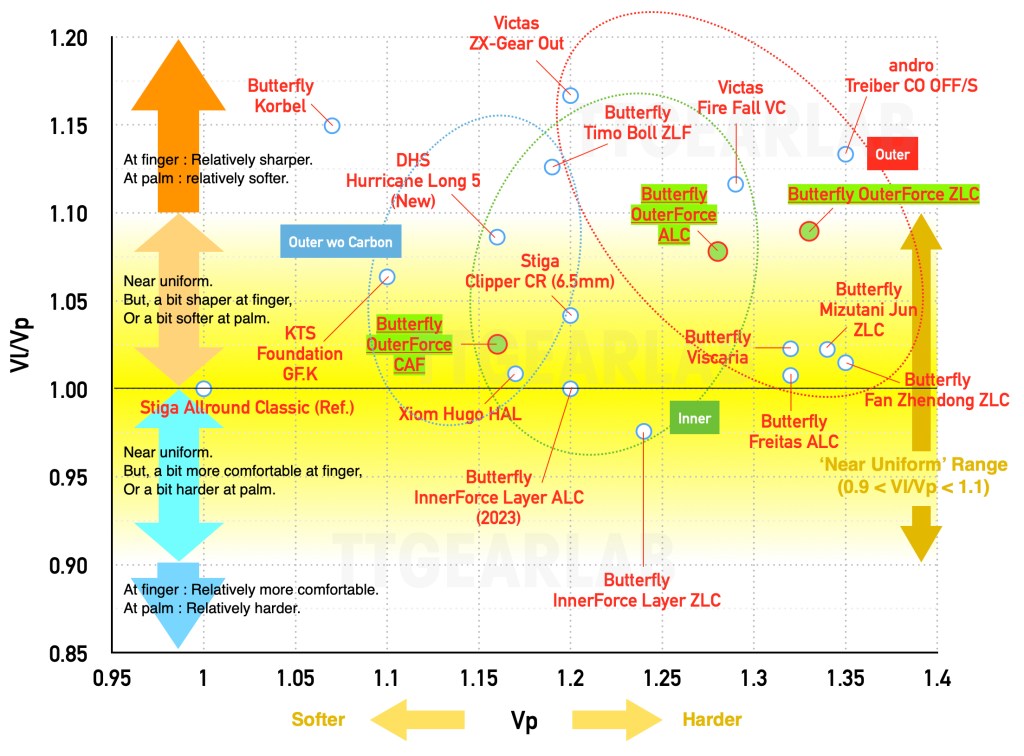
On the graph, most of blades in this comparison (except for three blades) are located in upper part of the graph – ‘Relatively sharper at finger’ range (Vl/Vp > 1.0). And, in that range, ‘Outer’ group is located at right side, and ‘Outer without Carbon’ group is located at left side. ‘Inner’ group is located between ‘Outer’ group and ‘Outer without Carbon’ group. But, we can observe that ‘Inner’ group is significantly overlapped with both of ‘Outer’ group and ‘Outer without Carbon’ group, and it looks like that even ‘Outer’ group and ‘Outer without Carbon’ group are slightly overlapped with each other. ‘OuterForce ZLC’ and ‘OuterForce ALC’ belong to ‘Outer’ group, and ‘OuterFroce CAF’ belongs to ‘Outer without Carbon’ group.
What we can understand from this graph can be summarized as follows :
- ’OuterForce ZLC’ is located above the four existing Butterfly outer-type blades – ‘Visdaria’, ‘Fan Zhendong ZLC’, ‘Freitas ALC’ and ‘Mizutani Jun ZLC’. It means that ‘OuterForce ZLC’ transmits sharper feeling to the index finger of the player, while transmitting similarly stiff feeling to the player’s palm. So, the overall feeling of ‘OuterForce ZLC’ is different from those of existing four Butterfly outer-type blades. Players may feel that the feeling of ‘Treiber CO OFF/S’ is closer to that of ‘OuterForce ZLC’.
- The Vl/Vp of ‘OuterForce ALC’ is not much different from that of ‘OuterForce ZLC’, while there is noticeable difference between the Vp’s of those two. Because the Vp of ‘OuterForce ALC’ is lower than that of ‘OuterForce ZLC’, ‘OuterForce ALC’ is located to upper left of the four existing Butterfly outer-type blades. It means that ‘OuterForce ALC’ transmits softer feeling to player’s palm while transmitting sharper feeling to player’s index finger when compared with existing four Butterfly outer-type blades.
- The position of ‘OuterForce ALC’ is also overlapped with the area of ‘Inner’ group. In fact, that is because of the existence of ‘Fire Fall VC’ and ‘ZX-Gear Out’ in this comparison. (‘Fire Fall VC’ is as fast and stiff as outer-type blades although it is an inner-type blade. And, ‘ZX-Gear Out’ is as soft as inner-type blades in primary feeling) So, if we ignore two Victas blades, we can observe that ‘OuterForce ALC’ is located between ‘Outer’ group and ‘Inner’ group.
- ‘OuterForce CAF’ is even softer than inner-type blades in primary feeling (if we ignore ‘Hurricane Long 5’). When compared with two Butterfly inner-type blades – ‘InnerForce Layer ZLC’ and ‘InnerForce Layer ALC’ – ‘OuterForce CAF’ gives noticeably softer feeling to player’s palm and a bit sharper feeling to player’s index finger.
As we also observed in the comparison of Elasticity Indices, we can see in the comparison of Vibration Indices that only ‘OuterForce ALC’ fits the description that this series is the transitional step between inner-type blade and outer-type blade. Further, that is only in case we just observe Vp’s. If we consider Vl’s of Butterfly blades, we can understand that ‘OuterForce ALC’ and ‘OuterForce ZLC’ form another group than Butterfly inner-type blades or Butterfly outer-type blades. Because of relatively higher Vl/Vp’s of those two, the players who have been accustomed to existing Butterfly blades (listed in this comparison) may feel that those two are much different from existing Butterfly blades.
Please click here to return to top (table of contents)
4. Summary
We have compared three models of Butterfly ‘OuterForce’ series through Performance Indices. The characteristics of each model can be summarized as follows:
4-1. Butterfly OuterForce ZLC
- ‘OuterForce ZLC’ is as elastic as or more elastic than most of outer-type blades, but it hugs the ball moderately when the player hits the ball very strongly. We can consider it as one of typical outer-type blades.
- The primary vibration characteristic of ‘OuterForce ZLC’ is not much different from that of other exiting outer-type blade. But its Vl is noticeably higher than those of existing Butterfly outer-type blades. When compared with existing Butterfly outer-type blades, ‘OuterForce ZLC’ transmits sharper feeling to player’s index finger.
- In case the player requires high power of outer-type blade but has thought that existing Butterfly outer-type blades don’t transmit sufficiently sharp feeling to finger, ‘OuterForce ZLC’ is seriously considerable.
4-2. Butterfly OuterForce ALC
- In primary elasticity, ‘OuterForec ALC’ is less elastic than ordinary outer-type blades, but it is more elastic than most of inner-type blades. And, it hugs the ball moderately when the player hits the ball very strongly. ‘OuterForce ALC’ is located between inner-type blades and outer-type blades.
- In primary vibration, ‘OuterForce ALC’ is also located between outer-type blades and inner-type blades. But, its lateral vibration character is considered as that of typical outer-type blades. As the result, it is softer (at palm) but it transmits clearer feeling (to index finger) when compared with existing Buttefly outer-type blades.
- ‘OuterForce ALC’ is suitable as an intermediate step to move from an inner-type blade to outer-type blade, as is explained by Butterfly. If fits the concept of ‘OuterForce’ series very well.
4-3. Butterfly OuterForce CAF

- In primary elasticity, ‘OuterForec CAF’ is less elastic than ordinary inner-type blades, but it is a bit more elastic than ordinary all wood blades or outer-type blades without Carbon fiber. And, it hugs the ball moderately when the player hits the ball very strongly.
- In primary vibration, ‘OuterForce CAF’ is located between inner-type blades and outer-type blades without Carbon fiber. And, its relative vibration character is close to uniform. It is quite soft at palm, and the relative feeling transmitted to index finger isn’t especially sharp.
- ‘OuterForce CAF’ is a soft blade with moderate elasticity. It is recommended for entry players who want to learn basic technics of table tennis. And, it is also considerable as the replacement of 7-ply wood blade or 5-ply wood all-round blade. The players who are considering inner-type blade but don’t like the feeling of carbon fiber will also be able to consider this blade.
Butterfly ‘OuterForce’ series are the blade family which is different from existing Butterfly inner-type or outer-type blade. Its concept is the intermediate blades between inner-type blades and outer-type blades. Butterfly is trying to realize that concept by adopting thicker construction with softer top layer. But, among three models, only ‘OuterForce ALC’ fits that concept, and the other two models – ‘OuterForce ZLC’ and ‘OuterForce CAF’ – are biased to power and control respectively. (From the description of those blades at Butterfly home page, we can notice that Butterfly is also aware of it.) Therefore, ‘OuterForce ALC’ is the best recommendation for the players who are considering a blade for transition step from inner-type to outer-type. ‘OuterForce ZLC’ is recommended for the players who are searching for the blade which can provide sharper feeling than existing Butterfly outer-type blades. And, as Butterfly is explaining, ‘OuterForce CAF’ will be a good choice for entry players.
[AD] You can buy Butterfly blades in this article at megaspin.net.
Please click here to return to top (table of contents)
 TTGearLab
Hey, first of all i would like to thank you for all the information you provide to us. Personally helped me alot to discover for example Victas brand which in my opinion is not very well presented in EU. Because of your work i moved out from all wood blades and discovered all new universe.
Would like to ask you for comparison between timo boll zlf, outer force caf and hugo hal.
LikeLike
Thank you for reply!
All of those three are good replacement from pure wood blades. But, OuterForce CAF is more focused on entry players, while Timo Boll ZLF and Hugo HAL are more focused on intermediate~skilled players. Although all of those three are good for entry players, there are differences in characteristics. If the player wants to concentrate on spin-oriented technics, Timo Boll ZLF or Hugo HAL will be better than OuterForce CAF. Those two are like enhanced version of thin 5-ply wood blades. On the contrary OuterForce CAF is closer to 7-ply wood blade, and therefore it is better for direct hitting. Betweem Timo Boll ZLF and Hugo HAL, if the player likes more comfortable feeling Hugo HAL is recommended. On the contrary, Timo Boll ZLF provides sharper feeling.
LikeLike
Hi
First thank you for all the work
It’s very helpful
I have a question if we have identical blade construction
But different thickness how this change Ec/Ep ?
Does it stay linear or no
For example fan zlc 5.5 mm vs fanzlc 6.0
Thank you
LikeLiked by 1 person
In general the thicker one of same model records lower Ec/Ep. But, there are cases of opposite results.
LikeLike
Do we need sealing if we have ayous outer plies?
LikeLike
Maybe yes because Ayous is weaker than Limbe and Koto.
LikeLike