
New ‘Hayabusa’ series released in April 2024 is the strategic blade family of Xiom mainly targeted for Asian market including Japan. This series is inheriting the blade family of the same name that released more than 10 years ago. In the past, original ‘Hayabusa’ series was a top product line consisting of relatively expensive blades manufactured in Korea. However, new ‘Hayabusa’ series consists of reasonably prices blades made in China. Five models are available in new ‘Hayabusa’ series – two outer fiber blades (ARX and ZLX) and three ‘Pro’ models (ZL Pro, HX Pro and OFF Pro). Although two outer fiber models don’t have the word ‘Pro’ in their names, those two are also professional class blades. ‘Pro’ is added for the other three models for emphasizing those three aims at more skilled players when compared with the blades of similar constructions.
‘Hayabusa ARX’ is an outer fiber blade whose artificial material is Aramid Carbon. It is equivalent for outer ALC/ARC blades of other manufacturers, and it replaces ‘Stradivarius’ which was released by Xiom in 2005 and has been sold for about 20 years. It is a very powerful blade, but it hugs ball deeply when the player hits the ball very strongly. ‘Hayabusa ARX’ is recommended for the players who play with topspin and lay emphasis on the power of ball.
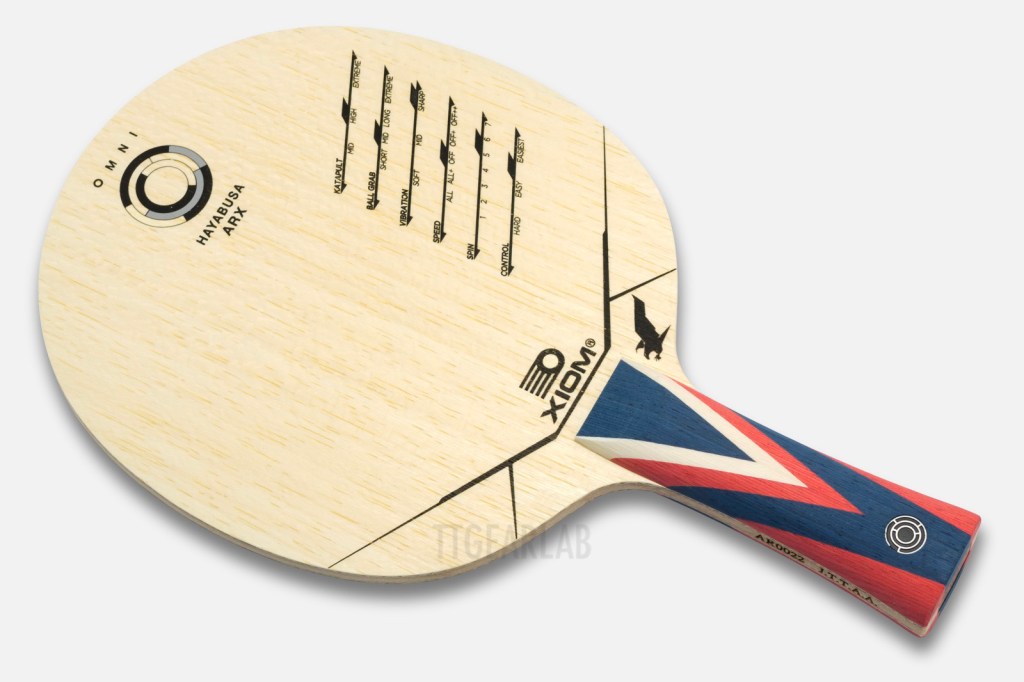
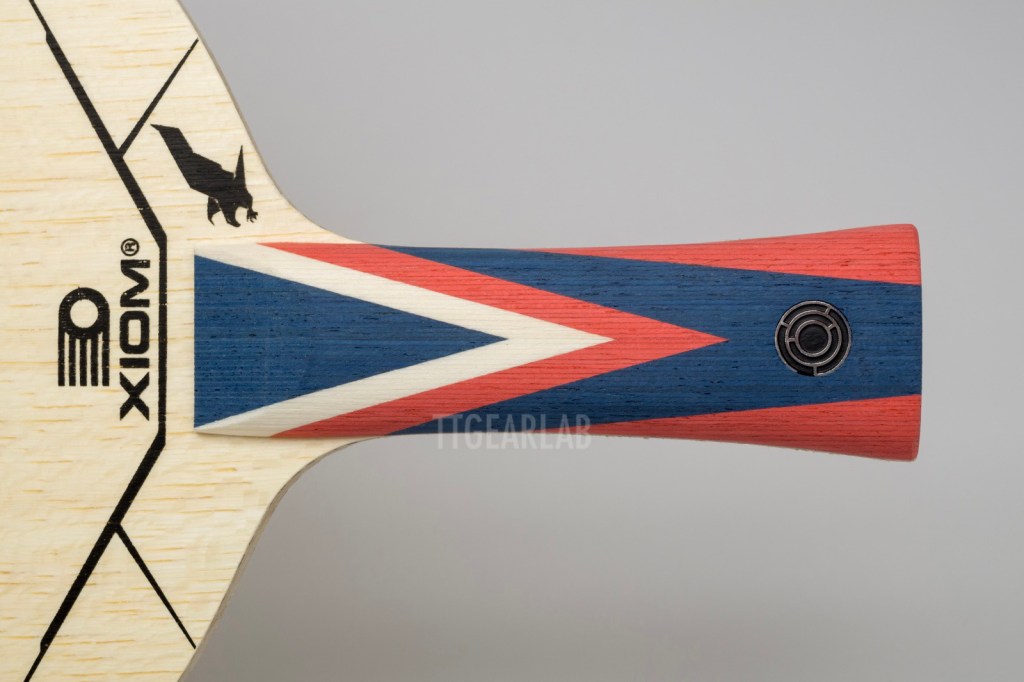
The graphic design of new ‘Hayabusa’ series is inheriting the design concept of original ‘Hayabusa’ series which symbolizes a falcon flying fast with its wings spread, but is much simplified from the original design. The five models in the series have a common design, and differ only in the color combination of the handle wood blocks. The color combination of ‘Hayabusa ARX’ is red & white on dark blue background.
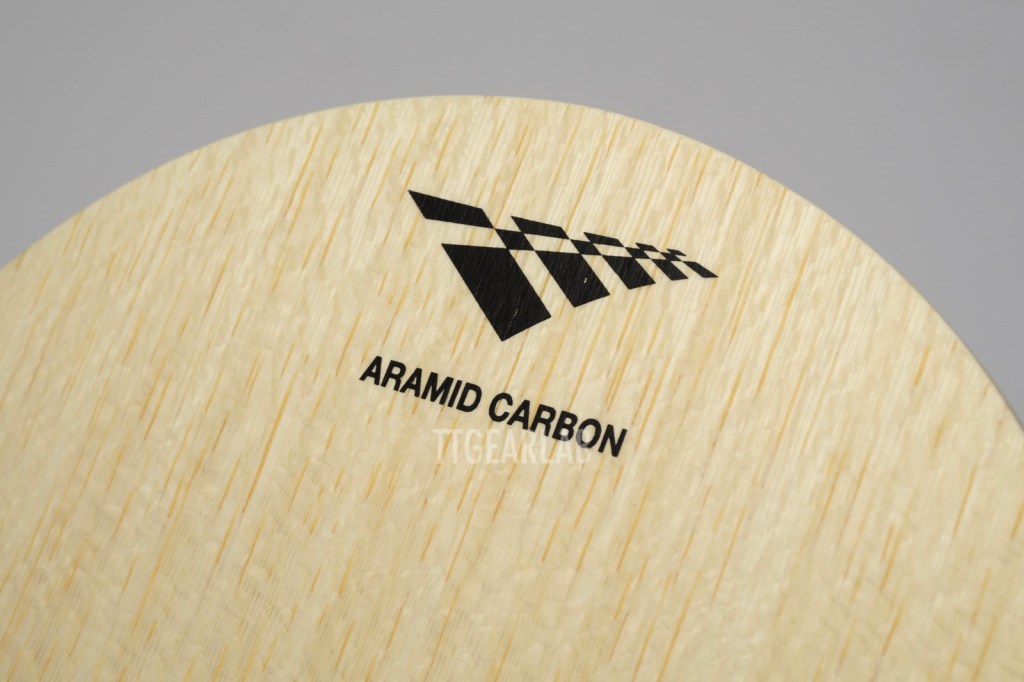
The kind of artificial fiber is indicated at top of the backside of head. The artificial material of ‘Hayabusa ARX’ is Aramid Carbon which is woven from aramid fiber and carbon fiber. ARX is the term of Xiom that expresses Aramid Carbon.

‘Hayabusa ARX’ is an outer fiber blade. Aramid Carbon (= ARX) is placed directly under the top layer. The top layer is Koto. The middle layer is Ayous, and the center layer is Kiri. Overall thickness is around 5.8mm.
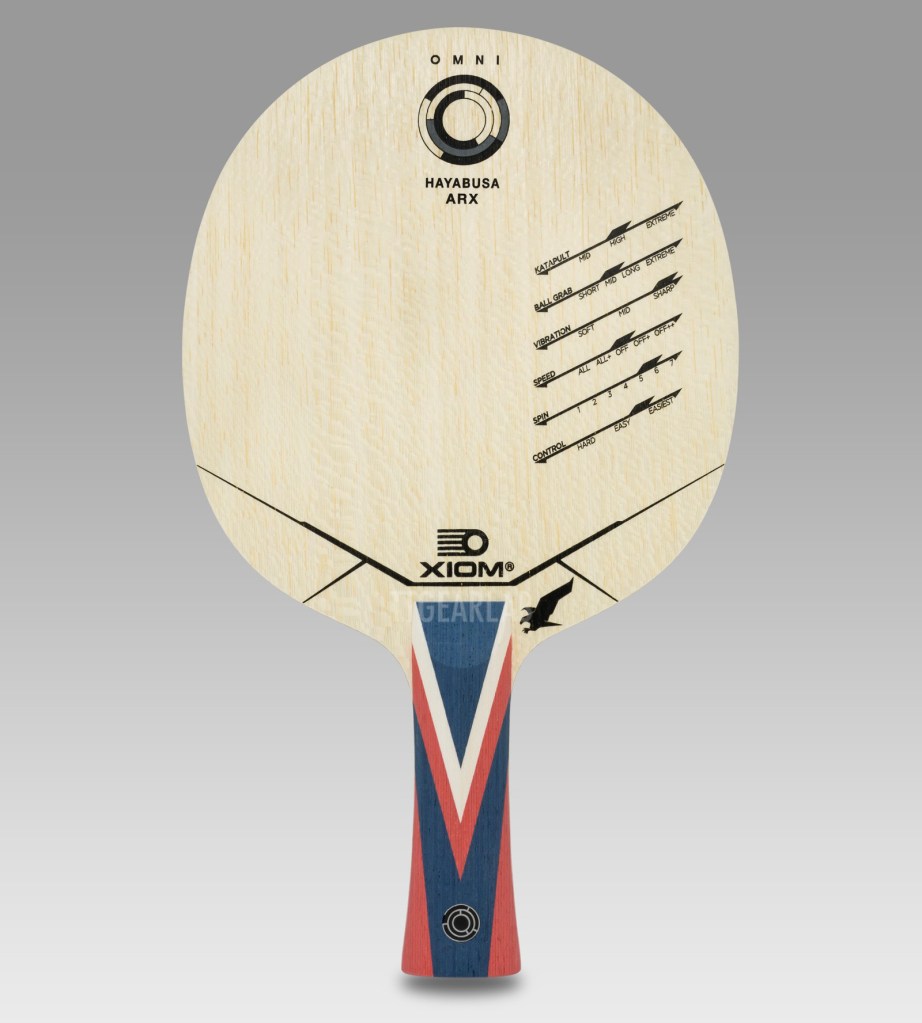
The head size on the catalog is 158mm x 150mm which is a bit bigger than regular size (157mm x 150mm). Measured size is around 158mm x 152mm.

The width of FL (flared) handle is around 26mm (at head side) ~ 27mm (at bulge) ~ 26mm (at narrowest point) ~ 33mm (at the end). And, the thickness of FL handle is around 23.5mm (at thumb) ~ 25.5mm (at the end). This FL handle is a narrow/tall handle that is preferred in Japan and China. Although it isn’t wide, the circumference of handle isn’t small because it is quite thick.
The size of ST (straight) handle which isn’t shown in picture is around 29mm (width) x 23mm (thickness).

‘Hayabusa’ series is categorized as ‘Omni’ line in the blade range of Xiom. ‘Omni’ is one of the subsidiary brands of Xiom blades, and introduced in 2011 with the release of original ‘Hayabusa’ series for distinguishing new blades family from existing blades of ‘Novus’ line. New ‘Hayabusa’ series released in 2024 is inheriting ‘Omni’ brand.

The chart that indicates the characteristics of this blade is printed at right side of the foreside of blade head. What this chart shows is based on different idea from the concept of Performance Indices of TTGearLab, and only two parameters among six are able to be quantified. So probably that is the result of the subjective field testing by test players. Especially, it is strange that SPIN is included in the six parameters of ‘blade’. It will be good for us that we accept its meaning as ‘how easy this blade is for producing rotation’ or ‘how suitable this blade is for the technics related with rotation’. Although those parameters are not the result of objective measurement, it seems that those are quite reliable. And the parameters almost coincide with the opinion of TTGearLab.

There is a picture of falcon on the right wing of foreside. Unfortunately, part of the falcon’s wing is covered by the rubber when the rubber is attached.

At foreside of handle, an aluminum panel that indicates the logo of ‘Omni’ is applied. This aluminum panel doesn’t disturb player’s finger because it is small.

At backside of handle, another aluminum panel that includes the 2nd name of the model in ‘Hayabusa’ series is applied.

At the end of handle, a hexagonal aluminum panel that includes Xiom logo and the names of blade family (= Hayabusa) and sub-brand (= Omni).

Various information including the kind of material, the description on blade, the name of sub-brand (= Omni) and the name of blade is printed.
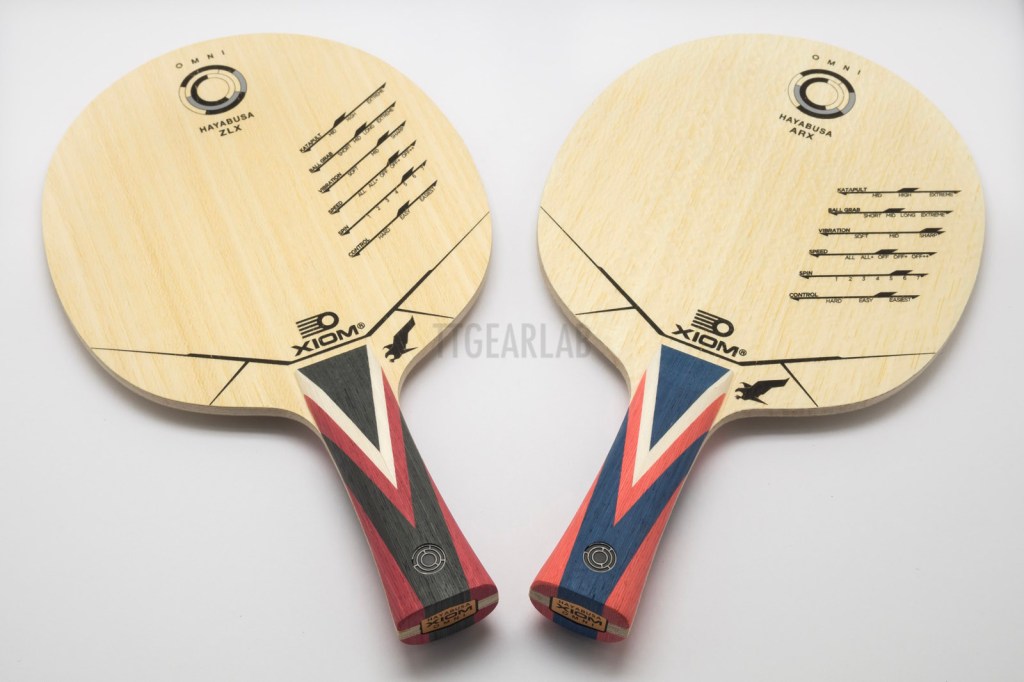
‘Hayabusa ZLX’ (left) and ‘Hayabusa ARX’ (right) are outer-fiber models. New ‘Hayabusa’ series consists of five models. Among those five, three models have ‘Pro’ in their names. But, two outer fiber models whose positions are highest in the series doesn’t have ‘Pro’ in their names. That is because the two outer fiber models – ‘Hayabusa ARX’ and ‘Hayabusa ZLX’ – are already the blades with professional specification, and therefore it isn’t needed to distinguish from the blades with similar specifications by adding ‘Pro’.
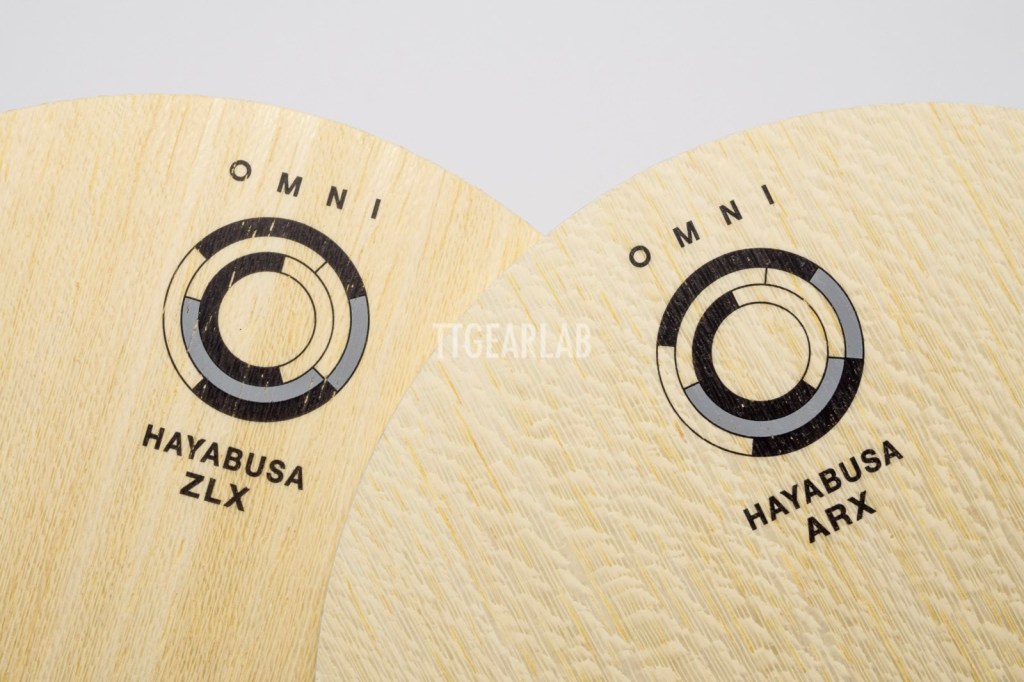
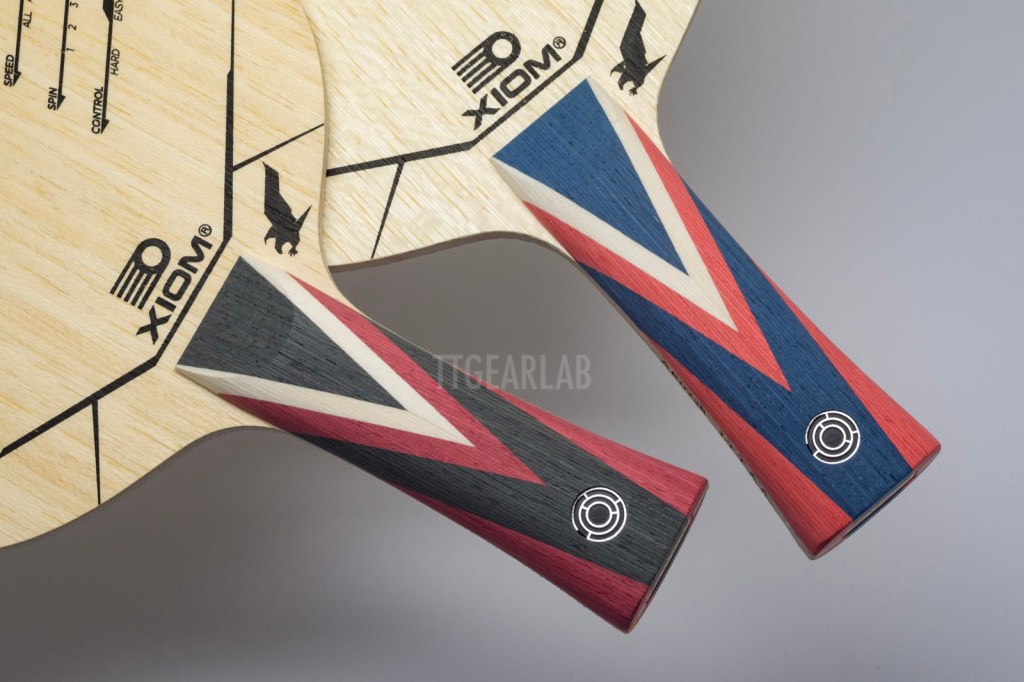
Same graphic design concept is applied for all models in ‘Hayabusa’ series. And, ‘Omni’ logo and the picture of a falcon are printed respectively at top and at right wing of foreside head. The graphic design of handle is also common for all five models, and each model is distinguished by the color combination. White & burgundy on black background is for ‘ZLX’, and white & red on dark blue background is for ‘ARX’.
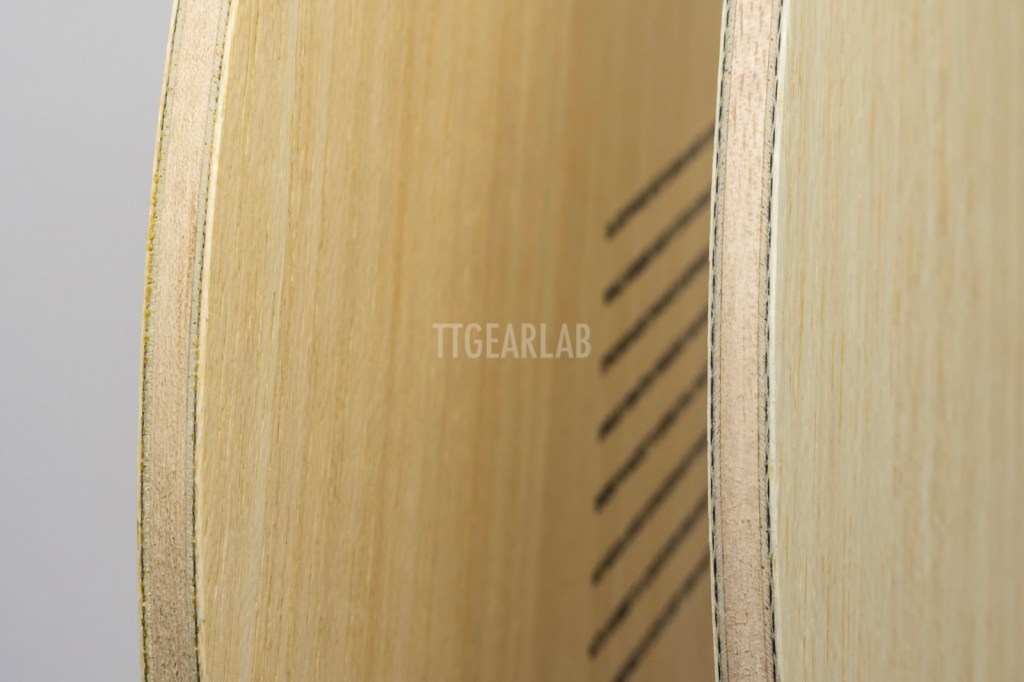

‘Hayabusa ZLX’ (left) and ‘Hayabusa ARX’ (right) share the basic construction. But, those two are distinguished by the kind of artificial material – Zephylium Carbon (Zylon Carbon) and Aramid Carbon.

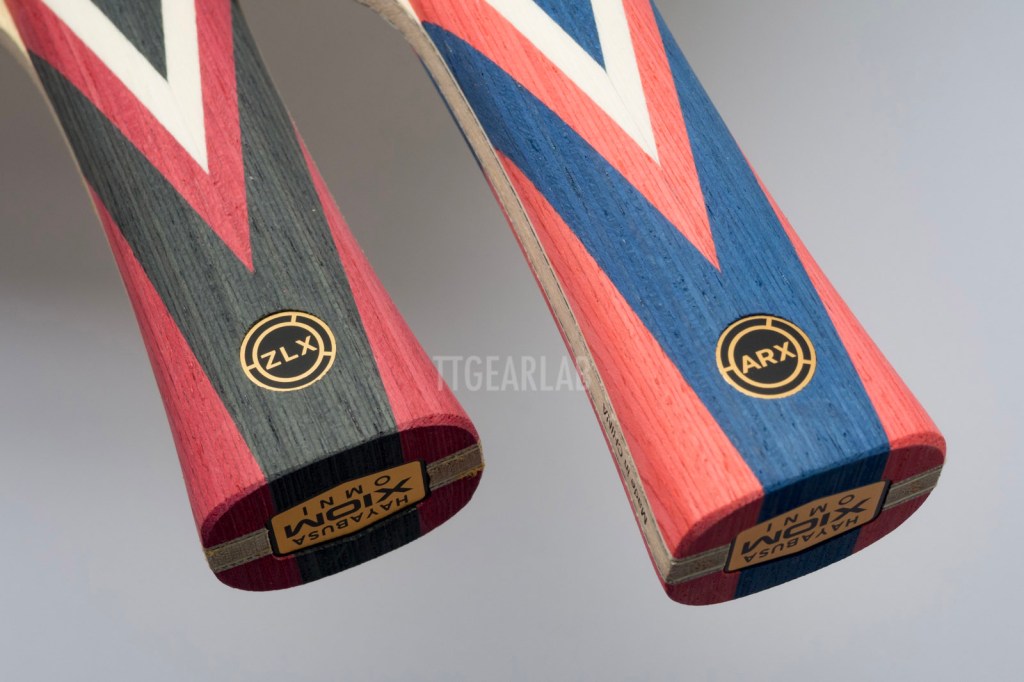
The name of artificial material is written at many points of backside of blade – top of head and the aluminum plate at handle. It is also written at right wing.

‘Hayabusa ZLX’ (left) and ‘Hayabusa ARX’ (right) provide high performance at reasonable price range. It is expected that those two will be the most important outer fiber models in Xiom’s blade range in the future.

‘Hayabusa ARX’ is a very important model that has inherited the role of the existing ‘Stradivarius’.


‘Hayabusa ARX’ is an outer-fiber blade, and its advantage when compared with existing top models of Xiom outer-fiber blades is its reasonable price. In near future TTGearLab will analyze and compare some outer fiber blades those are reasonably priced.
Following are the performance indices of Xiom Hayabusa ARX (avg.weight = 88.5g) :
– Ep = 2.29
– Ec = 1.93 (Ec/Ep = 0.84)
– Vp = 1.32
– Vl = 1.50 (Vl/Vp = 1.14)
Please note that above are average values and can be updated by further measurement.
Unauthorized use and/or duplication of this material without express and written permission from this website’s author and/or owner is strictly prohibited. Excerpts and links may be used, provided that full and clear credit is given to TTGearLab with appropriate and specific direction to the original content.
 TTGearLab
Thank you so much for continuing the test on new Hayabusa series.
Wow , the stat of ARX is amazing ,
Do you have the ep ec stat also on ZLX ?
Anyway , Xiom is working in correct direction in this series .
LikeLike
Thank you for comment.
Regarding the values of Hayabusa ZLX, please refer to following article :
Performance Indices DB – Victas & Xiom Blades – TTGearLab
or this article :
Performance Indices DB – Outer Fiber Blades – TTGearLab
Interestingly ZLX is less elastic than ARX.
Probably it is because the other factors of the constructions.
LikeLike
Hello, Are you sure the ALX has an outer ply of koto? It looks quite a bit like limba to me, no?
LikeLike
Yes. It is Koto. It isn’t Limba.
In fact, Xiom doesn’t make any outer type blade with Limba top layer.
LikeLike
Look like Butterfly Viscaria blade construction and thickness.
How does the feeling>speed>control>flexible of this Hayabusa ARX blade if comparable with Butterfly Viscaria blade.
Thank you sir.
Best regards,
LikeLike
This construction can be conisered as a copy of ‘Timo Boll Spirit’. (‘Timo Boll Spirit’ is based on ‘Viscaria’.) That is the reason why the construction of this blade looks like that of Viscaria.
But, the first production of Hayabusa ARX seems to be faster and harder than Viscaria. Regarding elasticity, the primary elasticity of Hayabusa ARX is noticeably higher than that of Viscaria. But, there isn’t noticeably difference in central elasticity. As the result, we will feel that Hayabusa ARX hugs the ball more deeply when we hit the ball very strongly although its basic elasticity is higher. And, the primary feeling transmitted to palm will not be much different. However, Hayabusa ARX will transmit much sharper feeling to our index finger.
LikeLike
Thank you for the review. How does the feeling speed, spin and control of this hayabusa ARX if comparable with Nittaku Mima Ito Carbon. Thank you
LikeLiked by 1 person
I think that Hayabusa ARX gives similar level of speed and feeling with Mima Ito Carbon. But, spin and control differ by player. The major differences between two blades are in the top layer and the artificial material. The player who like Koto top layer will prefer Hayabusa ARX. But, the player who like Limba top layer will prefer Mima Ito Carbon.
LikeLike
Hello, what do you mean with EP , EC , VP and VL ?
Thanks
LikeLiked by 1 person
Hi Marco, did you try to read this article: https://ttgearlab.com/2017/02/06/the-example-of-the-comparison-by-performance-indices/
Ep: base speed
Ec: speed when hitting hard through the ball
Vp: how much feeling in lower hand by pinky
Vl: how much feeling in upper hand by index finger
LikeLike
Thank you for comment. Please refer to following articles :
https://ttgearlab.com/2017/02/06/performance-indices-the-way-to-evaluatie-blade-by-measurement/
https://ttgearlab.com/2017/02/06/the-example-of-the-comparison-by-performance-indices/
LikeLike
FYI, this website is gaining notoriety on the forums.
LikeLike
Thank you for informing it to me.
This year I couldn’t have used much time for writing articles on this web site due to personal condition. But, it seems that I have to spend more time for TTGearLab web site. 🙂
LikeLiked by 1 person