
New ‘Hayabusa’ series released in April 2024 is the strategic blade family of Xiom mainly targeted for Asian market including Japan. This series is inheriting the blade family of the same name that released more than 10 years ago. In the past, original ‘Hayabusa’ series was a top product line consisting of relatively expensive blades manufactured in Korea. However, new ‘Hayabusa’ series consists of reasonably prices blades made in China. Five models are available in new ‘Hayabusa’ series – two outer fiber blades (ARX and ZLX) and three ‘Pro’ models (ZL Pro, HX Pro and OFF Pro). Although two outer fiber models don’t have the word ‘Pro’ in their names, those two are also professional class blades. ‘Pro’ is added for the other three models for emphasizing those three aims at more skilled players when compared with the blades of similar constructions.
‘Hayabusa ZL Pro’ is an inner fiber blade whose artificial material is pure Zephylium fiber that doesn’t include carbon fiber. It focuses on the ability of grabbing the ball and creating strong rotation of ball, at the same time with high level of control. ‘Hayabusa ZL Pro’ is recommended for the players who want to play with continuous topspin with strong rotation and high stability. Further, because it tends to hugs the ball deeply, ‘Hayabusa ZL Pro’ is suitable also for very aggressive topspin at extremely close-to-table area.
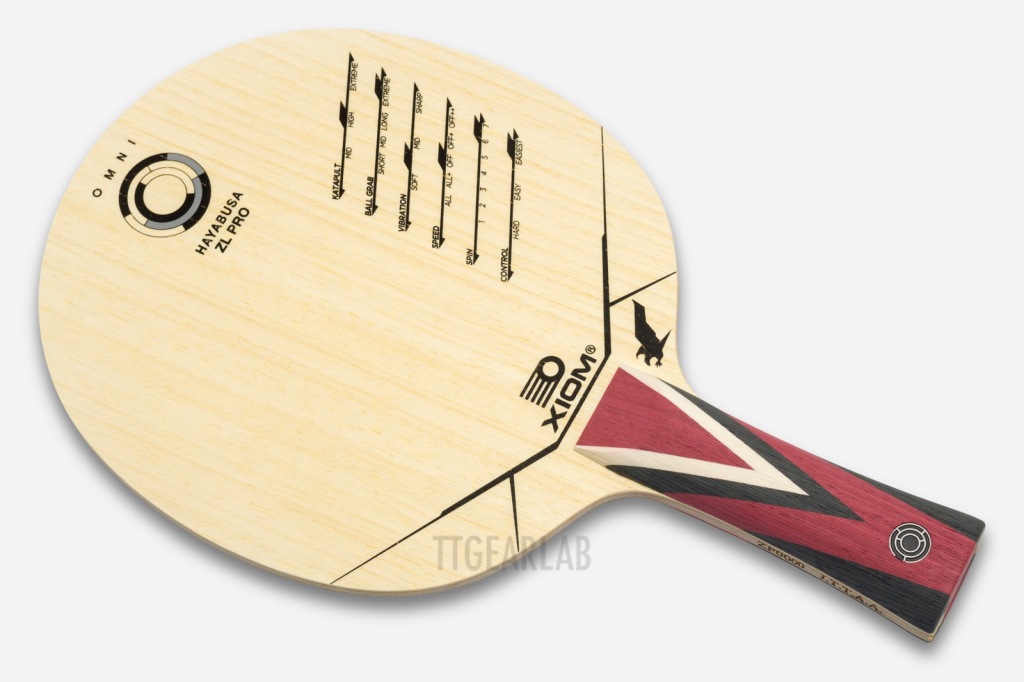
The graphic design of new ‘Hayabusa’ series is inheriting the design concept of original ‘Hayabusa’ series which symbolizes a falcon flying fast with its wings spread, but is much simplified from the original design. The five models in the series have a common design, and differ only in the color combination of the handle wood blocks. The color combination of ‘Hayabusa ZL Pro’ is black & white on burgundy background.

The kind of artificial fiber is indicated at top of the backside of head. The artificial material of ‘Hayabusa ZL Pro’ is Zephylium fiber. Zephylium fiber is Xiom’s own name for PBO fiber (= Zylon fiber).
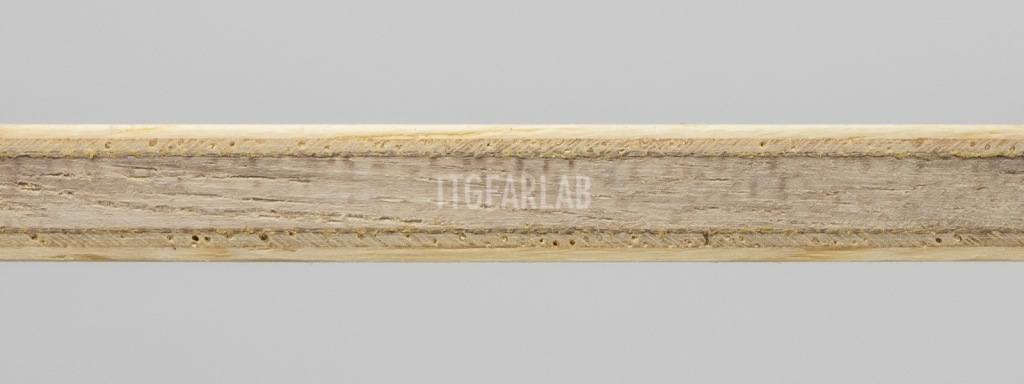
‘Hayabusa ZL Pro’ is an inner fiber blade. Woven Zephylium fiber (= PBO fiber) is placed between the middle layer and the center layer. The top layer is Koto. The middle layer is Ayous, and the center layer is Kiri. Overall thickness is around 5.7mm.
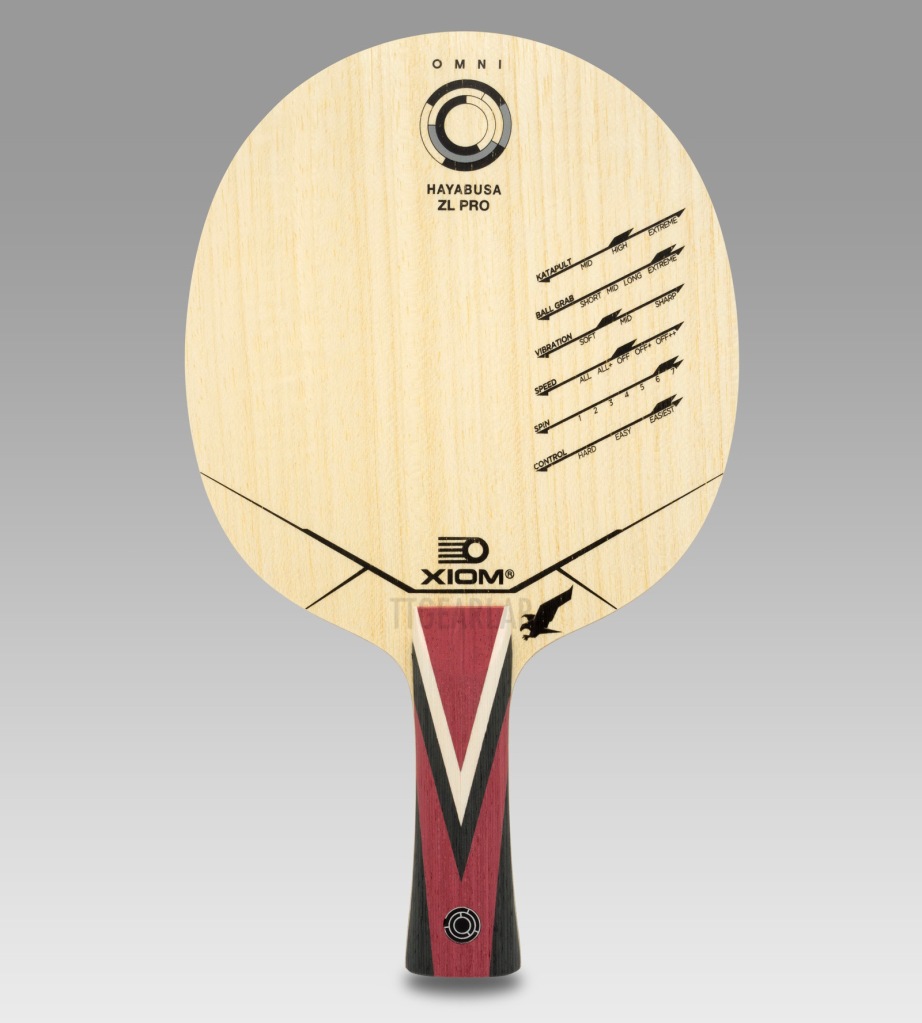
The official head size on the catalog is 157mm x 150mm. Measured size is around 157mm x 152mm.

The width of FL (flared) handle is around 26mm (at head side) ~ 27mm (at bulge) ~ 26mm (at narrowest point) ~ 33mm (at the end). And, the thickness of FL handle is around 23.5mm (at thumb) ~ 25.5mm (at the end). This FL handle is a narrow/tall handle that is preferred in Japan and China. Although it isn’t wide, the circumference of handle isn’t small because it is quite thick.
The size of ST (straight) handle which isn’t shown in picture is around 29mm (width) x 23mm (thickness).

‘Hayabusa’ series is categorized as ‘Omni’ line in the blade range of Xiom. ‘Omni’ is one of the subsidiary brands of Xiom blades, and introduced in 2011 with the release of original ‘Hayabusa’ series for distinguishing new blades family from existing blades of ‘Novus’ line. New ‘Hayabusa’ series released in 2024 is inheriting ‘Omni’ brand.
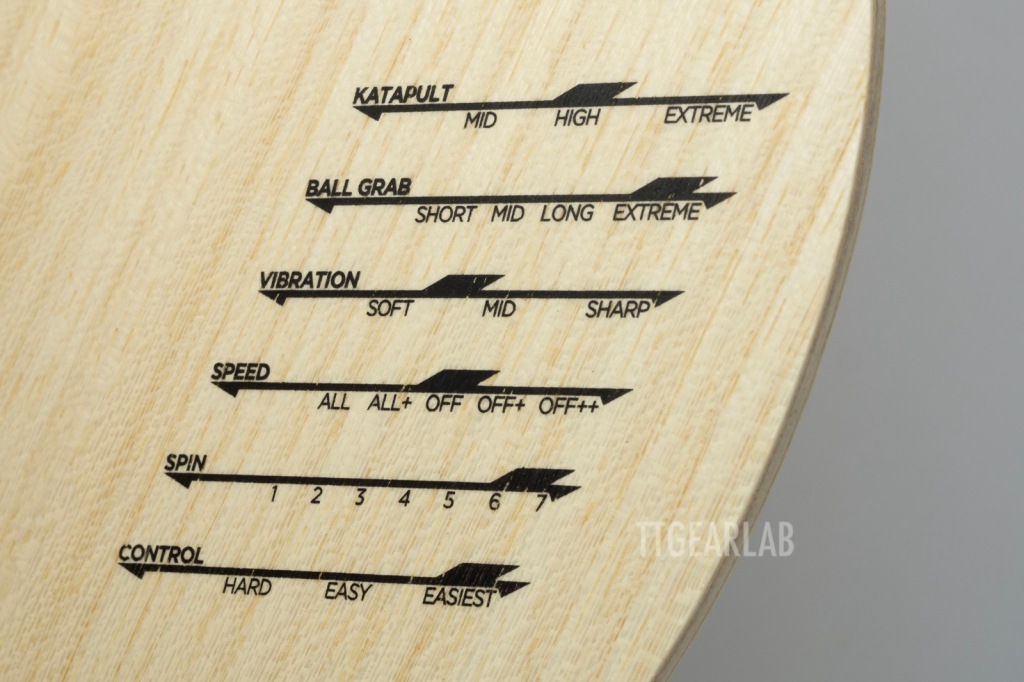
The chart that indicates the characteristics of this blade is printed at right side of the foreside of blade head. What this chart shows is based on different idea from the concept of Performance Indices of TTGearLab, and only two parameters among six are able to be quantified. So probably that is the result of the subjective field testing by test players. Especially, it is strange that SPIN is included in the six parameters of ‘blade’. It will be good for us that we accept its meaning as ‘how easy this blade is for producing rotation’ or ‘how suitable this blade is for the technics related with rotation’. Although those parameters are not the result of objective measurement, it seems that those are quite reliable. And the parameters almost coincide with the opinion of TTGearLab.
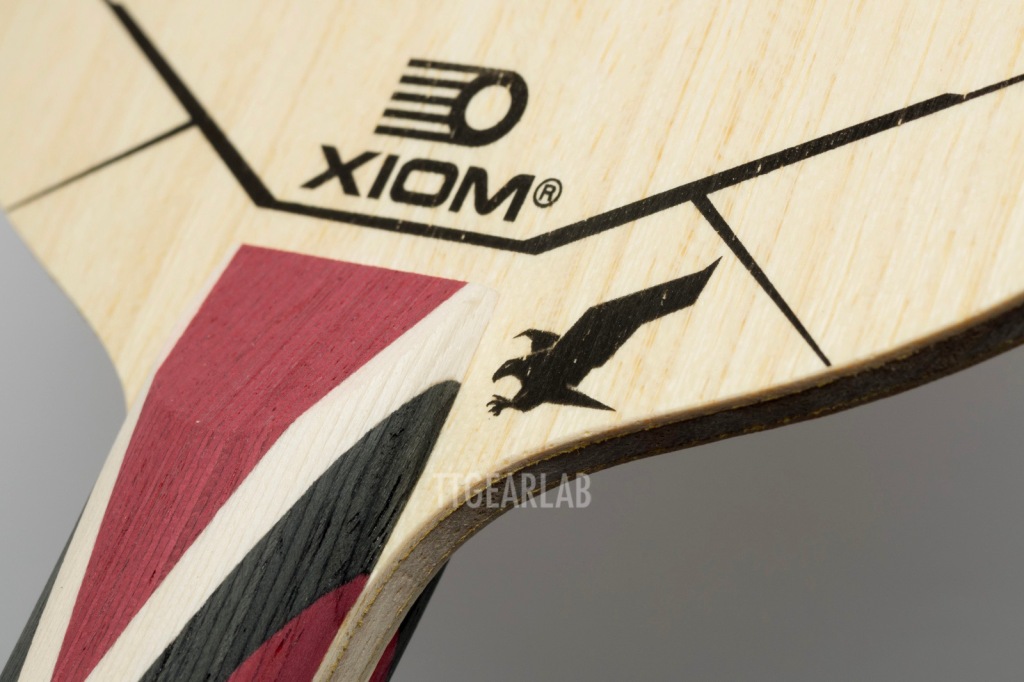
There is a picture of falcon on the right wing of foreside. Unfortunately, part of the falcon’s wing is covered by the rubber when the rubber is attached.

At foreside of handle, an aluminum panel that indicates the logo of ‘Omni’ is applied. This aluminum panel doesn’t disturb player’s finger because it is small.

At backside of handle, another aluminum panel that includes the 2nd name of the model in ‘Hayabusa’ series is applied.
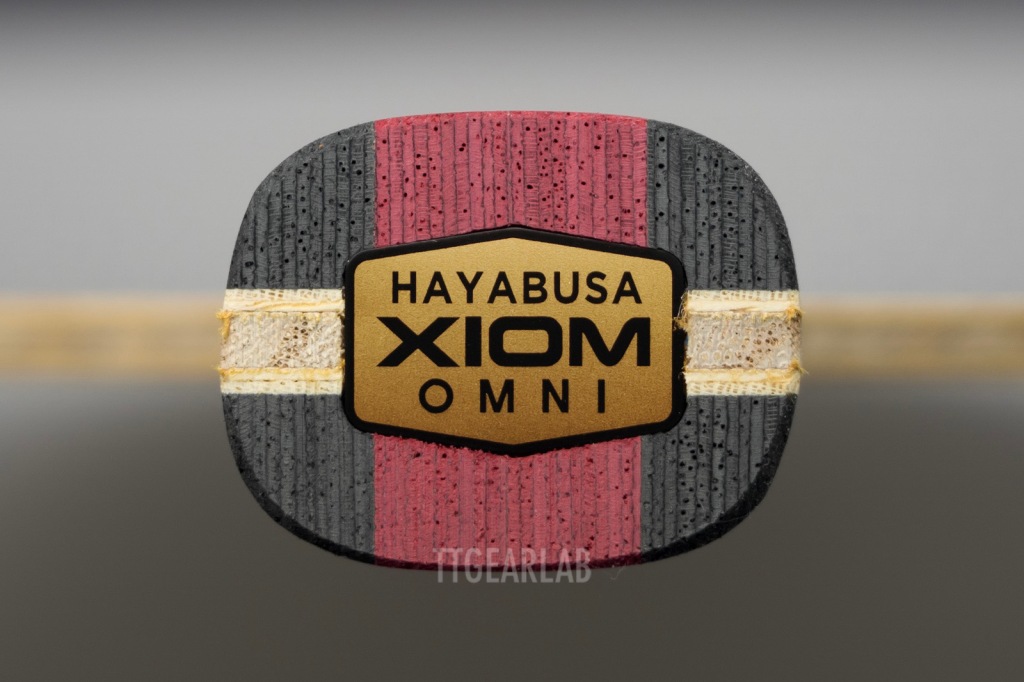
At the end of handle, a hexagonal aluminum panel that includes Xiom logo and the names of blade family (= Hayabusa) and sub-brand (= Omni).
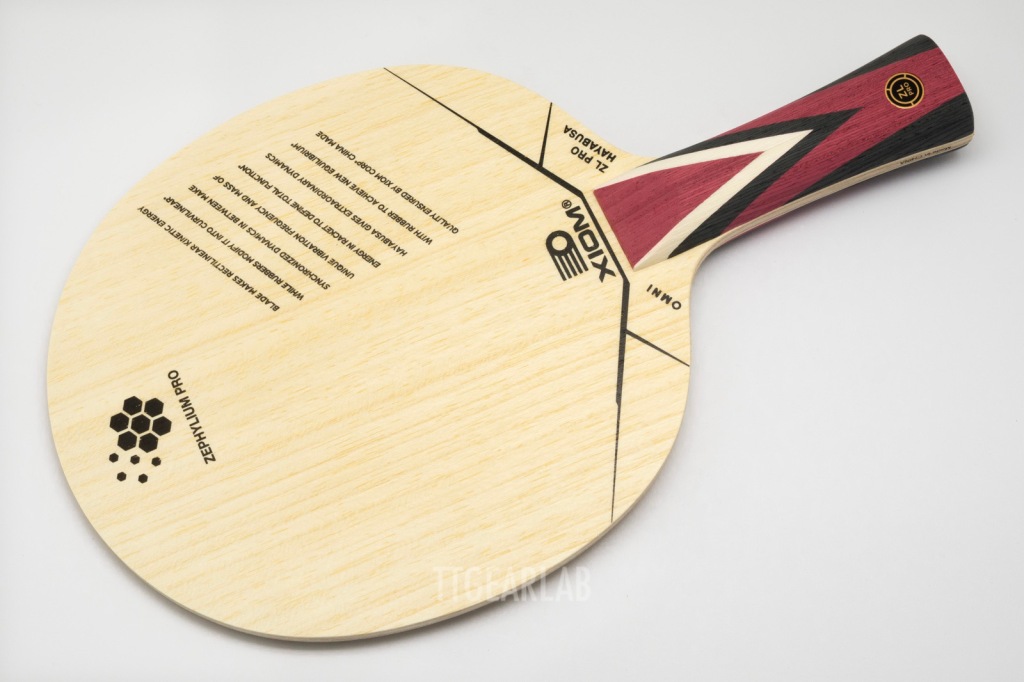
Various information including the kind of material, the description on blade, the name of sub-brand (= Omni) and the name of blade is printed.

New ‘Hayabusa’ series consists of five models. Among those five, three models have ‘Pro’ in their names. That doesn’t mean that the other two models are lower-class blades than those three, but that those three are close to professional spec. when compared with the blades with similar constructions.


Same graphic design concept is applied for all models in ‘Hayabusa’ series. And, ‘Omni’ logo and the picture of a falcon are printed respectively at top and at right wing of foreside head.


The graphic design of handle is common for all five models, and each model is distinguished by the color combination. Above pictures show three models including ‘Pro’ in their names. White & blade on burgundy background is for ‘ZL Pro’ (left), teal & orange on dark blue background is for ‘OFF Pro’ (center), and white and dark blue on dark brown background is for ‘HX Pro’ (right).

‘Hayabusa ZL Pro’ is a very important model that can be recommend for the players who play with both-hand topspin and want to use fiber blades but don’t like the feeling of carbon fiber.


‘Hayabusa ZL Pro’ is a unique blade which is an inner Zylon (= Zephylium) blade with Koto top layer. Its construction is very similar to that of Butterfly ‘Timo Boll ZLF’ except for the placement of ZL fiber. If the ZL fiber in the construction of ‘Timo Boll ZLF’ is moved one step inward, it becomes the construction of ‘Hayabusa ZL Pro’. So, we will be able to deal with ‘Hayabusa ZL Pro’ as the inner fiber version of ‘Timo Boll ZLF’. Like ‘Timo Boll ZLF’, ‘Hayabusa ZL Pro’ is also the blade with intermediate characteristics between pure wood blades and the blades containing carbon fiber. And, because of its moderate elasticity and reasonable price, ‘Hayabusa ZL Pro’ is expected to be a blade that can be recommended for various players.
TTGearLab will analyze and compare some inner fiber blades whose artificial fibers don’t contain carbon fiber in near future.
Following are the performance indices of Xiom Hayabusa ZL Pro (avg.weight = 86.2g) :
– Ep = 1.67
– Ec = 1.46 (Ec/Ep = 0.88)
– Vp = 1.16
– Vl = 1.16 (Vl/Vp = 1.00)
Please note that above are average values and can be updated by further measurement.
Unauthorized use and/or duplication of this material without express and written permission from this website’s author and/or owner is strictly prohibited. Excerpts and links may be used, provided that full and clear credit is given to TTGearLab with appropriate and specific direction to the original content.


Bonjour,
la couche extérieure du XIOM Hayabusa ZL Pro me semble être du Koto et non du limba d’après vos photos. Le XIOM Hayabusa OFF Pro, lui, semble être du limba.
LikeLike
Thank you for pointing it out. Of course the top layer of Hayabusa ZL Pro is Koto.
‘Limba’ was just the mistake happend while I was editing this article.
I have corrected it just now.
LikeLike
Hi, you are making two different statements in the article about the wood composition. Is it Limba ot Koto?!
LikeLike
It is Koto. ‘Limba’ is just the mistake. (I copied old text from other article and then edit it. I forgot to replace that word with Koto.) I have just corrected it.
LikeLiked by 1 person
Oh wow, very interesting family of blades. Really looking forward for your comparison of blades with no carbon fiber, maybe not only inner but outer too?
Also, you mentioned that the subjective “spin” measurement, printed on the blade is almost coincide with the opinion of TTGearLab, so wondering which characteristics are responsible for it in your opinion. My guess is deeper hold (< 0.9) and softer Vl and Vp?
LikeLike
I expect that Hayabusa ZL Pro will be quite similar to Timo Boll ZLF although there is big difference in construction – inner vs outer. I expect that those two share the basic characteristics – good ball dragging and high stability of topspin.
Regarding the performance measure, probably KATAPULT will be concerned with Ec/Ep. High value of KATAPULT may indicate low value of Ec/Ep. (Although there isn’t possibility that Xiom considered TTGearLab’s Ec/Ep.) And, VIBRATION may be concerned with Vp or Vl. (Probably Vp.) SPEED is concerned with Ep of course.
LikeLike
Does “Katapult” define or determine when we hit the ball mild in short touch game? First I thinked that “Katapult” determines behavior when we hit the ball strong.
LikeLike
In the terms of Xiom ‘KATAPULT’ means the level of hugging balls.
It is apparent if we see following two models.
Hayabusa OFF Pro (5-ply wood ) : Extreme
Hayabusa HX Pro (Hinoki Carbon) : Mid
So I think that your first idea is right. It is the behavior when we hit the ball strongly. Low KATAPULT means high Ec/Ep and high KATAPULT means low Ec/Ep probably.
LikeLike
Thanks ! Do you have the Timo Boll ZLF ec / ep / vp / vl measurements and ratios ?
LikeLike
https://ttgearlab.com/2023/01/17/performance-indices-db-butterfly-blades/
LikeLike
Thank you for comment. Please refer to this article : https://ttgearlab.com/2024/03/15/performance-indices-db-outer-fiber-blades/
LikeLike
Hi – you state multiple times that this Hayabusa ZL Pro is an INNER fiber blade – however, the official Xiom catalog – https://www.yumpu.com/en/document/read/68592680/2024-xiom-product-catalogue clearly says that this is an OUTER fiber blade.
LikeLike
Please just believe what we see. That Xiom catalog contains wrong information if the product Xiom provided me isn’t a wrong product. Without doubt the Hayabusa ZL Pro that is give to me from Xiom has ‘inner fiber’ construction. (Before it I expected that Hayabusa ZL Pro is an outer fiber blade which is very similar to Butterfly Timo Boll ZLF.)
And, that catalog contains another wrong information. It describes that Hayabusa ZLX is an inner fiber blade. But, it is an outer fiber blade.
ZL Pro = inner (written as outer on the catalog)
ZLX = outer (written as inner on the catalog)
Probably the editor was confused when the catalog is edited. I expect that the on-line catalog will be corrected until this autumn. I will inform Xiom on the wrong description of catalog.
LikeLike
thank you for testing the new xiom Hayabusa series. I am so surprised that xiom continue this series with a new generation
In fact , Hayabusa series is one of the most remarkable series from Xiom. Excellent design ,excellent finish, excellent package ,great blade.
I do not know this blade until last year , I get one in second hand market ,and then I immediately brought the last stock in a shop. Last stock, and no more stock left .
Being a faithful reader , I am looking forward the site can give a full test report on all blades from new Hayabusa series.
LikeLike
I was also astonished when I heard that new Hayabusa series will be released. New ones are much cheaper than original ones. But, still with beautiful design.
I’m considering to perform field test and write report. Especially for Hayabusa ZL Pro which may become one of my favorite blades.
LikeLike
I am looking forward to your test on Hayabusa series.
the old hayabua zx is also my favourite choice for competitions.
people may not aware that there are numerous inner carbon fibre blade from diff factories, Btf, DHS , but you can hardly find an inner carbon blade with Kiri core.
But the stability given by hayabusa is outstanding
LikeLike
Thank you for comment. I expect that Hayabusa ZL Pro will give us good result of testing. (Especially for the playes who lays emphasis on ball keeping on the surface of blade.)
LikeLike
While its an innerforce zl blade like the bt inner zlf, its ep/ec seems to be closer to the long 5 2022 sample, vp/vl is different tho, considering the dhs and bt are both limba while the xiom is koto, kind of interesting. If I can find one that is at least 90-92g I might get it to try.
LikeLike
One more difference is that the center layer is Kiri. Butterfly is using Ayous for the center layer of inner fiber blades. And, that is same for Hurricane Long 5. So, probably 90~92g ones are the heaviest ones possible, and I think that it will be difficult for you to find that heavy ones. That is because Kiri is softer and lighter than Ayous. But, if you can find, the comparison will be interesting. 🙂
LikeLike
Despite it’s made in China, it’s still not available for sale here in China just yet.
LikeLike
That is because it is new model just released in last month. Probably it will be launched in China market sooner or later.
LikeLike
Yeah, just a bit weird that it’s delayed selling it at production country and already started selling at other far away countries already.
LikeLike
I don’t know the details of sales. But, probably that is up to the decision of distributor.
LikeLike
How can you describe this ZL Pro compared to DHS 301Z or Hurricane Long 5/Fang Bo Carbon? Also according to Ep/Ec and Vl/Vp this ZL Pro placed between Innerforce ALC.S and Innerforce ALC. What is your thoughts? Does ZL Pro have something special among similar blades of its class?
LikeLike
Something special of Hayabusa ZL Pro is its artificial material – Zylon fiber. That shows different characteristics from Arylate fiber or Arylate Carbon. Among all blades you mentioned, the only one that doesn’t have carbon fiber in its construction is Hayabusa ZL Pro. It isn’t a carbon blade. That makes it very special, like Butterfly Timo Boll ZLF or Xiom Hugo HAL.
You will always feel it very comfortable even at the moment you hit the ball very strongly because there isn’t influence of carbon fiber on the feeling. (It is the story other than Performance Indices although performance indices also show that its vibration indices are quite low.)
LikeLike
I am really curious how hayabusa zl pro will differ from Hugo HAL. If I understand correctly, only the position of fiber is different? (inner vs outer)
I am looking forward to your field test, maybe hayabusa will be even more comfortable for me than my Hugo HAL that I love to play with
I hope you can test hayabusa zl pro with chinese rubbers like hurricane or hard xiom rubbers like O7A or H52.5.
Cheers!
LikeLike
There is one more important difference – the kind of fiber.
HAL : Hyper Axylium = woven Arylate fiber
ZL : Zephylium = woven Zylon fiber
What you mentioned applies when comparing Hayabusa ZL Pro and Butterfly Timo Boll ZLF. If we move the Zylon fiber of Timo Boll ZLF to one step deeper position, it becomes Hayabusa ZL Pro.
Because of the difference in fiber, we can’t easily expect that Hayabusa ZL Pro will be more comfortable than Hugo HAL. Hayabusa ZL Pro will give us the unique feeling of Zylon fiber as Timo Boll ZLF does.
LikeLike
Hi. Based on composition (Koto-Ayous-Kiri) and catalogue, probably this should have been an outer fiber blade, not inner. I suspect that the factory produced this model by mistake as an inner and now it is too late to change it :). So, if this blade will prove to be good, it will be by chance and not by research etc. Also, another reason to be concerned, measured thickness for a different specimen (youtube video) shows 5.4 mm for an 80 g blade, which will probably behave extremely different compared to a 5.7mm/86 g. Probably I will take my chances with this as well, since Victas inner fiber proved to be a little to slow (slower than Korbel, similar weight)
LikeLike
My sample is mass produced product. If it is made just by mistake, ……… , all piece in first production are wrong ones. 🙂
But, probably it is no more than the mistake of editing catalog. The catalog is even explaining that the artificial material of this blade is Zephylium Carbon! So the description is not for this model but for Hayabusa ZLX. I think that the text is mixed when the editor is editing the catalog. It sometimes happens.
Regarding Victas blades, not all Victas inner blades are slow. That result is just because the Ec’s of many Victas inner blades are low. But, there is a Victas inner blades which provides quite high value of Ec – Victas Fire Fall VC which is being used by Miyuu Kihara of Japanese Women’s National Team. It will not be slower than Korbel.
LikeLike
Thank you for the reply. I will check Fire fall vc. Both zx gear fiber (89g) and gear in (85g) are very nice but relatively slow, also from the feedback of my training partner (same rubbers). I like very much the ST handle of zx gear. Maybe I will have the chance to test a gear out. I have asked tt11 to check the ST of hayabusa zl pro – 85g, but 29×23.4 mm, so quite thick compared to victas or butterfly. It is a pitty that xiom discarder the hayabusa models with limba+fiber and kept only those with koto
LikeLike
I expect that ZX-Gear Out will not be bad for you. It isn’t much different from ZX-Gear although it is faster.
LikeLike
I try to order this Hayabusa ZL Pro, but answer from shop was that there is only light samples under 80 grams.
LikeLike
I think that those samples are the lightest pieces available for Hayabusa ZL Pro. 🙂
LikeLike
If we’re talking about tt11, then yes, that seems true – I ordered one without specifying the weight and I got one very light – 75 grams. I was hesitant to try it, but glued the rubbers anyway.. and I don’t regret it. It seems like lighter blade fits me better and it’s got enough speed for me. Being my first composite blade, I was afraid I wouldn’t be able to get used to different feeling, but it’s not that different, and the vibrations I actually like more than in my Tibhar SPW.
LikeLike
It is good to hear that your new blade is satisfactory. 🙂
LikeLike
hi. I have questions which rubber you use for the blade or test it. Have you any recommendations? Thx. Best regards andi
LikeLike
I haven’t tested this blade yet, so I can only recommend the combination just by my experience.
For the combination with this blade, I recommend the soft or medium soft version of top class rubbers those are focused on spin performance. For example Tenergy 05-FX, Hexer PowerGrip SFX, Rakza X Soft and so on.
LikeLike
I got the blade yesterday and i bought it only depends on your opinion bcz there is no other reviews online, i smiled when u mentioned T05 FX bcz i glued it on the BH and it was superp. I was rarely missing a BH spin, counter and block really it was awesome
i glued Ma Long Rubber boosted on FH and i didnt like it to be honest maybe bcz my usual FH is V22. And maybe the booster need some time to adjusted to it
anyhow how about using on FH jekyell or Nuzn since the balde is for spin
LikeLike
Thank you for sharing your experience. 🙂
It is good to hear that the combination with T05-FX on backhand side. Probably it will be also good for forehand side. (I recommend you to once use current backhand side as forehand side. Then the result of that trial will also be a good reference of your future rubber selection.)
If you want to combine hybrid rubber (sticky tension rubber with enhanced speed) on the forehand side of Hayabusa ZL Pro, please also consider andro Rasanter C45. (If you prefer a bit harder sponge, Rasanter C48 will be better.) I believe that it will make great combination.
LikeLike
Hi again,
actually, my usual FH is Victas 22 double extra and im very happy with it. Moreover i dont think mid soft or soft rubber would work for my FH.
but recently i tried Xiom Jekyll &hyd i found it awesome thats why i asked you opinion to gule it on my FH.
i will try the above suggested rubbers of andro, i will follow the said always listen to experts :).
Im still waiting you video testing review on the Hayabusa ZL Pro.
thank you
LikeLike
Thank you for giving detailed explanation. If you are satisfied with V>22 Double Extra, the hard sponge itself will not be problem. But, I wonder whether the combination of Hayabusa ZL Pro and the rubber with hard sponge will be that satisfactory or not.
And, what I worry about is the difference in the kind of rubber. V>22 Double Extra isn’t a sticky rubber. But, NUZN 55 and NUZN 50 are sticky rubbers. (Regarding Zekyll&Hyde, H52.5 and C55 are sticky rubbers. And, the other variations are non-sticky rubbers.) Probably those sticky rubbers will be better than Neo Hurricane 3 (Ma Long version) because the stickiness is weaker. But, anyway those are different from V>22 Double Extra.
So If you want to use the rubber with hard sponge, I recommend non-sticky rubbers. For example Zekyll&Hyde Z52.5 or Rasanter R53. I expect that those two will be much more satisfactory for you than sticky rubbers – Zekyll&Hyde H52.5, NUZN 55/50.
And, if you still want to use sticky rubbers, I recommend you Rasanter C45 or C48 again. 🙂
LikeLike
Finally, I got this blade and also want to hear your advise about rubber selection for it.
I have some new sheets:
1) Xiom Vega Europe (42,5 ESN sponge hardness)
2) NITTAKU FACTIVE (45 ESN sponge hardness)
3) NITTAKU FLYATT SOFT (38-40 ESN
sponge hardness)
4) Xiom Vega Europe Hybrid (45 ESN sponge hardness)
Should I use them or not? And which is better for FH or BH side of the racket?
Also, I must to mention that I am an amatuer and not very skilled player.
Thanks as always, with best regards.
LikeLike
If a bit low speed is allowed, I recommend (4) on FH and (1) on BH. Then you will get very controllable combination. Ball grip and tolerance are the key factors when you use Hayabusa ZL Pro, and those two rubbers fits for the purpose of this blade.
LikeLike
Thanks for your answer! How do you think, is this rubber combination (Xiom Vega Europe + Xiom Vega Europe Hybrid) also good for Donic Waldner Senso Carbon or Yasaka Ma Lin Carbon? Those blades have Ec/Ep ratio around 0,9 like Xiom Hayabusa ZL Pro.
LikeLike
Hi. I have tested Hayabusa Zl Pro (85 g, 157/151 mm, 5.8 mm), FL handle with:
– xiom vega euro 2.0 – extreme control, good spin, good speed on BH, a little slow on FH. Probably omega 4 euro would be a better choice. I have played with Nittaku factive on different other blades, good rubber for the price (especially 1.8 sponge) but a little inferior to vega euro. I have xiom tested vega euro hybrid on other blades, but it will probably be too slow on this one (maybe very good solution if player is a pusher and spinny server)
– xiom vega X 2.0 – very good precision, spin and speed on both FH and BH, less control compared to vega euro and tenergy 05fx, for more advanced players
– xiom omega 7 euro – fast but with good control, need to test again with a new sheet
– tenergy 0.5fx max both sides – pretty good control, speed and spin, but feeling and precision not so great (mushy, catapulty)
– tenergy 0.5fx 1.9 both sides – much better control, precision and spin, good speed, nice feeling, maybe a little too soft. Throw angle medium.
Sweet spot and stability not as high as with some ALC blades (eg. Donic true carbon inner has the same wood composition but ALC inner and is clearly more stable, plays and feels different). Played against same players and apparently more balls are returned compared to my Korbel japan 93g and same rubbers (05fx 1.9), but match results were similar. I could return many difficult balls from out of position, so very forgiving blade. Good for short/medium serves, not so good for long serves (similar with all tested rubbers).
Overall, very nice blade for control and spin oriented players. Somehow unusual Fl handle but I like it (small to medium hands).
Personal opinion (amateur player with limited playing experience and skills, but many blades/rubbers tested over the years)
LikeLike
Thank you a lot for sharing your experience! It will be really helpful for many players who are considering this blade.
The medium-soft version of the top models those are biased to spin are my first recommendation. Tenergy-05 FX is an example. 🙂 And, andro Hexer PowerGrip SFX and Tibhar Hybrid MK FX also seriously considerable in my opinion. 🙂
LikeLike
Thanks TTGear for this another valuable testing.
I am planning to order this model by the end of summer. I currently play with Victas Swat regular and I am curious about discovering practical benefits & feel. I understand that elasticity (both) is bit higher on ZL Pro and ball grab enters the deep hold zone. One thing is for sure (and following your advice), I will replicate my current rubbers setup (which i absolutely enjoy) : Thibhar MK Fx (BH)/ New Victas V20 Extra 47.5 (FH).
Knowing that Swat is on the softer side for a 7 layers wood, very satisfactory in terms of feeling and spin generation, I certainly appreciate your input on what i should expect.
LikeLike
Thank you for comment. You may feel many differences between Swat and Hayausa ZL Pro. But, I think that it is worth trying. Please share your experience after trying it. 🙂
LikeLike
To further elaborate on some comparisons : I am curious about the 36.5 ALXi which technically seems very close to the discussed Hayabusa. Thing is that 36.5 uses real carbon fiber weaving with a harder wood core. Kind of the opposite of Hayabusa (harder outer wood/ softer inner).
What is the ‘main’ advantages of one model over the other?
LikeLike
Good question.
LikeLike
It isn’t a simple story, because every model has been adjusted for optimum performance and feeling during the development. And, every model has its own ‘character’, and it can be advantage and disadvantage at the same time. Good for some players but bad for others.
I think that Xiom selected soft center wood for Hayabusa ZL Pro because it makes the best result that Xiom thinks. Ayous core may make the hitting feeling too hard for that construction.
LikeLike
Hi brother , I was thinking to combine Hayabusa Zl pro with Chinese hard tacky rubbers , for aggressive top spin play.
In your point of view which blade combines great with Chinese hard tacky rubber for aggressive topside play?
LikeLike
In my opinion Hayabusa ARX will be better than Hayabusa ZL Pro for the combination with Chinese ‘hard’ tacky rubbers. Hayabusa ZL Pro will be also good for some players but more players will prefer Hayabusa ARX when using Chinese sticky rubbers.
LikeLike
Hi brother in your opinion which values of Ep, Ec, Vi, Vp, Ec/Ep and Vi/Vp of a blade will be great for Chinese hard tacky rubber for aggressive top spin play?
And is there any blade among all the blades you have reviewed close to those values?
LikeLiked by 1 person
In fact there isn’t a right answer because the preference of player is more important than the kind of blades.
But, in my opinion, Ep should be moderately high, and Ec/Ep should be somewhat lower than 1.0. And, Vl/Vp should be higher than 1.0.
And, there are many blades those satisfy those conditions.
If Ep is not sufficiently high, Ec/Ep should be higher than above recommendation.
LikeLike
hello
this blade is really close to 36.5 ALXi ? which one would you recommend for agressive looping style ? I play with a BT Innerforce ZLC but it is a little bit too fast for me. I lost in precision and some of my hard strikes become too long ! I am looking for a blade with more control but still keeping the “extra kick” and easy looping of fibers.
best regards
LikeLike
Thank you for comment. I think that Hayabusa ZLX fits for aggressive looping. But, the additional kick provided by it will not be satisfactory for you if you have used InnerForce ZLC.
I think that andro Treiber CI OFF is worth trying. When compared with InnerForce ZLC, its Ep is much lower but its Ec isn’t. As the result, Treiber CI OFF provides noticeable ‘extra kick’ when you hit strongly while keeping high safety and high controllability of looping.
LikeLike
a
LikeLike
Hey TTGearLab,
Did you find the Hayabusa ZL Pro in FL handle to be well balanced or head heavy? Thanks!
LikeLike
I felt that it isn’t head heavy. 🙂
LikeLike
Hello! Thanks to your fantastic review and information, I purchased this blade with a straight handle and I LOVE it, but would like a flared instead for ergonomic reasons. The ST feels very balanced at 87 grams, and not very head heavy or light. With the same rubbers and overall weight being the same (87 grams), do you anticipate the balance shifting towards the head with a Flared, or staying relatively the same?
LikeLike
I expect that the weight balance will be similar to that of your current ST version. But, there may be case that then FL version is head heavy. That is because we don’t know whether there is hollow in handle or not until we actually check the blade. (Some makers adjust the overall weight my making additional hollow at the handle of heavy one.)
By the way, personally I don’t like the FL handle shape of Hayabusa series. It is different from the FL handle of Hugo HAL. But, it will be all right if you don’t hate the FL handle whose cross section is tall and narrow.
LikeLiked by 1 person
Thanks! I am thinking of getting an outer fiber blade like the HAL or 36.5 for more linear play instead of the ZL Pro. I loved the control in looping and short game. but the transition to the composite layer was not very smooth in my opinion.
LikeLike
Probably the transition from inner-type to outer-type will not be that easy. But, at least the straight handle of those two will be a bit slimmer than that of current Hayabusa ZL Pro.
LikeLiked by 1 person
I would be so grateful if you’d write a full-length article explaining the theory of how blade characteristics suit, or don’t suit, certain kinds of rubbers.
Honestly, with the variety of options available, I just feel lost. I know many others feel the same.
If you have time, please could you consider writing something on this?
LikeLike
In fact there isn’t any right answer for the rubber combination. One combination that is the worst for somebody can be the best for another.
But, probably it will be possible to summarize some ‘general’ way of selection. Before it, categorization and grouping of blades and rubbers are necessary.
I will seriously consider writing that kind of article.
LikeLike
Yes, thank you!
A “general” explanation based on categories/types would be very helpful. I understand that many players have preferences that don’t fit the general pattern. Nevertheless, for the many, many, many players at the hobby/intermediate level, some general guidance would be great!
LikeLike
I agree. Writing that kind of article may take much time. But, I will try.
LikeLike
I have been playing the Hugo HAL (76g) for 1 year now, and I recently bought a ZL Pro (86g) to try. Here’s what I noticed:
Overall feeling: Zl pro feels harder and has a more woody feel. The handle is similar to DHS blades, but is taller. The craftsmanship is very high, all the surfaces are very smooth. Despite 10g difference between the two blades, it does not feel that much heavier. I would say the Hugo is head heavy, and the Zl pro is balanced.
Backhand: (Hurricane neo3, 38 deg) Feels more direct and faster than Hugo. For me the feeling is better because with Hugo the feeling is softer, and I lose ability to precisely contact the ball.
Forehand: (Hurricane neo 3 BS, 40 deg) Feels harder and has less dwell. With Hugo I like doing a brush forehand loop/drive motion, but it was harder to drive directly forward. With the Zl pro its the opposite. It feels better to do a forward drive motion. With Hugo I would take it at a later timing, but with ZL pro I think it better to hit the ball more directly.
I feel like I need to adjust my forehand to use ZL pro, but not backhand. I agree with TTgearlab that 45-48 ESN degree rubbers are good for this blade. I’ve learnt that zylon and acrylate fiber have different playing qualities and I will continue to test the blade to see if its suitable for me.
LikeLiked by 1 person
Excellent report! Thank you very much for sharing your precious experience. 🙂
LikeLike
Have you tested old“hayabusa z”? What’s the difference between it and zl pro?
LikeLike
Unfortunately I couldn’t have got the sample of old model.
LikeLike
Hello TTGearlab,
I am currently using a DHS 301 – which I like a lot – that is rather worn out, so am looking at the ZL Pro as an alternative due to the inner fibre and outer koto similarities. My concern is that I may be sacrificing too much power in making this switch. Should I be concerned?
Many thanks.
LikeLike
I don’t recommend you to change to ZL Pro. The loss of power will not be as significant as expected. But, the difference in feeling will be significant. For some people ZL Pro will be better because it gives the feeling as if the ball sticks to the surface of racket. But, that will not be liked by everybody/ For that reason chaning to ZL Pro is risky if you just want similar one as 301.
LikeLike
Do you think this blade need varnish? Also i would like to know your opinion about sealing a blade. Fantastic article, thank you!
LikeLike
Thank you for comment! I think that just applying varnish a bit will be good if you worry about the peeling out. Peeling may happen because the top layer is Koto.
LikeLike
Hi, do you have any data of the old Hayabusa Series? Wood, thickness, weight, fiber, inner/outer. Ep Ec etc.. It would be interesting to know what changes XIOM made. Thanks
LikeLike
Unfortunatly I don’t have any model of old Hayabusa series.
LikeLike