
| Table of Contents | 1. Overview 2. Performance Indices 3. Comparison by Performance Indices ……. 3-1. Elasticity Indices ……. 3-2. Vibration Indices 4. Summary |
Table tennis blades with inner fiber construction, in which has artificial materials are inserted deeper than just below the top layer, were not the mainstream of fiber blades until about 20 years ago. At that time, the outer fiber construction in which artificial materials are inserted directly under the top layer, or the 3+2 ply construction were common configurations of fiber blades. However, after the ban of speed glue and the introduction of poly ball, inner fiber blades have gradually become one of the mainstream fiber blades, because an increasing number of players have been looking for blades those are faster than pure wood blade and yet feel as natural as possible. The inner fiber construction is less elastic than the outer fiber construction of same thickness because the gap between the artificial materials is relatively narrower in inner fiber construction. However, inner fiber construction gives more natural feeling – differently speaking the feeling closer to pure wood – than outer fiber construction of same thickness because artificial material is placed deeper. That fits the needs of many players who have used pure wood blades for long time. Although various kinds of artificial materials – ZL Carbon, ZL Fiber, Glass Fiber, Texalium, Carbon Fleece and so on – are being used as the fiber of inner fiber blades, the most popular artificial material is ALC (Arylate Carbon) or similar materials. And, Butterfly ‘InnerForce Layer ALC’ is one of two most famous inner ALC blades. (Another one is DHS ‘Hurricane Long 5’ which is even more popular than ‘InnerForce Layer ALC’ in many markets.) And, there are three other inner fiber models in Butterfly’s blade range. Although most of Butterfly’s inner ALC models have been already dealt with in many articles of TTGearLab, TTGearLab wants to focus on the comparison among four Butterfly inner ALC blades at this time.
In this article, TTGearLab will analyze four Butterfly Inner ALC blades by Performance Indices, and compare those four with some other inner fiber blades from other brands.

1. Overview
In Butterfly’s blade range there are four models of inner ALC blades – ‘Ovtcharov InnerForce ALC’, ‘Harimoto Tomokazu InnerForce ALC’, ‘InnerForce Layer ALC’ and ‘InnerForce Layer ALC.S’. (Among those four, ‘Harimoto T. InnerForce ALC’ is the bigger head version of current ‘InnerForce Layer ALC’, and it isn’t much different from its original model except for the size of head.) Followings are the basic features of four models.
1-1. Ovtcharov InnerForce ALC

‘Ovtcharov InnerForce ALC’ is the thickest and fastest blade among four inner ALC models. It is the blade for Dimitrij Ovtcharov of German Men’s National Team, and has thicker construction and bigger head than the standard inner ALC blade – ‘InnerForce Layer ALC’.
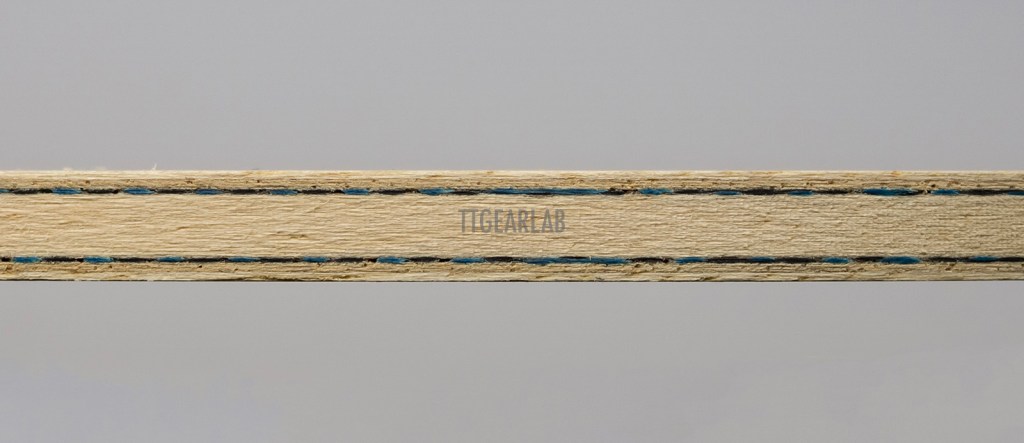
The construction of ‘Ovtcharov InnerForce ALC’ is based on that of ‘InnerForce Layer ALC’ but much thicker. The top layer is Limba. The middle layer and the center layer is Ayous. ALC (= Arylate Carbon) is of course inserted between the middle layer and the center layer. Overall thickness is around 6.2mm. The Arylate fiber that is used for Butterfly blades is Vectran that is produced by Kuraray, and it is woven together with Carbon fiber. (Note : By the way, Victas is calling the ALC with Vectran fiber as VC, and the ALC with Zxion fiber as ZC. Those mean Vectran Carbon and Zxion Carbon respectively. Both of those two are ALCs. And, in Victas blades, AC means Aramind Carbon.)
1-2. InnerForce Layer ALC & Harimoto Tomokazu InnerForce ALC

‘InnerForce Layer ALC’ is the standard model of Butterfly’s Inner ALC blades. Unfortunately, ‘InnerForce Layer ALC’ isn’t the representative of all inner ALC blades because there is a very strong rival – DHS ‘Hurricane Long 5’. However, ‘InnerForce Layer ALC’ is also the most important rival of ‘Hurricane Long 5’, and is being used by many top players. The head size of ‘InnerForce Layer ALC’ is regular 157mm x 150mm.
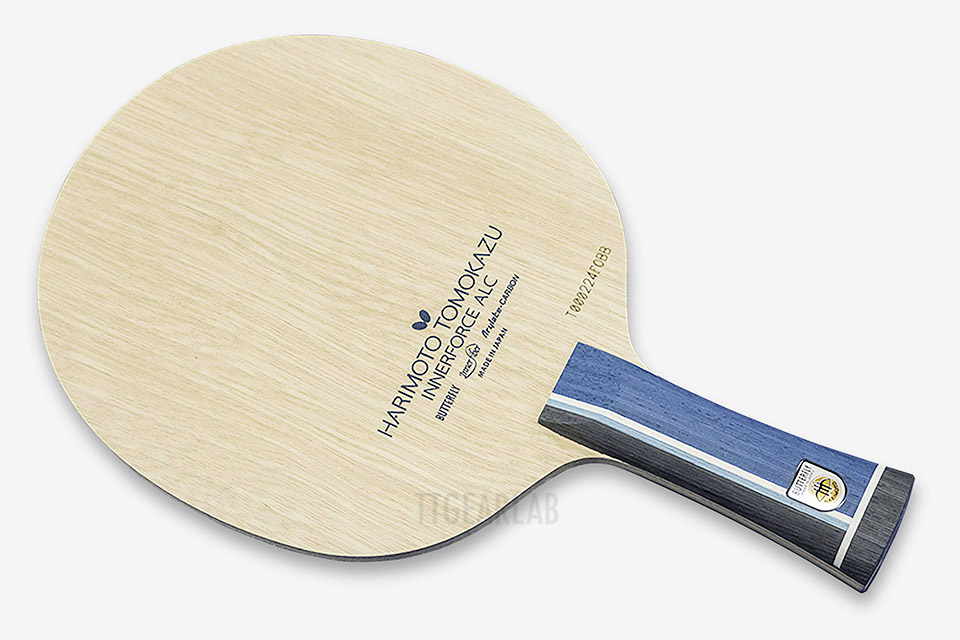
Fig. 04 Butterfly ‘Harimoto Tomokazu InnerForce ALC’
‘Harimoto T. (=Tomokazu) InnerForce ALC’ is the based on ‘InnerForce Layer ALC’ but has bigger head. Its head size is 158mm x 152mm which is same as that of ‘Ovtcharov InnerForce ALC’ and ‘Korbel’, while the head size of regular ‘InnerForce Layer ALC’ is 157mm x 150mm. Its construction isn’t different from that of current ‘InnerForce Layer ALC’. But, the relatively bigger head makes its weight, and the head becomes even heavier when rubbers are attached. In case the elasticity is identical, heavier head provides more power if the player can deal with it without the reduction of swing speed.
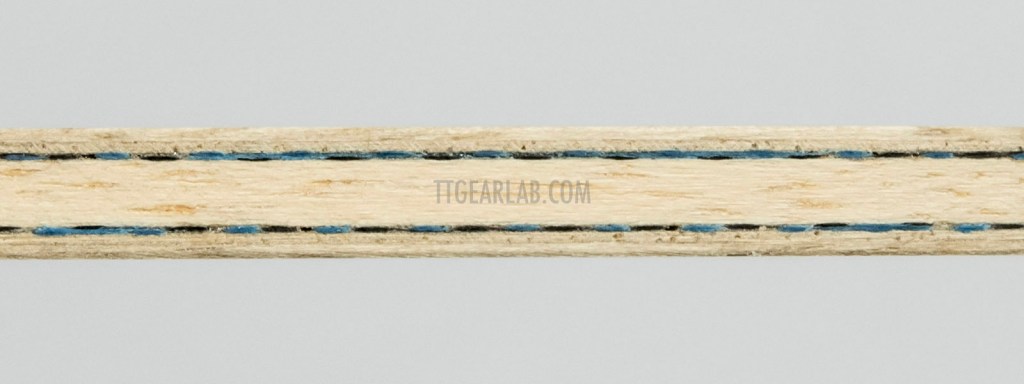
‘InnerForce Layer ALC’ and ‘Harimoto T. InnerForce ALC’ share the construction. The top layer is Limba. The middle layer and the center layer are Ayous. And, ALC (= Arylate Carbon, Vectran Carbon) is inserted between the middle layer and the center layer. Overall thickness of current models is around 5.9mm.
1-3. InnerForce Layer ALC.S
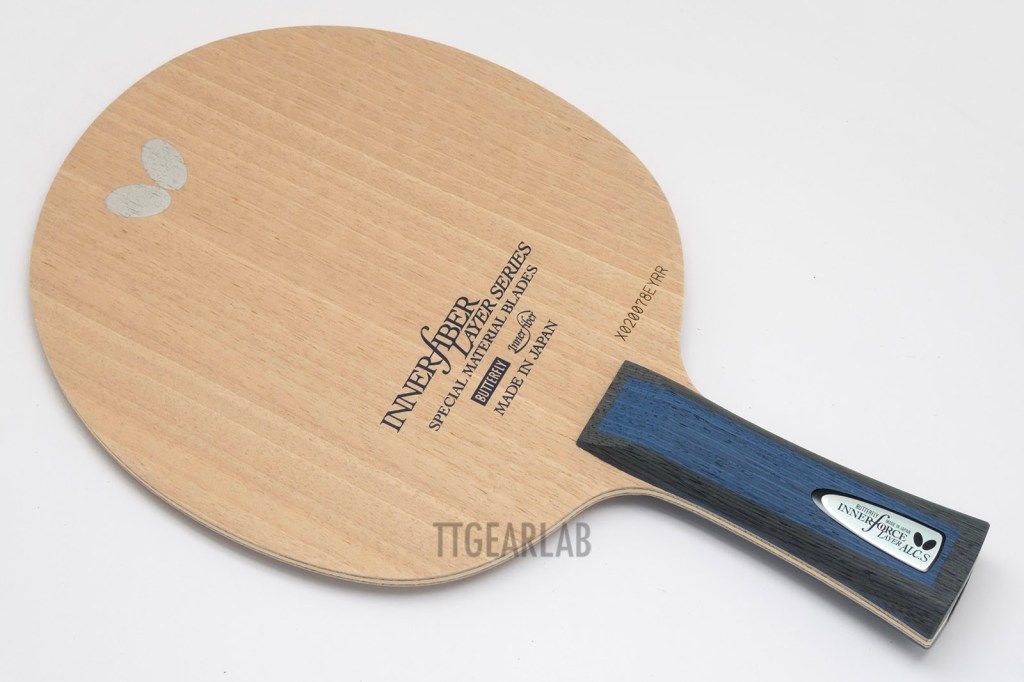
‘InnerForce Layer ALC.S’ is the softer variation of ‘InnerForce Layer ALC’. The meaning of ‘S’ hasn’t been announced, but we can guess that it is the initial of ‘Soft’. According to Butterfly, its new construction which is much thinner than the construction of ‘InnerForce Layer ALC’, makes its elasticity lower while making the stability higher. ‘InnerForce Layer ALC.S’ is especially optimized for counter-topspin at close-to-table area. The head size of ‘InnerForce Layer ALC.S’ is regular 157mm x 150mm.

The blade construction of ‘InnerForce Layer ALC’ looks noticeably different from the other models in ‘InnerForce Layer’ series. Its top layer is unknown. (It looks like just Limba of darker color, but not sure.) The middle layer is Spruce, and the center layer is Ayous. ALC (= Arylate Carbon, Vectran Carbon) is inserted between the middle layer and the center layer. Overall thickness is around 5.5mm.
Then let’s check the characteristics of Butterfly inner ALC blades by Performance Indices and then compare with some existing blades.
Please click here to return to top (table of contents)
2. Performance Indices
Performance Indices are measured objective values to represent the characteristics of table tennis gears. Concerning the detail of four performance indices, please refer to following articles in ‘About TTGearLab’ section :
- Performance indices : the way to evaluate blade by measurement
- The example of comparison by performance indices
The performance indices of four Butterfly Inner ALC blades are as follows:
| Name | Avg.Wt (g) | Ep | Ec | Ec/Ep | Vp | Vl | Vl/Vp |
| Butterfly Ovtcharov InnerForce ALC | 88.0 | 2.02 | 1.68 | 0.83 | 1.21 | 1.30 | 1.07 |
| Butterfly InnerForce Layer ALC | 91.2 | 1.87 | 1.67 | 0.89 | 1.20 | 1.20 | 1.00 |
| Butterfly Harimoto T. InnerForce ALC | 91.6 | 1.90 | 1.69 | 0.89 | 1.22 | 1.21 | 0.99 |
| Butterfly InnerForce Layer ALC.S | 88.0 | 1.48 | 1.33 | 0.90 | 1.10 | 1.13 | 1.03 |
2-1. Butterfly Ovtcharov InnerForce ALC

| Name | Avg.Wt (g) | Ep | Ec | Ec/Ep | Vp | Vl | Vl/Vp |
| Butterfly Ovtcharov InnerForce ALC | 88.0 | 2.02 | 1.68 | 0.83 | 1.21 | 1.30 | 1.07 |
The primary elasticity index (Ep) of ‘Ovtcharov InnerForce ALC’ exceeds 2.0. It is a very high value as that for an inner ALC blade, and is the value as high as that for many known outer-fiber blades. And, Ec/Ep is lower than 0.9. It means that ‘Ovtcharov InnerForce ALC’ hugs the ball very deeply when the player hits the ball very strongly.
Vp (Primary Vibration Index) is 1.21. It is a bit higher than that of ‘InnerForce Layer ALC’, but the difference isn’t big. So, although ‘Ovtcharov InnerForce ALC’ is fast than most of inner ALC blades, its feeling is not stiff. Vl/Vp (= 1.07) is higher than 1.0, but not extremely high. We can expect that the feeling transferred to index finger is noticeably sharper than the primary feeling transferred to palm, but the difference isn’t big.
2-2. Butterfly InnerForce Layer ALC & Harimoto T. InnerForce ALC

| Name | Avg.Wt (g) | Ep | Ec | Ec/Ep | Vp | Vl | Vl/Vp |
| Butterfly InnerForce Layer ALC | 91.2 | 1.87 | 1.67 | 0.89 | 1.20 | 1.20 | 1.00 |
| Butterfly Harimoto T. InnerForce ALC | 91.6 | 1.90 | 1.69 | 0.89 | 1.22 | 1.21 | 0.99 |
The primary elasticity index (Ep) of ‘InnerForce Layer ALC’ is higher than 1.8. It is quite high value as that of an inner ALC blade. (But, it is noticeably lower than that of ‘Ovtcharov InnerForce ALC’.) So, current version of ‘InnerForce Layer ALC’ is faster than current standard inner ALC blades. And, Ec/Ep is lower than 0.9. It means that ‘InnerForce Layer ALC’ hugs the ball deeply when the player hits the ball very strongly, but not as deep as ‘Ovtcharov InnerForce ALC’ and many 5-ply wood blades.
Vp (Primary Vibration Index) is 1.22. It is a bit higher than that of ‘Ovtcharov InnerForce ALC’, but the difference isn’t big. Tts feeling of ‘InnerForce Layer ALC’ is not stiff. Vl/Vp is 1.00. It means that the feeling is almost uniform throughout the blade. We can expect that the feeling transferred to index finger isn’t sharper or milder than the primary feeling transferred to palm.
The indices of ‘Harimoto T. InnerForce ALC’ is not much different from those of ‘InnerForce Layer ALC’. That is because its construction is identical to that of current ‘InnerForce Layer ALC.S’. But, even though its elasticity is same as that of ‘InnerForce Layer ALC’, ‘Harimoto T. InnerForce ALC’ will make more powerful ball if the player can use it without the reduction of swing speed because more energy will be transferred to the ball from the heavier racket. (Of course, the power of ball will be reduced if the swing speed is reduced due to the heavier weight.)
2-3. Butterfly InnerForce Layer ALC.S
| Name | Avg.Wt (g) | Ep | Ec | Ec/Ep | Vp | Vl | Vl/Vp |
| Butterfly InnerForce Layer ALC.S | 88.0 | 1.48 | 1.33 | 0.90 | 1.10 | 1.13 | 1.03 |
The primary elasticity index (Ep) of ‘InnerForce Layer ALC.S’ is around 1.5. It is much lower than the Ep of regular ‘InnerForce Layer ALC’, and is close to the Ep’s of many 5-ply wood blades. And, Ec/Ep is 0.90. It means that ‘InnerForce Layer ALC.s’ hugs the ball very deeply when the player hits the ball very strongly. But, not as deeply as many 5-ply wood blades whose Ec/Ep is under 0.85.
Vp (Primary Vibration Index) is 1.10. It is also noticeably lower than that of ‘InnerForce Layer ALC’. So, in primary feeling, ‘InnerForce Laye ALC.S’ is as soft as many 5-ply wood blades. However, the Vl/Vp (= 1.03) is much lower than those of many know 5-ply wood blades (except for reference blade).
Please click here to return to top (table of contents)
3. Comparison by Performance Indices
Then we can compare Butterfly’s inner ALC blades with some other blades. Following is the list of the blades to be compared :
Inner ALC (or similar fiber) blades with Limba top layer
| Name | Average Weight | Feature |
| Yasaka Falck Carbon | 87.6g | Inner ALC blade for fast attack at close-to-table area. |
| Victas ZX-Gear In | 88.0g | Inner Z-Carbon(Zxion Carbon) blade. |
| andro Synteliac VCI OFF | 88.6g | Inner ALC blade which is being used by Simon Gauzy. |
| Nittaku Hina Hayata H2 | 89.7g | Inner PKC blade developed for Hina Hayata. |
| Tmount KTS Core ALC | 89.9g | Inner ALC blade whose handle shape is very classic. |
| DHS Hurricane Long 5 | 88.1g | The representative of inner ALC blades. |
| Xiom 36.5 ALXi | 87.1g | Inner ALC blade of Xiom. Middle layer is different from those of ordinary inner ALC blades. |
| Tibhar Stratus Samsonov Carbon | 88.7g | nner Aramid Carbon. Center layer is softer than those of ordinary inner fiber blades. |
Various inner fiber blades with Limba top layer
| Name | Average Weight | Feature |
| Xiom An Jaehyun TXMi | 86.4g | Inner Trimetrix (Zylon + Arylate + Carbon). |
| Tibhar Zodia Libra ZAC | 87.3g | Inner ZAC (Zylon + Arylate + Carbon). |
| Yasaka Ma Lin Carbon | 88.6g | Inner fleece carbon. Very soft as a fiber blade. |
| Stiga Centric Carbon | 84.9g | Inner TeXtreme (flat woven carbon) blade. |
Fiber (inner/outer) blades with Koto top layer
| Name | Average Weight | Feature |
| Stiga Inspira CCF | 87.3g | Inner woven carbon blade with Koto top layer. |
| DHS Hurricane 301T | 90.7g | Inner fiber with Koto top layer. 3 kinds of fibers are mixed. |
| Butterfly Viscaria | 87.1g | The only one outer fiber blade in this comparison. |
5-ply wood blades (including reference blade)
| Name | Average Weight | Feature |
| Butterfy Korbel | 88.7g | The representative of 5-ply wood offensive blade. |
| Stiga Allround Classic (Reference) | 84.3g | The representative of 5-ply wood allround blade. |
3-1. Elasticity Indices

Fig.11 shows the comparison graph of Elasticity Indices.
Ep (Primary Elasticity Index) is directly concerned with the rebound speed of blade. Ec (Central Elasticity Index) is concerned with additional ‘kick’ when player hits ball very strongly.
We can see that the Ep of ‘Ovtcharov InnerForce ALC’ is one step higher than those of ‘Harimoto T. InnerForce ALC’ and ‘InnerForce Layer ALC’, but there isn’t much difference in Ec. For that reason, although ‘Ovtcharov InnerForce ALC’ is the fastest inner ALC blade in Butterfly’s blade range, there may be some players who don’t feel that it is especially faster than ‘InnerForce Layer ALC’. ‘Harimoto T. InnerForce ALC’ is a bit more elastic than ‘InnerForce Layer ALC’, but the difference is very small. ‘InnerForce Layer ALC.S’ is noticeably less elastic than the other three models of Butterfly inner ALC blades.
Then we can compare other blades with Butterfly inner ALC blades.
[Inner ALC / Limba Top Layer]
The blades in this group can be direct competitors of Butterfly inner ALC blades. However, we can see that each model has its own personality that distinguishes it from Butterfly inner ALC blades and other models.
- Yasaka ‘Falck Carbon’ is as elastic as ‘Ovtcharov InnerForce ALC’ in Ep. However, there is significant difference in Ec. Hard hitters may feel that ‘Falck Carbon’ is much more elastic than any of Butterfly inner ALC blades.
- Victas ‘ZX-Gear In’ shows Ep that is comparable with the Ep of ‘InnerForce Layer ALC’. However, its Ec is much lower than that of ‘InnerForce Layer ALC’. For that reason, there will be many players who feel that ‘ZX-Gear In’ is noticeably slower than ‘InnerForce Layer ALC’.
- andro ‘Synteliac VCI OFF’ has a bit lower Ep and much higher Ec when compared with ‘InnerForce Layer ALC’. Although its construction looks very similar to that of ‘InnerForce Layer ALC’, ‘Synteliac VCI OFF’ is a blade that aims at different playing characteristics.
- Nittaku ‘Hina Hayata H2’, KTS ‘Core ALC’, DHS ‘Hurricane Long 5’ and Xiom ‘36.5 ALXi’ are less elastic than ‘InnerForce Layer ALC’ and more elastic than ‘InnerForce Layer ALC.S’. And the graph shape of those four models are quite similar to the graph shapes of ‘InnerForce Layer ALC’. Although one step slower, these four models will be able to be directly compared with ‘InnerForce Layer ALC’.
- Tibhar ‘Stratus Samsonov Carbon’ is even less elastic than ‘InnerForce Layer ALC.S’. That is because its center layer is softer than those of ordinary inner fiber blades. The reduction of elasticity can be compensated by the increase of overall thickness, but ‘Stratus Samsonov Carbon’ isn’t thicker than ordinary inner fiber blades.
[Various Inner Fiber / Limba Top Layer]
The blades in this group are also inner fiber blades with Limba top layer. But, the artificial material isn’t ALC or similar fiber.
- Xiom ‘An Jaehyun TMXi’ has three kinds of artificial fibers. As the result, it is like an ALC blade in vertical direction and a ZLC blade in lateral direction. Its Ep isn’t meaningfully different from that of ‘InnerForce ALC’, but its Ec is much higher. Without doubt, the relatively higher Ec is because of the influence of Zylon fiber. (Center deflection is affected by both of vertical fiber and lateral fiber while primary deflection – vertical bending – is affected only by vertical fiber.)
- Tibhar ‘Zodiac Libra ZAC’ also has three kinds of artificial fibers, and it shows similar graph shape (= relatively high Ec) as ‘An Jaehyun TMXi’ although there are differences in elasticity level. (‘Zodiac Libra ZAC’ is less elastic than ‘An Jaehyun TMXi’.)
- Yasaka ‘Ma Lin Carbon’ is as elastic as ‘InnerForce Layer ALC.S’ although there are small differences in graph shape. So, it is expected that ‘Ma Lin Carbon’ can be the direct competitor of ‘InnerForce Layer ALC.S’.
- Stiga ‘Centric Carbon’ is the least elastic inner fiber blade in this comparison. Although its fiber is woven carbon fiber, the elasticity of woven carbon fiber is significantly diluted by its very thin inner fiber construction.
[Other Inner or Outer Fiber / Koto Top Layer]
This is the group that includes the blades with Koto top layer. In general, makers use Koto top layer for the blades those are positioned as a quite fast blade. So three blades in this group show very high level of elasticity. (Of course we can make much slower blades with Koto top layer. It is possible. However, there isn’t much reason for table tennis companies to develop and sell that kind of blades.) All three blades in this group are more elastic than any other blade in this comparison. ‘Viscaria’ which is an outer ALC blade is also in this group.
- Stiga ‘Inspira CCF’ which is a thick inner carbon blade is more elastic than most of blades in this comparison. Its Ep is the highest in this comparison, and is higher than that of ‘Viscaria’ which is an outer ALC blade. And its Ec (= 1.90) is just a bit lower than the highest value (= 1.93 of ‘Falck Carbon) in this comparison. The high elasticity of ‘Inspira CCF’ is because of its thick construction and highly elastic woven carbon fiber.
- DHS ‘Hurricane 301T’ is also as elastic as ‘Viscaria’ which is an outer fiber blade. Its Ep and Ec are a bit higher and a bit lower respectively when compared with the indices of ‘Viscaria’.
- The Ep of ‘Viscaria’ is same as that of ‘Ovtcharov InnerForce ALC’. But, there is big difference in Ec. ‘Viscaria’ provides higher center support than ‘Ovtcharov InnerForce ALC’.
[5-ply wood incl. Reference Blade]
5-ply wood blades can be compared with fiber blades just as reference.
- The elasticity level of ‘Korbel’ is comparable with those of ‘InnerForce Layer ALC.S’ and ‘Ma Lin Carbon’. But, in fact fiber blades provides higher level of energy efficiency, and that makes the difference when the strength of impact is high.
- ‘Allround Classic’ is much less elastic than all the blades in this comparison. However, there are some blades whose graph shapes look similar to that of ‘Allround Classic’. (= Ec is not much different from Ep.) For example, ‘Synteliac VCI OFF’. That kind of blade will be good replacement of ‘Allround Classic’ if the player wants to increase the power of ball.
Examining Ec/Ep is also a easier way to understand the characteristics of blade concerned with elasticity. Fig.12 shows the relationship between Ec/Ep and Ep.

Ec/Ep expresses the ‘tendency’ of the elasticity of blade. By examining Ec/Ep and Ep at the same time, we can easily understand the behavior of blades.
On the graph, all blades except for reference blade are located in ‘Hold’ range (Ec/Ep < 1.0). However, within that range, blades are widely distributed up, down, left and right. And, even though we only examine inner fiber blades, the distribution is also very wide. The ranges of Ep and Ec/Ep of inner fiber blades are 1.3 ~ 2.2, and 0.75~1.00 respectively. Therefore, we can’t say in one word what the elasticity characteristics of inner fiber blades are. Here, we can roughly categorize the inner fiber blades into three groups for the convenience of comparison. Three groups are as follows:
- ‘High Speed’ group
- ‘Standard’ (of inner fiber) group
- ‘High Stability’ group
‘High Speed’ group includes three very fast inner fiber blades. The blades in this group are as elastic as known outer fiber blades such as ‘Viscaria’. We can see that the location of ‘Falck Carbon’ is very close to that of ‘Viscaria’. We may also include ‘Ovtcharov InnerForce ALC’ in this group. But, because ‘Ovtcharov InnerForce ALC’ hugs the ball much deeper than the blades of this group when the player hits the ball very strongly, players will feel that ‘Ovtcharov InnerForce ALC’ is somewhat slower. (Some players may think that ‘Ovtcharov InnerForce ALC’ isn’t especially faster than ‘InnerForce Layer ALC’.)
The blades in ‘Standard’ group can be considered as current standard inner ALC blades. ‘Harimoto T. InnerForce ALC’ and current version of ‘InnerForce Layer ALC’ are located between this group and ‘High Speed’ group. It means that ‘Harimoto T. InnerForce ALC’ and current version of ‘InnerForce Layer ALC’ are faster than standard inner ALC blades. But, if we extend the range of this group to right side a bit, we may be able to also deal with ‘Harimoto T. InnerForce ALC’ and current version of ‘InnerForce Layer ALC’ as ‘Standard’ inner ALC blades. ‘An Jaehyun TMXi’ is located close to ‘InnerForce Layer ALC’ although it has different lateral fiber. ‘Synteliac VCI’ gives more kick than standard inner ALC blades, and ‘ZX-Gear In’ hugs the ball more deeply than standard inner ALC blades, when the impact strength is very high.
The range of ‘High Stability’ group is widely overlapped with the range of 5-ply wood blades, although just two models are shown in this comparison for avoiding complexity. The Ep’s of the blades in this group is even lower than that of ‘Korbel’. But, the Ec/Ep’s are higher than that of ‘Korbel’, and fiber blades provide higher energy efficiency during the period of impact. So the fiber blades provides higher power than 5-ply wood blades if the impact strength is high.
And, we can consider another criterion of selection. Some important blades – ‘InnnerForce Layer ALC.S’, ‘Hurricane Long 5’, ‘InnerForce Layer ALC’, ‘Harimoto T. InnerForce ALC’ and ‘Hurricane 301T’ – are located near the border line between ‘Mild Hold’ range and ‘Deep Hold’ range (Ec/Ep = 0.90). And, ‘Ma Lin Carbon’, ‘An Jaehyun TMXi’ and ‘Core ALC’ are also quite close to that line. Those blades can be considered as the optimum ones in case the player doesn’t have other criteria of selection. The blades in upper range or lower range can be selected in case the playing style of the player is more biased. The blades located over that line can be the blades for the players who want higher power for power play or better precision for modern all-round play. And, the blades located under that line can be the blades for the players who want to mainly use continuous topspin and play more aggressively.
Then next, let’s compare Vibration Indices.
Please click here to return to top (table of contents)
3-2. Vibration Indices

Fig.13 shows the comparison graph of Vibration Indices. Vibration Indices are concerned with feeling. Vp indicates primary feeling which is transferred to player’s palm. And, Vl is the feeling at the edge of the wing – the lower side of blade head. It is felt by player’s index finger or middle finger.
We can see that the Vp of ‘Ovtcharov InnerForce ALC’ is not meaningfully different from the Vp of ‘Harimoto T. InnerForce ALC’ or ‘InnerForce Layer ALC’ while its Vl is significantly higher than the Vl’s of those two Butterfly brothers. The high Vl is the factor that distinguishes ‘Ovtcharove InnerForce ALC’ from the other inner ALC blades in Butterfly’s blade range. And, Both of the Vp and the Vl of ‘InnerForce Layer ALC.S’ are significantly lower than those of the other Butterfly inner ALC blades. Differently speaking ‘InnerForce Layer ALC.S’ gives very soft feeling as the character ‘S’ in its name expresses.
Then we can compare other blades with Butterfly inner ALC blades.
[Inner ALC / Limba Top Layer]
The blades in this group can be direct competitors of Butterfly inner ALC blades. However, we can see that each model has its own personality that distinguishes it from Butterfly inner ALC blades and other models.
- Both of the Vp and the Vl of Yasaka ‘Falck Carbon’ are much higher than those of Butterfly blades. The only one model in this comparison whose Vibration Indices are higher than the values of ‘Falck Carbon’ is Stiga ‘Inspira CCF’ which is a thicker blade with woven carbon fiber and harder top layer. As an inner ALC blade, ‘Falck Carbon’ is a very hard blade
- The Vp of Victas ‘ZX-Gear In’ is much lower than those of ‘InnerForce Layer ALC’ and ‘Harimoto T. InnerForce ALC’. On the contrary, the Vl of ‘ZX-Gear In’ is very high. It is even higher than the Vl of ‘Ovtcharov InnerForce ALC’. The gap between its Vp and its Vl is significantly big. We can see similar relationships between Vp and Vl from ‘Stratus Samsonov Carbon’, ‘Centric Carbon’ and ‘Korbel’. ‘ZX-Gear In’ is a very soft blade in primary feeling, but it gives quite sharp feeling to index finger.
- andro ‘Synteliac VCI OFF’ is harder and sharper than ‘InnerForce Layer ALC’.
- Nittaku ‘Hina Hayata H2’ and ‘Hurricane Long 5’ are sofer in primary feeling and sharper in lateral feeling when compared ‘InnerForce Layer ALC’. ‘Core ALC’ is also softer than ‘InnerForce Layer ALC’ in primary feeling, but its Vl isn’t meaningfully higher than the Vl of ‘InnerForce Layer ALC’.
- The Vibration Indices of Xiom ‘36.5 ALXi’ are close to those of ‘Ovtcharov InnerForce ALC’.
- Tibhar ‘Stratus Samsonov Carbon’ is very soft in primary feeling. But, its Vl is higher than that of ‘InnerForce Layer ALC’. That will make some players feel that ‘Stratus Samsonov Carbon’ isn’t softer than ‘InnerForce Layer ALC’.
[Various Inner Fiber / Limba Top Layer]
The blades in this group are also inner fiber blades with Limba top layer. But, the artificial material isn’t ALC or similar fiber.
- The Vibration Indices of Xiom ‘An Jaehyun TMXi’ are higher than those of ‘InnerForce Layer ALC’. BTW, we can observe similarity between the Vibration Indices of ‘An Jaehyun TMXi’ and those of ‘Synteliac VCI OFF’.
- The Vibration Indices of Tibhar ‘Zodiac Libra ZAC’ are close to those of ‘Ovtcharov InnerForce ALC’. Vp is just a bit higher, and Vl is just a bit lower. (But, nobody will feel that ‘Zodiac Libra ZAC’ is similar to ‘Ovtcharov InnerForce ALC’ because of significant differences in Elasticity Indices.)
- Yasaka ‘Ma Lin Carbon’ is as soft as ‘InnerForce Layer ALC.S’ in primary feeling. But, in lateral feeling, it is somewhat sharper.
- Stiga ‘Centric Carbon’ is a very soft blade in primary feeling. Its Vp is very close to the value of reference blade. But, its Vl is as high as those of ‘InnerForce Layer ALC’ and ‘Harimoto T. InnerForce ALC’. That will make some players feel that ‘Centric Carbon’ isn’t softer than ‘InnerForce Layer ALC’.
[Other Inner or Outer Fiber / Koto Top Layer]
This is the group that includes the blades with Koto top layer. In general, makers use Koto top layer for the blades those are positioned as a quite fast blade. So three blades in this group show very high level of elasticity. (Of course we can make much slower blades with Koto top layer. It is possible. However, there isn’t much reason for table tennis companies to develop and sell that kind of blades.) All three blades in this group are more elastic than any other blade in this comparison. ‘Viscaria’ which is an outer ALC blade is also in this group.
- Stiga ‘Inspira CCF’ is a very hard and very sharp blade. Both of its Vp and its Vl are the highest in this comparison. Its Vp is just a bit higher than that of ‘Viscaria’ which is an outer fiber blade. But, its Vl is much higher than that of ‘Viscaria’. Because its Vl is much higher than its Vp, its graph shape look similar to that of ‘Ovtcharov InnerForce ALC’ although there is significant difference in the level of indices.
- DHS ‘Hurricane 301T’ gives unique feeling because its Vl is lower than its Vp. We can see similar relationship from ‘Harimoto T. InnerForce ALC’, but the gap is smaller.
- The Vibration Indices of ‘Viscaria’ which is an outer ALC blade are higher than those of Butterfly inner ALC blades. But, those are lower than the values of ‘Falck Carbon’ and ‘Inspira CCF’ those are also inner fiber blades.
[5-ply wood incl. Reference Blade]
5-ply wood blades can be compared with fiber blades just as reference.
- The graph shape of ‘Korbel’ looks similar to those of ‘Stratus Samsonov Carbon’ and ‘Centric Carbon’ those can be compared with 5-ply wood blades also in Elasticity Indices. And, although its Vp is very low, its Vl can be directly compared with those of most inner fiber blades in this comparison.
- ‘Allround Classic’ is a very soft all-round blade, and is a reference blade whose values are set to 1.0. Its graph shape is similar to the graph shape of ‘InnerForce Layer ALC’ although there is differences in the level of indices. And, we can think that the graph shapes of ‘Harimoto T. InnerForce ALC’, ‘Synteliac VCI OFF’ and ‘An Jaehyun TMXi’ are also similar to that of ‘Allround Classic’. We can expect that ‘InnerForce Layer ALC’, ‘Harimoto T. InnerForce ALC’ and ‘An Jaehyun TMXi’ will be good replacement of ‘Allround Classic’ in case the player wants to increase power but at the same time wants to keep the relationship between Vl and Vp.
Examining Vl/Vp is easier way for the comparison of the tendency of feeling. Fig.14 shows the relationship between Vl/Vp and Vp for easier comparison.
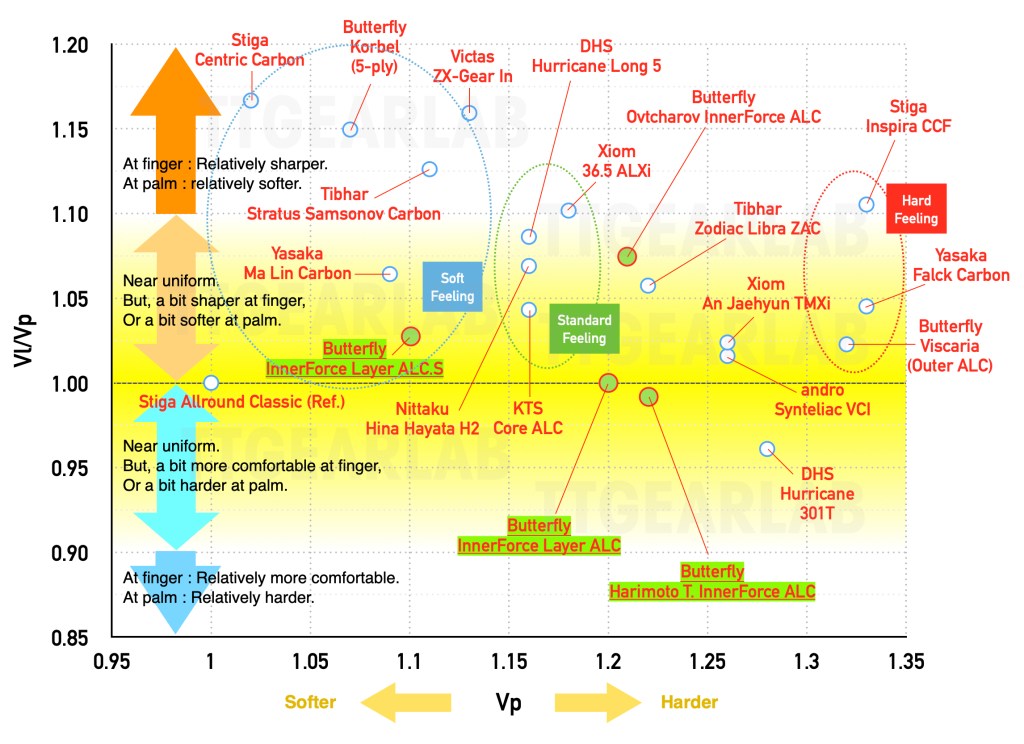
On the graph, most of blades in this comparison (except for four blades) are placed in upper part of the graph – ‘Relatively sharper at finger’ range (Vl/Vp > 1.0). However, within that range, blades are widely distributed up, down, left and right. We can understand that there isn’t any typical characteristics of the feeling of inner fiber blades. But, at least we can set a ‘Standard Feeling’ range that satisfies our expectation on the feeling of inner ALC blades. And, for comparison we can set the ranges of blades those give hard feeling or soft feeling. Then the three groups are as follows:
- ‘Hard Feeling’ group
- ‘Standard Feeling’ group
- ‘Soft Feeling’ group
‘Hard Feeling’ group includes three blades whose Vp’s are higher than 1.3. In general this is the range of ordinary outer fiber blades. However, two inner fiber blades – ‘Inspira CCF’ and ‘Falck Carbon’ are in this group. This group doesn’t include any Butterfly inner ALC blade.
‘Standard Feeling’ group consists of the blades whose Vp’s are in the range of 1.15~1.2 and Vl/Vp’s are higher than 1.0. This group includes current version of ‘Hurricane Long 5’ and ‘Hina Hayata H2’. Three Butterfly inner ALC blades – ‘Ovtcharov InnerForce ALC’, ‘Harimoto T. InnerForce ALC’ and ‘InnerForce Layer ALC’ are located to right or lower right of this group. It means that those Butterfly inner ALC blades are harder in primary feeling than the inner ALC blades of standard feeling. And, especially ‘InnerForce Layer ALC’ and ‘Harimoto T. InnerForce ALC’ are somewhat more comfortable at player’s index finger when compared with ‘Standard Feeling’ group.
But, if we expand the range of ‘Standard Feeling’ group to right side, it will be able to also include three Butterfly inner ALC blades.
‘Soft Feelng’ group includes the blades whose Vp’s are around 1.1 or lower. The blades in this group can be directly compared with 5-ply wood blades whose range is widely overlapped with this group. In this group, Vl/Vp’s are widely distributed up and down. ‘InnerForce Layer ALC.S’ is located at the bottom of this group because its Vl/Vp is close to 1.0. It means that ‘InnerForce Layer ALC.S’ gives more comfortable feeling at index finger when compared with other inner fiber blades in this group and 5-ply wood blade such as ‘Korbel’. On the contrary, ‘ZX-Gear In’, ‘Stratud Samsonov Carbon’ and ‘Centric Carbon’ provide the feeling quite similar to the feeling of ‘Korbel’ because of similar Vl/Vp (= around 1.15) although there are noticeable differences in Vp.
Here we can observe that Butterfly inner ALC blades except for ‘Ovtcharov InnerForce ALC’ are located near the ‘Uniform’ line which is the border line between ‘Relatively sharper at finger’ range and ‘Relatively more comfortable at finger’ range. Most of blades in this comparison are located higher, and give sharper feeling at index finger when compared with those Butterfly inner fiber blades. ‘InnerForce Layer ALC’, ‘InnerForce Layer ALC.S’ and ‘Harimoto T. InnerForce ALC’ give more comfortable feeling to index finger when compared with most of other inner fiber blades. We will be able to consider it as the personality of the Butterfly inner ALC blades.
Please click here to return to top (table of contents)
4. Summary
We have compared four models of Butterfly inner ALC blades through Performance Indices. The characteristics of each model can be summarized as follows:
4-1. Butterfly Ovtcharov InnerForce ALC

- The vibration characteristics of ‘Ovtcharov InnerForce ALC’ is the closest to those of standard inner ALC blades, although the Vp of ‘Ovtcharov InnerForce ALC’ is a bit higher than the Vp’s of standard inner ALC blades. And, ‘Ovtcharov InnerForce ALC’ is much softer than the blades with similar speed level.
- ‘Ovtcharov InnerForce ALC’ is as elastic as outer ALC blade in primary elasticity (shown as Ep). But, its Ec/Ep is much lower than 0.90. Its high elasticity and ‘Deep Hold (= Deep Hug)’ characteristics make ‘Ovtcharov InnerForce ALC’ suitable for continuous but powerful topspin strategy.
- In case the player who have used 5-ply wood blade such as ‘Korbel’ want to replace the blade with faster fiber blade, ‘Ovtcharov InnerForce ALC’ can be the best choice among four Butterfly inner ALC blades.
4-2. Butterfly InnerForce Layer ALC & Harimoto T. InnerForce ALC

- ‘InnerForce Layer ALC’ (current version) is more elastic in primary elasticity (shown as Ep) than current standard inner ALC blades such as ‘Hurricane Long 5’. But, its Ec/Ep is at the same level as the Ec/Ep’s of standard inner ALC blades. If we expand the range of ‘standard inner ALC’ a bit to the side of higher Ep, ‘InnerForce Layer ALC’ will be able to sufficiently considered as one of the current standard inner ALC blades.
- Because the Ec/Ep of ‘InnerForce Layer ALC’ is noticeably higher than that of ‘Ovtcharov InnerForce ALC’, the players will feel more kick from ‘InnerForce Layer ALC’ than ‘Ovtcharov InnerForce ALC’. It means that ‘InnerForce Layer ALC’ will be able to used more various playing styles when compared with ‘Ovtcharov InnerForce ALC’ which is specialized for continuous topspin. The Ec/Ep around 0.9 may be considered as the criterion of blade selection when the player wants to select a neutral or almighty blade that can be applied for various offensive styles. And, ‘InnerForce Layer ALC’ is one of that kind of blades.
- The primary feeling of ‘InnerForce Layer ALC’ is not noticeably softer than that of ‘Ovtcharov InnerForce ALC’. However, the relative feeling that it transmits to index finger is not as sharp as what ‘Ovtcharov InnerForce ALC’ does. The mild feeling at index finger is one of the important characteristics of ‘InnerForce Layer ALC’.
- When compared with other inner ALC blades, ‘InnerForce Layer ALC’ is expected to be more suitable for all-round play. And, it is also expected that ‘InnerForce Layer ALC’ will be good replacement of classic 5-ply wood all-round blades such as ‘Allround Classic’ when the players who have used those all-round blades want to change to faster fiber blade. In that case, ‘InnerForce Layer ALC’ will be much better choice than the other inner ALC blades.

Fig.17 Butterfly ‘Harimoto Tomokazu InnerForce ALC’
- The performance indices of ‘Harimoto Tomokazu InnerForce ALC’ aren’t much different from those of ‘InnerForce Layer ALC’. When compared with ‘InnerForce Layer ALC’, ‘Harimoto Tomokazu InnerForce ALC’ is a bit more elastic in primary elasticity and hugs the ball a bit deeper, and is a bit harder in primary feeling and a bit more comfortable at index finger. But, differences are not noticeable.
- The most important difference between ‘Harimoto Tomokazu InnerForce ALC’ and ‘InnerForce Layer ALC’ is that the head of ‘Harimoto Tomokazu InnerForce ALC’ is bigger. It makes the overall head weight of ‘Harimoto Tomokazu InnerForce ALC’ heavier, and as the result is that ‘Harimoto Tomokazu InnerForce ALC’ makes more powerful ball by transmitting more energy to the ball in case the swing speed is same.
- If the player doesn’t have sufficient muscle power, ‘Harimoto Tomokazu InnerForce ALC’ isn’t recommendable because the power of ball will be reduced by the reduction of swing speed. For more players including ordinary players, ‘InnerForce Layer ALC’ will be safer choice than ‘Harimoto Tomokazu InnerForce ALC’.
4-3. Butterfly InnerForce Layer ALC.S

- ‘InnerForce Layer ALC.S’ is much less elastic in primary elasticity (shown as Ep) than ‘InnerForce Layer ALC’. Its Ep is not much different from those of typical 5-ply wood blades. But, its Ec/Ep is at the same level as the Ec/Ep’s of ‘InnerForce Layer ALC’. So, ‘InnerForce Layer ALC.S’ can be the slower replacement of ‘InnerForce Layer ALC’ without problem. And, because Ec/Ep of ‘InnerForce Layer ALC.S’ is much higher than those of 5-ply wood blades such as ‘Korbel’, ‘InnerForce Layer ALC.S’ will give more kick to the ball when the player hits the ball very strongly. ‘InnerForce Layer ALC.S’ can be recommended for the players who want to keep the basic elasticity level of 5-ply wood offensive blade but hope that the new blade can give stronger kick at stronger impact.
- The primary feeling of ‘InnerForce Layer ALC’ is very soft. The Vp of ‘InnerForce Layer ALC.S’ isn’t much different from those of typical 5-ply wood offensive blades. And, because its Vl/Vp is close to 1.0, ‘InnerForce Layer ALC.S’ gives even more comfortable feeling to index finger.
- ‘InnerForce Layer ALC.S’ which is the slowest and the softest Butterfly inner ALC blade will be the good choice if a player who has used a 5-ply wood blade wants to change to a fiber blade but doesn’t want the feeling become harder.
- ‘InnerForce Layer ALC.S’ can be recommended for very aggressive player who play mainly with very aggressive but continuous topspin at close-to-table area. However, the relative feeling transmitted to index finger is not as sharp as those of 5-ply wood offensive blades or soft/slow inner fiber blades such as ‘Ma Lin Carbon’ and ‘Stratus Samsonov Carbon’.
[AD] You can buy Butterfly blades in this article at megaspin.net.
Please click here to return to top (table of contents)
 TTGearLab
Thank you for the great article which summarized the inner carbon blades. Does the carbon layer in a outer carbon blade more effective than the inner carbon blade, therefore outer carbon blades have larger sweet spot?
LikeLike
Yes. If everything is identical and the difference is only in the location of fiber layers, outer fiber has larger sweet spot than inner fiber.
Also outer fiber is always more effective for increasing the overall elasticity when compared with inner fiber.
Inner fiber is something between outer fiber and pure wood. The extreme form of inner fiber is the center fiber, and if the thickness of center fiber is zero it is pure wood. 🙂
LikeLike
Hi, I really enjoy the TTGearLab site! I have one question about Sweetpot. Can Sweetpot be objectively measured or is it just a matter of feeling?
LikeLike
It can be measured. But, I’m not doing it because it is somewhat time consuming, and in most cases the comparison of sweet spot is not that meaningful.
By the way, there is a simple way of finding sweet spot. If we try bouncing the ball on the blade, there will be points where the bounce is not good and the sound is not clear. We can get a closed curve by connecting those points. Then we can think that the inside of that curve is sweet spot which provides us sweet sound.
LikeLike
Can we think about the relationtip between Vp and Vl and correlate with sweetspot? a blade that is tortionally stiff should have a greater sweetspot right?
I currently have a Treiber CO that i like the feeling but i think it doesnt have a large sweetspot. Can you point out a similar blade with a larger sweetspot? I’m thinking about the Fan Zhendong SALC.
LikeLike
I think that the relationship between Vp & Vl isn’t directly related with the size of sweet spot. But, in many cases the blades with high Vp and high Vl have big sweet spot. (BTW, I don’t show the value concerned with tortional stiffness although it is also measured together with the other factors.)
In my opinion the sweet spot of Treiber CO is not small. But, it can be relatively smaller than the sweet spot of faster blades with similar construction as Treiber CO. If you just think about sweet spot, Fan Zhendong Super ALC is a right choice. But, I wonder whether you will be satisfied with the character of FzD SALC. If Viscaria (or FZD ALC) is a 5-ply wood blade, Viscaria Super ALC (or FZD SALC) is a 7-ply wood blade. Even though its sweet spot is bigger, you will feel that its stiffer center feeling may be uncomfortable for you.
LikeLike
Thank you for the reply. It was perfect.
Im also debating about that. I’ve tried the SALC from a club mate and despite having a nice feeling for the speed i still think it will be to fast for my game and im happy with the Treiber “speed”. I just think that when the ball its the Treiber just a little bit off center the feeling changes a lot.
Would you thinkg that the FZD ALC would be a better match compared to the Treiber? As per values they seem to be similar. To be fair the Freitas ALC looks like the foreign sister of my Treiber.
LikeLike
Thanks for the article.
Can you advise to glue soft rubbers such as Nittaku Flyatt Soft or Xiom Vega Europe on forehand side of Butterfly Innerforce ALC.S or Yasaka Ma Lin Carbon? I am a beginner player and currently use Nittaku Flyatt Soft on FH side of 5-ply wood offensive blade (which is similar to Butterfly Korbel). I like how this combo preforms and have improvements on my FH over my previous setup (Yasaka Sweden Extra whith Yinhe Mercury 2 sticky rubber). But I still want to find more powerful (but controllable) combination.
Also, I have Xiom “Allround S” blade and want to replace FH rubber on it too, but I have some doubts which type of rubber fits better for this blade.
LikeLike
In fact it is difficult to say that a specific rubber fits well for a specific blade. That is because the result differs by player. That is one interesting point of the selection of table tennis equipment, and at the same time it makes the combination more difficult than expected.
The soft sponge rubber such as Flyatt Soft or Vega Europe fits very well for all-round blades or slow offensive blades including inner fleece carbon blade such as Ma Lin Carbon.
The key of control and improvement of skill is in the loud sound of soft sponge rubber. Plus, the soft sponge rubber gives us high level of tolerance. We hear the sound clearly by our ear and then determine whether our shot is done rightly or not and then adjust our next shot. By repeating it we can improve our level of skill, because our body and brain remember what is right and what is wrong. And, the soft sponge absorbs our mistake in some level.
So the rubbers with soft sponges can be the best choice for beginners. If you want higher power, I strongly recommend you to just select the soft sponge version of the faster rubber family. For example the Europe versions of more improved Xiom rubbers.
LikeLike
Thank you very much for the response. Can you compare (in few words) Nittaku Flyat Soft and Xiom Vega Europe? At least which one is faster. I have two sheets of them and want to use them on some of my blades.
LikeLike
Flyatt Soft is an orthodox tension rubber, while Vega Europe is a new generation (= Tenergy type) tension rubber.
I think that Fylatt Soft will be a bit faster. Vega Europe will give you better control. For that reason I want to recommend Vega Europe for you.
LikeLike
thank you for this wonderful article. I can’t wait you to review the Lin yun ju super zlc and other super zlc
LikeLike
Thank you a lot for comment. 🙂
By the way the fundamental of Lin Yun Ju Super ZLC is not much different from that of Zhang Jike Super ZLC, and I have already tested Zhang Jike Super ZLC.
Zhang Jike Super ALC is a high speed blade. But, its most important advantage is that it doesn’t suddenly become hard when we hit the ball very strongly. Becoming hard like stone can be dealt as one disadvantage of Timo Boll ZLC and Zhang Jike ZLC. It may be good for hard hitters because it gives much higher speed of smash at the same time with becoming hard. But, the players who play with continuous topspin will not like that kind of characteristics. Timo Boll ZLC and Zhang Jike ALC are not behave like that way, and probably that is the reason why those two have been loved by topspin players, while Timo Boll ZLC and Zhang Jike ZLC are better for fast attackers.
And, that is probably the reason why Butterfly started to use ZLC with different weaving method, which is called as Super ZLC. The Super ZLC behaves like ALC. And, Zhang Jike Super ZLC is a good blade for continuous topspin, although it is faster than Zhang Jike ALC.
Further, it gives great control when combined with the rubbers with soft top sheets for example Tenergy 64, Vega Asia and Hexer Plus. Those rubbers make good combination with Zhang Jike Super ZLC especially for the classic all-round play at mid-distance area. At mid-distance area we can hit the ball like we catch and throw. Then the ball always enter into the opponent’s court very safely. It is really interesting experience. 🙂
LikeLike
Yasaka now has a formidable range of inner carbon blades too that deserve review:
Reinforce AC
Resonate GI
Resonate AI
Athletico Power / Power Pro
It would be great if you could take a look at these.
LikeLike
Thank you for comment. I’m also considering to get those blades, but unfortunately I couldn’t have.
LikeLike
Hello, what are the characteristics of butterfly Lin gaoyuan alc?
I have a falck carbon, but I would never have thought it was at the Viscaria speed level.
LikeLike
Lin Gaoyuan ALC is based on Viscaria. So you will be able to just refer to the date of Viscaria. Maybe there is difference that has been adjusted a bit by Butterfly. But, I think that it will not be more significant than the deviation itself of Viscaria.
Regarding Falck Carbon, the inner fiber blade produces less power than the outer fiber blade with similar elasticity. It isn’t noticeable if the player play at very close to table area. But, it becomes noticeably if the player steps back to mid-distance area and try to make powerful topspin. That is because the fiber is located at deeper place. The role of wood during bending distortion is bigger in inner fiber blade, and wood loses more energy during the process of distortion and restoration when compared with artificial fiber.
Or, there is a possibility that my samples of Falck Carbon are more elastic than the average Falck Carbon.
LikeLike
Will ALC.S be suitable for short pips on the backhand? Currently using Ma Lin Carbon and wondering if a move to ALC.S will be better or counterproductive? Any input would be much appreciated.
LikeLiked by 1 person
In fact, that kind of selection is totally up to the player, although there are general recommendations for each blade.
Basically, I don’t recommend both of Ma Lin Carbon and InnerForce Layer ALC.S fot short pips players. I personally think that none of those two are for short pips, because those two are too thin and too soft. I recommend thicker and harder blade for short pips. However, if you have been accustomed to the combination of Ma Lin Carbon and short pips on the backhand side, there will not be problem. But, it isn’t expected that there will be noticeable improvement when you replace your blade with InnerForce Layer ALC.S. (But, if you like twiddling, more rounded cross section of the FL handle of ALC.S will help you to do it. That may be improvement.)
If you are not satisfied with Ma Lin Carbon, and want to select among InnerForce Layer series, I recommend InnerForce Layer ALC or ZLC.
LikeLike
Thank you. Ma Lin carbon seemed much better with short pips on the backhand than ALC.S which was more unpredictable. Considering short pips on backhand and dignics 09c on the forehand for topspin, do you think innerforce ALC or ZLC would work better? Or something else entirely? Thank you.
LikeLike
It would be awesome to see a comparison between the ALC.s and a blade like the Joola Tezzo Paladin, which also has soft inner carbon.
LikeLike
Thank you for comment. Joola Tezzo Paladin. I memorized it.
LikeLike
love your detailed reviews! based on your review I bought my blade the ovtcharov. Interest to know how does the inner SALC blade like the harimoto SALC/SZLC in numbers compare to the ‘normal’ inner ALC blades
LikeLike
We can objerve the difference in Ec/Ep. Although not significant, the Ec’s of ALC blades are apparently lower than the Ep’s. However, the Ec’s of Super ALC blades are not much different from the Ep’s of those blades. For that reason Super ALC blades show higher Ec/Ep when compared with ALC blades. That makes totally different playing characteristics.
LikeLike
Which blade has better energy efficiency? Ma Lin Carbon or ALC.S?
LikeLiked by 1 person
I currently don’t have summarized value data. But, I think that InnerForce Layer ALC.S wil provide highe energy efficiency between those two.
LikeLike
Dear respected blogger, if possible, we would greatly appreciate it if you could create a review video about the Butterfly Harimoto Tomokazu Super ALC table tennis blade. Thank you for your consideration!
LikeLike
Thank you for comment. I’m considering to get that blade. (But, it may take some time.) 🙂
LikeLike
Where are you located? I could loan you my own blade so you could test it out.
LikeLike
Probably the shipping cost will be too high. I think that buying one here will be much better solution. 🙂
LikeLike
saw on Butterfly’s chart that the speed and control values of the Hadraw 5 blade are very similar to those of the innerforce ALC. Could someone clarify the differences?
LikeLike
The blades with different constructions can be similar in elasticity or vibration. But, those two can’t be totally similar because there are differences in materials. And, even though inner-type blade gives much more natural feeling than outer-type blade, its feeling is still less natural than what 5-ply wood blade provides. And, even though the basic elasticity of a 5-ply wood blade is close to an inner-type blade, there are difference in energy efficiency, and therefore, in general 5-ply wood blade becomes less powerful than the inner-type blade with similar elasticity when the player tries to attack from mid or long distance area. It has become prominent since the adoption of poly ball. But, if the player mainly plays at close-to-table area, 5-ply wood blade is still recommendable.
LikeLike
I always enjoy reading your articles. Thank you for a great article.
Some people say that the thickness of the core material of Harimoto Inner Force ALC and Inner Force Layer ALC is different, and that the ball release and feeling are different.
I am very curious as to whether the thickness of the core material is actually different and whether the difference is reflected in the numbers. I would appreciate it if you could verify it.
My English is poor, but thank you for your kindness.
LikeLike
Thank you for comment. Originally I had also thought that there are differences between the blade construction of Harimoto ALC and that of InnerForce ALC. And, as far as I remember there was differences. However, when I compared recent ones of those two models, I couldn’t find differences.
Maybe there has been small changes in constructions. Then maybe there will be differences when I check next time.
LikeLike
Hi
Two questions regarding short pips play:
1: Can innferforce layer alc or Harimoto alc be used for short pips play?
2. What about thickness of rubber and witch rubber do you sugge
Thanks!
LikeLike
If you don’t care the soft feeling of those blades, those two can be used for short pips. I recommend you to choose heavy pieces.
Regarding thickness, I recommend you to start with medium thickness. But, the other details of the kind of short pips vary by case. What to you want to do with short pips?
LikeLike
witch short pips do you suggest?
LikeLike
Do you have the values for Harimoto Super ALC? I really like that blade nowadays , using it with hurricane 3 neo blue sponge and fastarc g1
thank you as always 🙂
LikeLike
Thank you for sharing your experience.
Unfortunately I don’t have value of that blade. (I have considered it but couldn’t buy one so far.)
LikeLike