
Nittaku ‘Acoustic Carbon Inner’ which was released in 1st May 2014 is the inner fiber version of ‘Acoustic Carbon’ which had been released in December 2013. ‘Acoustic Carbon’ is a fiber blade based on ‘Acoustic’ which is a 5-ply wood blade in the ‘Instrument’ series. And ‘Acoustic Carbon’ has become very popular as it became famous as the blade of Mima Ito. In particular, due to the change of table tennis ball, ‘Acoustic Carbon’ has been considered as a blade that can be recommended for the players who want to replace their pure wood blades in ‘Instrument’ series with more powerful blades. However, even though the ‘FE Carbon’ which is the artificial material for ‘Acoustic Carbon’ is thinner and softer than common woven carbon fibers, the outer fiber construction of ‘Acoustic Carbon’ makes its feeling somewhat far from what we can expect from ‘Instrument’ series. The common way for solving that is to change the construction to inner fiber construction, and the result is ‘Acoustic Carbon Inner’. ‘Acoustic Carbon Inner’ gives much softer and much more natural feeling when compared with its outer fiber version – ‘Acoustic Carbon’ – although the elasticity has been significantly reduced by the change of construction. ‘Acoustic Carbon’ is a very easy-to-use blade, and provides high performance when the skilled player makes a clear impact.

As its name expresses, ‘Acoustic Carbon Inner’ is the inner fiber version of ‘Acoustic Carbon’.

The blade construction of ‘Acoustic Carbon Inner’ is same as that ‘Acoustic Carbon’ except for the placement of artificial material. The top layer and the middle layer are Limba. The center layer is Tung. FE Carbon which is an woven carbon fiber but thinner and softer than ordinary woven carbon fiber is placed between the middle layer and the center layer. Overalll thickness is around 5.4mm.

The size of head is around 157mm x 150mm which is the regular size for most of blades.

The width of FL (flared) handle is around 26mm (at head side) ~ 27mm (at bulge) ~ 26mm (at narrowest point) ~ 32mm (at the end). And, the thickness of FL handle is around 22.5mm (at thumb) ~ 23mm (at the end). The size of ST (straight) handle which is not shown in the picture is around 28mm (width) x around 22mm (thickness).
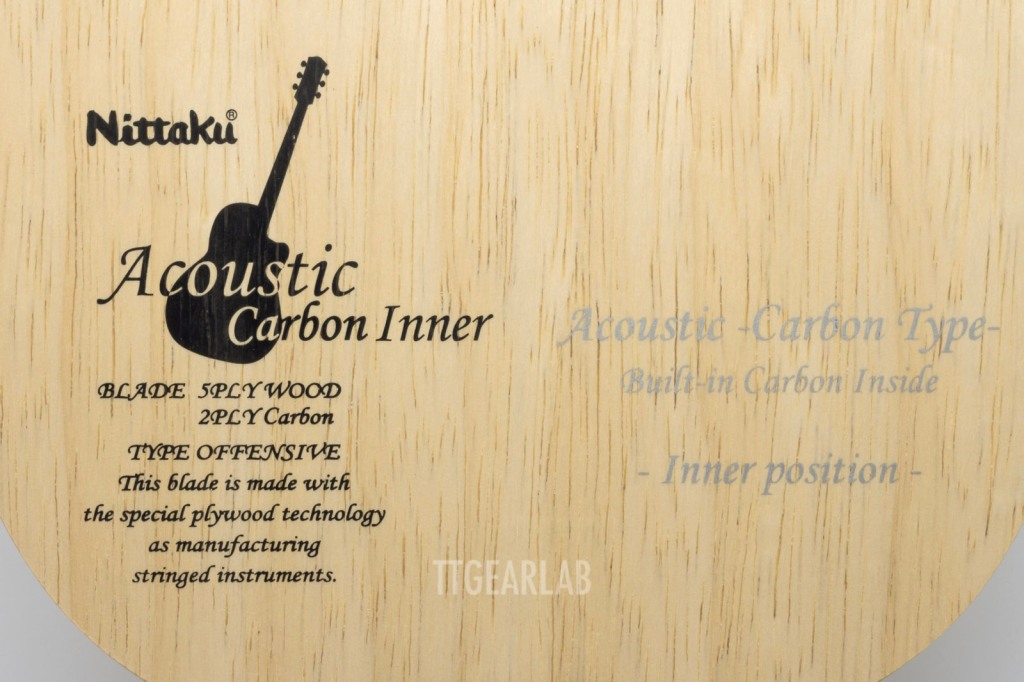
The printing on the head is similar to those of the other models in ‘Instrument’ series. The simple description on the blade is printed on the left bottom of the foreside of blade head. And, the sliver printing on the right bottom of the foreside of blade head indicates that this is a carbon blade of inner fiber type.
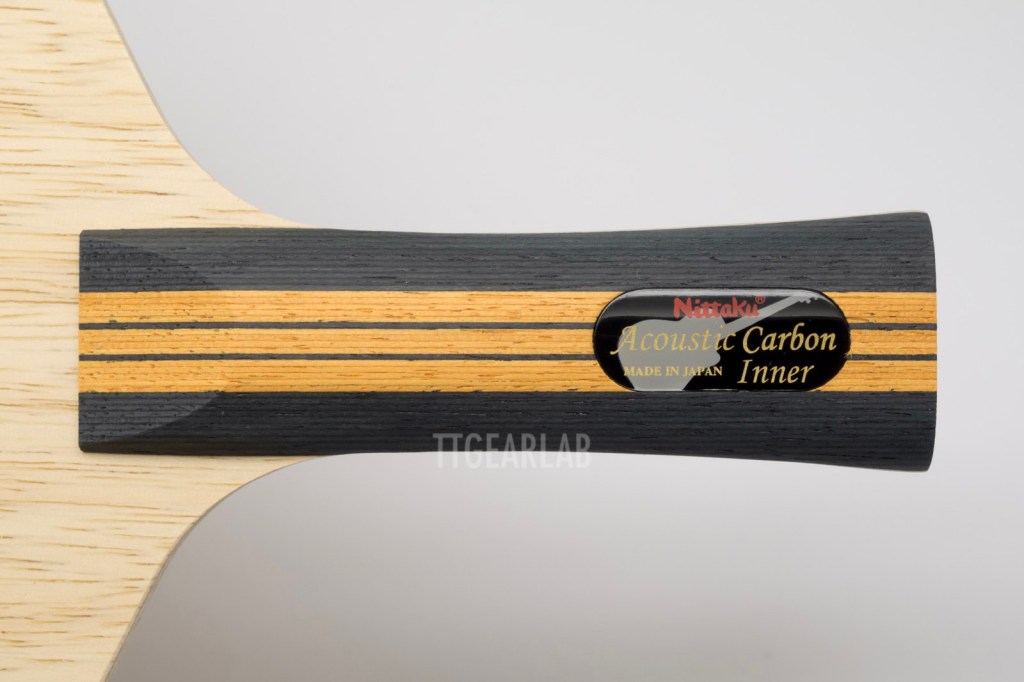
The nameplate made of transparent plastic is applied on the foreside of handle.
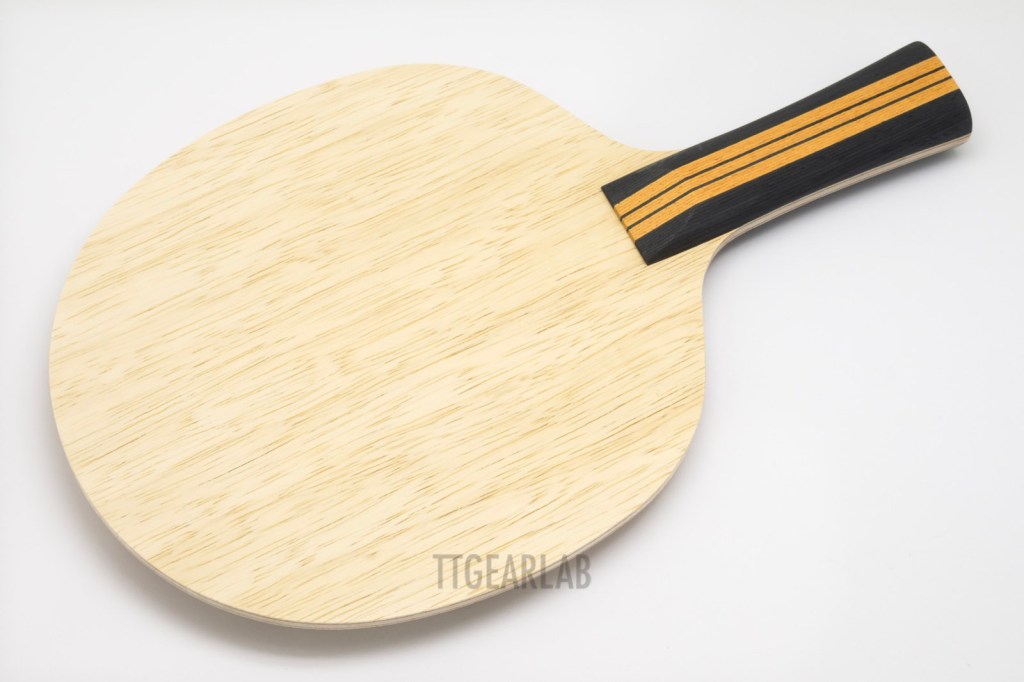
Nothing is printed on the backside of head, and there isn’t backside lens.

Brass plate including Nittaku logo is applied at the end of handle.

A card in included in the packaging of ‘Instrument’ series. It is written in Japanese as : “Thank you very much for purchasing a SELECTED BLADE made by string instrument manufacturing technology. We make every effort to manufacture our products, but please understand in advance that the blade may break or bend when subjected to impact because the blade is made of natural materials.”
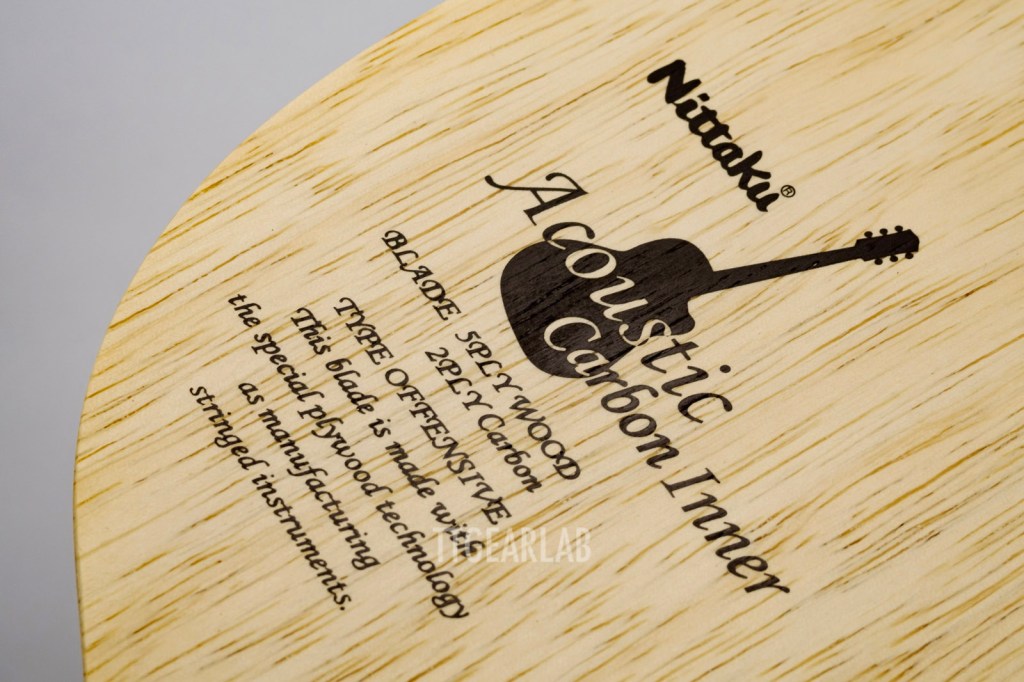


Following are the performance indices of Nittaku Acoustic Carbon Inner (avg.weight = 82.9g) :
– Ep = 1.36
– Ec = 1.22 (Ec/Ep = 0.90)
– Vp = 1.08
– Vl = 1.21 (Vl/Vp = 1.12)
Note : Current values seems to be somewhat lower than expected. Probably that is because the avg.weight is very low when compared to ordinary weight range of inner fiber blades (around 87~92g). 82.9g is also much lower than the official average weight of this model (= 90.0g).
Please note that above are average values and can be updated by further measurement.
Unauthorized use and/or duplication of this material without express and written permission from this website’s author and/or owner is strictly prohibited. Excerpts and links may be used, provided that full and clear credit is given to TTGearLab with appropriate and specific direction to the original content.
 TTGearLab
How is the handle compared to Butterfly innerforce handle?
And, Tung ist a bit less common than kiri or ayous as center, how would you expect the tung core to influence the blade‘s characteristics?
LikeLike
The handle of Acoustic Carbon Inner is slimmer. But, because there isn’t significant difference in width, it feels as if it is the small version of wide handle. So, for me, the handle of Acoustic Carbon Inner is more comfortable than the handle of InnerForce Layer ALC or ALC.S. (FL handle.)
Tung is very similar to Kiri. In fact it is a kind of Kiri that lives in different place. The Chinese character of Tung (= Tóng) is 桐, and 桐 is read as Kiri in Japanese. So the different pronunciation of the same character. For that reason, we may be able to call the center layer of Acoustic Carbon and Acoustic Carbon Inner just as Kiri.
But, because of the difference of habitats, there is also small difference in characteristics. So we will be able to fine tune characteristics of blade by using Tung instead of common Kiri.
When compared with Ayous, Kiri and Tung are lighter and softer.
In general, the center layer of inner fiber blade is Ayous. If Kiri (or Tung) is used for the center layer of inner fiber blade, the overall elasticity of that blade becomes dramatically lower. That is the reason why the elasticity of Acoustic Carbon Inner is so low. Tibhar Stratus Samsonov Carbon is another example. Its elasticity is also very low because it is an inner fiber blade with Kiri center layer.
LikeLiked by 2 people
Thanks for doing this one, always wondered how it was. Im sure heavier ones are faster.
LikeLike
In general, heavier ones are faster than lighter ones of the same model. (Especially when the weight difference is meaningfully big.) 🙂
LikeLike
Hi, do you plan an update also maybe with a comparison? There are also new handles (G-Revision). I’m really interested how you would compare it to other inner ALC. A recommendation for you is to test Nittaku Nordlinger AC 🙂
LikeLike
If there is a chance I want to also deal with G-Revision models. But, I’m not sure whether there is a chance or not.
New Nittaku Nordlinger series seems to be interesting. I will check it. I hope that I can get the samples in short time.
LikeLike
I would like to start by acknowledging the great work and valuable information this site provides for us table tennis equipment enthusiasts. It’s simply fantastic!
I own both the Nittaku Acoustic and Acoustic Carbon Inner blades, and as mentioned in the article, the 82g blade isn’t really representative in terms of speed. My Acoustic Carbon Inner, which weighs 91g, is slightly faster than my 89g Acoustic.
The Acoustic’s values of Ep 1.51 and Ec 1.21 align well with my own findings.
I would estimate my Acoustic Carbon Inner to have an Ep around 1.65-1.70 and an Ec around 1.35-1.40.
The Acoustic Carbon Inner is a lovely small step-up from the Acoustic, with slightly more speed and a more direct (medium) arc compared to the Acoustic’s medium-high arc. The Acoustic generates slightly better spin, but the Carbon Inner still retains a lot of the woody feel, despite being a carbon blade.
It would be interesting to measure a 90g Carbon Inner to see how much it differs and to establish a general guideline on how weight affects a blade.
LikeLiked by 1 person
Thanks Simon, this Information has helped me 😊
LikeLiked by 1 person
Thank you a lot for comment! 🙂
If there is a chance I will get heavier ones of Acoustic Carbon Inner and update the data.
LikeLike
Hi,
I am loving the Korbel (japan) blade for its feel and control. Thought I like to try a inner carbon blade as the next step, looking for a bit more speed without losing the feel and control of the korbel.
I am looking at the Nitaku acoustic inner carbon with the new handle (G revision).
This review seems to suggest its probably not faster tan the Korbel??. Other options the DHS 301 or the Butterfly Inner (acl). What would you recommend? Many Thanks. Steve
LikeLike
I recommend Victas ZX-GEAR IN.
LikeLike
Although the lightweight one of Acoustic Carbon Inner is not fast, it is still ‘pure-carbon’ blade. If you replace Korbel with faster fiber blade, I think that the blade with mixed fiber such as ALC will be more suitable than the blade with pure carbon fiber.
So H301 and InnerForce ALC are considerable. However, at this time those two are too much different from Korbel. The inner ALC blade which is very close to Korbel is Victas ZX-Gear In.
(BTW, if you like the FL handle shape of Korbel and don’t want to use the blade with different handle shape, please consider Tibhar Libra ZAC without concerning the performance.)
And, if the blade whose fiber doesn’t include Carbon is all right, please also consider Xiom Hugo HAL. Its handle shape is also very close to that of Korbel.
LikeLike
Hi,
Just picked up a Nittaku acoustic inner carbon G revision, at a special price. It was 94g so quite a bit heavier than the 82g. So hopefully not to heavy of a blade.
The handle was 85mm at its smallest circumferance, nice feel and size for my hands. Interesting the blade width is nearly 5.7mm (5.67). I haven’t put rubbers on it yet.
Steve
LikeLike
Hi,
An update, put rubbers on the Nittaku (acoustic inner carbon G revision) same rubbers as Korbel. Similar weight around 183g.
After first hit vs Korbel (japan), I would say about 10% faster than Korbel, a little harder and more direct but still has that woody feel and not as head heavy. Seems more accurate than the Korbel but lower arc and has a bit more spin, better at smashes- a nice upgrade to Korbel. However my backhand was less accurate – went out more.
I did try the Butterfly Viscaria, but it was to fast for me, less wood feel and seemed less accurate (probably because of my experience) than the Nittaku. Steve
LikeLike
Thank you a lot for sharing your precious experience!
Probably that one is much more elastic than the one in this article, but will still be less elastic than Viscaria or Acoustic Carbon (outer).
I expect that you’ll be able to adjust. Also you’ll be adjust by chaning the backhand rubber. Then the accuracy of backhand technics will be improved.
Many people select fast blade such as Viscaria or even faster ones. But, in my opinion for most of players that kind of blades are excessively fast and they will not be able to fully control it. In my personal opinion the inner-type blades such as Acoustic Carbon are much better than the outer-type blades such as Viscaria for most of ordinary players. We’ll be able to swing faster and be more aggressive.
LikeLike
Thanks.
I am wondering if the new G revision version is slightly thicker than the older version (5.5 vs 5.7mm). I measured with another digital vernier caliper, 5.7mm, maybe that is why its a bit heavier (94g) ?? I checked my korbel its 5.9/5.95mm and 91g the korbel (FL) handle is thinner too.
LikeLike
In fact ‘made in Japan’ blades of Nittaku have big deviations in thickness and weight. So, I feel the need of measuring more pieces of new G version and update the data. Because current average weight in this home page is too low, it is difficult to use the data of Acoustic Carbon Inner for comparison with other blades.
LikeLike
It would be great (and probably somewhat impossible) if you could possibly get all three of the new Acoustic G-Revisions within the same weight range to review them against each other. I really enjoy your reviews especially when the tables & playing characteristics are involved.
LikeLike
Thank you. I hope that I can get the chance of reviewing new G-revisions. (Currently it is being postponed due to the problem of budget.)
LikeLike
Can you tell me the handle’s measures of Acoustic G-Revision?
LikeLike
I haven’t got the samples yet. But, the revised handle shape is close to the handle shape of Butterfly InnerForce Layer series. The dimensions seem to be also very close to the dimensions of InnerForce Layer handles.
LikeLike
It would be interesting to compare the numbers of the newer 5.8 mm thick “special order” inner and outer acoustics to what we have here. Is it possible for you to get samples of them?
LikeLike
It would be really interesting. But, it is difficult for me to get samples in short time.
LikeLike
Hi,
There is now a new model with this blade, 5.8mm special. It is meant to be faster and more stable. https://www.tabletennis11.com/other_eng/nittaku-acoustic-carbon-inner-5-8
Love you to review it.
I also put Razka x on the forehand of the Nittaku AI carbon blade and it works well – more linear and more control than Rozena rubber on this blade.
Steve
LikeLike
Strange, it won’t let me reply to TTgearlab’s comment. Anyway. I understand it’s hard to get blades fast (or sometimes at all) The good thing is that there’s so many cool ones out there.
LikeLike
It is stange. There isn’t that kind of limitation in the setup of this home page. But, I will check once if there has been that kind of setting I haven’t known. 🙂
LikeLike