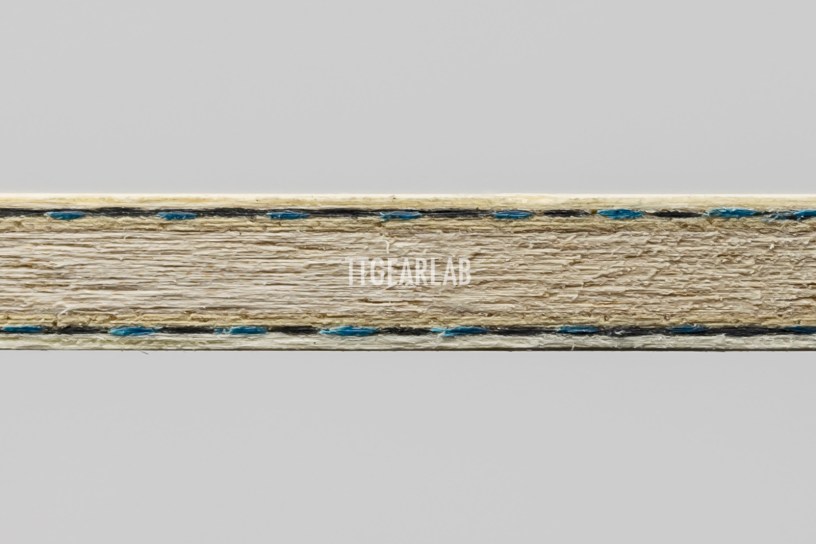
Note : All values are average values, and can be updated by further measurement.
| Quad/Triple Fiber | Outer | Inner | 3+2 ply | Center Fiber | 7-ply Wood | 5-ply Wood |
andro / Outer
| Name | Avg.Wt (g) | Ep | Ec | Ec/Ep | Vp | Vl | Vl/Vp |
| andro Synteliac ZCO OFF/S | 88.8 | 2.43 | 2.38 | 0.98 | 1.46 | 1.41 | 0.97 |
| andro Synteliac VCO OFF | 82.8 | 1.93 | 1.88 | 0.97 | 1.34 | 1.48 | 1.10 |
| andro TP_Ligna CO OFF | 87.0 | 1.64 | 1.55 | 0.94 | 1.19 | 1.20 | 1.01 |
| andro Treiber CO OFF/S | 83.9 | 2.04 | 1.92 | 0.94 | 1.35 | 1.53 | 1.13 |
Butterfly / Outer Fiber (* The term ‘Outer Fiber’ can be used only for Butterfly blades.)
| Name | Avg.Wt (g) | Ep | Ec | Ec/Ep | Vp | Vl | Vl/Vp |
| Butterfly Fan Zhendong Super ALC Butterfly Viscaria Super ALC | 92.7 | 2.22 | 2.15 | 0.97 | 1.35 | 1.24 | 0.92 |
| Butterfly Fan Zhendong ALC Butterfly Viscaria (current) Butterfly Zhang Jike ALC | 87.1 | 2.02 | 1.92 | 0.95 | 1.32 | 1.35 | 1.02 |
| Butterfly Viscaria (old, M-serial) | 86.0 | 1.97 | 1.80 | 0.91 | 1.28 | 1.37 | 1.07 |
| Butterfly Fan Zhendong ZLC Butterfly Zhang Jike ZLC | 85.1 | 2.03 | 1.96 | 0.97 | 1.35 | 1.37 | 1.01 |
| Butterfly Fan Zhendong Super ZLC Butterfly Zhang Jike Super ZLC | 90.8 | 2.55 | 2.15 | 0.84 | 1.37 | 1.48 | 1.08 |
| Butterfly Freitas ALC | 87.4 | 2.04 | 1.91 | 0.94 | 1.32 | 1.33 | 1.01 |
| Butterfly M.Maze | 84.2 | 1.80 | 1.60 | 0.89 | 1.23 | 1.32 | 1.07 |
| Butterfly Mizutani Jun Super ZLC | 90.0 | 2.35 | 2.24 | 0.95 | 1.42 | 1.42 | 1.00 |
| Butterfly Mizutani Jun ZLC | 89.7 | 2.24 | 1.99 | 0.89 | 1.34 | 1.37 | 1.02 |
| Butterfly Revoldia CNF | 87.4 | 1.84 | 1.61 | 0.87 | 1.21 | 1.25 | 1.03 |
| Butterfly Timo Boll ALC Butterfly Timo Boll Spirit | 90.6 | 2.14 | 1.77 | 0.83 | 1.26 | 1.41 | 1.12 |
| Butterfly Timo Boll T5000 | 91.4 | 2.59 | 2.11 | 0.81 | 1.35 | 1.51 | 1.12 |
| Butterfly Timo Boll ZLC | 87.2 | 2.11 | 2.01 | 0.95 | 1.36 | 1.39 | 1.02 |
| Butterfly Timo Boll ZLF | 84.7 | 1.63 | 1.47 | 0.90 | 1.19 | 1.34 | 1.13 |
DHS / Outer
| Name | Avg.Wt (g) | Ep | Ec | Ec/Ep | Vp | Vl | Vl/Vp |
| DHS 506A | 87.6 | 1.99 | 1.68 | 0.84 | 1.24 | 1.37 | 1.10 |
| DHS 506X | 85.2 | 2.03 | 1.82 | 0.90 | 1.31 | 1.39 | 1.06 |
Donic / Outer
| Name | Avg.Wt (g) | Ep | Ec | Ec/Ep | Vp | Vl | Vl/Vp |
| Donic Skachkov Carbon | 82.5 | 1.80 | 1.67 | 0.93 | 1.28 | 1.38 | 1.07 |
| Donic Zhang Jike New Era | 84.4 | 2.23 | 2.05 | 0.92 | 1.39 | 1.49 | 1.07 |
| Donic Zhang Jike Original Carbon | 85.8 | 2.31 | 2.03 | 0.88 | 1.37 | 1.46 | 1.06 |
| Donic Whiper Outer Carbon | 84.1 | 2.03 | 1.97 | 0.97 | 1.37 | 1.36 | 0.99 |
KTS / Outer
| Name | Avg.Wt (g) | Ep | Ec | Ec/Ep | Vp | Vl | Vl/Vp |
| KTS Foundation ALC | 85.7 | 1.77 | 1.58 | 0.89 | 1.20 | 1.30 | 1.08 |
| KTS Foundation AMC | 86.8 | 2.43 | 1.96 | 0.81 | 1.34 | 1.54 | 1.15 |
| KTS Foundation GF.K | 85.1 | 1.47 | 1.30 | 0.88 | 1.10 | 1.17 | 1.07 |
| KTS Problade Fury KC | 89.0 | 2.15 | 2.07 | 0.96 | 1.36 | 1.35 | 0.99 |
| KTS Problade Fury LC | 87.7 | 2.14 | 1.87 | 0.87 | 1.30 | 1.34 | 1.03 |
Nittaku / Outer
| Name | Avg.Wt (g) | Ep | Ec | Ec/Ep | Vp | Vl | Vl/Vp |
| Nittaku Mima Ito Carbon Nittaku Acoustic Carbon | 90.8 | 2.23 | 1.98 | 0.89 | 1.31 | 1.36 | 1.04 |
Nevagiva / Outer
| Name | Avg.Wt (g) | Ep | Ec | Ec/Ep | Vp | Vl | Vl/Vp |
| Nevagiva Magic Wall 2 | 88.7 | 1.38 | 1.52 | 1.11 | 1.16 | 1.00 | 0.86 |
Stiga / Outer
| Name | Avg.Wt (g) | Ep | Ec | Ec/Ep | Vp | Vl | Vl/Vp |
| Stiga Carbonado 45 | 89.6 | 1.80 | 1.37 | 0.76 | 1.10 | 1.29 | 1.17 |
| Stiga Carbonado 90 | 90.5 | 1.88 | 1.61 | 0.86 | 1.19 | 1.32 | 1.11 |
| Stiga Carbonado 145 | 89.0 | 1.95 | 1.40 | 0.72 | 1.12 | 1.29 | 1.15 |
| Stiga Carbonado 190 | 92.5 | 2.10 | 1.77 | 0.84 | 1.25 | 1.40 | 1.12 |
| Stiga Carbonado 245 | 88.4 | 2.31 | 1.49 | 0.65 | 1.17 | 1.28 | 1.09 |
| Stiga Carbonado 290 | 91.9 | 2.71 | 2.18 | 0.80 | 1.38 | 1.59 | 1.15 |
| Stiga Dynasty Carbon | 89.9 | 1.89 | 1.51 | 0.80 | 1.16 | 1.35 | 1.17 |
| Stiga Legacy Carbon | 83.0 | 1.63 | 1.32 | 0.80 | 1.12 | 1.37 | 1.17 |
Tibhar / Outer
| Name | Avg.Wt (g) | Ep | Ec | Ec/Ep | Vp | Vl | Vl/Vp |
| Tibhar Cedric Nuytinck | 85.6 | 2.02 | 1.89 | 0.94 | 1.33 | 1.32 | 0.99 |
| Tibhar CCA Uulimited Tibhar VS Unlimited | 84.2 | 2.08 | 2.26 | 1.09 | 1.47 | 1.33 | 0.90 |
| Tibhar Drinkhall Powerspin Carbon | 85.4 | 1.93 | 1.99 | 1.03 | 1.37 | 1.33 | 0.97 |
| Tibhar Fortino Pro | 90.9 | 1.97 | 2.70 | 1.37 | 1.55 | 1.15 | 0.74 |
| Tibhar Kinetic Speed | 83.2 | 2.20 | 2.15 | 0.98 | 1.45 | 1.56 | 1.08 |
| Tibhar MK Carbon | 85.4 | 2.01 | 1.84 | 0.92 | 1.32 | 1.45 | 1.10 |
| Tibhar Samsonov LE 25 (LE : Limited Edition) | 85.6 | 2.09 | 2.03 | 0.97 | 1.38 | 1.36 | 0.99 |
Victas / Outer
| Name | Avg.Wt (g) | Ep | Ec | Ec/Ep | Vp | Vl | Vl/Vp |
| Victas Liam Pitchford | 89.2 | 2.25 | 1.82 | 0.81 | 1.28 | 1.50 | 1.17 |
| Victas Swat Carbon | 86.0 | 1.49 | 1.29 | 0.87 | 1.10 | 1.20 | 1.09 |
| Victas ZX-Gear Out | 87.1 | 1.97 | 1.59 | 0.81 | 1.20 | 1.40 | 1.17 |
Xiom / Outer
| Name | Avg.Wt (g) | Ep | Ec | Ec/Ep | Vp | Vl | Vl/Vp |
| Xiom 36.5 ALX | 86.2 | 1.92 | 1.77 | 0.92 | 1.28 | 1.39 | 1.09 |
| Xiom An Jaehyun TMX | 87.0 | 2.19 | 1.79 | 0.82 | 1.29 | 1.49 | 1.16 |
| Xiom Hayabusa ARX | 88.5 | 2.29 | 1.93 | 0.84 | 1.32 | 1.50 | 1.14 |
| Xiom Hayabusa ZLX | 84.5 | 1.95 | 1.99 | 1.03 | 1.37 | 1.23 | 0.90 |
| Xiom Hugo HAL | 88.0 | 1.62 | 1.52 | 0.94 | 1.17 | 1.18 | 1.01 |
| Xiom Hugo SAL | 88.8 | 1.69 | 1.55 | 0.92 | 1.18 | 1.15 | 0.97 |
| Xiom Stradivarius | 86.1 | 1.99 | 1.59 | 0.80 | 1.24 | 1.51 | 1.22 |
| Xiom Zeta Offensive+ | 85.3 | 2.71 | 2.27 | 0.84 | 1.47 | 1.69 | 1.15 |
Yinhe / Outer
| Name | Avg.Wt (g) | Ep | Ec | Ec/Ep | Vp | Vl | Vl/Vp |
| Yinhe M101 | 85.2 | 2.04 | 1.76 | 0.86 | 1.29 | 1.44 | 1.12 |
| Yinhe M102 | 89.6 | 2.50 | 1.88 | 0.75 | 1.29 | 1.51 | 1.17 |
| Yinhe V-14 Pro | 89.9 | 1.98 | 1.71 | 0.86 | 1.23 | 1.29 | 1.05 |
Unauthorized use and/or duplication of this material without express and written permission from this website’s author and/or owner is strictly prohibited. Excerpts and links may be used, provided that full and clear credit is given to TTGearLab with appropriate and specific direction to the original content.
 TTGearLab
Hey, thanks for sharing all of this ! it’s a great work, and very useful.
Out of curiosity, you’re not doing any joola blades ?
Thanks again,
sebastien
LikeLike
Thank you for comment. Getting Joola blade is somewhat difficult for me. In fact I have data of some Joola blades but it seems that all of those are already discoutinued. And, I don’t have new models.
But, it seems that I will be able to get some Joole blades sooner or later by different source. I don’t know which models are those, but it seems that those are not current top models. Anyway I will write postings on those blades.
LikeLike
Amazing job! Thank you so much for sharing this. Picking a blade is soooo much easier now ❤
LikeLike
Thank you for comment. And, it is really good to hear that this is useful.
LikeLike
Have you managed to get your hands on an Inspira Hybrid or Inspira Plus?
LikeLike
Not yet. However, I expect that Inspira Hybrid Carbon isn’t much different from Tibhar MK Carbon.
LikeLike
I also would love to see the Inspira plus reviewed. Its a nice blade, like a grippy viscaria.
LikeLike
Now I’m more interested in Inspira Plus than Inspira Hybrid Carbon.
LikeLike
It’s made for the chinese market, I hope u can find one. Great job with this page, btw.
LikeLike
Thank you. I will check Chinese market. 🙂
LikeLike
Hi, thanks a lot. I can understand one thing. TBS is classified with deeper hold than Viscaria. I have TBS and I played with Viscaria. I felt each time that Viscaria is more controllable for me, especially in touch game. Sometimes I feel kick with Viscaria in touch game but not in Viscaria. What am I ignoring? Thansk
LikeLike
I mean, I can’t understand it
LikeLike
two mistakes in one comment 😅 I mean I felt kick in my TBS blade more than Viscaria
LikeLike
Ec/Ep is related with ‘additional’ hold/kick. Even though the Ec/Ep is very low, you will feel that the blade gives strong kick if the Ep itself is high. 🙂
BTW, in fact the plywood of Timo Boll Spirit is originally same with that of Viscaria. That is because Timo Boll Spirit is originally one version of Viscaria with different handle shape. However, due to the deviation is production, even the same blade may have differences depending on the production period and so on. And, Timo Boll Spirit and Viscaria are not produced at the same time. Further, because of the difference in the structure of hollow in handle, Timo Boll Spirit is more head heavy than Viscaria. Handle shape also affects the result. The handle of Viscaria is more stable, and that of TBS is more dynamic.
So there are so many factores those affect the difference between two models.
LikeLiked by 1 person
hey
LikeLike
since you take the average weight and results between several woods of the same type of blade i would be interested to know if there is a specific difference happening between different weights?
i just heard the blade gets softer and slower if you get a lighter one due to the lesser dense of the same wood. but is the data getting slower accordingly or is Ep or Ec change differently? Same with Vp and Vl
and what happens to a fiber/carbon blade? the fiber shouldn’t have a natural occuring difference in density like wood have. So let’s assume two Butterfly Viscaria as an example where the carbon has the most effect since it is under the first layer: would a 80g Viscaria play and feel the same as an 95g one, but just slower and softer (as i saw those big difference in weight)?
some question i always had but never could find out and hope with your testing and experience can come close to.
LikeLike
The lower the weight, the lower the Ep and the Ec. But, Ep is more significantly affected by the weight. And, Ec is slightly affected. For that reason, lighter pc. shows higher Ec/Ep, and heavier pc. shows lower Ec/Ep.
If the weight difference from average weight is withing 3~5gram, the differences of indices aren’t significant. So we can think that it will be a bit different. However, if the weight difference is too big, the blade becomes quite different one from normal one whose weight is close to average.
And, the story becomes more complex if the weight difference is also because of the difference in thickness. That can be seen from some blades which have been produced for long time.
The problem in measurement is that my budget is limited. For that reason I buy the pcs. whose weight range is as close to the average as possible.
LikeLike
Can you please check the Vl / Vp values for “Xiom Stradivarius”? I think there are slightly different values in the “Xiom Novus series” review you posted earlier.
LikeLike
The data has once been updated. Although there aren’t much differences, many heavier pcs. were newly measured for updated data. Please refer to new data (avg. weight = 86g).
The most significant difference is in Ep. The Ep of old data (avg. weight = 82g) was 1.89. But, the Ep of new data (ave. weight = 86g) is 1.99. The other parameters are not that different.
LikeLiked by 1 person
Thank you so much for the update. However it seems Vl and Vp are a bit inconsistent still.
In the “Xiom Novus series” review you are stating:
Stradivarius: Vp = 1.38, Vl = 1.60 (Vl/Vp = 1.16)
V1: Vp = 1.24, Vl = 1.51 (Vl/Vp = 1.22)
It seems you just need to swap them 🙂 since in this post Strad is having 1.24 1.51 respectively.
Again, thank you so much for all the work. This is just a pure treasure for all table tennis fans!
LikeLike
Woooooops! Thank you a lot for finding the error out! The data have been swapped!
I will correct it as quickly as possible.
LikeLike
Hello dear ttgear team, I am currently playing the Zhou Qihau 90 and would like to know its values if possible. Are you planning to test this wood in the near future?
Best regards .
LikeLike
If Joola provides the sample for me, I will be able to measure it. It is quite expensive blade, and my budget is limited. For that reason, it may take much time until I can get it if Joola doesn’t provide it for me.
However, that model looks quite similar to Tibhar MK Carbon. Same top layer, same fiber, same inner layers, and same thickness.
Head shape and handle shape are also identical. So you’ll be able to refer to the data of MK Carbon.
LikeLike
Hello,
Please cCould you test the Joola Zhou Qihao 45 blade (limba in outer plies) ?
I’ve read that this Joola blade (like the ZQ 90) is of excellent quality and offers a superb playing sensation.
Best regards.
LikeLike
Currently it is difficult to get those blades. But, in near future I will meet Joola distributor. Maybe there will be good result.
LikeLike
hello ttgearlab team. I have an Yinhe V14 pro, and I saw in this article you guys already tested one.
Since everyone says it is a Timo Boll ALC clone, can you make an article comparing both? Thank you!
LikeLike
One problem is that both of Timo Boll ALC and V14 Pro have quite big deviation by piece. Even significant differences in thicknesses is observed. That is one of the reason why I don’t like those two blades. (Because deciding the standard values of Performance Indices becomes difficult.) (For the same reason I don’t like Stiga Clipper series.)
Anyway, I think that V14 Pro can be good replacement of Timo Boll ALC or Viscaria. It is a really well-made clone as you heard.
BTW, could you let me know the weigh of your V14 Pro?
LikeLike
If Im not wrong, my V14 pro weights 89g. When I change rubbers, I will weight it again to confirm 100%
LikeLike
I just weighted with rubbers. Using a omega 7 china guang 2.1mm fh, and omega 7 pro max bh. Total weight is 193g
LikeLike
That weight is just good for V14 Pro! I recommend you to go with that blade.
I’m not sure whether Omega 7 China Guang will make good combination with V14 Pro or not. But, if I predict from experience, it will not be bad. That kind of blade makes very good harmony with sticky rubbers including hybrid rubbers.
LikeLike
yeah, it is a nice blade. Goes well with a lot of types of rubbers. I already used vega europe, vega pro, hurricane 3, fastarc g1… all of them were great, my favorite was the hurricane 3. The omega 7 setup is recent, so I’m getting used to it.
LikeLike
Good result! Thank you for information. I expect that Omega 7 combination will also be good.
LikeLike
great work! You did a review on the Primorac carbon before. Could you add the stats? 🙂
LikeLike
Thank you for comment. The data of Primorac Carbon is written in this article :
https://ttgearlab.com/2024/03/15/performance-indices-db-32-ply-blades/
LikeLike
Really insightful analysis.
Do you have any performance data for the 729 Friendship Blue ALC?
I have played a bit with that and also with a friend’s Viscaria with the same rubbers (Dignics on both) but a few days apart. They seemed to feel and perform the same – and the 729 is way cheaper. Would be nice to know if the data confirms the 729 as a good Viscaria clone
LikeLike
Thank you for comment. I don’t have that model. But, probably the data will not be much different from that of Viscaria if you and your friend felt so. In fact what TTGearLab is doing started with the intention of explaining the phenomenon numerically. For long time I have tried to describe what I felt by objective numbers. For that reason, if we feel those two blades similar with each other, the data of those blades will be similar to each other. 🙂
LikeLike
did you have any chance to measure a blade with CNF? like butterfly revoldia or fan zhendong CNF? would be interested to compare it with Xiom Hugo HAL too
LikeLike
I want to measure it once. But, so far my budget hasn’t allowed it. (It is too expensive blade.)
LikeLike
I highly appreciate your in-depth racket analysis. This might be the only website in the world that evaluates rackets based on scientific standards.
I want to ask for your advice between 2 rackets Synteliac VCO Off and Fan Zhendong Super ALC (FZD SALC). Currently, I am using the VCO. The EP, EC of VCO is slower than FSD SALC’s. It is no doubt that the FSD SALC is more faster, more kicker when player hit the ball strongly than VCO. But what I do not really understand is about the VP, VL, VP/VL. The VP from both of two rackets is similar (1,34 vs 1,35). The VL from VCO is 1,48 much higher than 1,24 VL from FSD SALC. According to the figure of relationship between Vl/Vp and Vp, Vl/Vp of VCO is 1,1 so much higher than 0,92 form FSD SALC. I know your explaination about finger and palm but what is the real different between the two rackets? It means vibration of VCO and FSD SALC is equal? Is FSD SALC more “harder”?
I really want to try FSD SALC. But i am affraid that is some of “similar” to my VCO lol.
I hope to hearing your answer and advice about two rackets.
Thank you for your dedication and hard work.
LikeLiked by 1 person
Thank you for comment. The Vibration Indices are related with feeling, and the feeling is related with the player’s preference.
The Vp’ of two blades are similar to each other. So the feeling transmitted to your palm will not be different. But, with much higher value of Vl, Synteliac VCO will give you much sharper feeling than FZD Super ALC to your index finger. You will feel that FZD Super ALC will be much milder at your index finger, if you compare those two blades.
There isn’t easier or more difficult. The feeling is only concerned with the preference of player. If you feel that the feeling of Synteliac VCO is too sharp at your index finger, you will be able to adjust the feeling to milder side by change the blade to FZD Super ALC. But, if you feel that current feeling at index finger is proper, you will feel that FZD Super ALC gives you much less exciting feeling at index finger.
The preference is more related with Vl/Vp than the Vl. Because the Vl/Vp of those two blades are significantly different, you will never feel that those two blades are similar to each other. However, you are sensitive only to Vp, you will feel that those two blades are similar to each other. The result depends on whether you are sensitive to the feeling at your index finger or not.
Q. Sensitive to the feeling at index finger?
YES ==> Those two blades will feel totally different.
NO ==> Those two blades will fee similar.
LikeLike
Hi,
Would you like make a gaint table to contain all your data for easier comparison?
LikeLike
I have considered it. But, still I don’t know whether it will be meaningful or not.
LikeLike
Hi, once again, thank you for your work. It’s great to have all that information, and it helps me a lot in understanding how racquets behave.
I’m using xiom 36.5 alx at the moment, and i like it a lot; but sometimes i wish i had more power. Do you think moving to Tibhar MK carbon would make a difference ? I’m using V15 extra on both sides.
(alternative solution : improve my technique and physical strength)
Thanks,
sebastien
LikeLike
Thank you for comment.
MK Carbon is more elastic than 36.5 ALX. However, the difference isn’t big. I’m not sure whether you can feel the difference in power or not.
In my opinion Xiom An Jaehyun TMX can be better solution because it is more elastic than MK Carbon. And, it also hugs the ball deeply when you hit the ball very hard.
Replacing the blade with outer-ZLC blade may be more effective solution. But, in this case you have to be accustomed to characteristics that is not familiar to you. The example is andro Synteliac ZCO OFF/S. It gives much more kick when you hits the ball strongly. That may be good or may be bad.
(I only mentioned the blades with similar FL handle shape.)
LikeLiked by 1 person
Hi!
Great work. The database is fantastic!
I need help regarding blade for short pips BH. I have asked you before regarding this in different reports you have published.
I’m currently playing with MK carbon, but I’m thinking if these blades are good?
Thanks!
Best regards
Karl Erik
LikeLike
If you are using MK Carbon and there isn’t any noticeable problem, I think that you don’t need to change your blade with those two. MK Carbon isn’t especially designed for short pips. However, there are many penholder players who are using short pips with Timo Boll Spirit CP whose blade construction is very similar to that of MK Carbon or Viscaria.
Timo Boll ZLC and Freitas ALC are not bad for the use with short pips, although those two are not designed for short pips. Timo Boll ZLC is very good for high-pitch rally at close-to-table area. You may feel that it suddenly becomes too stiff when you hit the ball very strongly. But, if you don’t use hard hitting frequently, there will not be the problem of feeling. Freitas ALC is for modern all-round play and mid-distance topspin. But, its characteristics are somewhat close to those of classic 7-ply wood blades with Limba top layer. That is good point for playing with short pips. However, if you are totally accustomed to MK Carbon, you may feel that the feeling of Freitas ALC is much less exciting. And, there may be problem in precise control in the rally by light shots at close-to-table area.
All things considered, I think that MK Carbon is the most balanced one in this question.
LikeLike
Will you be able to get your hands on a Joola Vyzaryz Trinity? Really curious how it stacks up to Xiom Tmx or Tmxi., with supposedly similar 3 material weave.
LikeLike
It has Limba top layer, while Xiom TMX has Koto top layer. (Both of those two are outer-type blades.) All the other factores are almost identical.
I’m considering to talk with Joola distributor about the samples. But, I’m not sure whether I will be able to check the blades in near future or not.
LikeLike
greetings, respect for the work done.any data on Victas Koki Niwa ZC?what hallowed woods are they like?Thank you!
LikeLike
Thank you for comment and appeciation.
Unfortunately I couldn’t have got the sample of Koki Niwa ZC. I had a chance of buying a sample when I visited Japan. But, at that time I selected Hina Hayata H2 instead of Koki Niwa ZC.
LikeLike
Hello ttgear team. Thanks for the great work, I’m here just to give a feedback about the combination of the yinhe v14 pro with the Omega 7 China Guang I used some time ago and mentioned in this section here.
I enjoyed the rubber/blade combination, it was reasonable fast and good control in short game. The only thing that made me go back to Hurricane 3 (and actually change the blade) was the lack of grip/tackiness. In more than 50% of my counter loops the ball was slipping from the rubber and making that thin sound we all know. This bothered me a lot because my game is spin oriented. Another problem, I did not have enough control on the active shots, so I missed a lot of balls.
long story short, moved back to the hurricane 3, and changed the v14 pro to a dhs pg5. My game improved a lot by slowing down the setup and making it spin oriented to suit my style. Now I am able to put much more balls on the table and win rallyes.
LikeLiked by 1 person
Thank you for sharing your experience. It seems that Omega 7 China Guang doesn’t make a good combination with Yinhe V14 Pro.
I think that PG5 will be better than V14 Pro if your playing sytle is spin oriented, and if you especially like the controllability at close-to-table area. PG5 is a good blade whose blade construction is identical to that of HL5 but is much more affordable.
LikeLiked by 1 person
Can you advise some blades with structure similar to M.Maze OFF or Freitas ALC (5+2 outer construction with limba top layer)?
LikeLike
The condition is (1) Outer construction, (2) ALC, (3) Limba top layer, (4) 5.8~6.0mm thickness. (In case the M.Maze OFF is its European version.)
The blade that fits for above condition is astonishingly few. Because currently the mainstream of outer-type is that with Koto top layer due to the influence of Viscaria and Zhang Jike series.
But, we can find one more model that fits for the condition – KTS Fury LC.
(Currently I’m managing an internet shop and selling table tennis equipments. KTS Fury LC is one of the products that is sold in my shop. :-))
LikeLike
Hello TTGearLab-Team,
I think your site is the most helpful to understand blades. Thank you. But still, I have open questions 😊
Are there any other advantages as speed to use carbon in a blade?
Why are as example Ma Long 5x on revspin has 9.6 Speed and your measurement shows this one is medium.
Is this all in the head of the players?
Thank you
LikeLiked by 1 person
Thank you for comment. The elasticity of blade doesn’t always coincide with the actual speed level. That is because there are many other factors those affect the actual speed of ball. But, nevertheless we can think that the blade with higher elasticity is in general faster.
There are many other advantages of using carbon fiber or other artificial materials. For example, the area of sweet spot increases by using artificial material. And, the blade can be much thinner when we require the same level of elasticity.
LikeLike
I currently use a 7-ply Butterfly Kong Linghui Euro OFF blade, likely manufactured around 2003, and I am considering switching to an Innerforce or inner-carbon model. My blade has a padauk (red) core and six anigre plies, and it feels quite stiff. Weight is 100gr . https://revspin.net/blade/butterfly-kong-linghui-euro.html
According to TT forums, some players liken its characteristics to older models such as the Stiga Clipper or the Butterfly SK-7 . I have not found any manufacturers information about blades using this particular wood combination, especially those with a padauk core.
I would be grateful if you could provide rough estimates of Ep, Ec, Vp, and Vl for my blade based on your experience (if possible) — this would help me choose my next rackets. Subjectively, I consider the ratio Ec/Ep should be ≥ 1, with Ep approximately 2.
LikeLike
Unfortunately I don’t have that blade. So currently there aren’t measured data for that blade. But, I also think that its Ep will be close to or higher than 2.0.
LikeLike