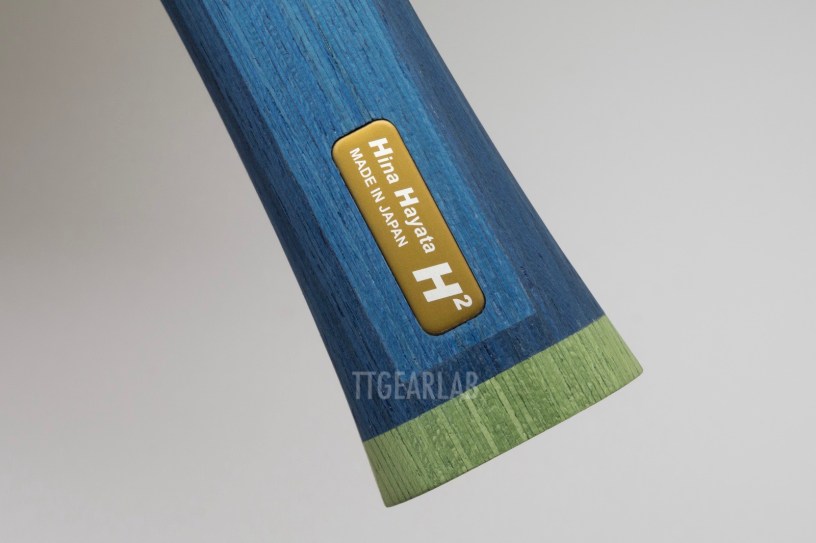
Nittaku ‘Hina Hayata H2’ which was released in 7th July 2022 is the blade developed for Hina Hayata who is the one of reading players of Japanese Women’s National Team. Everything of ‘Hina Hayata H2’ including the performance, the feeling and the shape of handle was adjusted for Hina Hayata. And, the exclusive logo designed by Hina Hayata is printed on the foreside of head. ‘H2’ is from the initial of Hina Hayata – H H. It is an inner fiber blades whose artificial material is new PKC which is the advanced version of Kevlar Carbon which has been used for many Nittaku blades. ‘Hina Hayata H2’ was developed especially for the harmony with ‘Neo Hurricane 3’ which is the foreside rubber of Hina Hayata. ‘Hina Hayata H2’ maintains the characteristics of sticky rubbers while providing higher speed.
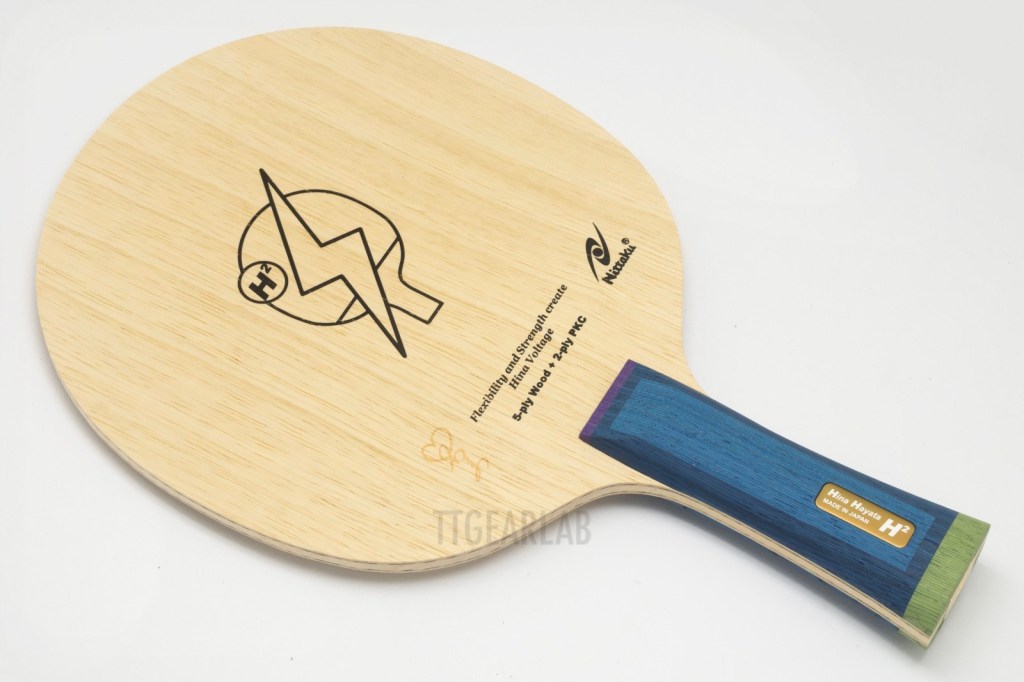
As its name expresses, ‘Hina Hayata H2’ is the blade developd for Hina Hayata.

The blade construction of ‘Hina Hayata H2’ is similar to that of typical inner ALC construction, but there are differences in material. Artificial material is new PKC which is the enhanced version of Kevlar Carbon which was used for many Nittaku blades. It is woven from high-modulus Kevlar fiber and Carbon fiber. The top layer is Limba. The middle layer looks like Ayous because its pattern by sawing machine is same as that of the center layer viewed from vertical direction, but its color viewed from diagonal angle is closer to that of Limba. The center layer is Ayous. PKC is inserted between the middle layer and the center layer. Overall thickness is around 5.8mm.
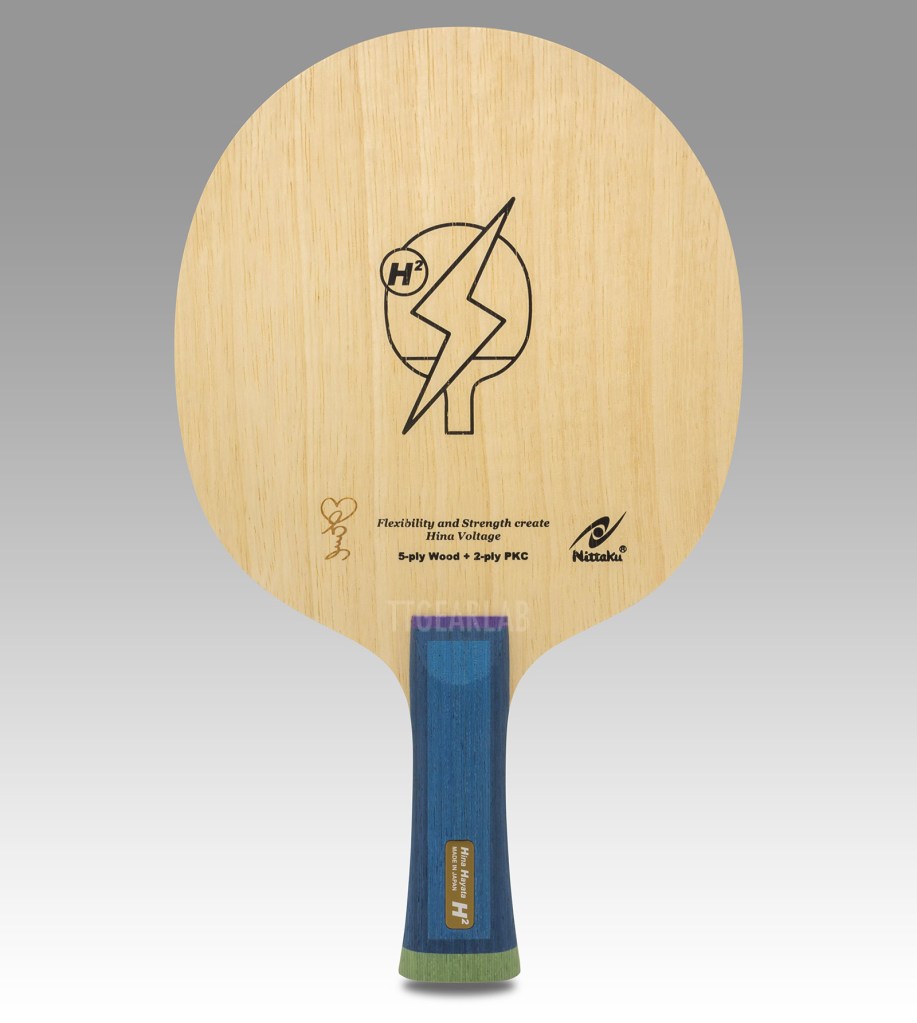
The size of head is around 158mm x 152mm which is a bit bigger than the 157mm x 150mm of ‘InnerForce Layer ALC’.
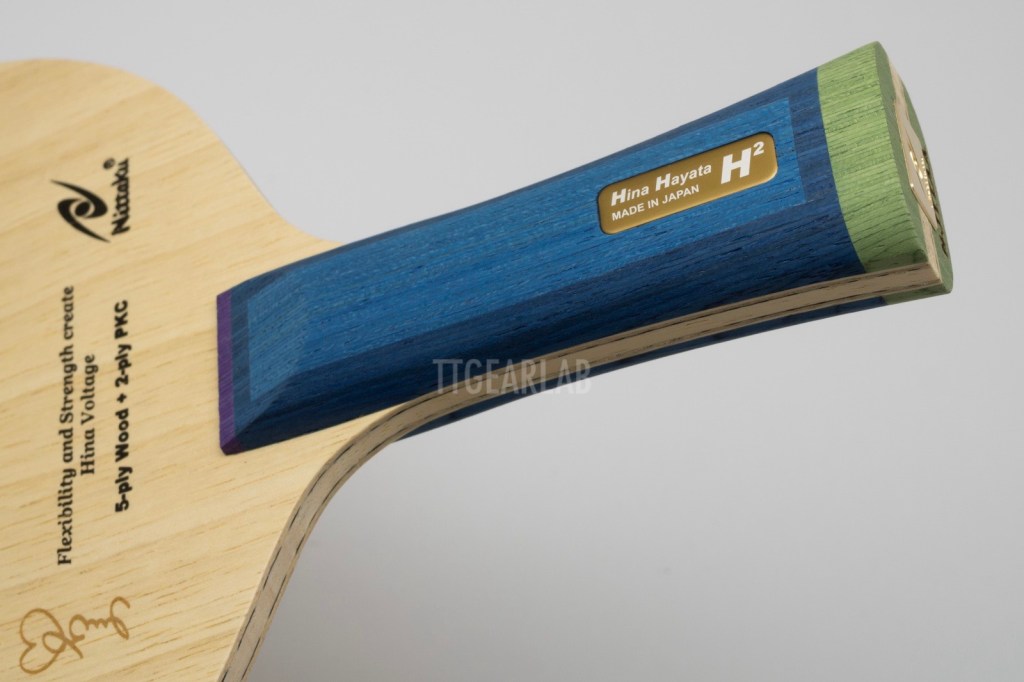
The width of FL (flared) handle is around 26mm (at head side) ~ 27mm (at bulge) ~ 26mm (at narrowest point) ~ 34mm (at the end). And, the thickness of FL handle is around 23mm (at thumb) ~ 24mm (at the end). The size of ST (straight) handle which is not shown in the picture is around 28mm (width) x around 22mm (thickness).

An exclusive logo mark for this blade is printed on the foreside of head. That logo including the pictures of table tennis racket and lightning bolt is designed by Hina Hayata.

Nothing is printed on the backside of head.

On the backside of handle, a small rounded lens including ‘H2’ logo that expresses ‘H H’ which is the initial of Hina Hayata.

Gold colored metal plate including Nittaku logo is applied at the end of handle.

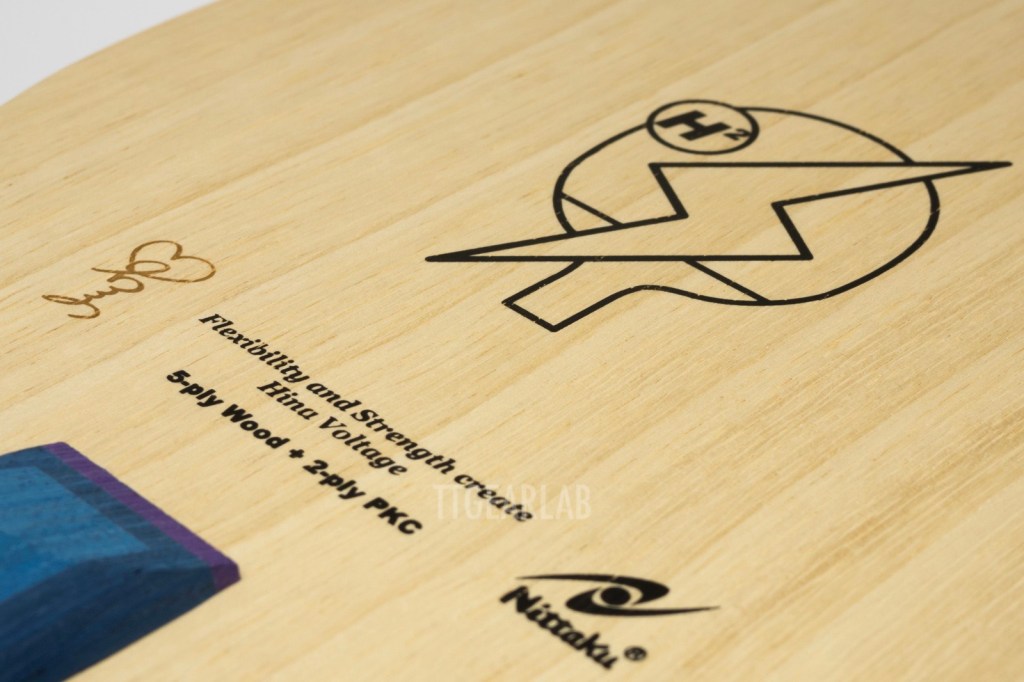

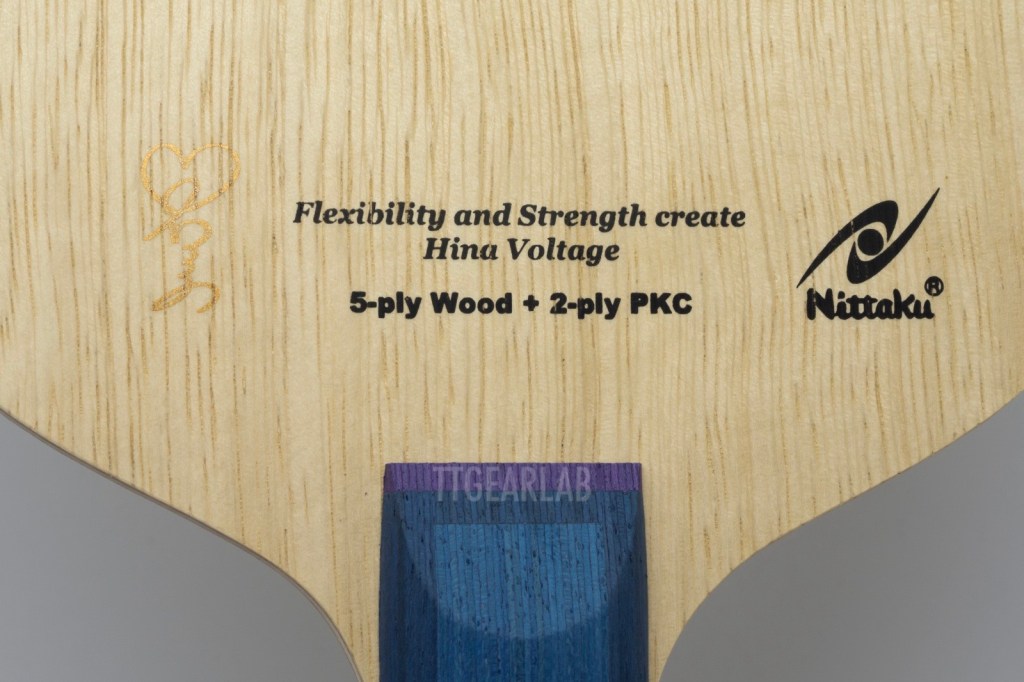
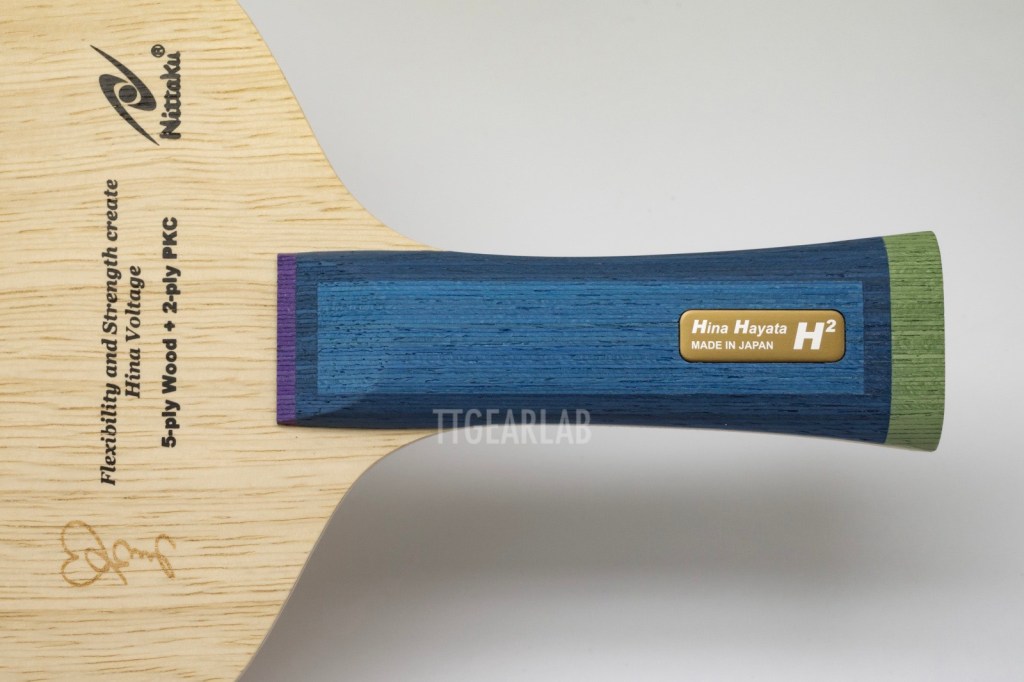
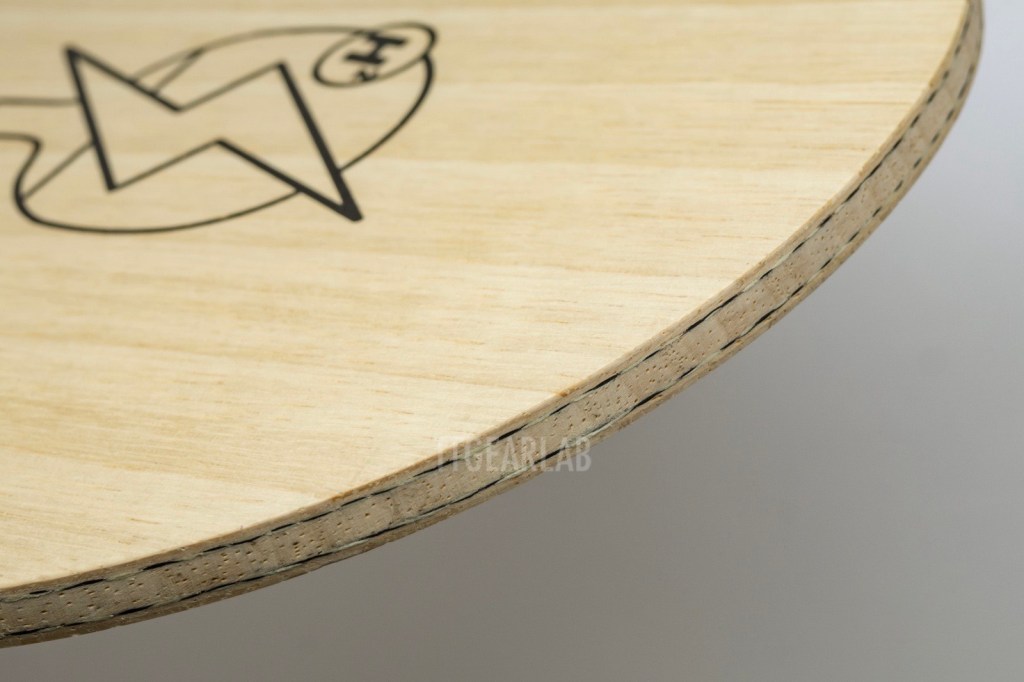


‘Hina Hayata H2’ is faster than current ‘Hurricane Long 5’. It provides moderately high elasiticyt, the characteristic that hugs the ball very deeply, a clear feeling of impact, and excellent harmony with sticky rubbers.
Following are the performance indices of Nittaku Hina Hayata H2 (avg.weight = 89.7) :
– Ep = 1.78
– Ec = 1.51 (Ec/Ep = 0.85)
– Vp = 1.16
– Vl = 1.24 (Vl/Vp = 1.08)
Please note that above are average values and can be updated by further measurement.
Unauthorized use and/or duplication of this material without express and written permission from this website’s author and/or owner is strictly prohibited. Excerpts and links may be used, provided that full and clear credit is given to TTGearLab with appropriate and specific direction to the original content.
 TTGearLab
Thanks for the review. Very nice looking blade indeed!
Is my assumption correct that a blade with relatively low value of the Ec/Ep ratio is good for hard Chinese-type rubbers?
In other words, if I want to switch to using softer tensor rubbers, should I use a blade with a higher Ec/Ep ratio?
LikeLike
I also think that the blades with low Ec/Ep fits for Chinese sticky rubber with hard sponge. But, that isn’t always true because there is blade with much higher Ec/Ep which also fits for Chinese sticky rubber very well, for example current Viscaria.
Regarding final sentence, it also differs by player. If there are 100 players, there can be 100 different answers. Some players will like extreme characteristics by the combination of low Ec/Ep and soft sponge. But, other players will like to neutralize the characteristics by the adjustment of Ec/Ep.
LikeLiked by 1 person
I’m far from the expert you are but to my kmowledge ayous has diagonal lines left from the saw machine if you look it in line with the wood grain (side picture for the middle layer, handle pic for the ayous core), in contrast with no saw marks in the limba top ply (handle pic also). This is also the case with my fang bo b2x blade and some of the dhs 301 series you posted. Please correct me if in the wrong
LikeLike
Thank you for comment. In fact at the beginning I thought as you mentioned. (Pattern by saw machine.) But, when the construction is observed diagonally the middle layer looks identical to the top layer. Even the color of the middle layers is different from the center layer. The color of middle layer viewed from vertical direction is same as the color of top layer viewed from lateral direction. And, also the color of middle layer viewed from lateral direction is same as the color of top layer viewed from vertical direction.
But, I’m not sure because I’m not the one who designed this blade. So probably you are right if the pattern by saw machine is more important than the color of wood. So I will correct it as Ayous, and just add that it looks similar to top layer if we don’t consider the pattern by saw machine.
LikeLike
Did Nitraku work with DHS on this blade or is that just a rumor?
LikeLike
I’m not sure. But, the fact is that everything of this blade looks quite different from that of Hurricane Long 5. The edge of blade shows different pattern from that of Hurricane Long 5. The feeling of surface is also different. The pattern of fiber also looks quite different.
LikeLike
So how is Nittaku So-Ten in comparison?
LikeLike
I couldn’t have got the sample of So-Ten yet.
LikeLike
Thank you for your review.
In terms of weight distribution, would you say the blade is head-heavy, balanced or handle-heavy?
LikeLike
I felt that this blade is balanced or a bit head heavy. (It differs by player. But, at least it is clear that this blade isn’t handle heavy.)
LikeLiked by 1 person
Thank you for the feedback. From the blades you’ve tested and have knowledge of, are there any blades you’d say are more handle-heavy and have playing characteristics similar to Timo Boll ALC?
LikeLike
Thank you for the thorough review of this apparently very convincing blade, which you mention could compare to innerforce ALC blades. Butterfly uses Speed and Vibration as indicators for their blades: How does it compare to Harimoto Innerforce ALC (S: 10.7, V: 9.2), and the new Harimoto Innerforce Super ALC (S: 11.4, V: 9.5)?
Is it “faster”? Does it vibrate less? Does it offer better control? How are they similar if not much different? Thanks in advance.
LikeLike
I haven’t checked Harimoto Super ALC yet.
However, Hina Hayata H2 isn’t a blade whose good point is high elasticity. And, deep hugging of the ball is one of the most important advantage of Hina Hayata H2.
On the contrary, Super ALC isn’t the artificial material for deep hugging. Whan compared with ALC, Super ALC provides more support at the center of the blade head. For that reason it is expected that Harimoto Super ALC will be better than Hina Hayata H2 for the players who frequently use smash. But, for topspin, Harimoto ALC or Hina Hayata H2 will be better.
BTW, there isn’t more or less for the Vibration Index of Butterfly. High value means high frequency, and low value means low frequency. If all the other conditions are same, the blade with high value of Vibration Index is harder (stiffer). Butterfly replaced the index ‘Feeling (harder or softer)’ by that new index. I’m not sure whether that index coincides with the Vibration Indices among 4 values of TTGearLab Performance Indices or not.
LikeLike
Thank you very much, also for quick reply. I wish I had the option of firsthand testing before I invested in any … May one roughly conclude that while H2 is not comparable with super ALC, it is closer to Innerforce ALC in characteristics (speed, hugging, spin and control)?
LikeLike
Hina Hayata H2 is a bit slower than InnerForce Layer ALC. And, it is a bit faster than HL5 in soft shot. But, it hugs the ball more deeply than HL5 or InnerForce Layer ALC. The appearance of the construction of H2 is closer to that of HL5.
Spin is more concerned with Rubber. So we can’t say anything about the ‘amount’ of rotation when we just observe blade. But, it is truth that softer and slower blade is easier to play mainly with spin. (That doesn’t mean that the softer and slower blade can create more spin.)
Super ALC seems to be closer to ZLC in the behavior when player it the ball strongly. (I have to check more blade for proving it.) The blades with Super ALC doesn’t hug the ball as deeply as H2. So, I think that Super ALC blades are not comparable with H2, at least for now.
LikeLiked by 1 person
Very helpful, thank you.
LikeLike
Thank you for comment! 🙂
LikeLike
Thank you for your review!
Specifically about the Hina Hiyata H2 I sometimes read that although you think play a great shot, the ball quality actually is lower than you’d think.
Could there be any truth to this?
LikeLike
In fact I have also heart that kind of opinion. But, I’m not sure whether it is truth or not. More intensive testing is required to determine it.
LikeLike