| Table of Contents | 1. Overview 2. Performance Indices 3. Comparison by Performance Indices ……. 3-1. Elasticity Indices ……. 3-2. Vibration Indices 4. Summary |
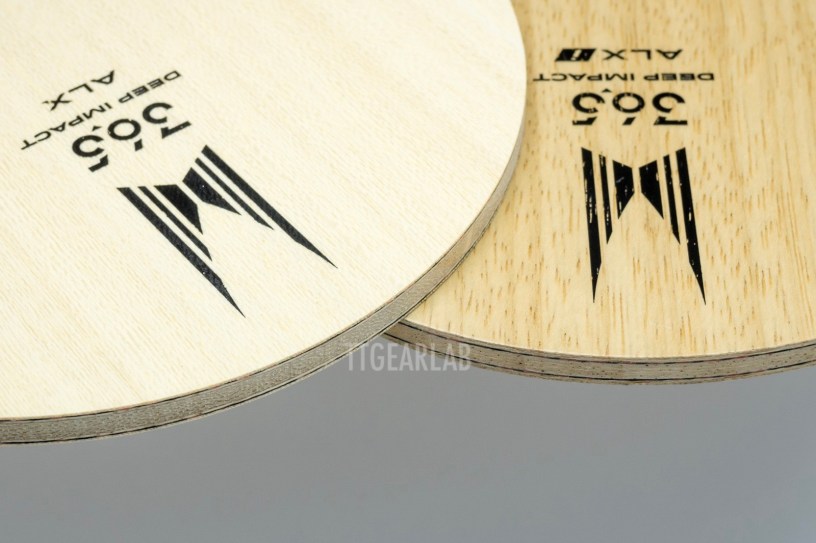
Xiom ‘36.5’ series is a product line using the special material ‘Axylium Carbon (ALX = ALC)’ and consists of ‘36.5 ALX’ with an outer-fiber consturciton and ‘36.5 ALXi’ with an inner-fiber construction. ‘Axylium’ is Xiom’s unique name for LCP fiber (= polyarylate fiber). (Because Butterfly has registered ‘Arylate’ and ‘ALC’ as trademarks, other manufacturers’ products using these names cannot be sold in the international market. Therefore, to avoid trademark issues, other manufacturers use their own names. For example Crypto Carbon or Voltema Carbon.) The Axylium (= Arylate) fiber and Carbon fiber are woven together to become ‘Axylium Carbon (ALX)’. (Generally, it is the same as the material called ALC, but there may be differences between manufacturers in terms of bundle spacing, number of fibers in the bundle, etc., so it cannot be said to be 100% the same.) ‘36.5’ means that these blade are produced using the ‘cold press’ method. Xiom explains that it preserves the natural feel of wood by manufacturing it using the special production method. The two products in the ‘36.5’ series Xiom’s core products that play very important roles as standard outer ALC and standard inner ALC blades, respectively. In this article, both of those two will be analyzed through Performance Indices and will be compared with some existing blades.
1. Overview
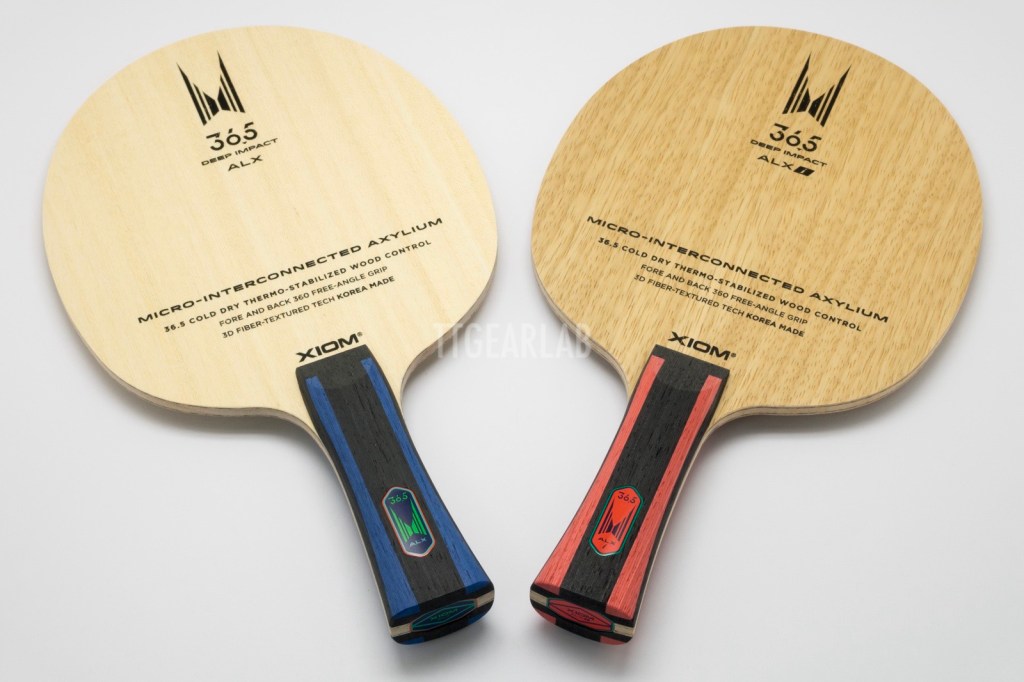
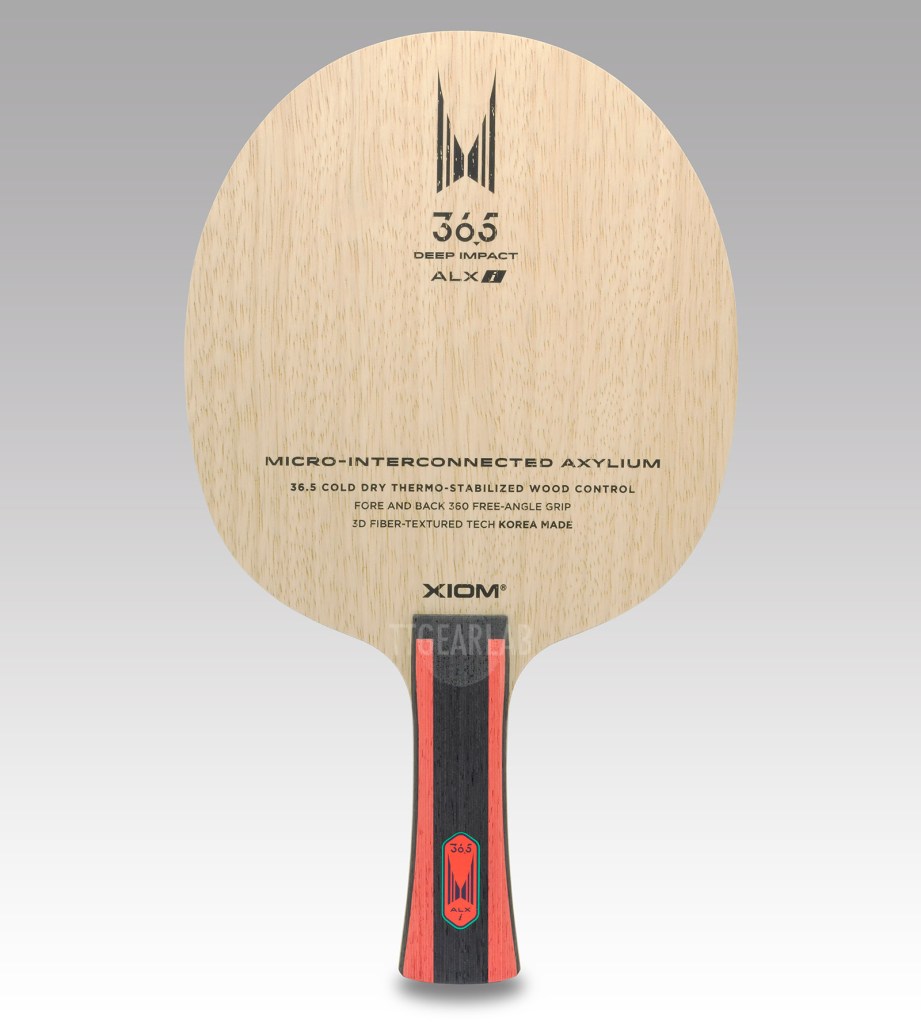
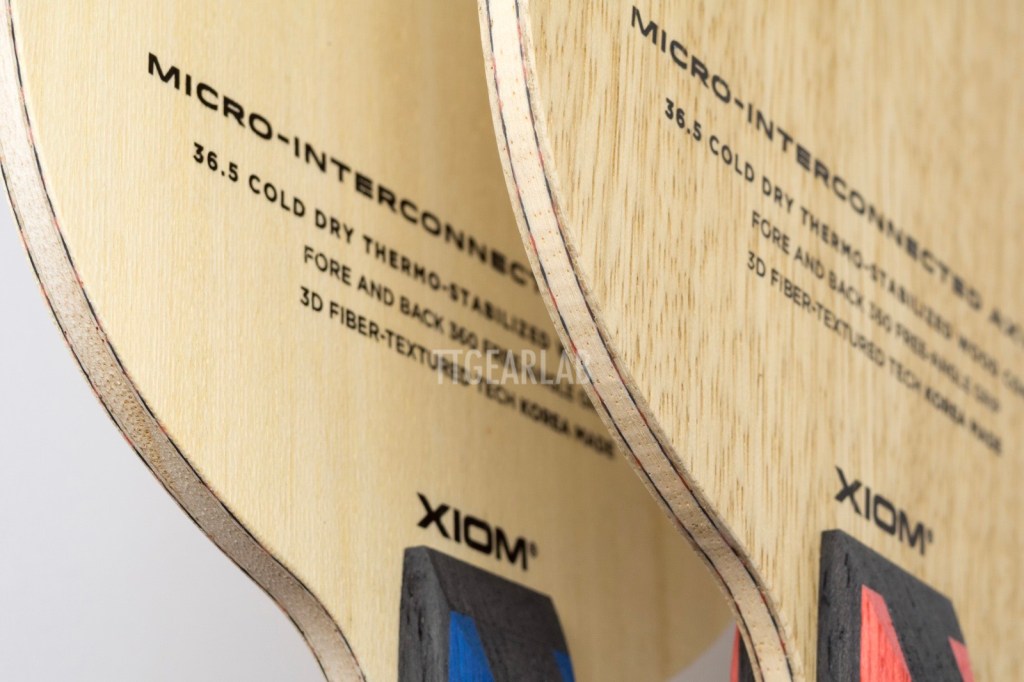
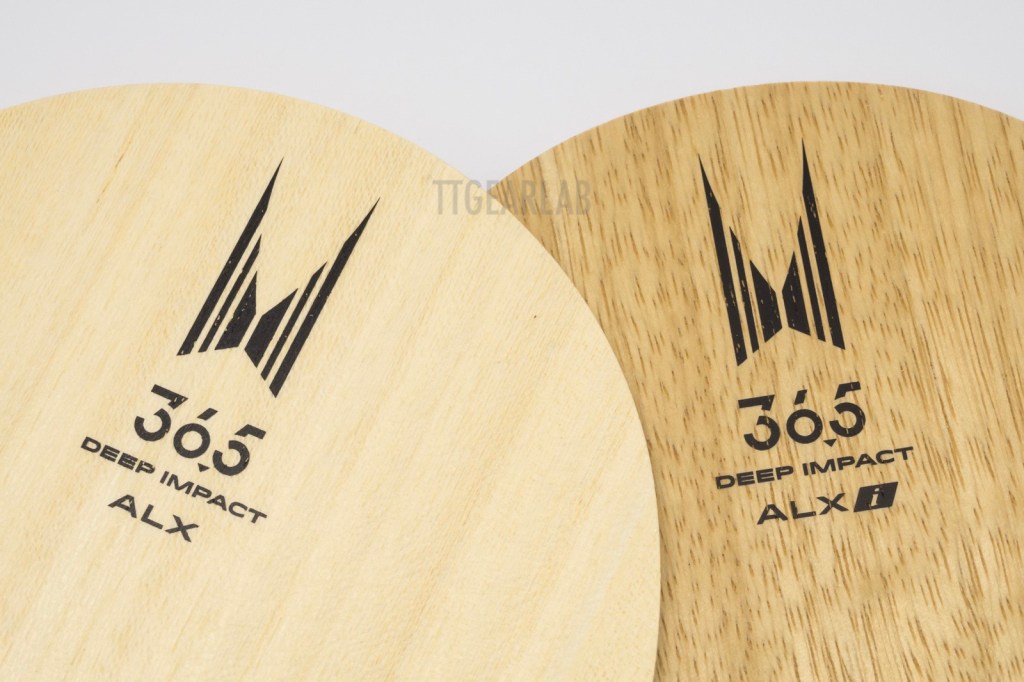
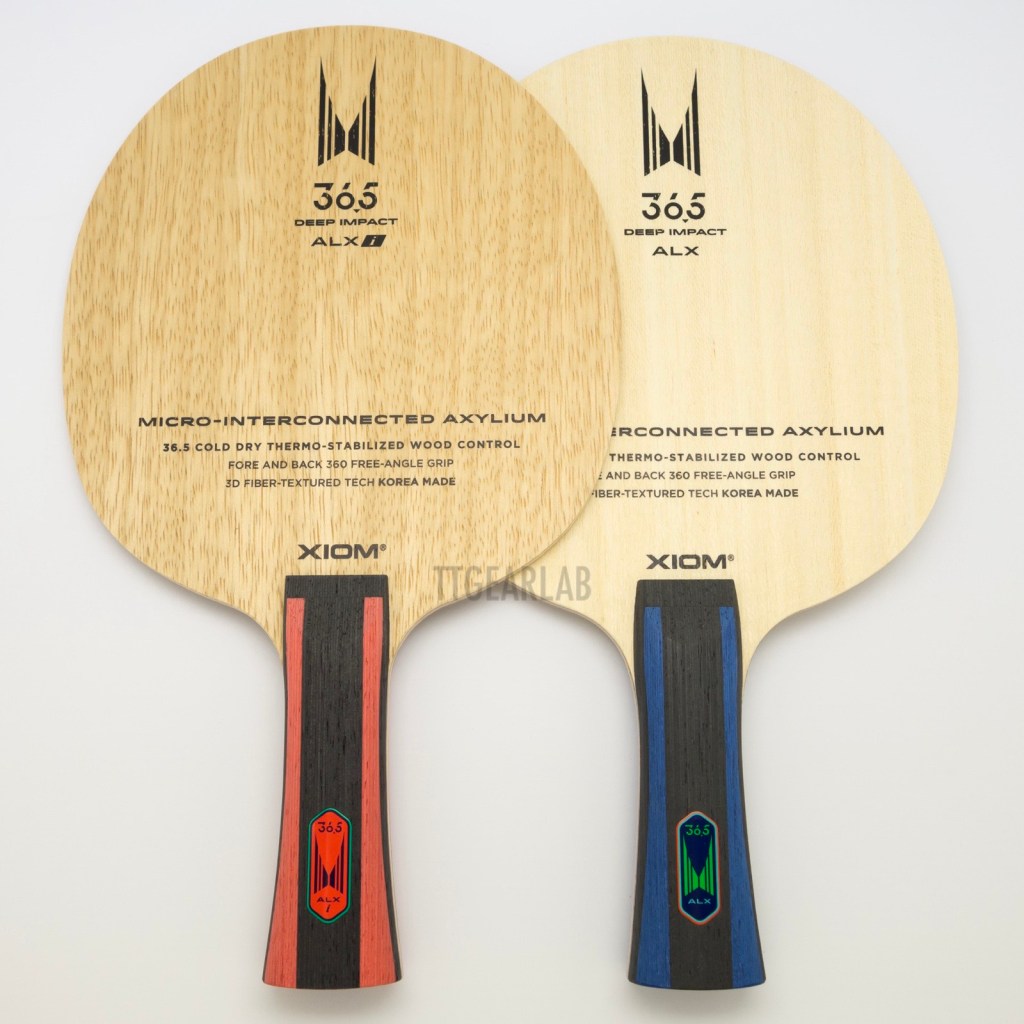
Above picture shows two models of ‘36.5’ series. Left is ‘36.5 ALX’ which is the outer fiber version, and right is ‘36.5 ALXi’ which is the inner fiber version’. The ‘i’ in the second name of Xiom blade means ‘inner-fiber construction’. And, the model which doesn’t include ‘I’ in its second name is an outer-fiber blade.
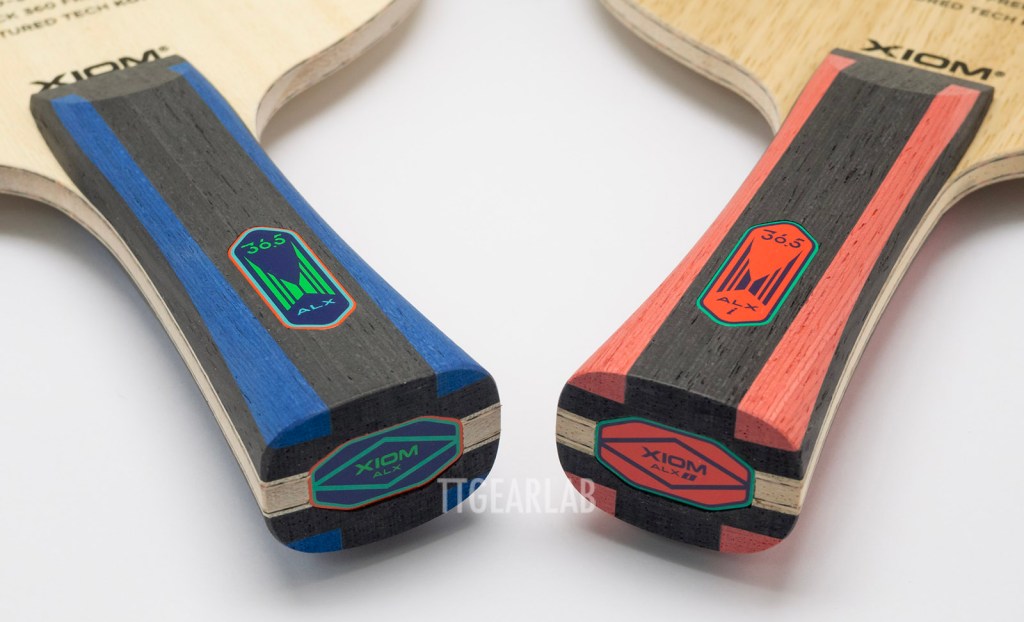
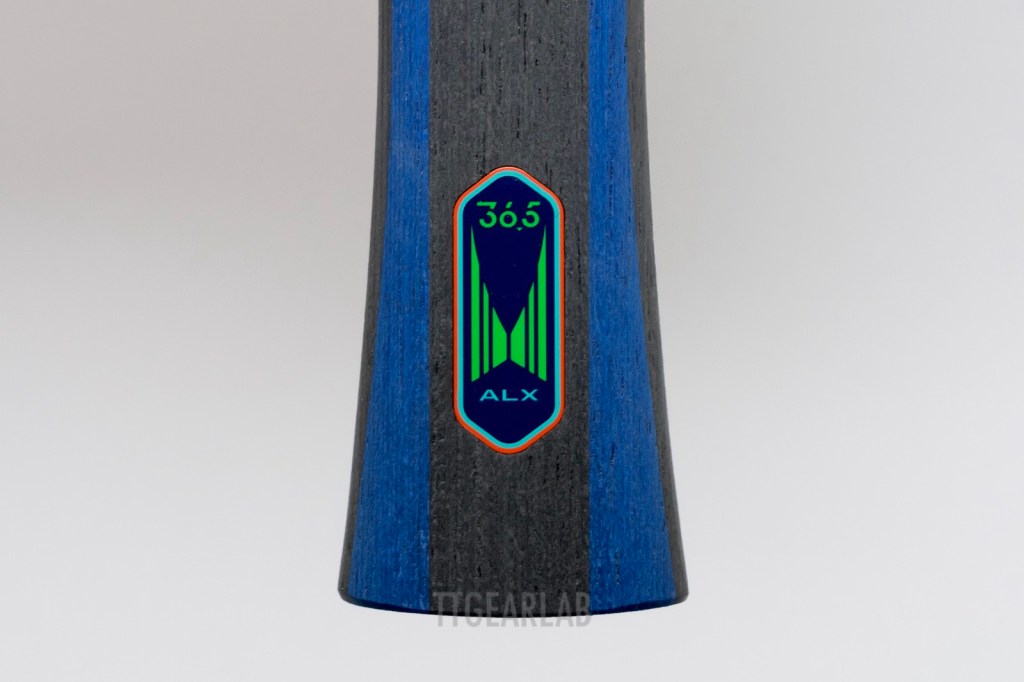
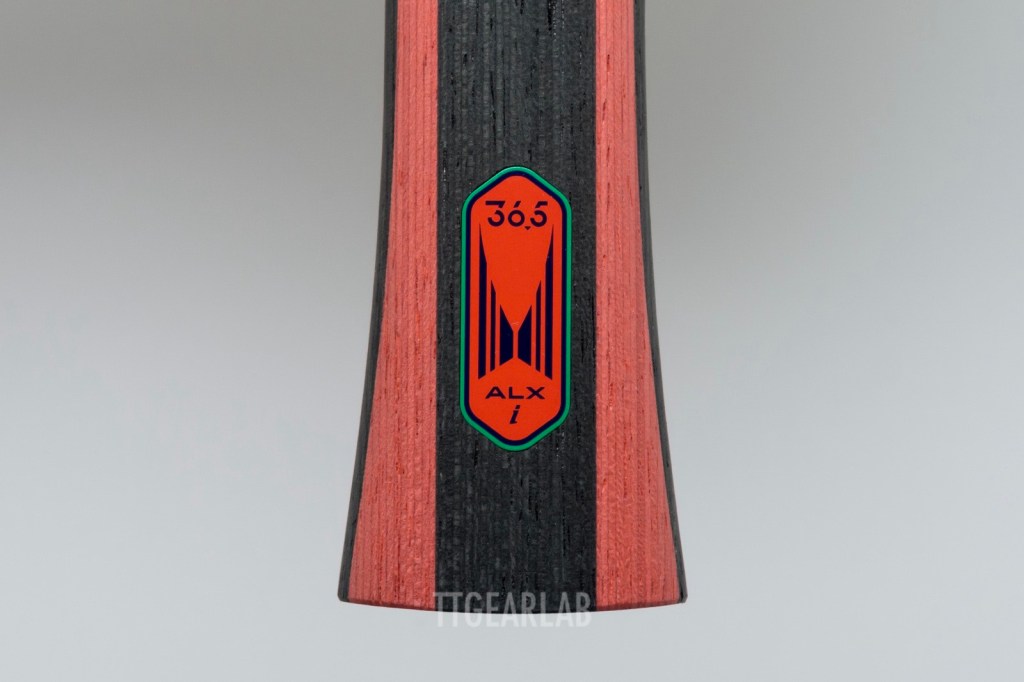
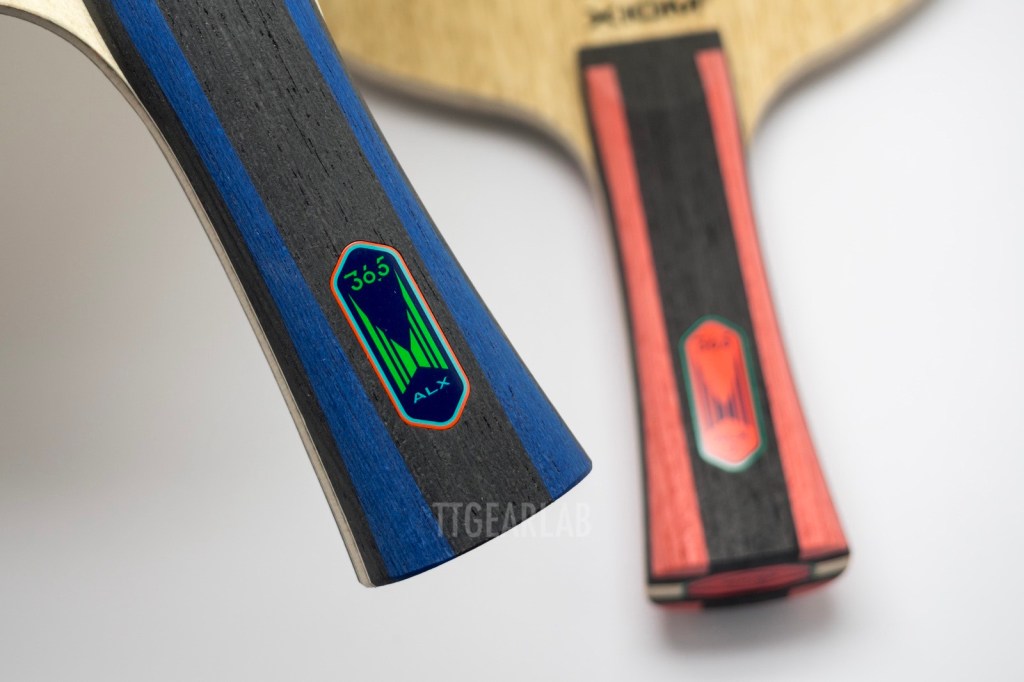
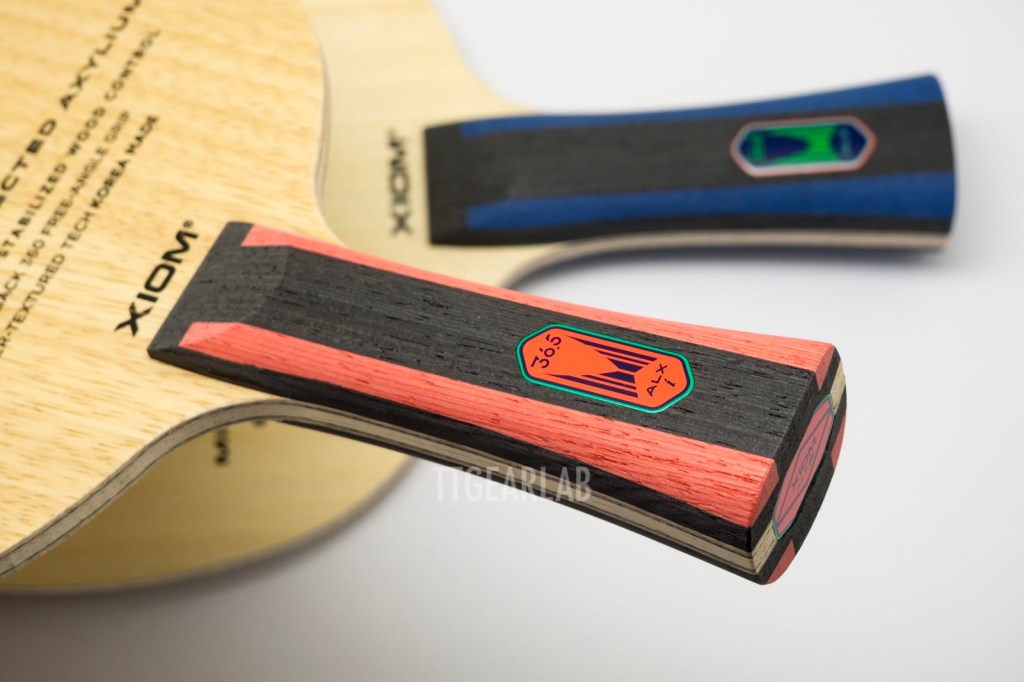
Same design concept is being applied to both models of this series. Two models can be distinguished by the difference of theme color. The theme color of ‘36.5 ALX’ which is the outer-fiber version is dark blue, and the theme color of ‘36.5 ALXi’ which is the inner-fiber version is red. Theme color is also applied to the aluminum nameplates at both sides of handle and the aluminum logo plate at the end of handle.
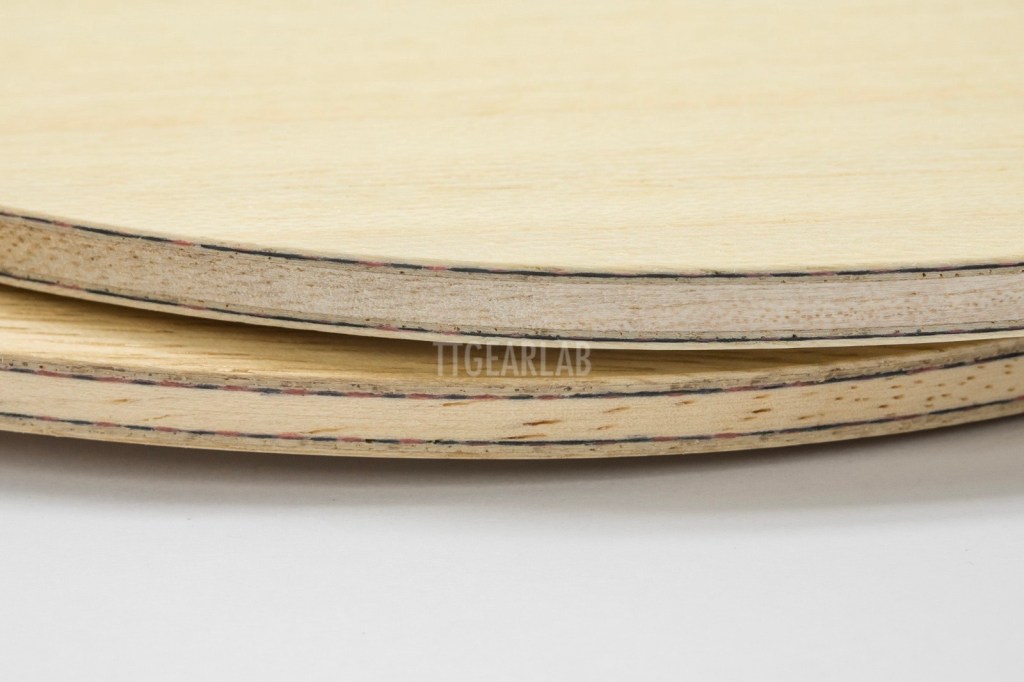
The artificial material of ‘36.5’ series is ALX (= Axylium Carbon) which is woven from Axylium fiber (= Arylate fiber) and carbon fiber. So ALX is considered as a kind of ALC. ‘36.5 ALC’ and ‘36.5 ALXi’ can be considered as Xiom’s standard outer ALC blade and inner ALC blade respectively.
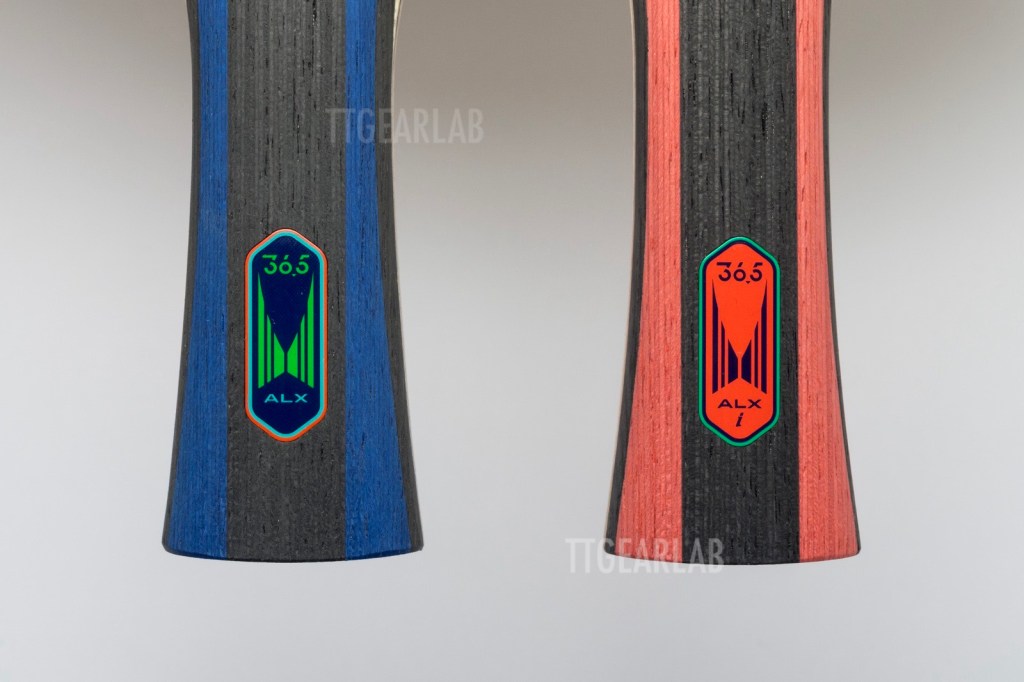
Aluminum nameplate is applied for both of foreside and backside. Therefore it is difficult to distinguish between foreside and backside at a glance.
1-1. 36.5 ALX (outer fiber version)
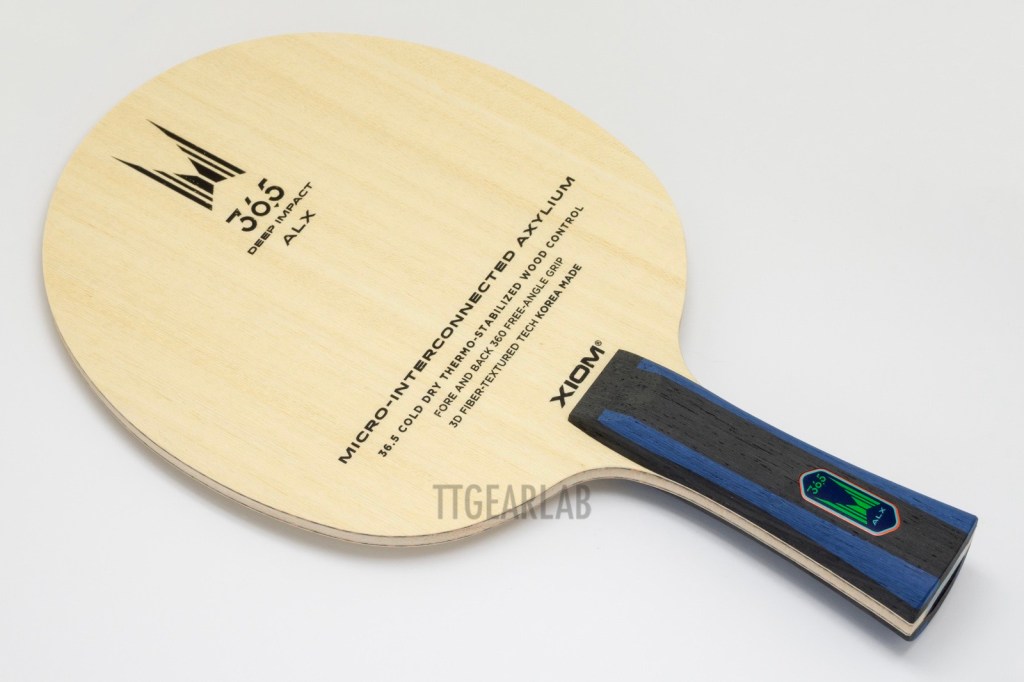
‘36.5 ALX’ is a standard outer-ALC (outer-ALX) blade in Xiom blade range, and it actually takes over the role of Xiom ‘Stradivarius’.
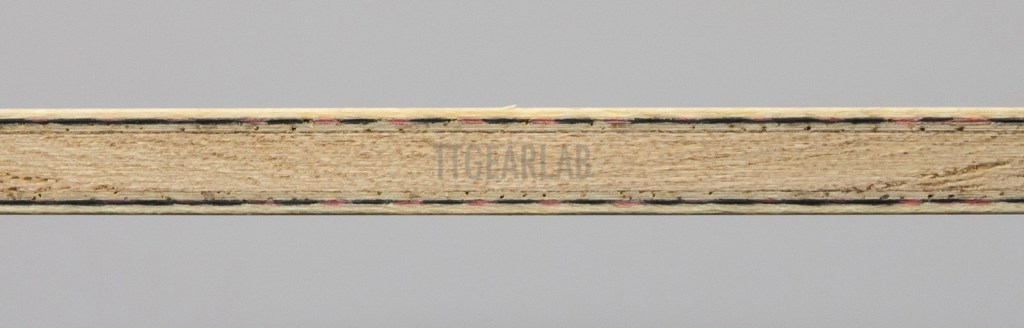
Axylium Carbon (= ALC) is placed directly under the top layer. The top layer is Koto, the middle layer is Limba and the center layer is Kiri. Overall thickness is around 5.8mm. This construction is similar to that of ‘Viscaria’ but a bit different.
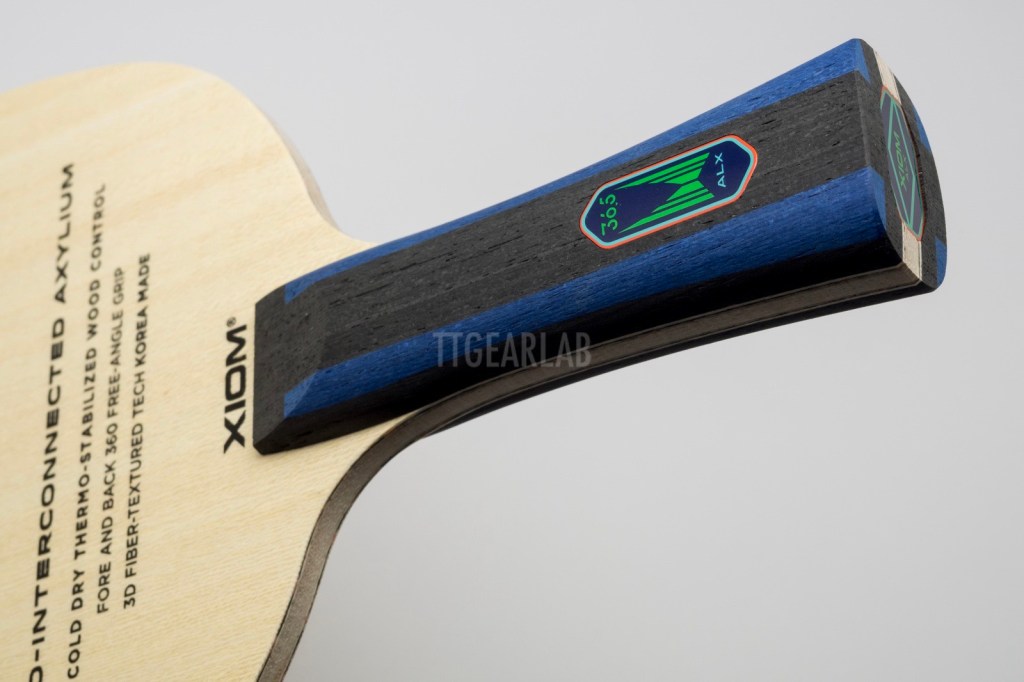
The FL (flared) handle of ‘36.5 ALX’ is similar to those of Butterfly ‘Viscaria’ and ‘Fan Zhendong’ series. Its width is around 25mm ~ 28mm (at bulge) ~ 26mm (at narrowest point) ~ 34mm (at the end). And, its thickness is around 23mm at thumb and 25mm at the end.
The ST (straight) handle whose picture isn’t shown has rounded cross section. Its width is around 28mm, and its thickness is around 23mm.
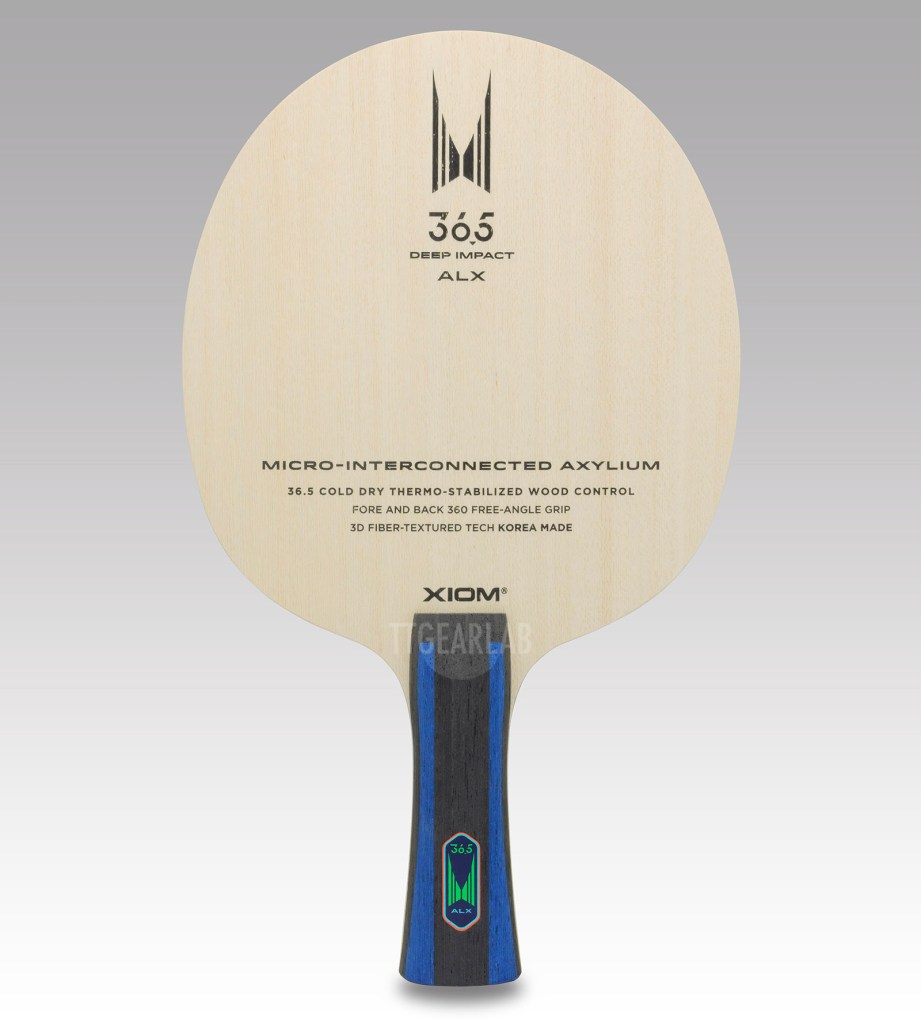
The head size of ‘36.5 ALX’ is around 157mm x 150mm. (Actually measure width is around 151mm.)
1-2. 36.5 ALXi (inner fiber version)
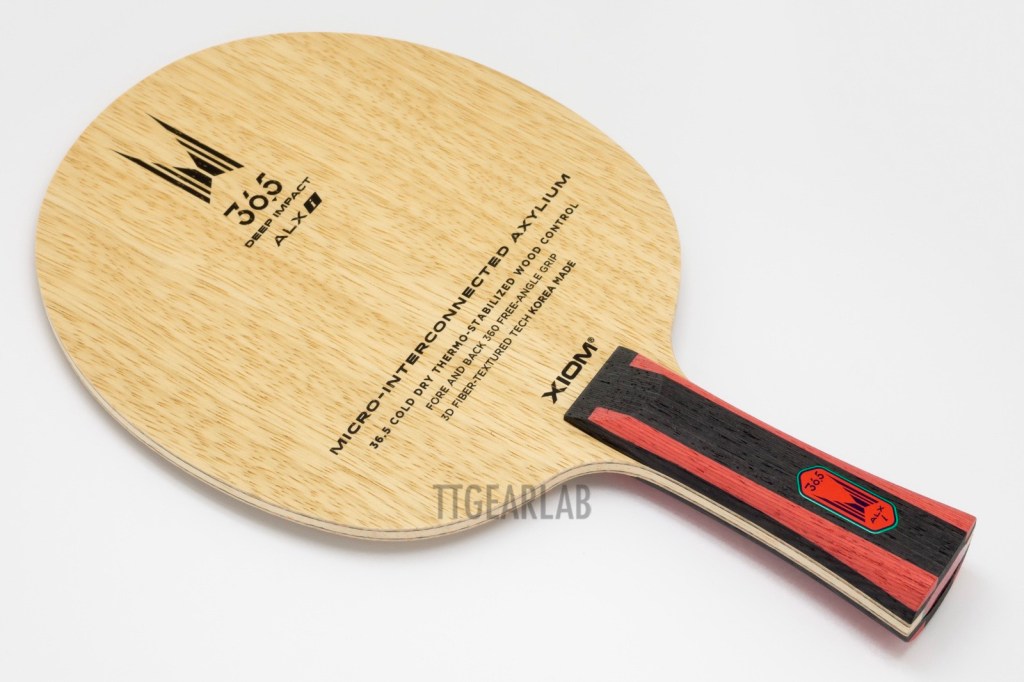
‘36.5 ALXi’ is a standard inner-ALC (inner-ALX) blade in Xiom blade range. In Xiom blade range the sign ‘i’ expresses inner-fiber version.
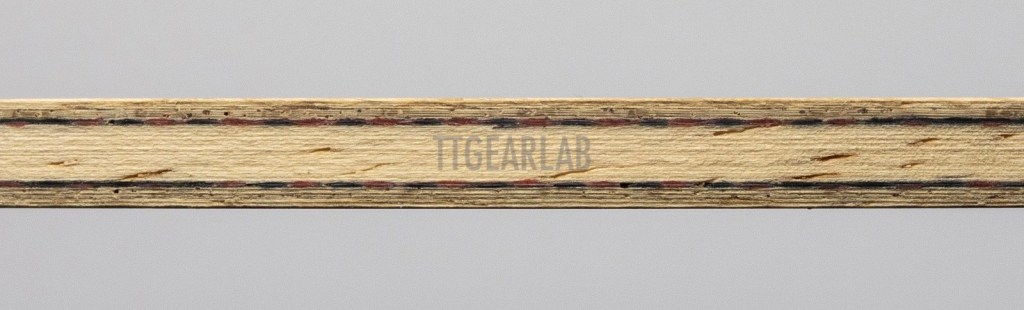
Axylium Carbon (= ALC) is placed between the middle layer and the center layer. The top layer is Limba, the middle layer is also Limba, and the center layer is also Ayous. Overall thickness is around 5.8mm. This construction is similar to that of ‘InnerForce Layer ALC’, but a bit different.
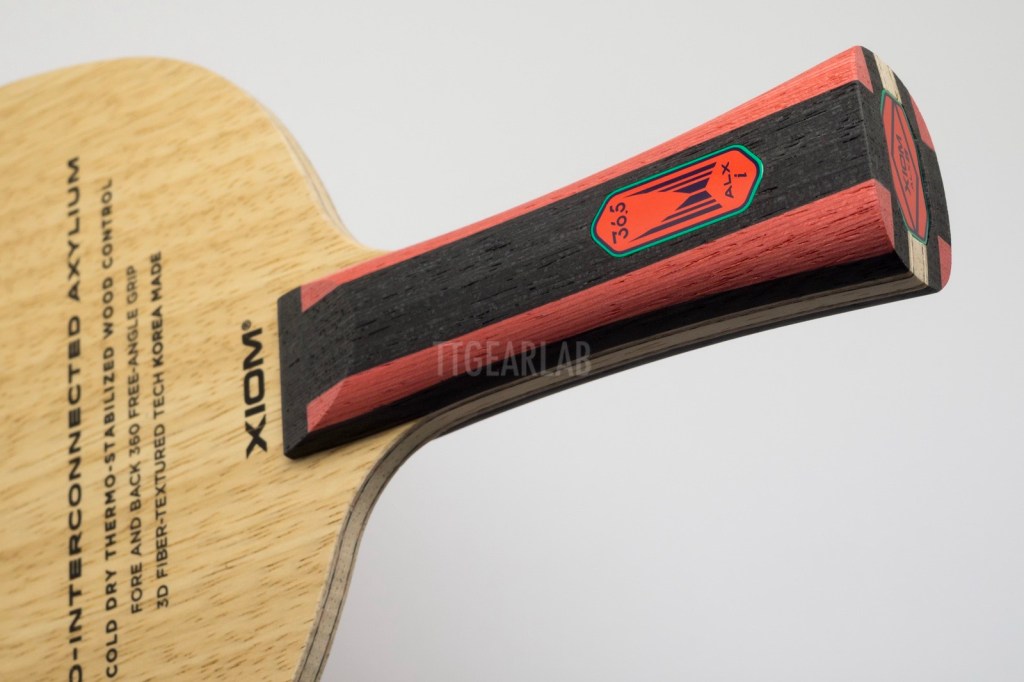
The FL (flared) handle of ‘36.5 ALXi’ is different from that of ‘36.5 ALX’ which is the outer-fiber model in the same blade family. It isn’t similar to the FL handle of Butterfly ‘Viscaria’ but to that of Butterfly ‘InnerForce’ series. Its width is around 26mm ~ 27mm (at bulge) ~ 25.6mm (at narrowest point) ~ 34mm (at the end). Its thickness is around 23.8mm at thumb and 25.5mm at the end. Another recent blade family of Xiom – ‘An Jaehyun’ series – also shows this kind of difference. The cross section of the FL handle of Xiom inner-fiber blade is narrower and taller than that of Xiom outer-fiber blade.
There isn’t any explanation about the reason why the FL for inner-fiber model is different from that for outer-fiber model in the same blade family. But, probably it is because of the comparable Butterfly blades. In general, the outer-fiber blades should compete with ‘Fan Zhendong’ series or ‘Viscaria’, while the inner-fiber models should compete with Butterfly ‘InnerForce Layer’ series.
The ST handle (not shown) of ‘36.5 ALXi’ isn’t different from that of ‘36.5 ALX’. Its width is around 28mm, and its thickness is around 23mm.
The head size is 157mm x 150mm, which is same as that of outer-fiber version – ‘36.5 ALX’.
Then let’s check the characteristics of ‘36.5 ALX’ and ‘36.5 ALXi’ by Performance Indices and then compare with some existing blades.
Please click here to return to top (table of contents)
2. Performance Indices
Performance Indices are measured objective values to represent the characteristics of table tennis gears. Concerning the detail of four performance indices, please refer to following articles in ‘About TTGearLab’ section :
- Performance indices : the way to evaluate blade by measurement
- The example of comparison by performance indices
The performance indices of ‘36.5 ALX’and ‘36.5 ALXi’ are as follows:
Xiom 36.5 ALX (average weight = 86.2g)
Ep = 1.92
Ec = 1.77 (Ec/Ep = 0.92)
Vp = 1.28
Vl = 1.39 (Vl/Vp = 1.08)
Xiom 36.5 ALXi (average weight = 87.1g)
Ep = 1.68
Ec = 1.42 (Ec/Ep = 0.85)
Vp = 1.18
Vl = 1.30 (Vl/Vp = 1.10)
‘36.5 ALX’ is the outer-fiber version of this series, and it Ep (= 1.92) is quite high. But, the Ep is lower than 2.0 which can be considered as the criteria of fast blade. And, its Ec (= 1.77) is lower than its Ep, but not significantly. The ration – Ec/Ep is 0.92 which is in the ‘Mild Hold’ range (0.9 < Ec/Ep < 1.0). It is expected that ‘36.5 ALX’ hugs the ball moderately when the player hits the ball very strongly.
Regarding Vibration Indices, the Vp of ‘36.5 ALX’ is 1.28. The Vp around 1.30 is what we can expect from standard outer ALC blade with Koto surface (for example ‘Viscaria’.). The Vl of ‘36.5 ALX’ (= 1.39) is close to those of the other standard outer ALC blades. The Vl/Vp of ‘36.5 ALX’ is moderately high (= 1.08). So, the feeling transferred to the player’s index finger is sharper than the primary feeling, but not extremely sharper.
‘36.5 ALXi’ is the inner-fiber version of this series. Its Ep (= 1.68) is what we can expect from standard inner-ALC blade whose thickness is around 5.8mm. Its Ec (= 1.42) is much lower than its Ep, and as a result its Ec/Ep (= 0.85) is under 0.9. It is expected that ‘36.5 ALXi’ holds ball very deeply when the player hits the ball very strongly.
Regarding Vibration Indices, the Vp of ‘36.5 ALXi’ is 1.18. It is the value that can be expected from the blade with standard inner-ALC construction. Because it is much lower than the Vp of ‘36.5 ALX’, ‘36.5 ALXi’ is much softer than ‘36.5 ALX’ in primary feeling. The Vl of ‘36.5 ALXi’ (= 1.30) is quite high as the value of inner-ALC blade, but not as high as that of the outer fiber version – ‘36.5 ALX’. The Vl/Vp of ‘36.5 ALXi’ is moderately high (= 1.10). So, the feeling transferred to the player’s index finger is sharper than the primary feeling, but not extremely sharper.
Although its Ep is somewhat lower, ‘36.5 ALX’ shows the characteristics we can expect from standard outer-ALC blade with Koto top layer. And, ‘36.5 ALXi’ also shows the characteristics we can expect from standard inner-ALC blade with Limba top layer. It is expected that ‘36.5 ALX’ fits for more aggressive offensive style and ‘36.5 ALXi’ fits for the offensive styles those lays emphasis on safety and stability. The characteristics of ‘36.5 ALX’ and ‘36.5 ALXi’ will be compared by graphs with those of some known blades in next chapter.
Please click here to return to top (table of contents)
3. Comparison by Performance Indices
Then we can compare ‘36.5 ALX’ and ‘36.5 ALXi’ with some other blades. For the comparison some well-known outer-fiber blades and inner-fiber blades have been selected. From this article, the explanation will be shown as more summarized form.
Following is the list of the blades to be compared :
Outer ALC blades with Koto top layer
- Butterfly ‘Viscaria’ (avg. weight = 87.1g) : Reference of all outer ALC blade. Current version.
- DHS ‘506X’ (avg. weight = 85.2g) : Outer ALC blade of DHS.
- Tibhar ‘MK Carbon’ (avg. weight = 85.4g) : The blade of Kenta Matsudaira.
- KTS ‘Fury KC’ (avg. weight = 89.0g) : ‘Viscaria type’ blade with a bit different characteristics
Other Outer Fiber blades
- Victas ZX-Gear Out (avg. weight = 87.1g) : Limba top layer + Zxion Carbon. Center layer is harder than ordinary outer fiber blades.
- Nittaku Acoustic Carbon (avg. weight = 90.8g) : Limba top layer + FE Carbon.
- Xiom An Jaehyun TMX (avg. weight = 87.0g) : Koto top layer + Trimetrix (Carbon + Zylon + Arylate)
Inner ALC blades with Limba top layer
- Butterfly ‘InnerForce Layer ALC’ (avg. weight = 91.2g) : The standard of inner-ALC blades. Current version measured in 2023. Thicker and more elastic than former ones measured in 2018.
- DHS ‘Hurricane Long 5’ (avg. weight = 88.1g) : Current representative of inner-ALC blades. 2022 version.
- KTS ‘Core ALC’ (avg. weight = 89.9g) : The top model of KTS (Kim Taek Soo). Standard inner-ALC construction.
- Victas ‘ZX-Gear In’ (avg. weight = 88.0g) : Fiber is Zxion Carbon which is a bit different from Vectran Carbon (ALC of Butterfly).
Other Inner Fiber blades
- DHS ‘Hurricane 301Z’ (avg. weight = 88.2) : Koto top layer + reinforced ALC. Center layer is softer than ordinary inner fiber blades.
- Yasaka ‘Ma Lin Carbon’ (avg. weight = 88.6g) : Limba top layer + fleece carbon.
- Tibhar ‘Stratus Samsonov Carbon’ (avg. weight = 88.7g) : Limba top layer + Aramid Carbon. Center layer is softer than ordinary inner fiber baldes.
5-ply Wood
- Butterfly ‘Korbel’ (avg. weight = 88.7g) : The standard of 5-ply wood offensive blades
3-1. Elasticity Indices
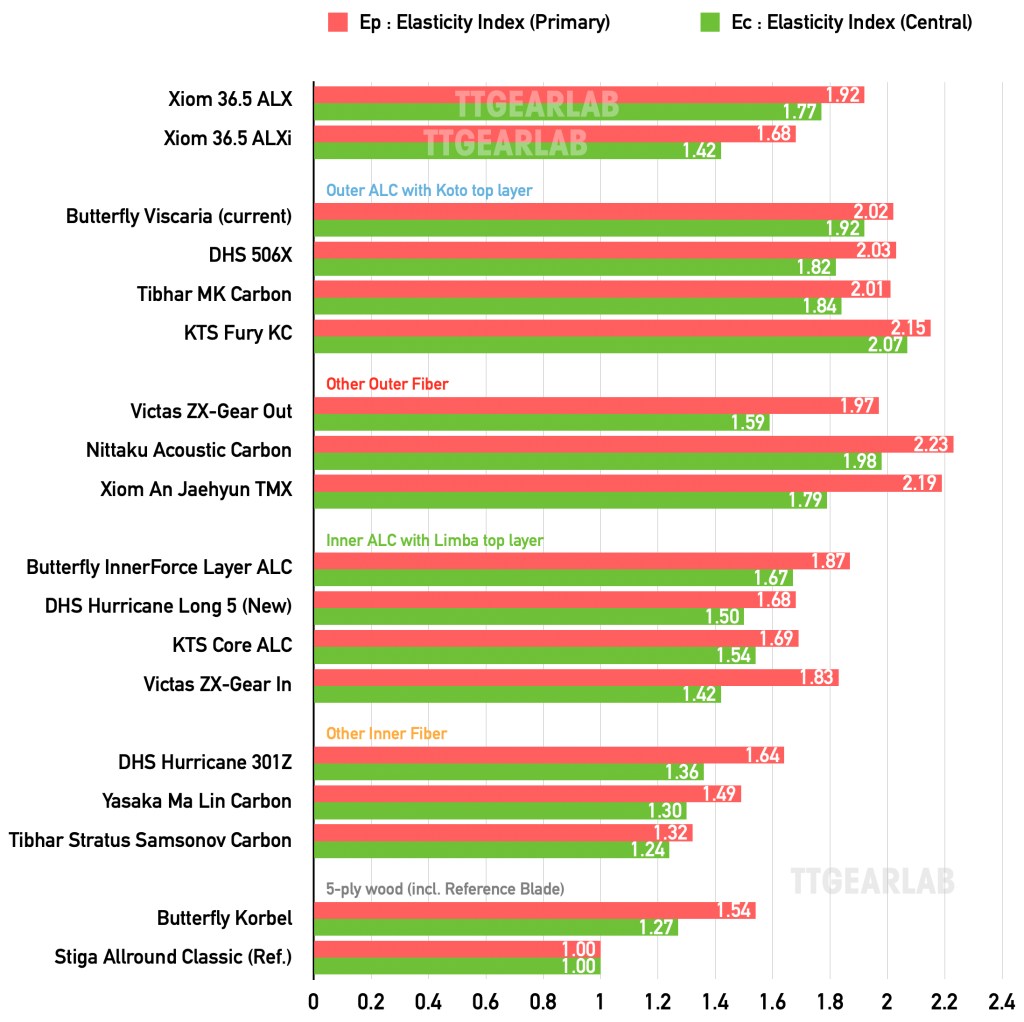
Fig.17 shows the comparison graph of Elasticity Indices.
Ep (Primary Elasticity Index) is directly concerned with the rebound speed of blade. Ec (Central Elasticity Index) is concerned with additional ‘kick’ when player hits ball very strongly.
[Outer ALC with Koto top layer]
‘36.5 ALX’ is an outer ALC blade with typical ‘Viscaria’ type construction whose top layer is Koto. Therefore, the blades of this group can be directly compared with ‘36.5 ALX’. The result of comparison can be summarized as follows :
- ‘36.5 ALX’ is somewhat less elastic than all blades in this group.
- The Ep of ‘36.5 ALX’ is noticeably lower than those of other blades in this group. On the contrary, the Ec of ‘36.5 ALX’ is not much different from those of ‘506X’ and ‘MK Carbon’. But, it is much less than those of ‘Viscaria’ and ‘Fury KC’.
- Although ‘36.5 ALX’ is very similar to ‘Viscaria’ in many aspects, it is noticeably different from ‘Viscaria. ‘36.5 ALX’ is slower than ‘Viscaria’. But instead, it is expected that ‘36.5 ALX’ will provide more controllability than ‘Viscaria’.
[Other Outer Fiber]
We can also compare various types of outer fiber blades with ‘36.5 ALX’. The result of comparison can be summarized as follows :
- ‘ZX-Gear Out’ is a bit more elastic than ‘36.5 ALX’ in primary elasticity. But, in central elasticity, ‘ZX-Gear Out’ is significantly less elastic than ‘36.5 ALX’.
- ‘Acoustic Carbon’ is noticeably more elastic than ‘36.5 ALX’.
- ‘An Jaehyun TMX’ is much more elastic in primary elasticity. But, in central elasticity, there isn’t meaningful difference between ‘36.5 ALX’ and ‘An Jaehyun TMX’.
[Inner ALC with Limba top layer]
‘36.5 ALXi’ is a typical inner ALC blade with Limba top layer. Therefore, the blades of this group can be directly compared with ‘36.5 ALXi’. The result of comparison can be summarized as follows :
- ‘36.5 ALXi’ looks similar to ‘InnerForce Layer ALC’ in construction. But, it is much less elastic than current version of ‘Inner Force Layer ALC’. That is just because current ‘InnerForce Layer ALC’ is more elastic than older version which can be still considered as the standard of inner ALC blade with Limba top layer.
- ‘36.5 ALXi’ is as elastic as ‘Hurricane Long 5’ (current version) and ‘Core ALC’ in primary elasticity. So we can understand that it is also a kind of ‘standard’ inner ALC blade. But, the Ec of ‘36.5 ALXi’ is noticeably lower than those of ‘Hurricane Long 5’ (current version) and ‘Core ALC’. It means that ‘36.5 ALXi’ hugs the ball deeper than other inner ALC blades when the player hits the ball very strongly.
- ‘36.5 ALXi’ is much less elastic than ‘ZX-Gear In’ in primary elasticity. But, it is as elastic as ‘ZX-Gear In’ in central elasticity.
[Other Inner Fiber]
We can also compare various types of inner fiber blades with ‘36.5 ALXi’. The result of comparison can be summarized as follows :
- ‘301Z’ is a bit less elastic than ‘36.5 ALXi’. But, the difference is small. And, the graph shape of ‘301Z’ looks similar to that of ‘36.5 ALXi’. Although the constructions of those two blades are different from each other, it is expected that those two blades will provide very similar playing characteristics.
- ‘36.5 ALXi’ is much more elastic than ‘Ma Lin Carbon’ and ‘Stratus Samsonov Carbon’.
[5-ply wood]
We can also compare ‘36.5 ALX’ and ‘36.5 ALXi’ with ‘Korbel’ which is the representative of 5-ply wood offensive blade.
- ‘Korbel’ is less elastic than ‘36.5 ALXi. And, the graph shape of ‘Korbel’ looks similar to that of ‘36.5 ALXi’.
- The graph shape of ‘Korbel’ looks different from that of ‘36.5 ALX’.
Examining Ec/Ep is also a easier way to understand the characteristics of blade concerned with elasticity. Fig.18 shows the relationship between Ec/Ep and Ep.
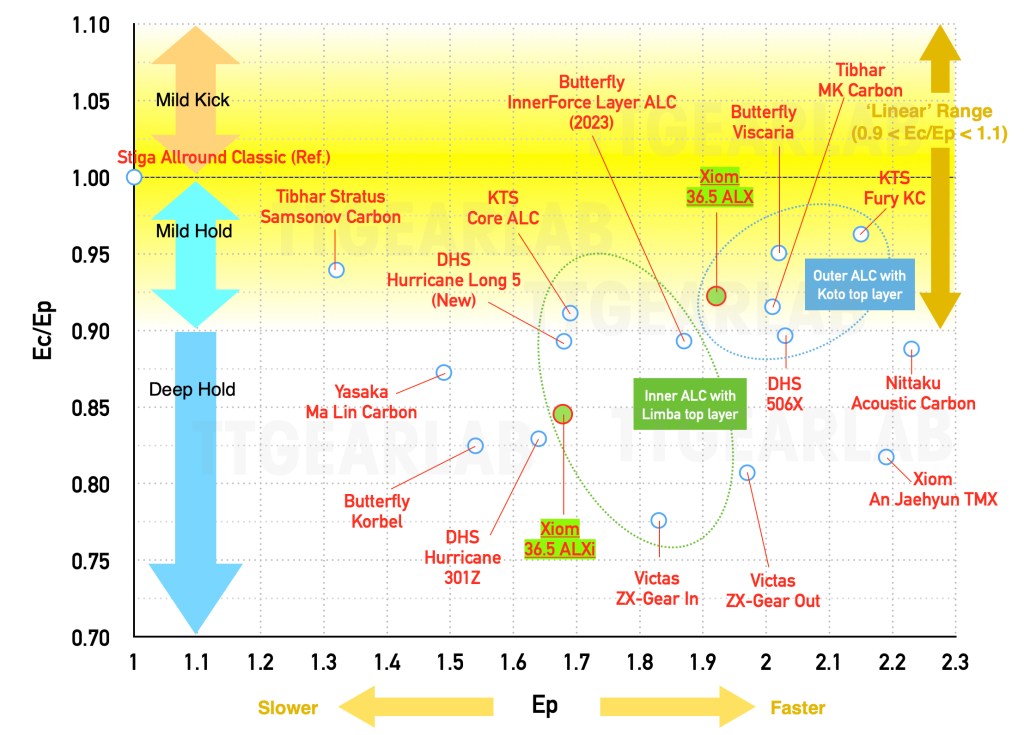
Ec/Ep expresses the ‘tendency’ of the elasticity of blade. By examining Ec/Ep and Ep at the same time, we can easily understand the behavior of blades.
On the graph, all blades in this comparison (except for reference blade whose Ec/Ep = 1.00) are in ‘Hold’ range (Ec/Ep < 1.0). But, the blades are widely distributed up, down, left and right within that range. The result of the comparison can be summarized as follows :
[‘36.5 ALX’ in ‘Outer ALC with Koto top layer’ group]
- ‘Outer ALC with Koto top layer’ group including ‘36.5 ALX’ is placed to upper right of ‘Inner ALC with Limba top layer’ group including ‘36.5 ALXi’. It means that the outer ALC blades with Koto top layer are more elastic and give more kick than the inner ALC blades with Limba top layer. (Regarding the features of hold/kick, there are some exceptions.) ‘36.5 ALX’ is faster than ‘36.5 ALXi’, and gives more kick when the player hits the ball very strongly.
- ‘36.5 ALX’ is in ‘Mild Hold’ range. And, most of outer ALC blades with Koto top layer in this comparison are also in that range. It means that those blades moderately hug the ball when the player hits the ball very strongly.
- In ‘Outer ALC with Koto top layer’ group, ‘36.5 ALX’ is located at the left end of the group. It means that ‘36.5 ALX’ is slower than the other blades in the group.
- The location of ‘36.5 ALX’ is closer to that of ‘InnerForce Layer ALC’ which is an inner ALC blade with Limba top layer. Because ‘36.5 ALX’ is close to ‘Inner ALC with Limba top layer’ group, the players will be able to select ‘36.5 ALX’ in case they want to change their blade from inner ALC blade to outer ALC blade but want to minimize the increase of elasticity.
- ‘36.5 ALX’ will be less powerful than ‘Viscaria’. But, it will be able to be a good entry blade for the players who want to start using the blade of ‘Viscaria’ type.
[‘36.5 ALXi’ in ‘Inner ALC with Limba top layer’ group]
- Inner ALC with Limba top layer’ group including ‘36.5 ALXi’ is placed to lower left of ‘Outer ALC with Koto top layer’ group including ‘365 ALX’. It means that the inner ALC blades with Limba top layer are less elastic and give more ability of hugging the ball than the outer ALC blades with Koto top layer. (Regarding the features of hold/kick, there are some exceptions.) ‘36.5 ALXi’ is slower than ‘36.5 ALX’, and hugs the ball more deeply when the player hits the ball very strongly.
- ‘36.5 ALXi’ is in ‘Deep Hold’ range. And, most of inner ALC blades with Limba top layer in this comparison are also in that range. It means that those blades hugs the ball very deeply when the player hits the ball very strongly.
- In ‘Inner ALC with Limba top layer’ group, ‘36.5 ALXi’ is located at the left end of the group. It means that ‘36.5 ALXi’ is slower than the other blades in the group.
- ‘36.5 ALXi’ hugs the ball even more deeply than ‘Hurricane Long 5’ and ‘Core ALC’ when the player hits the ball very strongly. Therefore, the player may feel that ‘36.5 ALXi’ is slower than other inner ALC blades. But instead, it is expected that ‘36.5 ALXi’ will provide higher safety for aggressive offensive play.
- ‘36.5 ALXi’ is located very close to ‘301Z’. Both of ‘301Z’ and ‘36.5 ALXi’ are expected to provide very good stability for aggressive topspin that aims that the rising of ball.
- ‘36.5 ALXi’ is close to ‘Korbel’, and its ‘Ec/Ep is also close to that of ‘Korbel’. So it is expected that ‘36.5 ALXi’ can be good replacement of 5-ply wood offensive blade such as ‘Korbel’ in case the player want to increase speed of ball by just one step.
Then next, let’s compare Vibration Indices.
Please click here to return to top (table of contents)
3-2. Vibration Indices
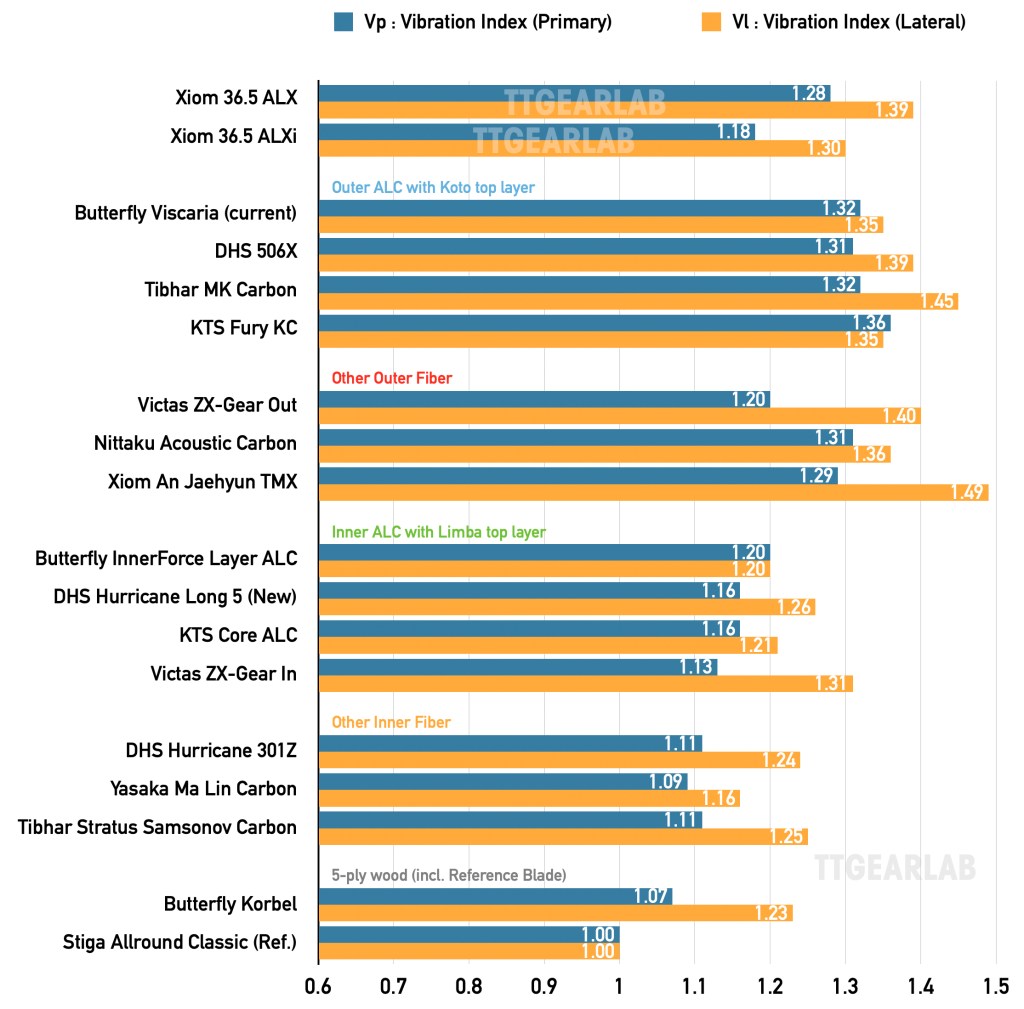
Fig.19 shows the comparison graph of Vibration Indices. Vibration Indices are concerned with feeling. Vp indicates primary feeling which is transferred to player’s palm. And, Vl is the feeling at the edge of the wing – the lower side of blade head. It is felt by player’s index finger or middle finger.
[Outer ALC with Koto top layer]
‘36.5 ALX’ is an outer ALC blade with typical ‘Viscaria’ type construction whose top layer is Koto. Therefore, the blades of this group can be directly compared with ‘36.5 ALX’. The result of comparison can be summarized as follows :
- ‘36.5 ALX’ shows higher Vp and lower Vl when compared with ‘Viscaria’. Although it is a blade whose construction is very similar to that of ‘Viscaria’, its feeling is significant different from that of ‘Viscaria’. ‘36.5 ALX’ is softer than ‘Viscaria’ in primary feeling. But, ‘36.5 ALX’ transmits sharper feeling to the index finger when compared with ‘Viscaria’. That difference will be much more noticeable when we observe relative values – Vl/Vp’s – in next section, because the graph shape of ‘36.5 ALX’ is much different from that of ‘Viscaria’.
- ‘506X’ is a bit harder than ‘36.5 ALX’ in primary feeling. But, its Vl is same as that of ‘36.5 ALX’.
- The overall feeling of ‘MK Carbon’ is harder than that of ‘36.5 ALX’. But, the graph shape of ‘MK Carbon’ is similar to that of ‘36.5 ALX’.
- The feeling of ‘Fury KC’ is totally different from that of ‘36.5 ALX’. Its Vp is noticeably higher and its Vl is somewhat lower than those of ‘36.5 ALX’ respectively.
[Other Outer Fiber]
We can also compare various types of outer fiber blades with ‘36.5 ALX’. The result of comparison can be summarized as follows :
- The Vp of ‘ZX-Gear Out’ is noticeably lower than that of ‘36.5 ALX’, but its Vl is very close to the Vl of ‘36.5 ALX’. In actual use the players will feel that ‘ZX-Gear Out’ is much sharper because its primary feeling is much softer.
- ‘Acoustic Carbon’ is a bit harder than ‘36.5 ALX’ in primary feeling, but a bit softer in lateral feeling.
- The primary feeling of ‘An Jaehyun TMX’ isn’t meaningfully different from that of ‘36.5 ALX’. However, its lateral feeling is much sharper than that of ‘36.5 ALX’. Probably that is because of the similarity of vertical fibers and the difference in lateral fibers.
[Inner ALC with Limba top layer]
‘36.5 ALXi’ is a typical inner ALC blade with Limba top layer. Therefore, the blades of this group can be directly compared with ‘36.5 ALXi’. The result of comparison can be summarized as follows :
- ‘36.5 ALXi’ looks similar to ‘InnerForce Layer ALC’ in construction. But, its graph shape is much different from that of ‘InnerForce Layer ALC’. There isn’t significant difference in Vp, but the Vl of ‘36.5 ALXi’ is much higher than that of ‘InnerForce Layer ALC’. Although ‘36.5 ALXi’ is a bit softer than ‘InnerForce Layer ALC’ in primary feeling, players will feel that it is harder or sharper than ‘InnerForce Layer ALC’ because in many cases players first feel Vl or Vl/Vp rather than Vp.
- ‘Hurricane Long 5’ is a bit softer than ‘36.5 ALXi’, but the difference isn’t significant.
- ‘Core ALC’ is a bit softer than ‘36.5 ALXi’ in primary feeling while it is much softer in lateral feeling.
- ‘ZX-Gear In’ is somewhat softer than ‘36.5 ALXi’ in primary feeling, but its lateral feeling isn’t meaningfully different from that of ‘36.5 ALXi’.
[Other Inner Fiber]
We can also compare various types of inner fiber blades with ‘36.5 ALXi’. The result of comparison can be summarized as follows :
- ‘301Z’ and ‘Stratus Samsonov Carbon’ are softer than ‘36.5 ALXi’. But, the graph shapes of those two blades look similar to that of ‘36.5 ALXi’.
- ‘Ma Lin Carbon’ is even softer than ‘301Z’ and ‘Stratus Samsonov Carbon’. And, its vibration characteristics are significantly different from those of ‘36.5 ALXi’.
[5-ply wood]
We can also compare ‘36.5 ALX’ and ‘36.5 ALXi’ with ‘Korbel’ which is the representative of 5-ply wood offensive blade.
- ‘Korbel’ is softer than ‘36.5 ALXi’, and it is even softer than ‘301Z’ and ‘Stratus Samsonov Carbon’. But, the difference aren’t that significant. It is expected that the players who have used ‘Korbel’ will easily adapts to ‘36.5 ALXi’, ‘301Z’ and ‘Stratus Samsonov Carbon’.
Examining Vl/Vp is easier way for the comparison of the tendency of feeling. Fig.20 shows the relationship between Vl/Vp and Vp for easier comparison.
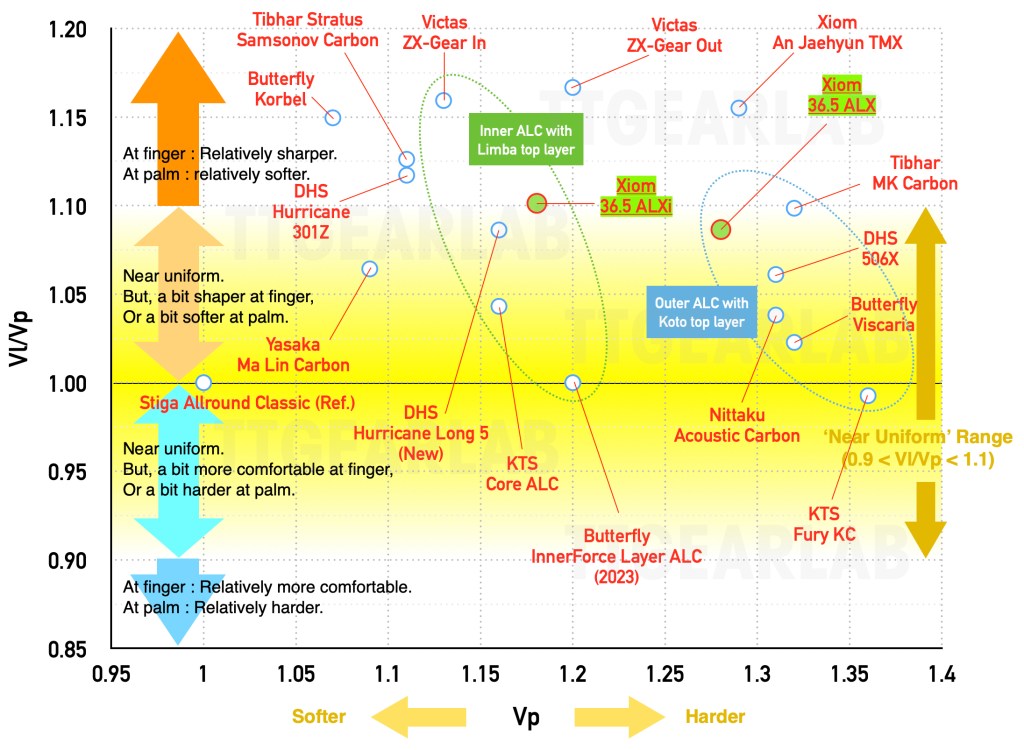
On the graph, most of blade in this comparison are placed in upper part of the graph – ‘Relatively sharper at finger’ range. And, one is in lower part – ‘Relatively more comfortable at finger’, and two including reference blade are on ‘Uniform’ line.
[‘36.5 ALX’ in ‘Outer ALC with Koto top layer’ group]
- ‘Outer ALC with Koto top layer’ group including ‘36.5 ALX’ is placed to right of ‘Inner ALC with Limba top layer’ group including ‘36.5 ALXi’. It means that the outer ALC blades with Koto top layer are harder than the inner ALC blades with Limba top layer.
- ‘36.5 ALX’ is located in the upper left corner of the group. The Vp of ‘36.5 ALX’ is smaller than 1.3 while the Vp’s of all other blades in the group are bigger than 1.3. It means that ‘36.5 ALX’ is softer than the other blades in the group. But, its relative feeling transmitted to index finger is sharper than those of other blades except for ‘MK Carbon’. So we can summarize the characteristics of ‘36.5 ALX’ when compared with other ‘Viscaria type’ blades as ‘softer and sharper feeling’.
- Although ‘36.5 ALX’ gives sharper feeling than the other blades in the group, its Vl/Vp is still in ‘Near Uniform’ range. It means that the feeling transferred to index finger is just ‘moderately’ sharper than the primary feeling. Outside the group, there are the outer fiber blades whose Vl/Vp’s are much higher than that of ‘36.5 ALX’, such as ‘ZX-Gear Out’ and ‘An Jaehyun TMX’.
[‘36.5 ALXi’ in ‘Inner ALC with Limba top layer’ group]
- Inner ALC with Limba top layer’ group including ‘36.5 ALXi’ is placed to left of ‘Outer ALC with Koto top layer’ group including ‘36.5 ALX’. It means that the inner ALC blades with Limba top layer are softer than the outer ALC blades with Koto top layer.
- In primary feeling, ‘36.5 ALXi’ is softer than ‘InnerForce Layer ALC’, but is harder than ‘Hurricane Long 5’ and ‘Core ALC’.
- The Vl/Vp of ‘36.5 ALXi’ is higher than those of ‘Hurricane Long 5’, ‘Core ALC’ and ‘InnerForce Layer ALC’. It means that ‘36.5 ALXi’ transmits sharper relative feeling than the other blades in this group except for ‘ZX-Gear In’. ‘ZX-Gear In’ shows much higher Vl/Vp than ‘36.5 ALXi’ while its Vp is noticeably smaller than that of ‘36.5 ALXi’.
- ‘Hurricane Long 5’ is located very close to ‘36.5 ALXi’. It means that there isn’t much difference between the feelings of those two blades.
- The three inner fiber blades outside this group are softer than the blades in this group. Among those three ‘Stratus Samsonov Carbon’ and ‘Hurricane 301Z’ show a bit higher values of Vl/Vp when compared with ‘36.5 ALXi’. Although their lateral feeling itself of those two is softer than that of ‘36.5 ALXi’, some players will feel that those two transmits sharper feeling than ‘36.5 ALXi’ to the index finger. But, almost all player will feel that ‘Ma Lin Carbon’ is softer than ‘36.5 ALXi’ because it is located to lower left of ‘36.5 ALXi’.
‘36.5 ALX’ and ‘36.5 ALXi’ are located to upper left of comparable Butterfly blades – ‘Viscaria’ and ‘InnerForce Layer ALC’ respectively. It means that ‘36.5 ALX’ and ‘36.5 ALXi’ are ‘basically softer but sharper at index finger’ than comparable Butterfly blades, which can be the important characteristic that distinguishes ‘36.5’ series. Some players will prefer it and the other players not. And, if the player hopes the ‘basically softer but sharper at index finger’ character to be even more extreme, ‘ZX-Gear’ series will be the solution.
Please click here to return to top (table of contents)
4. Summary
Xiom ‘36.5’ series is the blade family whose artificial fiber is Axylium Carbon (= ALX) that is the woven of Axylium fiber (= Arylate fiber) and Carbon fiber. So it can be considered as the product family of ALC blades. ‘36.5’ series consists of two models – ‘36.5 ALX’ which is the standard outer ALC blade with Koto top layer and ‘36.5 ALXi’ which is the standard inner ALC blade with Limba top layer.
4-1. 36.5 ALX (outer fiber version)
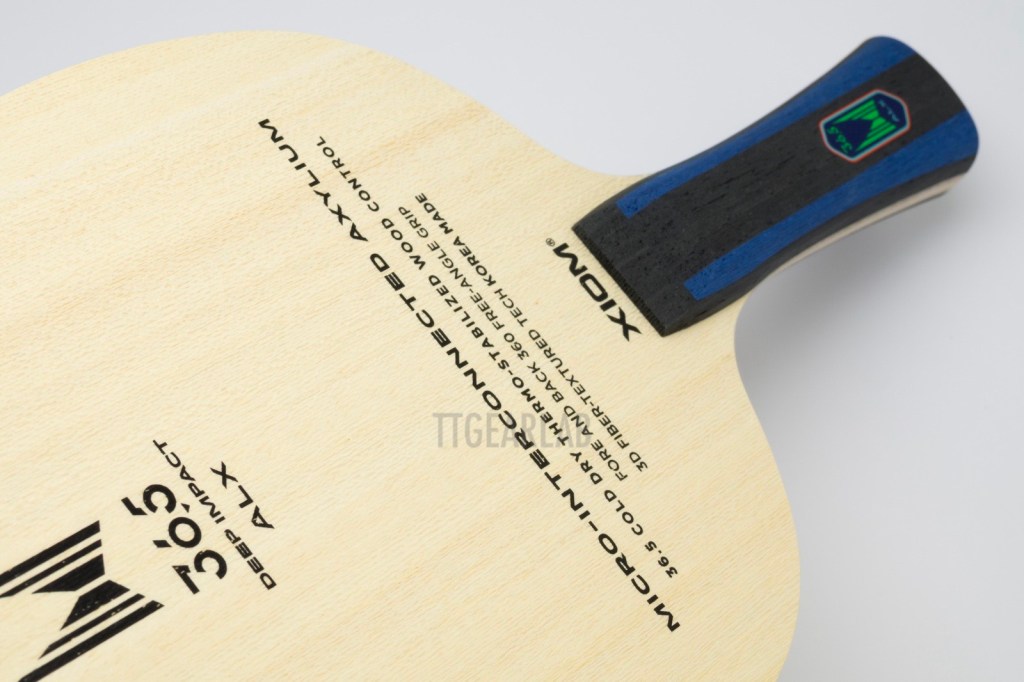
‘36.5 ALX’ is the outer-fiber version of Xiom ‘36.5’ series. Its characteristics can be summarized as follows:
- ‘36.5 ALX’ is the standard outer ALC blade whose top layer is Koto and ALX (= ALC) is placed directly under the top layer. It can be categorized as a blade of ‘Viscaria type’. Even its handle shape is similar to that of ‘Viscaria’.
- The overall elasticity of ‘36.5 ALX’ is high as we can expect from its construction. But, it is lower than those of ‘Viscaria’ and the other blades with similar constructions.
- The Ec and the Ec/Ep of ‘36.5 ALX’ are lower than those of ‘Viscaria’. So ‘36.5 ALX’ hugs the ball more deeply than ‘Viscaria’ when the player hits the ball very strongly. But, not as deeply as the blades in ‘Deep Hold’ range such as ‘36.5 ALXi’ in the same family.
- The overall feeling of ‘36.5 ALX’ is different from that of ‘Viscaria’. ‘36.5 ALX’ is softer than ‘Viscaria’ in primary feeling, and sharper in lateral feeling.
- Because ‘36.5 ALX’ is slower and softer than most of other outer ALC blades, it is expected that it fits for the player who first uses outer fiber blade. ‘36.5 ALX’ also fits for the players who play with very aggressive topspin at close to table area but fist uses outer fiber blade, because it hugs the ball more deeply than most of other outer fiber blades while giving softer but sharper feeling.
4-2. 36.5 ALXi (inner fiber version)
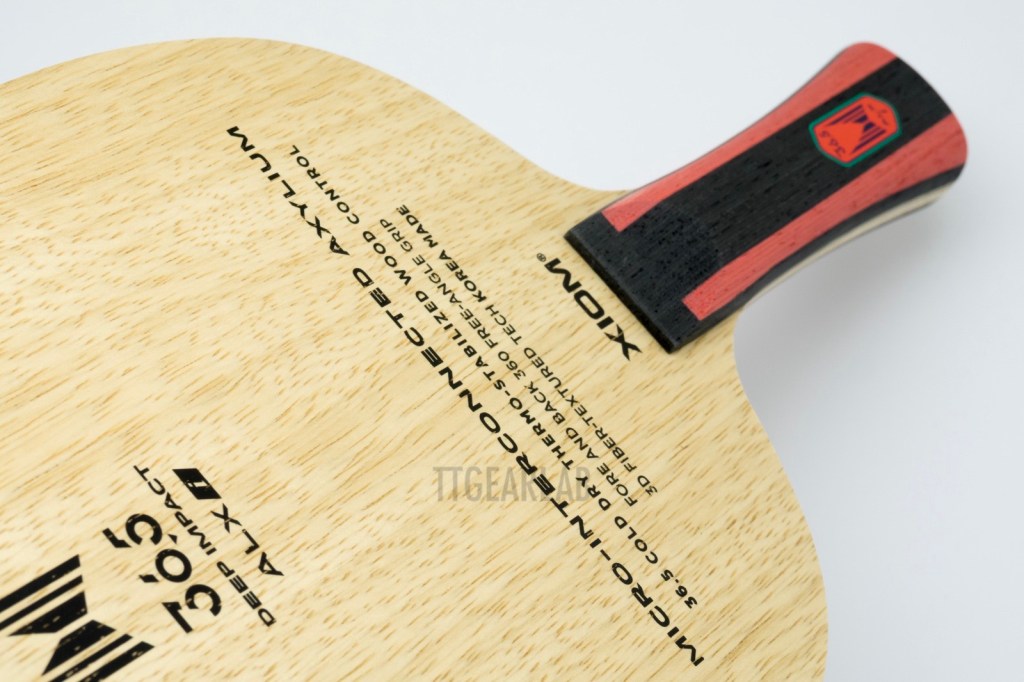
‘36.5 ALXi’ is the inner-fiber version of Xiom ‘36.5’ series. Its characteristics can be summarized as follows:
- ‘36.5 ALXi’ is the standard inner ALC blade whose top layer is Limba and ALX (= ALC) is placed between the middle layer and the center layer. Its construction is very similar to that of ‘InnerForce Layer ALC’. Even the handle shape of ‘36.5 ALXi’ is similar to that of ‘InnerForce Layer ALC’.
- ‘36.5 ALXi’ is much less elastic than current version of ‘InnerForce Layer ALC’, and hugs ball more deeply. For that reason players may feel that ‘36.5 ALXi’ is slower. But instead, it is expected that ‘36.5 ALXi’ provides higher level of stability and safety when compared with ‘InnerForce Layer ALC’.
- The primary feeling of ‘36.5 ALXi’ is a bit softer than that of ‘InnerForce Layer ALC’, but ‘36.5 ALXi’ transmits much sharper feeling to the index finger when compared with ‘InnerForce Layer ALC’ or the inner ALC blades with similar constructions. Overall feeling of ‘36.5 ALXi’ is close to that of current ‘Hurricane Long 5’.
- Like ‘Hurricane Long 5’, ‘36.5 ALXi’ is also recommended for the player who has used the 5-ply wood offensive blade such as ‘Korbel’ but want to replace the blade with fiber blade.
- It is expected that ‘36.5 ALXi’ also fits for very aggressive topspin that aims at very early timing of rising thanks to its moderate elasticity, ‘Deep Hold’ characteristics and sharper feeling at index finger.
Please click here to return to top (table of contents)
 TTGearLab
Are you sure “the middle layer is Ayous” for both blades? I ask this because “There are brands that use Limba, such as Xiom for example, and if you compare a Viscaria with a 36.5 you will see what I mean.”
https://www.sdcttblades.com/nerdy-stuff/limba-vs-ayous-in-the-second-layer
LikeLike
No. It is Limba. It is written on my record when I checked those two blades. Thank you for pointing it out. It seems that I didn’t correct it when I copied and pasted the text from the text of other blades. I will correct the data as soon as possible.
LikeLike
Hi!
Will you review the newest flagship blades of DHS?
the Hurricane Wang (Chuqin) and Hurricane Sha
LikeLike
I have a plan. But, it will take time until I get those blades because those are quite expensive blades.
LikeLike
Good afternoon,
I’m a beginner/intermediate player, I play using topspin mainly, I never use smash. I prefer spin over speed, I play close to the table and two steps from the table, but I tend to play far.
I played Andro temper tech all+, with soft rubbers, I lacked speed and rotation. I switched to Xiom Stradivarius Novus with Vega PRO, the racket felt very heavy, reactive, I couldn’t handle the speed and incoming rotation. I switched to Tibhar Felix Lebrun off- 7 ply wood with 2 layers of polymer fiber (have no idea about Ep/Ec). Couldn’t play with DonicBluefire M2/ Acuda S2 (heavy again). But I felt very comfortable with Vega Japan/Europe DF. This is what I play now, it’s enough for a low level, it’s easy to create spin, everything flies into the table. But for a higher level I don’t have enough speed at all. Even with a very strong swing there is no additional kick. DF also feels too soft.
I recently had the opportunity to purchase a 36.5 ALX at a discount. I tried playing it with Omega 7 Tour MAX/Pro MAX. Surprisingly, it was comfortable, I can’t say it was super fast, but maybe I didn’t break through such hard rubbers. I plan to play Vega Japan/Vega Europe H on it. Should I give this setup a chance? Or look towards Hugo Hal / ALXi?
Thank you for your time.
LikeLike
There isn’t a right answer for the combination of rubbers and blades. And, this case seems to be especially difficult.
I think that the 36.5 ALX is somewhat more elastic than the elasticity level for you, although it feels more comfortable than expected. On the other hand, I worry that Hugo HAL may be slower than you expect. Further, both of 36.5 ALX and Hugo HAL seems to be optimized for close-to-table play. If you never smash, play at close-to-table area, but also play at far-distance area, the inner version – 36.5 ALXi will be more considerable in my opinion.
LikeLike
Hi,
I’m just wondering if the 36.5 ALX is sealed from the factory?
LikeLike
No. It isn’t sealed.
The factory that produces 36.5 ALXi doesn’t seal the blade.
LikeLike
Hello,
Is the reason for not sealing just economic for Xiom?Or will the characteristics be better (as they comply with the 36.5 ALX project by Xiom) if it is not sealed?
Do you recommend sealing the 36.5 ALX blade (even if we use a non-aggressive glue like Revolution nr. 3?) ?
If so, why?
Many thanks.
LikeLike
Hi,
Here’s a link to a table tennis player who had a problem after sealing his Xiom 36.5 ALX.
https://www.tabletennisdaily.com/forum/topics/blade-defect-after-sealing.36078/
Do you have any further explanations to give us, as you have already worked for Xiom ?
LikeLike
Hello there,
Thank you very much for the recommendation. Unfortunately, I couldn’t find the inner version and took ALX to try. Now I play with the combination of FH: Xiom Vega Pro H max and BH: Xiom Vega Europe H 2.0 (just to save weight). This combination is quite slow, very linear (I hit harder, it flies faster), these rubbers have no catapult, and the base is very similar to wood in feel. This combination makes me work a lot and put in force, which is good for technique. I really should to stroke hard all the time. But I found several critical problems for the game regarding: it is difficult to keep the ball low in a short game, the first push often rises up, and secondly, if you try to make a thin topspin only with the edge of the topsheet, the ball always slides off. This is not a problem for development, but I am looking for some reasonable step forward.
I recently played the new Jekyll&Hyde C55, Omega 7 tour, Asia, pro on Hugo Hal. I am happy with everything, but I am afraid to use this rubber on ALX, because it is faster. I try to keep the catapult to a minimum (that is why I choose hybrids mainly). Now I was thinking about choosing J&H V52.5 2mm on BH, and J&H C55 FH. I have the opportunity to train every day to hone my technique. I am afraid to take the Omega series or j&h 47.5/50X because of the catapult. Maybe you can suggest something in which direction I should move? Or maybe I shoud find funds on Hugo Hal and take these hard rubbers? I still prefer high-spin topspins with control to speed, but rotation should be ready on level.
Thank you for your time.
LikeLike
Addition: After reading some reviews I am now a little bit doubtful. Basically Hal will give me more spin and the ability to play with hard rubbers. On the other hand C55 is a slow rubber, so even on ALX I should have good control and also allow me to improve my technique. I doubt that without it I will be able to get good spin on c55. But on BH I am not sure, maybe 47.5V will be a better option. I could not play acuda s2 on ALX, the ball often flew in unpredictable directions. 52.5V is not that fast according to the review, but I am afraid that it is too hard as C55. My ALX is 81g, so I am in a safe spot now in terms of weight. Another option is Omega 5 tour…I tried Stradivarius novus with Vega X, Pro, Donic bluefire everything was too reactive in short game. Vega Japan on ALX was good, but I feel like it has limitations in speed and spin…this addiction needs more.
47.5 or 52.5 would be better, what do you think? Or slows down with Hal/Sal?
Thanks!
LikeLike
I think that Hugo HAL + C55 will be the best choice for your forehand side. If you hit strongly in large angle it will not make that fast ball. However, if you totally concentrating on spin and make very strong impact in the direction of generating spin, the ball will become much faster than you expect. ‘Raising speed by putting more spin’ is the right way of using that C55.
And, I think that 36.5 ALX will not be bad for the combination with C55. In fact, if you concentrate on spin, the result from HAL + C55 will not be that different from the result from ALX + C55. (If you don’t hit in large angle.)
Regarding backhand rubber, could you once consider Xiom Omega IV Asia? I expect that it will provide very high ability of precise control.
LikeLiked by 1 person
Hello,
Thank you very much for the recommendation. I’ll take the c55 on ALX then, for the backhand I looked at the reviews of the omega IV. It’s a fairly old rubber, the reviews are mixed, but mostly positive.
I’ll clarify again, I usually use the BH either for a push on the undercut, or for a topspin on the undercut after my serve. I block often, often I don’t kill with my BH, rather I change direction from left to right and the opponent makes a mistake, use drive shots. For me, the ease of attack on the backspin, opening with topspin are very important. With Vega Europe H is was impossible to flick. Sometimes I hit a strong shot from afar, especially when playing in doubles. But I am learning, so I don’t want to put myself in limited rubber situation just because it’s more comfortable. In general, I need something that will also make me grow, if the rubber is comfortable but very dead, then it will not work.
I was thinking about: Rakza 7 (very popular but I haven’t noticed any super strong spin from my teammates), Rakza Z (but it’s a bit heavy, 53-54 grams, same as C55), I’m impressed by the spin from Tibhar Aurus (but it’s old), Omega V Tour, Omega VII Asia (but it’s too bouncy), J&h V47.5 (I like something new, they say the grip is good but the reviews are mixed), x47.5 is also available now. I generally believe it’s better to use the same brand of rubber and blade, but I’m open to suggestions. Do you still think Omega 4 is the best option for ALX?
Best regards)
LikeLike
Vega Europe H is a hybrid rubber which is the combination of sticky top sheet and new generation sponge. You may feel some difficulties if you use that kind of rubber at your backhand side but you are not accustomed to it.
Rakza 7 or Omega IV Asia will be totally different from Vega Europe H. Both of those two are somewhat old models, but I can strongly recommend those two for you. Newer and more expensive models may be able to make more power. But, for most of low~middle class players that difference is not meaningful.
Another option that I can recommend for you is andro Hexer PowerGrip. When compared with Rakza 7 or Omega IV Asia, it is a newer model and is more biased to spin performance. And, the ball will never die.
LikeLike
Look for new Xiom Vega Korea. Xiom Vega Korea. Better than Vega Japan? – Table Tennis Rubber Review (spintesters.com)
LikeLike
Hello sir!
Another brilliant review. I’ve looked at some other reviews for the ALX and folks seem pretty split on it’s ‘linearity.’ Some say it’s very controllable and predictable, while other say it “accelerates randomly,” whereas the Viscaria is said to be more controllable. Do you have an opinion on this or know why there seems to be a discrepancy? I would have thought ALX would be more controllable because it uses Limba in the second layer, which is supposed to be less bouncy than Ayous in Butterfly blades.
Thanks 🙂
LikeLike
I think that the meaning of ‘controllability’ differs by player. Some players think that high stability is high controllability. And, sometimes they think that the blade is more controllable if it is less sensitive to the impact angle or impact strength. On the contrary the other players think that the blade gives good control if the output is proportional to the input.
So the word ‘control’ is not an intuitive word for expressing the characteristics of table tennis equipment. There are always two different factors of control – precision and safety (= ease of use). The former is related with safety and the latter is related with precision.
And, Limba is more elastic than Ayous of the same thickness. So, if every condition is same as there is difference in the kind of one layer, the blade with Limba layer is faster than the blade with Ayous layer. However, the problem in the comparison is that the condition is not same. There is difference in the thickness of internal layers or the top layers. There is difference in the amount of glue and so on. For that reason we can’t easily expect the result just from the kind of a layer.
LikeLiked by 1 person
What a great response, I appreciate you taking the time for it 🙂 My idea of control is input=output -> precision.
I saw an article by SDCblades saying Limba was less bouncy, but harder than Ayous with higher speed potential. So I suppose that could help explain some people’s experience with it being more controllable than Viscaria in the short game, but ramps up in speed quickly. Of course, not all the characteristics are the same though as you said!
LikeLike
Then you are closer to professional players. 🙂
PRECISION : the control for professional players.
TOLERANCE (EASE OF USE) : the control for beginners.
In many cases, the blade with Ayous layer provides higher Ec/Ep than the blade with Limba layer. That makes the players feel that Limba is less bouncy. 🙂
LikeLiked by 1 person
Hello,
Is the reason for not sealing just economic for Xiom? Or will the characteristics be better (as they comply with the 36.5 ALX project by Xiom) if it is not sealed?
Do you recommend sealing the 36.5 ALX blade (even if we use a non-aggressive glue like Revolution nr. 3?) ?
If so, why?
Many thanks.
LikeLike
No blade needs sealing. Sealing is simply a matter of the preference of maker.
LikeLike
I understand that on all the sites where players compared viscaria with 36.5 they were wrong because 36.5 has a limbal inner layer?
LikeLike
36.5 (ALX) is quite different from Viacaria. But, the difference of middle layer isn’t all of the reason of that difference. There are many other tiny differences and those small differences result in the noticeable differences in overall characteristics. It is difficult for us to notice all the differences.
So what is important is measured value – Performance Indices. Those values tell us that 36.5 ALX is somewhat different from Viscaria.
BTW, I think that ‘old’ Viscaria is much closer to 36.5 ALX when compard with current Viscaria.
LikeLike