| Table of Contents | 1. Overview 2. Performance Indices 3. Comparison by Performance Indices ……. 3-1. Elasticity Indices ……. 3-2. Vibration Indices 4. Field Test 5. Summary |
In 2023, Tibhar announced two new fiber blade – one inner-fiber model and one outer-fiber model. The inner-fiber model is ‘Libra ZAC’ whose artificial material includes three different fibers. TTGearLab will deal with ‘Libra ZAC’ in near future. And, the outer-fiber model is ‘MK Carbon’ that will be dealt with in this article.
Tibhar ‘MK Carbon’ is the blade for Kenta Matsudaira who was signed with Tibhar on April 2022. ‘MK’ is the initial of ‘Matsudaira Kenta’. (‘Matsudaira’ is his family name, and ‘Kenta’ is his given name.) The blade that is preferred by Kenta Matsudaira is the outer-fiber blade which provides sufficient elasticity and can lift the ball upward well. The fiber that was selected for realizing the characteristics that Kenta Matsudaira wants is new ‘Crypto Carbon’. And, for the harmony with ‘Hybrid MK’ which is the new foreside rubber of Kenta Matsudaria that provides soft feeling, the overall feeling of ‘MK Carbon’ has been tuned to be a bit harder than the Butterfly ALC blade that had been used by Kenta Matsudaira for long time.
TTGearLab analyzed ‘MK Carbon’ through Performance Indices and compared it with some existing blades. Further, TTGearLab also checked the actual characteristics of ‘MK Carbon’ by field testing at table tennis court.
1. Overview

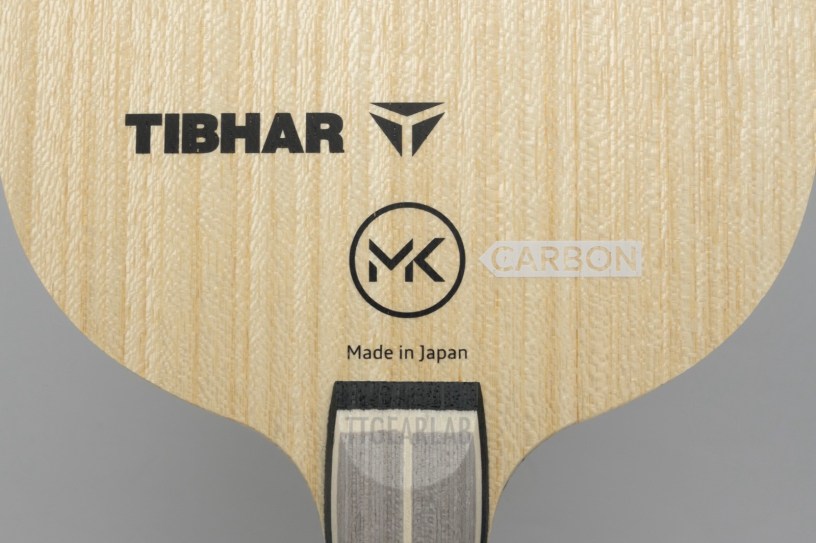
‘MK Carbon’ is the new blade of Kenta Matsudaira. It has been developed by the cooperation of Tibhar and Kenta Matsudaira, and has been tuned for ‘Hybrid MK’ and ‘Hybrid K3’ those are the rubbers used by Kenta Matsudaira.
The exclusive logo for ‘MK’ series expresses the initials of Kenta Matsudaira (M & K). ‘Matsudaira’ is family name of Kenta Matsudaira, and it comes before the given name in Japanese name system. For that reason, the initials aren’t KM but MK.

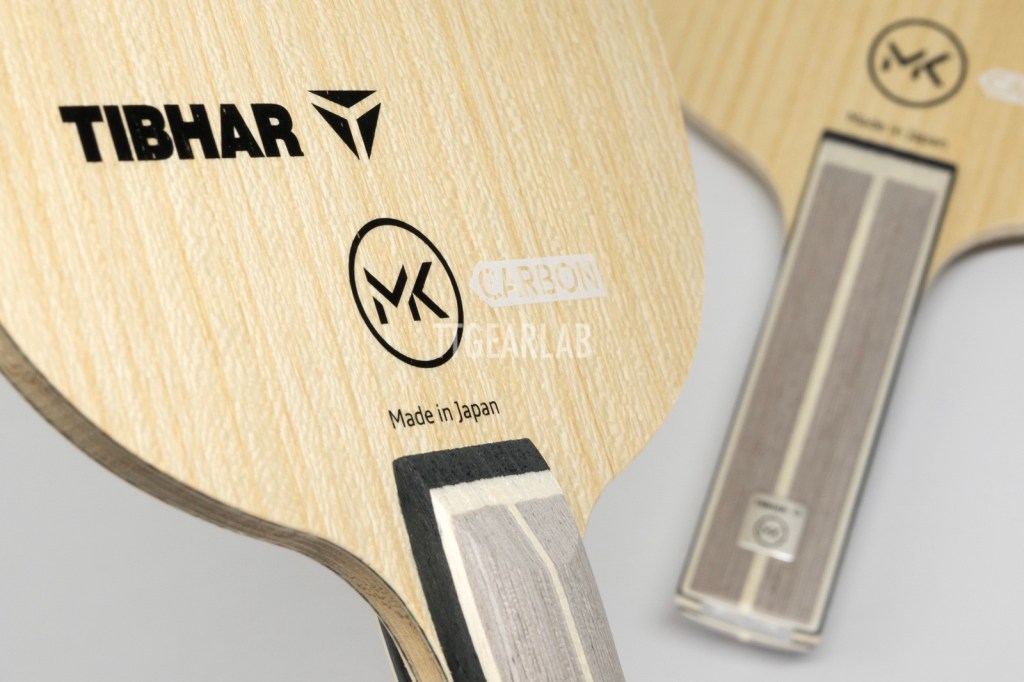
The fiber of ‘MK Carbon’ isn’t a pure woven carbon fiber but the mixed woven fiber with different material which is called as ‘Crypto Carbon’. ‘Crypto Carbon’ is assumed to be a kind of ALC (= Arylate Carbon), but the details of this material haven’t been announced. ‘Crypto Carbon’ is placed directly under the top layer. The top layer is Koto, the middle layer is Ayous and the center layer is ‘Kiri’. Overall thickness is 5.8mm. The construction looks very similar to that of Butterfly ‘Viscaria’ except for the color of fiber. (Green vs. blue.)
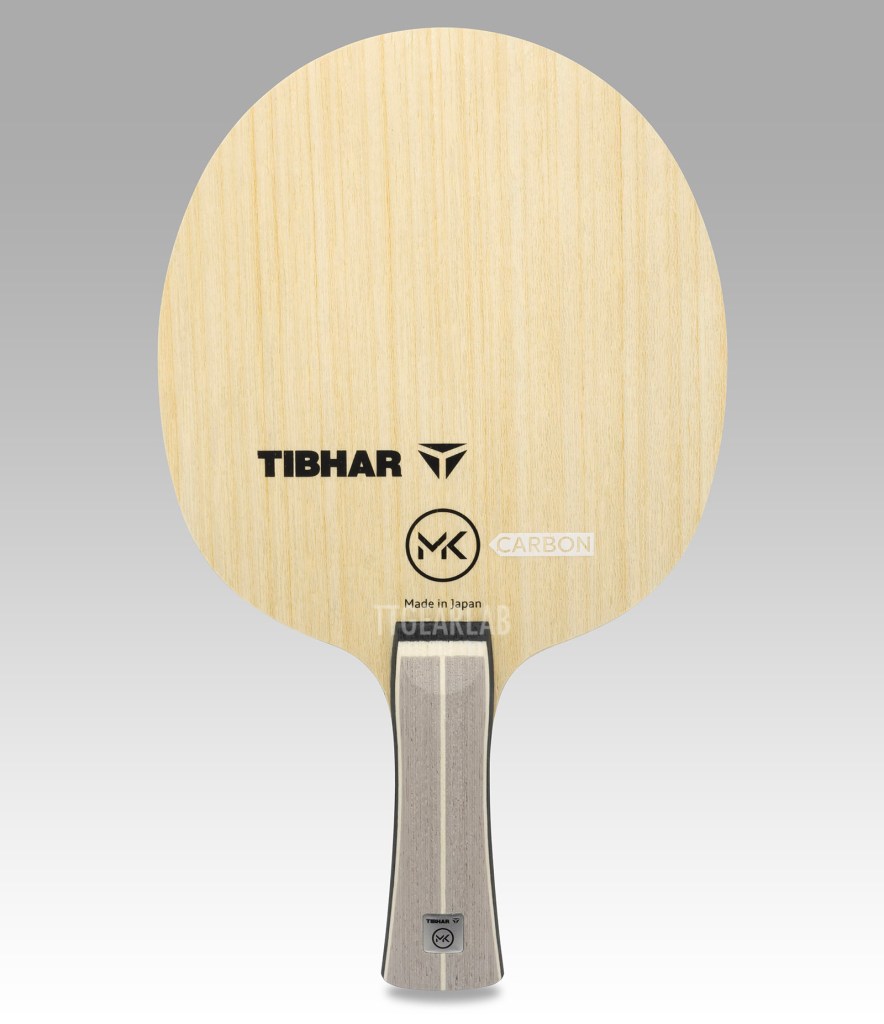
The size of head is 157mm x 150mm which is same as the head size of Viscaria’. The average weight of measured pcs. is 85.4g. We can even find many pcs. whose weights are under 85g. So, if the player is looking for a lightweight outer fiber blade, ‘MK Carbon’ is worth considering.

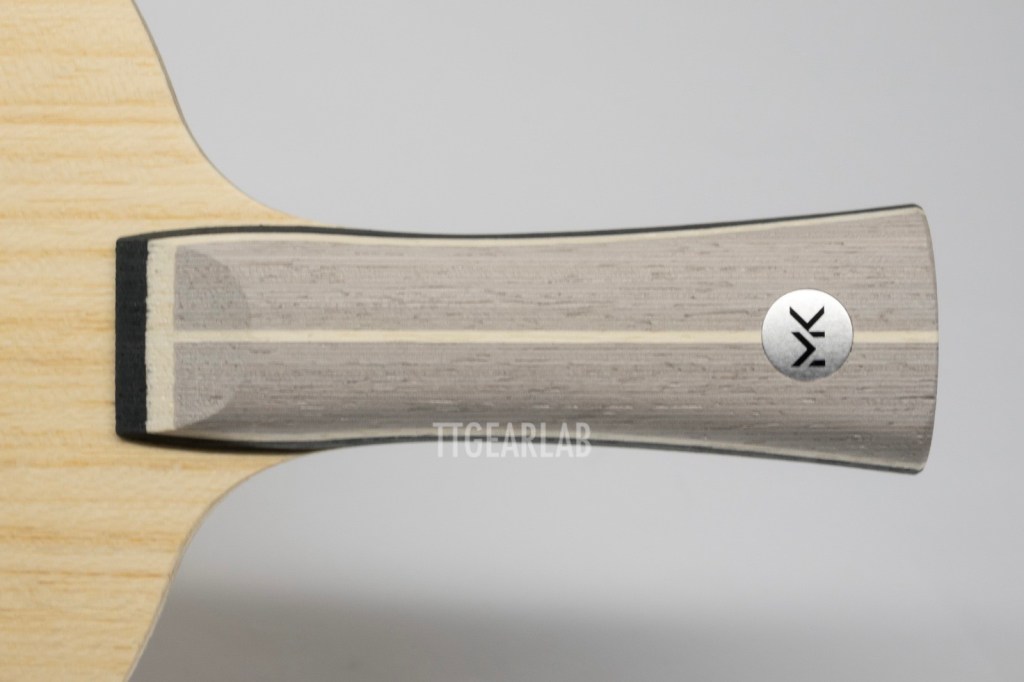
Two kinds of handles – FL (flared) and ST (straight) – are available. The FL handle of ‘MK Carbon’ is a FL handle of semi-wide type that is very similar to the FL handle of ‘Zhang Jike’ series, ‘Fan Zhendong’ series, ‘Viscaria’ series, and ‘Korbel’. Its width is around 25mm (at head sied) ~ 28mm (at bulge) ~ 26mm (at the narrowest point) ~ 34mm (at the end). Its thickness is around 23mm at thumb and around 25mm at the end. This semi-wide FL handle provides firm grip.
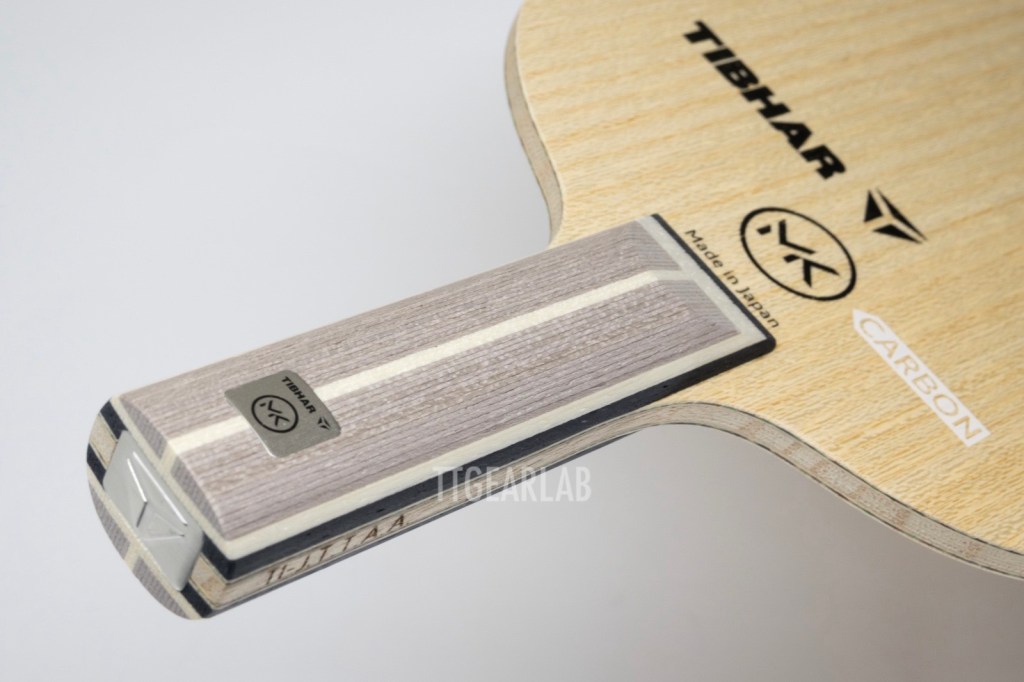
The ST handle of ‘MK Carbon’ is similar to the standard ST of Butterfly which is applied to most of Butterfly blades including ‘Viscaria’, ‘Fan Zhendong’ series, ‘InnerForce Layer’ series and so on. It is the semi-wide ST handle whose cross section is a bit rounded Its width is around 28mm, and its thickness is around 23mm. It also provides firm grip.
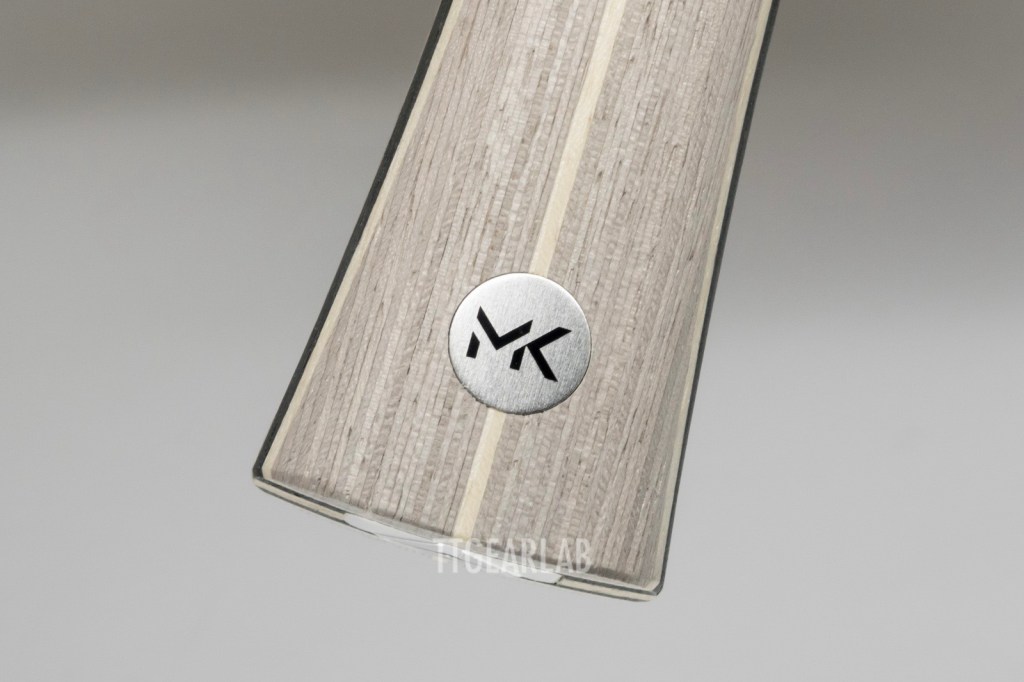
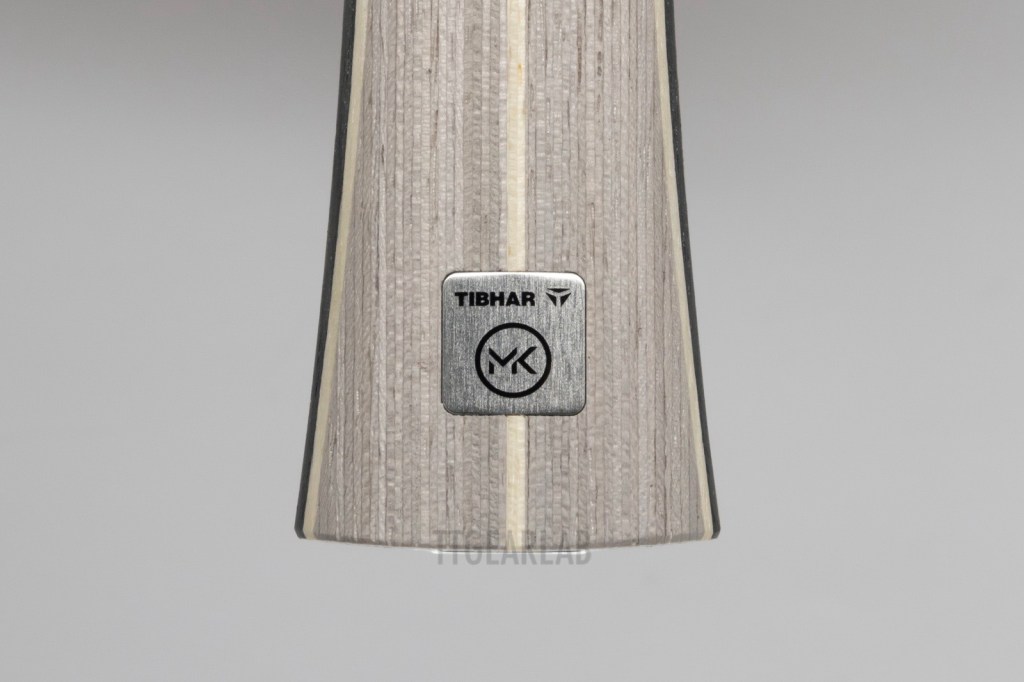
There is a rounded small Aluminum plate at the backside of handle. ‘MK’ logo is printed on backside plate.
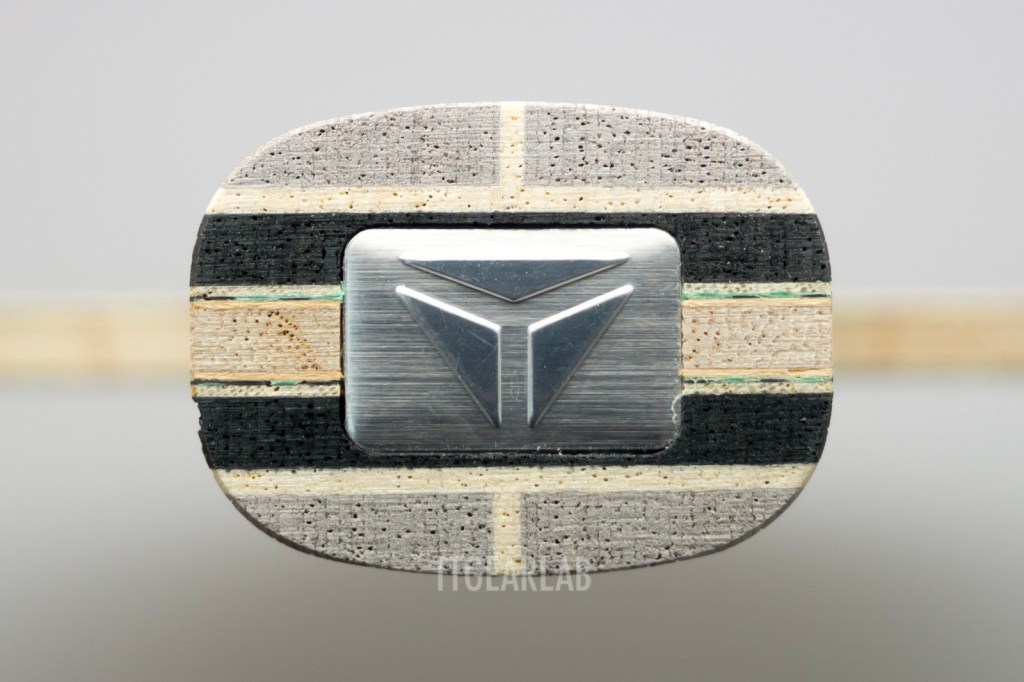
At the end of handle there is a squared logo plate that shows new diamond logo of Tibhar.
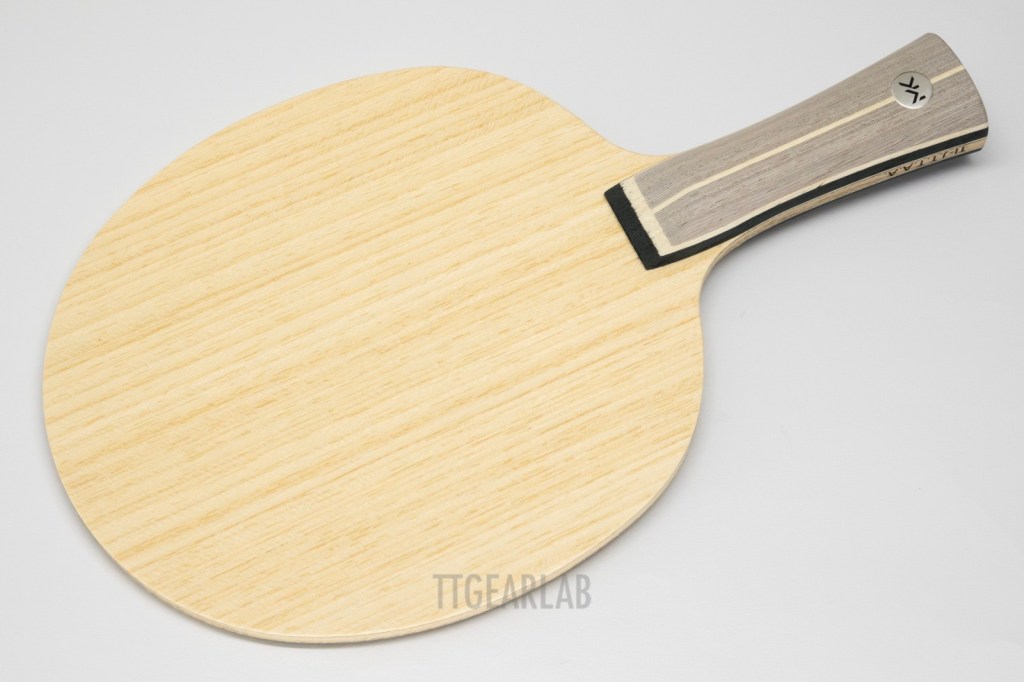
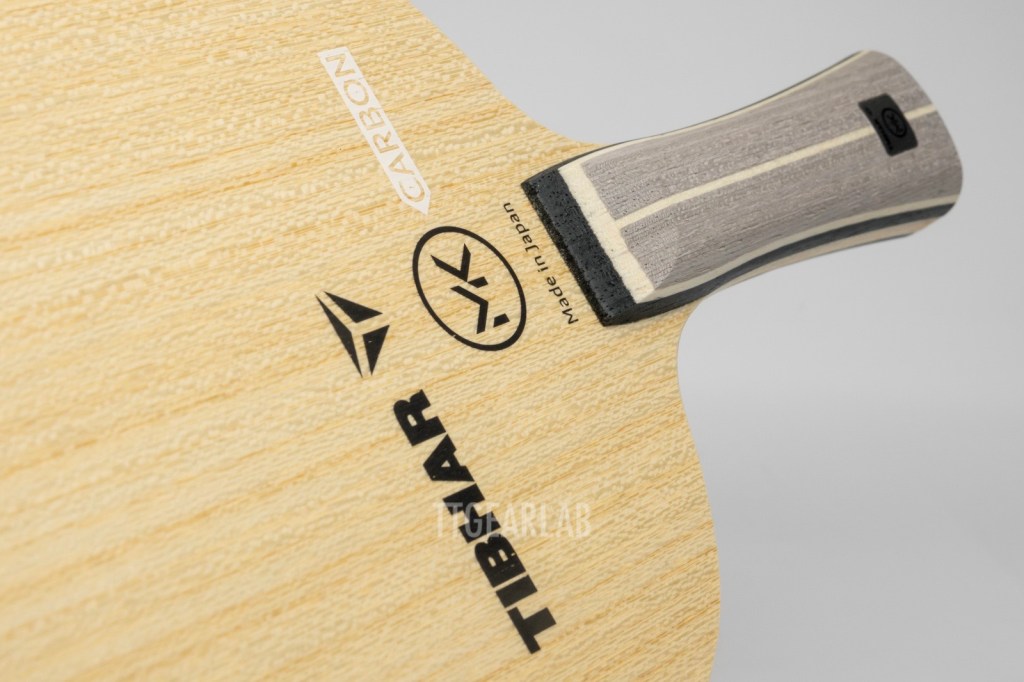
Printing isn’t applied on the basckside of head.
Then, let’s check the characteristics of ‘MK Carbon’ by Performance Indices and compare with the some existing blades.
Please click here to return to top (table of contents)
2. Performance Indices
Performance Indices are measured objective values to represent the characteristics of table tennis gears. Concerning the detail of four performance indices, please refer to following articles in ‘About TTGearLab’ section:
- Performance indices : the way to evaluate blade by measurement
- The example of comparison by performance indices
The performance indices of ‘MK Carbon’ are as follows:
MK Carbon (average weight = 85.4g)
Ep = 2.01
Ec = 1.84 (Ec/Ep = 0.92)
Vp = 1.32
Vl = 1.45 (Vl/Vp = 1.10)
Please note that above are average values and can be updated by further measurement.

‘MK Carbon’ is an outer-fiber blade whose artificial material is very similar to ALC and whose top layer is Koto. Its primary Elasticity Index (Ep) is around 2.0, and it is in the range that we can expect from an outer-ALC blade with Koto top layer. Basically ‘MK Carbon’ is a fast blade.
Its Ec is much lower than its Ep, and as the result its Ec/Ep (= 0.92) is lower than 1.0. It means that ‘MK Carbon’ hugs the ball deep when the player hits the ball very strongly. But, the amount of hug isn’t extreme. 0.92 is the value of Ec/Ep close to the border between ‘Mild Hold’ range and ‘Deep Hold’ range.
Its Vp (Primary Vibration Index) is 1.32. It is also in the range that we can expect from an outer-ALC blade with Koto top layer. Vp that exceeds 1.3 means that ‘MK Carbon’ isn’t soft or extremely hard. We can think that the basic feeling of ‘MK Carbon’ is moderately hard. On the contrary its Vl (Lateral Vibraion Index) is very high. The feeling that is transmitted to the index finger is very hard or sharp. And, as the result the relative value – Vl/Vp – (= 1.10) is also quite high as the value of an outer-ALC. It is expected that there will be many players who feel that ‘MK Carbon’ is harder than existing outer-ALC blades with Koto top layer, for example ‘Viscaria’.
Please click here to return to top (table of contents)
3. Comparison by Performance Indices
Then we can compare ‘MK Carbon’ with some other blades in the market. Because the construction of ‘MK Carbon’ is very close to that of current ‘Viscaria’, the main purpose of this comparison is to observe how ‘MK Carbon’ is different from ‘Viscaria’ or the blades with similar constructions. We will call the outer ALC (or outer Aramid Carbon) blades with Koto top layer as ‘Viscaria Type’. And, some inner ALC blades and ‘Korbel’ which is the representative of 5-ply offensive blade are selected for additional comparison.
Following is the list of the blades to be compared :
Viscaria Type (outer-ALC blades with Koto top layer)
- Butterfly ‘Viscaria’ current version (avg. weight = 87.1g) : The representative of outer-ALC blade
- Butterfly ‘Viscaria’ old version M-serial (avg. weight = 86.0g) : Former version of ‘Viscaria’. The material of handle is different from that of current version.
- DHS ‘506X’ (avg. weight = 85.2g) : Outer ALC blade of DHS.
- Tibhar Samsonov Limited Edition 25 (avg. weight = 87.7g) : Special version of Samsonov series. Fiber is Aramid Carbon.
- Tibhar Drinkhall Powerspin Carbon (avg. weight = 85.4g) : The blade of Paul Drinkhall.
- Xiom 36.5 ALX (avg. weight = 86.2g) : Outer Axylium Carbon (= ALC) blade of Xiom.
Inner ALC blades
- Butterfly Ovtcharov InnerForce ALC (avg. weight = 88.0g) : The blade of Dimitrij Ovtcharov. Thicker & faster than ‘InnerForce Layer ALC’.
- Tibhar Shang Kun Hybrid AC (avg. weight = 88.8g) : The inner ALC blade of Tibhar.
- Butterfly InnerForce Layer ALC current version (avg. weight = 91.2g) : The standard model of inner ALC blades
- DHS Hurricane Long 5X (avg. weight = 87.6g) : Thicker & Faster than Hurricane Long 5′.
- DHS New Hurricane Long 5 (avg. weight = 88.1g) : The representative of inner ALC blades. Ma Long used the special order version of this blade.
5-ply wood
- Butterfly ‘Korbel’ (avg. weight = 88.7g) : The standard of 5-ply wood offensive blades
3-1. Elasticity Indices
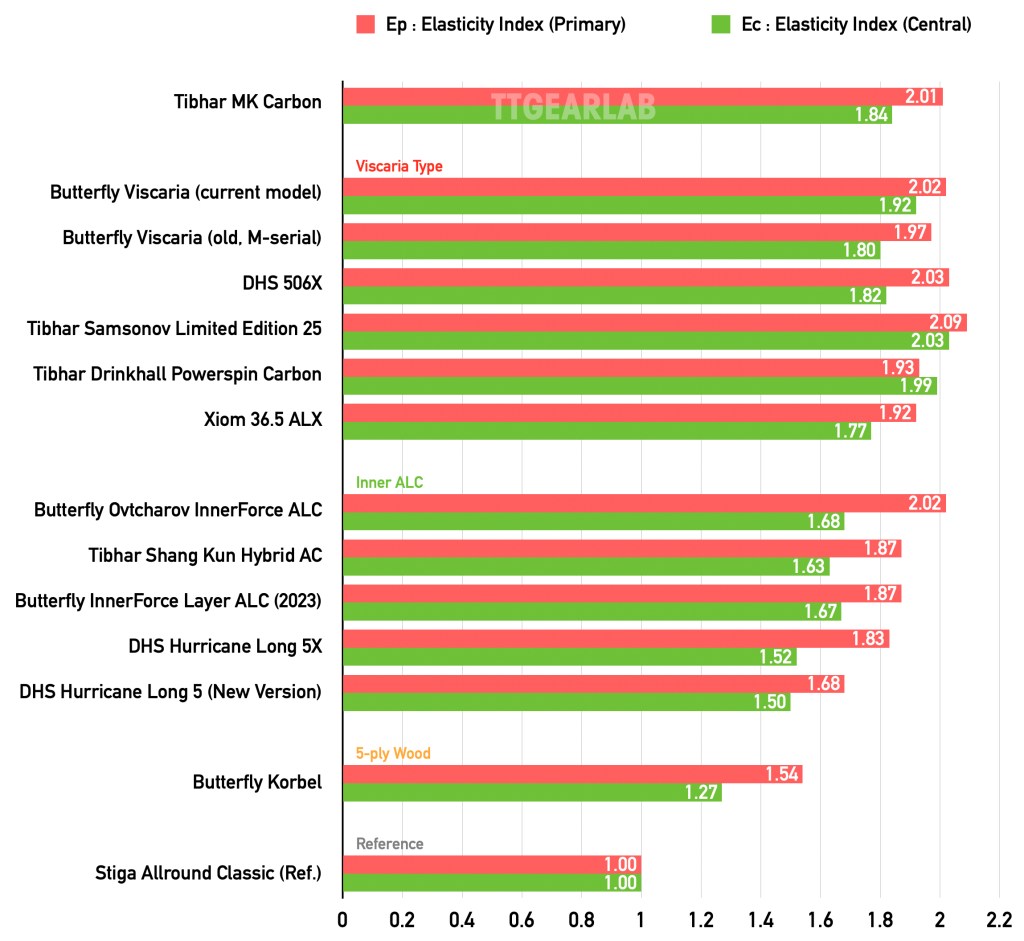
Fig.12 shows the comparison graph of Elasticity Indices.
Ep (Primary Elasticity Index) is directly concerned with the rebound speed of blade. Ec (Central Elasticity Index) is concerned with additional ‘kick’ when player hits ball very strongly.
[Viscaria Type]
‘MK Carbon’ can be categorized as ‘Viscaria Type’ because of its construction – top layer, artificial material and thickness. Further, its handle also resembles the handle of ‘Viscaria’. For that reason it will be meaningful that we first compare ‘MK Carbon’ with ‘Viscaria’. Interestingly there isn’t noticeable difference between the Ep of ‘MK Carbon’ and that of ‘Viscaria’ (current model). However, the Ec of ‘MK Carbon’ is lower than that of ‘Viscaria’. The difference isn’t significant, but noticeable. So, we can expect that players will feel that ‘MK Carbon’ is a bit slower than ‘Viscaria’ when the impact is very strong, while ‘MK Carbon’ is as fast as ‘Viscaria’ in light hitting. But, the result of the comparison between ‘MK Carbon’ and old version of ‘Visciar’ is somewhat different, because the Ec of old ‘Viscaria’ is noticeably lower than that of current ‘Viscaria’. Both of the Ep anc the Ec of old ‘Visciara’ are lower than those of ‘MK Carbon’.
Then let’s compare the other ‘Viscaria Type’ blades with ‘MK Carbon’. ‘506X’ shows a bit higher Ep and a bit lower Ec when compared with ‘MK Carbon’. And, the graph shape of ‘506X’ looks somewhat similar to that of ‘MK Carbon’. On the contrary, the graph shape of ‘Samsonov Limited Edition 25’ is different from that of ‘MK Carbon’. Players will feel that ‘Samsonov Limited Editon 25’ is much more elastic than ‘MK Carbon’. The high Ec may be one of the characteristics of Viscaria type blades of Tibhar. ‘Darinkhall Power Spin Carbon’ also shows very high value of Ec, although its Ep is noticeably lower than that of ‘MK Carbon’. Finally, both of Ep anc Ec of ‘36.5 ALX’ are noticeably lower than those of ‘MK Carbon’. Because of the similarity in graph shape, ‘36.5 ALX’ looks like the slower version of ‘MK Carbon’.
[Inner ALC]
Inner ALC blades are compared with ‘MK Carbon’ and ‘Viscaria Type’ blades just for reference. The most elastic one in this group is ‘Ovtcharov InnerForce ALC’. Its Ep is a little bit higher than that of ‘MK Carbon’. However, its Ec is much lower than that of ‘MK Carbon’, and is even lower than that of ‘36.5 ALX’ which is the lowest in ‘Viscaria Type’ group. The highest Ec of ‘Inner ALC’ group is lower than the lowest Ec of ‘Viscaria Type’ group. We may be able to think that the low Ec is one of the characteristics of inner ALC blade.
[5-ply wood]
‘Korbel’ is also being compared just for reference. As we can expect from the construction which doesn’t include any artificial fiber, the Elasticity Indices of ‘Korbel’ are lower than the lowest Elasticity Indices of ‘Inner ALC’ group. Of course, the gap becomes even larger if we compare ‘Korbel’ with ‘MK Carbon’ and ‘Viscaria Type’ blades.
Examining Ec/Ep is an easier way to understand the characteristics of blade concerned with elasticity. Fig.13 shows the relationship between Ec/Ep and Ep.

Ec/Ep expresses the ‘tendency’ of the elasticity of blade. By examining Ec/Ep and Ep at the same time, we can easily understand the behavior of blades.
On the graph, most of blades in this comparison are in ‘Hold’ range (Ec/Ep < 1.0). Five including ‘MK Carbon’ are in ‘Mild Hold’ range, and seven are in ‘Deep Hold’ range. But, among those twelve blades, six including ‘MK Carbon’ are close to the border between ‘Mild Hold’ range and ‘Deep Hold’ range.
At first, we can observe that ‘Viscaria Type’ group that includes ‘MK Carbon’ is located to upper right of ‘Inner ALC’ group. It means that the blades in ‘Viscaria Type’ are faster and give more hold (= less kick) for very strong impact when compared with ‘Inner ALC’ group.
[Viscaria Type]
‘MK Carbon’ is located to lower left of current ‘Viscaria’. For that reason players will feel that ‘MK Carbon’ is a bit slower than current ‘Viscaria’ when they hit the ball very strongly. The difference isn’t significant, but players will notice it. But, old version (M-serial) of ‘Viscaria’ shows same level of Ec/Ep as ‘MK Carbon’. It is expected that players will feel that ‘MK Carbon’ is close to old ‘Viscaria’ of similar weight.
Although there are differences between ‘Viscaria’s (old & new) and ‘MK Carbon’, the other blades in ‘Viscaria Type’ group are even further away from ‘MK Carbon’ when compared with ‘Viscaria’s. ‘36.5 ALX’ gives similar hold characteristic as ‘MK Carbon’ or old ‘Viscira’, but its primary elasticity is noticeably lower. ‘506X’ is even more elastic than ‘MK Carbon’ in primary elasticity, and it hugs the ball a bit deeper than ‘MK Carbon’ when the player hits the ball very strongly. ‘Samsonov Limited Edition 25’ is faster and gives more kick than ‘MK Carbon’ and ‘Viscaria’s. Players will feel that ‘Samsonov Limited Edition 25’ is much faster than ‘MK Carbon’. Finally, ‘Drinkhall Power Spin Carbon’ is in ‘Mild Kick’ range. Its primary elasticity is relatively low in ‘Viscaria Type’ group. But, because its Ec/Ep is much higher than other blades in this group, the players who can make strong impact will not feel that ‘Drinkhall Power Spin Carbon’ is a slower blade.
[Inner ALC]
This group is being observed just for reference. Except for ‘Ovtcharov InnerForce ALC’, the blades in ‘Inner ALC’ group are located to lower right of ‘MK Carbon’, and the gaps are significant. It means that those blades are much less elastic than ‘MK Carbon’. Some blades hug the ball a bit deeper than ‘MK Carbon’ when the player hits the ball very strongly, and the others much deeper. ‘Ovtcharov InnerForce ALC’ is located almost directly under ‘MK Carbon’. It shows same level as Ep as ‘MK Carbon’. (In fact, the Ep of ‘Ovtcharov InnerForce ALC’ is a bit higher than that of ‘MK Carbon’.) However, because of much lower Ec/Ep, it hugs the ball much deeper than ‘MK Carbon’ or ‘Viscaria’s. It will make the players feel that ‘Ovtcharov InnerForce ALC’ is slower than ‘MK Carbon’.
[5-ply wood]
‘Korbel’ which is a 5-ply wood blade is of course located to far lower left of ‘MK Carbon’. It is much slower than ‘Viscaria Type’ blades including ‘MK Carbon’, and the players will feel that it is even slower because it hugs the ball very deep when the impact strength is high. If the player who has used ‘Korbel’ requires higher elasticity of blade, inner ALC blades may be better solution than ‘MK Carbon’ or ‘Viscaria’ for smooth adaptation. Then next, let’s compare Vibration Indices.
Please click here to return to top (table of contents)
3-2. Vibration Indices

Fig.14 shows the comparison graph of Vibration Indices. Vibration Indices are concerned with feeling. Vp indicates primary feeling which is transferred to player’s palm. And, Vl is the feeling at the edge of the wing – the lower side of blade head. It is felt by player’s index finger or middle finger.
[Viscaria Type]
At first we can compare ‘MK Carbon’ with current ‘Viscaria’. The Vp of ‘MK Carbon’ is identical to that of current ‘Viscaria’. However, the Vl of ‘MK Carbon’ is much higher than that of ‘Viscaria’. I means that ‘MK Carbon’ transmits much harder or sharper feeling to the index finger when compared with ‘Viscaria’. This will make the player feel that ‘MK Carbon’ is harder than ‘Viscaria’. And, there isn’t any blade in this group whose Vl is higher than that of ‘MK Carbon’. So we can think that very high value of Vl is one of important characteristics of ‘MK Carbon’. The highest Vl is that of ‘36.5 ALX’. But, it is also noticeably lower than the Vl of ‘MK Carbon’.
[Inner ALC]
Inner ALC blades are compared with ‘MK Carbon’ and ‘Viscaria Type’ blades just for reference. The Vp’s of the blades in this group are much lower than those of ‘MK Carbon’ and blades in ‘Viscaria Type’ group. But, all blades in this group except for ‘InnerForce Layer ALC’ show much higher Vl’s than Vp’s. The Vl’s can even be compared with those of ‘Viscaria Type’ blades. So we can understand that the soft feeling of inner ALC blades are mainly due to the primary feeling transferred to palm except for the case of ‘InnerForce Layer ALC’.
[5-ply wood]
‘Korbel’ is also being compared just for reference. Both of Vp and Vl of ‘Korbel’ are much lower than those of ‘MK Carbon’ and ‘Viscaria Type’ blades. And, the values are also lower than those of ‘Inner ALC’ blades except for the case of the Vl of ‘InnerForce Layer ALC’. Examining Vl/Vp is an easier way for the comparison of the tendency of feeling. Fig.15 shows the relationship between Vl/Vp and Vp for easier comparison.

On the graph, most of blades in this comparison are placed in upper part of the graph – ‘Relatively sharper at finger’ range.
At first, we can observe that ‘Viscaria Type’ group that includes ‘MK Carbon’ is located to right of ‘Inner ALC’ group. It means that the blades in ‘Viscaria Type’ are harder in primary feeling that is transmitted to palm through handle. But, in both of two groups the blades are widely distributed in vertical direction. So, the relative feeling (= Vl/Vp) can’t be the criteria by which we can distinguish between ‘Viscaria Type’ blades and ‘Inner ALC’ blades.
[Viscaria Type]
‘MK Carbon’ is located above current ‘Viscaria’, and the gap is quite large. ‘MK Carbon’ transmits much sharper feeling to index finger when compared with ‘Viscaria’ although there isn’t difference in primary feeling transmitted to palm through handle. That is the most crucial difference between ‘MK Carbon’ and current ‘Viscaria’. Old M-serial version of ‘Viscaria’ is located upper left of current ‘Viscaria’, and the gap is also quite big. Although old ‘Viscaria’ is softer than ‘MK Carbon’ in primary feeling some players will feel that there isn’t much difference in feeling between old ‘Viscaria’ and ‘MK Carbon’ because the difference in Vl/Vp is not significant. And, ‘36.5 ALX’ is very close to old ‘Viscaria’. Some players will also feel that there isn’t much difference in feeling between ‘36.5 ALX’ and ‘MK Carbon’. On the contrary, the other two Viscaria Type blades of Tibhar give totally different feeling from ‘MK Carbon’. ‘Drinkhall Power Spin Carbon’ and ‘Samsonov Limited Edition 25’ are located to lower right of ‘MK Carbon’, and the gaps are quite big. Here we can see an example of the case that there are so many different subjective opinions on same blades. If a player feels that ‘Drinkhall Power Spin Carbon’ or ‘Samsonov Limited Edition 25’ is softer than ‘MK Carbon’, that player mainly feels Vl/Vp. And, if a player feels that ‘Drinkhall Power Spin Carbon’ or ‘Samsonov Limited Edition 25’ is harder than ‘MK Carbon’, that player is more sensitive to Vp than Vl/Vp.
[Inner ALC]
This group is being observed just for reference. The group itself is located to left of ‘Viscaria Type’ group. So inner ALC blades are softer than Viscaria type blades in primary feeling. Among fiver blades in this group, ‘Hurricane Long 5X’ and ‘Shang Kun Hybrid AC’ give very sharp relative feeling to the index finger. The players who have used those two may feel that ‘MK Carbon’ is a bit more comfortable than those two because of lower value of Vl/Vp. And, there will not be much problem when they replace their blade from ‘Hurricane Long 5X’ or ‘Shang Kun Hybrid AC’ to ‘MK Carbon’ for enhancement of power. And, the replacement between ‘Hurricane Long 5’ or ‘Ovtcharov InnerForce ALC’ and ‘MK Carbon’ will go quite smoothly because there isn’t much differences in Vl/Vp. However, the player will feel that ‘MK Carbon’ is much harder and much sharper when they replace their blades from ‘InnerForce Layer ALC’ to ‘MK Carbon’.
[5-ply wood]
‘Korbel’ which is a 5-ply wood blade is also being observed just for reference. We can see that ‘Korbel’ is located to upper left of ‘MK Carbon’. Although the Vl/Vp of ‘Korbel is higher than that of ‘MK Carbon’, probably their will not be the player who feels that ‘Korbel’ is harder than ‘MK Carbon’. That is because the differences in Vp is significantly big. And, in case the player wants to replace ‘Korbel’ with outer ALC blades of Viscaria type, probably ‘MK Carbon’ will be the choice that will make the replacement more smooth, because Vl/Vp is more important for the adaptation of player to new blade.
Please click here to return to top (table of contents)
4. Field Test
‘MK Carbon’ has been briefly tested at table tennis court. The test wasn’t an intensive one, and not many kinds of rubbers were combined. However, it was sufficient to find out the basic characteristics of the blade. The rubbers used for the testing are ‘Tenergy 05’, ‘Hybrid MK’ and ‘Hybrid K3’. Among those three, ‘Hybrid K3’ is a sticky rubber with integrated tension effect.
The basic feeling in light warm-up hitting is that ‘MK Carbon’ isn’t soft. It feels harder than expected. However, ‘MK Carbon’ also gives clear feeling that the blade hugs the ball. The outer ALC blades with Koto top layer tend to give somewhat strange feeling for stronger impact in case it is light in weight (low to mid 80 grams). That is a kind of ‘hollow’ feel as it there is a large hole in the center of the blade surface. However, ‘MK Carbon’ doesn’t give that kind of strange feeling although its average weight is around 85 gram. So the player can always feel the contact between the ball and the racket very precisely. That is one of good points of ‘MK Carbon’, and it is probably because the feeling transmitted to the index finger is harder or sharper than that of other blades with similar constructions. Except for it, overall impression of ‘MK Carbon’ isn’t significantly different from that of ‘Viscaria’. But, the differences are important. It is expected that there will be many players who prefer ‘MK Carbon’ to ‘Viscaria’ mainly because of the difference in feeling.
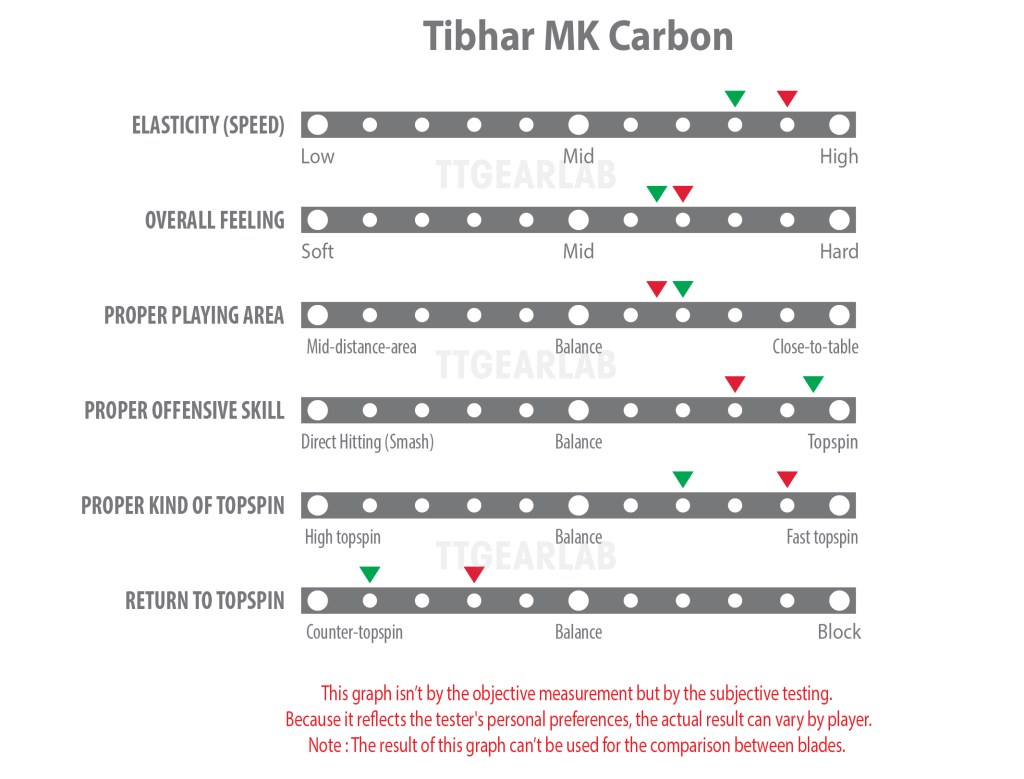
In attack with topspin, ‘MK Carbon’ gives the feeling that the blade hugs and catches the ball firmly. Further, the feeling of impact is transmitted to the index finger very clearly, and it enhances the ability of control. The impression is that ‘MK Carbon’ hugs and catches the ball a bit better than current version of ‘Viscaria’. On the contrary, the speed of ball from ‘MK Carbon’ is a bit lower than that from current ‘Viscaria’. Of course it doesn’t mean that the ball from ‘MK Carbon’ is slow. The speed of ball is basically very high. And, for that reason the player can attack by powerful topspin from mid-distance area. However, testers felt that the topspin at close-to-table area is much more effective. Also, high loop by intentionally lowering the hitting point and then pulling up the ball can be very easily performed. But, for freely using the various kinds of topspin, it seems that a certain level of technique is required. By the way, ‘Viscaria’ also shows similar characteristics in topspin. The difference between ‘MK Carbon’ and ‘Viscaria’ is that ‘MK Carbon’ is a bit slower but a bit more controllable.
‘MK Carbon’ also provides very high speed when the player attacks by smash. In general, the blades of this type (= thin outer ALC construction with Koto top layer) hugs the ball deeply at first when the player performs smash but shoots it explosively the next moment, and ‘MK Carbon’ is no exception. ‘MK Carbon’ isn’t a blade developed for the playing style oriented by smash & block, but it can be sufficiently used for that kind of playing style. The good point of ‘MK Carbon’ when the player performs smash is that it provides higher stability in smash than harder & faster blades.
Block against topspin is a bit slower than that by ‘Viscaria’ if the player just performs the block passively. But, there is also the feeling that the blade catches the ball once and then release. For that reason, the control of block is very good, and the player can increase power of block by moving the racket more actively. For the same reason, counter topspin is very effective and easy to perform. Although the block itself isn’t bad, it is recommended to use counter topspin more frequently if possible.
Stop and push are very stable even though ‘MK Carbon’ is a fast blade. Very sharp feeling that is transmitted to index finger helps the precise control. If former blade of the player is a much slower one, some time for adaptation is required of course. However, the period for adaptation will not be long. Flick is also easier than expected. But, the player should be careful about the counterattack from the opponent because the ball tends to fly rather quickly.
Above are the result when ‘MK Carbon’ is combined with ‘Hybrid MK’ or ‘Tenergy 05’. The combination with ‘Hybrid MK’ or ‘Tenergy 05’ is recommended as the standard combination. The players will be able to adjust from this standard by attaching different rubber. The result when ‘Hybrid K3’ which is a sticky rubber is attached to ‘MK Carbon’ is not much different, except for somewhat harder feeling. Players will just feel that the combination with sticky rubber such as ‘Hybrid K3’ is somewhat more biased to spin. The basic characteristics of ‘MK Carbon’ doesn’t change by the combination with sticky rubber. One reason is that ‘MK Carbon’ itself is a bit more biased to spin. But, although ‘Hybrid K3’ is a sticky rubber, it is possible to smash normally for high balls just like when using a non-sticky rubber. And, it is easier to make variation of block. The ease and the effectiveness of backhand counter topspin and block make it possible to understand why Kenta Matsudaira uses ‘Hybrid K3’ on his backhand side. But, what concerns is the hardness of sponge. Although ‘Hybrid K3’ doesn’t feel as hard as its sponge density indicates, ordinary players may feel that it is too hard on backhand side. Probably ‘Hybrid MK’ or ‘Hybrid K3’ will be better combination on the backhand side of ‘MK Carbon’ for ordinary players, and ‘Hybrid K3’ is recommended for forehand side.
Below is the summary of the testers’ opinions on the ‘MK Carbon’. Testers are distinguished by the color of indicator. (Red and green.) Please don’t forget that this subjective evaluation can’t be used for the comparison with the other blades, because the result is influenced by the characteristics of testers, and the condition of testing always varies.
Please click here to return to top (table of contents)
5. Summary
Tibhar ‘MK Carbon’ is the blade specially developed for Kenta Matsudaira. It is an outer fiber blade whose top layer is Koto and whose artificial material is new Crypto Carbon. Overall specification is like that of ‘Viscaria’ or ‘Zhang Jike ALC’.
‘MK Carbon’ provides high speed that we can expect from its construction. It is a bit slower than ‘Viscaria’ when the impact strength is high, but instead it hugs the ball a bit deeper than ‘Viscaria’.
The primary feeling of ‘MK Carbon’ is as hard as that of ‘Viscaria’. However, the feeling transmitted to the player’s index finger through the wing of blade is noticeably sharper or harder than that of ‘Viscaria’. For that reason, it is expected that there will be many players who feel that ‘MK Carbon’ is harder than ‘Viscaria’. Some players will feel this hard feeling uncomfortable. However, probably thanks to that hard feeling, the hollow feel that can be felt from outer ALC blade with Koto top layer whose weight is under 90g is significantly reduced. Some players will think that the feeling of ‘MK Carbon’ is quite natural although it is hard.
In actual testing at table tennis court, ‘MK Carbon’ shows good feeling and performance of topspin. Because ‘MK Carbon’ hugs and catches the ball firmly, various kinds of topspin can be performed easily and effectively.
Regarding rubber combination, the standard spin-oriented tension rubbers of new generation for example ‘Hybrid MK’ or ‘Tenergy 05’ fits for ‘MK Carbon’ very well, and are recommended as the rubbers for standard combination. Because ‘MK Carbon’ isn’t a blade with very unique characteristics, the rubbers with softer / harder sponges are expected to also fit for it without problem. And, it also makes good harmony with new sticky tension rubbers such as ‘Hybrid K3’. The combination with sticky rubber is recommended for the players who want to play with a bit more spin-oriented strategy.

PROS :
- High ability for attack by topspin. It properly hugs and catches ball while providing high elasticity.
- Great ball touch. Very precise control is possible because the hitting feeling is transmitted very clearly without the hollow feeling that sometimes occurs with the blades of similar type.
- Relatively light in weight. There are many pcs. whose weights are even under 85 grams.
CONS :
- Higher level of player’s skill is required if the player wants to freely use a variety of skills.
- The feeling which is harder than expected may be uncomfortable, especially for the players who have been accustomed to pure wood blades.
- Expensive as an outer-ALC blade.
VERDICT :
- A powerful blade for the offensive play with topspin.
RECOMMENDATION :
- The skilled players who play mainly with topspin and counter topspin.

Please click here to return to top (table of contents)
 TTGearLab
Thank you very much for this detailed report.
I think I’ll try the MK Carbon next season.
LikeLike
Thank you for comment. I think that this is a very good blade.
LikeLike
great review!
A revoldia’s review soon?
LikeLike
Thank you for comment. Currently there isn’t plan for reviewing of introducing Revoldia CNF. The reason is that its price is too high.
But, it may be possible in the future.
LikeLike
Thank you for our continuous contribution to this website, another interesting article full of information. I have read all your reports in the TTGEARLAB sites and the Koto top layer, ALC, Ayous second layer and Kiri center layer combination appears to be a very popular choice of material for table tennis blades manufacturers. Just from your recent posts, the Viscaria, KTS Fury KC, Tibhar MK Carbon, DHS 506X, Xiom 36.5ALX and the Yinhe V14 PRO are all made of the same combination of wood and artificial material. Even the Stiga Inspiria CCF use the same wood combination for its inner carbon configuration. The Ep values published in your articles fall in the range of 1.9 to 2.2 depending on the thickness of the blades and the variations of the carbon layers used by different manufacturer. The Ec values show more differences in values between these different blades though. In your opinion, do you think the average amateur player with intermediate skills level can feel the differences between the blades mentioned above? In other words, if I own a Butterfly Viscaria, should I invest in another blade of the same wood combination from a different company and expect it plays very differently.
I own a couple of Stiga blades made from Limba top layers and I can tell the difference between a Koto and a Lima top layers, since Lima has a softer feel when making contact with the ball. However, I don’t have playing experience with different blades of the same Koto, ALC, Ayous, Kiri combination.
Another question is the Ec value seems to have a wider variation for the blades you tested, and the Ep/Ec ratio is an indication of whether the blade is deep hold when hitting hard. Since hitting hard is not a measured value, can you qualify how hard do you have to hit for the Ec value to be meaningful? Can an average amateur player with intermediate skill level hit the ball hard at all or only professional with perfect skill can hit that hard for the Ep/Ec value to be meaningful?
Looking forward to your comments. Thank you.
LikeLike
Thank you for comment. In fact the constructions of those blades are ‘similar’ but not 100% same. So there can be differences, and sometimes the difference is significant. Regarding Ep, probably ordinary players will not be able to notice the difference. What is more noticeable is Ec/Ep. Even the beginners will easily notice the difference in Ec/Ep. And, in many cases Ec/Ep and Vl/Vp become the most important factors when we consider the replacement of blade.
However, there isn’t the clear criterion of ‘hitting hard’. It differs by player. Even some players will notice the difference from light hitting. What is more important isn’t the criterion but the difference between the Ec/Ep of one blade and that of another blade. If the difference is big, adaptation to new blade is somewhat difficult. But, if the difference is small, the player will be easily adapt to new blade.
LikeLike
Thank you for your comments. I am trying to relate your comment to my personal experience with the different blades that I am playing with. While I feel comfortable with the Stiga Carbonado 190 (Ec/Ep=0.84) and I have problem controlling the trajectory of the Carbonado 145 (Ec/Ep=0.74) even though the Ep of the Carbonado 145 (Ep=1.95) is lower than the Carbonado 190 (Ep=2.10). I use MX-P for my forehand rubber on all the blades and the Carbonado 145 seems to have a strong and unpredictable catapult effect. You have suggested to me in another post I can try a harder rubber on the Carbonado 145 and I have better control using a Xiom Omega 4 PRO which has a harder sponge and top sheet than the MX-P. In the meantime, I can adapt to the DHS 301T (Ec/Ep=0.91) without much problem. The 301T feels hard due to the Koto top layer despite the 301T is an inner carbon blade. I also have a Butterfly Viscaria Super ALC (Ec/Ep=0.97) in which I haven’t had much playing time with it to comment on, but the MX-P will not work because the blades and two rubbers weighs over 193 grams. I need to experiment the Viscaria SALC with lighter rubbers to reduce the weight to feel comfortable
Just one more question, how meaningful is the Vp, Vl and Vl/Vp values for a penhold grip blade?
Again, thank you for your time and sharing your knowledge to us.
LikeLike
Thank you for detailed explanation on your experience. That will be great information for readers.
Regarding the additional question, Vl/Vp is important also for penholder blades. That is because the penholder players will feel Vl by thumb and index finger.
LikeLike
Hi, do you know how this blade would compare to the Cho Daeseong TMX Pro blade? I know you have reviewed the an jaehyun TMX and TMXi blades (not pro versions), so maybe you have an idea of how the Cho Daeseong blade compares? Thanks!
LikeLike
Cho Daesung TMX Pro is the professional version of An Jaehyun TMX. Its construction is same as normal An Jaehyun TMX. But, its head is a bit bigger.
The bigger head will make it more elastic than normal version. Further it can create even higher power because of heavier head.
But, in many cases, deviation by pc. is even bigger than that difference. For that reason you may feel that CDS TMX Pro is not much different from normal AJH TMX. In my opinion, if you want to experience the advantage of PRO version, you have to select heavy one whose weight is over 90g. If you don’t like that heavy one, I recommend you to just select normal version.
LikeLike
Just bought MK Carbon, previous blade was Viscaria. I must say that every word in the review is true, especially about the feel – the blade really does not have the “cracked matchbox” effect and feels awesomely crisp. I’m in love 🙂
LikeLike
Thank you for comment and sharing your experience. 🙂 It is good to hear that you are satified with MK Carbon!
LikeLike
Hi!
I have two blades. MK carbon and Felix Lebrun crypto carbon. Witch blade do you think is best for short pips on BH?
LikeLike
None of those two are designed for short pips. But, if we have to select one between two, MK Carbon may be more proper solution. It is quite similar to Viscaria. And, there have been some cases that the players have used shopt pips with Viscaria or similar blades.
LikeLike
hi friend,
I always use FL handle blade. What if I change to ST one MK carbon blade?
Looking forward to your advice.
thank you
H
LikeLike
This is a rather difficult question to answer. But, anyway the ST handle of MK Carbon is ‘semi-wide’ type. It is a kind of ‘thin and wide’ handle. It will give you firm and stable, but not excessively firm grip. If that coincides with what you currently require from a new handle type, MK Carbon ST can be a solution.
And, if your current FL handle is also semi-wide type, adapting to this ST handle may not be as difficult as we expect.
But, if you like twiddling, different model will be better. For example Timo Boll ALC ST (or FL) is good for twiddling.
LikeLike
Hi,
I usually use FL handle. What if I switch to ST handle of MK carbon blade? What are pros and cons?
Thank you
H
LikeLike
That depends on the preference or the characteristics of each player. In general, they say that FL handle gives firmer grip and ST handle gives more freedom of adjustment. However, there are various types of FL handles and also various types of ST handles. For example the FL handle of MK Carbon or Viscaria is totally different from the FL handle of InnerForce Layer ALC. And, Master (standard FL) of Stiga is different from both of two. Stiga once produces another type of FL – Legend – which is also different from both of two. All different.
In case of MK Carbon, the FL is quite close to the ST. Those two are not extremely different from each other. So, the only noticeable difference would be that the ST grip end width is narrower, so it will be less of a hassle to bend your wrist. (But, the story will be different and more complex for other blades.)
LikeLike
Hi TTGearLab, I’m going to use the medium long pip for my backhand. Can you recommend the best one recently? Can I pair it with Timo Boll ZLC? Thank you. Hanh
LikeLike
Thank you for comment. But, I’m sorry that I’m not the specialist of that kind of rubbers. I don’t have much experience of using long pimple rubber with medium height pimple. I can only tell you that MK Carbon will not be bad for using with medium pimple rubbers if your playing style is aggressive.
LikeLike
No problem. Thanks anyway for your reply. Hanh
LikeLike
I just bought this blade and compared with my fzd alc, I do not see any difference! the handle the head size the wood the fiber they all look the same! I doubt if this blade is made by butterfly.
LikeLike
Even the handle shape is almost identical. The difference is that the color of fiber is green, while the color of fiber in FZD ALC is blue.
But, MK Carbon is not pruduced by Butterfly.
LikeLike
Good day. Really great information and very detailed too. I became aware of your site by chance. Am a player from Germany. Do you have a question? I play the Butterfly Viscaria and am looking for a blade that is as good for the backhand but also good for the forehand. The Viscaria is great for the backhand (with Tenergy 05) but the forehand has too little penetrating power and is not good from half distance. I read through your report on the XIOM Hugo and found it very interesting. Maybe you have some suggestions? Best regards
LikeLike
In my opinion, you’d better replace your forehand rubber with faster one which can be enhanced from Tenergy 05 or similar rubbers. For example Dignics 05 or Evolution MX-D. Tenergy 05 isn’t the rubber that is made for powerful attack from mid-distance. When Butterfly developed Tenergy series, they consider Tenergy 05 as the replacement of Sriver. (And, they consider Tenergy 64 as the replacement of Bryce which gives higher power for mid-distance attack.) But, because the players preferred Tenergy 05 to Tenergy 64 but required higher power, the new ones like Dignics series were developed. So Dignics 05 may be the solution.
And, if you want to replace your blade with faster one while keeping the basic characteristics of blade, currently the first recommendation is Fan Zhendong Super ZLC. Fan Zhendong ZLC is too much different from Viscaria or Fan Zhendong ALC. But, FZD Super ZLC shares many characteristics with Viscaria while providing higher speed.
LikeLike
Hello.
Thank you very much for the Information.
Best regards from Germany
LikeLike
Thanks again. I also read your article about the Tibhar MK Carbon and am wondering if I should play it instead of my Butterfly Viscaria? I really like the MK and also that it seems to have better control. Control has become important to me as I am an older player . Your report about it would persuade me to buy it. Thanks for your great tips and advice. Kind regards and stay healthy
LikeLiked by 1 person
Thank you for comment. Both of MK Carbon and Viscaria are good blades. So we will be able to select just by the appearance. You will be satisfied with any of those two if your playing style fits for that kind of blades. 🙂
LikeLike
Can you recommand this blade for a player who is not a complete beginner but still makes a lot of mistakes in matches? (2 years of diligent practice)
LikeLiked by 1 person
can you please explain shortly how the mk carbon performers compare to viscaria
LikeLike
Simply speaking, those two blades perform in very similar way.
LikeLike
Basically this kind of blade is not for the player whose skill is not stable. There may be some players who can dramatically reduce the mistakes by using this blade. But, there will be more players who becomes even worse with this blade. I recommend softer and slower blade for that kind of players.
For example Tibhar Libra.
LikeLike
I already own Tibhar Drinkhall Power Spin Carbon. I like it very much in all aspects of the game and also its low weight (mine 87 g). Except I want more power sometimes. Does it make sense to go for Tibhar MK Carbon? Is there any big difference between them or not really and therefore should I seek other faster OFF+ blades?
LikeLike
There are differences in playing characteriscits of those two blades. However, there will not be dramatic difference in power. If you want the blade that hugs ball a bit more deeply than Drinkhall Power Spin Carbon, MK Carbon will satify you, but that is the all. If you pursue highe power, you’d better go to faster blade in my opinion.
LikeLike
“Darinkhall Power Spin Carbon’ also shows very high value of Ec, although its Ep is noticeably lower than that of ‘MK Carbon’.” There is clearly an error in this formulation, since measurements indicate the opposite.
LikeLike
The Ep of Drinkhall Power Spin Carbon is 1.93 which is lower than 2.01 of MK Carbon.
LikeLike
Greetings! Tibhar also released the Alexis Lebrun and Oh Jungsung blades, which seem to have the same ‘Vis-like’ structure with this green Krypto carbon as this MK blade. Do you have any idea what the differences between the three might be?
LikeLike
Tibhar Alexis Lebrun has Limba top layer. That is the difference from MK Carbon.
Tibhar Alexis Lebrun can be compared not with Viscaria but with Freitas ALC.
LikeLiked by 1 person
Hello TTgearlab team! How would you compare this blade with the Zhang Jike New Era? Which one is faster? And which one has more dwell time? Thank you!!
LikeLiked by 1 person
Zhang Jike New Era is a bit faster. BTW, dwell time is identical for all blades. What we feel as if the ball dwells on the racket is no more than the residual vibration.
The dwell time is just around 1/1000 second. But, we feel that it is longer. We feel as if ball is still on the rubber surface, but in fact the ball has already left.
LikeLike