
| Table of Contents | 1. Overview 2. Performance Indices 3. Comparison by Performance Indices ……. 3-1. Elasticity Indices ……. 3-2. Vibration Indices 4. Field Test 5. Summary |
From the successful debut of ‘InnerForce’ series in 2009, Butterfly has been forcing on inner-fiber blades under the name of ‘InnerForce’. After getting confidence on inner fiber construction in the poly-ball age, Butterfly announced ‘InnerForce Layer’ series which is basically the renewal of the original ‘InnerForce’ series. And then, various signature blades based on ‘InnerForce Layer’ series have been introduced. Butterfly ‘Franziska InnerForce ZLC’ which was launched on July 1st 2021 is one of those signature blades. It is the blade developed for Patrick Franziska who is one of the main members of German Men’s National Team. It is based on ‘InnerForce Layer ZLC’, but the main difference is in its weight. ‘Franziska InnerForce ZLC’ is much lighter than ‘InnerForce Layer ZLC’. Apart from the weight, it hasn’t been announced what other adjustment have been made.
TTGearLab analyzed ‘Franziska InnerForce ZLC’ through Performance Indices and compared it with some existing blades. Further, TTGearLab also checked the actual characteristics of ‘Franziska InnerForce ZLC’ by field testing at table tennis court.
1. Overview
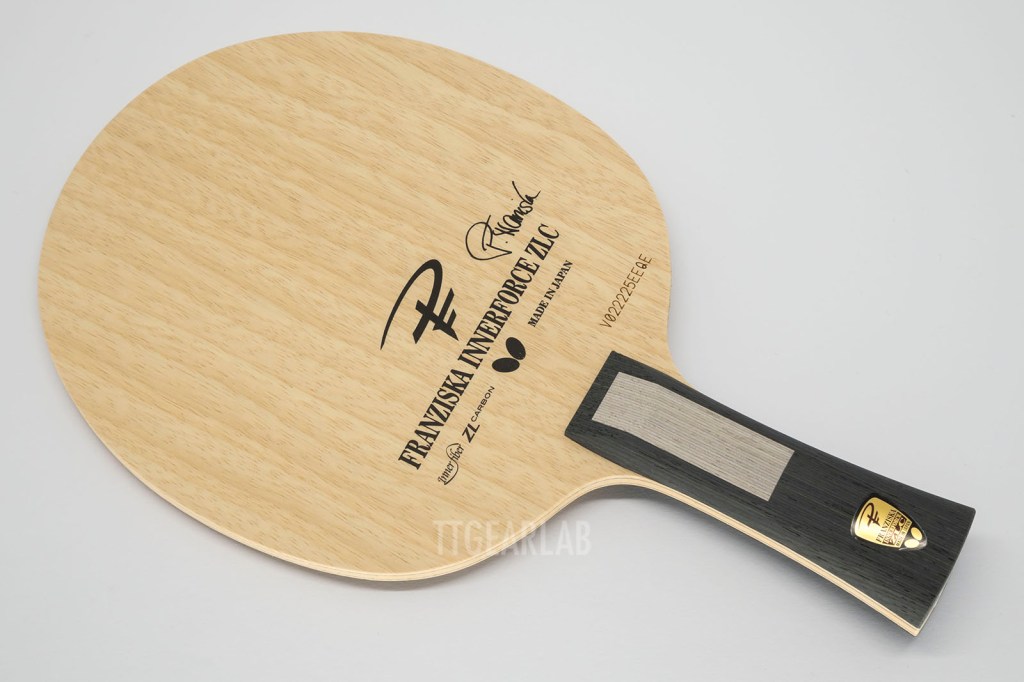
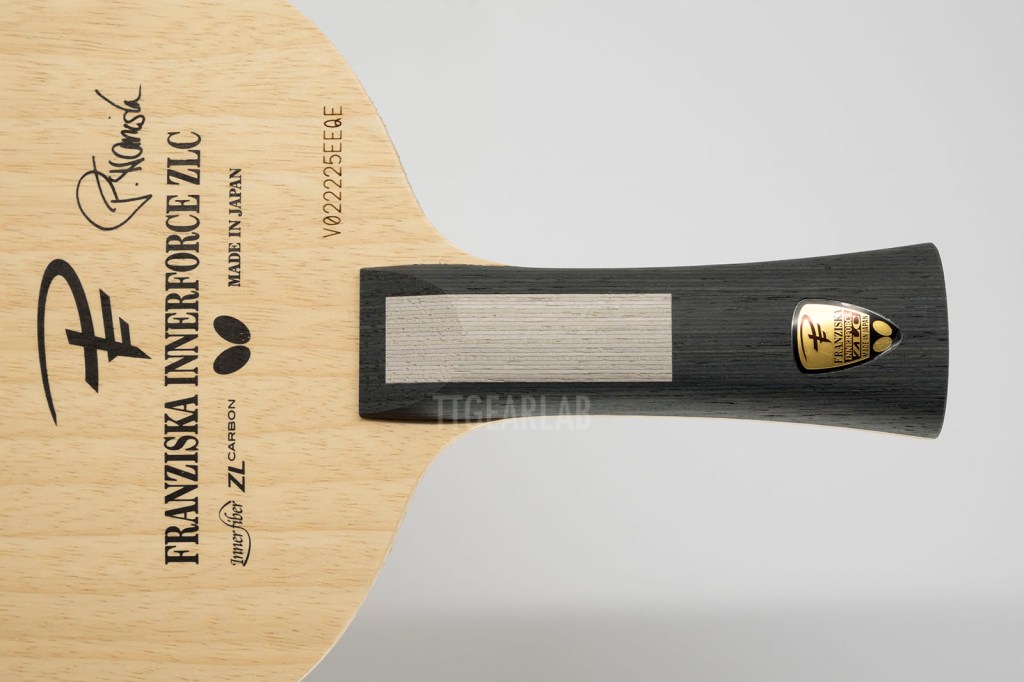
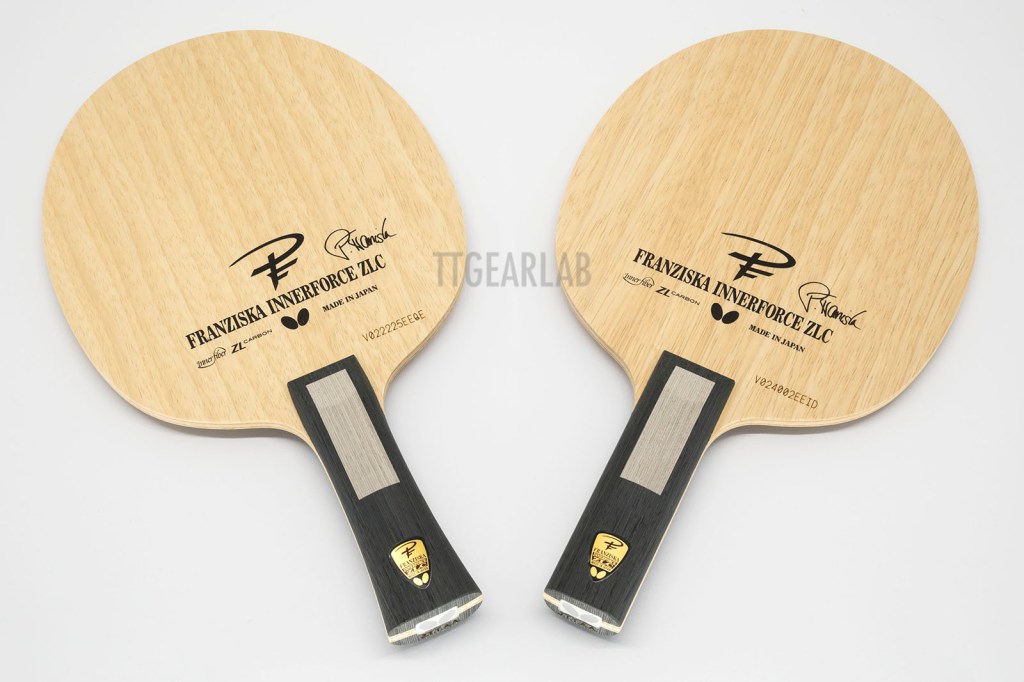
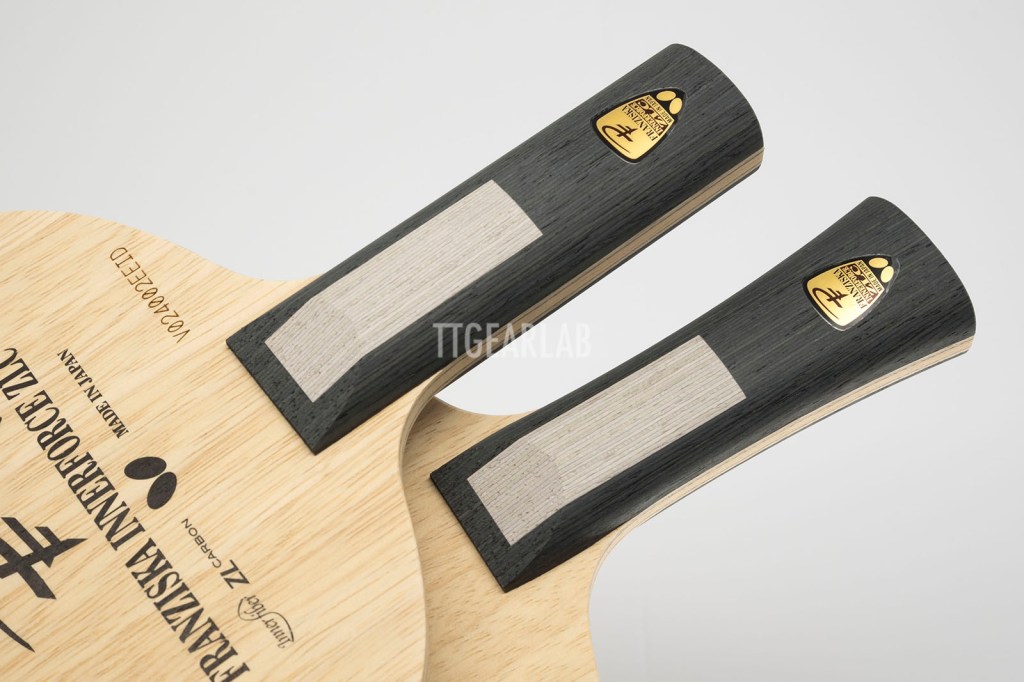
‘Franziska InnerForce ZLC’ is the blade for Patrick Franziska, and exclusive design for Patrick Franziska is applied to it.

The exclusive logo expresses P & F those are the initials of Patrick Franziska. With the simple color combination of handle, it expresses a stoic figure trying to find light through rigorous practice. It is expected that this graphic design will be also applied to the other blades of ‘Franziska’ series if those are launched in the future.
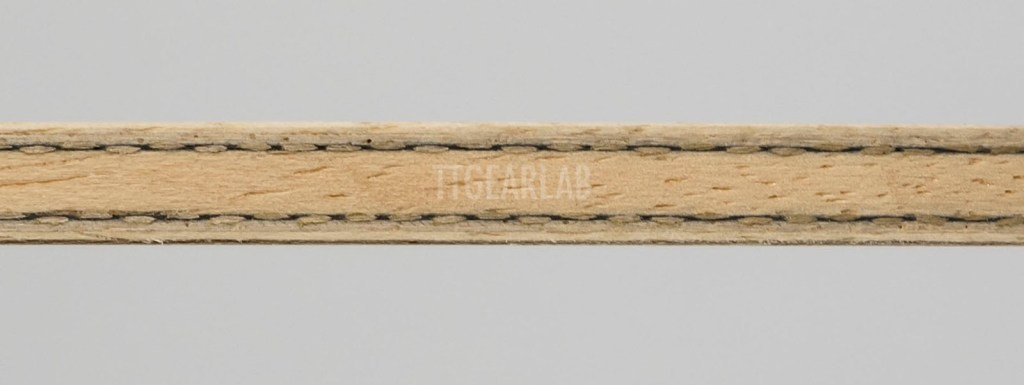
‘Franziska InnerForce ZLC’ is based on ‘InnerForce Layer ZLC’, and the specifications except for weight are identical to those of ‘InnerForce ZLC’. The top layer is Limba, the middle layer and the center layer are Ayous. ZLC (= Zylon Carbon) is inserted between the middle layer and the center layer. Overall thickness is 5.7mm which is identical to that of ‘InnerForce Layer ZLC’.
The size of head is 157mm (length) x 150mm (width) which is also identical to that of ‘InnerForce Layer ZLC’. But, the average weight written on Butterfly home page is 85 gram which is lighter by 5 gram than the weight of ‘InnerForce Layer ZLC’.
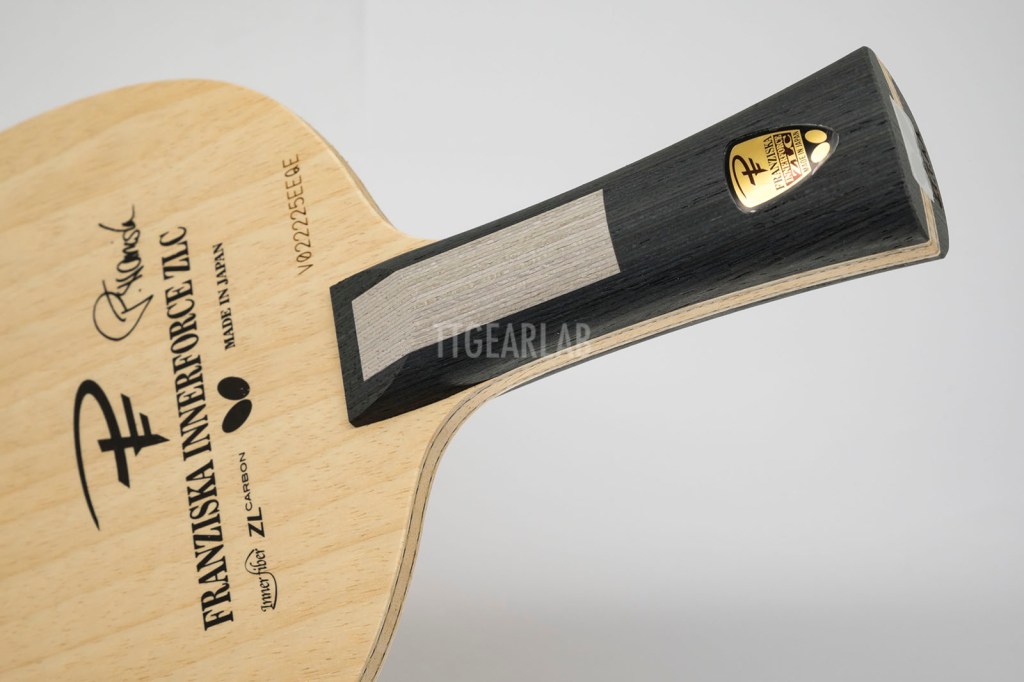
Three kinds of handles – FL (flared), ST (straight) and AN (anatomic) – are available. (But, TTGearLab couldn’t get the AN handle version.) The FL handle of ‘Franziska InnerForce ZLC’ is the standard FL of Butterfly which is also applied to ‘Timo Boll’ series or ‘InnerForce Layer’ series. It is different from the semi-wide FL which is applied to ‘Viscaria’ or ‘Fan Zhendong’ series. Its width is 26.5mm ~ 27.5mm (at bulge) ~ 25.6mm (at the narrowest point) ~ 34mm from the head side to handle end. Its thickness is around 24mm at thumb and around 25mm at the end.

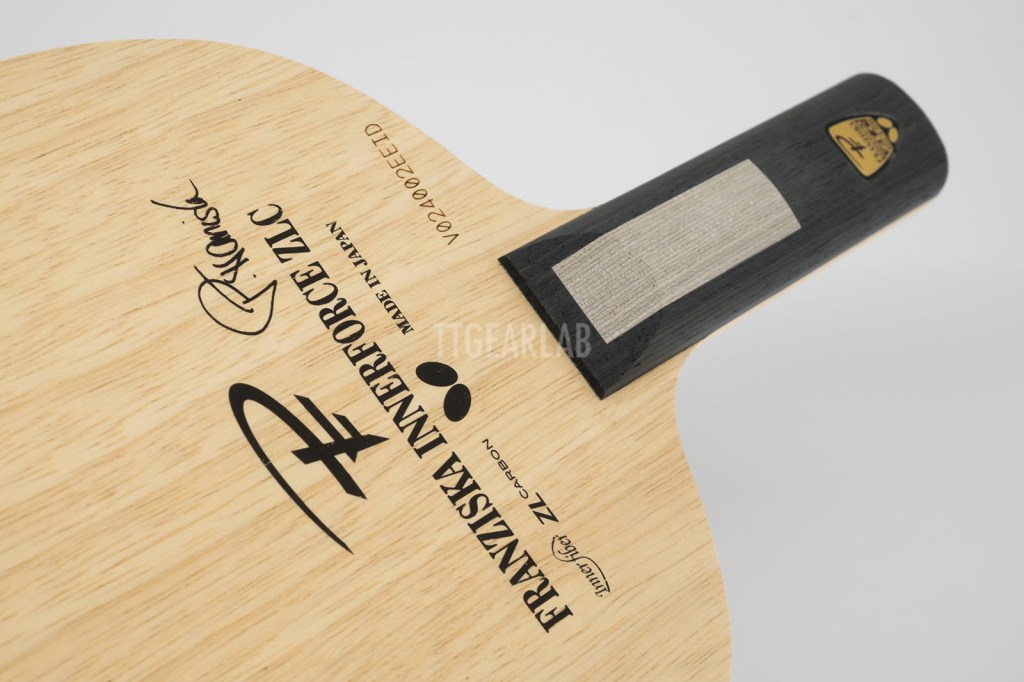
The ST handle of ‘Franziska InnerForce ZLC’ is the standard ST of Butterfly which is applied to most of Butterfly blades. It is the semi-wide ST handle whose cross section is a bit rounded. And, it is of course basically same as the ST handle of ‘InnerForce Layer’ series. Its width is around 28mm, and its thickness is around 23mm.

There is small hologram lens at the backside of handle. This small lens started to be applied to Butterfly blades in 2014, and has become one of the identity of Butterfly blades.
At the end of handle there is a squared logo plate. (No picture in this article.) The new logo without the text ‘Butterfly’ has been applied from 2014.

Then, let’s check the characteristics of ‘Franziska InnerForce ZLC’ by Performance Indices and compare with the some existing blades.
Please click here to return to top (table of contents)
2. Performance Indices
Performance Indices are measured objective values to represent the characteristics of table tennis gears. Concerning the detail of four performance indices, please refer to following articles in ‘About TTGearLab’ section:
- Performance indices : the way to evaluate blade by measurement
- The example of comparison by performance indices
The performance indices of ‘Franziska InnerForce ZLC’ are as follows:
Franziska InnerForce ZLC (average weight = 84.8g)
Ep = 1.70
Ec = 1.65 (Ec/Ep = 0.97)
Vp = 1.22
Vl = 1.22 (Vl/Vp = 1.00)

The Ep of ‘Franziska InnerForce ZLC’ (= 1.70) is a bit higher those we can expect from standard inner-ALC blades, but is noticeably lower than that of ‘InnerForce Layer ZLC’. Probably that is because ‘Franziska InnerForce ZLC’ is much lighter than ‘InnerForce Layer ZLC’.
Ec/Ep is a bit lower than 1.0 which is the neutral value. ‘Franziska InnerForce ZLC’ hugs the ball when the player hits the ball very strongly, but just a bit. It is expected that ‘Franziska InnerForce ZLC’ gives more kick than the blade whose Ec/Ep is lower.
Vp (Primary Vibration Index) is 1.21. It is a relatively high value as that of inner fiber blade, but is noticeably lower than the values of outer-fiber blades such as ‘Viscaria’. The players who have used outer-fiber blades will feel that ‘Franziska InnerForce ZLC’ is soft. And, Vl/Vp (= 1.00) is neutral. The feeling transmitted to index finger isn’t relatively sharper or more comfortable than the primary feeling transferred to palm.
The characteristics of ‘Franziska InnerForce ZLC’ other than elasticity is almost neutral. In general, that kind of characteristics fits for modern all-round play which utilizes a variety of techniques.
Please click here to return to top (table of contents)
3. Comparison by Performance Indices
Then we can compare ‘Franziska InnerForce ZLC’ with some other blades in the market. The main purpose of the comparison is to observe the difference between ‘Franziska InnerForce ZLC’ and its base model – ‘InnerForce Layer ZLC’. And additionally, six other inner fiber blades and three 5-ply wood blades (including reference blade) will be compared with ‘Franziska InnerForce ZLC’.
Following is the list of the blades to be compared :
Base Model of ‘Franziska InnerForce ZLC’
- Butterfly ‘InnerForce Layer ZLC’ (avg. weight = 89.8g) : Representative of inner-ZLC blades. Heavier than ‘Franziska InnerForce ZLC’.
Inner Fiber blades – Relatively Higher Elasticity
- Butterfly ‘Ovtcharov InnerForce ALC’ (avg. weight = 88.0g) : Thick inner-ALC blade. Faster than most of inner fiber blades.
- Xiom ‘An Jaehyun TMXi’ (avg. weight = 86.4g) : Inner Fiber blade whose artificial is ‘Trimetrix’ which is the weaved from three kinds of fibers.
- Butterfly ‘InnerForce Layer ALC’ (avg. weight = 91.2g) : The standard model of inner-ALC blades – 2023 version which is thicker, heavier and faster than older version measured in 2018
Inner Fiber blades – Moderate Elasticity
- DHS New ‘Hurricane Long 5’ (avg.weight = 88.1g) : Representative of current inner-ALC blades – New 2022 version
- Xiom ‘36.5 ALXi’ (avg.weight = 87.1g) : Inner-ALC blade whose construction is similar to that of ‘InnerForce Layer ALC’.
- Tibhar ‘Fortino Pro DC Inside’ (avg. weight = 83.4g) : Inner-DC (Dyneema Carbon)’ blade.
Others
- Butterfly ‘Korbel’ (avg. weight = 88.7g) : The standard of 5-ply wood offensive blades.
- Butterfly ‘Primorac’ (avg. weight = 87.5g) : Another standard 5-ply wood offensive blade that is slower than ‘Korbel’. European version.
- Stiga ‘Allround Classic’ (avg. weight = 84.3g) : The representative of classic 5-ply wood all-round blade. Reference blade of TTGearLab Performance Index System. All indices are 1.00.
3-1. Elasticity Indices

Fig.10 shows the comparison graph of Elasticity Indices.
Ep (Primary Elasticity Index) is directly concerned with the rebound speed of blade. Ec (Central Elasticity Index) is concerned with additional ‘kick’ when player hits ball very strongly.
[Base Model] ‘InnerForce Layer ZLC’ is the base model of ‘Franziska InnerForce ZLC’, and the plywood constructions of those two models are identical to each other in appearance. The Ep of ‘InnerForce Layer ZLC’ is noticeably higher than that of ‘Franziska InnerForce ZLC’. That difference is probably because of the difference in weight. On the contrary, the difference between the Ec’s of those two isn’t that significant. As the result, the shapes of the graphs of two models look different from each other. Then the actual impression of ‘Franziska InnerForce ZLC’ will be much more different from that of ‘InnerForce Layer ZLC’ than we expected from the constructions.
[Inner Fiber – Relatively Higher Elasticity] The blades of this group can be compared with ‘InnerForce Layer ZLC’. So, the Ec of the three blades in this group – ‘Ovtcharov InnerForce ALC’, ‘An Jaehyun TMXi’ and ‘InnerForce Layer ALC’ – show noticeably higher Ep’s than ‘Franziska InnerForce ZLC’. The Ec’s of these three models are also higher than the Ec of ‘Franziska InnerForce ZLC’, but the difference isn’t significant.
[Inner Fiber – Moderate Elasticity] This group includes three models – ‘Hurricane Long 5’ (current model), ‘36.5 ALXi’ and ‘Fortino Pro DC Inside’. The Ep’s of ‘Hurricane Long 5’ and ‘36.5 ALXi’ are just a bit lower than the Ep of ‘Franziska InnerForce ZLC’, but the differences are very small. We will be able to think that the primary elasticity levels of those two models are same as that of ‘Franziska InnerForce ZLC’. However, the Ec’s of those two are significantly lower than the Ec of ‘Franziska InnerForce ZLC’. Those two will hug the ball even more deeply than ‘Franziska InnerForce ZLC’ when the player hits the ball very strongly. (And, for that reason some players will feel that those two are softer.) Both of Ep and Ec of ‘Fortino Pro DC Inside’ are much lower than those of ‘Franziska InnerForce ZLC’. However, we can see that there isn’t difference between the Ep and the Ec of ‘Fortino Pro DC Inside’. As the result, the graph shape of ‘Fortino Pro DC Inside’ is quite similar to that of ‘Franziska InnerForce ZLC’. Although there is clear difference in overall elasticity level, some players will feel that ‘Fortino Pro DC Inside’ and ‘Franziska InnerForce ZLC’ can be used in same way.
[5-ply wood] 5-ply wood blades are apparently less elastic than ‘Franziska InnerForce ZLC’. The most elastic in this group is ‘Korbel’. But, its Ec is much lower than its Ep, and therefore its graph shape looks much different from that of ‘Franziska InnerForce ZLC’. On the contrary, ‘Primorac’ (Europe version) and ‘Allround Classic’ show similar graph shapes as ‘Franziska InnerForce ZLC’. It means that the player who have used ‘Primorac’ or ‘Allround Classic’ may be able to use ‘Franziska InnerForce ZLC’ without much problem although there are differences in elasticity.
Examining Ec/Ep is an easier way to understand the characteristics of blade concerned with elasticity. Fig.11 shows the relationship between Ec/Ep and Ep.

Ec/Ep expresses the ‘tendency’ of the elasticity of blade. By examining Ec/Ep and Ep at the same time, we can easily understand the behavior of blades.
On the graph, all blades in this comparison excluding two blades are in ‘Hold’ range (Ec/Ep < 1.0). But, the blades are widely distributed in the range. ‘Franziska InnerForce ZLC’ is located just below the ‘Linear’ line, and it means that ‘Franziska InnerForce ZLC’ hugs the ball a bit when the player hits the ball very strongly. But, the amount of hug is not big, and the character of ‘Franziska InnerForce ZLC’ is close to linear. ‘Franziska InnerForce ZLC’ linearly reacts as much as the strength of impact by the player. That ‘linear’ behavior helps the player to control the ball precisely.
Then we can first compare the positions of ‘Franziska InnerForce ZLC’ and ‘InnerForce Layer ZLC’. ‘InnerForce Layer ZLC’ is located to the lower right of ‘Franziska InnerForce ZLC’. It means that ‘InnerForce Layer ZLC’ is more elastic in primary elasticity and hugs the ball more deeply than ‘Franziska InnerForce ZLC’ when the player hits the ball very strongly. Between two blades, it is expected that ‘InnerForce Layer ZLC’ fits more for continuous topspin while ‘Franziska InnerForce ZLC’ fits more for all-round play, if we just consider elasticity characteristics.
And, ‘An Jaehyun TMXi’ and ‘InnerForce Layer ALC’ (current model) are located close to ‘InnerForce Layer ZLC’. If we compare those two with ‘Franziska InnerForce ZLC’, those two will not much different from ‘InnerForce Layer ZLC’. And, ‘Ovtcharov InnerForce ALC’ is located further to the lower right than ‘InnerForce Layer ZLC’ and two nearby blades. We can see that there are significant difference of elasticity characteristics between ‘Franziska InnerForce ZLC’ and ‘Ovtcharov InnerForce ALC’.
‘Hurricane Long 5’ and ‘36.5 ALXi’ show similar Ep’s to ‘Franziska InnerForce ZLC’. However, ‘Hurricane Long 5’ is located below ‘Franziska InnerForce ZLC’ and the gap is quite significant, and ‘36.5 ALXi’ is located even further below ‘Hurricane Long 5’. So ‘Hurricane Long 5’ will hug the ball more deeply than ‘Franziska InnerForce ZLC’ when the player hits the ball very strongly, and ‘36.5 ALXi’ will hug the ball even more deeply than ‘Hurricane Long 5’. If the impact strength is high, it is expected that ‘Franziska InnerForce ZLC’ can make much faster ball than ‘Hurricane Long 5’ or ‘36.5 ALXi’, but that difference will not be significant if the impact strength isn’t high.
There are three blades whose levels of Ec/Ep’s are similar to that of ‘Franziska InnerForce ZLC’. Those are ‘Allround Classic’, ‘Primorac’ (European version) and ‘Fortino Pro DC Inside’. We can categorize ‘Franziska InnerForce ZLC’ and those tree into ‘Linear or close to linear’ blades. Despite the differences in primary elasticities, there will not be serious problem when the player changes blade from one to another among those four models. And, we can expect that all four models will provide the ability of very precise control, and will suit for all-round play that uses a variety of techniques.
Then next, let’s compare Vibration Indices.
Please click here to return to top (table of contents)
3-2. Vibration Indices
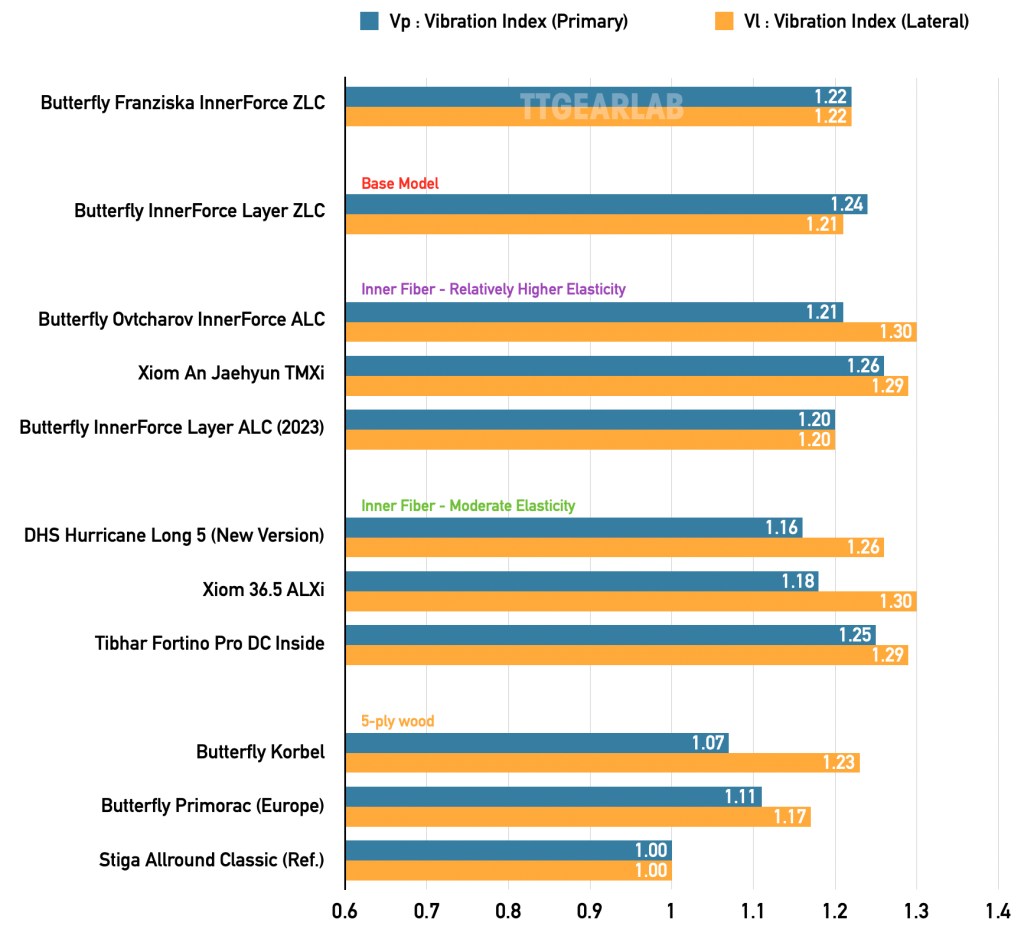
Fig.12 shows the comparison graph of Vibration Indices. Vibration Indices are concerned with feeling. Vp indicates primary feeling which is transferred to player’s palm. And, Vl is the feeling at the edge of the wing – the lower side of blade head. It is felt by player’s index finger or middle finger.
[Base Model] ‘InnerForce Layer ZLC’ is the base model of ‘Franziska InnerForce ZLC’, and the plywood constructions of those two models are identical to each other in appearance. The Vp and Vc of ‘InnerForce Layer ZLC’ are a bit higher and a bit lower than those of ‘Franziska InnerForce ZLC’ respectively, but the differences aren’t big. So we can expect that there isn’t much difference in feeling between two models. (But, the difference in Ec/Ep also works as the difference in feeling. So, the players will feel that those two are different from each other.)
[Inner Fiber – Relatively Higher Elasticity] The blades of this group can be compared with ‘InnerForce Layer ZLC’. The Vp of ‘Ovtcharov InnerForce ALC’ is close to that of ‘Franziska InnerForce ZLC’, but its Vl is much higher than that of ‘Franziska InnerForce ZLC’. ‘Ovtcharove InnerForce ALC’ will give much sharper feeling to the index finger of the player, when compared with ‘Franziska InnerForce ZLC’. And, both of the Vp and the Vl of ‘An Jaehyun TMXi’ are higher than those of ‘Franziska InnerForce ZLC’. On the contrary, both of the Vp and the Vl of ‘InnerForce Layer ALC’ are close to those of ‘Franziska InnerForce ZLC’. (But again, the difference in Ec/Ep will make ‘InnerForce Layer ALC’ and ‘Franziska InnerForce ZLC’ feel different from each other.)
[Inner Fiber – Moderate Elasticity] This group includes three models – ‘Hurricane Long 5’ (current model), ‘36.5 ALXi’ and ‘Fortino Pro DC Inside’. The Vp’s of ‘Hurricane Long 5’ and ‘36.5 ALXi’ are lower than that of ‘Franziska InnerForce ZLC’. However, the Vl’s of those two are much higher than that of ‘Franziska InnerForce ZLC’. So those two will give totally different feeling from ‘Franziska InnerForce ZLC’. And, both of the Vp and the Vl of ‘Fortino Pro DC Inside’ are higher than those of ‘Franziska InnerForce ZLC’.
[5-ply wood] Three models of 5-ply wood blades show much lower values of Vp’s when compared with ‘Franziska InnerForce ZLC’. However, the Vl’s of ‘Korbel’ and ‘Primorac’ are not much different from the Vl of ‘Franziska InnerForce ZLC’. So ‘Korbel’ and ‘Primorac’ show much different graph shapes from ‘Franziska InnerForce ZLC’. On the contrary, ‘Allround Classic’ shows same graph shape as ‘Franziska InnerForce ZLC’. It is expected that the players who have used ‘Allround Classic’ can use ‘Franziska InnerForce ZLC’ without much problem despite there is big difference in elasticity.
Examining Vl/Vp is an easier way for the comparison of the tendency of feeling. Fig.13 shows the relationship between Vl/Vp and Vp for easier comparison.
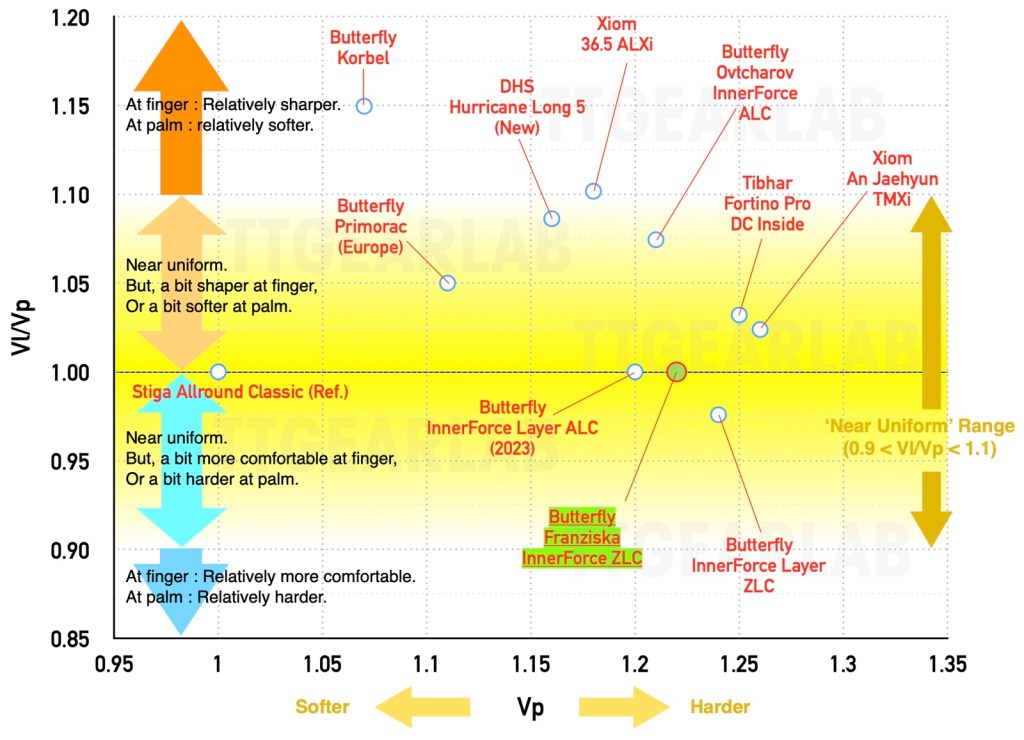
On the graph, seven blades in this comparison are placed in upper part of the graph – ‘Relatively sharper at finger’ range, one blade is in lower part of the graph – ‘Relatively more comfortable at finger’ range, and three blades are on the ‘Uniform’ line – border between upper part and lower part. And, ‘Franziska InnerForce ZLC’ is one of the three on the ‘Uniform’ line. The feeling transmitted to the index finger by ‘Franziska InnerForce ZLC’ isn’t especially sharper or more comfortable than the primary feeling that is transmitted to palm through the handle of ‘Franziska InnerForce ZLC’.
First, we can find ‘InnerForce Layer ZLC’ near the bottom right of ‘Franziska InnerForce ZLC’. ‘InnerForce Layer ZLC’ is a bit harder and a bit more comfortable than ‘Franziska InnerForce ZLC’ in primary feeling and lateral feeling respectively. Unlike the large difference between ‘Franziska InnerForce ZLC’ and ‘InnerForce Layer ZLC’ in Elasticity Indices, the difference in Vibration Indices isn’t that large. (But, although the major factors of feeling are not much different, the big difference of Ec/Ep will make some players feel those two blades different.) And, ‘InnerForce Layer ALC’ is located to near left of ‘Franziska InnerForce ZLC’. So we can tell the same thing as ‘InnerForce Layer ZLC’ for ‘InnerForce Layer ALC’.
‘An Jaehyun TMXi’ is somewhat harder in primary feeling and just a bit sharper in relative feeling when compared to ‘Franziska InnerForce ZLC’, and we can say the same thing for ‘Fortino Pro DC Inside’. The differences are not significant, but bigger than the difference between ‘InnerForce Layer ZLC’ and ‘Franziska InnerForce ZLC’.
‘Ovtcharov InnerForce ALC’, ‘36.5 ALXi’ and ‘Hurricane Long 5’ show noticeably higher values of Vl/Vp’s and lower values of Vp’s when compared to ‘Franziska InnerForce ZLC’. Those three are softer than ‘Franziska InnerForce ZLC’ in primary feeling but transmit much sharper relative feeling to index finger. We can understand that those tree are quite different from ‘Franziska InnerForce ZLC’. Among three 5-ply wood blades, ‘Primorac’ is located at lower place than ‘Korbel’. ‘Korbel’ transmits much sharper relative feeling than ‘Franziska InnerForce ZLC’. So the change from ‘Primorac’ to ‘Franziska InnerForce ZLC’ will be easier than the change from ‘Korbel’ to ‘Franziska InnerForce ZLC’. If the player has used ‘Korbel’ and want to increase the power of ball, changing to ‘Franziska InnerForce ZLC’ isn’t expected to be a good choice. Instead, ‘Ovtcharov InnerForce ALC’ is recommended as the replacement of ‘Korbel’. On the contrary, the changing from ‘Korbel’ to ‘Franziska InnerForce ZLC’ will not be that difficult. Also, despite the great difference in Primary Elasticity Indices, it is expected that ‘Franziska InnerForce ZLC’ will be good replacement of ‘Allround Classic’ for increasing the power of shot, because both of those two blades lie on the ‘Uniform’ line (Vl/Vp = 1.0).
Please click here to return to top (table of contents)
4. Field Test
‘Franziska InnerForce ZLC’ has been briefly tested at table tennis court. The test wasn’t an intensive one, and not many kinds of rubbers were combined. However, it was sufficient to find out the basic characteristics of the blade. The rubbers used for the testing are ‘Rasanter R48’, ‘Tenergy 05’, ‘Vega Asia’ and so on. In addition to those non-sticky rubbers, some sticky rubbers such as ‘Dignics 09c’ and ‘Rasanter C53’. The hitting feeling of ‘Franziska InnerForce ZLC’ is softer but a bit tougher than the feeling of ‘InnerForce Layer ZLC’. In fact, that feeling isn’t as good as the feeling of the other inner fiber blades. However, probably some players will think that the feeling of ‘Franziska InnerForce ZLC’ is a bit more natural than the feeling of ‘InnerForce Layer ZLC’. The players who have used pure wood blades may prefer ‘Franziska InnerForce ZLC’ to ‘InnerForce Layer ZLC’.
The impression of ‘Franziska InnerForce ZLC’ during the light warm-up rally is that this blade is moderately fast and highly controllable. The ball didn’t scatter, but very precisely went to aimed location while drawing vey stable trajectory. And, the ball becomes quite speedy if the player intentionally hits the ball very strongly. The trajectory tends to significantly change depending on the angle of impact and the angle of racket. In general, that kind of characteristics fits for modern all-round play which utilizes a variety of techniques. The variation by the angle is noticeable even in the situation of attack by topspin. If the angle of racket is large, the ball flies with very high speed while drawing somewhat linear trajectory. But, if the angle of racket is small, the ball draws dramatic arc which is shorter and higher. So it is easy for the player to adjust the kind of topspin. That is also one of the characteristics of ‘InnerForce Layer ZLC’ which is the base model of ‘Franziska InnerForce ZLC’, however it is even more noticeable in ‘Franziska InnerForce ZLC’. Because of its controllability and light weight ‘Franziska InnerForce ZLC’ is expected to be used by the players of all levels.
Next is the impression of topspin at close-to-table area or from mis-distance. At close-to-table area, rather than playing with just continuous topspin, it was more fun and effective to use a mix of various techniques. When playing with continuous topspin, the ball is dragged very well and draws a dramatic arc if the player adjust the angle thinner, and the ball digs into opponent’s court deeper while drawing a straighter trajectory if the player adjust the angle thicker. Utilizing this variation actively will be the key for the successful play at close-to-table area. Similar variation can also be used in the topspin from mid-distance area. It is easy to adjust between high topspin by thin racket angle and fast topspin by relatively thicker racket angle.
The block against topspin tends to be offensive block that stretches strongly. And, the feel of block is closer to that of typical 7-ply wood blades than that of typical 5-ply wood blades. ‘InnerForce Layer ZLC’ which is the base model of this blade also gives that kind of feeling, however such characteristics appear more strongly in ‘Franziska InnerForce ZLC’. The feeling of block is close to ‘kicking directly’ than to ‘catching once then release’. This makes the opponent feel that the timing of the block is earlier. And, the actual speed of the ball by block is also high. Therefore it is good for putting pressure on the opponent just by block. The player can take the initiative of rally by an offensive block, and if needed the player can step back to mid-distance area and continue the rally by topspin. That fits for modern all-round style that mixes the offense and the difference. In case the player wants to make variation of block, it will be better to use a counter-topspin rather than change the kind of the block itself. It would be good to use the mixture of block and counter-topspin.
Although the basic elasticity of ‘Franziska InnerForce ZLC’ isn’t that high, the smash is much more destructive than expected. It will be good to actively use smash as finishing stroke against a chance ball.
It is easy to put strong backspin when performing push, and in that case the ball tends to go fast into deep place of opponent’s court. Therefore, push can be actively used for taking the initiative of rally. The tactic from the receive by push will be very effective. On the contrary, stop is somewhat normal. But it doesn’t mean that there are any weaknesses in stop for example the ball easily floats high. So, the player will be able to perform stop without problem as long as the player has mastered the skill of stop. Flick will be effective if the player concentrates on scraping the ball up by the surface of racket. Of course, the player needs to consciously put strong rotation when performing flick. Then the ball goes deep into opponent’s court with the speed higher than expected. So, it becomes very effective preemptive attack. However, the player should not forget that the opponent’s counterattack is also faster. In that case, intermediate or highly skilled players will be able to continue the rally after flick by topspin at mid-distance area, but it will be somewhat difficult for entry level players. For that reason, push may be more effective way of receiving than flick for entry level players.
Regarding the combination, there isn’t any restriction in the selection of rubber. But, the rubbers that focus on spin and whose sponge density is around 48° in German standard (= around 36º in Butterfly standard) is recommended as standard rubbers for combination. Those rubbers will make good combinations for modern all-round play. Because the basic feeling of the blade isn’t hard, the rubbers whose sponge densities are over 50° can be combined without problem, but in that case, it is better for the player to be conscious of applying as strong spin as possible for more effective usage of those rubbers. The sticky tension rubbers for example ‘Dignics 09c’ or ‘Rasanter C53’ can be used quite normally, but of course the player would better be conscious of strong spin for utilizing maximum ability of those rubbers. In any combination, ‘Franziska InnerForce ZLC’ provides higher effectiveness of playing when clearly differentiated techniques are used rather than intermediate techniques.
The overall impression of ‘Franziska InnerForce ZLC’ is that it is the blade good for using a variety of techniques. ‘Franziska InnerForce ZLC’ is suitable for all-round play that actively utilizes a variety of techniques rather than focusing on specific techniques. And, ‘Franziska InnerForce ZLC’ can be evaluated as a ‘power all-round’ blade which is relatively fast one among that kind of blades. If the player has played with 5-ply wood all-round blade whose elasticity is low and want to increase the power by replacing the blade, ‘Franziska InnerForce ZLC’ will be able to be seriously considered. But, if the player has used classic thick 7-ply wood blade for fast attack and is considering a fiber blade, ‘InnerForce Layer ZLC’ will be better choice than ‘Franziska InnerForce ZLC’.
Below is the testers’ opinions on the ‘Franziska InnerForce ZLC’. Testers are distinguished by the color of indicator. (Red and green.) Please don’t forget that this evaluation can’t be used for the comparison with the other blades, because the result is influenced by the characteristics of testers, and the condition of testing always varies.

Please click here to return to top (table of contents)
5. Summary
Butterfly ‘Franziska InnerForce ZLC’ is the blade specially designed for Patrick Franziska of German Men’s National Team. It is based on ‘InnerForce Layer ZLC’, and its specifications except for weight are identical to those of ‘InnerForce Layer ZLC’. The main difference from ‘InnerForce Layer ZLC’ is that ‘Franziska InnerForce ZLC’ is much lighter in weight. It isn’t clear whether there is another adjustment in construction or not. ‘Franziska InnerForce ZLC’ is less elastic than ‘InnerForce Layer ZLC’, and it is even less elastic than ‘InnerForce Layer ALC’. But instead, ‘Franziska InnerForce ZLC’ gives more additional kick than ‘InnerForce Layer ZLC’ when the player hits the ball very strongly. The overall characteristics of ‘Franziska InnerForce ZLC’ is close to neutral, and it fits for modern all-round play that utilizes a variety of techniques and integrates attack and defense. With ‘Franziska InnerForce ZLC’ the player can take the initiative of rally by active block, and can operate offensive tactics using a variety of offensive skills including topspin and smash. It is expected that the all-round players who have played with 5-ply wood all-round blades will be able to easily adapt to ‘Franziska InnerForce ZLC’ and increase overall power of their shots. There are few restrictions in combination with rubber, but the combination with medium sponge rubber (whose sponge density is around 48º in German standard) that focuses on rotation is recommended if the player doesn’t have any standard of rubber combination. Further, ‘Franziska InnerForce ZLC’ shows very balanced performance even when combined with the recently introduced German or Japanese sticky tension rubbers, so it is worthy considering the combination with those sticky rubbers.
PROS :
- Each technique is very effective if the player clearly distinguishes between techniques.
- Lighter weight than the base model – ‘InnerForce Layer ZLC’. The weight doesn’t become a burden.
- Good harmony with various kinds of rubbers.
CONS :
- If the player doesn’t clearly distinguish between techniques, the ball tends to lose power.
- The actual feeling isn’t as good as the other inner fiber blades. (It is expected that this will not be problem for most of players.)
VERDICT :
- A well-balanced blade which allows the player to easily use a variety of techniques.
RECOMMENDATION :
- Modern all-round players who want to improve the power of shots.
Please click here to return to top (table of contents)
 TTGearLab
Hi, your website is great!
Regarding Innerforce Layer ZLC, Butterfly claims regular blade weighs 87 grams, Franziska type weighs 88 grams:
https://shop.butterflyonline.com/innerforce-layer-zlc
Do you have insider information regarding weight difference?
Best regards
Tom
LikeLike
Thank you a lot for comment.
Regarding the weight, I’m just writing the average measured weights of blades. The avg. weight of Franziska InnerForce ZLC measured is 84.8g, and the avg. weight of InnerForce Layer ZLC is 89.8g. But, those average data can be modified in the future by further measurement.
So far, those data coincides with the data officially provided by Butterfly.
InnerForce Layer ZLC = 90g (https://www.butterfly.co.jp/products/detail/36681.html)
Franziska InnerForce ZLC = 85g (https://www.butterfly.co.jp/products/detail/37121.html)
Of course, the specification data on Butterfly home page is sometimes very doubtful. However, the data on home page have become more correct than those of some years ago, and at least the weights data of these two blades coincide with my measured data.
LikeLike
Thank you for your answer! The japanese butterfly website is surely a more reliable information source than others.
By the way, the data and the information you are providing helps me a lot to build up a deeper understanding of table tennis blades and to carefully select only promising ones for tests. I do not test any blade without information from your website!
LikeLike
Thank you a lot for reading the articles on this web site and using them as reference. I’ll continuously try to improve the reliability of the data on this web site. 🙂
And, please don’t forget that the values (especially Ep) may differ if the weight of your blade is much heavier or much lighter than the avg. weight of measured blade. 🙂
LikeLike
Please, review on bty amultart zl carbon.
Regards
LikeLike
The problem for review is that I haven’t had a clean pc. of Amultart for taking picture, and the model had already been discontinued. But, at least there is data. I will use the data for some articles in the future.
Butterfly Amultart (average weight = 90.4g)
Ep = 2.48
Ec = 3.18 (Ec/Ep = 1.28)
Vp = 1.67
Vl = 1.29 (Vl/Vp = 0.77)
Its characteristics is quite unique, and there aren’t many blades those can be comparable with Amultart. It is a very good blade for smash and block. But, we can make good topspin by thin & long impact.
LikeLike
Great article!
Nice to see the data for European version of Primorac. Now the difference between Japan version is obvious. Euro version has less elasticity.
LikeLike
Where have you seen the data for Japan version of Primorac?
LikeLike
Ok, here they are:
Elasticity 1,27/1,09=0,86; Vibration 1,01/1,12=1,11. But this (as I understood) are for old version. Same is for Eu (classic) version in this article. Modern EU and JP versions may be little different I guess.
LikeLike
Hello,
Have you ever been able to get data for Harimoto ZLC? Some people say that it’s a copy of the old innerforce zlc, but that would make it slower. I’m curious if it’s just a new innerforce layer zlc w/ a slightly larger head. Either way, it looks like a nice blade.
LikeLike
I couldn’t have got the sample of Harimoto ZLC yet. However, it is not different from old InnerForce ZLC.
The difference between old InnerForce ZLC and new InnerForce Layer ZLC is in the size of head. Old one have bigger head (158 x 152) and new one have smaller head (157 x 150).
LikeLike
Hello,
Do you know an alternative to this balade at Tibhar please?
LikeLike
Hybrid ZC (originally Shang Kun Hybrid ZC) was made as the competitor of this blade. But, Hybrid ZC is somewhat unique, and you may feel that it is quite different from this one.
So I think that you’d better select andro Synteliac ZCI OFF.
LikeLike
Awesome review 🙂
Do you think the andro synteliac ZCI is much different from the Franziska? Quite curious
LikeLike
Thank you for comment.
The pieces with similar weight will not be much different.
LikeLike
Hi TTGearLab, can you make a detailed test and review of the old
Butterfly Innerforce Series (The ZLC, ZLF, TAMCA T5000 (T5000), ARYLATE (AL), ARYLATE-CARBON (ALC), & TAMCA ULC)? Thanks
LikeLiked by 1 person
If there is time I want to deal with everyghing. But, I’m not sure whether I can write the detailed test results of list blades or not. 🙂
LikeLike
Ok thanks for your reply. The old Butterfly Innerforce Series is the benchmark series for the innerfiber blades because it was the first time the innerfiber was introduced. The first innerfiber blade is the Innerforce ZLC made specially for Zhang Yining back from the period when she was an active player. She won several titles maybe the Grand Slam by using this blade and this blade was made commercially available in 2009 (J code). The J series is the first time Innerforce ZLC, ZLF & ULC is introduced. in 2010 the Innerforce AL, ALC & T5000 is introduced. Every blade has its unique feature ZLC (balance of speed, spin and control for powerful attacking play), ZLF (spin oriented topspin), ULC (speed & all out attack from powerful topspins and smashes), AL (shock-absorbing material enabling controlled heavy topspin and blocks), T5000 (maximum speed and power for powerful topspins with control) and ALC (balance between power and feeling, speed and spin for all-around topspin play). From this Innerforce series you can compare the special materials Butterfly on an apple to apple comparison due to the same construction. I am looking forward for the old Butterfly Innerforce Series review. Thanks
LikeLike
Hi, can this blade be good with short pips? If yes, do you recommend soft or hard pips?
Thanks!
LikeLike
In my personal opinion this blades isn’t for short pips. But, probably there will be players who play very well with the combination of this one and shorp pips.
LikeLike
I just found your page and I am impressed by the details of your reviews.
Based on your review, I’m switching from FZD ZLC to this blade because I had the feeling that I wasn”t able to control the ball as I wished to when blocking or countering. Counterlooping is very easy with FZD but requires much physical effort. Naturally, I am now seeking a slower and more controllable blade, but with nice stiffness and the “kick” when hitting the ball strongly (which is my signature shot).
I will update my comment once my blade arrives.
LikeLike
Thank you for comment. If you are finding the blade which is more controllable than FZD ZLC, this blade can be one of candidates. I hope that you get good result. 🙂
LikeLike