
| Table of Contents | 1. Overview 2. Performance Indices 3. Comparison by Performance Indices ……. 3-1. Elasticity Indices ……. 3-2. Vibration Indices 4. Summary |
DHS ‘Hurricane 301’ is the blade family of inner fiber blades with Koto top layers. It is usually called just as ‘301’ series, but originally it is one of the families of high-class blades in DHS range those have ‘Hurricane’ is their names. ‘Hurricane 301’ series aims at more various playing styles than ‘Hurricane Long’ series which is more expensive than ‘Hurricane 301’ series. When compared with ordinary inner fiber blades with Limba top layers, ‘Hurricane 301’ series transfers more direct feeling and provide higher speed for light hitting. Currently 4 variations are available. TTGearLab will analyze these four models through Performance Indices and then compare with some other models in the market.
1. Overview

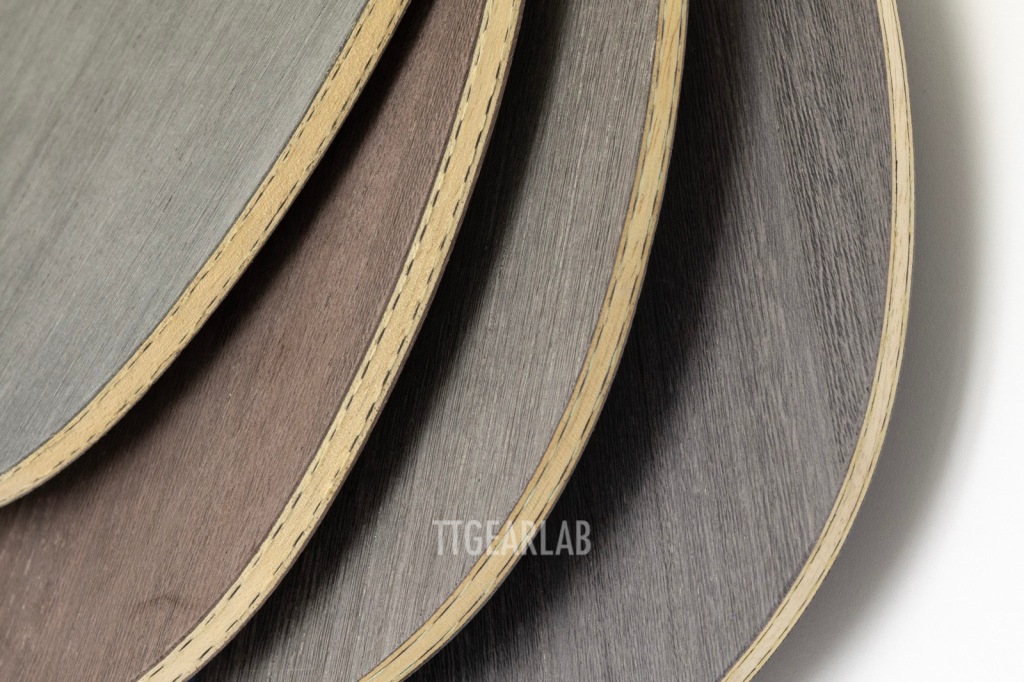
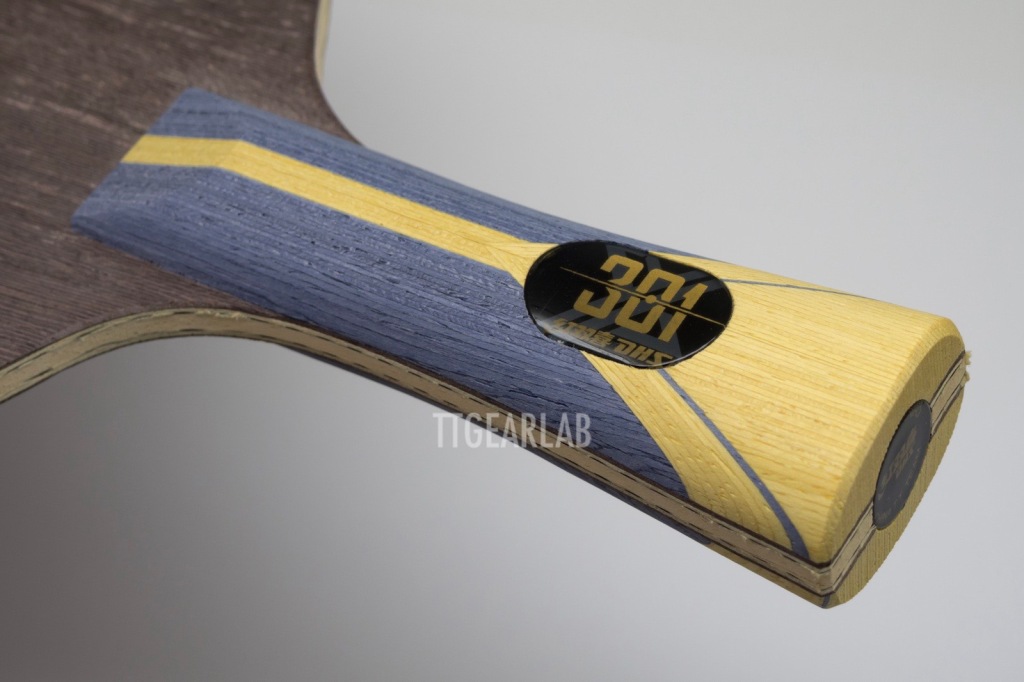
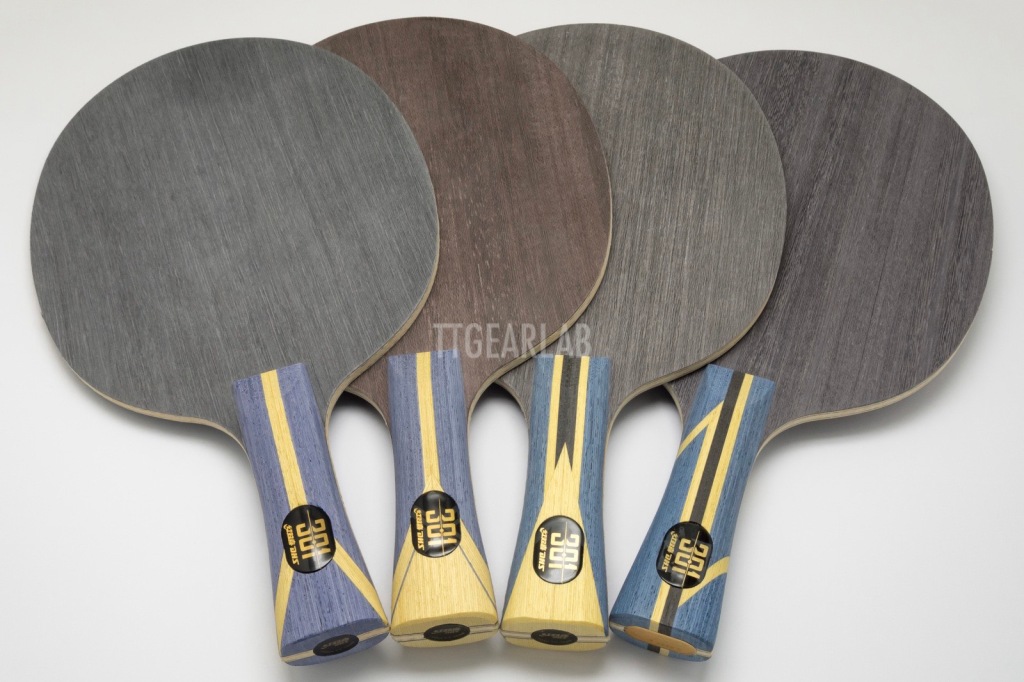
Above picture shows four variations of current ‘Hurricane 301’ series – ‘Hurricane 301’, ‘Hurricane 301X’, ‘Hurricane 301T’ and ‘Hurricane 301Z’ from left to right. That order is also the order in which each model was released. ‘Hurricane 301’ is the base model, and the other three models are the variations based on ‘Hurricane 301’. All four models are inner fiber blades with Koto top layers.
The appearance and composition of each model are as follows:
1-1. Hurricane 301
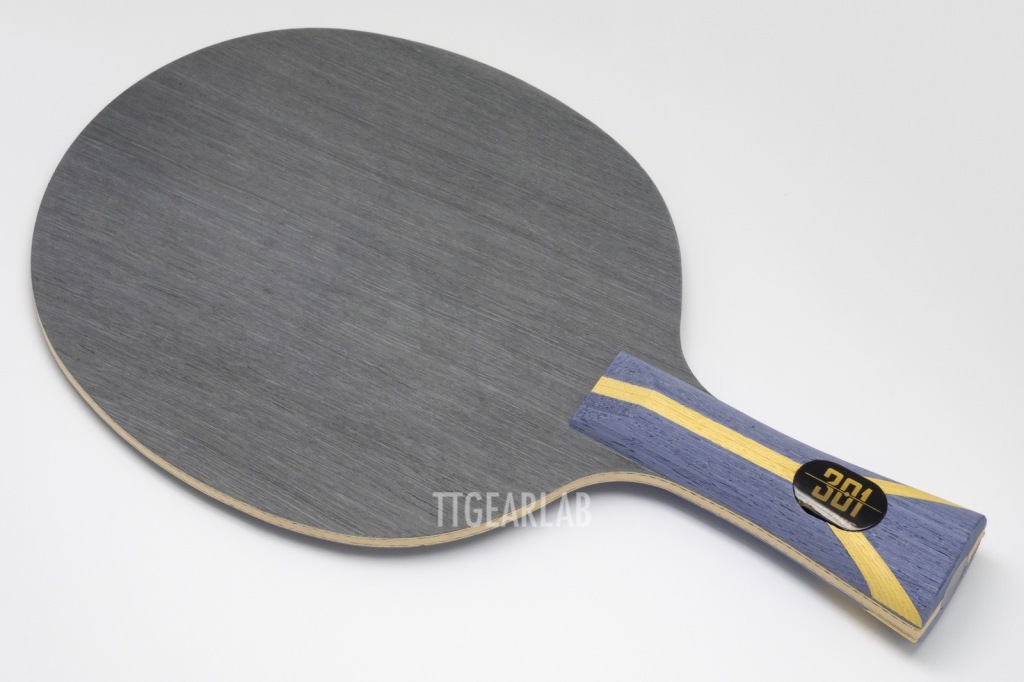
‘Hurricane 301’ is the base model of this series. DHS is explaining that ‘Hurricane 301’ is produced by new technology that makes the blade less influenced by temperature and humidity.

Above picture shows the construction of ‘Hurricane 301’. The top layer is dyed Koto, the middle layer and the center layer are Ayous. ALC(= Arylate Carbon) is inserted between the middle layer and the center layer. Overall thickness is around 5.8mm.

Above picture shows the weave pattern of the fiber which is used in ‘Hurricane 301’. Arylate fibers are arranged only in vertical direction, and Carbon fibers are arranged only in lateral direction.
1-2. Hurricane 301X

‘Hurricane 301X’ is the high-power version of ‘Hurricane 301’ series. It provides improved speed by increasing thickness of center layer from ‘Hurricane 301’ and adopting new fiber.

Above picture shows the construction of ‘Hurricane 301X’. The concept is based on that of ‘Hurricane 301’. Like ‘Hurricane 301’, the top layer is dyed Koto, the middle layer and the center layer are Ayous. ALC(= Arylate Carbon) is inserted between the middle layer and the center layer. Overall thickness is around 6.0mm.

‘Hurricane 301X’ has different fiber from ‘Hurricane 301’. The difference of fiber is in the weave pattern. In the fiber of ‘Hurricane 301X’, both of Arylates and Carbon fibers are arranged in both of vertical direction and lateral direction. Thicker construction and different weave pattern make ‘Hurricane 301X’ quite different from the original ‘Hurricane 301’.
1-3. Hurricane 301T

‘Hurricane 301T’ is also based on ‘Hurricane 301’. But it uses three kinds of fibers for the fine adjustment of characteristics of vertical direction and lateral direction.
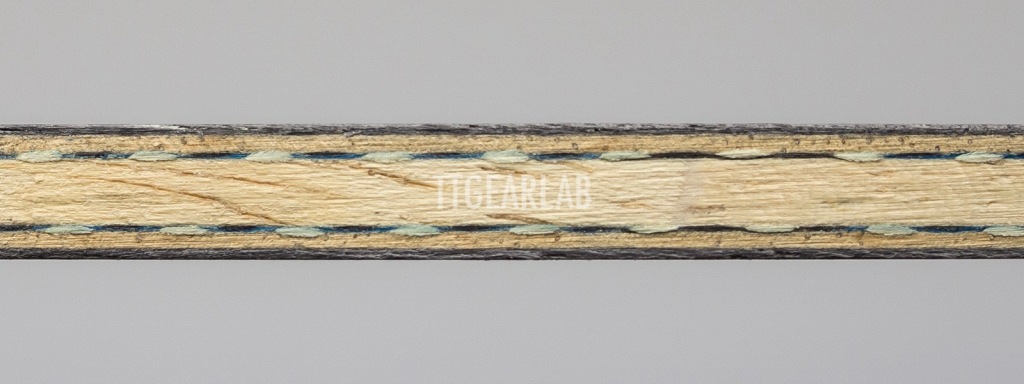
Above picture shows the construction of ‘Hurricane 301T’. The top layer is also dyed Koto, the middle layer and the center layer are Ayous. The artificial material that is woven from three kinds of fibers is inserted between the middle layer and the center layer. Overall thickness is around 5.8mm.

The artificial material of ‘Hurricane 301T’ has three kinds of fibers – Carbon fibers and two kinds of Arylate fibers. The two kinds of Arylate fibers with different characteristics are distinguished by colors – yellow and blue. Carbon fibers are arranged in both of vertical direction and lateral direction. Yellow Arylate fibers are arrange only in lateral direction, while the Blue Arylate fibers are arranged in vertical direction. By the use of this artificial material, ‘Hurricane 301T’ provides same level of elasticity as ‘Hurricane 301X’ without increasing thickness from ‘Hurricane 301’.
1-4. Hurricane 301Z

‘Hurricane 301Z’ is the newest version of ‘Hurricane 301’ series. It adopts new artificial material which is called as ZC (Z-Carbon). The new graphic pattern of handle symbolizes ‘Z’. Z-Carbon is woven from Carbon fiber and Z fiber. We may think of ‘Zylon’ when we heard ‘Z’. But, according to DHS, Z fiber is a kind of Arylate fiber which is more deformable and gives more transparent feeling than conventional Arylate fibers. (If it is revealed that this description is wrong and Z fiber is Zylon fiber, I will correct the description.) DHS also explains that ‘Hurricane 301Z’ is the most powerful version in ‘Hurricane 301’ series. (But it seems that the high power can be achieved only when the player actively performs offensive skills with strong impact, while the other three models of ‘Hurricane 301’ series utilize the high elasticity of the blades themselves to help the player make fast ball.)

Above picture shows the construction of ‘Hurricane 301Z’. The top layer is dyed Koto, the middle layer is Ayous. Overall thickness is around 5.8mm. Z Carbon is inserted between the middle layer and the center layer. But the center layer of ‘Hurricane 301Z’ looks a bit different from the Ayous of the other models in ‘301’ series, and it is somewhat softer than ordinary Ayous. Further it looks close to Kiri that is used for the center layer of outer fiber blades such as ‘506X’. (Once I explained that it is Kiri, but it seems that it is also different from Kiri. Regarding the kind of center wood, I have to check further.) The elasticity of ‘Hurricane 301Z’ seems to be significantly reduced due to the relatively softer center layer.
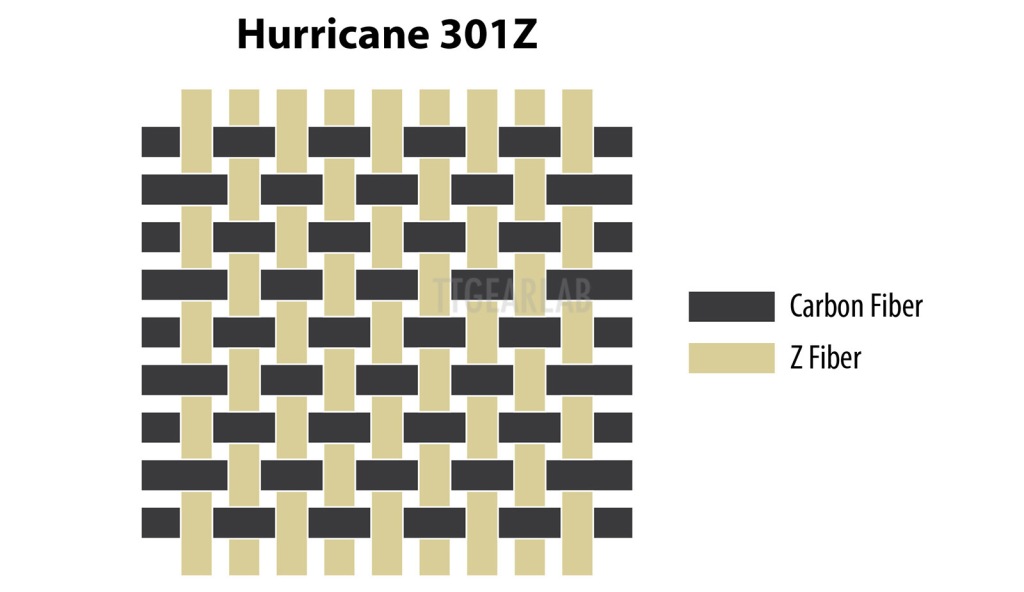
Above picture shows the weave pattern of the fiber which is used in ‘Hurricane 301Z’. Z fibers are arranged only in vertical direction, and Carbon fibers are arranged only in lateral direction.
<Additional Information>
The width of FL (flared) handle is around 26mm (at top) ~ 26.5mm (at bulge) ~ 26 mm (at narrowest point) ~ 35mm (at the end) for ‘Hurricane 301’ & ‘Hurricane 301T’, around 25.5mm (at top) ~ 26mm (at bulge) ~ 25.5 mm (at narrows point) ~ 34mm (at the end) for ‘Hurricane 301X’, and around 25mm (at top) ~ 25.5mm (at bulge) ~ 25 mm (at narrowest point) ~ 34mm (at the end) for ‘Hurricane 301Z’. And the thickness of FL handle is around 21.5mm (at thumb) ~ 25.5mm (at the end) for ‘Hurricane 301’ & ‘Hurricane 301X, and around 22.5mm (at thumb) ~ 26mm (at the end) for ‘Hurricane 301T’ & ‘Hurricane 301Z’. ST handle isn’t available. The players will feel that the handle of ‘Hurricane 301Z’ is slimmer than the handles of the other three models. (And the length of FL handle is around 101mm which is longer than ordinary handles by 1mm. This is one characteristic of DHS blades.)
The size of head is around 158mm x 150mm for all four models in ‘Hurricane’ series. But please note that there is difference by piece.
Then let’s check the characteristics of ‘Hurricane 301’ series by Performance Indices and then compare with some existing blades.
Please click here to return to top (table of contents)
2. Performance Indices
Performance Indices are measured objective values to represent the characteristics of table tennis gears. Concerning the detail of four performance indices, please refer to following articles in ‘About TTGearLab’ section :
- Performance indices : the way to evaluate blade by measurement
- The example of comparison by performance indices
The performance indices of four models of ‘Hurricane 301’ series are as follows. Please note that the values are average values, and can be updated at any time by further measurement.
DHS Hurricane 301 (average weight = 89.6g)
Ep = 1.88
Ec = 1.64 (Ec/Ep = 0.87)
Vp = 1.20
Vl = 1.29 (Vl/Vp = 1.07)
DHS Hurricane 301X (average weight = 89.9g)
Ep = 1.98
Ec = 1.86 (Ec/Ep = 0.94)
Vp = 1.28
Vl = 1.27 (Vl/Vp = 0.99)
DHS Hurricane 301T (average weight = 90.7g)
Ep = 2.05
Ec = 1.87 (Ec/Ep = 0.91)
Vp = 1.28
Vl = 1.23 (Vl/Vp = 0.96)
DHS Hurricane 301Z (average weight = 88.2g)
Ep = 1.64
Ec = 1.36 (Ec/Ep = 0.83)
Vp = 1.11
Vl = 1.24 (Vl/Vp = 1.12)
‘Hurricane 301’ shows the Elasticity Indices those are in the range of the indices of general inner fiber blades. But, among the values are quite high within the general range. And Ec is much lower than Ep. Therefore, ‘Hurricane 301’ provides relatively higher speed as an inner-fiber blades, and it holds the ball deeply when the player hits the ball very strongly. Regarding feeling, the primary feeling of ‘Hurricane 301’ isn’t hard, but it gives somewhat sharper feeling to the index finger of the player. It is expected that ‘Hurricane 301’ is good for aggressive topspin at close-to-table area.
‘Hurricane 301X’ is noticeably more elastic than ‘Hurricane 301’. And the difference of Ec’s is bigger than the differences of Ep’s. So, we can expect that ‘Hurricane 301X’ will give much more additional kick than ‘Hurricane 301’ when the player hits the ball very strongly. But, instead, it will not embrace the ball that deeply. Regarding Vibration Indices, the primary feeling of ‘Hurricane 301X’ is harder than that of ‘Hurricane 301’, but the lateral feeling isn’t. The distribution of feeling is more uniform in ‘Hurricane 301X’ when compared with ‘Hurricane 301’. These characteristics make ‘Hurricane 301’ recommendable for hard hitters. Especially the players who have used 7-ply wood blades of classic construction will be able to replace their blades with ‘Hurricane 301X’.
‘Hurricane 301T’ is a more elastic than ‘Hurricane 301X’ when we observe the primary Elasticity Indices. But its central Elasticity Index is just a bit higher than that of ‘Hurricane 301X’. (It will be good for us to think that the central elasticity characteristics of two blades are almost identical to each other.) Because its Ec/Ep is small than that of ‘Hurricane 301X’, many players will feel that ‘Hurricane 301T’ holds the ball more deeply when they hit the ball very strongly. The primary Vibration Index of ‘Hurricane 301T’ is same as that of ‘Hurricane 301X’. But the lateral Vibration Index of ‘Hurricane 301T’ is lower than that of ‘Hurricane 301X’. The players will feel that ‘Hurricane 301T’ gives more comfortable feeling than ‘Hurricane 301X’. The advantage of ‘Hurricane 301T’ is that it provides more elasticity than ‘301X’ from thinner plywood construction while inhibiting the feeling to be harder.
‘Hurricane 301Z’ is less elastic than ‘Hurricane 301’. It coincides with what we can predict from the construction. Probably the cause is the softer center layer. But the ‘less elastic’ doesn’t always mean that it will not be less powerful. It’s just the matter of how we use the blade. With ‘Hurricane 301’ or even more elastic ‘Hurricane 301X’ we can make fast ball without effort thanks to the high elasticity of the blade itself. However, we can’t use ‘Hurricane 301Z’ in the same way. The blade itself will not make fast ball if the player doesn’t hit the ball strongly. In particular, the power of topspin largely depends on the properties of the rubber, and the blade only helps with that. It is expected that the highly skilled players will be able to make sufficiently powerful ball from ‘Hurricane 301Z’. And, for ordinary players, ‘Hurricane 301Z’ will be accepted as a highly controllable blade. Regarding Vibration Indices, the Vp of ‘Hurricane 301Z’ is noticeably lower than those of other three models. It means that ‘Hurricane 301Z’ is the softest model in the series. But the Vl of ‘Hurricane 301Z’ isn’t that different from those of three other models. Because the Vl is much higher than the Vp, players will feel that ‘Hurricane 301Z’ is soft but sharp at the index finger. That is also the characteristic which is good for aggressive topspin.

Then let’s compare four models of ‘Hurricane 301’ series with some other blades in the market by Performance Indices. It will help us to understand the position of four models.
Please click here to return to top (table of contents)
3. Comparison by Performance Indices
For the comparison 12 blades (except for reference blade) have been selected. Following is the list of the blades to be compared :
Inner Fiber blades with Koto top layer
- Stiga ‘Inspira CCF’ (avg. weight = 87.3g) : Inner woven carbon fiber. Koto top layer.
- Yinhe ‘M201’ (avg. weight = 87.6g) : Inner PL. Koto top layer.
Inner Fiber blades with Limba top layer
- Butterfly ‘InnerForce Layer ZLC’ (avg. weight = 89.8) : Standard inner ZLC of Butterfly. Limba top layer.
- Xiom ‘An Jaehyun TMXi’ (avg. weight = 86.4g) : Inner fiber version of Xiom Tri-metrix (Carbon + Zylon + Arylate) blade. Limba top layer.
- Butterfly ‘InnerForce Layer ALC (current)’ (avg. weight = 91.2g) : Standard inner ALC of Butterfly. Limba top layer. Current version measured in 2023. Thicker and more elastic than former ones measured in 2018.
- Butterfly ‘InnerForce Layer ALC (old)’ (avg. weight = 88.1g) : Standard inner ALC of Butterfly. Limba top layer. Old version measured in 2018. Thinner and less elastic than current ones measured in 2023.
DHS Hurricane Long 5 (inner ALC with Limba top layer)
- DHS ‘Hurricane Long 5 (new)’ (avg. weight = 88.1g) : Inner ALC blade. Limba top layer. New version whose artificial material is similar to that of ‘Hurricane 301X’. Measured samples were produced in 2022.
- DHS ‘Hurricane Long 5 (old)’ (avg. weight = 88.2g) : Inner ALC blade. Limba top layer. Old version whose artificial material is similar to that of ‘Hurricane 301’. Measured samples were produced in 2018.
Various types of blades
- Butterfly ‘Viscaria’ (avg. weight = 87.1g) : Reference of all outer ALC blade. Koto top layer.
- Butterfly ‘Clearfield’ (avg. weight = 97.0g) : Discontinued 7-ply wood blade with Koto top layer. Famous as Chen Jing’s blade.
- Stiga ‘Rosewood NCT V’ (avg. weight = 90.8g) : The 5-ply wood blade with Rosewood top layer.
- Butterfly ‘Korbel’ (avg. weight = 88.7g) : The standard of 5-ply wood offensive blades
(Reference blade)
- Stiga ‘Allround Classic’ (avg.weight = 84.3g) : Reference blade. Standard 5-ply wood all-round blade.
3-1. Elasticity Indices

Fig.16 shows the comparison graph of Elasticity Indices.
Ep (Primary Elasticity Index) is directly concerned with the rebound speed of blade. Ec (Central Elasticity Index) is concerned with additional ‘kick’ when player hits ball very strongly.
The first group to be compared is ‘Inner / Koto top layer’ group. ‘Hurricane 301’ series is a quite unique blade family because it includes four models of inner fiber blades with Koto top layers. In the market, there aren’t many inner fiber blades whose top layers are Koto, probably because softness is one of the main concepts of inner fiber blades. But, although its construction is inner-fiber construction, Koto top layer can be applied for the blades those lay emphasis on speed. And ‘Inspira CCF’ is another example than ‘Hurricane 301’ series. It is even thicker than ‘Hurricane 301X’ which is the thickest one in ‘Hurricane 301’ series, and its artificial material is pure woven Carbon fiber which is much more elastic than the artificial materials of ‘Hurricane 301’ series. So, it is more elastic than any model in ‘Hurricane 301’ series. However, the differences of Ep’s don’t look significant, and the differences of Ec’s are even smaller, even though ‘Inspira CCF’ is thicker than ‘Hurricane 301X’ which is the thickest model in ‘Hurricane 301’ series. That is because the center layer of ‘Inspira CCF’ is Kiri which is softer than Ayous that is the common wood material for the center layers of inner fiber blades. The second one in this group is ‘M201’ which is the standard speed version of inner fiber models in Yinhe ‘Mars’ series. The shape of its graph looks like those of ‘Hurricane 301’ and ‘Hurricane 301Z’. ‘M201’ is less elastic than ‘Hurricane 301’, but more elastic than ‘Hurricane 301Z’.
Next, we can compare ‘Inner / Limba top layer’ group with ‘Hurricane 301’ series. ‘InnerForce Layer ZLC’ and ‘An Jaehyun TMXi’ are less elastic than ‘Hurricane 301X & 301T’ but more elastic than ‘Hurricane 301 & 301Z’. Although Zylon fiber is more elastic than Arylate fiber, the thicker constructions and the harder top layer of ‘Hurricane 301X’ and ‘Hurricane 301T’ make those two blades faster than the blades with a bit more elastic fibers. The comparison with inner ALC blade – ‘InnerForce Layer ALC’ – will be more meaningful. The elasticity of current version of ‘InnerForce Layer ALC’ is similar to that of ‘Hurricane 301’. Although ‘InnerForce Layer ALC’ has softer top layer, thicker construction of its new version makes its elasticity comparable with the elasticity of ‘Hurricane 301’. Players will feel the difference between new ‘InnerForce Layer ALC’ and ‘Hurricane 301’ due to the difference of top layer. But, anyway the elasticity characteristics of those two blades are similar to each other. ‘Hurricane 301Z’ provides the primary elasticity comparable with old version of ‘InnerForce Layer ALC’. But, it holds the ball more deeply when the player hits the ball very strongly. This difference is noticeable, and the players will hardly feel the similarity between ‘Hurricane 301Z’ and old ‘InnerForce Layer ALC’.
Then let’s compare old & new ‘Hurricane Long 5’s with ‘Hurricane 301’ series. We can observe that ‘Hurricane 301Z’ is quite close to old ‘Hurricane Long 5’ while the other three are noticeably more elastic than two versions of ‘Hurricane Long 5’. Although there is the difference in top layer, we may be able to expect that ‘Hurricane 301Z’ can be used in similar way as old ‘Hurricane Long 5’.
Finally, we can compare various kinds of blades with ‘Hurricane 301’ series. We can see that the primary elasticity of ‘Hurricane 301T’ is even higher than that of ‘Viscaria’. (Of course heavier piece of ‘Viscaria’ can be more elastic.) But, the central elasticity of ‘Hurricane 301T’ is a bit lower than that of ‘Viscaria’. ‘Hurricane 301X’ can also be comparable with ‘Viscaria’. Here we can understand that inner fiber blade can be as elastic as outer fiber blade by the adoption of thicker construction. And, we can see the similarity between the elasticity characteristics of ‘Hurricane 301’ and those of ‘Clearfield’ which is a famous 7-ply wood blade with Koto top layer. But, ‘Hurricane 301’ is much lighter than ‘Clearfield’. That is the advantage of fiber blades when compared with 7-ply wood blades. ‘Rosewood NCT V’ shows 100% same values as ‘Hurricane 301Z’. (Of course the values are average values, and actual values of each piece can be a bit different.) Probably ‘Hurricane 301Z’ will be able to replace ‘Rosewood NCT V’ directly, but will provide more power than ‘Rosewood NCT V’ thanks to the higher energy efficiency of artificial fiber. The players who have used ‘Rosewood NCT V’ and need more power but think that current elasticity level is proper will be able to seriously consider ‘Hurricane 301Z’ as next blade to try.
Examining Ec/Ep is an easier way to understand the characteristics of blade concerned with elasticity. Fig.17 shows the relationship between Ec/Ep and Ep.

Ec/Ep expresses the ‘tendency’ of the elasticity of blade. By examining Ec/Ep and Ep at the same time, we can easily understand the behavior of blades.
On the graph, all blades in this comparison (except for reference blade whose Ec/Ep = 1.00) are in ‘Hold’ range (Ec/Ep < 1.0). We can roughly group them into three new groups according to the positions of the models of ‘Hurricane 301’ series. This grouping is different from the grouping discussed in the previous section.
‘Hurricane 301’ is the standard model of this series. The blades near ‘Hurricane 301’ are relatively fast models as inner-fiber blades. In the past, slower models were the standard of inner-fiber blades, and ‘Hurricane 301’ was classified as fast inner-fiber blade. However, in the meantime the elasticity level of inner-fiber blades has been gradually increasing, and currently the average elasticity of inner-fiber blades is noticeably higher than that of some years ago. ‘Hurricane 301’ which has once been dealt as a ‘fast’ inner fiber blade can now be considered as an inner-fiber blade of standard elasticity. When compared with three inner-fiber models nearby – ‘InnerForce Layer ZLC’, ‘InnerForce Layer ALC’ (current 5.9mm version) and ‘An Jaehyun TMXi’ –, ‘Hurricane 301’ shows the characteristic of deeper hold while there isn’t noticeably difference in primary elasticity. It is also interesting that ‘Clearfield’ which is once famous but now discontinued 7-ply wood blade is placed very close to ‘Hurricane 301’. ‘Hurricane 301’ realizes the characteristics similar to ‘Clearfield’ which was the blade for fast attackers, with a much thinner construction.
‘Hurricane 301X’ and ‘Hurricane 301T’ are high elasticity models in this series. Both of the Ep’s and Ec/Ep’s of those two are noticeably higher than those of ‘Hurricane 301’. ‘Hurricane 301X’ and ‘Hurricane 301T’ gives higher speed than ‘Hurricane 301’ even at light hitting, and provide more kick (= less hold) when the player hits the ball very strongly. The blade which can be grouped with ‘Hurricane 301X’ and ‘Hurricane 301T’ is ‘Viscaria’. We can observe that ‘Hurricane 301X’ and ‘Hurricane 301T’ those are inner ALC blades can be as elastic as ‘Viscaria’ which is the outer ALC blade. But, the ‘Hurricane 301X’ and ‘Hurricane 301T’ are much less elastic than ‘Inspira CCF’. Although ‘Inspira CCF’ is an inner fiber blade, its thickness and artificial fiber make it extremely elastic blade. When comparing ‘Hurricane 301X’ and ‘Hurricane 301T’, ‘Hurricane 301T’ is located to lower right of ‘Hurricane 301X’. ‘Hurricane 301T’ is basically more elastic than ‘Hurricane 301X’, but players will feel that ‘Hurricane 301T’ holds the ball a bit more deeply when they hit the ball very strongly, although the differences aren’t significant. The most important advantage of ‘Hurricane 301T’ is that it provides higher elasticity than ‘Hurricane 301X’ with a thinner blade constrction.
On the other hand, ‘Hurricane 301Z’ has lower elasticity than ‘Hurricane 301’. Both of Ep anc Ec/Ep of ‘Hurricane 301Z’ are lower than those of the standard model of this series – ‘Hurricane 301’. Therefore, unlike other three models of this series, ‘Hurricane 301Z’ doesn’t let the player easily make fast ball by light hitting. If we set the ‘Low Elasticity’ group somewhat wide, it can include old version of ‘InnerForce Layer ALC’ and old/new versions of ‘Hurricane Long 5’. There isn’t significant difference in Ep’s between those three models and ‘Hurricane 301Z’. However, there are noticeable differences in Ec/Ep’s. When the player hits the ball very strongly, ‘Hurricane 301Z’ holds the ball deeper than old ‘InnerForce Layer ALC’ and new ‘Hurricane Long 5’, but not as deep as old ‘Hurricane Long 5’. With same artificial fiber as ‘Hurricane 301Z’, old ‘Hurricane Long 5’ provides more extreme ‘Deep Hold’ characteristics than ‘Hurricane 301Z’. It may be too excessive in current standard, and that may be the reason why DHS changed the weaving method of ‘Hurricane Long 5’. The location of ‘Hurricane 301Z’ on the graph coincides with the location of ‘Rosewood NCT V’ which is a famous 5-ply wood blade. But, although the elasticity characteristics are identical, fiber blade can make more powerful ball because its energy efficiency during the process of deformation and restoration is higher than that of 5-ply wood blade. Probably that will be the most important advantage of ‘Hurricane 301Z’ when compared with 5-ply wood blades with similar elasticity characteristics. Finally, ‘Hurricane 301Z’ gives higher primary elasticity than ‘Korbel’, while giving the same level of Deep Hold characteristic and higher level of energy efficiency.
Then next, let’s compare Vibration Indices.
Please click here to return to top (table of contents)
3-2. Vibration Indices

Fig.18 shows the comparison graph of Vibration Indices. Vibration Indices are concerned with feeling. Vp indicates primary feeling which is transferred to player’s palm. And, Vl is the feeling at the edge of the wing – the lower side of blade head. It is felt by player’s index finger or middle finger.
‘Inner / Koto top layer’ group can be directly compared with ‘Hurricane 301’ series because ‘Hurricane 301’ series is a blade family of inner fiber blades with Koto top layer. But, the graph shapes of ‘Inspira CCF’ and ‘M201’ aren’t similar to the those of ‘Hurricane 301’, ‘Hurricane 301X’ and ‘Hurricane 301T’. Only ‘Hurricane 301Z’ shows similar graph shape with those two. But, both of the Vp and the Vl of ‘Inspira CCF’ are noticeably higher than the Vp and the Vl of any model in ‘Hurricane 301’ series. The Vp and the Vl of ‘M201’ are also higher than those of ‘Hurricane 301Z’, but some players will feel that ‘M201’ is similar to ‘Hurricane 301Z’.
‘Inner / Limba top layer’ group looks more similar to ‘Hurricane 301’ series than ‘Inner / Koto top layer’ group. Especially the graphs shape of ‘InnerForce Layer ZLC’ is very similar to that of ‘Hurricane 301T’ despite the differences in top layers and artificial materials. And, the graph shape of ‘InnerForce Layer ALC’ (old version) looks somewhat similar to those of ‘Hurricane 301’ and ‘Hurricane 301Z’ although there are differences in values. Its Vp is between that of ‘Hurricane 301’ and that of ‘Hurricane 301Z’, and its Vl is close to that of ‘Hurricane 301Z’.
In DHS blade range, the Limba top layer version is ‘Hurricane Long 5’ while the Koto top layer version is ‘Hurricane 301’ series. For that reason ‘Hurricane Long 5’ group shares two artificial materials and basic blade constructions (except for top layer) with ‘Hurricane 301’ series. If we don’t consider ‘Hurricane 301Z’, the Vp’s of ‘Hurricane Long 5’ group are lower than those of ‘Hurricane 301’ series, while the Vl’s of ‘Hurricane Long 5’ group are close to those of ‘Hurricane 301’ series. The low Vp’s of ‘Hurricane Long 5’ group is probably because the top layer of ‘Hurricae Long 5’ (old & new) is softer than the top layer of ‘Hurricane 301’ series.
In ‘Various’ group, we have observed that ‘Viscaria’ which is an outer ALC blade with Koto top layer shows elasticity characteristics close to ‘301X’ and ‘301T’. However, its vibration characteristics aren’t. Both of the Vp and the Vl of ‘Viscaria’ are higher than those of ‘301X’ or ‘301T’, and especially the differences in Vl is noticeable. That is probably the difference between outer fiber construction and inner fiber construction. On the contrary, ‘Clearfield’ is very close to ‘Hurricane 301’ not only in elasticity characteristics but also in vibration characteristics. Also, ‘Rosewood NCT V’ which is close to ‘Hurricane 301Z’ in elasticity characteristics also shows vibration characteristics close to ‘Hurricane 301Z’. ‘Korbel’ also looks simialr to ‘Hurricane 301’ on the graph. We may be able to think that ‘Hurricane 301’ and ‘Hurricane 301Z’ can be the replacement of 7-ply wood blades and 5-ply wood blades respectively.
Examining Vl/Vp is an easier way for the comparison of the tendency of feeling. Fig.19 shows the relationship between Vl/Vp and Vp for easier comparison.

On the graph, most of blade in this comparison are placed in upper part of the graph – ‘Relatively sharper at finger’ range. And, four lies in lower part – ‘Relatively more comfortable at finger’, and two including reference blade are on uniform line (Vl/Vp = 1.0). As we did when we observed the graph of Elasticity Indices, we can roughly group the blades into three new groups – ‘Medium’, ‘Hard’ and ‘Soft’ – according to the positions of the models of ‘Hurricane 301’ series. This grouping is of course different from the grouping discussed in the previous section.
Since ‘Hurricane 301’ is in the middle position within the series, ‘Medium’ group for comparison can be set up around it. With its Vp (= 1.20), ‘Hurricane 301’ isn’t a blade with hard feeling. And, Vl/Vp is within ‘Near Uniform’ range. The one that is at the closest position to ‘Hurricane 301’ is ‘Clearfield’. Not only the elasticity characteristics but also the vibration characteristics of ‘Clearfield’ are very similar to those of ‘Hurricane 301’. Current ‘InnerForce Layer ALC’ (= new version with 5.8mm thickness) is located below ‘Hurricane 301’. So, ‘Hurricane 301’ gives sharper relative feeling to the index finger of the player while providing similar primary feeling, when compared with ‘InnerForce Layer ALC’. On the contrary, old ‘InnerForce Layer ALC’ (= old version with 5.7mm thickness) and new ‘Hurricane Long 5’ (MY 2022) are located to the left of ‘Hurricane 301’. Differently speaking, ‘Hurricane 301’ gives harder feeling than old ‘InnerForce Layer ALC’ and new ‘Hurricane Long 5’ while keeping the feeling transmitted to the player’s finger. Because Vl/Vp is more important than Vp for the player’s adaptation, it will not be difficult for players to change between ‘Hurricane 301’ and old ‘InnerForce Layer ALC’ or new ‘Hurricane Long 5’. But, players will feel much difference between ‘Hurricane 301’ and new ‘InnerForce Layer ALC’ although the Vp’s of those two are almost identical to each other.
Because the Vp’s of ‘Hurricane 301X’ and ‘Hurricane 301T’ are much higher than that of ‘Hurricane 301’, we can set ‘Hard’ group around those two. The blades near those two are ‘Viscaria’, ‘InnerForce Layer ZLC’ and ‘An Jaehyun TMXi’. ‘Hurricane 301X’ and ‘Hurricane 301T’ are located in ‘A bit more comfortable at finger’ range (Vl/vp < 1.0)’. And, ‘301T’ is located below ‘301X’. It means that the players will feel that ‘Hurricane 301T’ is a bit more comfortable than ‘Hurricane 301X’. ‘InnerForce Layer ZLC’ is softer than those two, and it is probably because of the harder top layer of ‘Hurricane 301’ series. ‘Viscaria’, which shows similar elasticity characteristics to ‘Hurricane 301X’ and ‘Hurricane 301T’, is located to upper right of those two. So we can understand that outer fiber blade can be harder and sharper than inner fiber blade with similar elasticity characteristics.
Finally, we can set ‘Soft’ group around ‘Hurricane 301Z’. ‘Hurricane 301Z’ is much softer than ‘Hurricane 301’, but it transmits sharper feeling to the index finger of the player. New ‘Hurricane Long 5’ lied in the middle between ‘Hurricane 301’ and ‘Hurricane 301Z’. Players will be able to fine-tune the feeling among ‘Hurricane Long 5’, ‘Hurricane 301’ and ‘Hurricane 301Z’. ‘Korbel’ and ‘Rosewood NCT V’ are located close to ‘Hurricane 301Z’. The replacement from ‘Korbel’ or ‘Rosewood NCT V’ to ‘Hurricane 301Z’ will require some time for adjustment because ‘Hurricane 301Z’ is somewhat more comfortable at index finger. But, because ‘Hurricane 301Z’ is also in ‘Relatively sharp’ range (Vl/Vp > 1.0), that adjustment isn’t expected to be difficult.
The standard model of the series is ‘Hurricane 301’. If the player wants the feeling closer to 5-ply wood offensive blade, ‘Hurricane 301Z’ will be the solution. And, if the player wants harder feeling, ‘Hurricane 301X’ can be considered first. And, if the player wants to adjust the feeling of ‘Hurricane 301X’ more comfortable, ‘Hurricane 301T’ will be the solution.
Please click here to return to top (table of contents)
4. Summary
DHS ‘Hurricane 301’ series is the blade family of inner fiber models with Koto top layers, and currently four models – ‘Hurricane 301’, ‘Hurricane 301X’, ‘Hurricane 301T’ and ‘Hurricane 301Z’ – are available. The characteristics of each of the four models are as follows :

‘Hurricane 301’ is the standard model in this series. Its elasticity characteristics are comparable with those of inner ALC/ZLC blades of Butterfly, but ‘Hurricane 301’ hugs the ball bit deeper than Butterfly models when the player hits the ball very strongly. Regarding feeling, with its harder Koto top layer, ‘Hurricane 301’ gives harder or sharper feeling than comparable inner ALC blades with softer Limba top layers, and it makes ‘Hurricane 301’ a blade which is good not only for topspin but also for fast attack with pimples out rubber on one face. In the past ‘Hurricane 301’ was dealt as an inner fiber blade with enhanced speed, but now it can be considered as a well-balanced blade that can be used for various strategy of table tennis. ‘Hurricane 301’ is recommended for the players who are searching for an inner-fiber blade that is more ‘exciting’ than ‘Hurricane Long 5’.
‘Hurricane 301X’ is thicker and faster than ‘Hurricane 301’. Its primary feeling is harder than ‘Hurricane 301’, it transmits more comfortable feeling to the player’s index finger. It provides high level of elasticity comparable with outer-ALC blade with Koto top layer, but its feeling isn’t as stiff as the feeling of outer-ALC blade. The players will be able to choose ‘Hurricane 301X’ without being conscious of its inner fiber construction when they need a blade that provide high level of elasticity. ‘Hurricane 301X’ is recommended for the players who want to play with various technics including hard smash.

‘Hurricane 301T’ is even more elastic than ‘Hurricane 301X’. However, it is thinner than ‘Hurricane 301X’, and probably as the result it hugs the ball a bit deeper when the player hits the ball very strongly, and will transmits more comfortable feeling to the index finger of player. Thanks to its thinner construction and more comfortable feeling than ‘Hurricane 301X’, ‘Hurricane 301T’ is expected to provide higher power and better ease of use when the player performs topspin.
Both of ‘Hurricane 301X’ and ‘Hurricane 301T’ are recommended for the players who lay emphasis on the speed of ball. Between those two, ‘Hurricane 301T’ expected to be better for the players whose main technic is topspin, and ‘Hurricane 301X’ for the players who play with a variety of technics including hard smash.

‘Hurricane 301Z’ provides reduced elasticity and soft but sharper feeling than standard ‘Hurricane 301’. Because its characteristics are close to those of 5-ply wood offensive blades it will provide absolute stability when the player aims at very early timing after the bounce of the ball. But, because ‘Hurricane 301Z’ is also a blade with artificial fiber, it will provide better energy efficieny than 5-ply wood blade, and as the result the ball from ‘Hurricane 301Z’ will be more powerful than the ball from 5-ply wood blade. Differently from the other three variations in ‘Hurricane 301’ series, ‘Hurricane 301Z’ will not make fast ball without the effort of the player. Therefore, ‘Hurricane 301Z’ is basically recommended for highly skilled close-to-topspin players. (But, the starters will be able to enjoy the high level of safety and stability of ‘Hurricane 301Z’ although they will not be able to easily make fast balls. For thar reason, if an entry-level player wants to start with ‘Hurricane 301’ series, ‘Hurricane 301Z’ may become a very good start point.)
Please click here to return to top (table of contents)
 TTGearLab
Hi. Another great test.
I have a question: how big can be the difference in parameters (Ep,Ec) between: Fan Zhendong Super ZLC 91g. vs Lin Yun-Ju Super ZLC 81g. they have the same structure and only the weight is different.
LikeLike
In general, all the indices become lower. So the blade becomes less elastic and softer while keeping the relative values – Ec/Ep and Vl/Vp – in some range. But, sometimes the Ep becomes even lower than expected, and in that case Ec/Ep becomes somewhat higher. Of course, I can’t predict correctly until I measure the super light one.
LikeLiked by 1 person
Thank you for that incredible work !
Question : Could you estimate/compare the “throw angle” of 301 / 301x / 301t ? And if so, how do you do for that ? Is there a link between ep, ec or ep/ec and the “throw” of the ball that will result ?
Thanks !
LikeLike
I have played DHS 301 (ST), 301T and 301Z. 301Z has the highest throw angle of the three. I can make quite strong top-spin close to the table against heavy back-spin ball with 301Z, but it requires a lot of power when you play from mid/far distance. 301T and 301 have the same throw angle and lesser than 301Z
LikeLike
Thank you for comment. Your comment will be useful information for readers.
And, as you mentioned 301Z requires a lot of power if we try to use it at mid/far distance area. That is of course because of its low elasticity.
Regarding throw angle, I’m avoiding mentioning it because the relationship between performance indices and the throw angle isn’t always clear. However, in general most of players can make higher trajectory with the blade whose Elasticity Indices are lower. So it is expected that players will be able to easily make higher trajectory by 301Z, and you proved it. 🙂
LikeLike
Thank you fro comment. Throw angle is somewhat different from the elasticity itself. I have seen many cases where they are not directly related. For that reason I’m concentrating on the elasticity and feeling those can be measured and expressed by numbers. And, I’m avoiding to mention the throw angle that is affected by many factors and is difficult to be expressed by number.
LikeLike
Thank you for your great work. Will you consider to test DHS 506a someday?I heard this blade is pertty nice,and it is not expensive.I wonder what the performance indices would like
LikeLike
Of course. I have already got the sample of 506A and preparing for articles.
LikeLike
Very nice analysis as always. Did you manage to test the DHS PG7 maybe? I’m interested where it lies “speed” wise.
LikeLike
Thank you for comment. The data of PG7 is as follows:
Avg.weight = 91.1g
Ep = 1.49
Ec = 1.26 (Ec/Ep = 0.85)
Vp = 1.07
Vl = 1.20 (Vl/Vp = 1.12)
The construction of PG7 is same as that of Hurricane Long 3, but there is difference in head size and quality control. PG7 shows bigger deviation of values than Hurricane Long 3. But, anyway the avg. values are similar to those of HL3. There is difference. But, not big.
LikeLike
Did you manage to test the DHS PG7X blade ? And any data of this DHS PG7X blade ?
Thank you sir.
Best regards,
LikeLike
Thank you for comment. I haven’t god the sample of PG7X. I’m considering to get it in the future, but the priority is somewhat low.
LikeLike
Thank you for another great article and this particular article interested me more because I own a 301T. I currently have 3 blades that I use in rotation, a Stiga Carbonade 190 which I use most of the time, then a Carbonado 145 and a DHS 301T. I feel most comfortable with the Carbonade 145, but for some reason the balls tend to go long and the catapult effect tends to be most pronounced. The Carbonade 190 feels harder and the ball flight is much lower, but the 145 and 190 is practical the same blade with the exception of the direction of the carbon placement. I use the same forehand rubber, the Tibhar MX-P , can you shed some light to my playing experience?
I found the 301T is the most comfortable and balance of the three blades for someone using a penhold grip, and I like the feel when making ball contact most. I use the same FH rubber, the MX-P, and it could be the difference between the Koto vs Lima top layers. I found the 301T speed is practically the same the Carbonado 190 and your performance measurement align with my playing experience. I recently swapped a blade with my playing partner and try his DHS Hurricane King 3, I feel very comfortable with his Hurricane King 3 and need no adjustment time at all, I found the 301T and the King 3 is very similar. I do feel the Hurricane 3 is more solid while the 301T is a bit hollow when making ball contacts. Just wondering do you have any information on the DHS Hurricane 3, the top layer is a darker wood, could it be dyed Koto, or walnut or wenge? It feel harder than the 301T. Also have you done any measurement on the King 3 that you can share with me? Thank you for your contributions to this great website.
LikeLike
Thank you for comment. In my opinion we have to deal with Carbonado 190 and Carbonado 145 as totally different blades. That is because 45 degree rotation of fiber makes the property of that fiber totally different. As the result Carbonado 145 hugs the ball even deeper. But, it may be too extreme for some players. It causes the problem you experienced. In my opinion, attaching the rubber with softer sponge may be the solution in that case. For example Evolution EL-P or Evolution FX-P. Or the sticky rubber with even harder sponge may be better. For example Neo Hurricane 3.
And, the Elasticity Indices of Carbonado 190 are quite close to those of Hurricane 301T as you commented. 🙂
Regarding Hurricane King 3, I couldn’t have got it yet. But, without doubt its top layer is dyed Koto. I’m interested in Hurricane King 3, and I want to measure it sooner or later. 🙂
LikeLiked by 1 person
Thank you for your prompt and valuable input. I have a Yasaka Rakza Z (sticky top sheet and harder sponge) and an Evolution EL-P rubbers in my collection. I definitely can experiment them with the Carbonado 145.
If the Hurricane King 3 top layer is dyed Koto which is same as 301T, then it must be the carbon or the core layer that makes it more solid feel than the 301T then.
LikeLike
I hope that you get good result with Rakza Z and Evolution EL-P. Your experience will also be very good information for me and other readers.
Regarding HK3, I don’t know whether HK3 is same as or similar to 301T. We have to also consider the possibility that there is difference in thickness. Overall thickness or the thickness of each layer. Not only the kind of material but also the thickness effect the feeling significantly. 🙂 I think that I have to actually check it as soon as possible. (But, the problem is the cost for that blade unless DHS provide samples.)
LikeLike
Hi, thanks for the test. Can you check again whether the 301Z really has Kiri as the center layer? I’m pretty sure mine has an ayous center layer. Thank you.
“Differently from the other three models (and common inner fiber blades) whose center layers are Ayous, ‘Hurricane 301Z’ adopts Kiri which is softer and lighter than Ayous as its center layer.”
LikeLike
Probably you are right. Or it may be another kind of wood. I have to check it further.
When I checked ‘301Z’, I noticed that it is softer than ordinary Ayous, and its appearance is somewhat different from the center layers of the other models of ‘301’ series. In fact, when I push the center wood by thick needle, the needle digs deeper than the case of the other models. Further, without doubt it is softer than ordinary Ayous because the performance indices are so low.
Once I wrote that it is Kiri. But, it seems that it is also somewhat different from Kiri.
So I corrected the test and left the explanation that it is softer than and looks different from the center layer of the other models in ‘301’ series.
LikeLike
hi, amazing work !!!
Do you know anything about the nittaku ma long carbon 2 as it seems very similar 🙂
LikeLike
It looks similar to H301 series. But, according to Nittaku, the artificial material of Ma Long Carbon 2 isn’t ALC but FE Carbon which is a kind of pure woven carbon fiber.
It seems that there will not be chance for me to actually check it. But, if I can get it I will once compare Ma Long Carbon 2 with H301 series.
LikeLike
When you said:
“By the use of this artificial material, ‘Hurricane 301T’ provides same level of elasticity as ‘Hurricane 301T’ without increasing thickness from ‘Hurricane 301’. “
you meant same level of elasticity of the hurricane 301x?
LikeLike
Thank you for pointing out the mistake in the description. It should be ‘301X’. I will correct it immediately.
LikeLike
hey,
are you sure that normal 301 is still with the old carbon weave like old long 5 or did they also change the weave pattern in the 301?
LikeLike
I’m not sure. And, I haven’t checked it yet.
LikeLike
Thanks for all your work! As a pimples-out player, I really appreciate that you mentioned the 301 was great for pimples-out play. Which properties would you say makes a blade good for a pimple-out style?
LikeLike
The ‘Deep Hold’ characteristics of 301 can be both of good point and bad point for pimple out players. It hugs the ball deeply when the player hits the ball strongly. That makes you feel that the ball doesn’t leave the surface of racket quickly. Especially in case the type of pimple out rubber is ‘speed type’, that character of blade may make the effect of pimple out rubber somewhat ambiquous. However, if the type of pimple out rubber is ‘spin type’, that characteristics of blade will help the player to make full use of the performance of pimple out rubber. And, the player will be able to play more aggressively.
And, the really good point of 301 is its moderately high speed and clear feeling of top layer. That will always make the play with pimple out rubber comfortable and effective. In my personal opinion, the elasticity level of 301 is optimum for pimple out players. But, the pimple out players who like very high elasticity of blade will not like 301.
LikeLike
I have an acoustic 5 ply 81g with skyline 3 blue sponge 39 deg fh and h3 prov orange 39 deg fh that I’ve used for 6 months. I feel like I can’t miss the table but could use more speed with a little more driving help but still good at looping. Can you recommend a version for me? Maybe the Z with highest throw which would probably be lower and quicker than my acoustic. I would like a harder, more crisp feel than acoustic.
LikeLike
If you want to select on among four models of 301 series, I think that 301Z will be the optimum solution for you in my opinion. The other three are too much different from Acoustic.
And, if the thickness will not be problem, please also consider Yasaka Falck W7. It is a seven ply blade. But, it is much softer than classic 7-ply wood blades, and gives very good feeling like Acoustic.
LikeLiked by 1 person
I am lingayuan alc user and recently tried out the DHS301 blade, was surprised by it, felt better control, similar feel but at higher power delivery when you want it, which was absent with the lingayaun alc.
LikeLike
Thank you for sharing your experience. DHS H301 is a very good blade although it is much less expensive than some Viscaria type blades. And, it is a good example that inner ALC blade can be as fast as or faster than outer ALC blades. 🙂
Probably not all players will feel the same way as you. But, because the elasticity level of H301 is similar to that of Lin Gaoyuan ALC, there will be many players who agree with you. 🙂
LikeLike
Hello. Now I am using xiom Feel Ax Blade, if I want to increase the rotation level, what is the best option? Xiom 36.5 alx or dhs 301x or another option?
LikeLike
I don’t have the sample of Feel AX. However, it is just the variation of Stradivarius with burnt top layer and a bit thicker construction. So we can expect its performance in some level.
If you have trouble in creating rotation with that blade, probably it is because of its high elasticity. It is expected that Feel AX is more elastic and gives more additional kick than Stradivarius or similar inner ARC/ALC blades because of its thicker construction.
Then I think that you’d better decrease the elasticity level of blade. And, it will be better if the new blade is softer. Both of 36.5 ALX and 301X can be good solutions but the difference will not be dramatic. I recommend even softer/slower blade. For example 36.5 ALXi or new Hayabusa ZL Pro. If you want to select among DHS blades, 301Z will be better choice. (301X is a fast blade. It will be better than Feel AX, but probably you will feel that it is still too fast for creation more rotation. But, 301Z is sufficiently soft, and suitable for continuous topspin game.)
LikeLike
Hello, I really liked your work on the analysis of tennis blades, I played for quite a long time with the H 301, a very good blade, but it lacked speed due to a strong ball delay, now I have acquired a new King blade, it has excellent speed, a comfortable handle, but there is no elasticity in the blade despite its light weight. Now I am considering returning to the 301 series X, will this be the right decision from your point of view?
LikeLike
Hello, I really liked your work on the analysis of tennis blades, I played for quite a long time with the H 301, a very good blade, but it lacked speed due to a strong ball delay, now I have acquired a new King ac-b blade, it has excellent speed, a comfortable handle, but there is no flexibility in the blade despite its light weight. Now I am considering returning to the 301 series X, will this be the right decision from your point of view?
LikeLiked by 1 person
In my opinion, if H301 is not sufficiently fast, trying faster rubber is the better way than replacing blade. I don’t have the sample of Hurricane King AcB, but it doesn’t look like much faster and stiffer blade than H301.
I think that the feeling of H301 fits for you. Then H301X may give you same result as HK AcB.
Could you tell me the rubbers you have used so far? Maybe just replacing rubber with faster one while keeping H301 will be the better solution.
LikeLike
I used mx-s backhand, battle 3 39 degrees forhand.
LikeLike
please tell me, do I understand correctly that the lower the Ec/Ep coefficient, the more flexible the blade is? The smaller the rebound spot, the more flexible the base is. + this results in a lower release angle (when analyzing 301 series bases)
LikeLike
Both of Ep and Ec are related with flexibility. Low Ep means that the primary flexibility is high, and low Ec means that the central flexibility is high. The ratio – Ec/Ep is not related with flexibility itself. That is no more than the ratio of two kinds of elasticities. And, it is not concerned with release angle.
BTW, MX-S is somewhat biased to spin. I recommend you to once replace it with MX-D if you want to raise the speed without replacing blade.
LikeLike
First time visiting your website. Good comparisons. Can you give me some advice? I stopped playing regularly for years and I am now picking up playing with my old dhs hao 5-ply pure wood blade (with new rubbers). I noticed that the ball size has changed recently and i feel like my blade is lacking in power. I come across the 301series and i would like to have a more but not very elastic one than my current blade. 301z seems to be the least elastic one, but is it already a big upgrade in terms of speed to my current one? Which one would you suggest? I also notice that there are 3 versions of 301 in the market, ie the normal one, the tailor made version for the provincial team and the national team. The latter two has at least 5-6times in price difference. Have you tested those too? Thank you very much, appreciated.
LikeLike
Thank you for comment! Among four models of DHS 301 series I think that 301Z will be the best choice for you.
Regarding three versions of 201, I haven’t tested provincial team version and national team version.
LikeLike
Hi,
A couple of questions – comparing the DHS 301 and Butterforce Innerforce layer ALC on your graphs.
Would you say as the 301 has a slightly more deep hold and slightly more vibration it would have a little more control ?(or feeling?) than the Innerforce model even though the 301 is koto outer and innerforce limba outer?
I read the 301 feels a bit more of a wood in feel??. Which would be closer to the Korbel model even though faster?. Thanks
LikeLike
The controllability differs by the playing style of the player. If you prefer controlling the kind of technic and the placement of ball precisely, you will feel that InnerForce Layer ALC is more controllable. But, if you like aiming at rising of the ball when you attack with topspin, you will feel that H301 is more controllable. (Some players will not agree with this explanation. But, I think that more players will agree with it.)
And, although there is difference in top layer, you’ll feel that H301 is closer to Korbel. On the ohter hand InnerForce Layer ALC is closer to Allround Classic.
LikeLike
Hi TTGearLab, thank you for researching all of these metrics. It allows me to compare blades and to avoid ones that are too fast for my liking.
Have you heard of the Gambler Fire Dragon blade series? I personally use the Gambler Fire Dragon Touch, and it feels slower than the Ma Lin Carbon. I would be interested to see the Ep and Ec of the Gambler Fire Dragon Touch. There are two other blades in the Fire Dragon series as well. Lastly, Gambler also has a series of blades with the theme of “Vector”.
LikeLike
Thank you for comment. I don’t have any Gambler blade except for some pre-product samples without graphic design. And, I haven’t measured Fire Dragon yet. However, as far as I expect from its appearance, it will be difficult to be slower than Ma Lin Carbon. Probably what you feel is because of the non-carbon fiber that is included in its artificial material.
LikeLike
Thanks for the reply. Also, I should note that the Ma Lin Carbon set up does feel heavier, which definitely affects things too.
LikeLike
Probably it is because Ma Lin Carbon isn’t a lightweight blade. Its avg. weight is around 90g.
LikeLike
Hello,
Your graph shows the H301 being faster than the long 5 (both versions).
I also saw two popular online stores with ratings that say the long 5 is faster.
Please let me know what you think.
Thank you.
LikeLike
What the Performance Indices show is pure elasticity of blade. H301 is more elastic than HL5. That is mainly because of its harder Koto top layer.
However, in table tennis the more elastic blade can’t always make the faster ball. Elasticity does affect the speed of ball, but that isn’t everything that decides the speed.
If the player attaches fast rubbers and play mainly with smash, H301 will be faster than HL5. However, topspin is more related with the characteristics of rubber. And, sometimes less elastic blade can make faster ball than more elastic blade because it can utilize the ability of rubber more effectively. Of course the result differs by player and combination.
And, that is the reason why I value Ec/Ep over the single values of Ec or Ep. The player can easily ‘adjust’ the impact to suit the difference in elasticity. But, if the Ec/Ep of the new blade is much different from that of old blade, the adjustment is not easy.
LikeLiked by 1 person
I’d like a more solid feeling and speed when hitting from mid distance than I get from acoustic 81g. I’ve narrowed it down to a few blades like the Falk W7 ec/ep 0.8 you mentioned and Fang bo 7ply wood which has ec/ep 0.84 and pg7 ec/ep 0.86.
You mentioned “But, if the Ec/Ep of the new blade is much different from that of old blade, the adjustment is not easy.”
How much of a change in ec/ep do you think I could make before the adjustment isn’t easy?
I’m leaning toward Fang Bo but what you think.
Thank you.
LikeLike
The recommendation will be different if you have a clear purpose. And, your requirement is ‘a more solid feeling and speed when hitting from mid distance’. Then you don’t need to worry about the problem of adaptation.
And, both of ‘Falck W7’ and ‘Fang Bo B’ are considerable. You will feel the improvement. However, if you mainly play at mid-distance area, you may feel that the improvement isn’t sufficient. In this case, I recommend a blade with even highe Ec/Ep. (Higher Ep is also required. But, that will not be an issue because most of blades considerable provide much higher Ep’s than Acoustic.) For example andro ‘Synteliac VCI OFF’.
LikeLike
I’m actually just finishing up gluing my skyline 3 blue sponge 39 deg boosted fh, rakza 7 bh on dhs 301 I borrowed from a friend.
Ep 1.88, ec/ep 0.87 might be doable for me with these rubbers.
Really looking forward to testing tomorrow.
Thank you.
LikeLike
I think that it will make good combination. How is the result?
LikeLike
The warmup was great. The DHS 301 seemed to have effortless power and topspin until I started playing a game. It felt like the combined dhs301 with my usual skyline 3 blue/rakza 7 rubbers had a throw angle that was considerably lower than what I’m used to on acoustic and had my doubts whether I could adapt. I tested the same rubber on a long 5 a friend lent to me and preferred it, due to lower elasticity. I then tried an old H3 orange nat, 2.2 40 deg on fh with rakza 7 bh and felt great to me. Tonight’s test will be substituting rakza for H3 on bh. I think the long 5 will be my new daily blade.
LikeLike
Thank you for sharing your experience!
Both of HL5 and H301 has factors similar to Acoustic. Acoustic fits for both of very aggressive topspin and stable continuous topspin. If your playing style is biased to more aggressive one, H301 will be good. But, if you lay more emphasis on stability and higher trajectory, HL5 will be better choice.
LikeLiked by 1 person
Hello, thank you very much for your time and analysis.I´m an intermediate player currently with simple 5-ply wooden Butterfly Mezzoforte OFF- bat & sticky Rakza Z rubbers. Rakza Z is great, it took me a while to adjust my play for the high angle and close the racket more. Now it´s very good, especially for the close to the table game, but I feel Rakza Z is lacking power from larger distance. Do you think 301 or maybe 301T will be a good upgrade, or is it too big jump from OFF- 5-ply wood? Thank you!
LikeLike
In fact, it is difficult to use sticky rubbers for mid-range play. Basically sticky rubbers are for close-to-table play. Even though the stickiness of new hybrid rubbers like Rakza Z is weaker than that of traditional sticky rubbers, still those hybrid rubbers are for close-to-table game. For mid~long distance game, you’d better consider non-sticky rubber such as Rakza XX. Or Rakza 7 will be better solution because it is more spin-oriented than Rakza XX. I recommend you to first try Rakza 7.
Raising the elasticity of blade can be another solution, as you are considering H301 or H301T. Although it can be big jump from current blade, that is needed if you want to keep current rubber. But, you may have to also adjust racket angle or the way of hitting.
LikeLike
Thank you! And please one more question – does the 301 series have some serial/production numbers visible on the wood? It’s not clear from your photos if it has something on the right side of the handle, or not. I’ve seen people checking this and commenting on f.e. the DHS Long 5 from Aliexpress, to verify if it is original blade or not.
LikeLike
Yes. H301 series also has those numbers. The system is same as that for HL5.
LikeLike
Do you have any plans to test the new DHS 301H?
LikeLike
Good work!!
do you have any information about Dhs Hurricane 301H?
thank you!
LikeLike
No. I couldn’t have got the new 301H. I’m considering it.
LikeLike
I asked someone I know the same question. Here’s the Q & A.
on bilibili it seems 301H has much denser ALC.
BH is a much improved aspect, speed on par with Viscaria, good crisp feedback
FH also much harder than original 301, but less dwell time as expected.
It would be interesting to see some measurements on it.
LikeLike
I hope that I can get one.
LikeLike