| Table of Contents | 1. Overview 2. Performance Indices 3. Comparison by Performance Indices ……. 3-1. Elasticity Indices ……. 3-2. Vibration Indices 4. Summary |
In late 2022, andro launched ‘Synteliac’ series, which consists of four fiber blades – two outer fiber blades and two inner fiber blades. andro is explaining that the advantage of new ‘Synteliac’ series is that it makes the player’s reaction faster by providing clearer feedback. Two kinds of fibers are used for ‘Synteliac’ series – Zyreema and Voltema. And, both of outer fiber version and inner fiber version are available for those two fibers – ZCO (Zyreema Carbon Outer), ZCI (Zyreema Carbon Inner), VCO (Voltema Carbon Outer) and VCI (Voltema Carbon Inner). And, differently from existing ‘TP_Ligna’ series and ‘Treiber’ series, ‘Synteliac’ series is aiming at more direct competition against Butterfly blades.
Among four models, TTGearLab selected two models – ‘Synteliac VCO OFF/S’ and ‘Synteliac ZCI OFF’. (‘OFF/S’ and ‘OFF’ are speed signs, and Andro is also calling those blades as just ‘Synteliac VCO’ and ‘Synteliac ZCI’.) In this article, those two will be analyzed through Performance Indices, and will be compared with some other blades in the market.
1. Overview
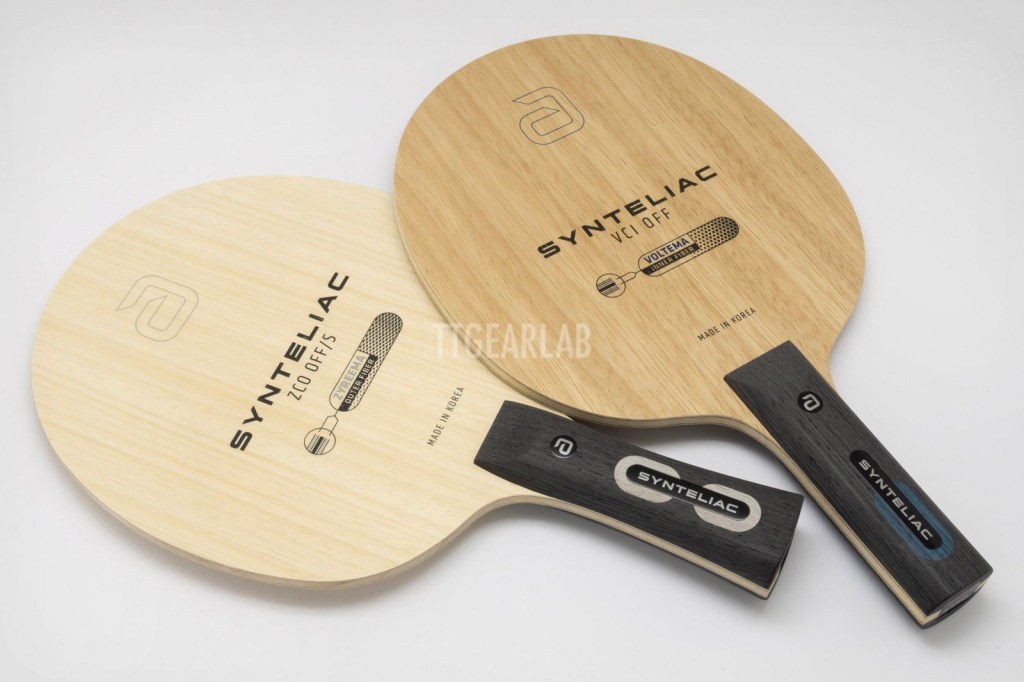
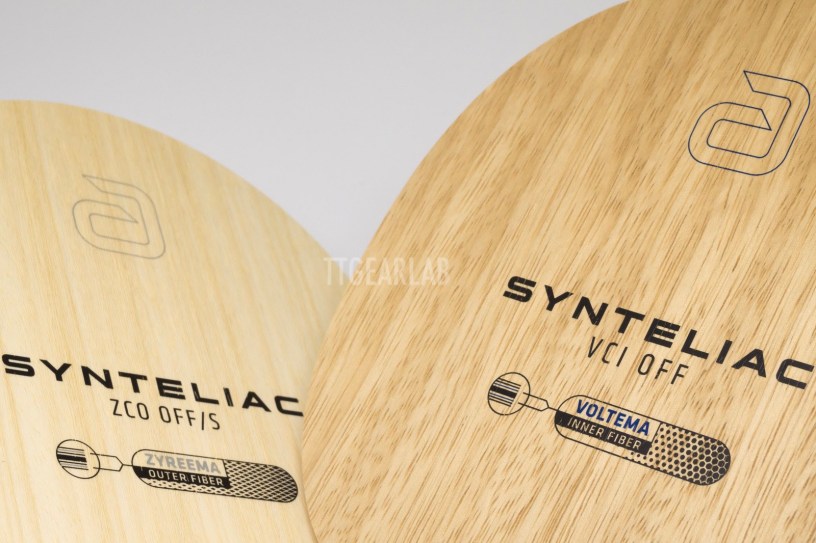
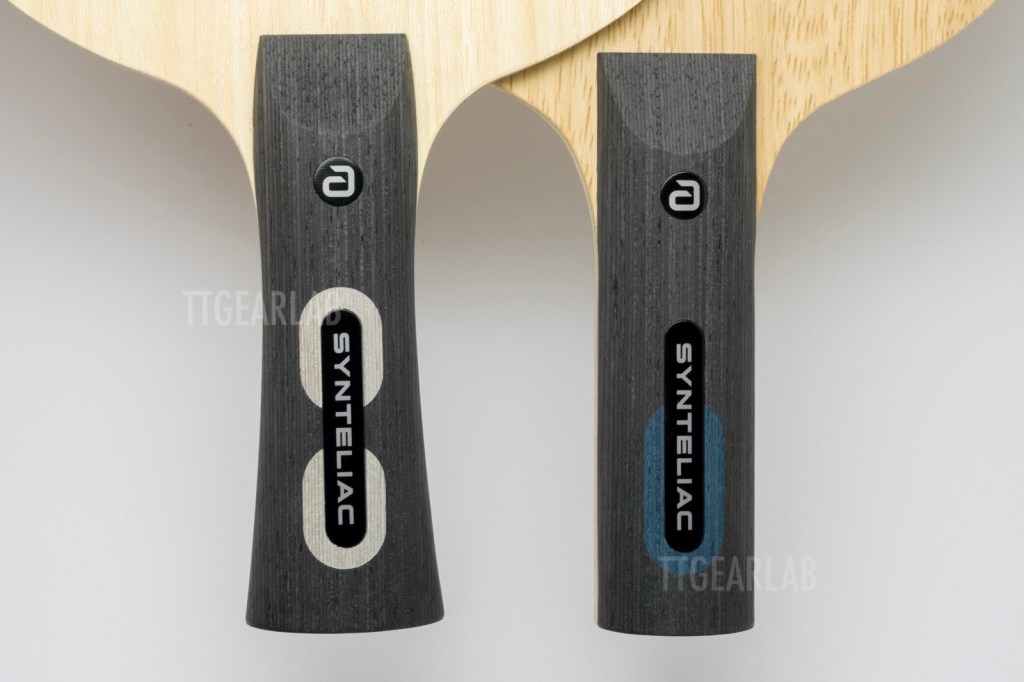
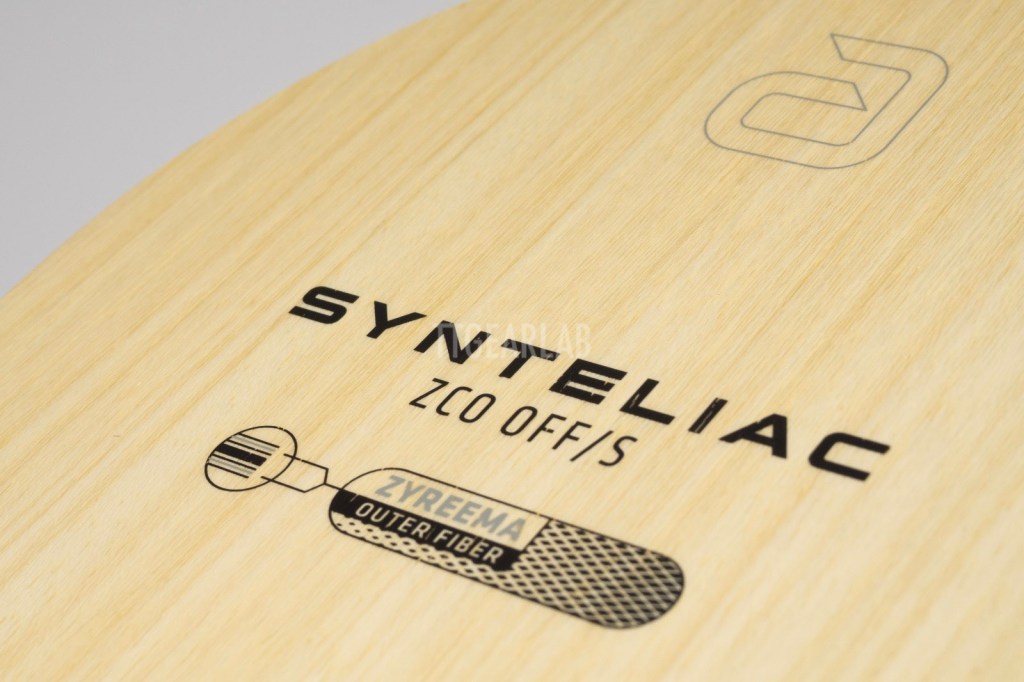
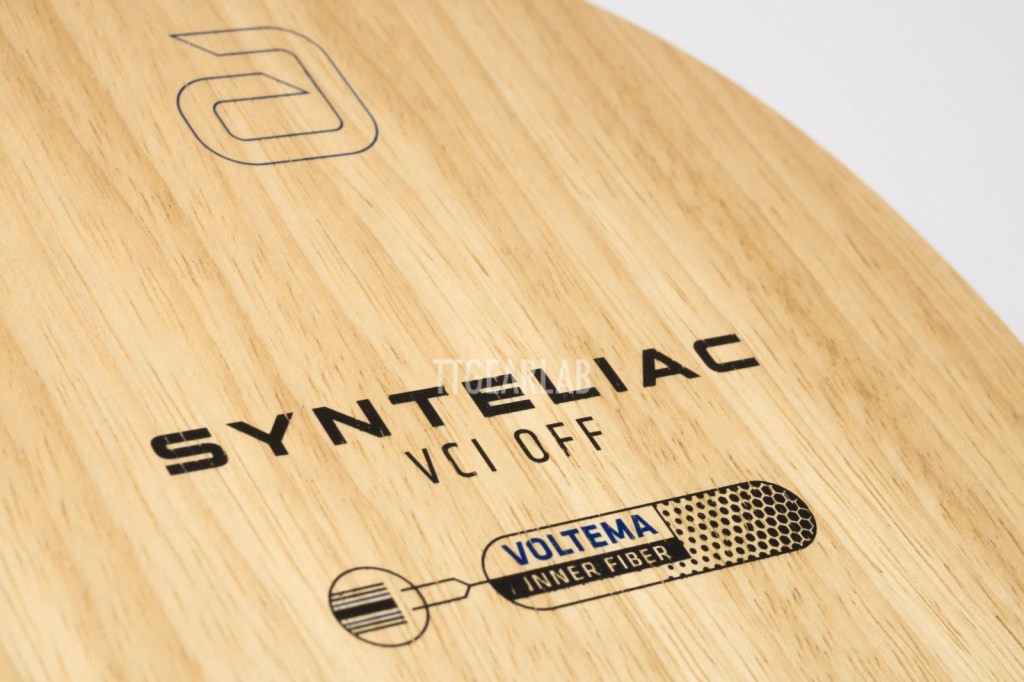
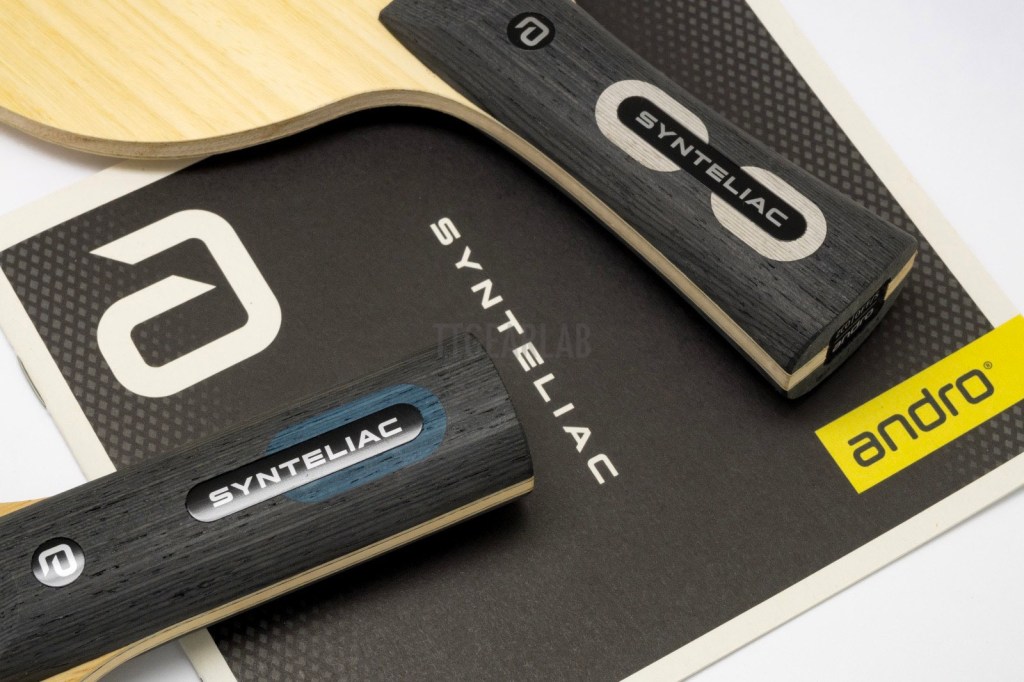
Left is ‘Synteliac ZCO OFF/S’ (FL handle) and right is ‘Synteliac VCI OFF’ (ST handle). Same design theme is being applied for all models in ‘Synteliac’ series, but each model is distinguished by the color block around the Aluminum plate at handle. ‘Synteliac ZCO OFF/S’ has two light gray blocks around its nameplate, and ‘Synteliac VCI OFF’ has one dark blue block around Aluminum plate. In the names, ‘ZC’ & ‘VC’ indicates the kinds of materials, and ‘O’ & ‘I’ indicates the type of constructions – outer or inner.
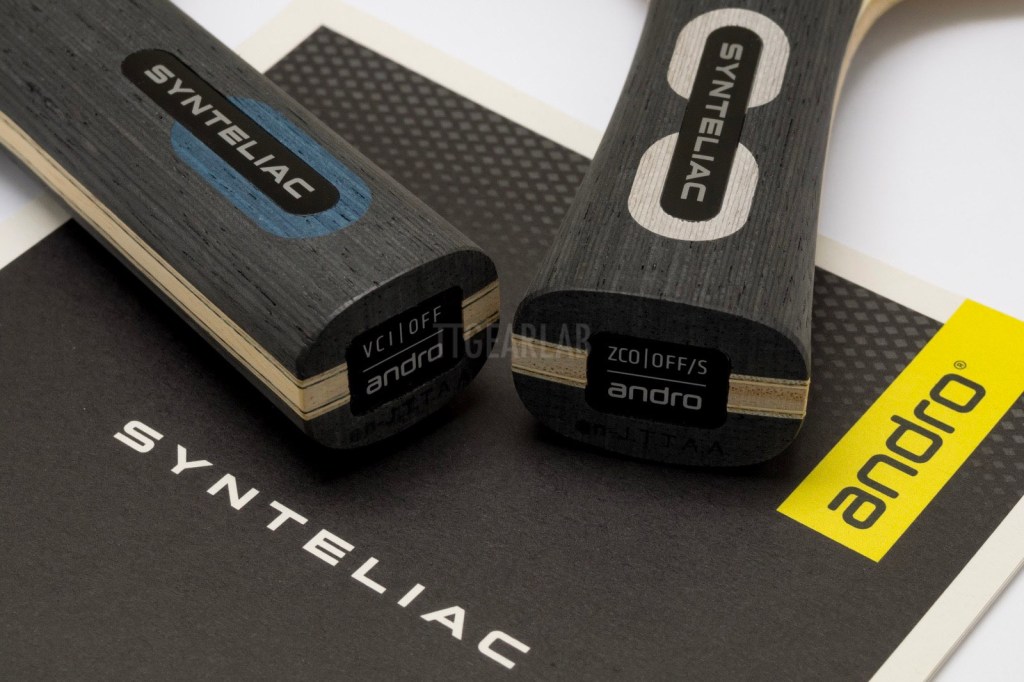
The Aluminum nameplate including the name of ‘SYNTELIAC’ is applied at the foreside of handle. That lens doesn’t include ‘andro’ logo. Instead, another small rounded logo plate that includes ‘a’ logo is applied close to the thumb part of handle. The additional name (= ZCO or VCI) and speed sign (OFF/S or OFF) are written not on the Aluminum plate at foreside of handle but at the transparent plastic lens at the end of handle.
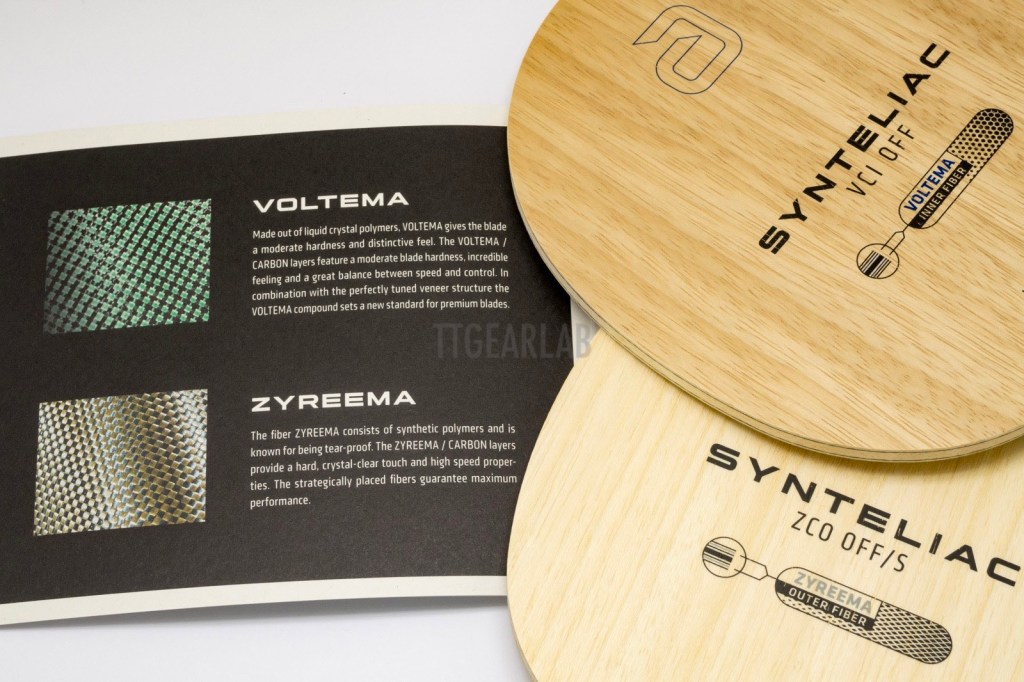
Two kinds of artificial materials – Voltema Carbon and Zyreema Carbon – are being used for ‘Synteliac’ series. According to the explanation by andro, Voltema is a liquid crystal polymer fiber that provides very good feeling and great balance between speed and control, and Zyreema is a tear-proof synthetic polymers fiber that provides clear touch and high speed for maximum performance. In fact, ‘liquid crystal polymer fiber’ means Arylate fiber, and ‘tear-proof synthetic polymers fiber’ means PBO (= Zylon) fiber. But, because ‘Arylate’ and ‘Zylon’ are registered trademarks, andro is calling those fibers in different names to avoid disputes on trademarks. (For the same reason other makers such as Tibhar, Victas and Xiom are also calling Arylate or Zylon in different names.)
1-1. Constructions
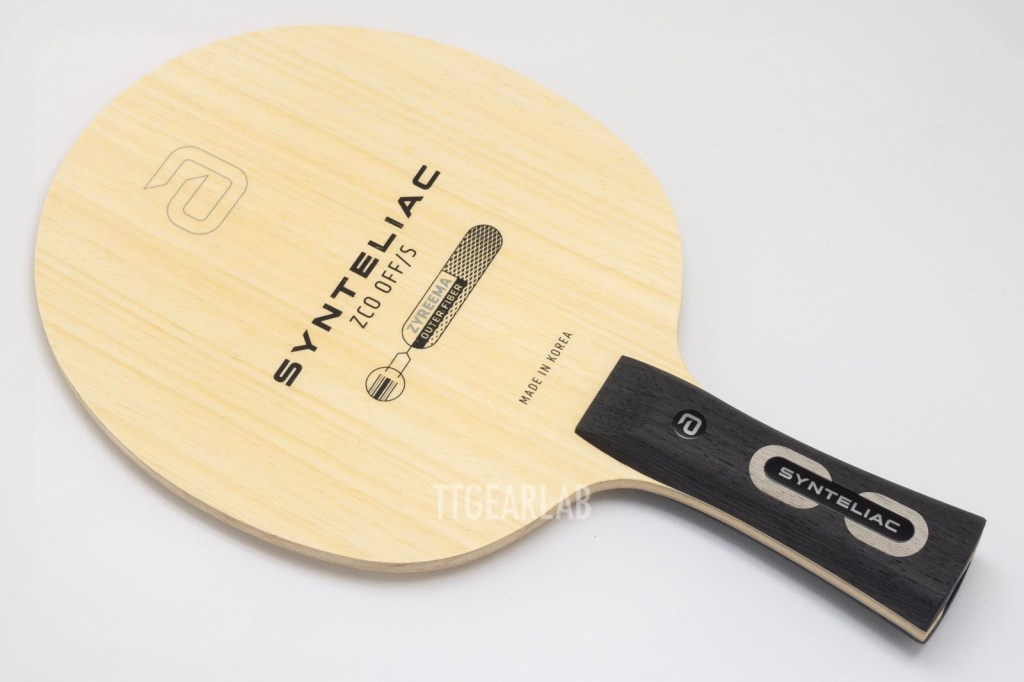
‘Synteliac ZCO OFF/S’ is the fastest model in ‘Synteliac’ series. ‘ZC’ means ‘Zyreema Carbon’, and ‘O’ means ‘outer fiber construction’. andro is explaining that the Zyreema Carbon gives ‘Synteliac ZCO OFF/S’ immense dynamics as well as a crystal-clear sound.
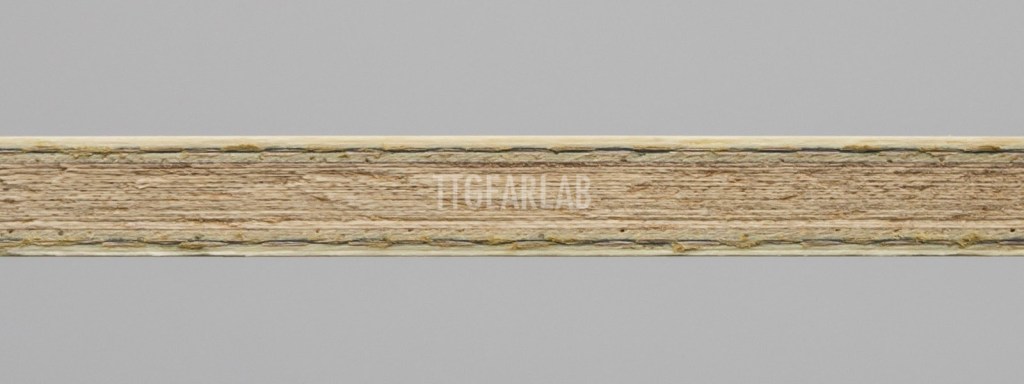
Above is the blade construction of ‘Synteliac ZCO OFF/S’. Zyreema Carbon (= ZLC) is placed directly under the top layer. The top layer is Koto, the middle layer is Ayous, and the center layer is Kiri. Overall thickness is measured as around 5.8mm.
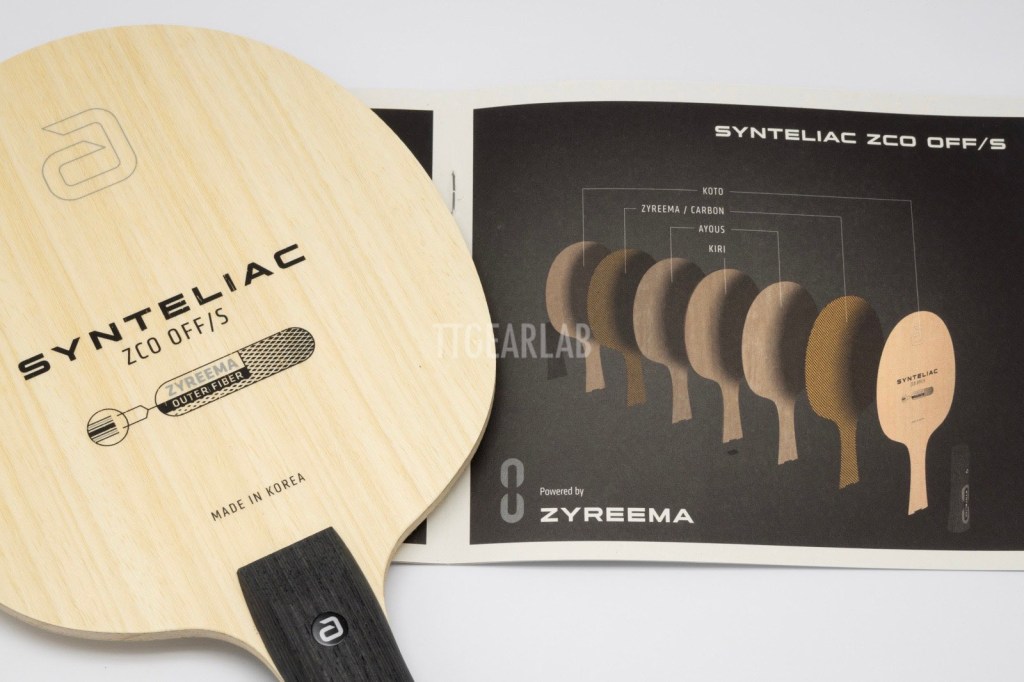
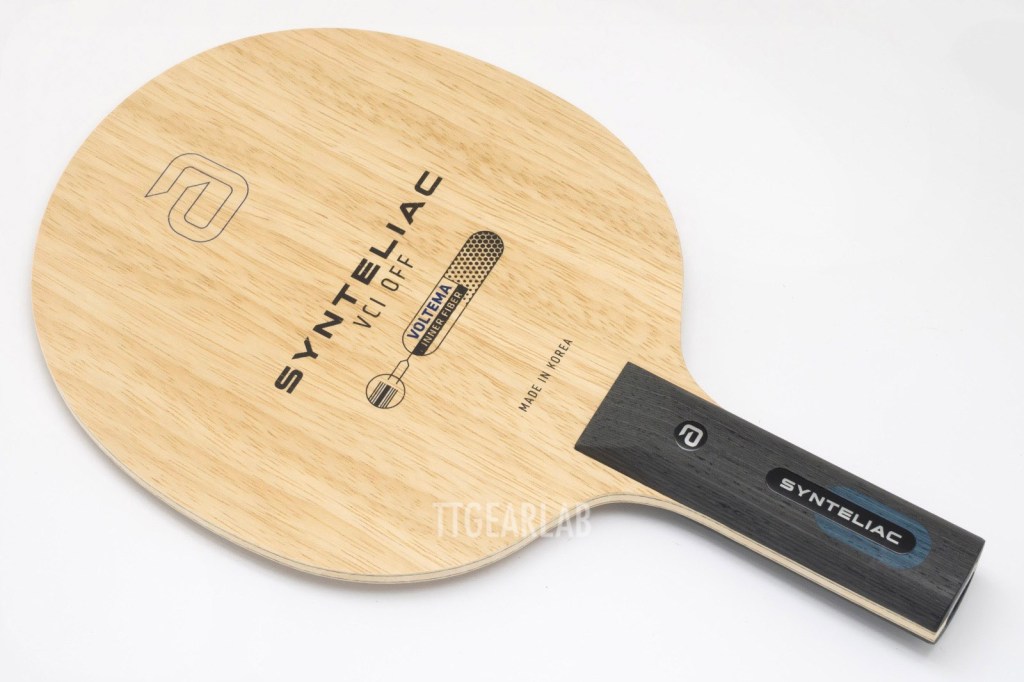
‘Synteliac VCI OFF’ is the least elastic but the most controllable model in ‘Synteliac’ series. ‘VC’ means ‘Voltema Carbon’ and ‘I’ means ‘inner fiber construction’. andro is explaining that the construction of ‘Synteliac VCI OFF’ provides well balanced speed and ball control.
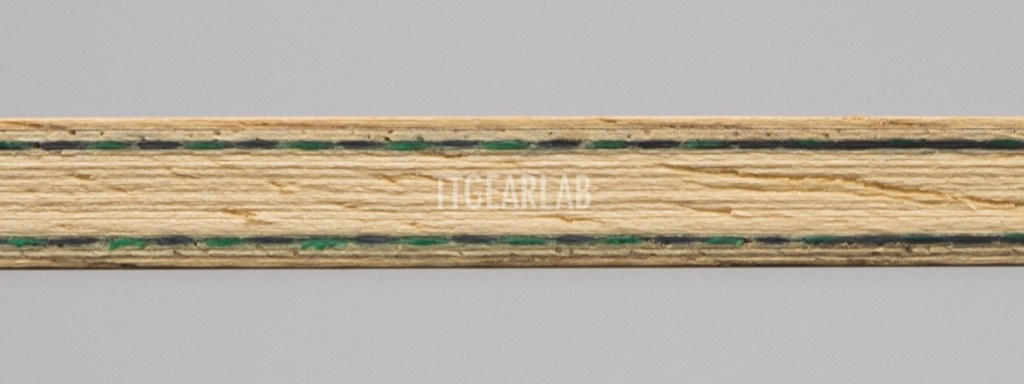
Above is the blade construction of ‘Synteliac VCI OFF. Voltema Carbon (= ALC) is placed between the middle layer and the center layer. The top layer is Limba, the middle layer and the center layer are Ayous. Overall thickness is measured as around 5.9mm.
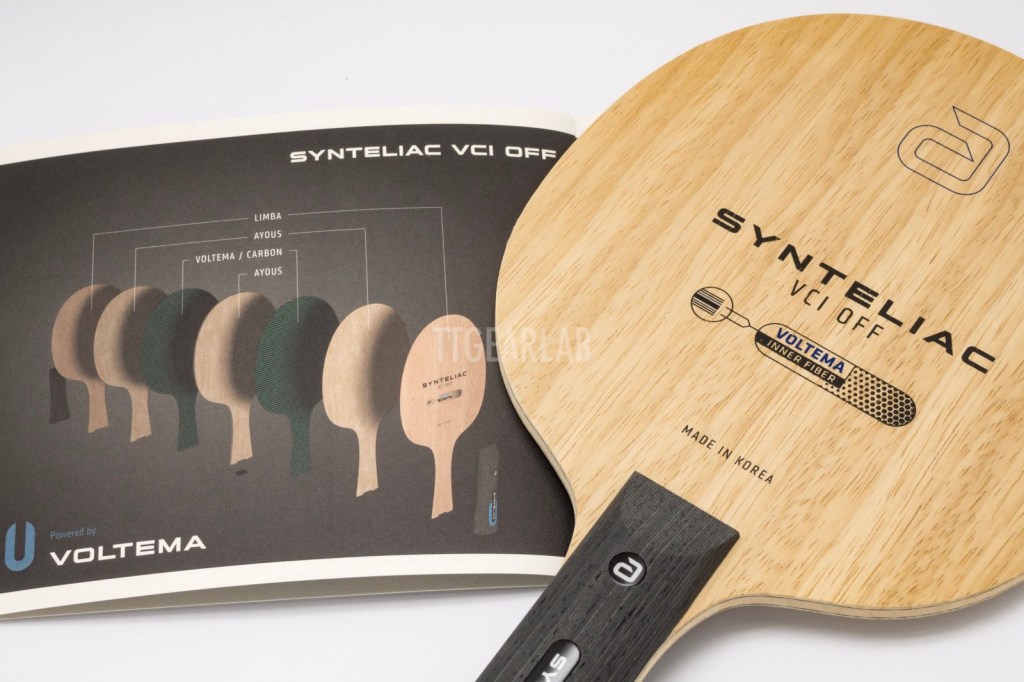
The box of ‘Synteliac’ series includes a small book that explains the characteristics and the constructions of ‘Synteliac’ series. The blade construction of ‘VCI OFF’ is shown in 3D graphics. (But, grain of middle Ayous layer isn’t shown in right orientation.)
1-2. Shapes of handles
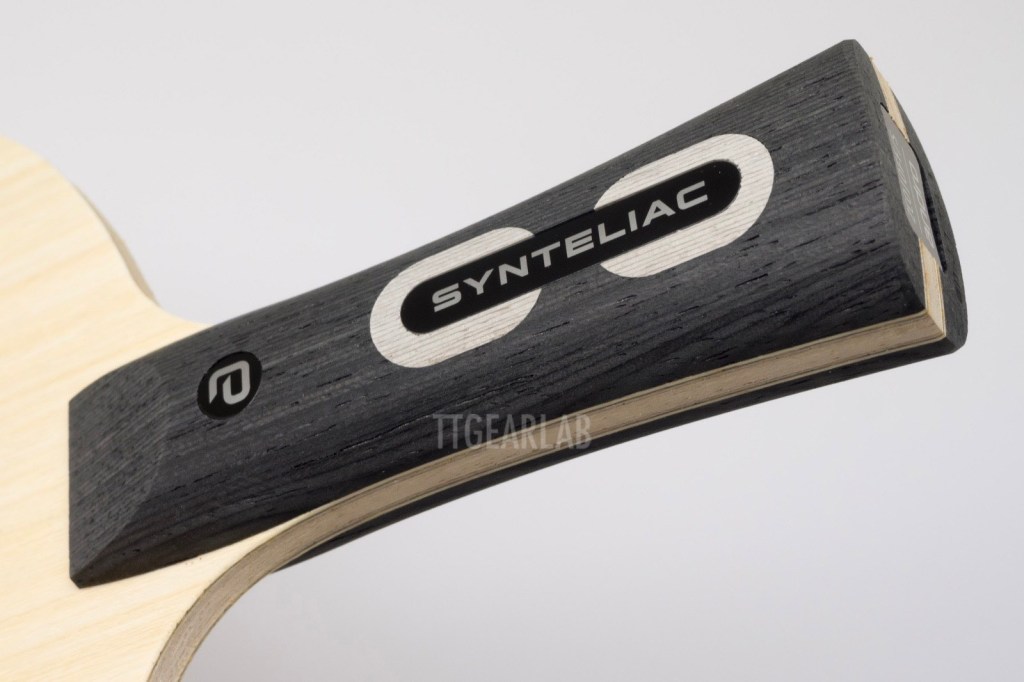
Two kinds of shapes are applied for the FL (flared) handles of ‘Synteliac’ series. The FL handles of outer fiber models (ZCO & VCO) are semi-wide type which is similar to the FL handle of ‘Viscaria’. On the contrary, the FL handles of inner fiber models (ZCI & VCI) are relatively narrower and taller (= thicker) handle which is similar to the FL handle of Butterfly ‘InnerForce Layer’ series or ‘Timo Boll’ series. Above picture shows the FL handle of outer fiber models. (Model is ‘Synteliac ZCO OFF/S’). Its width is around 25mm ~ 28mm (at bulge) ~ 26mm (at narrowest point) ~ 34mm (at the end). And, its thickness is around 22.5mm at thumb and 25mm at the end. There isn’t picture of the FL handles of inner fiber models. But, its width is around 26mm ~ 27mm (at bulge) ~ 25.6mm (at narrowest point) ~ 34mm (at the end). And, its thickness is around 23.5mm at thumb and 25.5mm at the end.
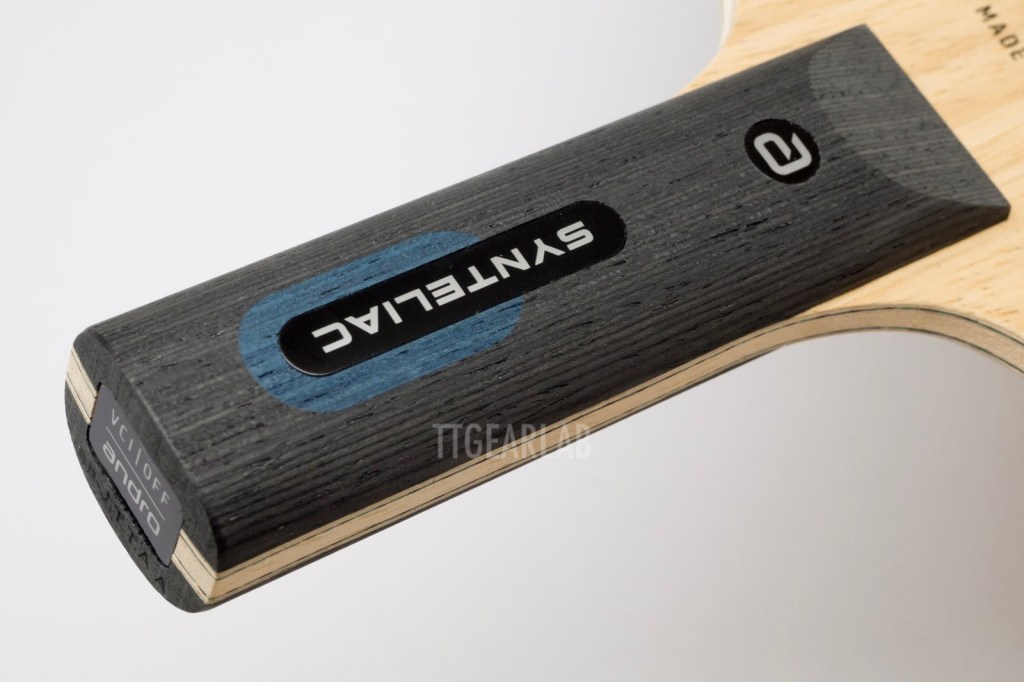
The shape of ST (straight) handle is common for all four models. Above picture shows the ST handle (Model is ‘Synteliac VCI Off’). Its width is around 28mm, and its thickness is around 23mm. This ST handle is also very similar to the standard Butterfly ST handle which is being applied most of important Butterfly blades (excluding ‘Timo Boll’ series and ‘Mizutani Jun’ series.)
1-3. Shapes of heads
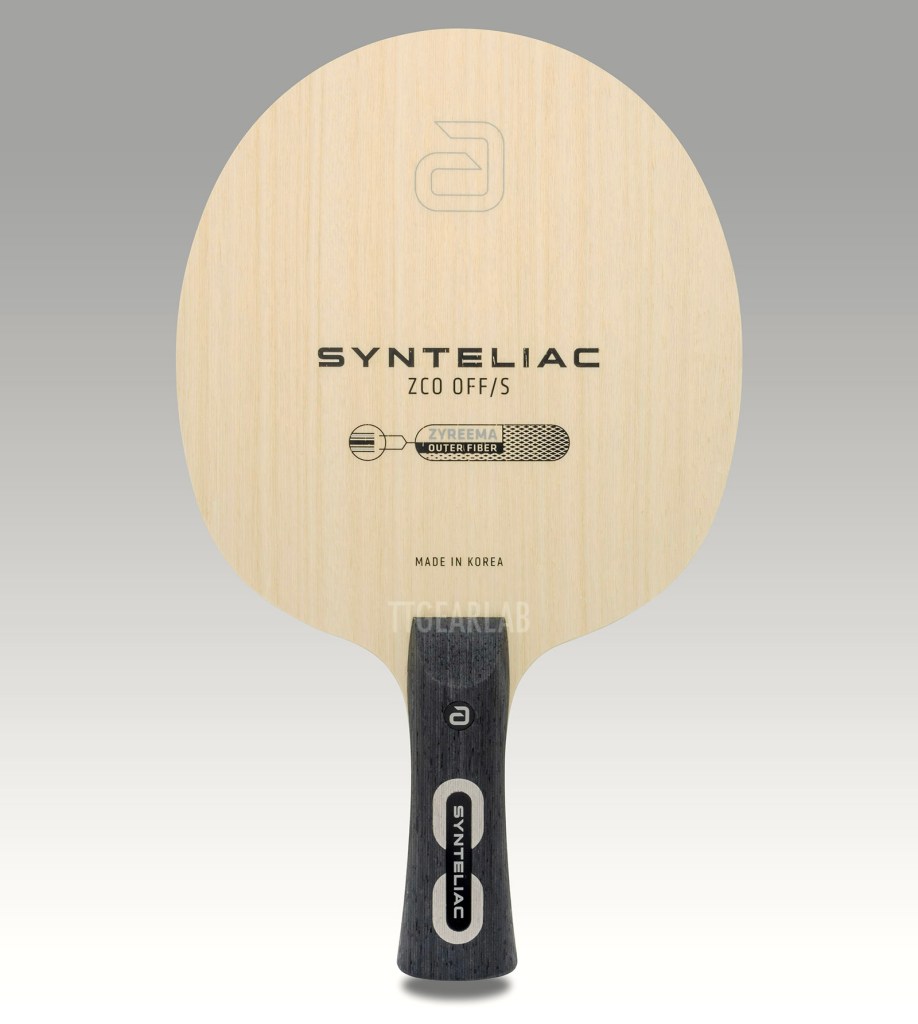
The head size of outer-fiber models is around 157mm x 150mm. Above picture shows ‘Synteliac ZCO OFF/S’.
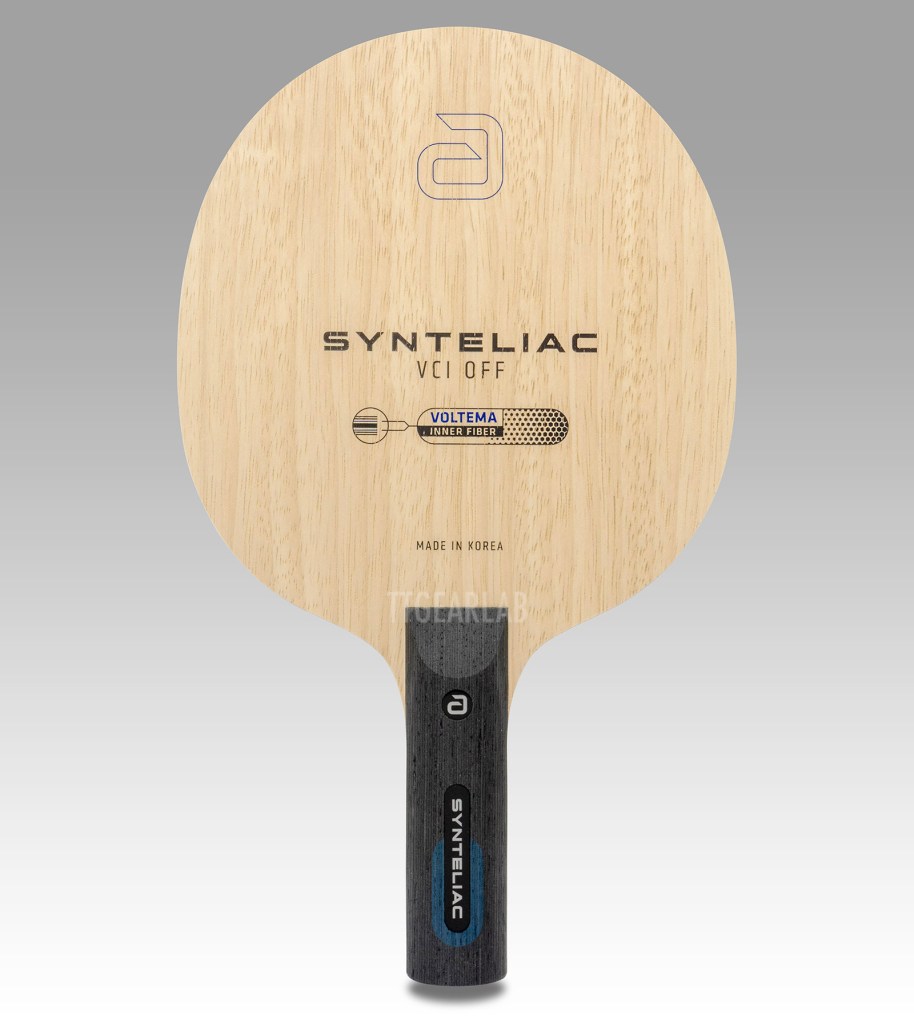
The head size of inner-fiber models is around 158mm x 152mm. Above picture shows ‘Synteliac VCI OFF’. It is interesting that the inner-fiber models have bigger head than the outer-fiber models in the same series.
Then let’s check the characteristics of ‘Synteliac ZCO OFF/S’ and ‘Synteliac VCI OFF’ by Performance Indices and then compare with some other blades in the market.
Please click here to return to top (table of contents)
2. Performance Indices
Performance Indices are measured objective values to represent the characteristics of table tennis gears. Concerning the detail of four performance indices, please refer to following articles in ‘About TTGearLab’ section :
- Performance indices : the way to evaluate blade by measurement
- The example of comparison by performance indices
The performance indices of ‘Synteliac ZCO OFF/S’ and ‘Synteliac VCI OFF’ are as follows:
Synteliac ZCO OFF/S (average weight = 88.8g)
Ep = 2.43
Ec = 2.38 (Ec/Ep = 0.98)
Vp = 1.46
Vl = 1.41 (Vl/Vp = 0.96)
Synteliac VCI OFF (average weight = 88.6g)
Ep = 1.80
Ec = 1.78 (Ec/Ep = 0.99)
Vp = 1.26
Vl = 1.28 (Vl/Vp = 1.01)
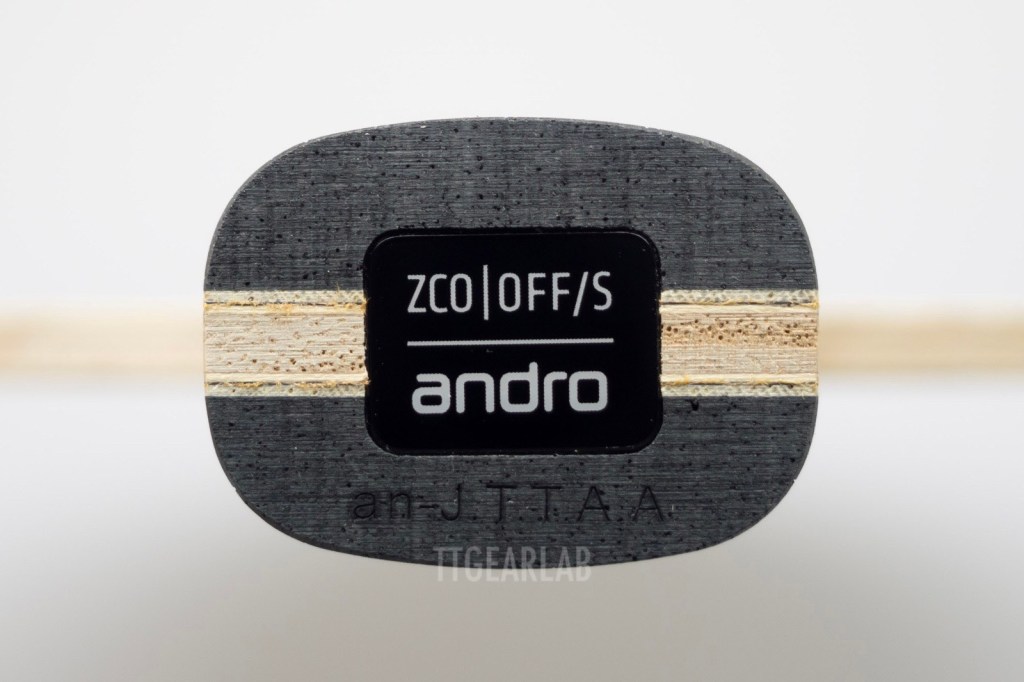
With ‘outer-ZLC’ construction, ‘Synteliac ZCO OFF/S’ is the fastest model in ‘Synteliac’ series, and as is expected it provides very high level of elasticity. Its Ep (= 2.43) and Ec (= 2.38) are much higher than those of the most of blades in the market. One interesting point is that there isn’t much difference between its Ec and its Ep. Because Ec/Ep is close to 1.0, ‘Synteliac ZCO OFF/S’ provides linear elastic characteristics. It doesn’t hold ball deeply or give additional kick when the player hits the ball very strongly. However, the players who have been accustomed to the blades those hold the ball very deeply when they hit the ball very strongly may feel that ‘Synteliac ZCO OFF/S’ kicks the ball strongly.
Regarding Vibration Indices, the Vp of ‘Synteliac ZCO OFF/S’ is 1.46. It is a much higher value than those of most of fiber blades. So it will be good for us to understand that ‘Synteliac ZCO OFF/S’ is a very stiff blade. But, its Vl (= 1.41) is lower than its Vp, and therefore its Vl/Vp is slightly under 1.0. It means that the distribution of the feeling is almost uniform. So the feeling transferred to the player’s index finger isn’t sharper than the primary feeling. The players who mainly feel relative feeling may think that ‘Synteliac ZCO OFF/S’ gives more comfortable feeling than some softer/slower blades.
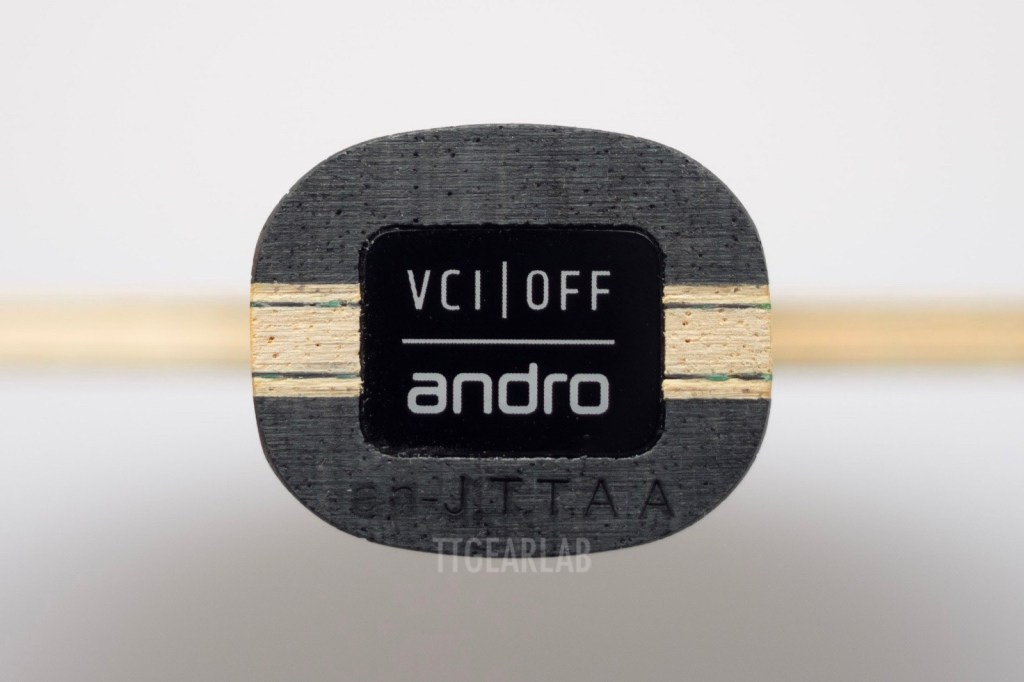
With ‘inner-ALC’ construction, ‘Synteliac VCI OFF’ is the most slowest model in ‘Synteliac’ series. However, its Ep (= 1.80) isn’t a low value. ‘Synteliac VCI OFF’ can be considered as one of the fastest inner-ALC blades. And, its Ec (= 1.78) is also quite high as the Ec of an inner-ALC blade. Because the Ec/Ep (= 0.99) is close to 1.0, ‘Synteliac VCO OFF’ provides linear elastic characteristics. It doesn’t hold ball deeply or give additional kick when the player hits the ball very strongly. However, the players who have been accustomed to the blades those hold the ball very deeply when they hit the ball very strongly may feel that ‘Synteliac VCI OFF’ kicks the ball strongly.
Regarding Vibration Indices, the Vp of ‘Synteliac VCI OFF’ is 1.26. It is the value we can expect from inner-ALC construction although it looks a bit higher than the Vp of standard inner-ALC blades. And, because the Vl (= 1.28) is close to Vp, its Vl/Vp (= 1.01) is close to 1.0. It means that the distribution of the feeling is almost uniform. Because the Vl isn’t high, the hard feeling due to high Vp is alleviated to some extent. Some player will feel that ‘Synteliac VCI OFF’ gives comfortable feeling. And, there will also be some players who will feel that ‘Synteliac VCI OFF’ is close to some 7-ply wood blades.
‘Synteliac ZCO OFF/S’ and ‘Synteliac VCI OFF’ provide relatively high elasticity and hard feeling in their respective categories (= outer-ZLC and inner-ALC). We can think that both of two blades focus on speed, and that is consistent with the phrase ‘SPEED WINS’ with which Andro explains ‘Synteliac’ series.
The comparison by Performance Indices will be able to help us to find the actual position of ‘Synteliac ZCO OFF/S’ and ‘Synteliac VCI OFF’.
Please click here to return to top (table of contents)
3. Comparison by Performance Indices
Then we can compare ‘Synteliac ZCO OFF/S’ and ‘Synteliac VCI OFF’ with some other blades. For the comparison some well-known outer-fiber blades and inner-fiber blades have been selected.
Following is the list of the blades to be compared :
Outer Fiber blades
- Butterfly ‘Fan Zhendong Super ZLC’ (avg. weight = 90.8g) : Faster version of Butterfly outer ZLC.
- Butterfly ‘Fan Zhendong ZLC’ (avg. weight = 85.1g) : Standard outer ZLC of Butterfly. Thinner than ‘super ZLC’ version.
- Butterfly ‘Viscaria Super ALC’ (avg. weight = 92.7g) : Faster than ‘Viscaria’.
- Butterfly ‘Viscaria’ (avg. weight = 87.1g) : Reference of all outer ALC blade. Current version.
Inner Fiber blades
- Butterfly ‘InnerForce Layer ZLC’ (avg. weight = 89.8) : Standard inner ZLC of Butterfly.
- Butterfly ‘Ovtcharov InnerForce ALC’ (avg. weight = 89.2g) : High speed model of Butterfly inner ALC blades.
- Butterfly ‘InnerForce Layer ALC’ (avg. weight = 91.2g) : The standard of inner ALC blades. Current version measured in 2023. Thicker and more elastic than former ones measured in 2018.
- DHS ‘Hurricane Long 5’ (avg. weight = 88.1g) : The representative of current inner ALC blades. This is the base model of Ma Long’s blade. New 2022 version whose fiber structure is different from the older version.
- Xiom ‘36.5 ALXi’ (avg. weight = 87.1g) : Similar to older ‘InnerForce Layer ALC’ measured in 2018.
Others
- Butterfly ‘SK Carbon’ (avg. weight = 80.6g) : Very thin & light carbon blade whose artificial material is woven carbon fiber.
- Xiom ‘Hugo HAL’ (avg. weight = 87.9g) : Outer fiber blade whose artificial material is pure Arylate fiber that doesn’t include carbon fiber.
- andro ‘Gauzy SL OFF’ (avg. weight = 90.2g) : 7-ply wood blade which has been used by Simon Gauzy. Simon Gauzy may replace this blade with ‘Synteliac VCI OFF’.
- Butterfly ‘Korbel’ (avg. weight = 88.7g) : The standard of 5-ply wood offensive blades
3-1. Elasticity Indices
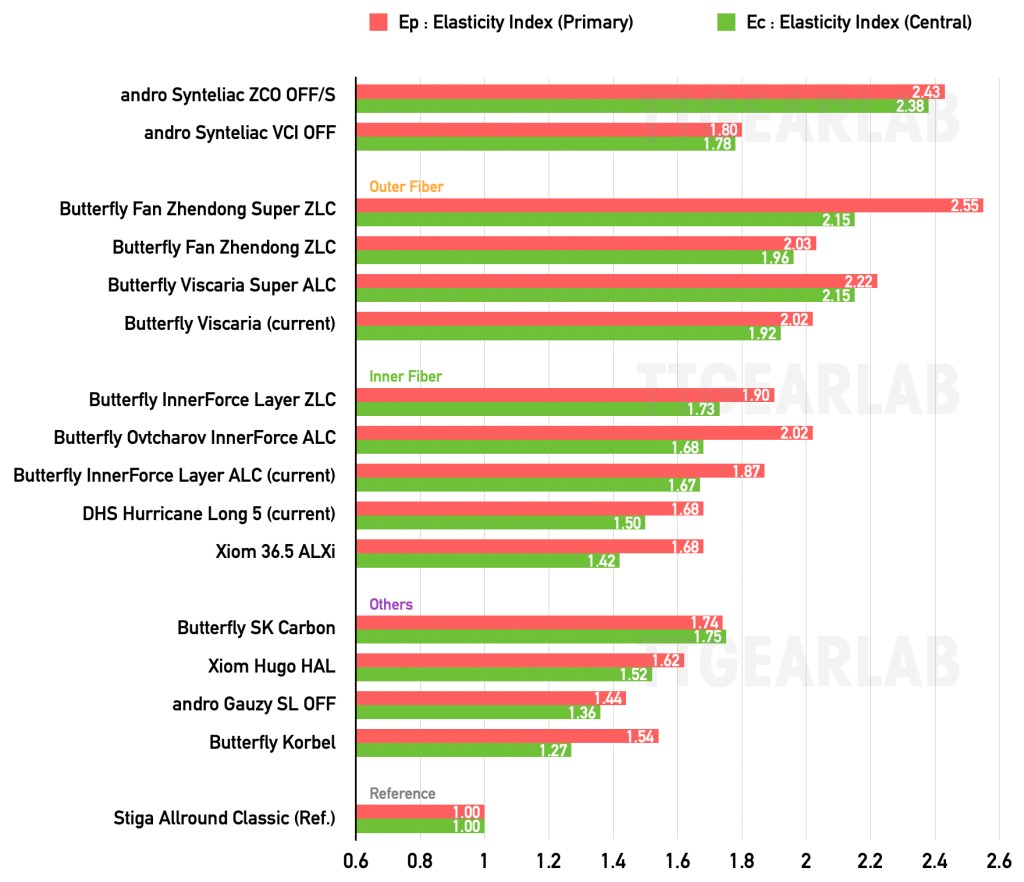
Fig.17 shows the comparison graph of Elasticity Indices.
Ep (Primary Elasticity Index) is directly concerned with the rebound speed of blade. Ec (Central Elasticity Index) is concerned with additional ‘kick’ when player hits ball very strongly.
First, we can compare outer fiber blades with ‘Synteliac ZCO OFF/S’. The Ep of ‘Synteliac ZCO OFF/S’ is the second highest in this comparison. The only one blade whose Ep is higher than that of ‘Synteliac ZCO OFF/S’ is ‘Fan Zhendong Super ZLC’, but the difference between two blades isn’t significant in this elasticity level. But, there is big difference between the Ec’s of two blades. The Ec of ‘Synteliac ZCO OFF/S’ is much higher than the Ec of ‘Fan Zhendong Super ZLC’. There isn’t big difference between the Ec and the Ep of ‘Synteliac ZCO OFF/S’ while Zhendong Super ZLC shows big difference between its Ec and its Ep. Therefore, we can expect that the actual playing characteristics of ‘Synteliac ZCO OFF/S’ will be much different from that of ‘Fan Zhendong Super ZLC’. If we observe the relationship between Ec and Ep, the other three blades in this group look closer to ‘Synteliac ZCO OFF/S’ although those three are much less elastic than ‘Synteliac ZCO OFF/S’ or ‘Fan Zhendong Super ZLC’.
Then, let’s compare inner fiber blades with ‘Synteliac VCI OFF’. Its Ep is lower than those of three Butterfly inner fiber blades – ‘InnerForce Layer ZLC’, ‘Ovtcharov InnerForce ALC’ and ‘InnerForce Layer ALC’. On the contrary its Ec is higher than those of three Butterfly inner fiber blades. One common characteristic of inner fiber blades in this comparison (except for ‘Synteliac VCI OFF’) is that Ep is much higher than Ec. But, ‘Synteliac VCI OFF’ doesn’t show that characteristic. Therefore we can expect that the playing character of ‘Synteliac VCI OFF’ will be somewhat different from the playing characters of other inner fiber blades in this comparison.
Last comparison is with other kinds of blades. Both of ‘Synteliac ZCO OFF/S’ and ‘Synteliac VCI OFF’ are more elastic than any blade in ‘Others’ group. The one which is closest to ‘Synteliac VCI OFF’ is ‘SK Carbon’ although its construction and artificial material are totally different from those of ‘Synteliac VCI OFF’. Its Ec is slightly higher than its Ep, but the difference is ignorable. That graph shape looks very similar to the shapes of the graphs of ‘Synteliac ZCO OFF/S’ and ‘Synteliac VCI OFF’. And, if we allow a bit more gap between Ec and Ep, ‘Hugo HAL’ and ‘Gauzy SL OFF’ can be also compared with ‘Synteliac ZCO OFF/S’ and ‘Synteliac VCI OFF’. But, ‘Korbel’ can’t because its Ec is much lower than its Ep.
Examining Ec/Ep is an easier way to understand the characteristics of blade concerned with elasticity. Fig.18 shows the relationship between Ec/Ep and Ep.
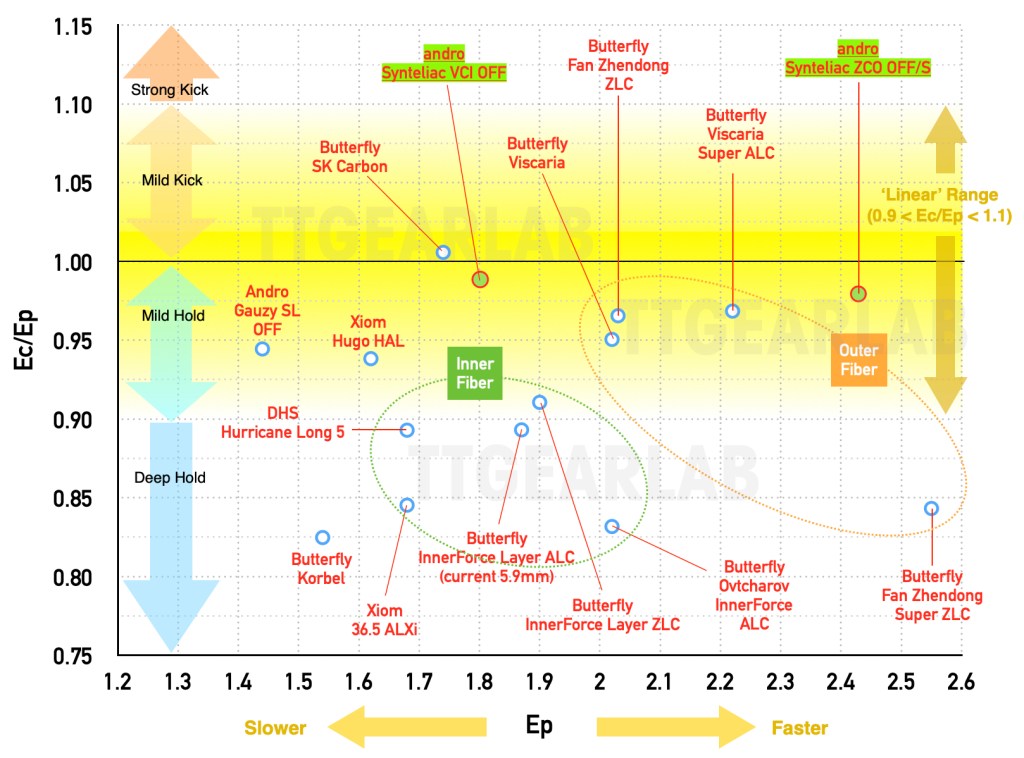
Ec/Ep expresses the ‘tendency’ of the elasticity of blade. By examining Ec/Ep and Ep at the same time, we can easily understand the behavior of blades.
On the graph, most of the blades in this comparison (except for reference blade and ‘SK Carbon’) are in ‘Hold’ range (Ec/Ep < 1.0). And, we can see that many blades are placed near the ‘Linear’ line (Ec/Ep = 1.0).
We can observe that ‘Outer Fiber’ group is located to upper right of ‘Inner Fiber’ group. In general outer fiber blades are more elastic, and give more kick than inner fiber blades. Inner fiber blades are less elastic, and hold the ball more deeply when the player hits the ball very strongly. One exception of outer fiber baldes is ‘Fan Zhendong Super ZLC’. It holds ball very deeply when the player hits the ball very strongly, and that is the major difference between the ZLC version and the Super ZLC version of ‘Fan Zhendong / Zhang Jike’ series.
First, let’s observe the location of outer-ZLC version – ‘Synteliac ZCO OFF/S’. When we see only the primary elasticity indices, ‘Synteliac ZCO OFF/S’ is a bit less elastic than ‘Fan Zhendong Super ZLC’ However, differentfly from ‘Fan Zhendong Super ZLC’, ‘Synteliac ZCO OFF/S’ is placed close to the ‘Linear’ line (Ec/Ep = 1.0). It means that ‘Synteliac ZCO OFF/S’ will not hold the ball as deeply as ‘Fan Zhendong Super ZLC’ does when the player hits the ball very strongly. Instead, ‘Synteliac ZCO OFF/S’ will provide more power than ‘Fan Zhendong Super ZLC’ when the impact strength is high. On the graph, we can see that three other Butterfly outer fiber blades – ‘Viscaria Super ALC’, ‘Fan Zhendong ZLC’ and ‘Viscaria’ are at similar level of Ec/Ep as ‘Synteliac ZCO OFF/S’. Especially ‘Fan Zhendong ZLC’. Therefore, we will be able to consider ‘Synteliac ZCO OFF/S’ as faster ‘Fan Zhendong ZLC’.
Next is the observation of inner-ALC version – ‘Synteliac VCI OFF’. It lies above ‘Inner Fiber’ group, and the distance between ‘Synteliac VCI OFF’ and the ‘Inner Fiber’ group is quite large. Most of inner fiber blades in this comparison holds the ball very deeply when the player hits the ball very strongly. But, ‘Synteliac VCI OFF’ doesn’t. Because it is placed near the ‘Linear’ line, ‘Synteliac VCI OFF’ responds to the player’s impact strength without any addition or subtraction. That kind of characteristic is suitable for modern all round play that mixes a variety of technics including block, but less suitable for aggressive topspin that aims at the early timing of rising. Some players who has been accustomed to the other inner ALC blades will feel that ‘Synteliac VCI OFF’ gives strong kick when they perform smash or active block at close-to-table area.
Both of the two models of ‘Synteliac’ series are located near the Linear line. Because many players tends to feel that the blades near the Linear line or over the Linear line ‘speedy’, it coincides with Andro’s slogan for ‘Synteliac’ series – ‘SPEED WINS’.
Among the other blades, the one which is close to ‘Synteliac VCI OFF’ is ‘SK Carbon’. Although its construction is totally different from that of ‘Synteliac VCI OFF’, we can expect that its behavior will be similar to that of ‘Synteliac VCI OFF’.
‘Korbel’ is located too far from ‘Synteliac VCI OFF’. In many cases inner ALC blades are recommended for the players who want to replace Korbel to one step faster blade. That is thanks to the ‘Deep Hold’ characteristics of many inner ALC blades. However, ‘Synteliac VCI OFF’ can’t be recommended for the replacement of ‘Korbel’. Instead, ‘Synteliac VCI OFF’ can be recommended for the players who replace classic 7-ply wood blades to fiber blade. Although ‘Gauzy SL OFF’ isn’t a classic 7-ply wood blade, it makes sense to try ‘Synteliac VCI OFF’ as the replacement of ‘Gauzy SL’ for the enhancement of power, because both of ‘Gauzy SL OFF’ and ‘Synteliac VCI OFF’ are located in ‘Mild Hold’ range. Then next, let’s compare Vibration Indices.
Please click here to return to top (table of contents)
3-2. Vibration Indices
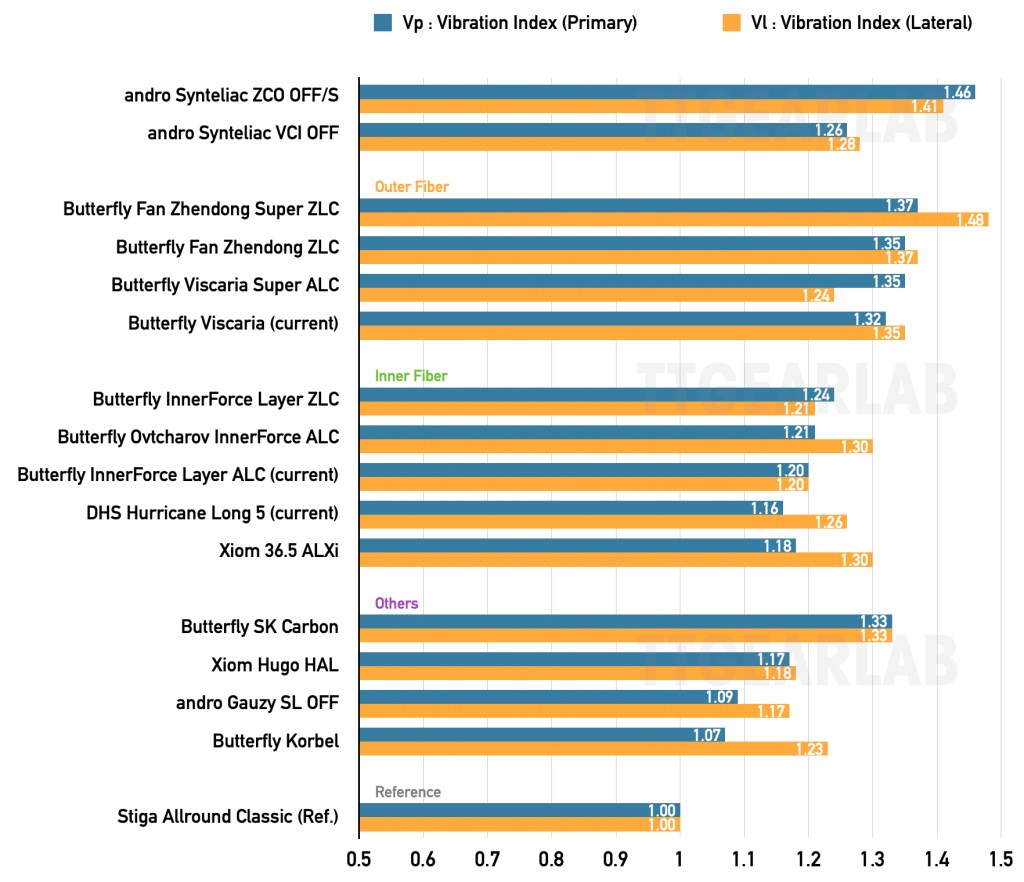
Fig.19 shows the comparison graph of Vibration Indices. Vibration Indices are concerned with feeling. Vp indicates primary feeling which is transferred to player’s palm. And, Vl is the feeling at the edge of the wing – the lower side of blade head. It is felt by player’s index finger or middle finger.
First comparison is between ‘Synteliac ZCO OFF/S’ and ‘Outer Fiber’ group. We can see that the Vp of ‘Synteliac ZCO OFF/S’ is noticeably higher than those of all blades in ‘Outer Fiber’ group. ‘Synteliac ZCO OFF/S’ is a very stiff blade, and it is even stiffer than ‘Fan Zhendong Super ZLC’. On the contrary, the Vl of ‘Synteliac ZCO OFF/S’ is lower than that of ‘Fan Zhendong Super ZLC’. From this difference, we can predict that the feeling of ‘Synteliac ZCO OFF/S’ will be significantly different from the feeling of ‘Fan Zhendong Super ZLC’. Althogh ‘Synteliac ZCO OFF/S’ is a very stiff blade, many players will feel that its feeling isn’t that hard, because its Vl is lower than its Vp.
‘Synteliac VCI OFF’ can be compared with ‘Inner Fiber’ group and other blades. We can see that the Vp of ‘Synteliac VCI OFF’ is a higher than those of all blades in ‘Inner Fiber’ group. Especially it is important that there is clear difference between the Vp of ‘Synteliac VCI OFF’ and that of ‘InnerForce Layer ALC’ because those two can be direct competitors because of similar constructions. And, the graph shape of ‘InnerForce Layer ALC’ look similar to that of ‘Synteliac VCI OFF’, although there is difference in the level of indices. Some players will feel that those two blades are similar in feelings although ‘Synteliac VCI OFF’ is harder than ‘InnerForce Layer ALC’. Regarding Vl, ‘Ovtcharov InnerForce ALC’ and ‘36.5 ALXi’ show the Vl’s those are slightly higher than the Vl of ‘Synteliac VCI OFF’, while the Vp’s of those two are lower than that of ‘Synteliac VCI OFF’. Then players feel much difference between the feeling of ‘Synteliac VCI OFF’ and that of ‘Ovtcharov InnerForce ALC’ or ‘36.5 ALXi’.
And, in ‘Others’ group, we can’t find any blade whose Vibration Indices are close to those of two ‘Synteliac’ models. But, because of the similarity in graph shapes, it is expected that changing among the three blades – ‘Synteliac VCI OFF’, ‘SK Carbon’ and ‘Hugo HAL’ – will not be difficult although there is the difference of stiffness level. However, the players feel that ‘Gauzy SL OFF’ is totally different from ‘Synteliac VCI OFF’.
Examining Vl/Vp is an easier way for the comparison of the tendency of feeling. Fig.20 shows the relationship between Vl/Vp and Vp for easier comparison.
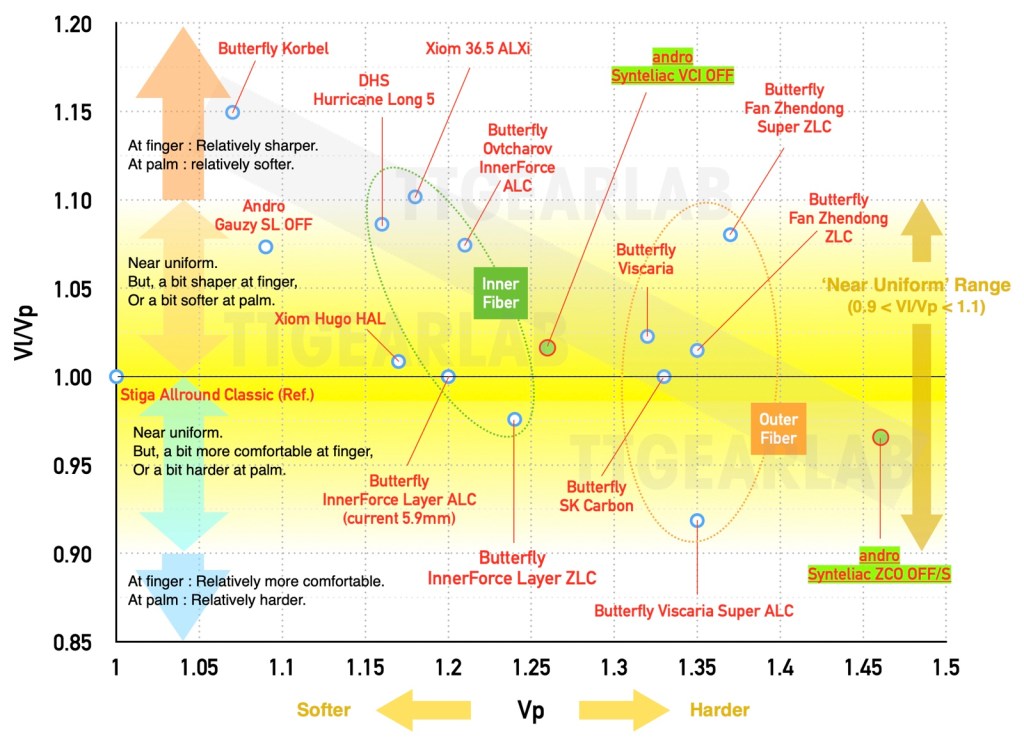
On the graph, most of blade in this comparison are in upper part of the graph – ‘Relatively sharper at finger’ range. And, two are located in lower part – ‘Relatively more comfortable at finger’, and two including reference blade are on the ‘Uniform’ line (Vl/Vp = 1.0). We can see that ‘Outer Fiber’ group is located to the right of ‘Inner Fiber’ group. As we can expect from the constructions of the blades, the measure data says that outer fiber blades are harder than inner fiber blades. But, both groups are spread out vertically upwards and downwards. Vl/Vp varies for each individual model regardless of the type (inner or outer or others) of blade construction.
‘Synteliac ZCO OFF/S’ is located further to the right than ‘Outer Fiber’ group. We can understand that ‘Synteliac ZCO OFF/S’ is a very hard blade. But, its Vl/Vp is under 1.0, differently from most of the blades in ‘Outer Fiber’ group. It means that the hard feeling transmitted to the index finger is alleviated to some extent. Anyway, it is clear that the feeling of ‘Synteliac ZCO OFF/S’ totally different from the feeling of ‘Fan Zhendong ZLC’ or ‘Fan Zhendong Super ZLC’.
‘Synteliac VCI OFF’ is also located further to the right than ‘Inner Fiber’ group. Its location is between ‘Inner Fiber’ group and ‘Outer Fiber’ group. The primary feeling of ‘Synteliac VCI OFF’ is harder than that of any blade in ‘Inner Fiber’ group. When compared with ‘InnerForce Layer ALC’ which can be the direct competitor, both of the Vp and the Vl/Vp of ‘Synteliac VCI OFF’ is relatively higher. But, the difference of Vl/Vp isn’t significant. So the primary feeling is the most important factor when we compare ‘Synteliac VCI OFF’ and ‘InnerForce Layer ALC’. When compared with ‘Hurricane Long 5’ or ‘36.5 ALXi’ or ‘Ovtcharov InnerForce ALC’, ‘Syntelicac VCI OFF’ is located to the lower right. It means that ‘Synteliac VCI OFF’ is harder than those three models, but the hard feeling transmitted to the index finger is alleviated to some extent.
Here we can imagine a diagonal band running from top left to bottom right. (That band is shown in gray color on the graph.) That kind of band can be the criteria when we change the blade to another one. As we move from top left to bottom right, the feeling of blade becomes harder. However, the relative feeling becomes comfortable because Vl/Vp becomes lower. By the reduction of Vl/Vp, the hard feeling transmitted to the index finger is alleviated, as is explained above when we observe ‘Synteliac ZCO OFF/S’ and ‘Synteliac VCI OFF’. Then the replacement from ‘Korbel’ to ‘Ovtcharov InnerForce ALC’, from ‘Ovtcharov InnerForce ALC’ to ‘Viscaria’ or ‘Fan Zhendong ZLC’, and from ‘Fan Zhendong ZLC’ to ‘Synteliac ZCO OFF/S’ can be natural ways. For some players, this method can be more reasonable way than just considering indices. (And, we will be able to consider the same way for elasticity characteristics shown in Fig.18. In that case the direction of band will be from bottom left to top right.) We can see that Both of ‘Gauzy SL OFF’ and ‘Synteliac VCI OFF’ are just below the band, and therefore the replacement from ‘Gauzy SL OFF’ to ‘Synteliac VCI OFF’ follows right below the band. It will be a kind of natural way of replacement.
Please click here to return to top (table of contents)
4. Summary
andro ‘Synteliac’ series is the new fiber blade family that represent the blade range of andro. The characteristics of ‘Synteliac ZCO OFF/S’ which is the fastest one in the family and ‘Synteliac VCI OFF’ which is the most controllable one in the family can be summarized as follows:
‘Synteliac ZCO OFF/S’ is the outer-ZLC version of andro ‘Synteliac’ series. It provides top level of elasticity which is higher than the elasticity of most outer fiber blades. Further it doesn’t hold ball deeply when the player hits the ball very strongly. The combination of high primary elasticity and Mild Hold characteristic let the player easily make very fast ball with ‘Synteliac ZCO OFF/S’. The primary feeling of ‘Synteliac ZCO OFF/S’ is stiffer than the other outer fiber blades, but that feeling transmitted to the index finger isn’t that hard. Basically, ‘Synteliac’ series is the blade family for top players whose main technic is topspin. But, it is expected that ‘Synteliac ZCO OFF/S’ is also very good for smash. Therefore ‘Synteliac ZCO OFF/S’ is strongly recommended for the players who want to change the blade from ‘Hinoki-Carbon’ blades to the blade for topspin but don’t want to give up the ability of smash.
‘Synteliac VCI OFF’ is the inner-ALC version of andro ‘Synteliac’ series. Its primary elasticity is what we can expect from inner-ALC construction. But, differently from ordinary inner-ALC blades, ‘Synteliac VCI OFF’ doesn’t hold the ball deeply when the player hits the ball very strongly. Therefore, ‘Synteliac VCI OFF’ provides high ability of control for light hits and higher elasticity than the other inner-ALC blades for hard hits. The primary feeling is a bit harder than the other inner-ALC blades, and the distribution of feeling is almost uniform. These characteristics are better suited for using a variety of technics rather than continuous topspin aiming at early timing. Therefore, we can expect that ‘Synteliac VCI OFF’ is suitable for modern all-round play that integrates attack and defense while frequently using block and counter topspin. Additionally, the characteristics of ‘Synteliac VCI OFF’ are close to those of modern 7-ply wood blades. For that reason the player who want to replaced 5-ply wood blade by 7-ply wood blade but are hesitant because of the 7-ply wood blades are too thick will be able to seriously consider ‘Synteliac VCI OFF’.
Please click here to return to top (table of contents)
 TTGearLab
Thanks for sharing this detailed report. Looking at the vibration indexes, VCI seems more “balanced” versus Shang Kun AC for example. Not sure if it would make sense to replace Shang Kun AC with VCI.
Thanks again, greatly appreciated all the work you put in this and all other reports. Keep up the good work!
LikeLike
Thank you for comment. I have just noticed that I forgot to add ‘Shang Kun Hybrid AC’ to this comparison. I’m considering to update the article when I have time.
As you mentioned ‘Synteliac VCI’ is more balanced than ‘Shang Kun Hybrid AC’. (Some players think that ‘Shang Kun Hybrid AC’ is more balanced just because it holds ball more deeply. But, that isn’t ‘balance’.) And, in my opinion, replacing ‘Shang Kun Hybrid AC’ with ‘Synteliac VCI’ is meaningful only in case that you want to use smash and block more frequently. If not, I don’t recommend the replacement.
LikeLike
Thanks for the detailed explanation. I have a question. Based on the Ep data, the hurricane long 5 is slower than synteliac VCI OFF and even the innerforce layer ALC. However, from the reviews I read, HL5 is very very fast. How accurate is the indexes to represent the speed of the blade?
Moreover, Andro Gauzy SL OFF is only rated 1.44 (slower than korbel) which is not very logical.
Thank you in advance for the further explanation!
LikeLike
The elasticity of the Hurricane Long 5 itself isn’t high. There isn’t any way that makes the elasticity of the construction HL 5 very high. It can’t physically exceed the range of the elasticity of inner ALC construction with that thickness. But, it doesn’t mean that Hurricane Long 5 makes slow ball. Hurricane Long 5 is the blade that makes power of ball by the ability of player.
The result of Gauzy SL OFF is measured result. So it is the physical characteristic of Gauzy SL OFF. But, if there is a chance, I will measure more pcs. and get the average again. (But, there isn’t many cases that the value changes significantly by new measurement.)
LikeLike
Great info!
Looking forward to see some data on VCO also. Thx for all the hard work.
LikeLike
Thank you for comment! I will also try ZCI and VCO in near future. 🙂
LikeLike
Hello ! I have seen that ZCO is a hinoki “outer” blade, but could you tell me if you have data on some hinoki “inner” blades, like the joola santoru KL-C inner by example ?
Thanks !
LikeLike
The top layer of Synteliac ZCO isn’t Hinoki but Koto. 🙂
There aren’t many models of Hinoki / inner fiber in the market, and I don’t have Joola Santoru KL-C inner.
I have the data of adidas FiberTec Extreme and RadiX Impress. Both of those two are inner fiber blades with Hinoki top layer. But, I think that both of those two are somewhat unique blades.
LikeLike
Ok thanks. It is the ANDRO TREIBER FO that is using hinoki, my bad
LikeLike
Do you have the data for treiber FI, FO and treiber CI, CO?
LikeLike
I don’t. But, I think that there will be chance to measure those blades.
LikeLike
Any chances for “Andro Timber 5 OFF” to be tested?
LikeLike
Probably there will be a chance. One problem is that there are too many models on the list of blades to be tested. 🙂
LikeLiked by 1 person
Hi! Thank you very much for the article! I’m wondering if you by any chance have the data for the Andro TP_Ligna series? In my opinion, it would be quite interesting to see if better-quality veneers (the usage of which Soulspin that made these blades presents as an important feature) make any measurable difference or produce interesting outcomes.
LikeLike
Thank you for comment! I think that I will be able to get the chance sooner or later. I’m trying to make the complete database of current andro blades. TP Ligna series is on the list. 🙂
LikeLike
Hi, thank you for the detailed information you provide. Is it possible to get information on Nittaku hino 7.2.2 and Andro TP ligna ci off ?
LikeLike
Hello! Thank you very much for your work – fascinating data and great analysis. I realize how many requests for data on various blades you receive. Let me ask you about one older Andro blade, Treiber H – an inner fiber 5+2 model with Koto outer layer, unknown second layer and Kiri core. This blade weighs only 80 grams, while having a standard 157x150mm head size. Do you have any data on it by any chance? If you don’t, but have any interest in exploring this further, I will be able to provide a new and sealed blade for testing.
LikeLike
Thank you for comment. The fiber of Andro Treiber H is Carbotox whose carbon fiber bundles are woven very sparsely. The data is omitted from the list just because it is discontinued model. The data is as follows:
Andro Treiber H ALL+ (avg.weight = 81.7g)
Ep = 1.24
Ec = 1.28 (Ec/Ep = 1.03)
Vp = 1.12
Vl = 1.10 (Vl/Vp = 0.97)
I hope that above data will be helpful for you. 🙂
LikeLike
Thank you for detailed information, really appreciate it. It is very helpful indeed, as I need to re-evaluate my understanding of the blade behavior. I thought that I am able to generate a heavy spin with this blade (both top and under) thanks to the blade “holding” property, so to see Ec/Ep>1 was a surprise. I assume that a rather rare ratio of Vl/Vp<1 is responsible for feeling vibrations more in my palm, than in my finger. That’s what I will have to look for in the next blade.On another note, Andro rated this blade as OFF, proving again that this rating really doesn’t mean much.
LikeLike
This blade is quite easy to use because its Ep isn’t that high. The combination of moderate Ep and high Ec/Ep sometimes makes quite interesting character of blade. The response of blade changes dramatically by the adjustment of racket angle or impact angle.
BTW, the Ec/Ep of Treiber H isn’t that high. We’d better consider this blade as quite ‘NEUTRAL’ blade both in elasticity and in feeling. (Both of Ec/Ep and Vl/Vp are close to 1.0.) This kind of blade is quite easy to use because we can get the result almost as we expect.
LikeLike
Hi, could you compare this blade with the Timo Boll ZLC? What are the similarities and differences between these two blades?
LikeLike
Timo Boll ZLC have taller and narrower cross section of FL handle. But, the cross section of FL handle of Synteliac ZCO is lower and wider. FL handle of Timo Boll ZLC is similar to that of Synteliac VCI, while FL handle of Synteliac ZCO is similar to that of Viscaria.
Regarding ST handle, the ST of Timo Boll ZLC is squared, while the ST handles of Synteliac series are not squard.
LikeLike
Could you tell me between the Timo Boll ZLC and the Andro Synteliac ZCO which is faster, which has more control, which racket is better for what type of player?
LikeLike
Synteliac ZCO is fater, even in case the weight is same.
Regarding control, in general slower means more controllable. But, for this kind of fast blades, what player actually feel differs by various factors.
LikeLike