| Table of Contents | 1. Overview 2. Performance Indices 3. Comparison by Performance Indices ……. 3-1. Elasticity Indices ……. 3-2. Vibration Indices 4. Summary |
Xiom ‘An Jaehyun’ series is the blade family made for An Jaehyun who is the member of Korean Men’s National Team. The artificial material of ‘An Jaehyun’ series is woven from three kinds of different fibers – Carbon fiber, Axylium fiber and Zephylium fiber. Axylium is Xiom’s own name for liquid crystal polymer fiber (= Arylate), and Zephylium is for synthetic polymer fiber (= Zylon). So, it is expected that Trimetrix will behave as something between ALC (= Arylate Carbon) and ZLC (= Zylon Carbon). Xiom is applying Trimetrix for two kinds of blade constructions – inner fiber and outer fiber. ‘An Jaehyun TMXi’ is an inner-fiber version, and ‘An Jaehyun TMX’ is an outer-fiber version. In this article, both of those two will be analyzed through Performance Indices, and will be compared with some existing blades. We expect that we will be able to find the exact position of TMX blades by examining Performance Indices.
1. Overview
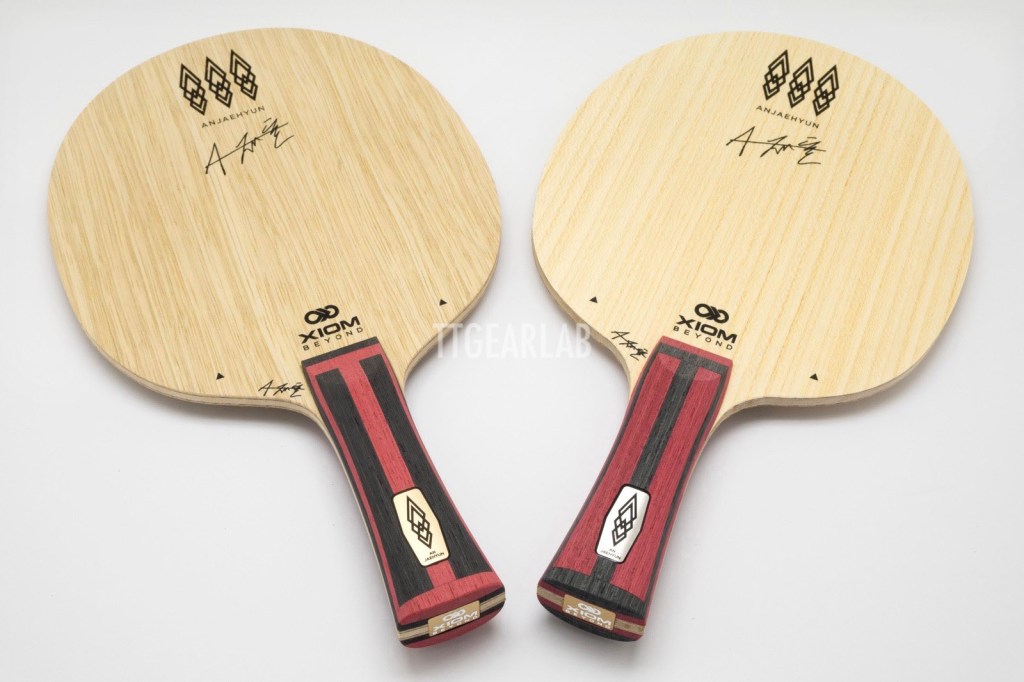
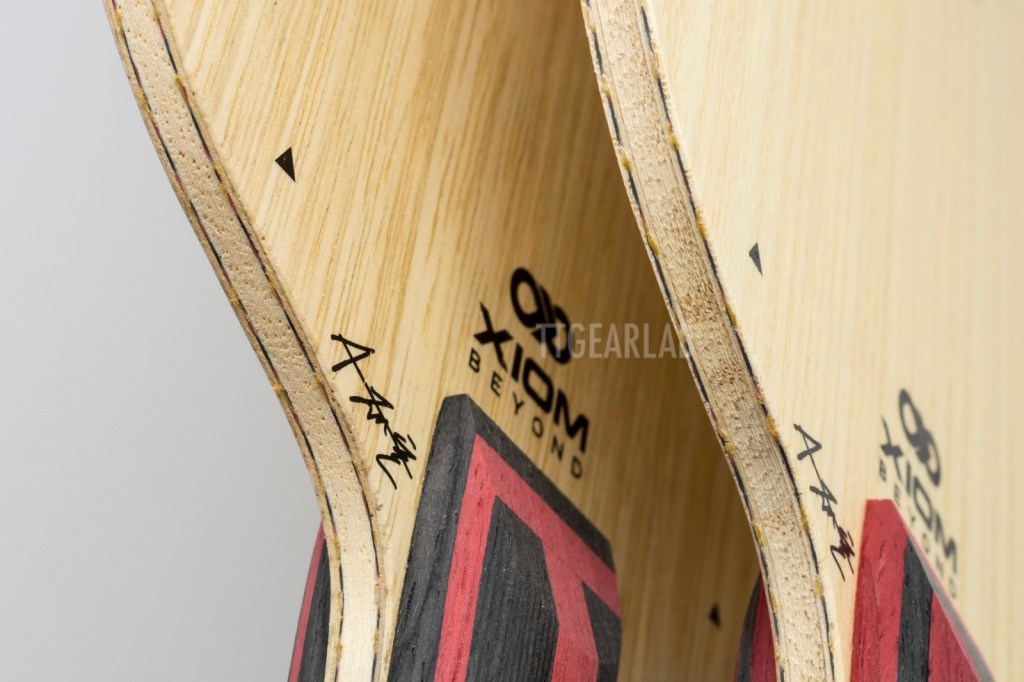
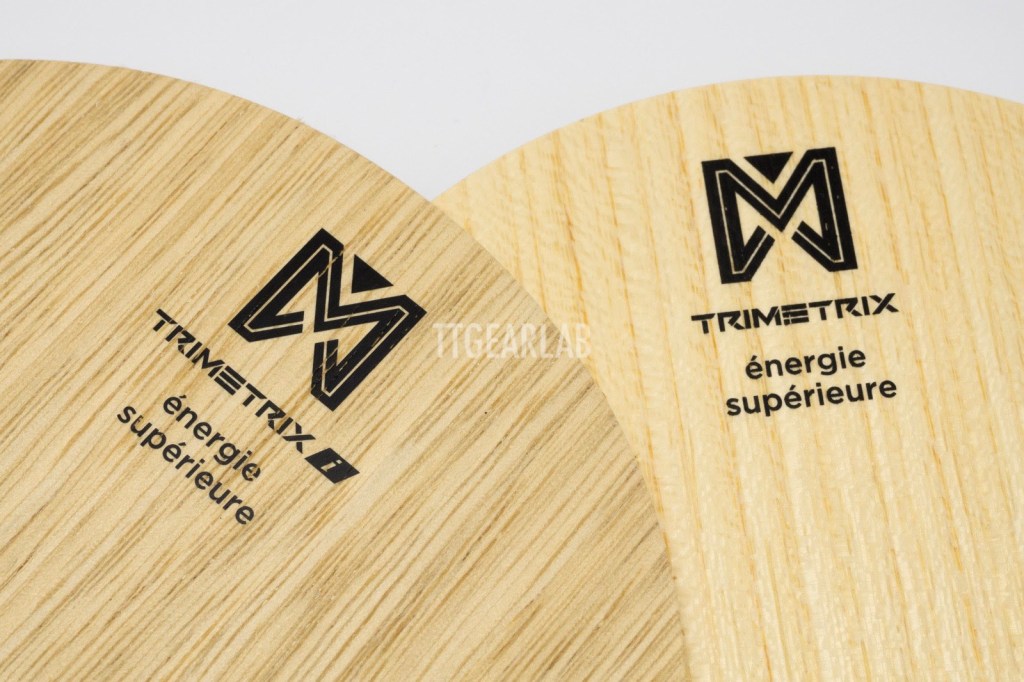
‘An Jaehyun’ series consists of two models shown in above picture. Left one is ‘An Jaehyun TMXi’, and right one is ‘An Jaehyun TMX’. The ‘i’ in the second name of Xiom blade means ‘inner-fiber construction’. And, the model which doesn’t include ‘I’ in its second name is an outer-fiber blade. Among two models the one which is being used by An Jaehyun is ‘An Jaehyun TMXi’ which is the inner-fiber version of this series. (To be more precise, the blade which is actually used by An Jaehyun is ‘PRO’ version which has bigger head and is heavier than normal version. But, the blade construction of Pro version is identical to that of normal version.)
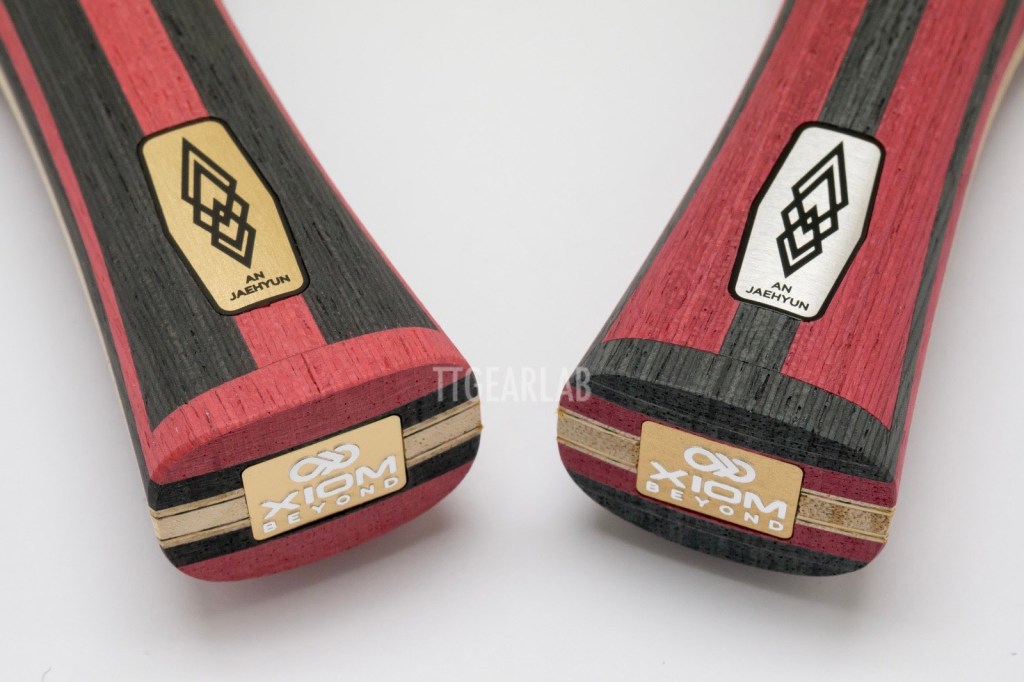
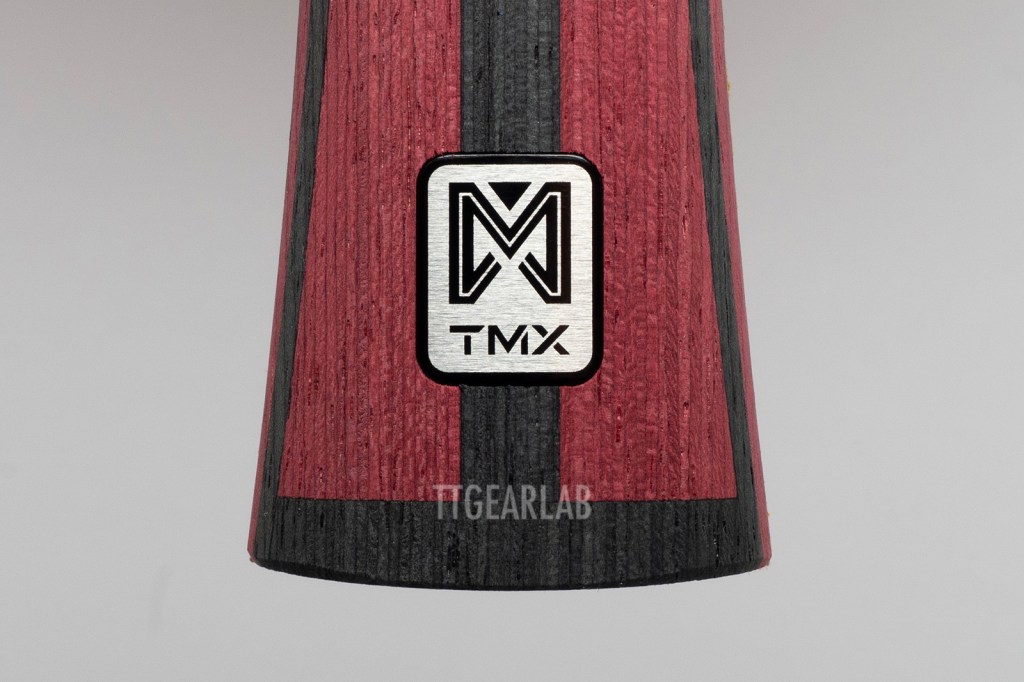
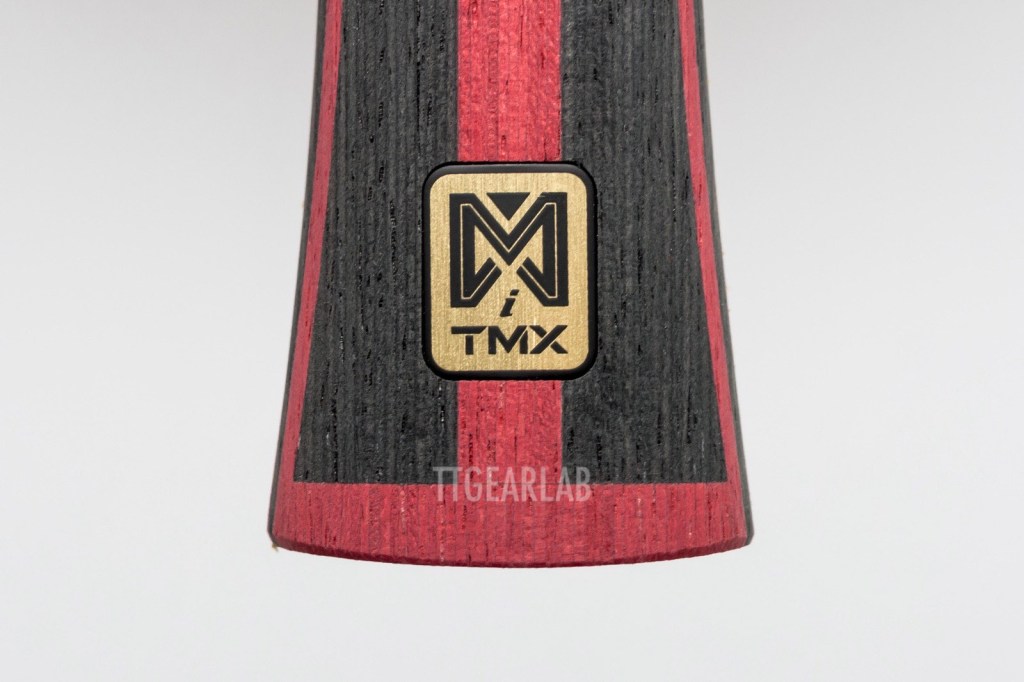
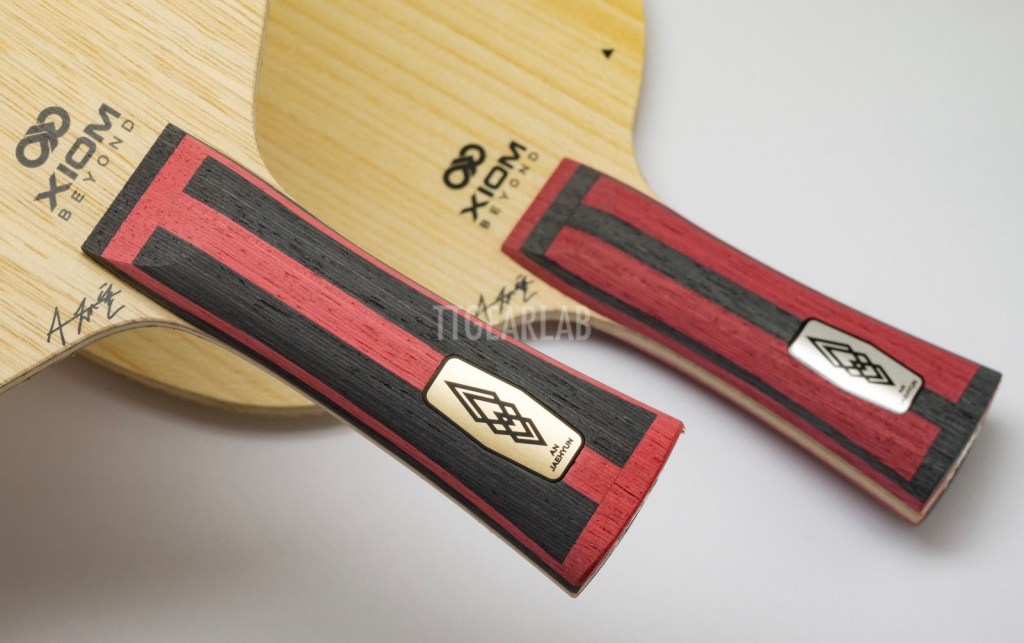
Same design concept is being applied to both models of this series. The color of handle is the combination of black and burgundy red. But, the two models can be distinguished from each other because their color composition is reversed. And, the two models can also be distinguished by the color of Aluminum nameplate at foreside of handle – gold for ‘An Jaehyun TMXi’ and silver for ‘An Jaehyun TMX’.
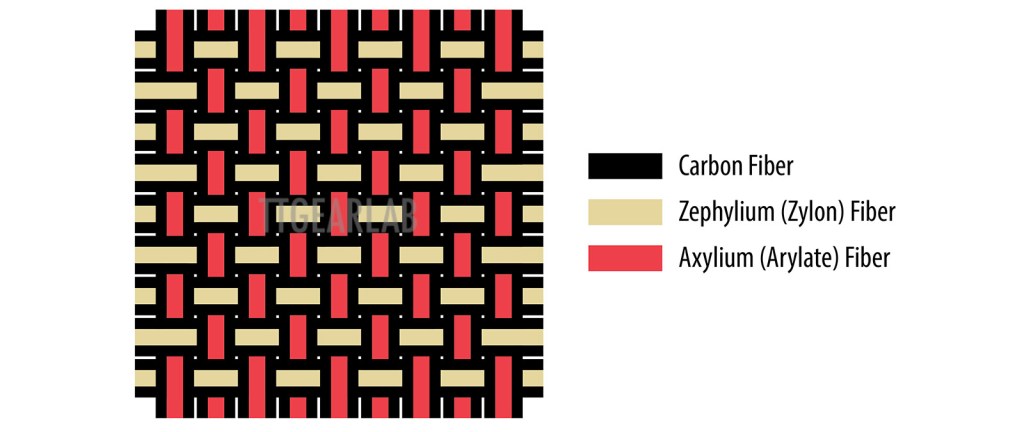
The most important feature of this series is its artificial material – Trimetrix. Above picture is a newly drawn one referring to the official image of Xiom. As is shown in above picture, it is woven from three kinds of different fibers – Carbon fiber, Zephylium fiber (= Zylon) and Axylium fiber (= Arylate). Carbon fiber is arranged both in lateral direction and in vertical direction. But, the other two fibers are arranged only in one direction – Zephylium in lateral direction & Axylium in vertical direction.
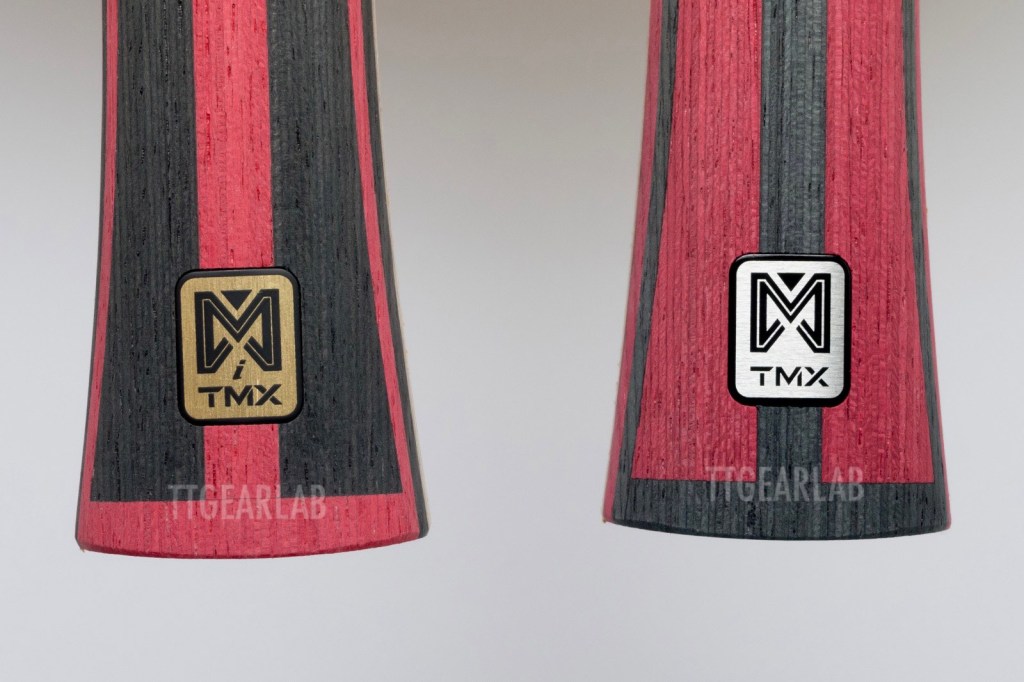
Small, squared Aluminum plate with ‘TMX’ mark is at the backside of handle. The coloring of this Aluminum plate is following that of foreside Aluminum nameplate – gold for ‘An Jaehyun TMXi’ and silver for ‘An Jaehyun TMX’.
1-1. An Jaehyun TMX (outer fiber version)
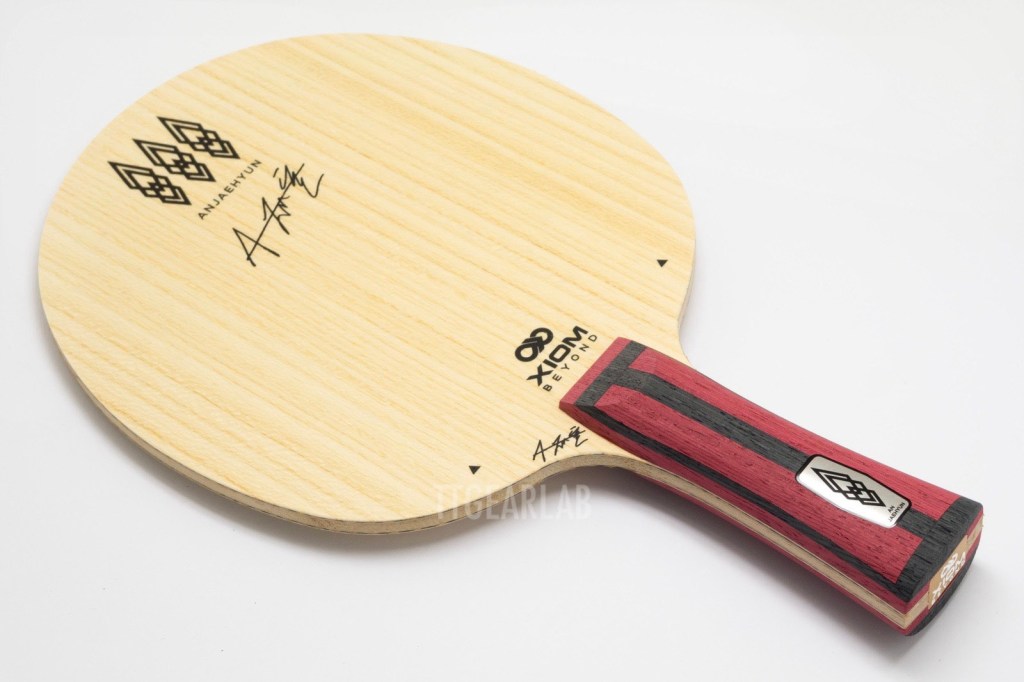
‘An Jaehyun TMX’ is the outer fiber version of this series. Although it isn’t used by An Jaehyun, another Korean top player – Cho Daeseong – is using ‘Cho Daeseong TMX Pro’ which is based on ‘An Jaehyun TMX’. (Like ‘An Jaehyun TMXi Pro’, it has bigger head than normal version.)
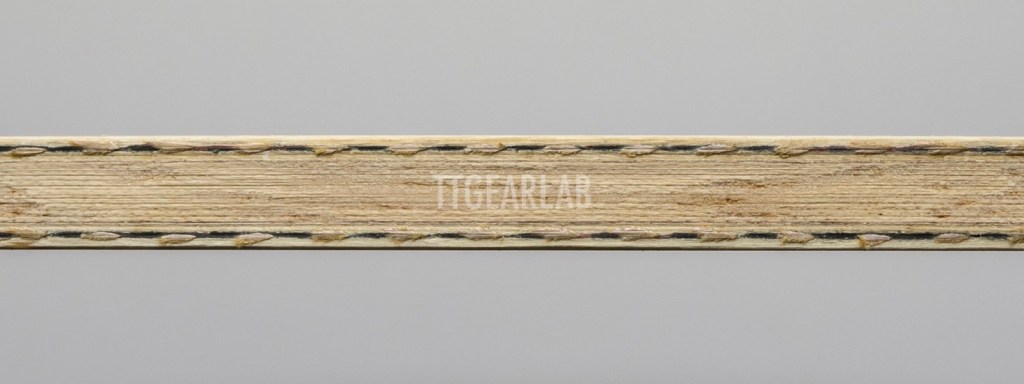
Above is the blade construction of ‘An Jaehyun TMX’. TMX is placed directly under the top layer. The top layer is Koto, the middle layer is Ayous, and the center layer is Kiri. Overall thickness is measured as around 5.8mm.
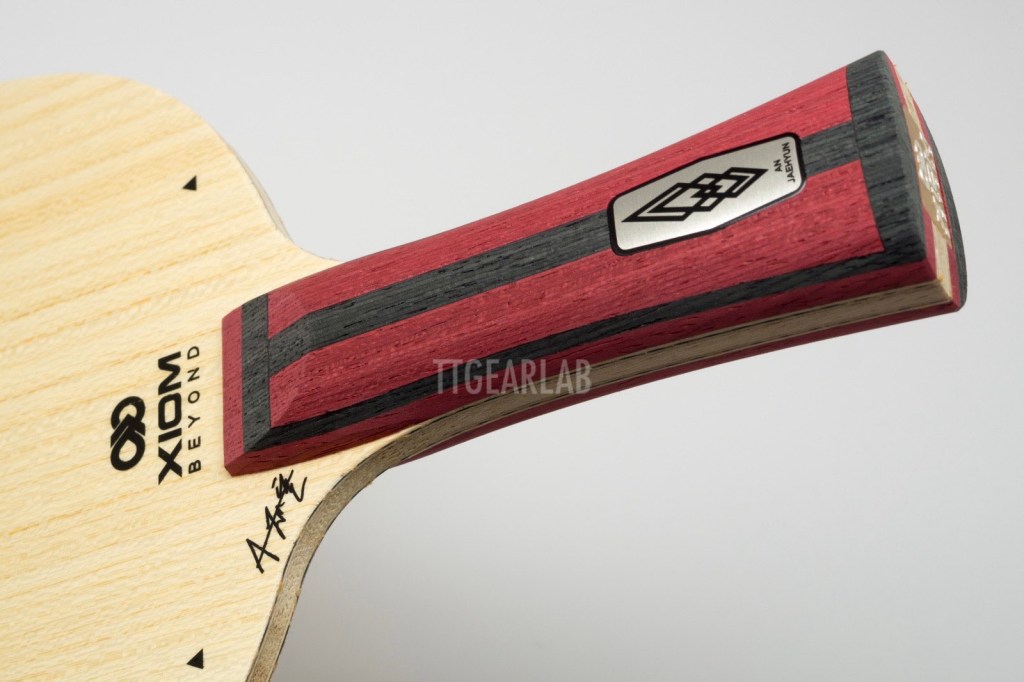
The FL (flared) handle of ‘An Jaehyun TMX’ is similar to those of Butterfly ‘Viscaria’ and ‘Fan Zhendong’ series. Its width is around 25mm ~ 28mm (at bulge) ~ 26mm (at narrowest point) ~ 34mm (at the end). And, its thickness is around 23mm at thumb and 25mm at the end.
The ST (straight) handle whose picture isn’t shown has rounded cross section. Its width is around 28mm, and its thickness is around 23mm.
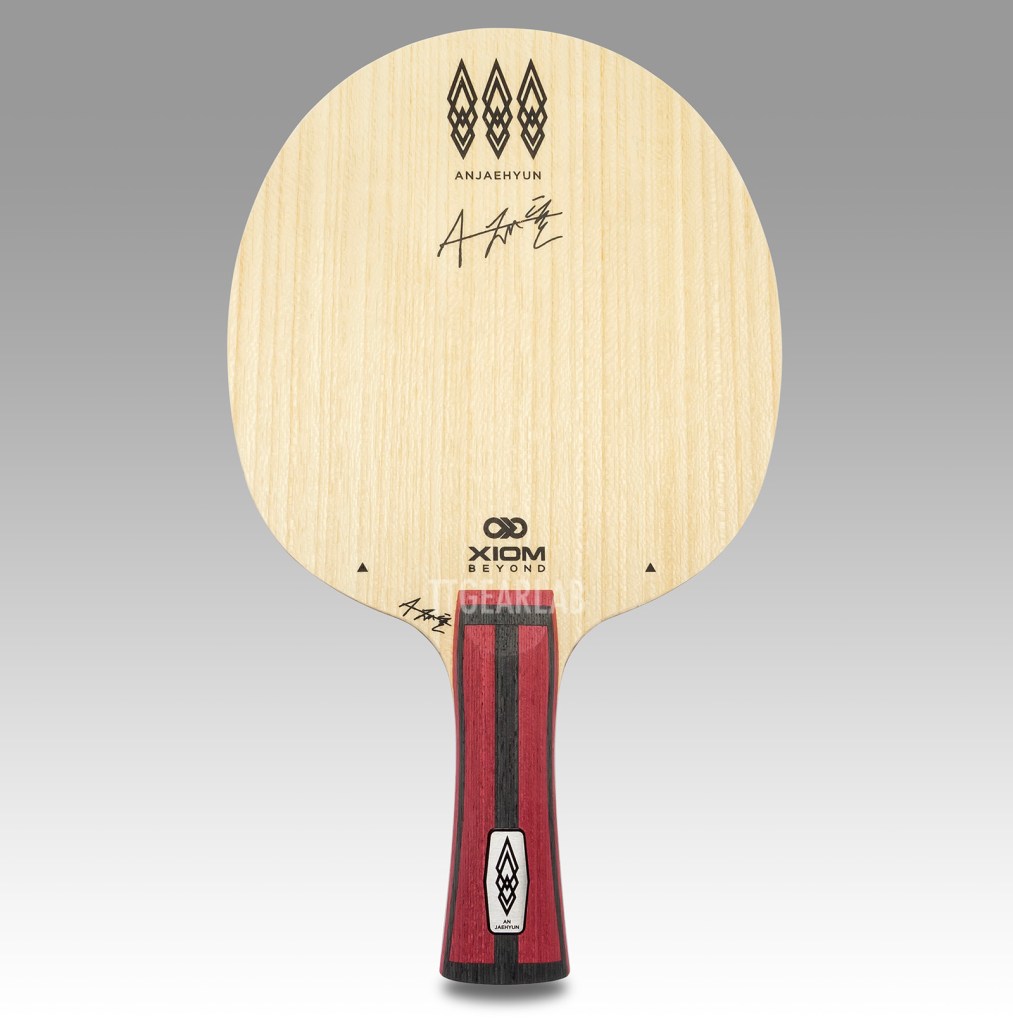
The head size of ‘An Jaehyun TMX’ is around 157mm x 150mm.
1-2. An Jaehyun TMXi (inner fiber version)
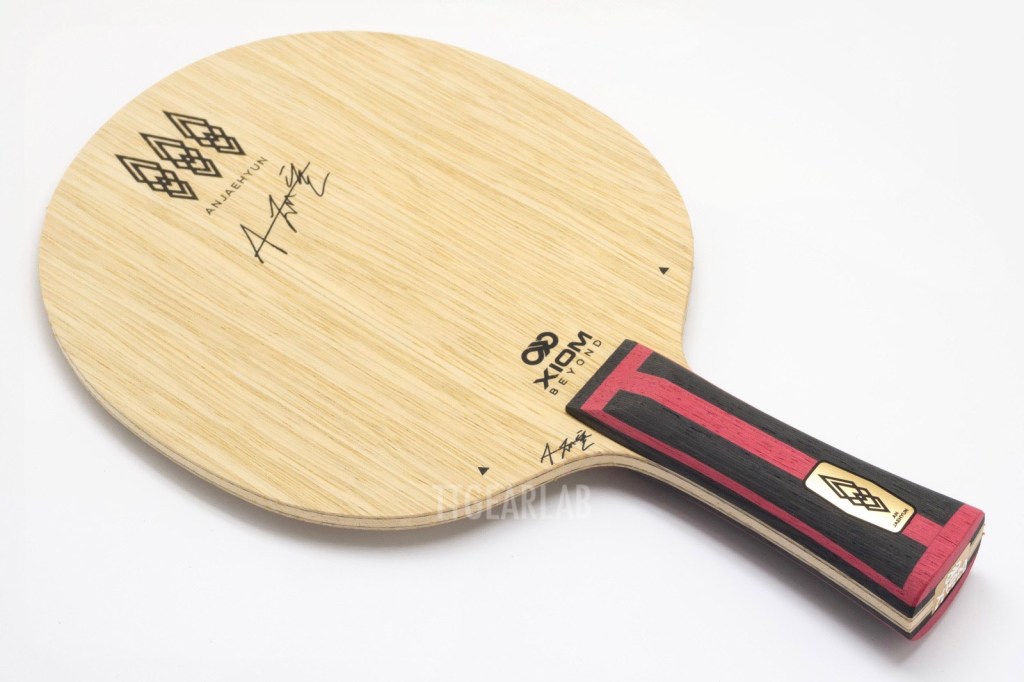
‘An Jaehyun TMXi’ is the inner fiber version of this series. And, An Jaehyun is currently using its ‘PRO’ version which has enlarged head to fit the preference of top players.
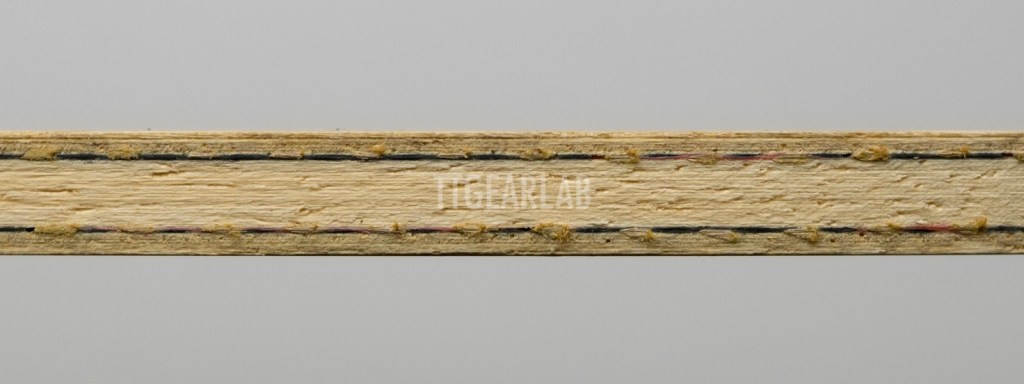
Above is the blade construction of ‘An Jaehyun TMXi’. TMX is placed between the middle layer and the center layer. The top layer is Limba, the middle layer and the center layer are Ayous. Overall thickness is measured as around 6.0mm.
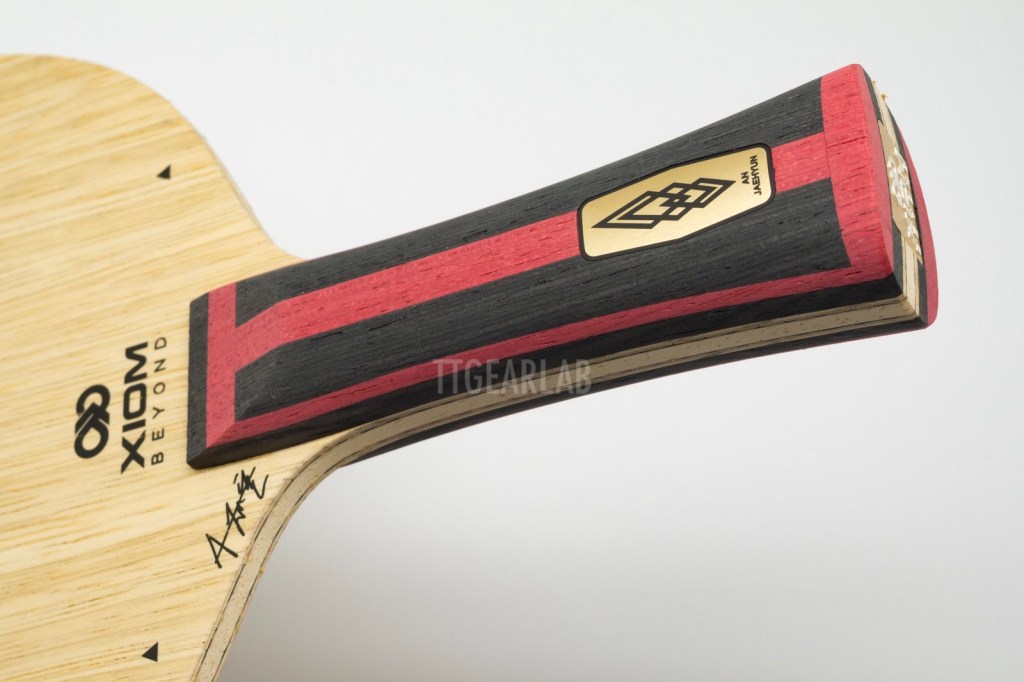
The FL (flared) handle of ‘An Jaehyun TMXi’ is different from that of ‘An Jaehyun TMX’ in the same blade family. It isn’t similar to the FL handle of Butterfly ‘Viscaria’ but to that of Butterfly ‘InnerForce’ series. Its width is around 26mm ~ 27mm (at bulge) ~ 25.6mm (at narrowest point) ~ 34mm (at the end). Its thickness is around 23.5mm at thumb and 25.5mm at the end. Another recent blade family of Xiom – ‘36.5’ series – also shows this kind of difference. ‘36.5 ALX’ which is the outer-fiber version has the FL handle similar to that of ‘An Jaehyun TMX’ which is also an outer-fiber blade. However, the FL handle of ‘36.5 ALXi’ which is the inner-fiber version of this series is similar to the FL handle of ‘An Jaehyun TMXi’ which is also on inner-fiber blade. The cross section of the FL handle of Xiom inner-fiber blade is narrower and taller than that of Xiom outer-fiber blade.
There isn’t any explanation about the reason why the FL for inner-fiber model is different from that for outer-fiber model in the same blade family. But, probably it is because of the comparable Butterfly blades. In general, the outer-fiber blades should compete with ‘Fan Zhendong’ series or ‘Viscaria’, while the inner-fiber models should compete with Butterfly ‘InnerForce Layer’ series.
The ST handle (not shown) of ‘An Jaehyun TMXi’ isn’t different from that of ‘An Jaehyun TMX’. Its width is around 28mm, and its thickness is around 23mm.
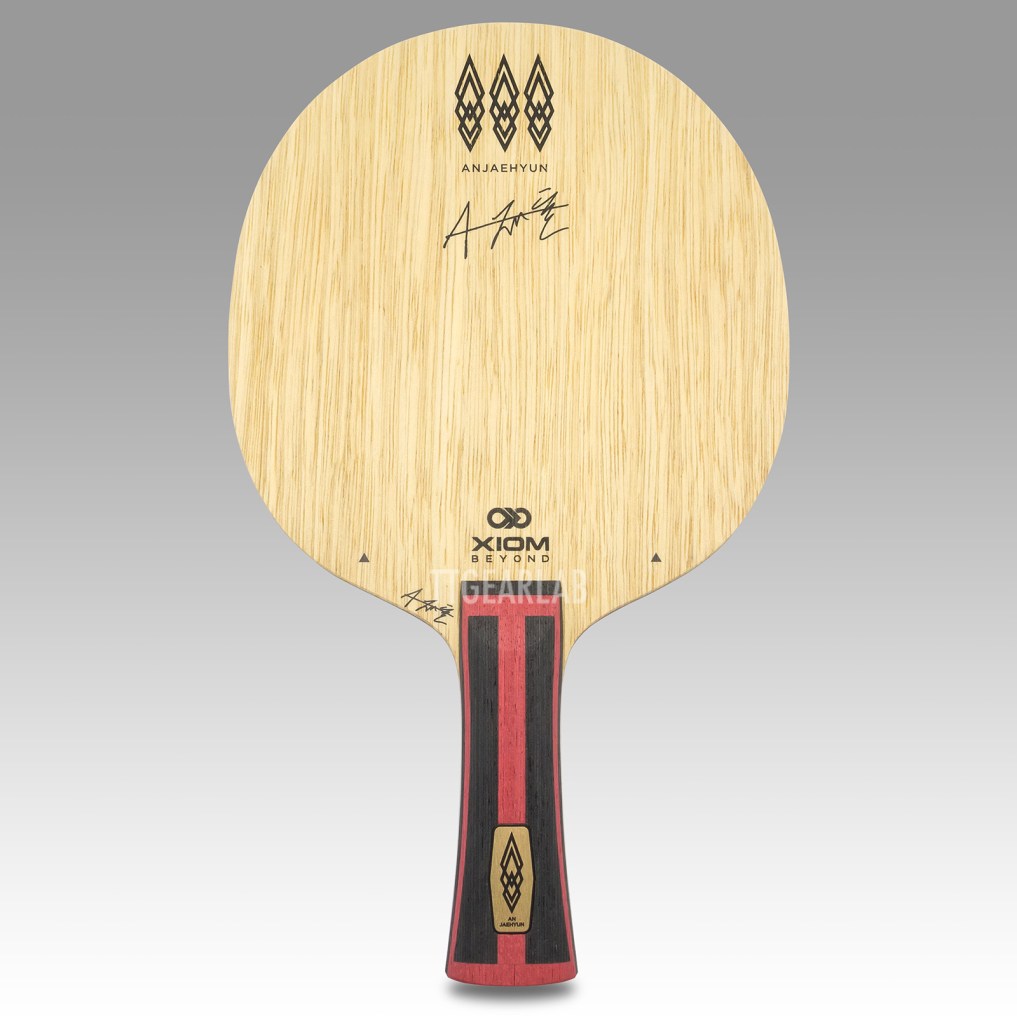
The head size of ‘An Jaehyun TMXi’ is around 158mm x 152mm. It is bigger than the head of ‘An Jaehyun TMX’.
Then let’s check the characteristics of ‘An Jaehyun TMX’ and ‘An Jaehyun TMXi’ by Performance Indices and then compare with some existing blades.
Please click here to return to top (table of contents)
2. Performance Indices
Performance Indices are measured objective values to represent the characteristics of table tennis gears. Concerning the detail of four performance indices, please refer to following articles in ‘About TTGearLab’ section :
- Performance indices : the way to evaluate blade by measurement
- The example of comparison by performance indices
The performance indices of ‘An Jaehyun TMX’ and ‘An Jaehyun TMXi’ are as follows:
Xiom An Jaehyun TMX (average weight = 87.0g)
Ep = 2.19
Ec = 1.79 (Ec/Ep = 0.82)
Vp = 1.29
Vl = 1.49 (Vl/Vp = 1.16)
Xiom An Jaehyun TMXi (average weight = 86.4g)
Ep = 1.88
Ec = 1.73 (Ec/Ep = 0.92)
Vp = 1.26
Vl = 1.29 (Vl/Vp = 1.02)
‘An Jaehyun TMX’ is the outer-fiber version of this series, and it is a highly elastic blade whose Ep (= 2.19) exceeds 2.0 that can be considered as the criteria of fast blade. On the contrary, its Ec (= 1.79) is significantly lower than its Ep. Therefore, its Ec/Ep is just 0.82. It is expected that ‘An Jaehyun TMX’ is very fast blade but it holds ball very deeply when the player hits the ball very strongly.
Regarding Vibration Indices, the Vp of ‘An Jaehyun TMX’ is 1.29. The Vp around 1.30 is what we can expect from standard outer ALC blade with Koto surface (for example ‘Viscaria’.). But, the Vl of ‘An Jaehyun TMX’ (= 1.49) is much higher than that of standard outer ALC blade. Because Vl is very high, the Vl/Vp of ‘An Jaehyun TMX’ is also high (= 1.16). So, the feeling transferred to the player’s index finger is much sharper than the primary feeling.
‘An Jaehyun TMXi’ is the inner-fiber version of this series. Its Ep (= 1.88) is what we can expect from inner-ALC blade whose thickness is 5.9~6.0mm. Its Ec (= 1.73) is lower than its Ep, and as a result its Ec/Ep (= 0.92) is under 1.0. ‘An Jaehyun TMXi’ is a moderately fast blade, and it is expected that it holds ball to some level when the player hits the ball very strongly.
Regarding Vibration Indices, the Vp of ‘An Jaehyun TMXi’ is 1.26. It is the value that isn’t much different from the value of ‘An Jaehyun TMX’ and some other outer-fiber blades. So, we can think that ‘An Jaehyun TMXi’ is as hard as outer-fiber blades. Its Vl (= 1.29) also looks quite high, but not as high as that of ‘An Jaehyun TMX’. Because its Vl is not much different from its Vp, the Vl/Vp (=1.02) is close to 1.0. Therefore, we can say that the feeling of ‘An Jaehyun TMX’ is almost uniform throughout the blade.
From the construction and Performance Indices, it is expected that the TMX blades are placed between the ZLC blades and the ALC blades. However, because there are many other factors those affect the characteristics of blades, we can’t say that two models of ‘An Jaehyun’ series provide the characteristics those are exactly between comparable ZLC blades and ALC blades. The comparison by Performance Indices will be able to help us to find the actual position of ‘An Jaehyun TMX’ and ‘An Jaehyun TMXi’ among many blades in the market.
Please click here to return to top (table of contents)
3. Comparison by Performance Indices
Then we can compare ‘An Jaehyun TMX’ and ‘An Jaehyun TMXi’ with some other blades. For the comparison some well-known outer-fiber blades and inner-fiber blades have been selected.
Following is the list of the blades to be compared :
Outer ZLC
- Butterfly ‘Fan Zhendong Super ZLC’ (avg. weight = 90.8g) : Faster version of Butterfly outer ZLC.
- Butterfly ‘Fan Zhendong ZLC’ (avg. weight = 85.1g) : Standard outer ZLC of Butterfly. Thinner than ‘super ZLC’ version.
Outer ALC
- Butterfly ‘Viscaria Super ALC’ (avg. weight = 92.7g) : Faster than ‘Viscaria’.
- Butterfly ‘Viscaria’ (avg. weight = 87.1g) : Reference of all outer ALC blade. Current version.
Inner ZLC
- ‘Tibher Shang Kun Hybrid ZC’ (avg. weight = 92.0g) : Inner ALC blade with enhanced speed.
- Butterfly ‘InnerForce Layer ZLC’ (avg. weight = 89.8) : Standard inner ZLC of Butterfly. Thinner and slower than ‘Shang Kun Hybrid ZC’.
Inner ALC
- Butterfly ‘InnerForce Layer ALC’ (avg. weight = 91.2g) : The standard of inner-ALC blades. Current version measured in 2023. Thicker and more elastic than former ones measured in 2018.
- DHS ‘Hurricane Long 5X’ (avg. weight = 87.6g) : Faster than ‘Hurricane Long 5’.
- Xiom ‘36.5 ALXi’ (avg. weight = 87.1g) : Similar to older ‘InnerForce Layer ALC’ measured in 2018.
5-ply Wood
- Butterfly ‘Korbel’ (avg. weight = 88.7g) : The standard of 5-ply wood offensive blades
3-1. Elasticity Indices
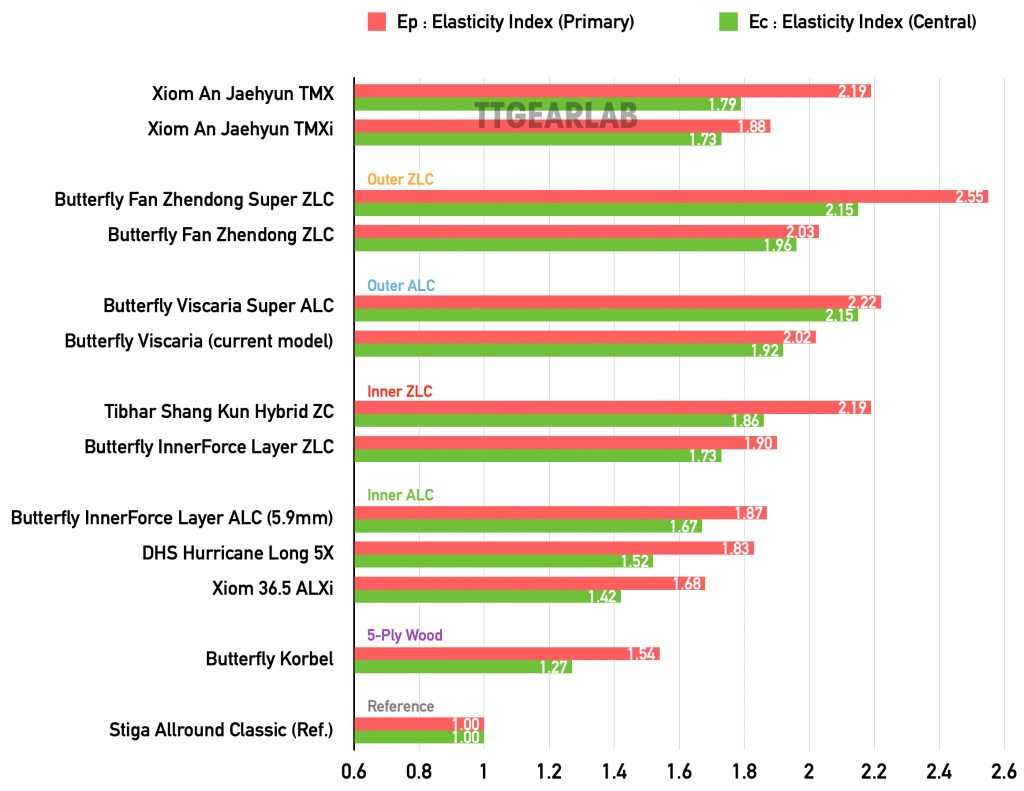
Fig.17 shows the comparison graph of Elasticity Indices.
Ep (Primary Elasticity Index) is directly concerned with the rebound speed of blade. Ec (Central Elasticity Index) is concerned with additional ‘kick’ when player hits ball very strongly.
First, we can compare outer ZLC blades and outer ALC blades with ‘An Jaehyun TMX’.
The Ep of ‘Fan Zhendong Super ZLC’ is higher than that of ‘An Jaehyun TMX’, but that of ‘Fan Zhendong ZLC’ isn’t. The low Ep of ‘Fan Zhendong ZLC’ is probably not because of the elasticity of ZLC but because of the thinner construction of ‘Fan Zhendong ZLC’. And, the Ep of ‘Viscaria Super ALC’ is close to that of ‘An Jaehyun TMX’. But, the Ep of ‘Viscaria’ is lower than the Ep of ‘An Jaehyun TMX’. Regarding Ec, the Ec of ‘An Jaehuyn TMX’ is lower than all Ec’s of four Butterfly outer fiber blades. Here we can observe the shape of the graph – the relationship between Ep and Ec. Only the graph of ‘Fan Zhendong Super ZLC’ looks similar to that of ‘An Jaehyun TMX’. So ‘An Jaehyun TMX’ is something like the ‘Fan Zhendong Super ZLC’ with reduced elasticity. And, if the player thinks that the primary elasticity of ‘Viscaria Super ALC’ is optimum but its central elasticity is too high, ‘An Jaehyun TMX’ can be a good solution.
Then, let’s compare inner ZLC blades and inner ALC blades with ‘An Jaehyun TMXi’.
Between two inner ZLC blades, ‘Shang Kun Hybrid ZC’ is noticeably more elastic than ‘An Jaehyun TMXi’. (It is as elastic as ‘An Jaehyun TMX’ which is an outer fiber blade.) But, ‘InnerForce Layer ZLC’ is very close to ‘An Jaehyun TMXi’. And, among three inner ALC blades, ‘InnerForce Layer ALC’ (current version) is very close to ‘An Jaehyun TMXi’. But, ‘Hurricane Long 5X’ shows noticeably lower Ec, and ‘36.5 ALXi’ is apparently less elastic than ‘An Jaehyun TMXi’. It is interesting that there isn’t much difference between ‘InnerForce Layer ZLC’ and ‘InnerForce Layer ALC’. But, that is because ‘InnerForce Layer ZLC’ is thinner than ‘InnerForce Layer ALC’. (If the thickness is same, probably ‘InnerForce Layer ALC’ will be more elastic than ‘InnerForce Layer ALC’.) Anyway, we can understand that the elasticity characteristics of ‘An Jaehyun TMXi’ is close to those of ‘InnerForce Layer ZLC’ and ‘InnerForce Layer ALC’.
Finally, ‘Korbel’ is noticeably less elastic than any of the blades in the comparison except for the reference blade. But, the graph shape of ‘Korbel’ looks simiar to those of ‘An Jaehyun TMX’, ‘Fan Zhendong Super ALC’, ‘Hurricane Long 5X’ and ‘36.5 ALXi’. Examining Ec/Ep is an easier way to understand the characteristics of blade concerned with elasticity. Fig.18 shows the relationship between Ec/Ep and Ep.
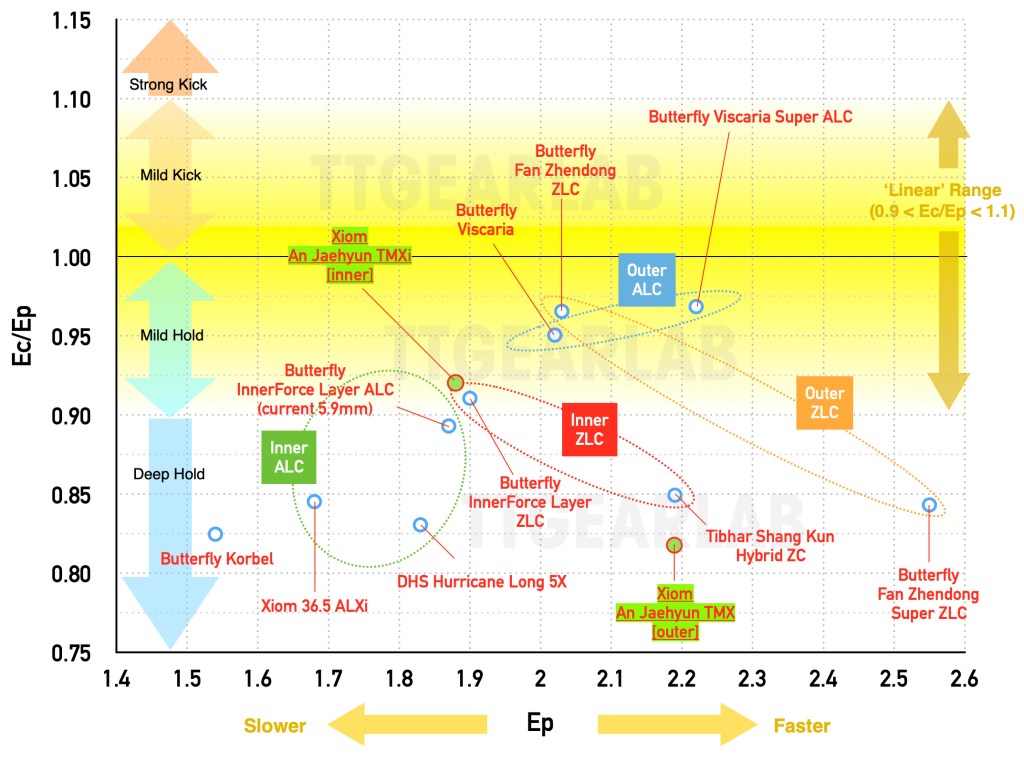
Ec/Ep expresses the ‘tendency’ of the elasticity of blade. By examining Ec/Ep and Ep at the same time, we can easily understand the behavior of blades.
On the graph, all blades in this comparison (except for reference blade whose Ec/Ep = 1.00) are in ‘Hold’ range (Ec/Ep < 1.0). But, the blades are widely distributed up, down, left and right within that range.
Before observing the locations of ‘An Jaehuyn’ series, there is one thing we need to check. In general we expect that the ZLC blade will be more elastic than the ALC blade. However, on the graph we can see that ‘Fan Zhendong ZLC’ (outer ZLC) and ‘Viscaria’ (outer ALC) are located very close to each other. And likewise, ‘InnerForce Layer ZLC’ (inner ZLC) and ‘InnerForce Layer ALC’ (inner ALC) are also located very close to each other. Although ZLC blades (outer or inner) are a bit more elastic than the ALC blades, the differences are very small. But, it doesn’t mean that ZLC is not meaningfully more elastic than ALC. It is just because Butterfly ZLC blades are thinner than Butterfly ALC blades. If the condition is same or similar, ZLC blades will be clearly more elastic than ALC blades. The example is the comparison between ‘Viscaria Super ALC’ and ‘Fan Zhendong Super ZLC’. Because ‘Fan Zhendong Super ZLC’ isn’t as thin as ‘Fan Zhendong ZLC’, it shows very high primary elasticity than any other blades in this comparison.
First, let’s observe the location of the outer TMX version – ‘An Jaehyun TMX’. On the graph, ‘An Jaehyun TMX’ is located far away from both of ‘Outer ALC’ group and ‘Outer ZLC’ group. That is because the Ec/Ep of ‘An Jaehyun TMX’ is very low. ‘Fan Zhendong Super ALC’ is only one blade whose Ec/Ep is comparable with that of ‘An Jaehyun TMX’. The Ep and the Ec/Ep of ‘An Jaehyun TMX’ are comparable with those of ‘Viscaria Super ALC’ and ‘Fan Zhendong Super ZLC’ respectively. It means that ‘An Jaehyun TMX’ provides similar level of primary elasticity as ‘Viscaria Super ALC’, but holds ball as deep as ‘Fan Zhendong Super ZLC’ when the player hits the ball very strongly. As an outer-fiber blade, ‘An Jaehyun TMX’ can be considered as a quite unique blade.
On the contrary, the inner TMX version – An Jaehyun TMXi’ doesn’t look as unique as ‘An Jaehyun TMX’. ‘An Jaehyun TMXi’ is located very close to ‘InnerForce Layer ALC’ (current version) and ‘InnerForce Layer ZLC’. Between two Butterfly inner fiber blades, ‘InnerForce Layer ZLC’ is closer to ‘An Jaehyun TMXi’. When compared with ‘InnerForce Layer ALC’, ‘An Jaehyun TMXi’ gives more kick (= shallower hold). But, the difference isn’t significant. Anyway it is apparent that ‘An Jaehyun TMXi’ is comparable with ‘InnerForce Layer ZLC/ALC’. And, when compared with ‘36.5 ALXi’ which is a mainstream inner-fiber blade in Xiom range and close to the former version of ‘InnerForce Layer ALC’ measured in 2018, ‘An Jaehyun TMXi’ is much more elastic and gives much more kick for stronger impact.
It is meaningful that we observe the blades those hold the ball very deep when the player hits the ball very strongly, because those can be the replacement of ‘Korbel’. Recently the Ec/Ep of fiber blade seems to be getting higher. And, ‘Fan Zhendong/Zhang Jike Super ZLC’ is the exception. It holds the ball very deep and then shoots the ball with very high speed in next moment. So the player can feel clear ‘catapult’ effect not from the rubber but from the blade. And, although it makes less faster ball than ‘Fan Zhendong Super ZLC’, ‘An Jaehyun TMX’ is also that kind of blade. Among inner fiber blades, ‘36.5 ALXi’, ‘Hurricane Long 5X’ and ‘Shang Kun Hybrid ZC’ hold the ball very deep. (Note : We have to check current version of ‘Hurricane Long 5X’. If the fiber has been replaced by another one like ‘Hurricane Long 5’, the characteristics of ‘Hurricane Long 5X’ will not be the one in this comparison.) Those blades can be the replacement of ‘Korbel’ in case the player who have used ‘Korbel’ requires higher elasticity but doesn’t want to give up the Deep Hold character of ‘Korbel’. Then next, let’s compare Vibration Indices.
Please click here to return to top (table of contents)
3-2. Vibration Indices
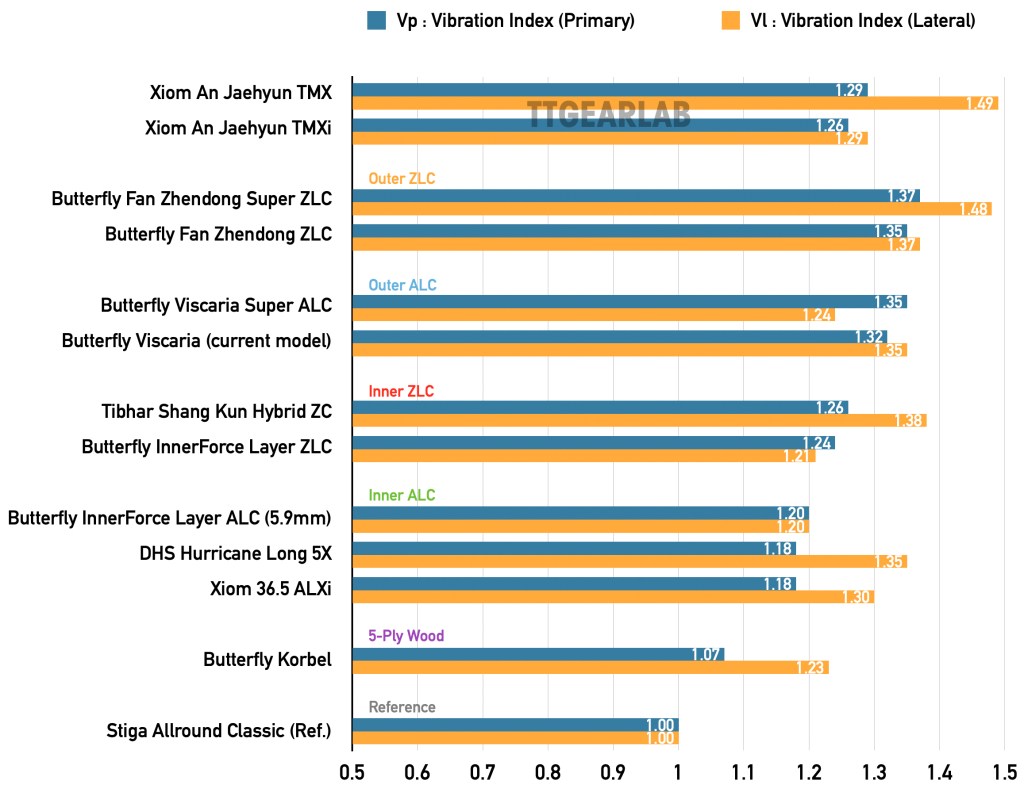
Fig.19 shows the comparison graph of Vibration Indices. Vibration Indices are concerned with feeling. Vp indicates primary feeling which is transferred to player’s palm. And, Vl is the feeling at the edge of the wing – the lower side of blade head. It is felt by player’s index finger or middle finger.
We can observe that the Vp of ‘An Jaehyn TMX’ is just a bit higher than that of ‘An Jaehyun TMXi’. On the contrary, the Vl of ‘An Jaehyun TMX’ is much higher than that of ‘An Jaehyun TMXi’. Therefore, the difference in Vl is the major difference between the outer version and the inner version of ‘An Jaehyun’ series in the comparison of Vibration Indices. The high index in lateral direction is probably the influence of Zephylium (= Zylon) fiber arranged in lateral direction. The outer-fiber construction of ‘An Jaehyun TMX’ clearly demonstrates the characteristics of Zephylium fiber, but the inner-fiber construction of ‘An Jaehyun TMXi’ doesn’t. In lateral direction, ‘An Jaehyun TMXi’ will give much more comfortable feeling than ‘An Jaehyun TMXi’.
Then first, we can compare ‘An Jaehyun TMX’ with Butterfly outer ZLC/ALC blades. The Vp of ‘An Jaehyun TMX’ is lower than the Vp’s of all four Butterfly blades. The lowest Vp of Butterfly blades is that of ‘Viscaria’, but it is still a bit higher than the Vp of ‘An Jaehyun TMX’. On the contrary, the Vl of ‘An Jaehyun TMX’ is higher than the Vl’s of all four Butterfly blades. The highest Vl of Butterfly blades is that of ‘Fan Zhendong Super ZLC’, and it is very close to that the Vl of ‘An Jaehyun TMX’. So in vibration characteristics, ‘An Jaehyun TMX’ is close to ‘Viscaria’ in vertical direction and to ‘Fan Zhendong Super ZLC’ in lateral direction. Probably it is because the Axylium (= Arylate) and the Zephylium (= Zylon) are arranged in vertical and horizontal direction respectively in the TMX of ‘An Jaehyun’ series.
Then let’s compare the inner-TMX version – ‘An Jaehyun TMXi’ with inner ALC/ALC blades. The Vp of ‘An Jaehyun TMXi’ is same as the highest Vp of all five inner-fiber blades in this comparison. And, the Vl of ‘An Jaehyun TMXi’ is higher than those of ‘InnerForce Layer ZLC’ and ‘InnerForce Layer ALC’, but lower than those of ‘Shang Kun Hybrid ZC’ and ‘36.5 ALXi’. Here we can’t find any rule or any tendency concerned with vertically arranged Axylium and horizontally arranged Zephylium. Probably that is because the influence of fiber to the feeling is reduced by the inner-fiber construction. The result can dramatically vary by the other conditions – the characteristics of each wood layer, overall thickness and so on.
Examining Vl/Vp is an easier way for the comparison of the tendency of feeling. Fig.20 shows the relationship between Vl/Vp and Vp for easier comparison.
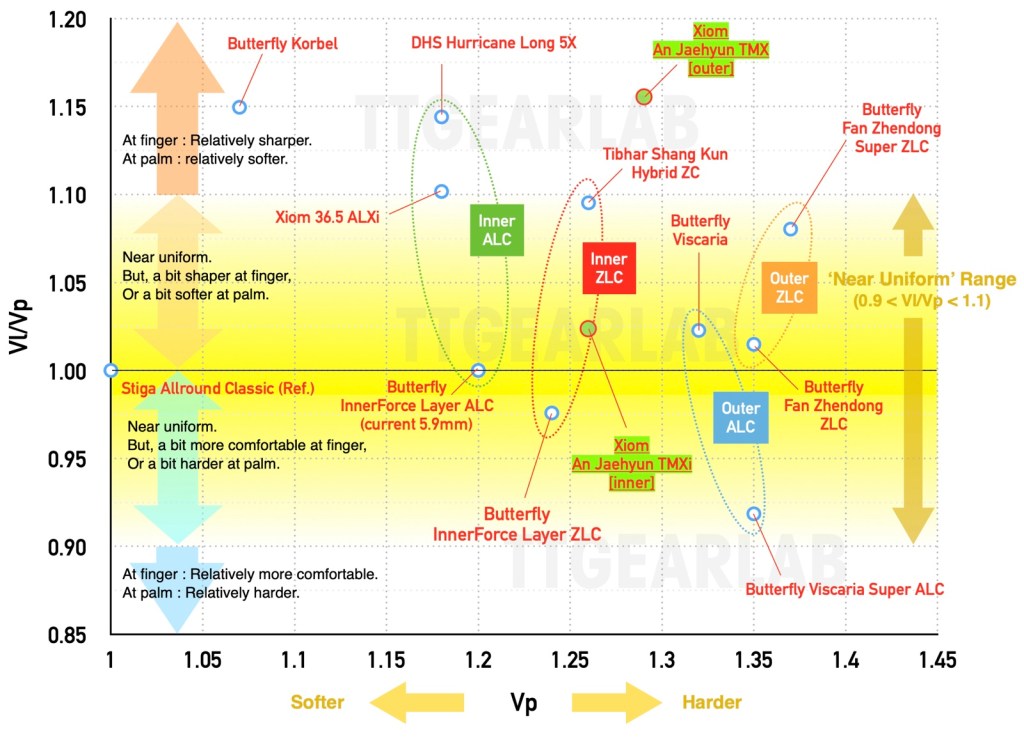
On the graph, most of blade in this comparison are placed in upper part of the graph – ‘Relatively sharper at finger’ range. And, two are in lower part – ‘Relatively more comfortable at finger’, and two including reference blade are on uniform line.
First, let’s observe the location of the outer TMX version – ‘An Jaehyun TMX’. The expectation before the measurement and comparison was that ‘An Jaehyun TMX’ will be somewhere between outer ALC blade and outer ALC blade. However, from the graph we can see that the result is completely different from the expectation. ‘An Jaehyun TMX’ is located at different position from ‘Outer ZLC’ group or ‘Outer ALC’ group. The Vp of ‘An Jaehyun TMX’ is lower, and the Vl/Vp of ‘An Jaehyun TMX’ is much higher than any other outer fiber blade in this comparison. So from the viewpoint of the feeling, ‘An Jaehyun TMX’ is unique as an outer fiber blade. It is softer than Butterfly ALC/ZLC blades, and gives higher level of sharper relative feeling to the index finger.
On the contrary, the inner TMX version – An Jaehyun TMXi’ isn’t located far from the inner fiber blades in this comparison. It is located on the area of ‘Inner ZLC’ group – the position between ‘Shang Kun Hybrid ZC’ and ‘InnerForce Layer ZLC’. The Vp of ‘An Jaehyun TMXi’ is higher than those of all three blades in ‘Inner ALC’ group, and even higher than that of ‘InnerForce Layer ZLC’. And, the Vl/Vp of ‘An Jaehyun TMXi’ is higher than those of ‘InnerForce Layer ALC’ and ‘InnerForce Layer ALC’, and lower than those of ‘Hurricane Long 5X’, ‘36.5 ALXi’ and ‘Shang Kun Hybrid ZC’. Anyway, differently from its outer version – ‘An Jaehyun TMX’, ‘An Jaehyun TMXi’ isn’t unique as an inner fiber blade. Its feeling is what we can expect from inner ZLC blade, although it is different from the feeling of inner ALC blades.
If we don’t consider the type of construction, Vl/Vp (and Ec/Ep) can give the criteria for replacement of blade. If the player select the blade whose Vl/Vp (and Ec/Ep if possible) is close to that of former blade, the replacement is expected to be done smoothly. On the graph, we can see that the Vl/Vp of ‘An Jaehyun TMX’ at similar level as that of ‘Korbel’. So we can expect that ‘An Jaehyun TMX’ will be good solution in case the player who has used ‘Korbel’ want to replace the blade with faster one. We observed the same relationship between ‘Korbel’ and ‘An Jaehyun TMX’ from the graph of Ec/Ep vs. Ep. ‘An Jaehyun TMXi’ and ‘InnerForce Layer ALC’ (current version) aren’t bad solutions if we consider just Elasticity Indices, but if the player who has used ‘Korbel’ replace the blade with those two inner fiber blades, the adaptation to the feeling of new blade will take more time because of the difference in Vl/Vp. And, we can also see that ‘An Jaehyun TMXi’ and ‘Viscaria’ are at similar level of Vl/Vp. So if the player who have used current ‘Viscaria’ wants to adjust the feeling softer, ‘An Jaehyun TMX’ can be good solution although its type of construction is different from that of ‘Viscaria’. Of course Performance Indices can’t tell everything of blades. But, at least the Performance Indices will be able to ‘help’ the selection of blade to some level.
Please click here to return to top (table of contents)
4. Summary
Xiom ‘An Jaehyun’ series is the blade family whose artificial fiber is unique ‘Trimetrix’ that is the woven of three different fibers – Zephylium (= Zylon) fiber, Axylium (= Arylate) fiber and Carbon fiber. It is available in two versions – ‘An Jaehyun TMX’ which is the outer-fiber version, and ‘An Jaehyun TMXi’ which is the inner-fiber version.The characteristics of two versions are summarized as follows:
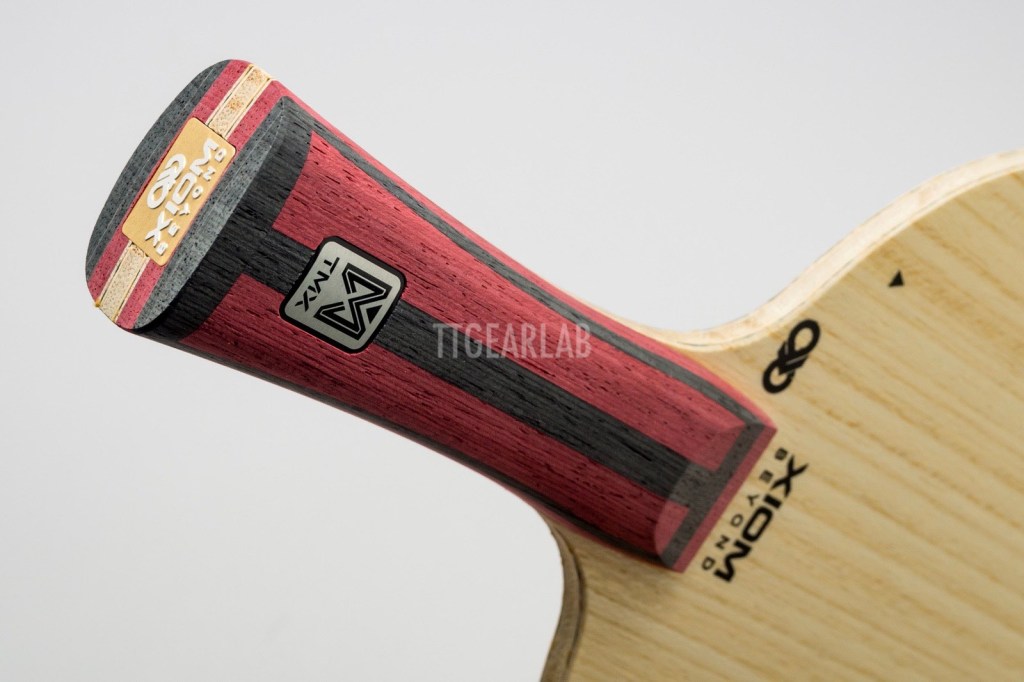
‘An Jaehyun TMX’ is the outer-fiber version of Xiom TMX blade. Its primary elasticity is close to that of ‘Viscaria Super ALC’, and higher than those of standard outer ALC/ZLC blades of Butterfly (= ‘Viscaria’ and ‘Fan Zhendong ZLC’) but much lower than that of ‘Fan Zhendong Super ZLC’. And, it holds the ball very deep when the player hits the ball very strongly. The level of Deep Hold of ‘An Jaehyun TMX’ is comparable to that of ‘Fan Zhendong Super ZLC’. The feeling of ‘An Jaehyun TMX’ is softer than outer-fiber blades in this comparison. On the contrary, its feeling transferred to the index finger is sharper than any other outer-fiber blade in this comparison. Its ‘vertically soft but horizontally sharp’ feeling is probably due to the orientation of fibers in the TMX (vertical Zephylium and horizontal Axylium). ‘An Jaehyun TMX’ is recommended for the player whose main technic is close-to-table topspin aiming at the rising of the ball but requires higher elasticity than 5-ply wood or inner-fiber blades.
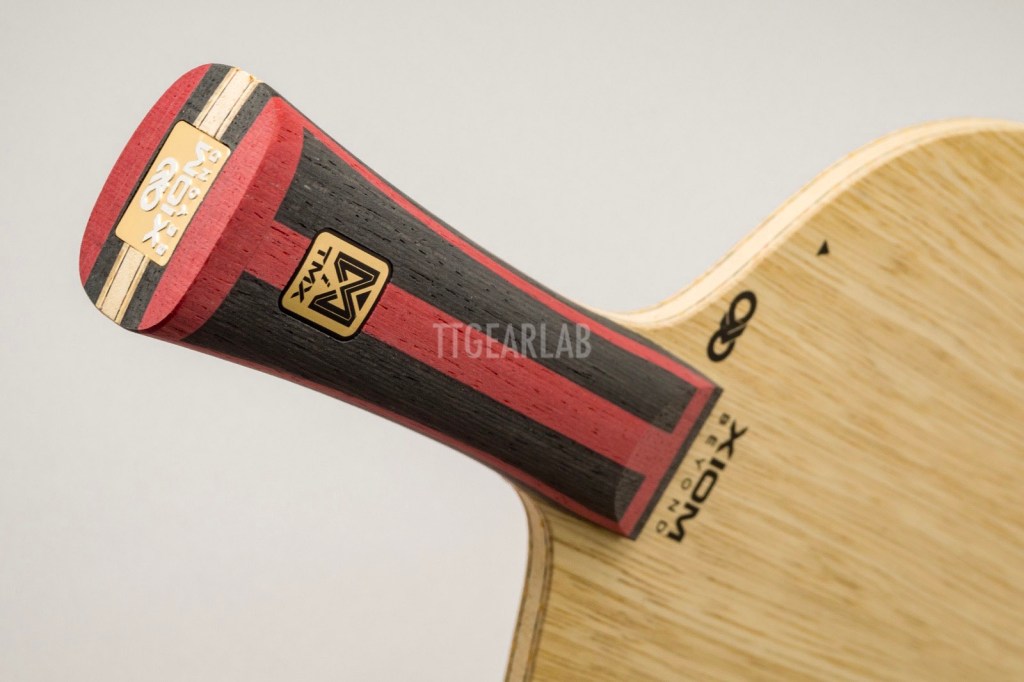
‘An Jaehyun TMXi’ is the inner-fiber version of Xiom TMX blade. Its elasticity characteristics is close to those of ‘InnerForce Layer ALC’ and ‘InnerForce Layer ZLC’. It is more elastic than ‘36.5 ALXi’ which is the inner-ALC blade of Xiom. It holds ball deep when the player hits the ball very strongly, but the level of hold is mild. The feeling of ‘An Jaehyun TMXi’ is harder than those of inner-ALC blades in this comparison, and is comparable to those of inner-ZLC blades in this comparison. The distribution of feeling of ‘An Jaehyun TMXi’ is almost uniform. Overall characteristics of ‘An Jaehyun TMXi’ is quite close to that of ‘InnerForce ZLC’, and the characteristics of each fiber in TMX don’t appear clearly as the case of its outer-fiber version. ‘An Jaehyun TMXi’ is recommended for the all-round player who play with various technics but requires higher power than 5-ply wood blades.
Please click here to return to top (table of contents)
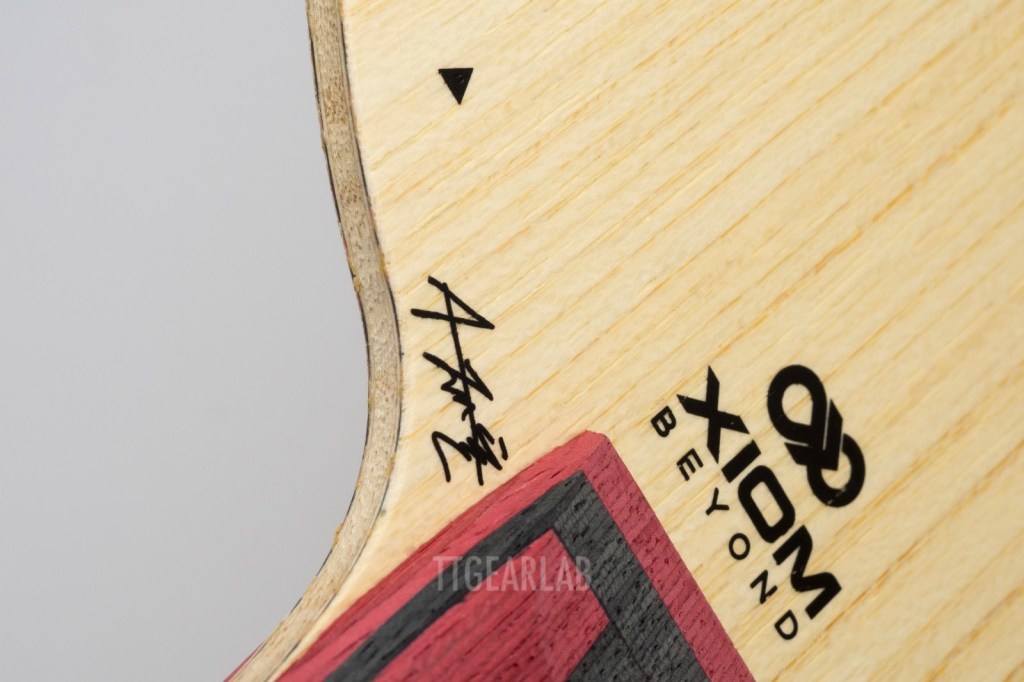
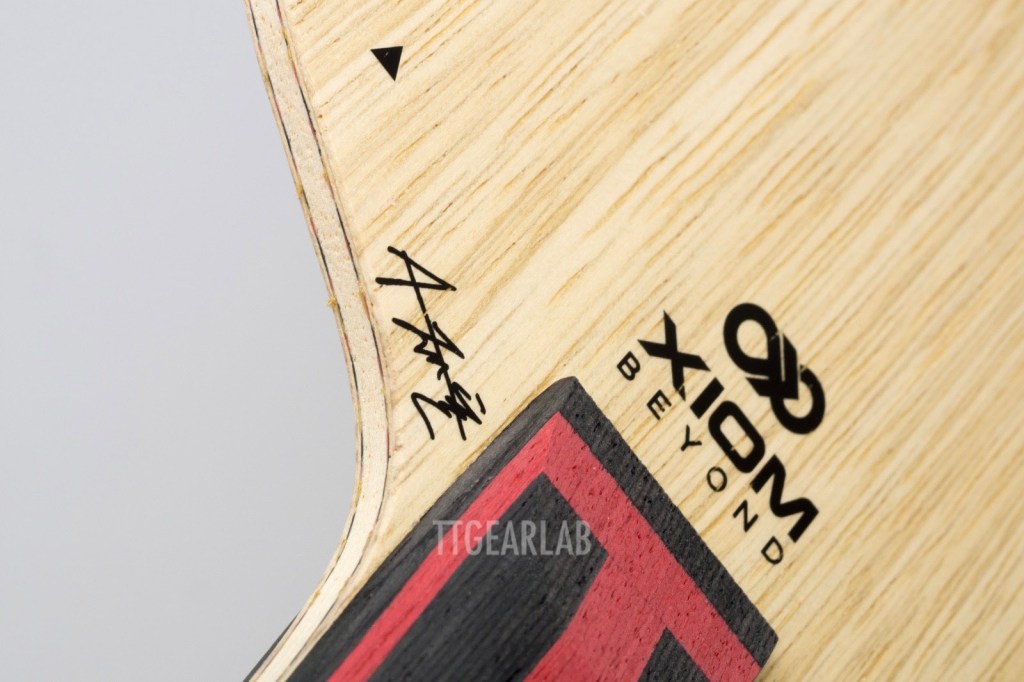
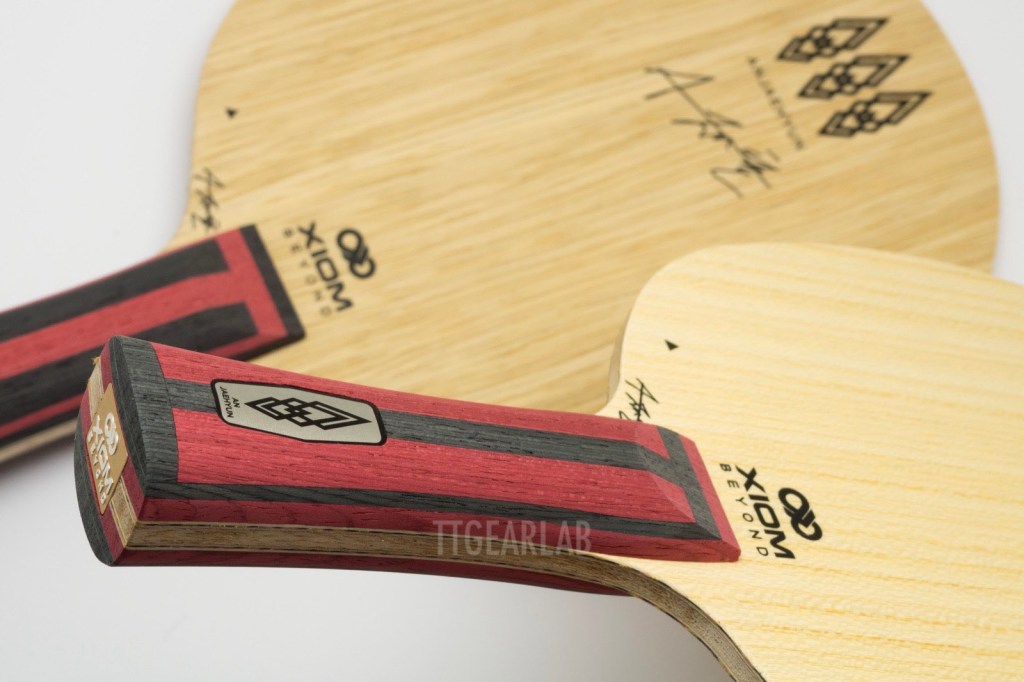
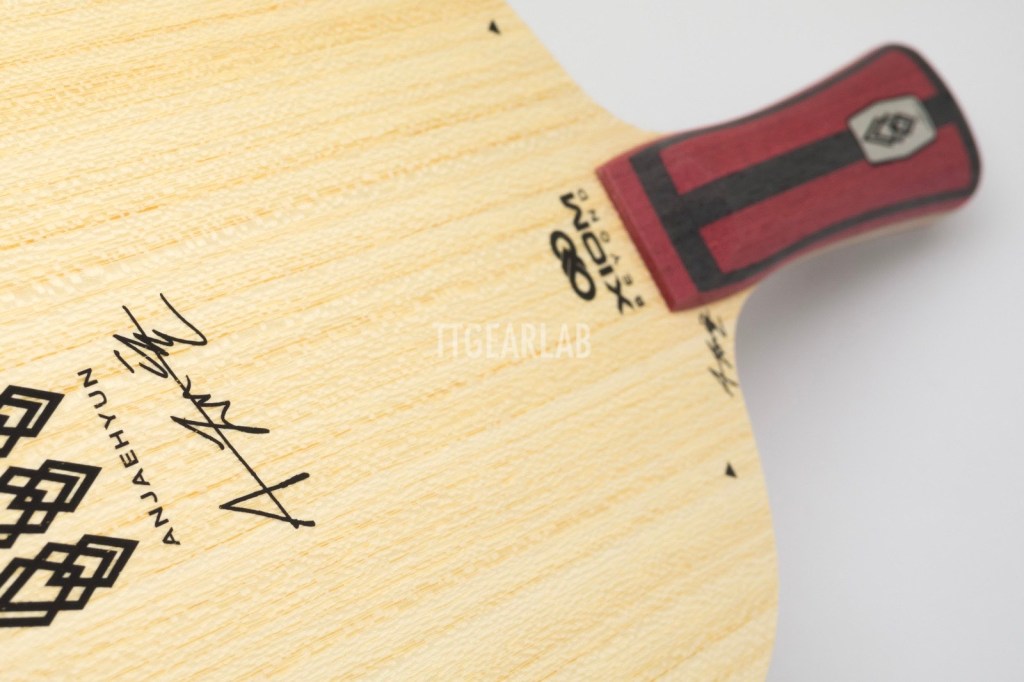
Followings are additional pictures of ‘An Jaehyun’ series :
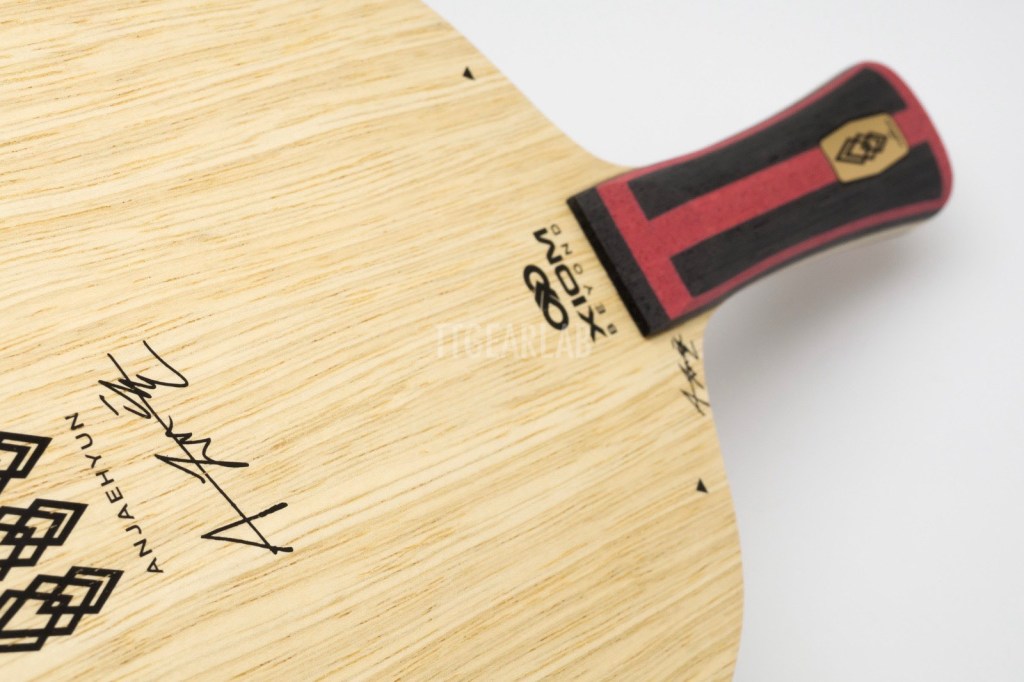
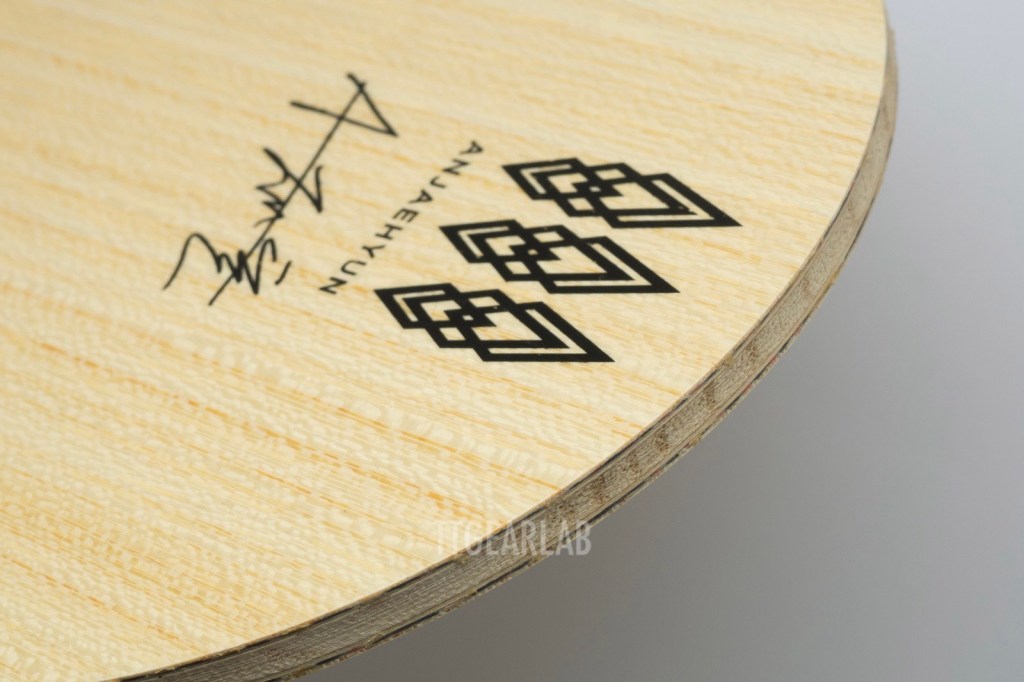
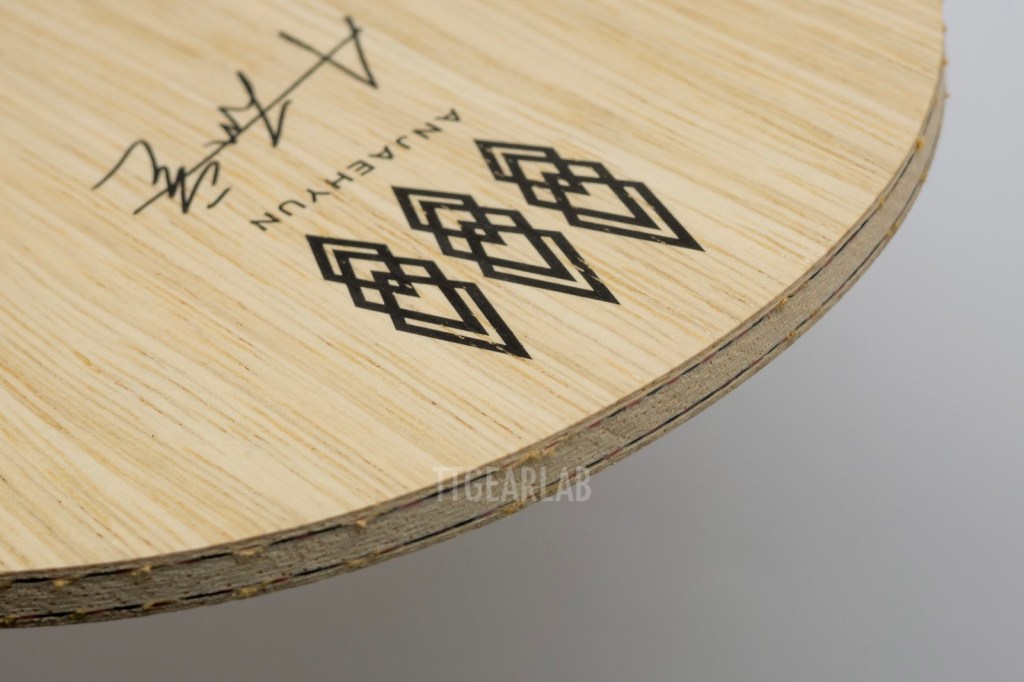
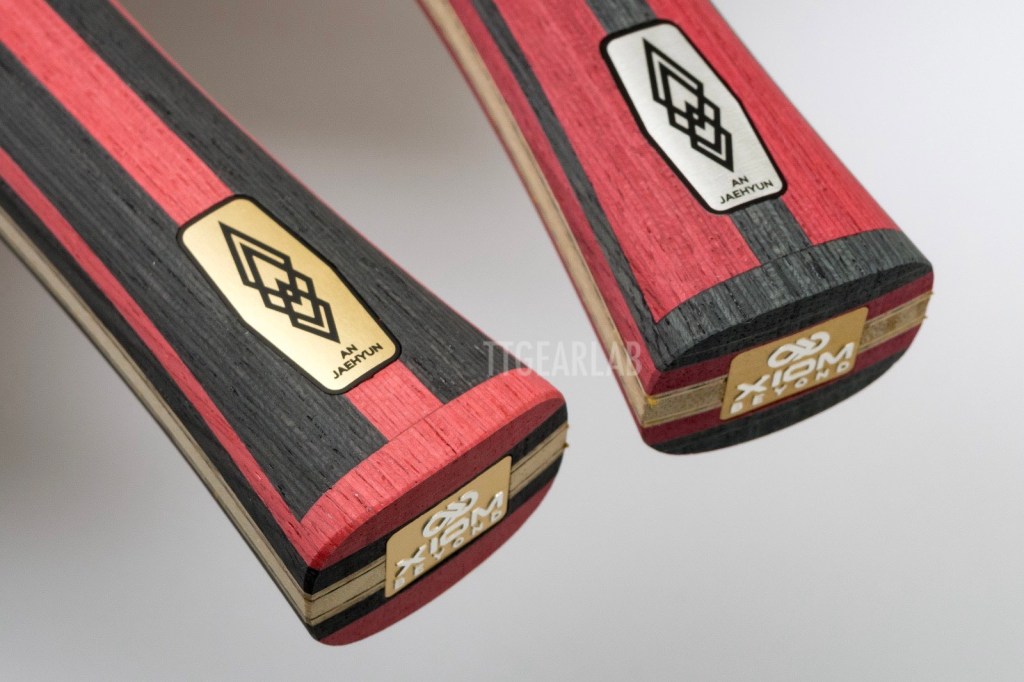
Please click here to return to top (table of contents)


Fantastic review, as always, thanks!
Been waiting for these blades 🙂 Do you know what kind of rubbers will better fit the TMXi blade?
LikeLike
Thank you for comment. I think that ‘An Jaehyun TMXi’ will accept various kinds of rubbers. But, the standard combination for modern all-round play will be new-generation tension rubbers of top level whose sponge density is 45~50 degree. For example Andro Rasanter R48 , Tibhar Hybrid MK and Butterfly Tenergy 05. Even ordinary players will be able to control it without much problem. And, you will be able to adjust the hardness of rubber from that standard. (Please note that the ‘best’ combination differs by player because the preference, the experience and the playing style differ by player. Therefore, even the recommended combination can’t be the answer for all players.)
LikeLike
This is excellent info. Thanks for the reply!
LikeLiked by 1 person
Great review, however I experienced some differences: tmxi for me was much harder and quicker than measured here. I measured even higher frequencies than Ovtcharov Innerforce alc (1420hz vs 1410hz) and mich higher than the Shang kun (1350 hz).
Not only the frequency, but also in playing I felt that the tmxi was comparable to Ovtcharov, even though it was flexier.
Regarding your handle observation: the fl handle for me is really a pity. I prefer the Viscaria type of fl shape a lot (here also used for tmx) and hate the slim Innerforce fl handles. But almost no one uses this thicker type for Innerforce blades… do you have good advices?
LikeLike
Thank you for comment.
I think that the data isn’t different from your experience.
What you mentioned is 4th frequency. However, the frequency that is more directly concerned with the feeling (at index finger) is 3rd frequency. (4th frequency is more concerned with sound and the central elasticity.) The 3rd frequency of ‘AJH TMXi’ is around 930Hz (avg.), and the 3rd freeuqncy of ‘Ovtcharov InnerForce ALC’ is also around 930 Hz (avg.). (Those two are a bit different. Please note that I wrote the word ‘around’.) So the feeling of those two are comparable, as you mentioned. That appears as Vl’s of two blades. The Vl of ‘AJH TMXi’ is 1.29, and the Vl of ‘Ovtcharov InnerForce ALC’ is 1.30. Very close to each other.
And, the Ep of ‘AJH TMXi’ is 1.88 while that of ‘Ovtcharov InnerForce ALC’ is 2.02. So ‘AJH TMXi’ is more flexible than ‘Ovtcharov InnerForce ALC’.
So everything coincides with your experience.
And, from your commend I noticed that I forgot to add ‘Ovtcharov InnerForce ALC’ to the list of comparable blades in this review. It will take some time but I will add it for easier understanding.
Regarding the shape of handle, I also don’t like the FL handle of ‘AJH TMXi’. (BTW, that isn’t disturbance for me because I mainly use ST handle.) However, there are also many players who like the standard (= narrow) FL handle of Butterfly (= Timo Boll type). Probably that is the reason why Xiom applied two different FL handles for the blades in the same series. And, Andro did the same thing for its ‘Synteliac’ series. The inner-fiber versions of ‘Synteliac’ series have narrow FL.
Fortunately Tibhar didn’t make the same decision for its ‘Libra’. ‘Libra’ is one step softer and slower than ‘AJH TMXi’, but its FL is semi-wide type (= Viscaria type).
LikeLike
Thank you for the excellent data and explanation in the comments about frequency.
How different do you think the TMXi Pro would be in comparison to the TMXi?
I believe the Pro has a slightly larger headsize (160mm vs 158mm) and is marginally thicker (6.2 mm vs 6.0mm). Would this make the TMXi Pro much faster compared to the non-Pro TMXi?
Thanks again.
LikeLike
I haven’t got the sample of PRO version yet. On Xiom home page the thickness is written as 5.9mm which is identical to that of regular version. Then the speed of PRO version will not be much different from the regular version. However, if the data on the home page is wrong, of course the PRO version will be one step faster than regular version.
I heard the opinion on the PRO version from some players. They said that the main difference from the regular version is that the center of weight is more toward the head. That is because of the enlarged head. There isn’t basic difference in elasticity, but the raised position of the center of weight makes the ball more powerful. However, at the same time it requires more physical power of the player, and it puts more strain on the wrist of the player.
LikeLike
I look forward to your review of the PRO version, although it says the total thickness is 5.9mm, the PRO version has a thinner center layer and a slightly thicker middle layer
LikeLike
Probably it will take some time, but I will check it.
LikeLike
Can you please compare both with the joola trinity ? Thanks
LikeLike
If I have a chance to get it. I have to contact Joola first.
LikeLike
Great review, thanks!
Do you know what kind of rubbers will better fit the TMX blade?
How would the Fastarc g1, the hurricane neo work? Which ones would you recommend and how hard? Thank you very much for your work
LikeLike
In fact there isn’t a right answer because it differs by player.
But, the rubbers you mentioned can be the basic combination in my opinion. In that case Neo Hurricane 3 will be the forehand rubber, and Fastarc G-1 will be the backhand rubber. An Jaehyun TMX will make great combination with sticky rubbers such as Neo Hurricane 3.
Also you will be able to consider Butterfly Dignics 09c or new German sticky rubbers such as Andro Rasanter C53. The feeling will become quite hard, but in my opinion those rubbers will make great combination. If it is too hard, you will be able to adjust afterwards by replacing the rubber with softer one.
LikeLike
Thank you very much for the reply. Hurricane 3 neo in Fh and G1 in BH was the combination I had in mind. I currently use Cybershape Wood with G1 on both sides. I chose this racket because, as you say, going from Korbel to THX was easier than with other fiber blades What do you think? Thanks a lot
LikeLike
One thing you have to be careful is tht An Jaehyun TMX is much, much faster than Cybershape wood. It will be big speed jump. But, both of Cybershape wood and An Jaehyun TMX hug the ball very well when we hit the ball very hard. It will make the adaptation to new blade not so difficult. It may take time for you to adjust because the speed difference is so significant, but I think that you will be successful.
By the way, if you have used Fastarc G-1 for both sides, I recommend you to continue to use if for both sides. Then you will be able to understand the overall characteristics of new blades in shorter time. And, please change the forehand rubber to Neo Hurricane 3 or German/Japanese sticky rubber after the adaptation period. I don’t recommend you to change both of rubber and blade at the same time. 🙂
LikeLike
Thank you very much for the reply. The truth is that I like the G1 on both sides so I will continue with them on the new blade as you recommend. Regardless of all this, I have read that the Nittaku PK50 Sieger rubber is an evolution of the G1. Do you know it?
Thank you
LikeLike
I don’t have much information on Sieger PK50, but it is apparent that it is a newer generation than Fastarc G-1 and, its pimple geometry is identical to that of Fastarc G-1. 🙂
LikeLike
Do you think that tmxi is an alternative to w968?
an jaehyun played with w968 before switching t tmxi
LikeLike
W968 is the word that indicates special order made version of DHS Hurricane Long 5. For that reason the specification of W968 isn’t fixed. There are many kinds of different W968s. One is soft and another is hard. One kicks the ball very strongly while another hugs the ball very deep.
But, probably An Jaehyun TMXi can be the replacement of a kind of W968 if that has same characteristics as An Jaehyun’s W968. (But, we don’t know the exact characteristics of An Jaehyun’s W968 which is probably different from the other W968s.)
LikeLike
thx for explanation!
also today i see an jaehyun play at busan and he switch back to his variation of w968, i gues xiom tmxi wasnt fod him
LikeLike
Thank you for precious information!
Then probably he hasn’t been satisfied with An Jaehyun TMXi Pro.
LikeLike
Upon looking a photo of the Trimertrix as depicted here : XIOM An JaeHyun 安宰賢 TMXi 球板 (chunhingtt.com)
I notice a very important difference from your review: Zephylium fiber is verrtical and Axylium fiber is lateral, while you have them the other way around.
LikeLiked by 1 person
Zephylium is lateral, and Axylium is vertical, definitely.
The yellow fiber is Zephylium, and is arranged laterally.
And, the red fiber is Axylium, and is arranged vertically.
So I think that the description in the link is not correct.
LikeLike
I just took a look at the promotional photo of the Trimetrix fiber as depicted in Xiom’s brochure: The yellow fiber (Zephylium) is arranged vertically, while the red (Axylium) and the black (X) are arranged horizontally. You can check it out yourself
LikeLike
What I checked is from the actual blades. Not from the brochure.
LikeLike
So you actually removed the upper two wood layers of Limba and Ayous, in order to check the weaving of the TMX ?
LikeLike
I directly asked Xiom on the directions of fibers in TMX. Xiom confirmed that Zylon is lateral and Arylate is vertical.
LikeLike
If that is Xiom’s answer, then there is no more debate. The promotional brochures however and the pictures on their website are wrong and need to be changed. Since you are in communication with them, just inform them about this matter.
LikeLike
The promotional picture in Xiom’s brochure is wrong, definitely.
LikeLike
thanks for those great article.
i was defender till lastly using victas Matsushita offensive. Lastly I decided to get back to inverted rubber.
i tried osp virtuoso which is very soft, high throw angle ( which is good), vibrate well… But it was quite slow.
I tried also yinhe v14 pro and sanwei 75 alc outer, the game features are amazing but it is way too fast and feeling is too much muted.
i tried then 7 ply wood which is good comprise but much less spinny than the ALC.
I am looking for equivalent of the yinhe v14 pro but slower and with bit more woody feel that how I came here. It starts to be expensive experience 😅 Do you have a recommendation for me?
LikeLike
In fact, the one equivalent of V14 Pro is as fast as V14 Pro.
So, I think that you’d better select something between V14 Pro and 5-ply wood offensive blade. Then we can consider many 7-ply wood blades and inner fiber blades.
Please don’t think that all 7-ply wood blades will be similar. Probably there will be other 7-ply wood blades those will give you much more spin performance. But, we have to also consider the possibility that most of 7-ply wood blades don’t fit for you.
Then inner fiber blade with Koto top layer can be the solution.
I recommend you DHS H301. I’m not sure it will be satisfactory or not. But, I think that it is worth considering.
Another choice is an outer fiber blade that is slower than V14 Pro. For example Xiom Hugo HAL. Its fiber isn’t ALC but AL fiber which doesn’t include carbon. But, anyway it is an outer fiber blade, and its top layer is also Koto.
LikeLike
thank you for your kind and detailed guidance.
I ordered a sanwei V5 pro on Aliexpress and xiom tmxi (second hand) to have a feeling with it. Both will be same weight.
I hope the tmxi and v5 won’t too fast (some say it’s off+, some off-), it is really hard to have an idea of how fast is a blade based on internet description and reviews.
I checked none of them have outer koto plywood oupsss.
Anyway, I will keep you in touch.
LikeLike
I hope that you will get good result. 🙂
An Jaehyun TMXi is a moderately fast blade. At lease it will not be a blade which is too fast.
LikeLike
Hello, could you possibly review the Cho Daeseong TMX PRO- am interested to how it stacks up to other viscaria type blades, including tibhar MK carbon and viscaria. Thanks!
LikeLike
I’m considering to get it sooner or later. But, it seems that Cho Daeseong TMX Pro isn’t much different from An Jaehyun TMX. The only one difference is in the head size. Cho Daesung TMX Pro has bigger head than An Jaehyun TMX, and the difference affects the overall characteristics a bit. But, the difference in Performance Indices will not be big. More important role of bigger head is that it makes the head even heavier after two pcs. of rubbers are attached. The bigger mass of head results in the more powerful shot. That is mostly because of the mass and not because of the elasticity itself.
(Even in case the performance indices of two blades are identical, heavier blade with bigger head makes more powerful ball because of the heavier head. The difference will not be big if the difference in the head size isn’t serious. But, anyway there ‘is’ the influence of head size.)
So, regarding performance indices, you will be able to refer to the data of An Jaehyun TMX.
LikeLike
Thanks!
LikeLike
Hello bro, could you tell me if tmxi is more stable and easier to control compared to the one I’m currently using, fzd alc?
LikeLike
It differs by player. In general inner construction gives us more natural and more stable feeling than outer construction. However, ‘more stable & more natural feeling’ doesn’t always mean high stability. If you are fully accustomed to FZD ALC, you may feel that AJH TMXi is somewhat strange and more difficult to control. But, if you feel that current FZD ALC is too hard, and searching for softer blade, AJH TMXi will be one of good solutions.
LikeLike
Thanks for the reply! I really appreciate the quality of your scientific research.
LikeLiked by 1 person
Thank you. 🙂
LikeLike
I recently started using the xiom 36.5 ALXi, would it be similar in any way to the TMXi pro?
LikeLike
I don’t have the PRO version of TMXi.
But, it will be closer to normal version of AJH TMXi than 36.5 ALXi. I don’t think that 36.5 ALXi will be similar to AJH TMXi Pro.
LikeLike
Thank you, what about 36.5 ALXi and AJH TMXi non-pro?
LikeLike
Those two are also quite different from each other. AJH TMXi is noticeably faster than 36.5 ALXi. And, 36.5 ALXi can be felt even slower because it hugs the ball even more deeply than AJH TMXi. Further, there are big differences in feeling because of the kind of middle layer wood and the lateral fiber.
LikeLike
Hi,
I hope you could review the TMXi Pro version at some point. Pro version does not only differ in headsize in comparison to regular tmx (160×152 vs 158×152). The pro version core veneer is about 10% thinner, while the veneer between fiber and outer veneer has been reinforced.
I have seen a review of a high level player (former privincial player in China). He said the regular tmxi feels like harimoto alc (stiff), while the tmxi pro version feels more like w968.
I hope that you will get the chance to playtest tmxi pro at some point. and I am curious about your opinion and impressions
as always, thank you for this great website
LikeLike
one more thing to add, I have been using the pro version for a while now. it is not so fast if you dont hit hard, so its easily controllable for amateurs.
headsize could be a burden but I dont feel it. the handle is very large, which balances the weight.
unfortunatly I never tried regular tmxi, so I cant make a comparison. But I believe pro version plays better, at least according to the many reviews online
LikeLike
Thank you for sharing your experience.
And, if the plywood of Pro version is different from normal version, it is worth testing. It seems that it isn’t just a ‘version’ but a different model that shares the series name with normal model, becuase that is fundamental difference.
LikeLike
Hello bro! Can you please give your opinion which is better for allround play with accent on cuts and slow but spinny serves tmxi or h2? Thank you so much!
LikeLike
If you prefer slower one or the one that hugs the ball deeply with softer feeling, Hina Hayata H2 will be the choice.
But, if you require the ability of ‘precise’ control, ‘An Jaehyun TMXi’ will be better although it is faster than Hina Hayata H2.
Safety ==> Hina Hayata H2
Precision ==> An Jaehyun TMXi
LikeLike
Hi,
I am currently using Cho Daeseong TMX pro (86g) for about 8 months now. It took me tons of rubbers to be able to fit my playstyle. Currently, the best setup for me is H3 National Blue and 09C.
What I am looking for is a new blade with little bit higher ARC without sacrificing the speed. Does Ep-Ec ratio effect the arc of a blade ? I found that Butterfly ALC blades have significant higher arc compared to ZLC.
This blade has very flat direct arc and not a problem for the BH as I can use a lot of wrist to generate arc. But I can lose a lot of points on the FH, especially in tight matches. It has Very low margin of error on the Forehand.
Indeed, I really love the BH on this blade. When paired with 09C, I can kill the balls with loads of spin with very low arc. I am thinking about get a custom made blade for me (possibly with OSP), with the outer on the BH and inner on the FH. or different carbon fibre or wood to achieve high arc on my FH and low arc on my BH.
I do not care about the vibration and the feeling of the blade. The only restriction would be the weight of the blade. Must be less than 86g. My combined rubbers weight 100+g and my wrist cannot handle more than that.
My previous blades – DHS 301 – 1 Year , Stiga Legency Carbon – 1 Year, ZJK ZLC – 1 Year, Harimoto ZLC – 2 Year, TMX pro (Current)
I play mid distance and winning points with loop kills, aggressive topspin and counter topspin.
If you can guide me what blades or material I should use, I would be very much appreciated.
LikeLike
Thank you for comment. The influence of Ec/Ep differs by player. From your experience, I think that the Ec/Ep which is lower but not extremely low may be the best solution for you.
And, in fact the blade with asymmetric construction isn’t that helpful. You may feel the difference in ball touch between forehand side and backhand side. However, the overall performance is decided by the total structure of blade, and the actual difference between FH and BH in performance will not be as big as expected. Adjument by rubber may be better way of differentiating FH and BH.
Further, if you change blade, you may have to test many rubbers again for finding the best combination with new blade.
LikeLike
Thanks for your insights. What about the arc of a blade ? Are all blades follow the same rule of More Speed = More direct flatter arc ? or Is there exception based on the structure ?
Have you ever come across Xiom Ice Cream series ? I can’t find data on your site about it. I might consider having similar build.
Kaung
LikeLike
Higher speed doesn’t always mean flatter trajectory. In general it is easier to make flatter trajectory with faster blade. However some fast blades have the ability to make really high arc. There isn’t rule.
LikeLike
Thanks for the info. I have got a new blade, the new STIGA Hybrid Aura which is innerforce Limba top.
It have better control than TMX pro and somehow without sacrificing the speed. It has really good vibration dumping property as advertised.
You should have a review on this one.
Kaung
LikeLike
Thank you for sharing your experience. I hope that I have a chance of testing that blade.
LikeLike
Hello bro! Are you interested in testing Hugo Pro tmxi? I look forward to your scientific evaluation!
LikeLike
Of course I’m interested in that model. I’m considering to get a sample. But, it is questionable whether it is really different from An Jaehyun TMXi (Pro version). I have to first check it.
LikeLike
do you have any information about indeed zlxi xiom blade.?
Amazing work!
LikeLike
Thank you for comment. By the way, I don’t have the information of that blade yet.
LikeLike