
In this blog, for understanding a blade and comparing blades, four performance indices – two elasticity indices and two vibration indices – will be used.
- Ep : Elasticity Index (Primary)
- Ec : Elasticity Index (Central)
- Vp : Vibration Index (Primary)
- Vl : Vibration Index (Lateral)
As the name itself expresses elasticity index means the elasticity (= stiffness) of blade. So it is directly concerned with speed of blade. Especially Ep is similar to speed. Ec becomes meaningful only when we hit blade very hard. The higher value of Ec means that the blade can give more ‘kick’ when we hit the blade very hard.
Vibration index means the level of vibration. Vp is directly concerned with longitudinal bending vibration, and it is mainly transferred to player’s palm. Vl is concerned with lateral vibration of blade head, and player can feel it at fingertip of index finger. So Vp and Vl can be translated as ‘feeling’. The higher value of Vp or Vl means sharper feeling.
In this article, I will show the values for some known blades for the understanding on performance indices. I selected 10 blades as follows:
(1) 5-ply wood blades
- Stiga Allround Classic (Reference blade)
- Butterfly Korbel
- Tibhar IV-S
- Butterfly Mazunov
(2) 7-ply wood blades
- Butterfly Primo Powerfeeling
- Donic Ovcharov Senso V1
- Stiga Clipper CR
(3) Fiber blades (usually Carbon fiber)
- Yasaka Ma Lin Carbon
- Butterfly Timo Boll Spirit (same as Timo Boll ALC)
- Tibhar Rapid Carbon
- Butterfly Schlager
As you see above, there are three ‘groups’ of blades in this comparison. I tried to show you as various blades as possible. So I selected three kinds of different groups, and even I selected blades with various characteristics even in the same group. The reference blade is Stiga Allround Classic, and all the performance indices of Stiga Allround Classic are 1.00.
At first, let’s see Fig.01 – the comparison graph of Elasticity Indices. (Please note that ‘elasticity’ doesn’t mean ‘flexibility’ but ‘stiffness’ although the word itself can be translated both of those two. Throughout this blog, higher elasticity means higher rebound, i.e. higher speed.)
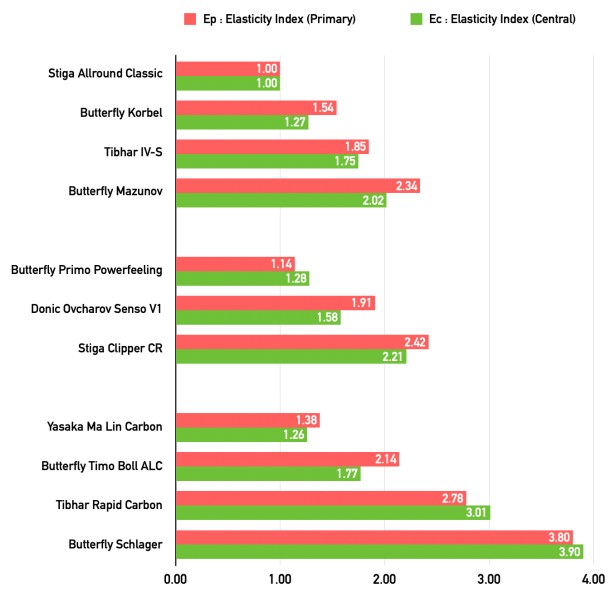
Fig.01 Comparison by Elasticity Indices
Red bars indicate Ep = ‘Primary’ Elasticity Indices. ‘Primary’ means bending deflection which is the most important behavior of blade during the impact between racket and ball.
Green bars indicate Ec = ‘Central’ Elasticity Indices. ‘Central’ means the deflection of the center of blade head, and Ec is the stiffness of that deflection. Before normalization, the value of Ec is much bigger than that of Ep. I.e. central stiffness is much higher than primary (bending) stiffness. So the amount of central deflection is smaller than primary deflection (= bending deflection).
Although Ec isn’t the value that doesn’t directly express feeling, the relationship between Ec and Ep can express a kind of feeling. Please also refer to Fig.02 when the relationship between Ep and Ec is considered.
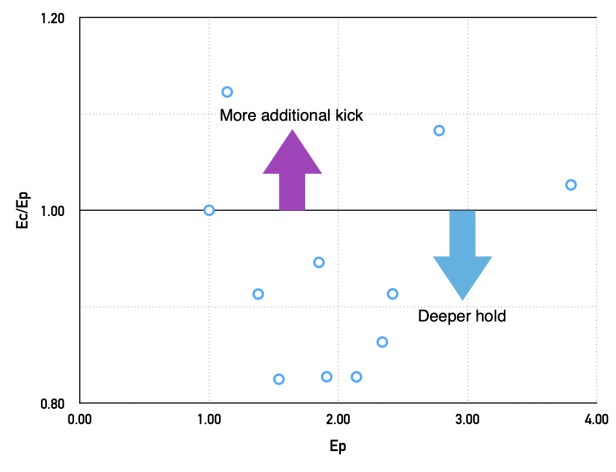
Fig.02 Ec/Ep vs. Ep
If Ec is relatively bigger than Ep, player feels that the blade is hard at center of head because the relative ‘kick’ when we hit ball very hard is noticeably big. If Ec is relatively smaller than Ep, player feels that the blade is soft at center of head because the blade doesn’t provide additional kick when we hit the ball hard. Instead player feel that the blade head holds the ball. (In fact, usually the blade with high value of Ep also has quite high value of Ec. But, if Ec is relatively small, player can’t feel the additional kick by high Ec because basic rebound by bending stiffness is already very high. That is another reason why the behavior of blade center can’t be ‘primary’ when we examine the performance of blade.) Interestingly, if Ec and Ep are similar with each other, the behavior of that blade is linear. ‘Linear’ means that player doesn’t feel the additional kicking or holding. That is not an intended result of this research but just accidental after the use of poly ball. In the age of celluloid ball, to become linear the Ec should be relatively smaller. However from the introduction of poly ball, all of blades became softer at center of head. (It is another theme of research. But, I will not touch the detail of that phenomenon.)
From the graph, we can see that Butterfly Korbal has 54% bigger Ep (red bar) than Stiga Allround Classic. So Butterfly Korbel is faster offensive 5-ply wood blade while Stiga Allround Classic is slower allround 5-ply wood blade. But, the Ec (green bar) of Korbel is only 27% bigger than that of Allround Classic, and it is significantly smaller than the Ep of Korbel. So we can expect that Butterfly Korbal holds ball deep when we hit ball hard. Differently speaking Butterfly Korbel doesn’t give additional kick so much when compared with its basic speed that can be expected from Ep. In fact, we feel more additional kick from Stiga Allround Classic than from Butterfly Korbel when we hit ball hard although Stiga Allround Classic is apparently slower. That is because of the relationship between Ep and Ec.
Tibhar IV-S and Butterfly Mazunov are known as very fast 5-ply wood blades. It is proved by the values on the graph. Ep of Tibhar IV-S is 1.85 and that of Butterfly Mazunov is 2.34. Those values are close to the Ep of Stiga Clipper CR which is a very fast 7-ply wood blade or that of Butterfly Timo Boll Spirit which is a famous fiber blade. Also, we can see that Ep of Butterfly Primo Powerfeeling which is a 7-ply wood blade is smaller than that of Butterfly Korbel which is a 5-ply wood blade. Again, we can see that the Ep of Yasaka Ma Lin Carbon which is a carbon blade is smaller than that of Butterfly Korbel which is a 5-ply wood blade.
We may think that 5-ply blade is relatively slow and 7-ply or Carbon blade is relatively fast. However, that is not always truth. In the world of table tennis blade, there are many ‘relatively fast’ 5-ply blades and many ‘relatively slow’ Carbon blades. Of course there also exists actually fast carbon blades such as Tibhar Rapid Carbon and Butterfly Schlager on the graph.
From the graph, we can expect the characteristics of blades. For example, Butterfly Timo Boll Spirit is as fast as usual 7-ply wood blades but it tends to significantly hold ball when we hit the ball very hard. It doesn’t provide additional kick. Donic Ovcharov Senso V1 has similar characteristics with Butterfly Timo Boll Spirit. Yasaka Ma Lin Carbon is not a fast blade although it is a carbon blade. Its speed is similar to that of usual 5-ply blade or slower. But, its Ec (1.26) is close to Ep (1.38), and as a result its behavior is close to linear. (It tends to hold ball, but just a bit.) Similarly, Tibhar IV-S and Butterfly Schlager are close to linear.
By the way, although I mentioned that player can ‘feel’ the relationship between Ec and Ep, it isn’t the feeling that is directly felt by human hand. Both of Ec and Ep are performance factors, and the feeling of the relationship between Ec and Ep is not felt by hand but felt by brain. I.e. it is not ‘feeling’ but what the player judge or understand in brain while playing with that blade. What are actually concerned with feeling are Vibration Indices.
Then let’s see Vibration Indices. Fig.03 is the graph of the comparison by Vibration indices.
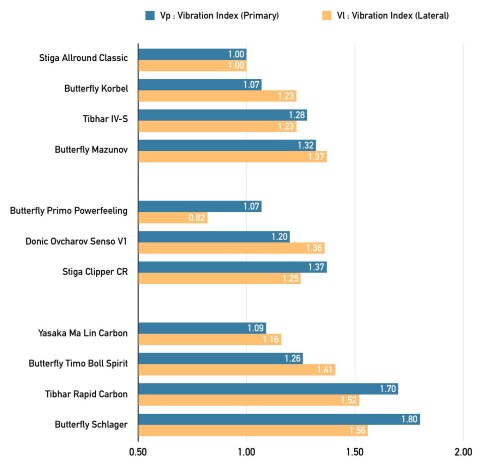
Navy bars indicate Vp = ‘Primary’ Vibration Indices. Again, ‘primary’ is concerned with bending deflection which is the most important behavior of blade during the impact between racket and ball. It is normalized value of the frequency of vibration. It is concerned with stiffness (= elasticity), but isn’t the stiffness itself. The primary (= bending) vibration is generally felt by player’s palm which is in contact with the handle of blade. More correctly speaking, the sensing point of Vp is little (fifth) finger and a part of palm which is close to little finger in case of shakehand. (In case of penholder, Vp is felt at the point between thumb and index finger.)
Orange bars indicate Vl = ‘lateral’ Vibration Indices. It is concerned with the vibration which is similar to the movement of bird’s wing. Also it is felt at the fingertip of index finger which is in contact with the wing of a blade. Sometimes Vl is more important than Vp because index finger is generally more sensitive than palm or little finger.
There is again the issue of the relationship between Vp and Vl. That is because those two are felt at different points of hand but at the same time. That may be more important than the single values themselves. Please also refer to Fig.4 when the relationship between Vp and Vl is considered.
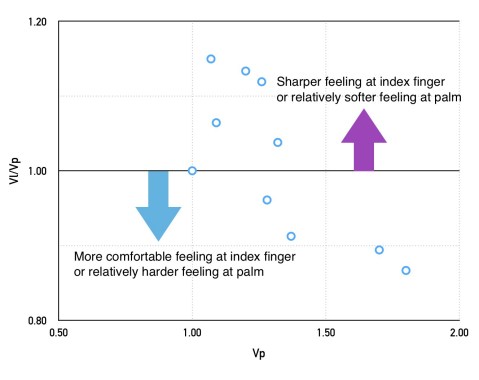
The comparison between Butterfly Korbel and Buttefly Primo Powerfeeling gives us very good example. The Vp of both of those blades is 1.07. However Vl of Butterfly Korbel is 1.27, and is much bigger than Vp. And, Vl of Butterfly Primo Powerfeeling is 0.82, and is much smaller than Vp. Even though those two blades have the same value of Vp, we will expect that the feeling at the fingertip of index finger will not be same. Actually, Butterfly Korbel gives very sharp feeling at the fingertip of index finger, and on the contrary Butterfly Primo Powerfeeling gives very comfortable feeling at the fingertip of index finger. By the way, we may feel that Primo Powerfeeling is harder than Korbel. If a player says that Primo Powerfeeling is harder than Korbel, we can understand that the player mainly feels at the fingertip of index finger and then judge the feeling at the palm. This kind of complexity causes the inconsistency of the result of testing by human testers. A tester mainly feels Vp, but another tester mainly feels Vl. A tester judges Vl after Vp, but another tester judges Vp after Vl. We usually read many different opinions about the same blade on table tennis magazines or internet home pages. The reason why there can exist so many different opinions on identical blade is the existence of many factors of feeling. Human tends to biased to a specific element of feeling, and it affects not only the result on feeling but also even the result on performance. That is the reason why we can’t believe the result of subjective testing by human tester, even though that tester is a top player. However, the Vibration Indices – Vp and Vl – don’t give us biased result. We can believe the indices because those indices are ‘measured’ values.
Comparison between two 7-ply blades – Donic Ovcharov Senso V1 and Stiga Clipper CR is very interesting. On the palm, Stiga Clipper CR shows bigger value of Vp than Donic Ovcharov Senso V1. It means that Stiga Clipper CR is harder than Donic Ovcharov Senso V1 on the palm. So basically we can consider that Stiga Clipper CR is harder because bending deflection is primary behavior of blade. However, the Vl of Ovcharov Senso V1 is bigger than that of Clipper CR. It means that Ovcharov Senso V1 provides sharper feeling at the fingertip of index finger. So from the viewpoint of feeling, those two blades are totally different. We can understand that those two blade are designed under totally different concept.
Among four carbon blades on the graph, it is interesting to compare between Butterfly Timo Boll Spirit and Tibhar Rapid Carbon. Tibhar Rapid Carbon is thick and hard blade. But, Butterfly Timo Boll Spirit is thin and relatively soft blade. So the Vp of Rapid Carbon is high (= 1.70), and the Vp of Timo Boll Spirit is not high (= 1.26). However, at the fingertip of index finger, we may feel that those two blades are similar because the Vl of Rapid Carbon (= 1.52) is close to that of Timo Boll Spirit (= 1.41). Some players will say that Rapid Carbon is much harder than Timo Boll Spirit, but other players will say that Rapid Carbon is similar to Timo Boll Spirit.
I will skip the detailed comparison of Vibration Indices on the other blades because this article is for just showing the example of utilization of four performance indices.
As is explained above, by comparing the values of four performance indices we can understand table tennis blades without bias. So I will always use four indices in reviews on blades. I believe that it will help you to understand table tennis blades more objectively. Finally accumulated data of performance indices will help your fine adjustment when we want to select a blade which is the best fit for you.
 TTGearLab
Would it be possible to measure the performance indices and make a comparison of some “classic” (or let’s say well appreciated) 5-ply all-wood blades with a Limba external ply? For example:
Nittaku Acoustic, OSP Virtuoso Off-, OSP Virtuoso+, Tibhar Stratus Powerwood, Butterfly Primorac, Butterfly Petr Korbel, Stiga Infinity VPS V, Avalox BT555, etc.
Also some well-known blades, again with 5 plies, but with a harder external one, like:
Nittaku Violin, Stiga Ebenholz NCT V, Avalox P500, …
LikeLiked by 1 person
Of course it is possible. But, I don’t have any OSP blade and any Avalox blade. I have all other blades you mentioned, and I have already measured those blades. Now I’m thinking about the format of postings concerning classic blades.
Maybe I will be able to write postings on classic blades after I the posting of Stiga Carbonado series.
LikeLike
Even without the Avalox and the OSP, I would be very much willing to see your measurements for the rest of the blades. Thanks a lot in advance.
PS: Am I correct if I guess that your measurements would be affected by the weight of a blade? Of course I understand that you don’t have a given model in many available weights. But maybe when you give your results of the indices, you could also report the weight of the blade used.
LikeLike
OK. I will try to post it as soon as possible.
Concerning the weight of blade, of course the result is affected by weight. However, the form of the influence of weight differs by blade model. In general heavier one is faster and softer than lighter one. (But, there are exceptions of course.) And, some blades show big difference, but other blades doesn’t.
I try to measure many pieces and to get the average value if possible. If it isn’t possible (i.e. the price of blade is too high), I buy sample blade whose weight is close to average.
LikeLike
Would you mind to review please the new Innerforce layer ALC.S and Violin? Thank you in advance, I really appreciate your work! 👍
LikeLike
Thank you for your reading and appreciating my posting.
The ‘full review’ or ‘lab test report’ on Butterfly Apolonia ZLC is on my schedule. Apolonia ZLC is identical to InnerForce Layer ZLC if we don’t concern appearance (= graphic design) of those blades.
I also have InnerForce ZLC. The difference between InnerForce ZLC and Apolonia ZLC (= InnerForce Layer ZLC) exists in head sizes. New ‘Layer’ version has small head. And, that is the only one difference. Of course the difference of head size affects performance. But, in case of these fast fiber blades, the influence is not that serious. The main advantage of new version is a bit reduced weight thanks to a bit reduced head. Anyway, I hope that the posting on Apolonia ZLC helps you.
Regarding Violin, I will write a posting on the performance indices of classic 5-ply blades. Violin is included in the list.
LikeLike
I’m asking you about the ALC.S because it was launched as a tamed version of the innerforce ALC so I would like to know if it fits in a new range of mesurements different from the innerforce ones… I hear someone sayin it is similar to Fang Bo 2 but I have doubts about it
LikeLike
If I understand correctly, you are meaning ‘InnerForce Layer ALC.S’. Isn’t it?
I don’t have the sample of ‘InnerForce Layer ALC’ yet. But, what is apparent is that new ‘InnerForce Layer ALC.S’ is completely different from old ‘InnerForce ALC’.
At the beginning, the thickness is reduced to 5.5mm from 5.8mm of old model.
Further, there is difference of wood material. The second layer of old ‘InnerForce ALC’ is Ayous. However, when they develop new ‘InnerForce Layer ALC.S’, Butterfly replaced Ayous of second layer with different wood which looks like Spruce. I can easily expect that new model will behave differently from old model. I have old InnerForce ALC but I don’t like its feeling at all. However, I expect that the feeling of new model will be quite good, although it is no more than expectation because I haven’t bought sample of new one yet.
For the same reason, InnerForce Layer ALC.S is different from Fang Bo 2. The second layer of Fang Bo 2 is Ayous that is common on many ‘inner fiber’ blades.
Of course, the wood material doesn’t tell everything. However, the difference between Spruce and Ayous is too big.
If I expect the performance indices of InnerForce Layer ALC.S, its Ec will be relatively low, and its Vl will be relatively high. Because of thin construction whose thickness is only 5.5mm, Ep and Vp will not be that high. So InnerForce Layer ALC.S will behave like softer and slower version of Timo Boll ALC in my expectation. And, it will behave differently from InnerForce ALC or Fang Bo 2.
LikeLike
If I understand the graphs correctly, they are demonstrating that the Stiga Cipper CR and Schlager Carbon are ‘more elastic’ (i.e. More flexible) blades than the Stiga Allround Classic.
Am I understanding your graphs correctly?
LikeLike
Yes. It is correct.
LikeLike
How can this be correct? Im very irritated now..I thought the higher the Vp value is the stiffer is the blade. I thought the All classic ist the most flexible blade and that why you are taking it as reference…!!?? this would mean carbon blades are more flexible than the All clasic!!? could you please explain! You generally need to provide easier formulations for these key figures , i mean ” high Vp means xxx and so on ..Thank you
LikeLike
I can’t understand your question. If Vp just means the stiffness of blade as you mentioned, there isn’t any carbon blade which is more flexible than Allround Classic in this article. The Vp of any blade is under 1.0 in this article.
LikeLike
I have left a comment here in this page and some questions, also a nother comment/question on another test ..cant find them any more? did you remove them? Thank you.
LikeLike
Sorry, my mistake 🙂 there are there . Hope you can answer soon
LikeLike
Thanks for the really amazing work! I’m trying to understand the value of “Ec” in terms of the “catapult” of a blade. Right now, especially when looking at the Schlager Carbon, I think that higher values mean nearly no “deflection” of the part of the blade where I hit the ball. This would make sense, the Schlager Carbon might be the hardest blade ever made on earth so it should not have any deflection at all. Now, comparing it to rubbers, we have hard and soft rubbers. Normally, the softer rubbers have more catapult and also a low throwing arc when you’re hitting the ball tangential and vice versa for harder rubbers. Can we apply this also to blades? Would make sense to me, I’ve tried Viscaria, Boll Spirit, ALC a lot and I “dislike” the really low throwing arc of those blades. Those blades are in your terms “mild to deep hold” blades. I once thought that this is a characteristic of the Koto outer verneer but it might be more the overall behaviour of the blade. Sure, the Koto is also playing its part in the overall behaviour but I also think that the center verneer might be more important for this.
As a scientist myself, I’m now doing some research on my own ^^.
I ordered the Nittaku Barewell, Stiga Maplewood, Stiga Offensive Classic Carbon and Tibhar Chila Off. I also have two Boll Spirits and one ALC.
I will try them with the same rubbers and then I might get a conclusion how this will translate for me into the real world!
LikeLike
Thank you for comment.
1. Higher Ec means less deflection at the center of blade. (You are right although ‘less’ is better expression than your ‘no’. ;-))
2. Lower Ec ‘may’ cause higher catapult effect. However, Ec is concerned with normal direction. The value of Ec is meaningful only when we put more force in ‘normal’ direction. On the contrary, the catapult effect is mainly with tangential (planar) direction. Therefore, ‘the catapult effect of blade by low Ec’ and ‘the catapult effect of rubber’ are different stories.
3. Some soft rubbers have more catapult effect. It is right. For example Mantra S has more catapult effect than Mantra H. But, not all soft rubbers. There are some exceptions for example Evolution MX-P vs. Evolution FX-P. (But, maybe players ‘feel’ that Evolution FX-P’ has more catapult effect.) Further, ‘more catapult effect’ doesn’t mean ‘more spin’. When compared with Mantra H, Mantra S has more catapult effect but produces less spin.
4. Center veneer plays an important role on Ec, of course. But, of course, there is also the influence of other veneers on Ec. Simply speaking, the phenomenon is quite complex, and therefore we should consider everything when we think about the behavior of blade. 🙂
5. I expect that you will be able to easily connect the performance indices and the actual behavior of your blades. Concerning Timo Boll Spirit, the result may be somewhat different if the weight of Timo Boll Spirit is over 90 gram. Some heavy Timo Boll Spirit has a bit thicker top layer, and it makes different result. But, Maplewood and Chila OFF can be good example because the characteristics of those two are extreme.
LikeLike
your post is very useful. i have just read it and have somethings to ask you: about the Vp and Vl, you wrote:
_The comparison between Butterfly Korbel and Buttefly Primo Powerfeeling gives us very good example. The Vp of both of those blades is 1.07. However Vl of Butterfly Korbel is 1.27, and is much bigger than Vp. And, Vl of Butterfly Primo Powerfeeling is 0.82, and is much smaller than Vp. Even though those two blades have the same value of Vp, we will expect that the feeling at the fingertip of index finger will not be same. Actually, Butterfly Korbel gives very sharp feeling at the fingertip of index finger, and on the contrary Butterfly Primo Powerfeeling gives very comfortable feeling at the fingertip of index finger. By the way, we may feel that Primo Powerfeeling is harder than Korbel.
=> the smaller Vl , the harder felling.
_Butterfly Timo Boll Spirit is thin and relatively soft blade. So the Vp of Rapid Carbon is high (= 1.70), and the Vp of Timo Boll Spirit is not high (= 1.26)
=> the higher Vp, the harder felling.
i think you have a mistake. that right?
LikeLike
Is this the Japanese Korbel or the European Korbel?
LikeLike
‘Korbel’ is European model. There isn’t ‘Japanese’ Korbel. What is being sold in Japan is also European model.
Many years ago there was ‘Adolescen’ that is Japanese model. That has same plywood as ‘Korbel’.
Cresail (Japanese) = Mazunov (European)
Adolescen (Japanese) = Korbel (European)
Hermoso (Japanese) = Primorac (European)
LikeLike
I would be super curious for comparisons and reviews on Gambler blades by Zeropong as they frequently compare their low priced blades to very high priced, described by reviewers as clones.
For example, USD60 Gambler Fire Dragon Touch is said to compare favourably to EUR199.90 Butterfly Innerforce Layer ZLC
Your reviews certainly help to provide more information before purchase, but I wonder if perhaps your review on Gambler products might make high quality Table Tennis equipment more affordable and accessible to all players if indeed they are as high a quality as the more expensive equipment.
I really like that you can afford to try lots of Gambler combos at a fraction of the cost instead of committing to a high priced setup that you might not like, but it would be great to confirm wether it makes sense to buy the ‘pro’ version once you find the setup you like, or if the ‘clone’ version is already quite ‘pro.’
LikeLike
Thank you a lot. But, I don’t know Gambler blades.
If the blade has same construction as reference blade, at least the primary elasticity will be similar with that of original one. However, there may be noticeable differences in all the other factors.
LikeLike
Hello, I’ve just discovered your blog and I found it very interesting to focus on equipment by measurements. I have never seen this approach, but I like it as it it’s as objective as it can be I guess.
I’d be very interested to see you test chinese rubbers, for example Hurricane as it has versions with traditional chinese sponge and with tensor type sponge.
From the blade side I’m super curious about the Xiom Ice cream blade as it has a ALC and ZLC composite on oppsing sides which makes it an interesting blade. I wonder how the different sides stack up against eachother.
LikeLike
Thank you a lot. In fact there has already been similar approach on rubbers, although I hasn’t yet posted anything.
The speed or spin when we apply unit impact force can be the performance index of rubber. Because the measurement of rubber is not easy, there is limit in the measurement of rubber. (That is the reason why I hasn’t posted anything.) But, at least we can overview the performance of rubber.
We can define the indices as :
R : The spin resulted by unit impact force
V : The vertical speed resulted by unit impact force (This is mainly concerned with the speed of smash)
T : The tangential (planar) speed resulted by unit impact force (This is greatly concerned with the speed of topspin)
Although its sponge is not TENSOR type, Neo Hurricane 3 can be considered as a kind of ‘tension rubber’. And, it can be compared with original ‘Hurricane 3’.
If we compare the indices, of course V of Neo version is higher than that of original version. However, interestingly R of Neo version is smaller than that of original version while T of Neo Version is much bigger than that of original version.
Of course in real world we don’t put same impact force to rubber because we always adjust our impact while we get accustomed to a rubber. But, if we don’t try any ‘adjustment’, we will get less spin from Neo Hurricane 3 than original Hurricane 3.
Regarding Ice Cream, I wonder whether the Zephylium Carbon is ZLC or not. That is because of the explanation of Xiom. They are explaining that the face with Arylate Carbon is for power and the face with Zephylium Carbon is for control. It means that the tensile modulus of Zephylium Carbon is lower that that of Arylate Carbon. If that is truth, there is a possibility that Zephylium is not Zylon. If there is a chance, I want to get a sample and tear it down for examining the kind of fiber.
By the way, in that kind of blade, the difference between one side and the other side is not as big as we expect.
LikeLike
Good explanation 👏
I want to ask four questions and answer it one by one thank you a lot 💗
LikeLike
The feeling of ZLC is more natural than the feeling of ALC in soft strokes. But, if we hit the ball very strongly, the feeling of ZLC becomes very stiff like that of stone. That may be good for hard smash, but there will be more players who don’t like that kind of characteristics. Probably that will be the reason why professional players prefer ALC to ZLC. (And, probably that is the reason why Super ZLC was developed. Super ZLC doesn’t become that stiff when the player hits the ball very strongly. So, Super ZLC is quite close to ALC.)
The level of Vp or Vl isn’t good or bad. That is concerned with the personal characteristics or preferece of player. In most cases, the blade with high Vl gives ‘sharper’ or ‘clearer’ feedback. But, that isn’t ‘better’ feedback. That is the issue of sharper or milder. (Some players think that milder feeling gives less feedback.) And, from my experience, there are more cases that Vl/Vp is more important than Vl itself.
The hardness/softness of blade is concerned with both of elasticity and vibration. But, elasticity is related with performance, and vibration is related with feeling.
The Ec is not directly related with ball release. In fact the dwelling time of ball on the surface of rubber is always same. (It is aound 1/1000 second. Because it is so short, the ball leaves the surface of rubber much earlier than our brain receives the information of the contact. The transmission speed of our nerves is very slow.) However, we ‘feel’ that the contact is short if Ec is much higher than Ep, and long if Ec is much lower than Ep. In fact the relationship between Ec and Ep is concerned with how deep the center of blade deforms when we hit the ball very strongly. But, if the center deformation is big, we feel that the center of blade hugs the ball very deeply. And, if the deformation is small, we feel that the center of blade kicks the ball strongly.
LikeLiked by 1 person
What do you think is the effect of kick and hold effect that the blade has on the trajectory of the ball? Would holding the ball gives it a higher arc or lower arc?
LikeLiked by 1 person
Lower and more linear arc in general, if the other conditions such as primary elasticity is similar. But, it more depends on how the player uses the skill.
LikeLike
very good explanation of our dwell time perception.
Initially, i too misunderstood elasticity as flexibilty (how much it can bend on ball’s impact) so i thought a greater elasticity should be slower and only upon reading it again did i realise by elasticity you are referring to the blade’s “tendency to rebound”. i think i understand it correctly this time. would prefer it calling “Tendency to rebound” instead of elasticity to avoid such misunderstandings. thanks
LikeLike
I want to ask four questions and answer it one by one thank you a lot 💗
1.when I read the compression of butterfly outer carbon blade and I noticed that there are very similar Ep,Ec and Vp,Vl indices results of different blades like Timo boll ZLC and Fan zhendong ALC so what kind of difference between zlc and alc fiber at playing with those two blades however both of those blades are very similar or you think there are not much difference in feeling or playing 🤔 this is the first question.
2.Is it when we have high vibration indices Vp/Vl it’s mean that we have nice feelings of blade or not.. I understand that high Vl give sharp feelings to index finger, so sharp feeling give more feedback or lower is give more, and what is the relationship between comfortable and feedback? And is there is a relationship between the hardness/softness of blade and Ep,c or Vp,c indices?
3.What is the difference between holding ball and catapult it I know its about kicking the ball or not but my question about the fast releasing of the ball when it’s impact with the blade is there are a relationship between releasing and Ec or not? And when I have a lower Ec it’s not mean that the ball will release slow right.
4.Why most professional players used arylate carbon blades instead of zlc blades?
LikeLiked by 1 person
Thank you for comment.
(1) There can be many opinions. But, I think that ZLC in general gives more natural feeling than ALC at soft impact. That is the advantage of ZLC. However, if the impact becomes very strong, ZLC suddenly becomes extremely stiff, as a stone. That can be cons or pros. The players who have used typical 5-ply wood offensive blades such as Korbel may think that it is very, very strange. The smash becomes much more destructive than we imagine. Anyway, if the other factors are identical, ZLC blade is much different from ALC blade even thouth the values are similar. Performance Indices can’t explain that difference because currently only very simple parameters are used in this home page.
(2) That is just the issue of preference. And, in fact there isn’t better or worse in feeling. However, it seems that more players feel that the blade with higher Vl/Vp gives more feedback. (‘Clearer feedback’ is more correct expression in this case.)
Hardness/softness is the characteristic of an object, and the parameters like Ec are the mearued values those express the characteristics of that object. Therefore, of course there are strong relationships.
(3) The blade with deep hugging gives more ‘catapult’ feel. The blade with ‘kick’ characteristics gives the feel as if it shoots the ball very strongly, however that is different from ‘catapult’ feel. Catapult feel is a kind of ‘hugging and then release’. All the feelings are concerned with Ec. But, strictly speaking Ec/Ep. If the Ep of the blade is very low because that blade is slow but Ec is relatively high, we will feel that the blade shoots the ball strongly when we give stong impact. The example is Butterfly ‘Jonyer-H’. It is a slow blade, but was used for smash.
(4) In my personal opinion, it is concerned with (1). For them the response or feeling of ZLC blade is strange.
Super ZLC is the material that was develped for solving that problem of ZLC. Super ZLC is close to ALC than ZLC, and probably that is the reason why there are professional players who are using Super ZLC blades. But, because there are already ALC blades, it is questionable whether Super ZLC blades have any reason to exist. (The only one reason is that there are many different preferrences of players, and there are some players who prefer Super ZLC to ALC.)
LikeLike
If Super ZLC was created solve the problems of ZLC and to be more like ALC, what was the reason for creating Super ALC? And how do these materials compare to spread tow carbon as in some Stiga blades and other manufacturers?
LikeLike
Probably that is for more variation of characteristics. Anyway Super ALC is different from ZLC. So there will be players who don’t like ALC, ZLC and Super ZLC but like Super ALC. Table tennis is the sports of individuality, and blade is directly related with that individuality. Somebody will like the blade with Super ALC.
Spread tow carbon gives sufficient softness without the mixture with other material. That is the meaning of that material. It is thinner than ordinary woven carbon fiber, and it uses less amount of epoxy. As the result it provides better feeling and better energy efficiency than conventional woven carbon.
But, anyway it is different from ALC, SZLC, ZLC, SZLC. As the material, it is better than ALC, SZLC, ZLC, SZLC. But, somebody will prefer the feeling of other materials.
LikeLike
From your experience I want to take your advice about choosing blade for me between timo boll alc and zhang jike alc
I know that the Ep of timo boll alc is bigger than zhang jike alc so timo boll alc will be fast but in the index of Ec zhang jike alc is faster when you hit the ball harder. (Is it right with point of Ec when I said that zjk alc is faster when you hit hard or when Ec is bigger it’s not about speed but it’s just about holding the ball or kicking it only not about speed and the speed will be the same i want to understand this point well 🤔)
My arm is weak so I need power when I hit harder or I don’t want to feel lack with power, I like solid feeling not empty one when hitting the ball, give acceleration to the shot as soon as I hit hard, also having many gears if I slow down the rhythm or speed it will allowed for me and also fast release when the ball impact with more spinny.
My playing style is Agressor from close to mid distance to the table
so what you recommend for me between those two blades with your explanation
Thank you. 😊 🙏❤
LikeLike
In fact the Ec/Ep is more important than the single values of Ec or Ep, although we can’t ignore Ep and Ec. And, there are more factors those can’t be explained by Performance Indices.
Both of Timo Boll ZLC and Timo Boll ALC are good blades, but not perfect.
Timo Boll ALC is very good for continuous topspin with high speed. It hugs ball deeply when the impact is strong. That will make continuous topspin comfortable. However, the problem of this blade is that its feeling is somewhat unnatural, and it gives the feeling that there is a hollow at the center of blade when the player hits the ball very strongly. Hugging the ball deeply, but the player doesn’t feel the ball. This feeling is more distinct when the weight of Timo Boll ALC is low. (Heavy ones doesn’t give us that level of strange hollow feeling.)
Timo Boll ZLC gives us more natural feeling at soft contact when compared with Timo Boll ALC. But, one problem is that the feeling of blade center becomes extremely hard when the player hits the ball very strongly. (It is not concerned with Ec or Ep. It is a different story.) And, in that case the ball draws a straight line. The players who like always drawing arc will not like this characteristics.
But, it seems that the characteristics of Timo Boll ZLC will fit for you. You will be able to enjoy ‘adjusting’ the ball by changing the way of impact. And, it gives you very hard (= solid?) feeling when you hits the ball very strongly.
LikeLike
Lovely blog you have heere
LikeLiked by 1 person
Thank you a lot for comment. 🙂
LikeLike
Hello, I would like to learn how your indices match with the characteristics of rubbers. For instance, a blade which is a “deep holder” how does it match with Hurricane 3 neo as compared with a butterfly Dignics 09c or Tenergy 05? Which one would be the best complement? and what characteristics should we consider to make choices? Can you elaborate a little bit?
LikeLike
In fact the parameteres are deeply related with the personal preference of player. (Preference of feeling, playing style and so on.) If a player like the combination of sticky rubber with very hard sponge and the blade with Deep Hold characteristics, finding the blade with Deep Hold characteristics will be good. However, for the player who don’t like that kind of combination, the blade with Deep Hold will not be solution for the combination with sticky rubbers.
But, in general ‘ordinary’ player would better select the blade with relatively low Ep and Ec/Ep for the combination with hard sticky rubbers. That will make the fast topspin at close-to-table area easy.
Howeverm if that player want to hit the ball with more open angle and want to put more distance from table, the blade with higher Ep will be better.
LikeLike
I learned some interesting information. Did you have the opportunity to measure the values of the Sanwei 75 series blades?
LikeLike
Unfortunately it seems that there will not be chance. (I hope I can get the chance in the future.)
LikeLike
Now the differences in some woods are very small. At what point should you feel a difference? Just as an example, I switch between the Hugo HAL and the Cho Daeseong TMX PRO from time to time. According to the indices, the difference is huge. However, it seems to me that the Hugo HAL just holds the ball a little longer. I don’t notice any differences in speed. I play the J&H C55 on forehand and backhand on both blades.
LikeLike
Not all players feel everything of blade. Even the difference in elasticity is sometimes not meaningful for some players. That is also one interesting point of the selection of table tennis equipments. So we need to find which parameter is really meaningful for us. That differs by player, and for some player no parameter is meaningful.
LikeLike